


Definitive Healthcare vs Lusha: Different Tools, Different Jobs
Enterprise health system tech purchases involve roughly 12-15 stakeholders per Bain research - nearly double a typical B2B deal. The Definitive Healthcare vs Lusha comparison comes up often because both tools "find people," but they solve fundamentally different problems. And no single tool handles both facility intelligence and accurate contact data without a large annual commitment.
30-Second Verdict
Definitive Healthcare is healthcare commercial intelligence - claims data, procedure volumes, facility profiles. It's a research platform, not a contact database. Expect $50K+/year.
Lusha is fast contact enrichment for any industry. Free tier available, paid plans up to ~$79/mo per user. No healthcare-native fields like NPI, specialty taxonomy, claims data, or procedure volumes.
Skip both if you need verified emails for healthcare decision-makers without an enterprise-sized contract. Prospeo fills that gap at ~$0.01/email with 98% accuracy.
What Each Tool Actually Does
Definitive Healthcare covers 9,000+ hospitals, 2.3M physicians, and 114,000 physician groups. It provides NPI data, claims analytics, procedure volumes, EHR install base, and facility affiliations. You're buying a research engine for understanding who's buying what in healthcare and why - not a tool for pulling direct dials.
Lusha is a generalist B2B contact enrichment tool. It pulls emails and phone numbers across every industry, integrates with CRMs, and runs a browser extension that's genuinely fast. It carries a 4.3/5 on G2 across 1,619 reviews, mostly from SDRs who like the speed. But it's not healthcare-specific. No NPI numbers, no specialty taxonomy, no claims data.
Head-to-Head Feature Comparison
| Dimension | Definitive Healthcare | Lusha | Edge |
|---|---|---|---|
| Healthcare data depth | Deep (claims, NPI, procedures) | Not healthcare-specific | Definitive Healthcare |
| Contact accuracy | Weak for direct dials | Decent for email, weak for phone | Lusha (barely) |
| NPI / specialty fields | Yes | No | Definitive Healthcare |
| API access | Add-on ($15K-$75K+/yr) | Included on paid plans | Lusha |
| Minimum commitment | Annual contract | Monthly (cancel anytime) | Lusha |
| Starting cost | ~$25K-$60K/yr for small teams | Free-$79/mo/user | Lusha |
| Best for | Facility intelligence | Quick contact pulls | Depends on job |
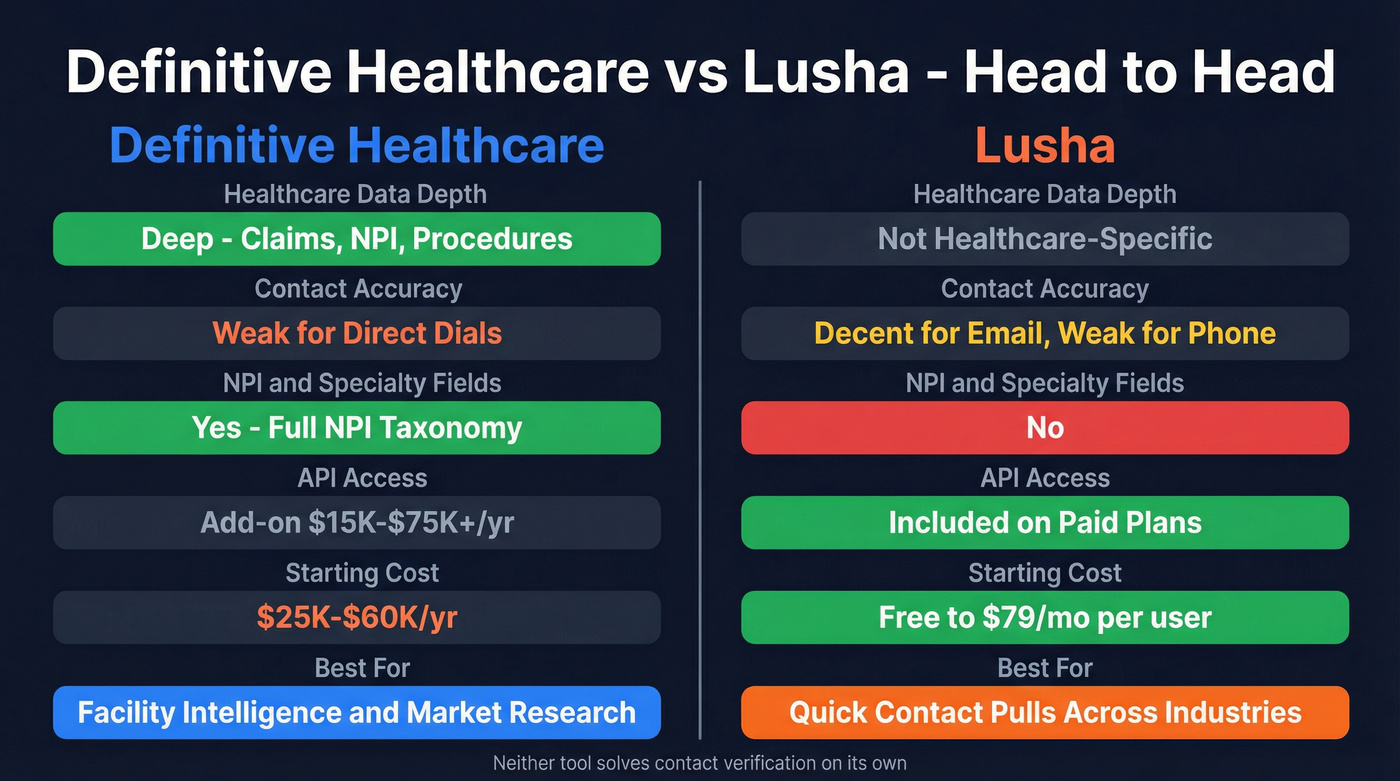
As one poster in r/gtmengineering put it, "standard Apollo or Clay data is almost worthless" for healthcare signals like claims and procedure volumes. The same applies to Lusha - and frankly, to every generalist database in healthcare. If you need deep clinical market data, IQVIA and Definitive Healthcare are two of the most established options.
If you're evaluating broader sales prospecting databases, the key is separating facility intelligence from contact accuracy.

Definitive Healthcare costs $50K+/yr. Lusha burns credits in days. Prospeo gives you 98% accurate emails at ~$0.01 each with a 7-day refresh cycle - so healthcare role changes don't wreck your deliverability.
Stop paying enterprise prices for contacts that bounce.
Pricing Breakdown for 2026
Definitive Healthcare doesn't publish pricing, which is frustrating. Vendr's benchmark data fills the gap: the median buyer pays $50,150/year. Small teams of 1-5 users land in the $25K-$60K range, while teams of 10-25 users with multiple modules and API access typically land between $100K and $250K. Enterprise agreements can exceed $500K. Typical discounts run 15-30% off initial quotes on multi-year terms.
If you're comparing vendors across the broader data enrichment landscape, pricing transparency is often the first red flag.
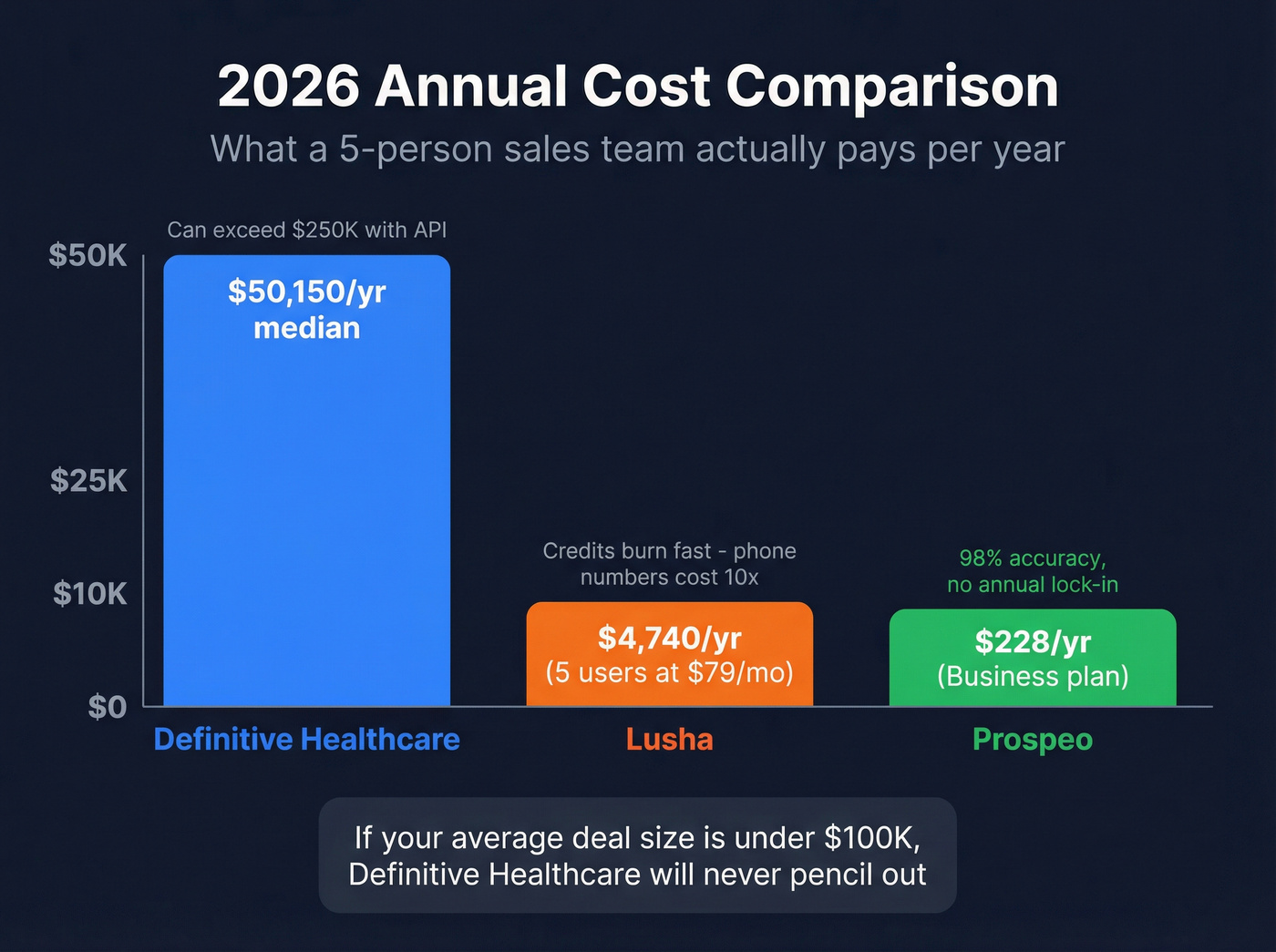
Lusha's credit model is simpler on the surface. One credit gets you an email; a phone number costs 10 credits. The free plan includes 70 credits/month - that's 70 emails or just 7 phone numbers. Paid plans scale up to ~$79/mo per user. Unused credits roll over up to 2x your monthly limit, which softens the blow slightly. But credits burn fast if you're pulling phones, and phone numbers tend to be weaker outside North America.
Let's be honest: if your average deal size is under $100K, Definitive Healthcare's price tag will never pencil out. Use the free NPI Registry and CMS datasets for facility basics, pair with a contact tool, and save $50K.
What Real Users Say
Definitive Healthcare scores 3.9/5 on G2 across 42 reviews. Users praise the depth of facility data, but contact accuracy is the recurring pain point. One reviewer wrote that "phone numbers are often wrong or not direct." On Reddit, a med device seller targeting hospitals called Definitive Healthcare "garbage" for contact data - harsh, but it reflects a real gap between the platform's research strength and its contact-level quality.
Lusha's G2 score reflects genuine ease of use, but credit limits dominate the complaints. On Software Advice (4.0/5, 396 reviews), wrong-person matches and incorrect company associations show up repeatedly. We've seen healthcare sales teams burn through a month's credits in three days of heavy prospecting, then sit idle waiting for the reset. That's not a workflow - it's a bottleneck.
When to Use Which
Selling $500K+ solutions into IDNs and health systems? Definitive Healthcare earns its price tag. You need the facility intelligence, claims data, and procedure volumes that no generalist tool provides. Budget $50K+ and pair it with a contact verification layer.
This is also where enterprise B2B sales mechanics (multi-threading, consensus building, procurement) matter as much as the data source.
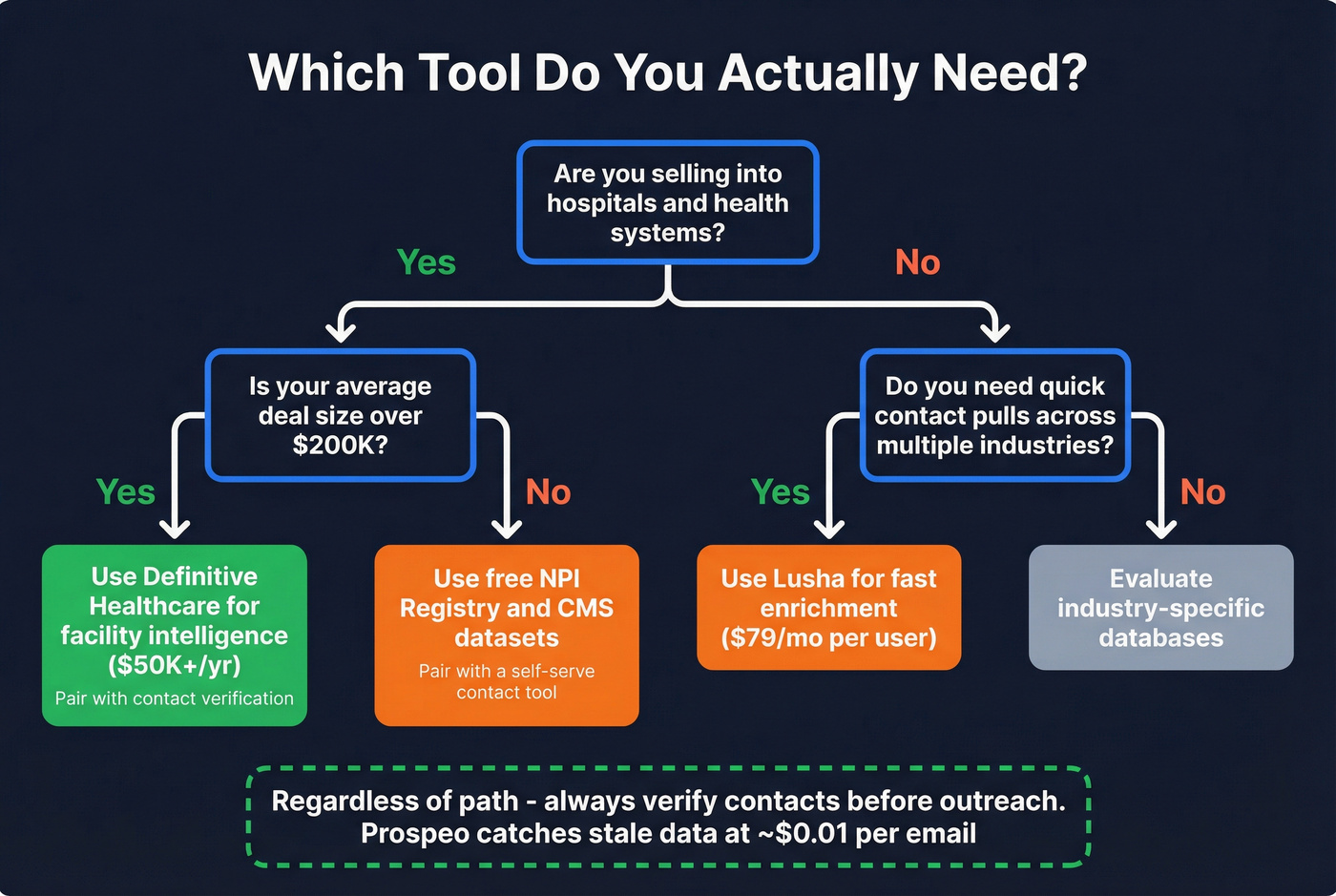
For teams running multi-industry outbound where speed matters more than clinical granularity, Lusha makes sense. It's the right call when deal sizes don't justify an enterprise data contract and you just need admin, IT, or executive contacts fast.
Think of the ideal healthcare sales stack as three layers: facility intelligence (Definitive Healthcare or IQVIA), contact enrichment (Lusha or similar), and email verification to catch the errors both layers introduce. Use both tools only if you have $50K+ in data budget and a dedicated ops person to manage two platforms. Otherwise, it's overkill.
If you're building a modern outbound stack, start with the SDR tools you’ll actually use daily.
The Verification Layer Both Tools Need
Look - both tools share the same weakness: contact accuracy. Definitive Healthcare users complain about wrong phone numbers. Lusha users flag outdated contacts and wrong-person matches. Neither refreshes data fast enough for healthcare, where provider turnover and role changes are constant.
If you're trying to protect deliverability, it helps to track email bounce rate and fix issues before they compound.
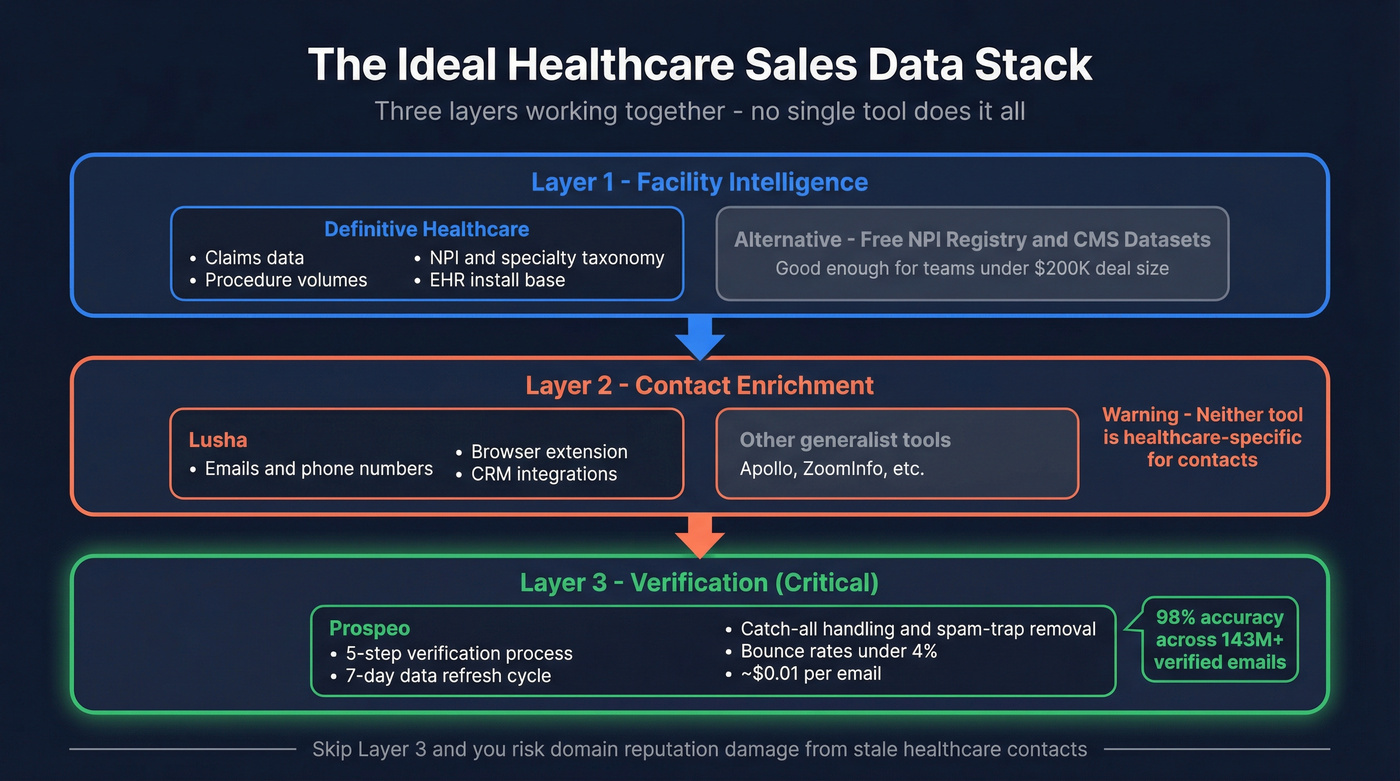
In our testing, Prospeo's 7-day data refresh cycle catches stale records that slip through both platforms. Its 5-step verification process - including catch-all handling, spam-trap removal, and honeypot filtering - keeps bounce rates under 4% even in high-turnover healthcare segments. Use Definitive Healthcare for facility research, Lusha for quick enrichment, and run everything through verification before it hits your sequences. At ~$0.01 per email with no annual contract, that verification step pays for itself after a single saved domain reputation incident.
If you want the deeper playbook, follow an email deliverability guide and keep a tight handle on sender reputation.

Both Definitive Healthcare and Lusha users flag stale contacts as their top complaint. Prospeo's 5-step verification catches bad data before it hits your sequences - keeping bounce rates under 4% even in high-turnover healthcare segments.
Verify every healthcare contact before you send. 75 free emails/month.
FAQ
Can Lusha replace Definitive Healthcare?
No. Lusha lacks NPI numbers, procedure volumes, claims analytics, and facility intelligence. They solve different problems - Lusha handles contact enrichment across industries, while Definitive Healthcare provides clinical market data specific to healthcare.
Do I need both tools for healthcare sales?
Only if you're selling complex solutions to health systems with $50K+ in annual data budget. Most mid-market teams do better pairing a generalist contact tool with free NPI Registry and CMS datasets for facility basics.
What's the most accurate tool for healthcare contact emails?
Prospeo delivers 98% email accuracy with a 7-day refresh cycle across 143M+ verified emails. Pair it with either platform to verify contacts before outreach - that protects your sender reputation and keeps bounce rates under 4%.
Is Definitive Healthcare worth the cost for small teams?
For teams with average deal sizes under $200K, the $50K+ annual commitment rarely pencils out. Free public datasets like the NPI Registry and CMS Open Payments cover basic facility data. Combine those with a self-serve contact tool for verified emails at a fraction of the cost.