

How to Structure a Demand Generation Team at Every Stage
Most demand generation team structure advice gives you a role list and calls it a day. No hiring order, no salary context, no explanation of why a 5-person team looks fundamentally different from a 15-person team.
This is the version that actually helps you build - with org breakdowns by stage, compensation benchmarks, and the KPIs each role should own.
What a Demand Gen Team Actually Does
Demand generation isn't a synonym for growth marketing. It's a subset of it - focused on segment-level campaigns, ABM motions, and pipeline creation. Growth marketing spans the full journey from trial activation to expansion revenue. Demand gen lives between "nobody knows us" and "sales has a qualified conversation."
One Reddit practitioner frames it as two jobs: demand generation grows the universe of Tier-3 prospects (aware of you), and demand capture converts them into Tier-2s and Tier-1s (engaged, then buying). Your org structure should reflect which of those stages is actually broken.
Team Structure by Company Stage
Early Stage (3-5 People)
Hire in this order: (1) Demand Generation Manager who can own strategy and run campaigns, (2) Content/Campaign Specialist to fuel those campaigns, (3) Marketing Ops to wire the infrastructure. Don't specialize further until pipeline proves the model works.
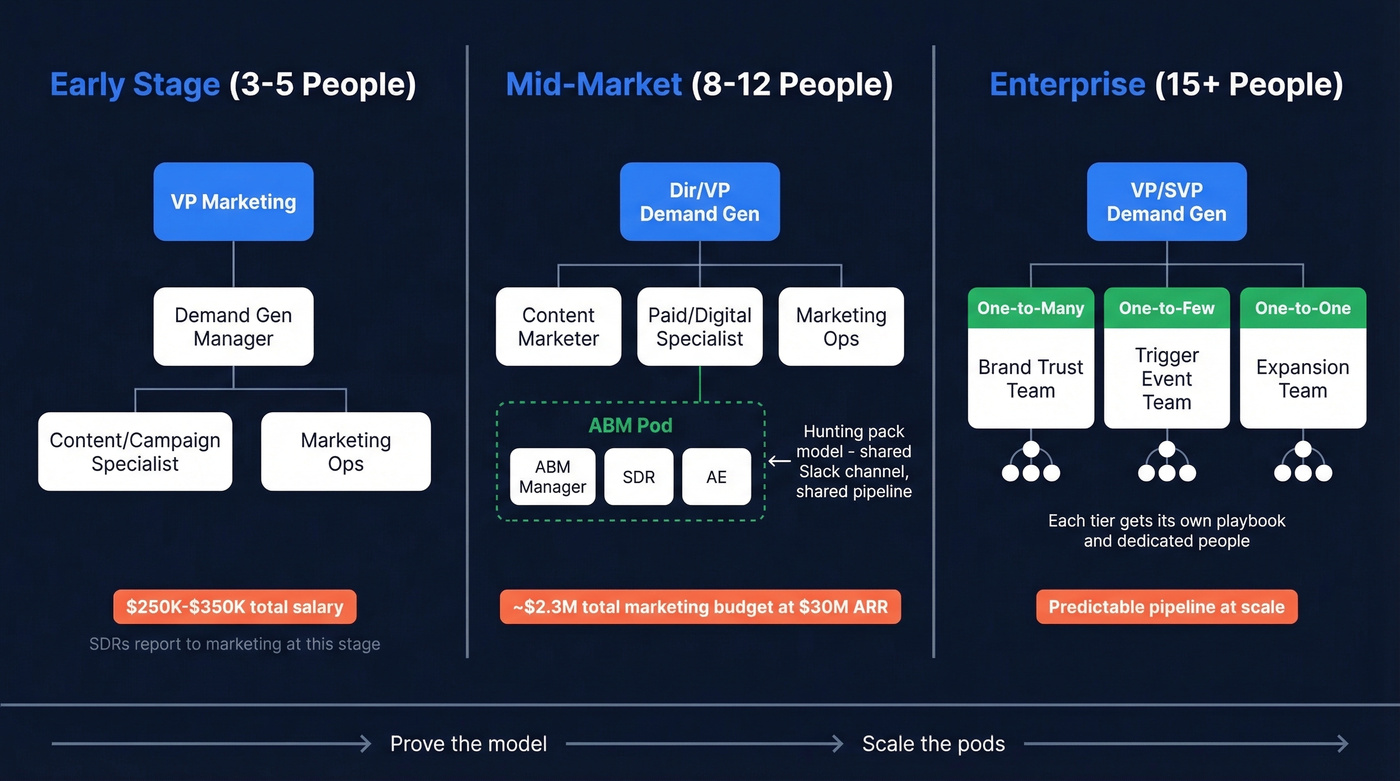
At this stage, SDRs belong under marketing - they're moving cold prospects through awareness tiers, not qualifying warm inbound. The trigger for building this team isn't headcount goals; it's proven product-market fit and a need for repeatable pipeline. A 3-person team runs around $250K-$350K in salary alone. For a $10M ARR company spending at Gartner's 7.7% benchmark, that's roughly 32-45% of your total marketing budget. Spend it on the right sequence.
In smaller orgs, the demand gen manager sometimes reports to a VP of Operations rather than a dedicated marketing leader - that's fine as long as pipeline ownership is clear. If budget is tight, outsource paid media execution and keep strategy in-house.
Skip at this stage: dedicated ABM manager, paid media specialist, separate analytics hire. Your demand gen manager should cover those bases until volume justifies splitting them out.
Mid-Market (8-12 People)
At 8-12 people, you can finally stop asking everyone to do everything. Add a paid/digital specialist, a dedicated content marketer, and an ABM manager. The big structural shift here is introducing pod models - an AE + SDR + ABM manager operating as a "hunting pack" against target accounts. In our experience, the pod model works best when the AE and ABM manager share a Slack channel, not just a dashboard.
This is also where shared pipeline dashboards become non-negotiable. Apptio built a dashboard drillable to the individual seller level so marketing and sales could see exactly which levers to pull. Without that shared visibility, the two teams will argue about lead quality forever - and nobody wins that argument.
Enterprise (15+ People)
At scale, demand gen runs tiered ABM. Cognism's framework is the clearest version we've seen: one-to-many (broad brand trust), one-to-few (trigger-event-led capture), and one-to-one (expansion within open opportunities). Each tier needs different people and different playbooks.
BloomReach aligns pods as marketing person + salesperson + channel rep, all working toward shared pipeline targets. One operating rule worth stealing: when sales is actively working a lead with an open opportunity, marketing pulls back to a "light surround" - digital visibility only, no bombardment. This builds trust between teams faster than any alignment meeting ever will.
| Stage | Headcount | Key Roles | Reports To | Primary Motion |
|---|---|---|---|---|
| Early | 3-5 | DG Manager, Content, Mktg Ops | VP Marketing | Repeatable pipeline |
| Mid-Market | 8-12 | All above + Paid, ABM Mgr, SDR pods | Dir/VP Demand Gen | Scaled ABM pods |
| Enterprise | 15+ | Tiered ABM teams, channel pods | VP/SVP Demand Gen | Predictable pipeline |
Who Should Lead the Team
Match the leader to the motion, not the org chart template. If you're product-led with self-serve revenue, hire a growth marketer who lives at the product-marketing intersection. Running sales-led complex deals? You need a demand gen leader who thinks in pipeline stages and ABM tiers. Heavy paid acquisition calls for a digital marketing leader.
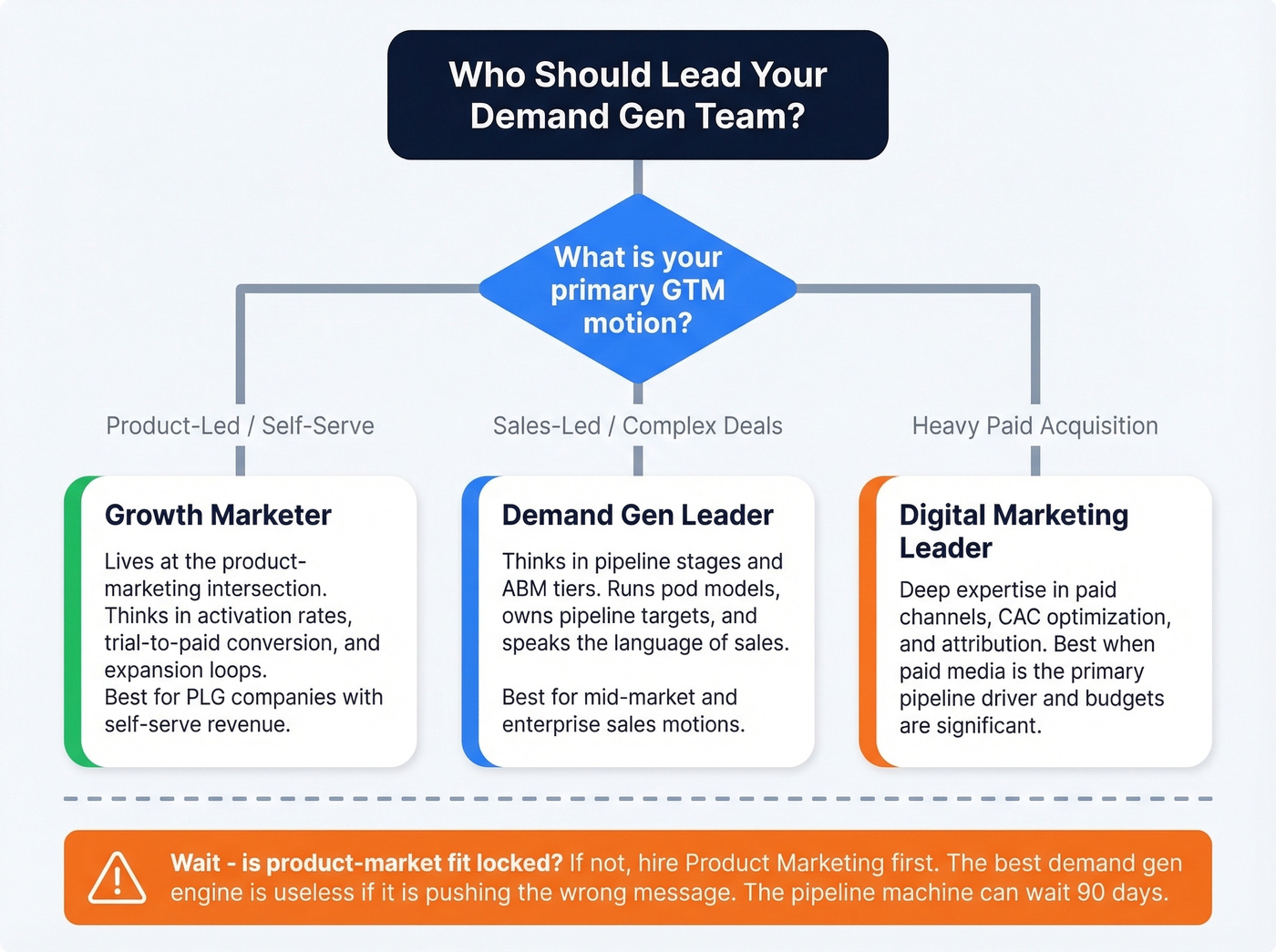
Here's the thing: if product-market fit isn't locked, hire product marketing first. It doesn't matter how good your demand gen engine is if it's pushing the wrong message.
Most Series A companies hire a demand gen manager before they have a message worth generating demand for. Get positioning right first. The pipeline machine can wait 90 days.

You just read that 69% of the buyer journey is anonymous and stale data tanks deliverability. Your demand gen team needs infrastructure that keeps up. Prospeo refreshes 300M+ profiles every 7 days - not 6 weeks - with 98% email accuracy and 125M+ verified mobiles.
Give your demand gen team data that actually converts.
Compensation Benchmarks
Demand gen talent isn't cheap, and lowballing offers means you'll be re-hiring in 9 months.
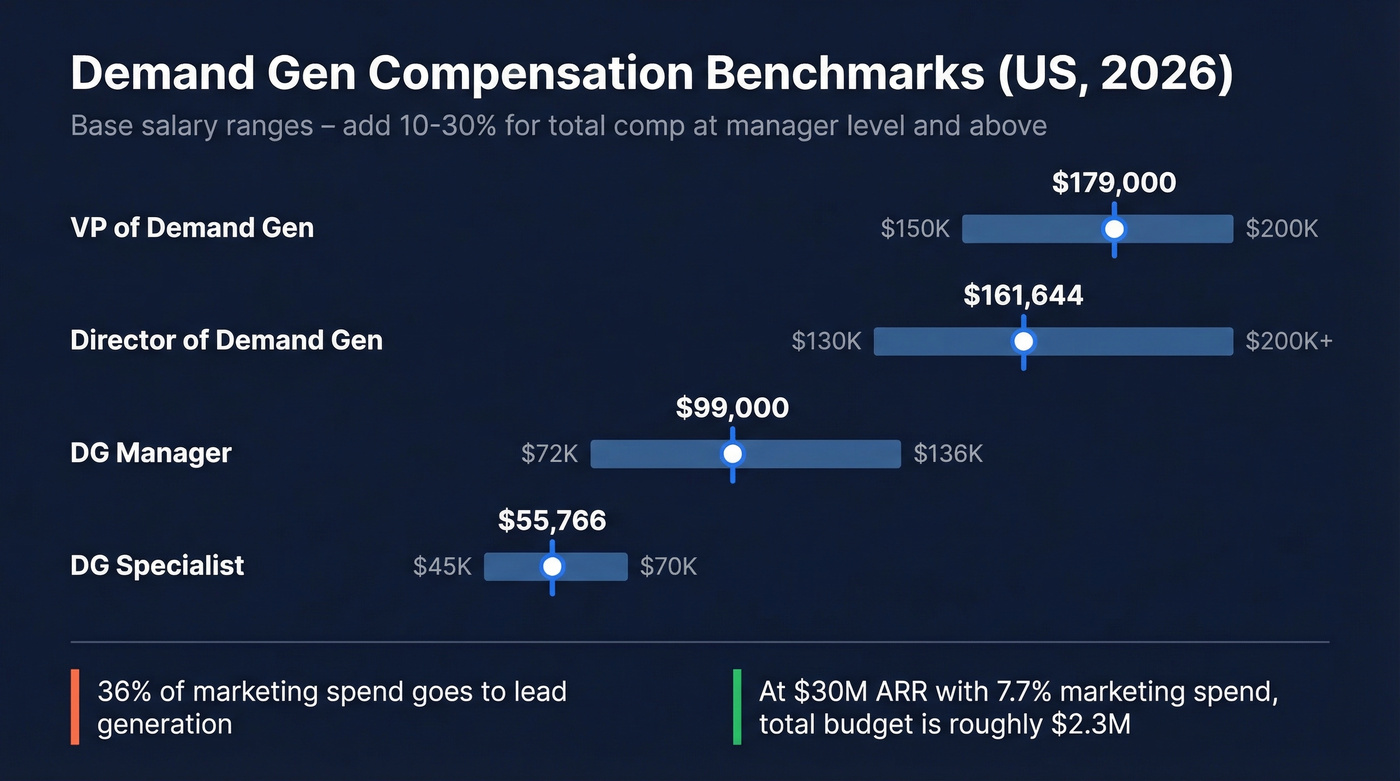
| Role | Avg (US, 2026) | Range |
|---|---|---|
| VP of Demand Gen | $179,000 | $150K-$200K |
| Director of Demand Gen | $161,644 | $130K-$200K+ |
| DG Manager | $99,000 | $72K-$136K |
| DG Specialist | $55,766 | $45K-$70K |
Total comp often adds 10-30% for manager-level and above once you factor in bonuses and equity. Lead generation alone consumes roughly 36% of total marketing spend, so your team's budget extends well beyond salaries. A mid-market company at $30M ARR with marketing budgets at ~7.7% of revenue has roughly $2.3M to work with across all of marketing - and demand gen will consume a meaningful chunk of that.
KPIs Your Team Should Own
| Metric | Benchmark | Context |
|---|---|---|
| Avg B2B conversion rate | 2.9% | 100M+ data points across industries |
| Cost per lead | $100-$700 | Varies by channel and industry |
| Cold email reply rate | 1-5% baseline | AI-personalized sequences hit 15-25% |
| Buyer journey anonymous | Up to 69% | Before any sales contact occurs |
| Content syndication | 6-8% pipeline conversion | Within 90 days of engagement |
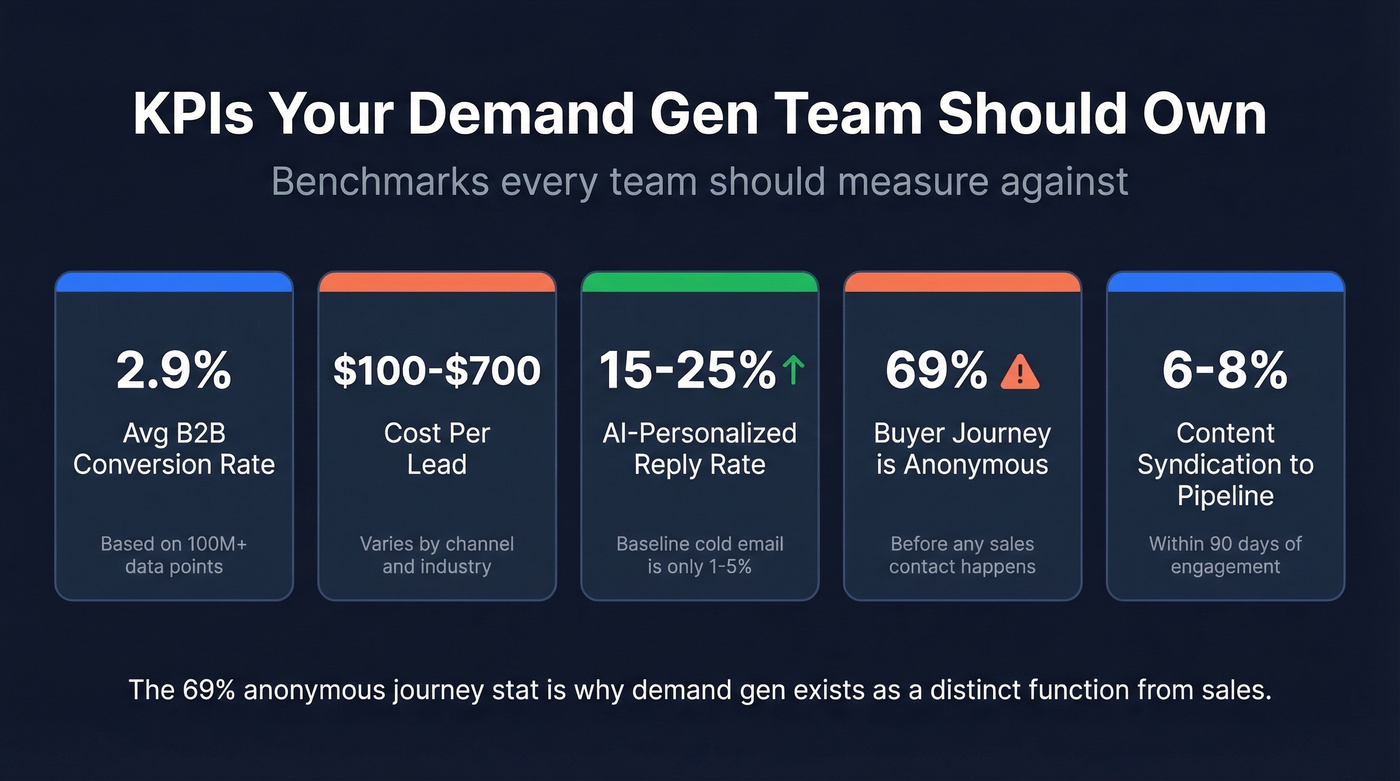
That 69% anonymous journey stat matters structurally. It means your team needs people and systems that influence buyers before they ever raise their hand - which is exactly why demand gen exists as a distinct function from sales.
Data Quality as a Structural Function
Let's be honest: marketing ops must own contact data quality explicitly, not as a side task. Stale emails and dead phone numbers don't just waste campaign spend; they tank domain deliverability and poison every downstream metric. We've seen teams troubleshoot "low reply rates" for weeks before realizing a big chunk of their list was bouncing.
This is where your tooling choice matters. Prospeo runs a 7-day data refresh cycle versus the 6-week industry average, with 98% email accuracy across 300M+ professional profiles. That kind of infrastructure keeps your demand gen campaigns running on clean data instead of decaying lists.
If you're building a stack around list hygiene, start with email deliverability and a clear email bounce rate target.

Marketing ops should own data quality, not troubleshoot bounces. Prospeo's 5-step verification, catch-all handling, and spam-trap removal keep bounce rates under control at $0.01 per email. That's how teams like Snyk cut bounces from 35% to under 5% and added 200+ opportunities per month.
Stop bleeding pipeline to bad data - fix it in minutes.
Mistakes That Kill Pipeline
Five anti-patterns that consistently destroy demand gen performance:
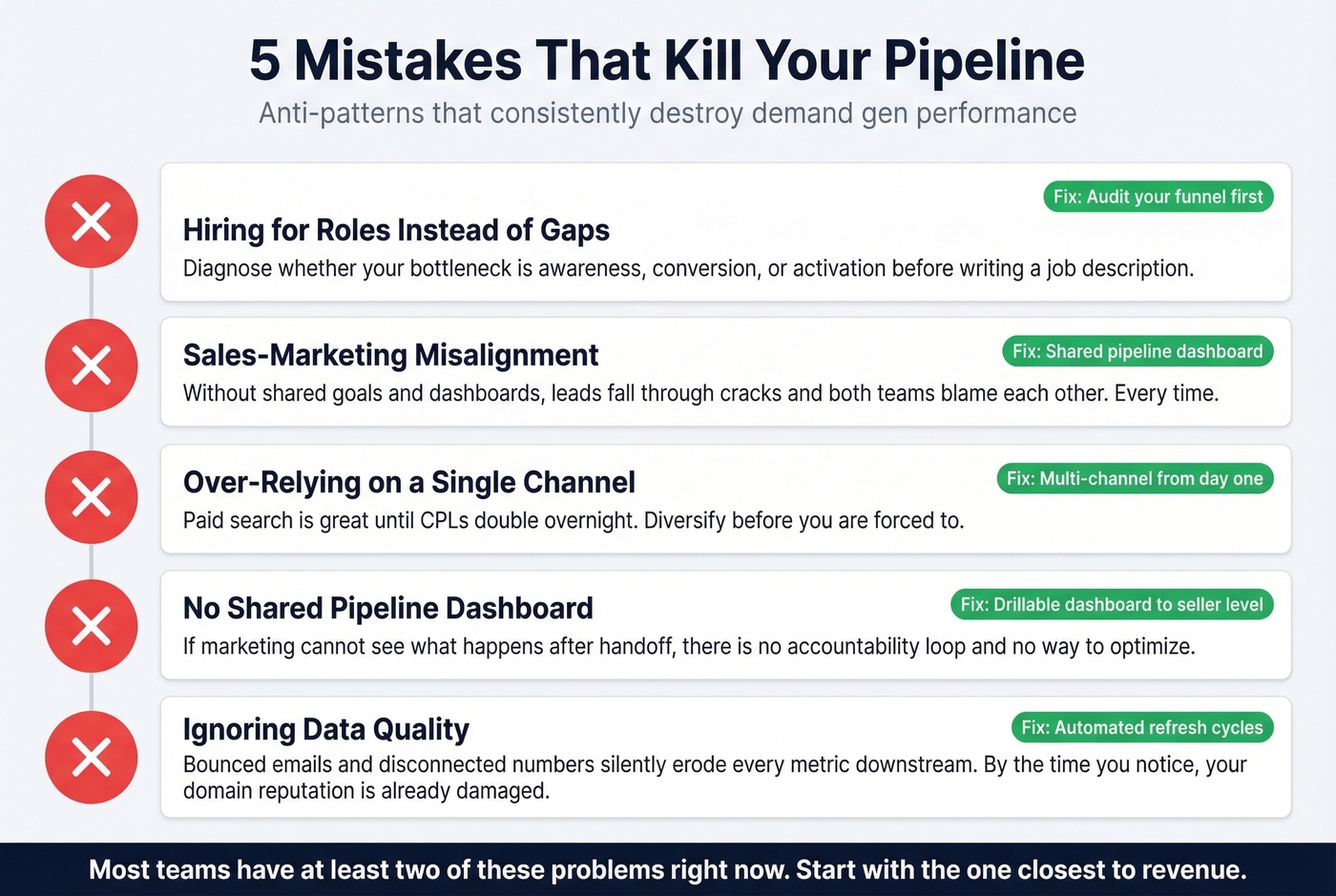
- Hiring for roles instead of gaps. Diagnose whether your bottleneck is awareness, conversion, or activation before writing a job description.
- Sales-marketing misalignment. Without shared goals and dashboards, leads fall through cracks and both teams blame each other. Every time.
- Over-relying on a single channel. Paid search is great until CPLs double. Diversify before you're forced to.
- No shared pipeline dashboard. If marketing can't see what happens after handoff, there's no accountability loop and no way to optimize.
- Ignoring data quality. Bounced emails and disconnected numbers silently erode every metric downstream, and by the time you notice, your domain reputation is already damaged.
If you're seeing these symptoms, it usually shows up first as sales pipeline challenges and poor pipeline health.
FAQ
Where should SDRs report - marketing or sales?
SDRs belong under marketing when they're running outbound to cold accounts and moving prospects through awareness tiers. Move them to sales when they're qualifying warm inbound leads. Match the reporting line to the motion the SDR is actually running, not org chart tradition.
What's the first demand gen hire?
A Demand Generation Manager who can own strategy, run campaigns, and prove repeatable pipeline. Add a content specialist second and marketing ops third. Don't specialize until pipeline volume proves the model works.
How do you keep demand gen data accurate at scale?
Assign data quality ownership to marketing ops and use infrastructure with automated refresh cycles. Tools with weekly data refreshes and built-in verification prevent the deliverability decay that quietly kills campaign performance.
What budget should a demand gen team expect?
At a $30M ARR company spending ~7.7% of revenue on marketing, total budget is roughly $2.3M. Lead generation typically consumes 36% of marketing spend, so expect $800K-$1M allocated to demand gen activities including headcount, tools, and media.