

Demographic Segmentation Examples That Actually Drove Results
81% of executives say segmentation is critical for growing profits. Only 25% believe their organization uses it effectively. Meanwhile, 65% of organizations admit their segmentation is basic or incomplete.
That gap isn't a knowledge problem - it's an execution problem. Most guides hand you textbook definitions and generic demographic segmentation examples. This one gives you real cases with measurable outcomes, the mistakes that kill most segmentation efforts, and a framework you can actually put to work.
What Is Demographic Segmentation?
Demographic segmentation divides your audience into groups based on measurable, observable traits: age, gender, income, occupation, education, family status, language, and ethnicity. It's the most widely used segmentation approach - 48% of marketers segment by demographics because the data is relatively easy to collect and act on.
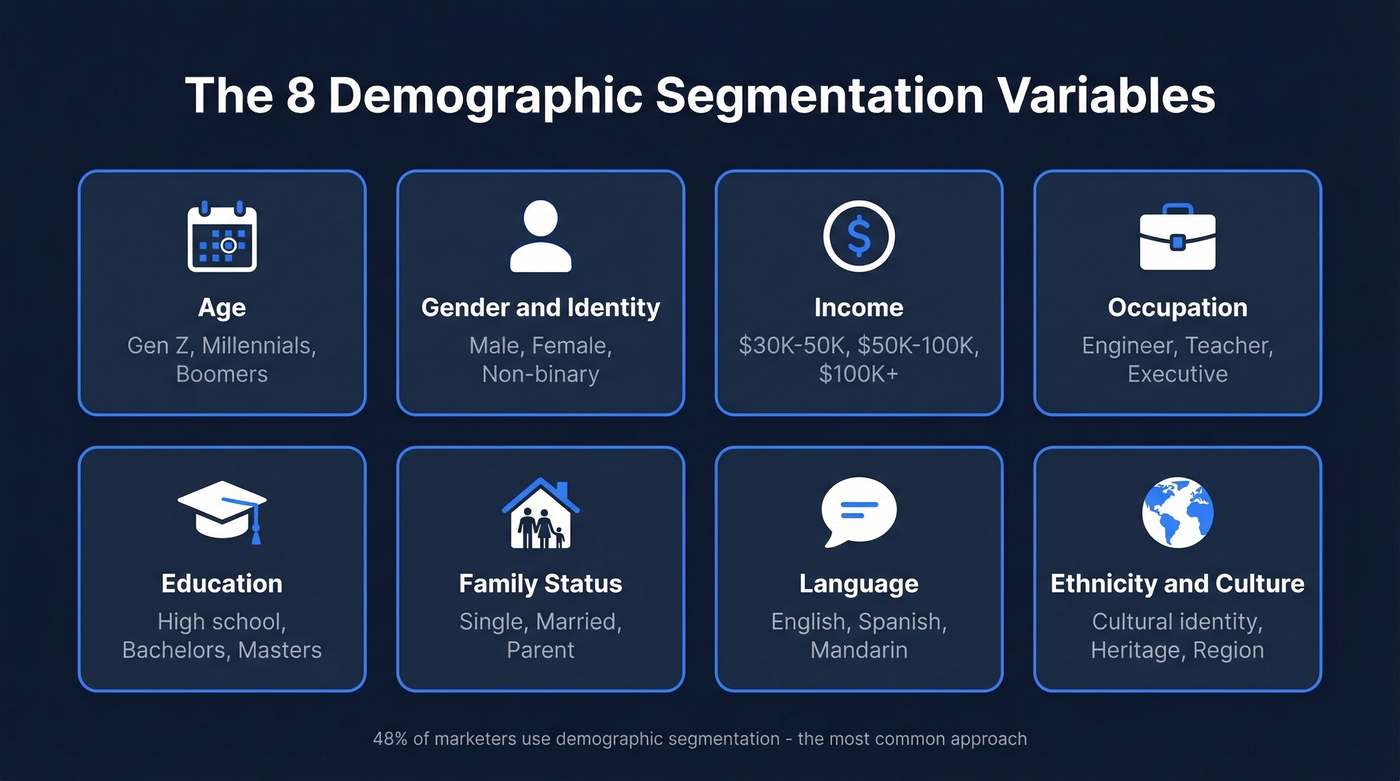
The reason it works as a starting point is simple. Demographics correlate with purchasing behavior. A 28-year-old renting their first apartment buys differently than a 55-year-old empty nester. A household earning $45K/year shops differently than one earning $200K. These aren't stereotypes - they're statistical patterns that hold at scale.
Segmentation ≠ Targeting. This trips up even experienced marketers - it's common enough to drive dedicated Reddit threads among working marketers who confuse the two. Segmentation creates groups. Targeting selects which groups to pursue. Positioning defines how you'll message each group. This is the STP framework - Segmentation, Targeting, Positioning - and skipping steps is how you end up with segments that sit in a spreadsheet and never drive a campaign.
8 Real-World Examples by Variable
Age & Life Stage
Age is one of the most common demographic variables - 62% of marketers use it. But raw age brackets are blunt instruments. The real power comes from pairing age with life stage.
Saga Holidays built an entire business targeting retirees - not just "people over 50" but specifically people in the post-career, active-travel life stage. Nike goes the other direction, targeting Gen Z through creator-led campaigns that speak to identity formation, not just an age bracket. The activation tip here: pair age ranges with life-stage events like graduation, first child, retirement, or career change. A 35-year-old first-time parent and a 35-year-old single professional have almost nothing in common as consumers.
Gender & Identity
Fenty Beauty's launch is the gold standard for inclusive segmentation in beauty. Rather than creating "for women" and "for men" product lines, Rihanna launched with 40 foundation shades that served demographics most beauty brands ignored entirely.
On the niche end, War Paint for Men carved out a segment that traditional beauty brands wouldn't touch - men who want skincare and cosmetics without the feminine branding. And then there's Bic for Her: a cautionary tale of lazy gender segmentation that became a punchline. Acxiom's guidance reinforces the lesson - heavy reliance on demographics can lead to stereotypes that alienate audiences.
Income & Purchasing Power
This is where demographic segmentation gets measurably powerful.
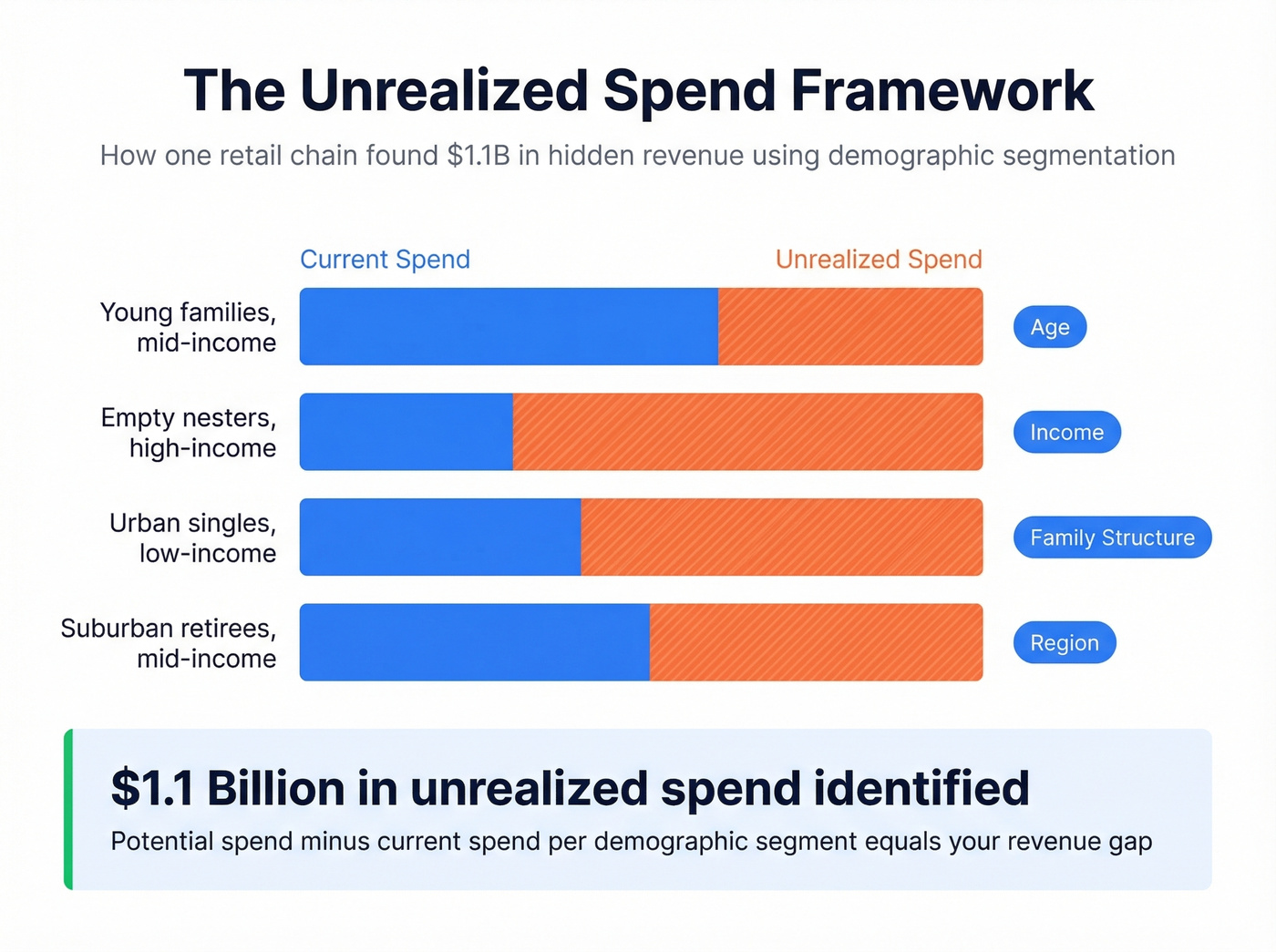
Dollar General and Dollar Tree each built multi-billion-dollar businesses by segmenting on household income and optimizing everything - store locations, product mix, price points - for value-conscious shoppers. But the best example we've come across is from Experian's retail case study. A retail chain identified four demographic drivers of spending: age, income, family structure, and region. They built segments around these variables and calculated two metrics for each customer: potential spend (what they'd spend if they reached the top 20% of spenders within their demographic segment) and unrealized spend (potential minus current). They identified $1.1B in unrealized spend - revenue sitting on the table because marketing wasn't tailored to each segment's purchasing power. That's not a theoretical framework. It's a measurement approach you can replicate.
Occupation & Industry
Retailers and service businesses often target tradespeople with pro accounts, bulk pricing, and hours that match job-site schedules. Collaboration tools target knowledge workers with messaging about productivity and async communication. The segmentation isn't just "what do you do for work" - it's "what does your work require?"
For B2B, occupation segmentation becomes firmographic segmentation: industry, company size, job title, seniority level. A VP of Engineering at a 500-person SaaS company has different pain points than a CTO at a 50-person agency, even if they're the same age and income bracket.
Education, Language, Family & Culture
These four variables work best as refinement layers rather than primary segmentation axes.
Many consumer brands segment heavily by language - it's one of the cleanest ways to tailor creative, offers, and support. Family-size packaging like warehouse-club bulk formats versus single-serve convenience is household composition segmentation in action. Culturally targeted campaigns often combine ethnicity, geography, and cultural identity to hit the right note.
One practical heuristic: segments smaller than 15% of your addressable market often struggle to attract internal investment, while segments larger than 60% are too broad to benefit from tailored messaging.
Demographics vs. Psychographics vs. Behavioral
Prince Charles and Ozzy Osbourne share nearly identical demographics - British men, born in 1948, wealthy, married twice, famous. Their psychographics couldn't be more different. Demographics tell you who someone is. Psychographics tell you why they buy. Behavioral data tells you what they actually do.
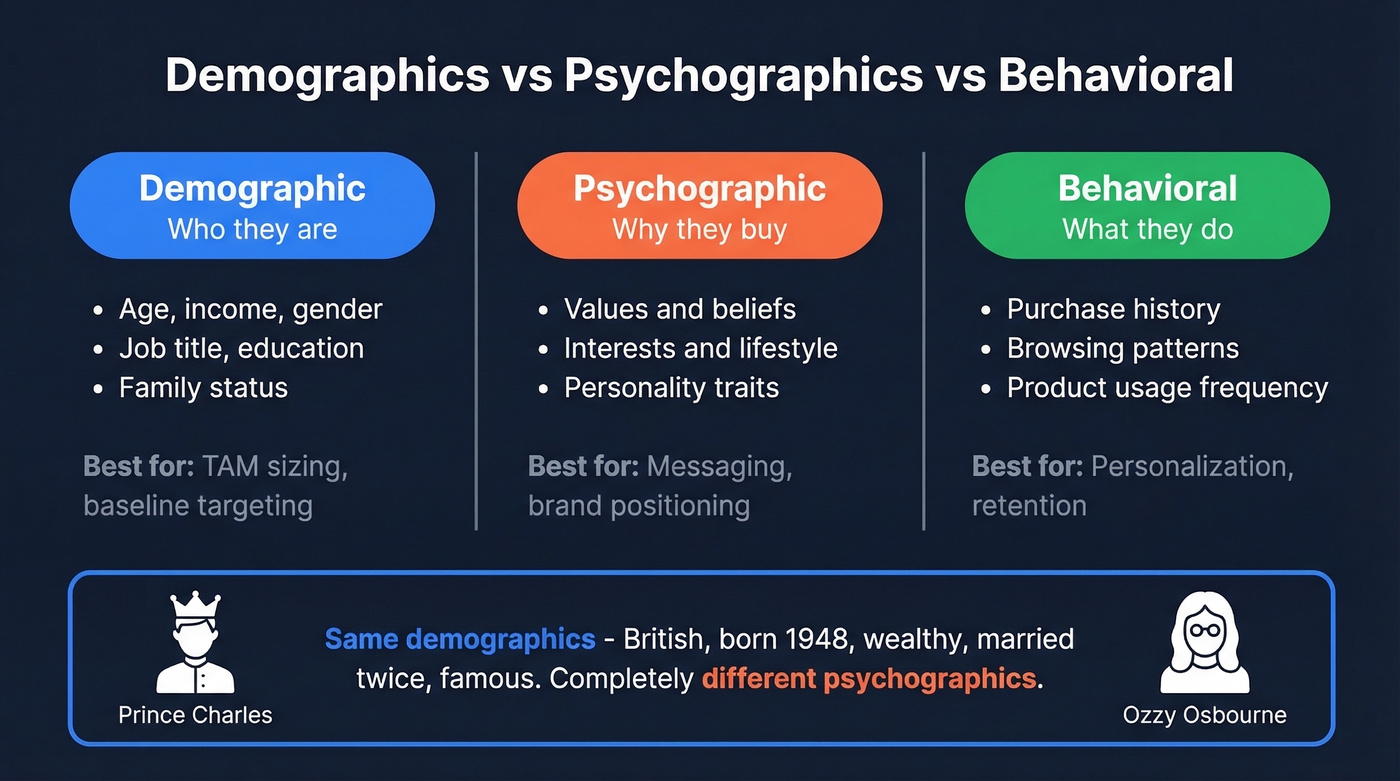
| Dimension | Demographic | Psychographic | Behavioral |
|---|---|---|---|
| Answers | Who they are | Why they buy | What they do |
| Variables | Age, income, gender, title | Values, interests, lifestyle | Purchases, browsing, engagement |
| Data source | CRM, surveys, B2B databases | Interviews, social listening | Analytics, CDP, product usage |
| Best for | Baseline targeting, TAM sizing | Messaging, positioning | Personalization, retention |
| Limitation | Doesn't explain motivation | Hard to collect at scale | Requires tracking infrastructure |
| Combine with | Behavioral for activation | Demographic for reach | Demographic for context |
The data backs up why you need all three. ~7 in 10 US adults say they buy brands that reflect their personal values, per Ipsos (n=1,118, Jan 2024). And 23% stopped using a company in the past three months because of its stance on an issue. Demographics alone can't capture that. The strongest segmentation strategies layer demographic baselines with psychographic motivation and behavioral signals.
Hot take: If your average deal size is under $10K, you probably don't need 12-variable segmentation models. Two demographic variables paired with one behavioral signal will outperform a complex model that nobody on your team can explain or activate. Sophistication isn't the goal - revenue lift is.

You just read how occupation and industry segmentation drives B2B results. Prospeo's database gives you 30+ filters - job title, seniority, department headcount, industry, funding, and buyer intent across 15,000 topics - so your demographic segments turn into verified contact lists, not idle spreadsheets.
Stop segmenting into spreadsheets. Start segmenting into pipelines.
7 Mistakes That Kill Your Segmentation
Here's the thing: most segmentation projects don't fail because of bad data. They fail because of bad decisions about how to use it.
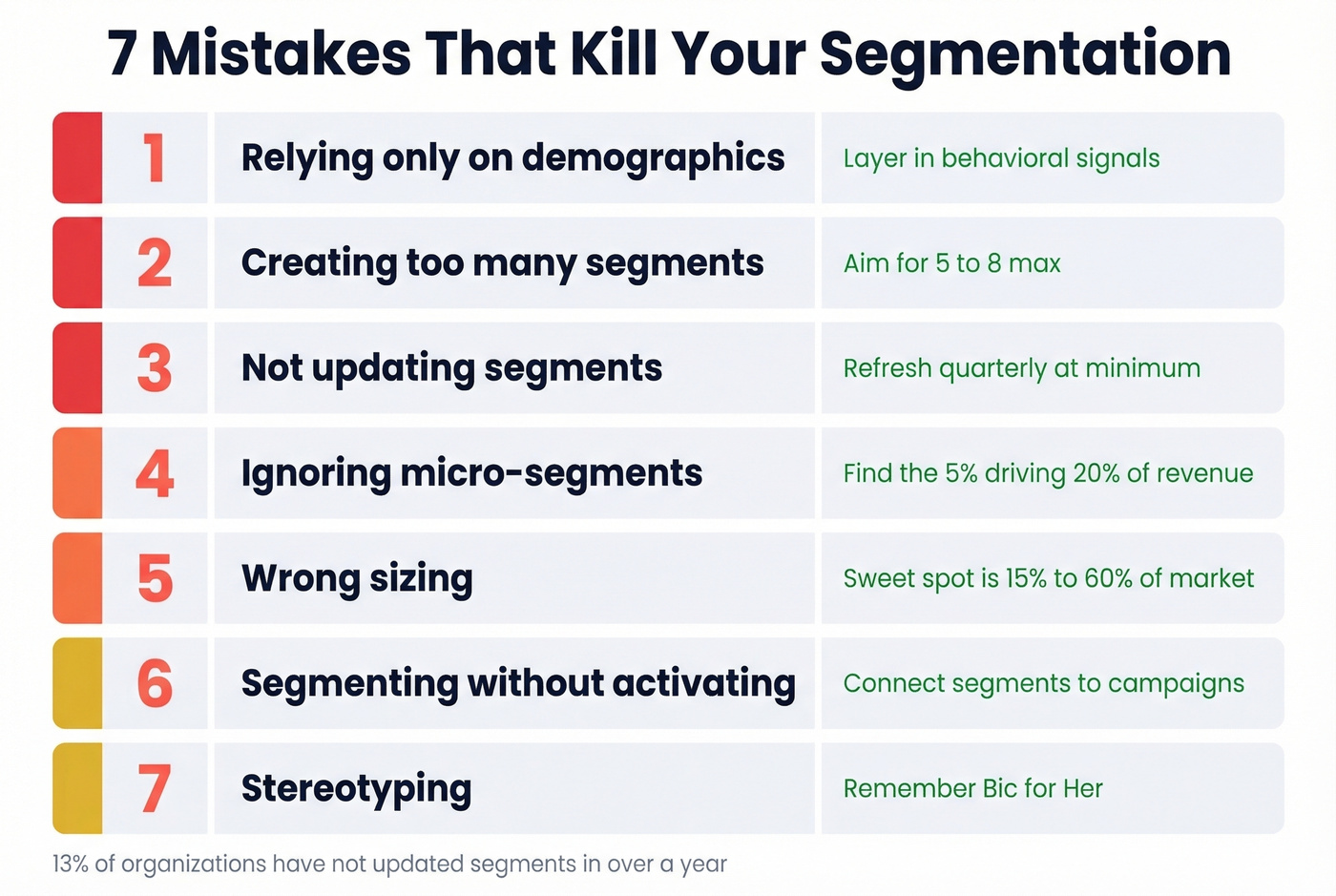
1. Relying only on demographics. A thrift store owner on Reddit described their customer base as ~75% women, ~40% aged 35-55. When they tried to target that demographic on social media, it fell flat. Posting specific items people actually wanted - preference-based content - outperformed demographic targeting every time. They ended up building a hybrid approach: demographic segments to define the audience, behavioral signals to decide what to show them. Demographics are the foundation, not the whole house.
2. Creating too many segments. If your marketing team can't name all your segments from memory, you have too many. Each segment needs its own messaging, creative, and measurement. Five to eight is manageable. Twenty is a spreadsheet exercise.
3. Not updating segments. 13% of organizations haven't updated their segments in over a year. People change jobs, move cities, have kids, get promoted. If you aren't refreshing at least quarterly (44% of teams do), your segments are already wrong.
4. Ignoring micro-segments. The high-value niche that represents 5% of your customers but 20% of your revenue deserves its own segment. Don't let it get averaged into a broader group.
5. Wrong sizing. Segments under 15% of your market struggle to justify investment. Segments over 60% are too broad to differentiate. Hit the sweet spot.
6. Segmenting without activating. Segments in a deck are worthless. If your segments don't connect to campaigns, content, or sales workflows, you've done analysis, not segmentation.
7. Stereotyping. Remember Bic for Her. If your segment strategy is "women like pink" or "millennials like avocados," you're not segmenting - you're caricaturing.
How to Implement Demographic Segmentation
Collect the Right Data
Not all data is equal. Zero-party data - the information customers share directly through surveys, preference centers, and forms - is the highest quality. First-party data from CRM records, purchase history, and website behavior is reliable and scalable. Third-party data purchased from external platforms fills gaps but varies in accuracy and freshness.
Start with what you already have in your CRM. Most teams are sitting on demographic data they've never segmented. Privacy constraints are real, but the bigger problem is usually underusing data you already collected with consent.
Define Your Segments
Stop collecting demographic data you won't use. You don't need all eight variables. Pick the 2-3 that connect most directly to purchasing behavior in your specific business. For a B2C retailer, that's probably age, income, and household size. For a B2B SaaS company, it's job title, company size, and industry.
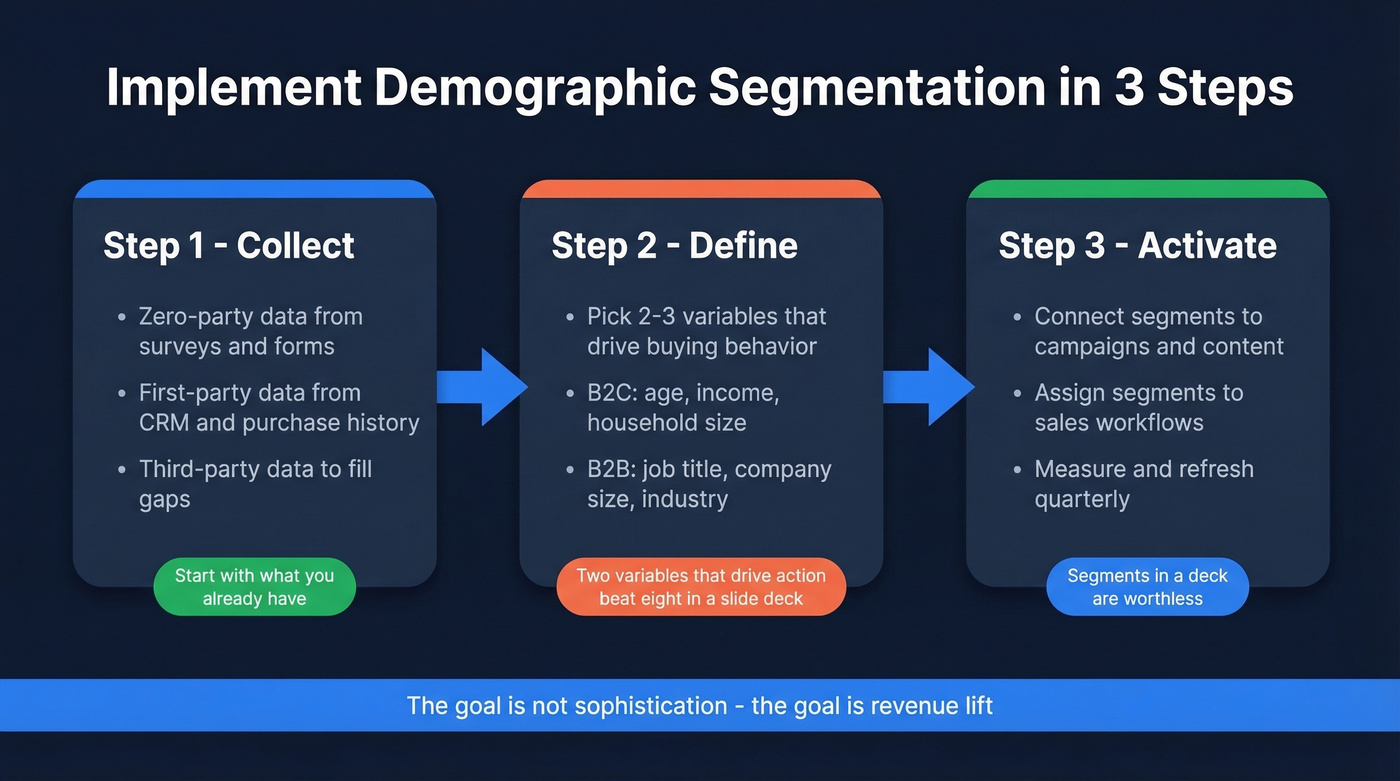
Let's be honest about something we've seen repeatedly: teams spend months building elaborate 12-variable segmentation models that nobody uses because they're too complex to activate. Two variables that drive real campaign differences beat eight variables in a pretty slide deck. Every time.
In product teams, segmentation goes beyond demographics entirely - pricing tier, engagement level, and user maturity often drive roadmap decisions more than age or income. If you're a PM reading this, your segmentation axes probably look nothing like marketing's, and that's fine.
Activate Across Channels
Segments in a spreadsheet are worthless. You need to push them into the tools where campaigns actually run - email platforms like Klaviyo, CRMs like HubSpot, or CDPs like Twilio Segment.
For B2B teams, activation means finding verified contacts within your defined segments. Once you've identified that you're targeting VPs of Marketing at 200-500 person SaaS companies, you need actual email addresses and phone numbers to reach those people. Prospeo lets you filter by 30+ demographic and firmographic variables - job title, industry, company size, seniority - and returns 98% accurate verified emails and direct dials. The 7-day data refresh cycle means your segments don't decay the way they do with platforms that update monthly or quarterly.

Measure What Works
The KPIs that matter: conversion lift by segment, ROAS by segment, LTV by segment, and - if you can calculate it - unrealized spend using the Experian framework described earlier.
If you want to operationalize this, treat it like funnel metrics: define the baseline, measure lift by segment, and keep the model simple enough to ship.
The "30% lift" myth. You'll find articles claiming demographic segmentation delivers "up to 30% conversion lifts." That number is often presented without clear methodology, sample size, or study details. Realistic range? Single-digit to low double-digit lifts when moving from broad targeting to segmented messaging. That's still meaningful: a 5-10% lift on a $1M campaign is $50-100K in incremental revenue. Don't chase inflated benchmarks - measure your own segments against your own baseline.
That $1.1B in unrealized spend? It existed because segments weren't activated with the right contacts. Prospeo delivers 98% email accuracy and 125M+ verified mobiles so every demographic segment you build reaches real decision-makers - at $0.01 per email, not $1.
Close the gap between segmentation strategy and revenue. Data refreshed every 7 days.
Privacy Rules for Demographic Data in 2026
Privacy isn't a legal footnote - it's an execution constraint that determines whether your segments can actually activate.
GDPR requires a lawful basis for processing demographic data, granular consent with no pre-checked boxes, and purpose limitation. Fines reach EUR 20M or 4% of global revenue. If you're segmenting EU residents, you need explicit consent per purpose - analytics, marketing, and personalization each require separate opt-in.
US state laws now cover 20+ states with comprehensive privacy legislation. There's no single federal standard, which means compliance is a patchwork. COPPA matters if your segments include anyone under 13 - age-gating isn't optional. Global Privacy Control signals must be honored in applicable jurisdictions.
The operational requirement that catches most teams: opt-outs must propagate simultaneously across your CRM, CDP, paid media platforms, and analytics tools. If someone opts out of email marketing but your paid media platform still targets them, you've got a compliance problem. Build suppression logic that syncs across every system touching your segments.
If you're doing B2B segmentation with purchased data, it’s also worth understanding data enrichment services and how they impact consent, freshness, and suppression.
FAQ
What are the four types of market segmentation?
Demographic (who they are), psychographic (why they buy), behavioral (what they do), and geographic (where they live). The most effective strategies layer at least two types - demographics for baseline reach, plus behavioral or psychographic data for activation and messaging precision.
What's the difference between demographic and psychographic segmentation?
Demographics describe observable traits like age, income, and job title. Psychographics describe internal traits like values, interests, and lifestyle. Prince Charles and Ozzy Osbourne share nearly identical demographics but opposite psychographics - that's why layering both produces stronger segments.
How often should I update my demographic segments?
Refresh quarterly at minimum - 44% of high-performing teams do. 13% of organizations haven't updated in over a year, which means their segments are already stale. People change jobs, relocate, and hit new life stages constantly. Monthly refreshes (22% of teams) are ideal if your data infrastructure supports it.
Can small businesses use demographic segmentation?
Absolutely - start with 2-3 variables tied to purchasing behavior. A thrift store might segment by age and product preference; a local gym by age and household income. Even basic email platform segmentation delivers measurable lift without enterprise tools.
How do I find contacts within my B2B demographic segments?
Use a B2B data platform to filter profiles by job title, industry, company size, and seniority. Export verified emails and direct dials, then push them into your CRM or sequencing tool. Weekly data refresh cycles are critical here - targeting fast-changing roles with stale data wastes budget and burns sender reputation.