


Dexi.io Pricing, Reviews, Pros & Cons (2026)
You're researching a tool that's actively being shut down. Dexi.io is migrating all customers to Mozenda by October 31, the pricing page already redirects, and no new accounts are being created. If you're evaluating it for a new project, save yourself the trouble.
Here's the thing: we've seen this pattern before with sunsetting SaaS products - the docs go stale, support slows to a crawl, and you're left holding a contract for software nobody's maintaining. Let's break down what Dexi actually costs, what users say about it, and where to go instead.
The Bottom Line
What Is Dexi.io?
Dexi.io is a cloud-based web scraping platform founded in 2015. It merged with Mozenda in July 2020 under Engage3, with both products initially maintained as distinct brands. The platform offered three robot types - Extractor, Crawler, and Pipes - plus a visual editor, built-in CAPTCHA solving, and Change Detection alerts for monitoring page updates.
Automated bots now generate nearly 50% of all internet traffic, so the market for scraping tools is massive. Dexi never managed to carve out a defensible position within it. The "Pipes" feature acted as an ETL layer for chaining robots and applying transformations like deduplication and JSON parsing, and API access enabled scheduling and triggering. On paper, a solid stack. In practice, the story got complicated fast.
Dexi.io Pricing Breakdown
Dexi's pricing page now redirects to Mozenda, so current numbers require piecing together third-party sources. Here's the last known tier structure:
| Plan | Monthly Price | Workers |
|---|---|---|
| Standard | $119/mo | 1 |
| Professional | $399/mo | 3 |
| Corporate | $699/mo | 6 |
A free trial was available with no credit card required.
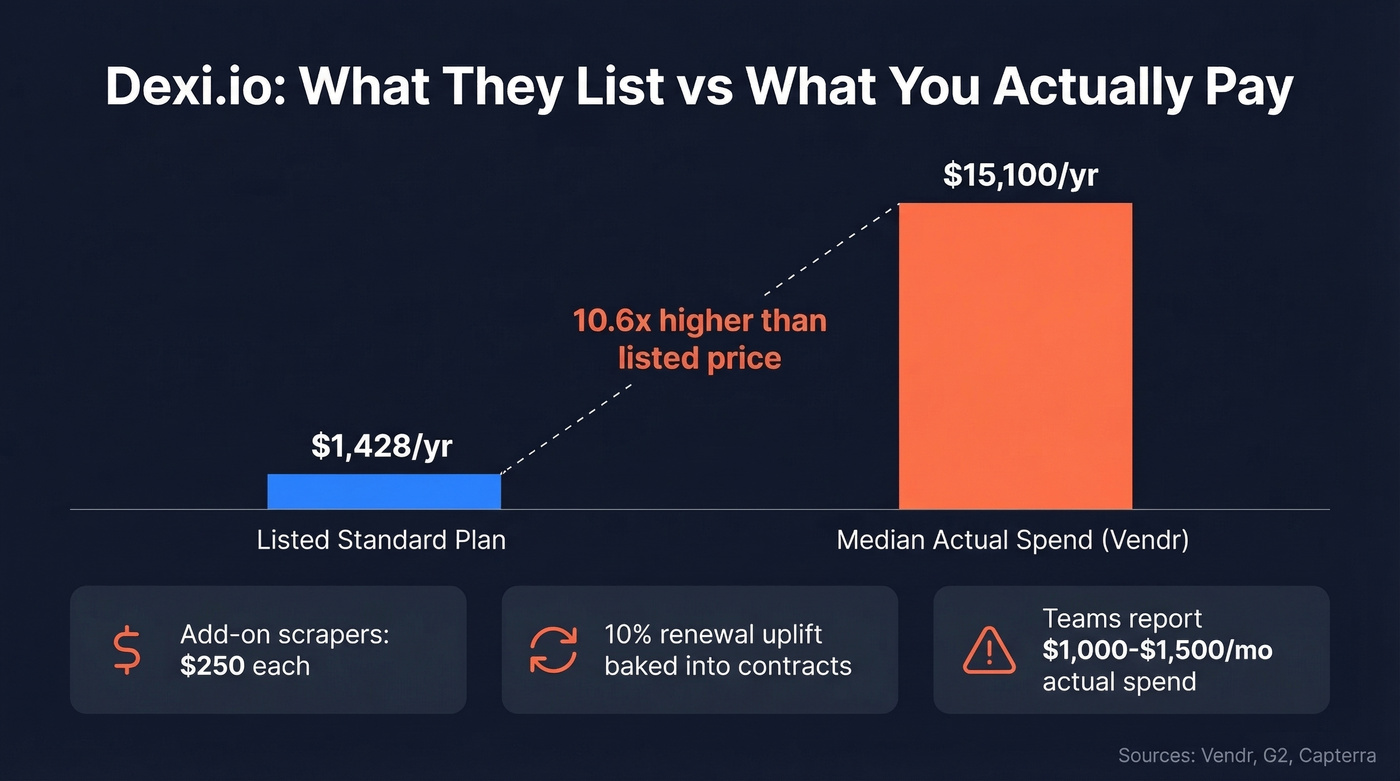
What buyers actually pay: Vendr reports the median Dexi buyer spends $15,100/year - over 10x the Standard plan annualized. Vendr also flags a 10% renewal uplift baked into contracts if you don't negotiate it down (see Anchor in Negotiation for a practical framework).
The gap between list price and real-world spend makes sense once you read the fine print. G2 reviewers report that add-on services run $250 per scraper or function, with monthly subscriptions hitting $400 and total costs climbing to $1,000-$1,500/mo for teams running multiple scrapers. Capterra lists the starting price as "$119 per feature, per month," which contradicts the "per worker" framing elsewhere. Nobody agrees on what you're actually paying for - a red flag on its own.
We've evaluated dozens of scraping tools over the years, and the gap between listed price and actual spend is almost always wider than vendors admit. Dexi is one of the worst offenders.

Dexi.io customers pay $15K/year for a tool that's shutting down. Prospeo gives you 300M+ verified B2B contacts with 98% email accuracy at ~$0.01 per email - no robots to build, no hidden setup fees, no sunsetting surprises.
Replace your scraping stack with verified data in under 60 seconds.
Pros and Cons
Pros:
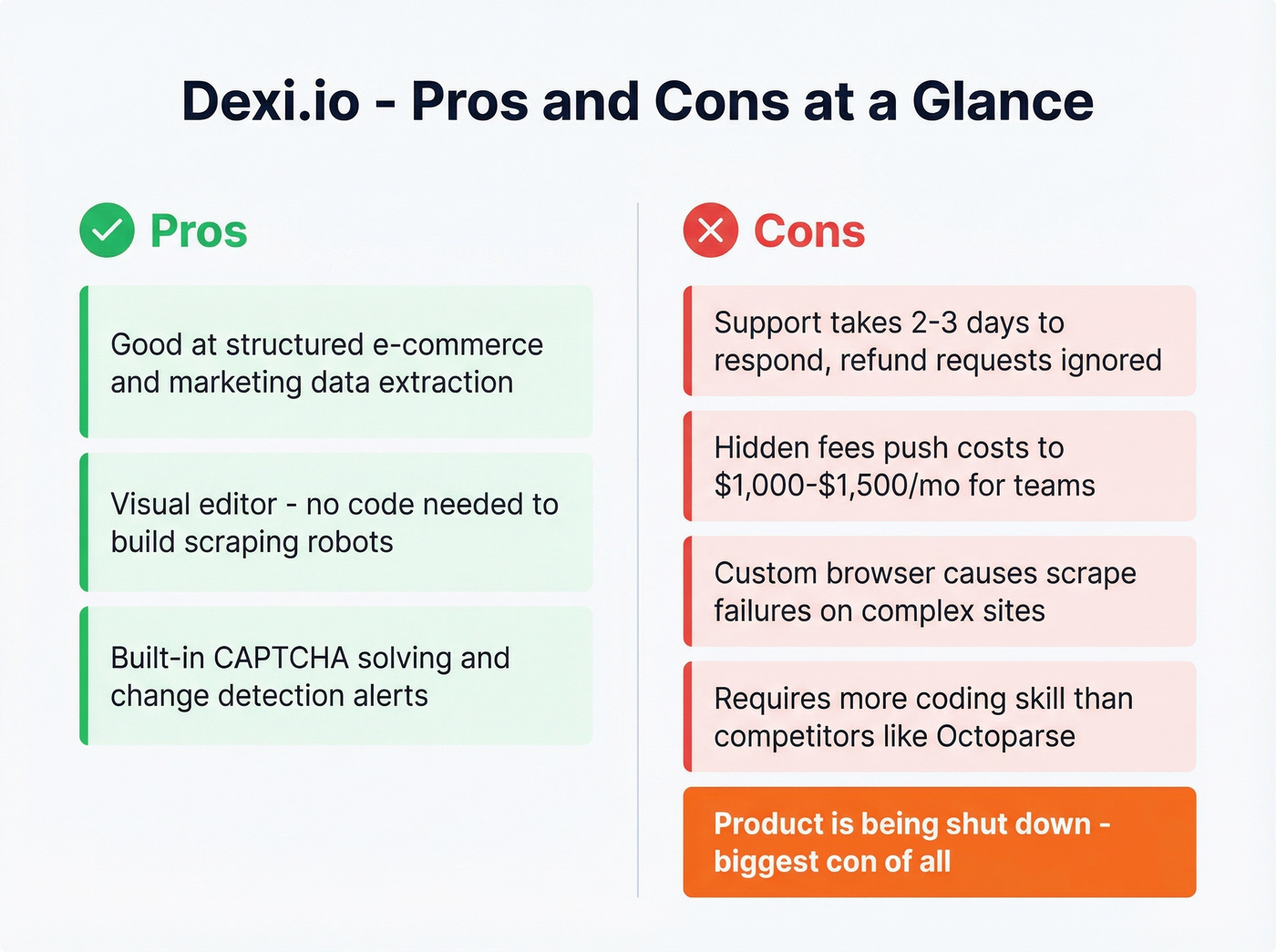
- Effective at extracting structured marketing and e-commerce data - Capterra users describe it as delivering exactly what they need for campaign workflows.
- The visual editor lets non-coders build scraping robots without writing code. Cloud-hosted execution means no servers to maintain.
- Built-in CAPTCHA solving and Change Detection alerts were genuine differentiators when the product was actively developed.
Cons:
- Support response times of 2-3 days are common per G2 reviews. One Capterra reviewer reported requesting a refund and getting silence.
- Hidden setup costs push monthly spend well beyond listed tiers. The sticker price gets you in the door, then professional services fees double the bill.
- Dexi's custom browser behaves differently than standard browsers, causing scrape failures on complex sites. The platform "meets only minimum requirements" and carries real failure risk on complex projects.
- The consensus on r/webscraping is that Dexi requires more advanced programming skills than Octoparse or ParseHub, despite marketing itself as accessible.
- The product is being sunset. That's the biggest con of all.
User Ratings
| Platform | Rating | Reviews |
|---|---|---|
| Capterra | 4.7/5 | 12 |
| G2 | 3.7/5 | 5 |
| SourceForge | 5.0/5 | 1 |
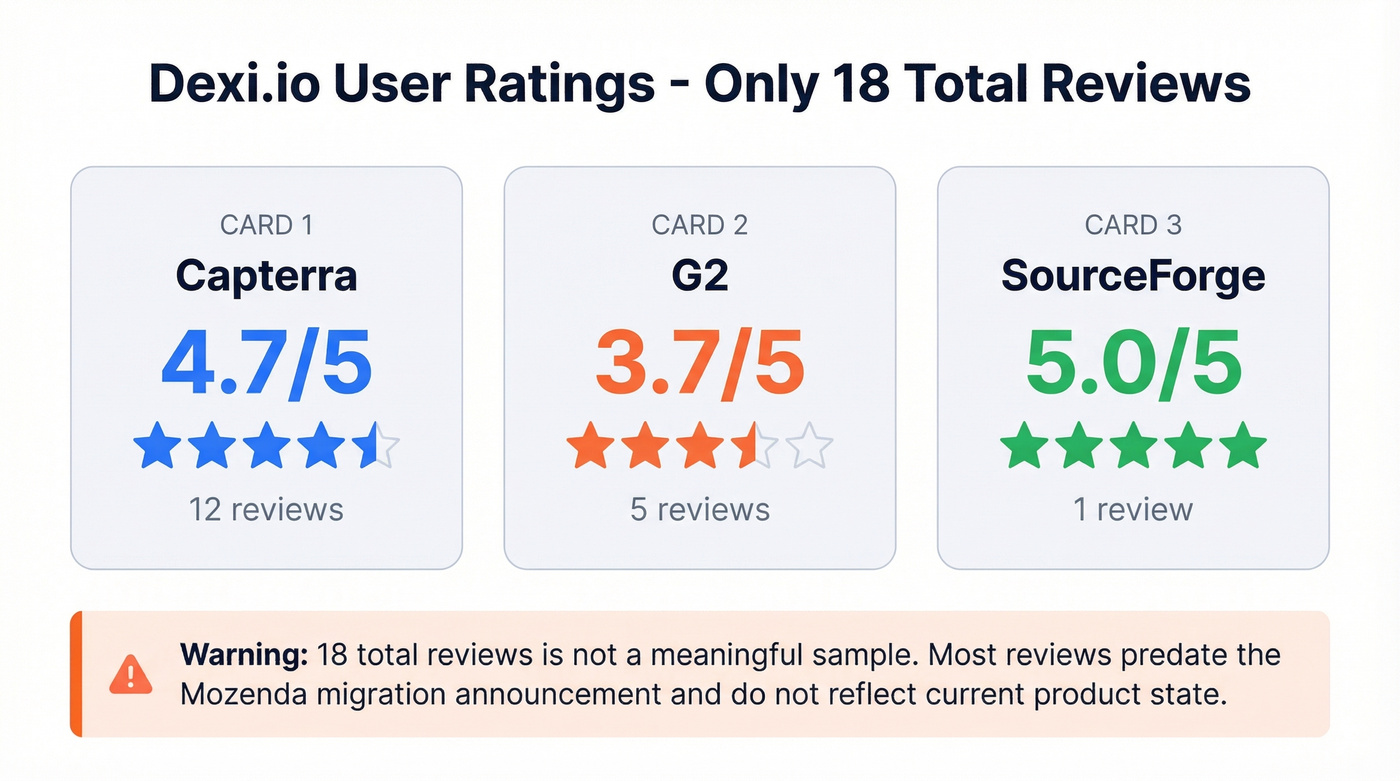
Let's be honest: 18 total reviews across three platforms isn't a meaningful sample. The Capterra score looks strong at 4.7, but 12 reviews swing wildly on a single submission. G2's 3.7 from 5 reviews is where the detailed complaints about hidden costs and slow support live. Most of these reviews predate the Mozenda transition notice, so they don't reflect the product's current state at all.
Should You Buy Dexi.io in 2026?
No. The pricing page redirects to Mozenda, existing customers are being pushed to migrate by October 31, and the product met only minimum requirements even when it was actively maintained. If you're an existing customer, start evaluating alternatives now rather than waiting for the deadline.
If your real goal is lead gen (not scraping), you'll usually get to ROI faster with free lead generation tools and a clean outbound workflow.
Better Alternatives to Dexi.io
| Tool | Starting Price | Best For |
|---|---|---|
| Prospeo | Free / ~$0.01/email | Verified B2B emails and mobiles |
| Apify | Free / $29/mo | Cloud scraping with open pricing |
| Octoparse | $119/mo | No-code visual scraping |
| ParseHub | $155/mo | Mid-complexity visual scraping |
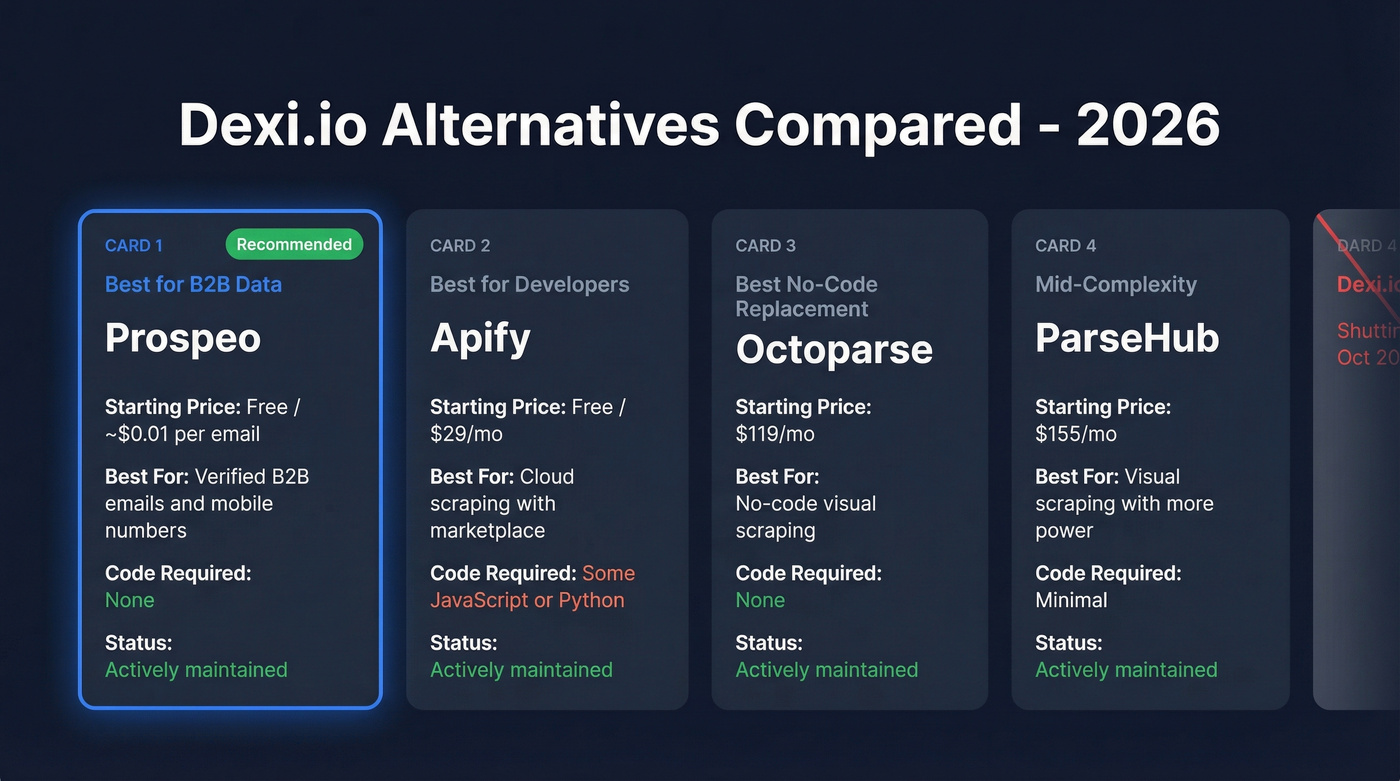
Look - most people researching Dexi.io in 2026 don't actually need a general-purpose scraping tool. If you're after B2B contact data, you're solving the wrong problem with the wrong tool category. A dedicated data platform will get you there in minutes, not days of building and debugging robots.
If you're comparing scrapers specifically, see Apify vs Octoparse for a deeper breakdown.
When You Need B2B Data, Not a Scraper
If you landed on this page because you need business contact data - emails, phone numbers, company info - you don't need a scraping tool at all. You need a workflow that combines sales prospecting techniques, accurate data, and enrichment (see data enrichment services).
If you're researching Dexi.io for B2B contact data, you're solving the wrong problem. Prospeo's database has 143M+ verified emails and 125M+ mobile numbers with 30+ search filters - no scraping, no CAPTCHA solving, no $250 add-on fees.
Get 75 free verified emails today. No credit card, no contracts.
Apify
Use this if you want transparent pricing and a marketplace of pre-built scrapers you can deploy immediately. Free plan available, $29/mo for Starter, $99/mo for Scale.
Skip this if you need a pure point-and-click interface with zero code. Apify's flexibility comes with a learning curve, and their documentation assumes you're comfortable with JavaScript or Python.
Octoparse
The closest no-code replacement for Dexi's visual editor. Same $119/mo entry price, but the product is actively maintained and the point-and-click interface genuinely works for non-technical users. The template library covers common scraping targets out of the box, which means less time configuring robots and more time using data. Where it falls short is heavy customization - for API-first workflows, Apify is the better bet.
If your end goal is emails (not pages), compare options in our guide to the best email scraper Chrome extensions and the broader list of free email scrapers.
ParseHub
A solid middle ground at $155/mo for users comfortable with visual scraping tools but needing more power than basic templates. Not the cheapest or the most powerful, but reliable for intermediate use cases. For enterprise ETL needs, Fivetran and Hevo Data are also worth evaluating.
If you're building outbound lists from scraped sources, make sure you understand email bounce rate and how to check if an email exists before you send.
FAQ
Is Dexi.io still available to new customers?
No. Engage3 is sunsetting Dexi.io and migrating all customers to Mozenda by October 31, 2026. The pricing page already redirects to Mozenda's site, and no new accounts are being created.
How much does Dexi.io actually cost?
Plans started at $119/month, but Vendr reports the median buyer pays $15,100/year. G2 reviewers report hidden add-on fees pushing monthly spend to $1,000-$1,500 for teams running multiple scrapers.
How does Octoparse compare to Dexi.io?
Octoparse matches Dexi's $119/mo starting price but is actively maintained with a stronger no-code visual editor. It's the closest direct replacement for teams that relied on Dexi's point-and-click robot builder.