

Different Types of Sales: What Each One Pays, How It Works, and Which One Fits You
You're selling cars, making decent money, but working every Saturday and wondering if there's something better. Maybe it's tech sales. Maybe it's medical devices. Maybe it's something you haven't even heard of yet. That question - "what else is out there?" - is what drives most people to research the different types of sales. This isn't another glossary. It's a breakdown with real benchmarks, salary data, and a framework for figuring out which sales type fits your goals in 2026.
Every Sales Type at a Glance
Before we go deep, here's the cheat sheet. Bookmark it.
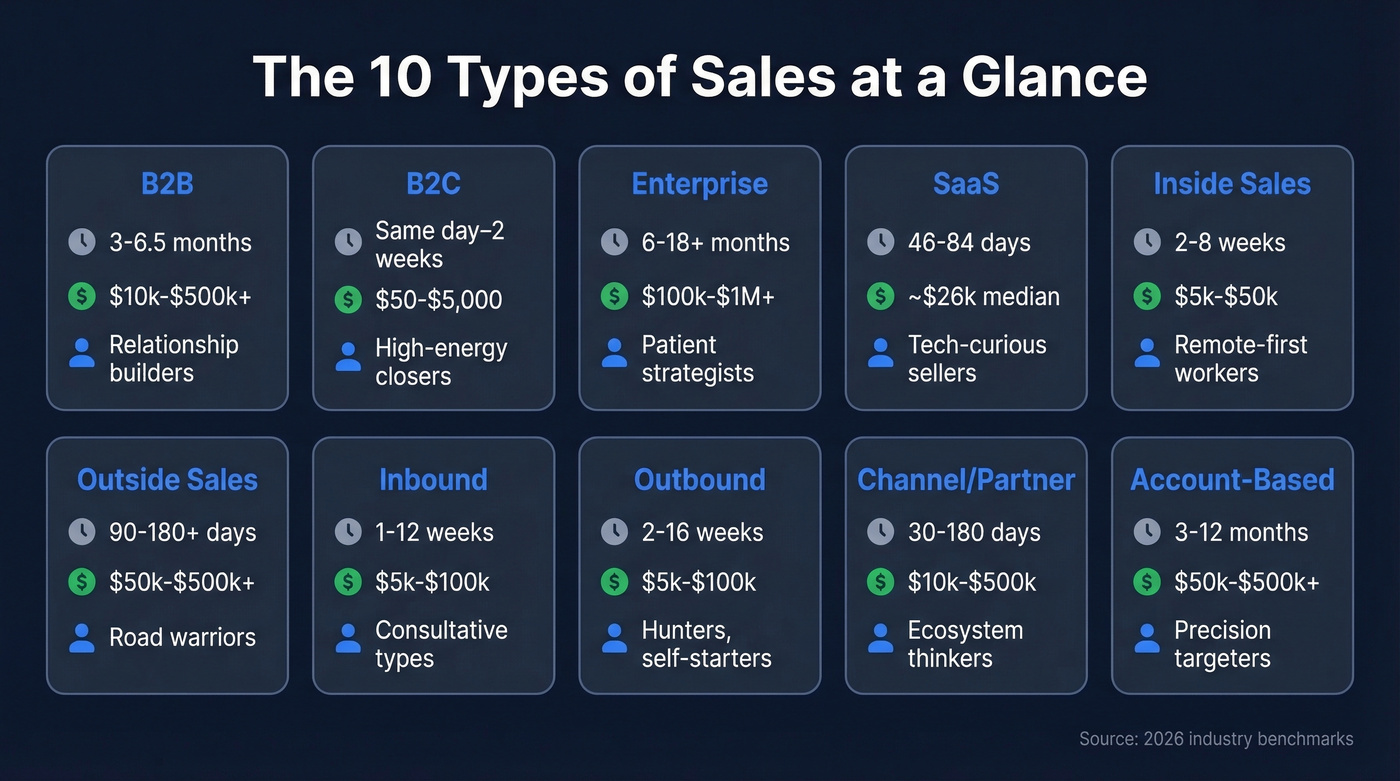
| Type | Cycle Length | Typical Deal Size | Best For |
|---|---|---|---|
| B2B (general) | 3-6.5 months | $10k-$500k+ | Relationship builders |
| B2C (retail/DTC) | Same day-2 weeks | $50-$5,000 | High-energy closers |
| Enterprise | 6-18+ months | $100k-$1M+ | Patient strategists |
| SaaS | 46-75 days (84-day median) | ~$26k median | Tech-curious sellers |
| Inside sales | 2-8 weeks | $5k-$50k | Remote-first workers |
| Outside sales | 90-180+ days | $50k-$500k+ | Road warriors |
| Inbound | 1-12 weeks | $5k-$100k | Consultative types |
| Outbound | 2-16 weeks | $5k-$100k | Hunters, self-starters |
| Channel/partner | 30-180 days | $10k-$500k | Ecosystem thinkers |
| Account-based | 3-12 months | $50k-$500k+ | Precision targeters |
Now let's unpack each one.
Sales Categories by Market
B2B Sales
B2B sales is where you sell to other businesses - and where most of the money in professional selling lives. Bigger deals, longer cycles, more stakeholders, higher earnings potential.
The numbers tell the story. The average B2B sales cycle runs 6.5 months, up from 4.9 months in 2019. Buying committees now average 25 stakeholders, up from 16 in 2017. Win rates hover around 20-21%, meaning four out of five deals end in a loss or no-decision. That's the reality nobody puts on the job posting. And reps spend only 28-30% of their time actually selling - the rest disappears into CRM updates, internal meetings, and admin work.
Within B2B, you'll find distinct sub-types. Supply sales involves selling raw materials or components to manufacturers - think industrial chemicals or electronic parts. Distribution sales is a high-volume game where margins are thin but order sizes are massive. Service sales focuses on ongoing relationships and repeat business, where the initial deal is just the beginning of a long customer relationship.
The common thread across all B2B: you're selling to people who have to justify the purchase to someone else. That changes everything about how you sell.
B2C Sales
B2C is the world most people picture when they hear "sales." Retail floors, car lots, eCommerce checkout pages, door-to-door - anywhere a business sells directly to a consumer.
Cycles are compressed. A retail transaction happens in minutes. A car sale takes a weekend. Even big-ticket B2C purchases like home renovations or financial products rarely stretch beyond a few weeks. The emotional component is higher, the decision-maker count is lower (usually one or two people), and volume matters more than individual deal size.
The DTC explosion has blurred lines here. Brands that used to sell through retailers now sell through their own websites and social channels, and eCommerce has become a major B2B channel too - not just B2C. These hybrid roles blend marketing and sales in ways that didn't exist a decade ago.
B2B vs B2C - Which Fits You?
This is a personality question disguised as a career question. The consensus on r/sales frames it this way: B2B attracts people who enjoy analytical relationship-building, multi-threaded conversations, and the patience to nurture a deal over months. B2C attracts people who thrive on energy, quick wins, and high-volume interactions.
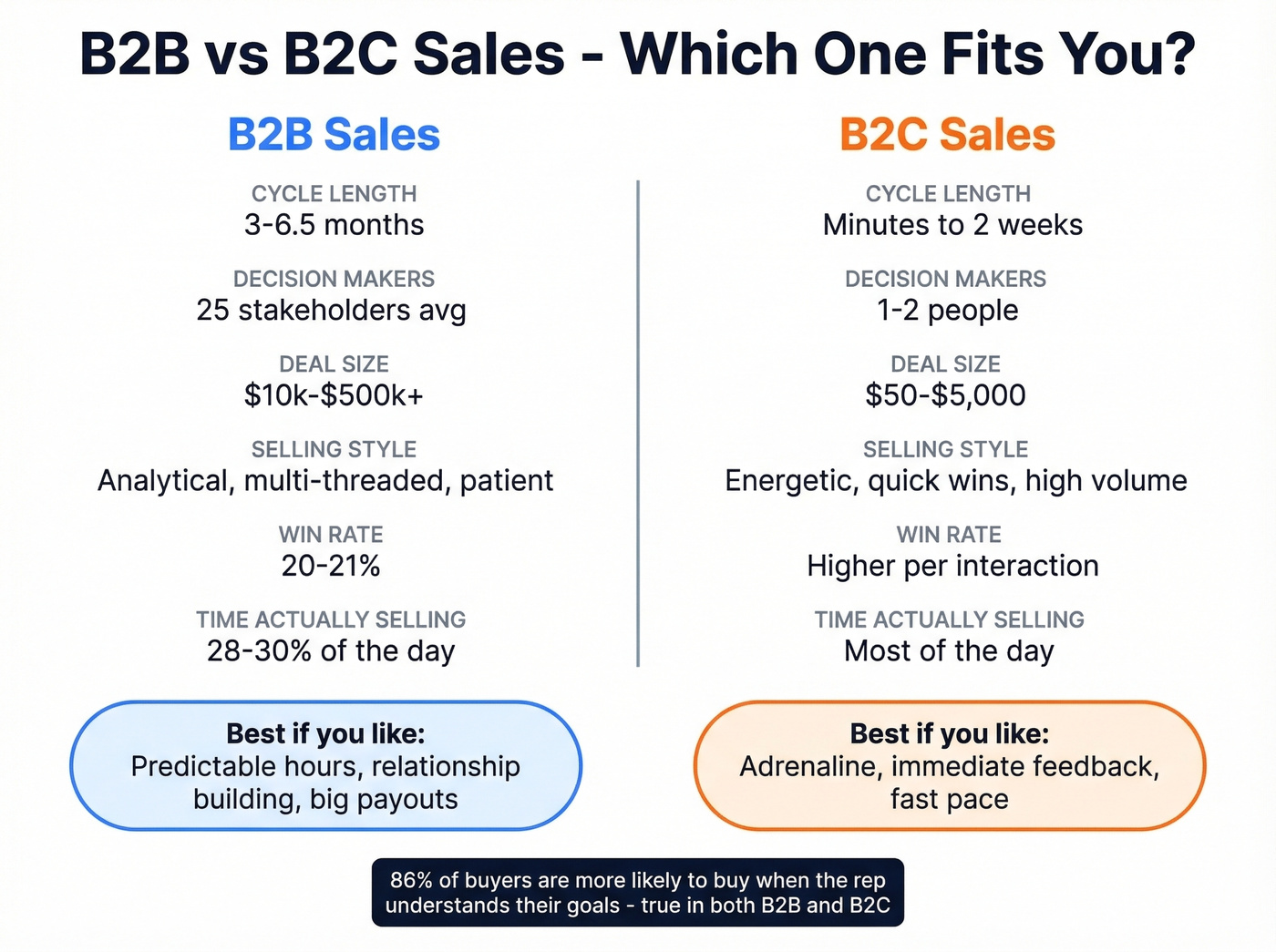
One stat that matters for both: 86% of business buyers are more likely to buy when the rep understands their goals. That applies in B2C too - it just plays out faster. The car buyer who feels understood closes in an afternoon. The VP of Engineering who feels understood closes in four months. Same principle, different timescale.
If you want predictable hours and a clear earnings trajectory, B2B inside sales is your move. If you want adrenaline and immediate feedback, B2C gives you that. Neither is objectively better - but one will make you miserable if it doesn't match how you're wired.
Enterprise and Midmarket Sales
Enterprise sales is B2B turned up to eleven. You're selling to large organizations, navigating procurement departments, legal reviews, security questionnaires, and executive committees.
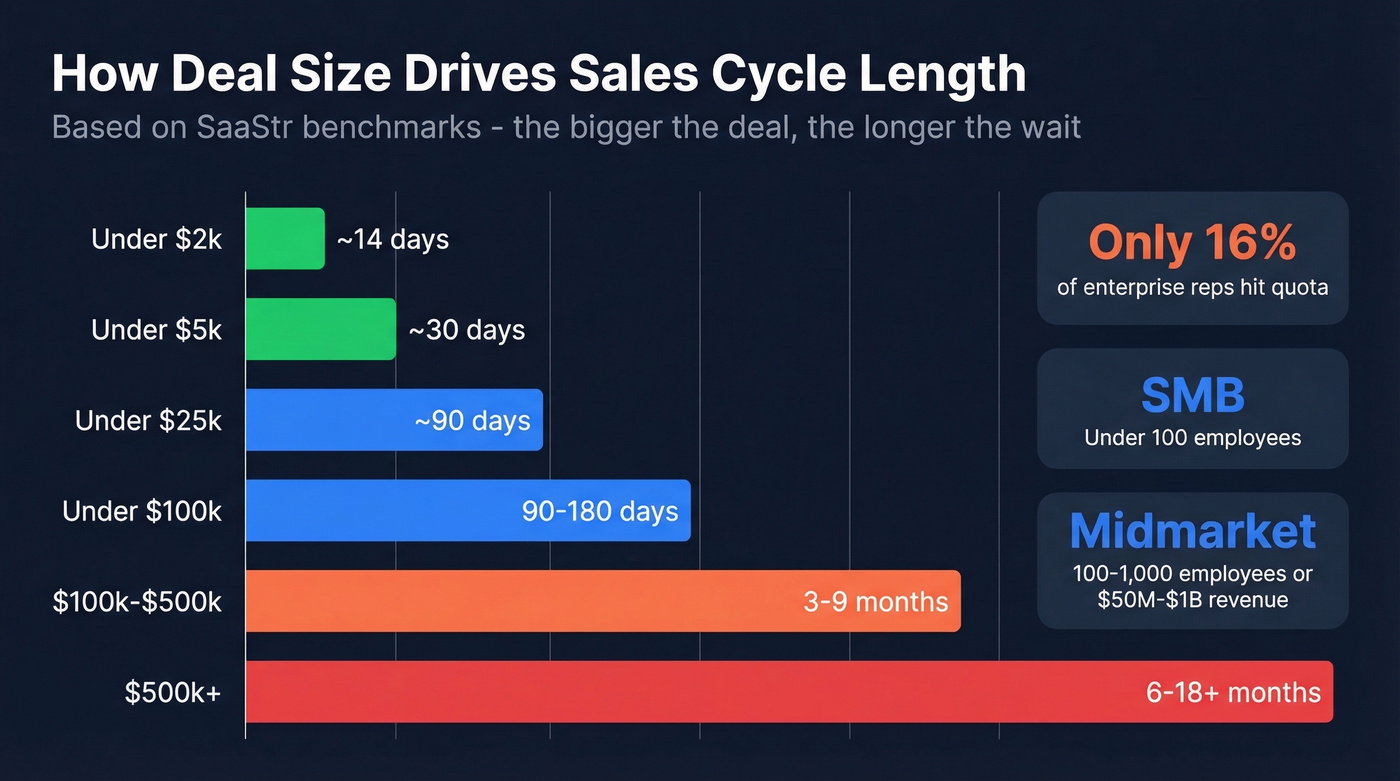
The deal size drives everything. Cycle length scales predictably with contract value, based on SaaStr's benchmarks:
| Annual Deal Size | Expected Cycle |
|---|---|
| Under $2k | ~14 days |
| Under $5k | ~30 days |
| Under $25k | ~90 days |
| Under $100k | 90-180 days |
| $100k-$500k | 3-9 months |
| $500k+ | 6-18+ months |
The segmentation matters for your career. SMBs are typically under 100 employees. Midmarket covers companies with 100-1,000 employees or $50M-$1B in revenue. Enterprise is everything above that. Each segment has a fundamentally different selling motion, and only 16% of reps hit quota in enterprise. The ceiling is high, but so is the failure rate.
SaaS and Platform Sales
SaaS sales deserves its own category because the subscription model changes the math. You're not closing a one-time purchase - you're starting a recurring revenue relationship where retention matters as much as acquisition.
The benchmarks are well-documented: lead-to-customer conversion sits at 2-5%, with the biggest funnel bottleneck at MQL to SQL (15-21%). Median sales cycle runs 84 days, with an optimal range of 46-75 days. Win rates land at 20-30%, and the median deal size for private SaaS companies is $26,265.
The trial-and-demo motion is what makes SaaS unique. Prospects can often experience the product before buying, which means the sales conversation shifts from "trust me" to "let me show you." Platform sales roles - where reps sell an ecosystem of integrations and add-ons rather than a single tool - follow a similar pattern but with larger deal sizes and more complex stakeholder maps. That's why SaaS has become the default entry point for people transitioning from other sales types. The product does some of the selling for you.
Sales Types by Channel
Inside vs. Outside Sales
This is the split that defines most sales careers. Inside sales means selling remotely - phone, email, video, social. Outside sales means getting in the car or on a plane and meeting prospects face-to-face.
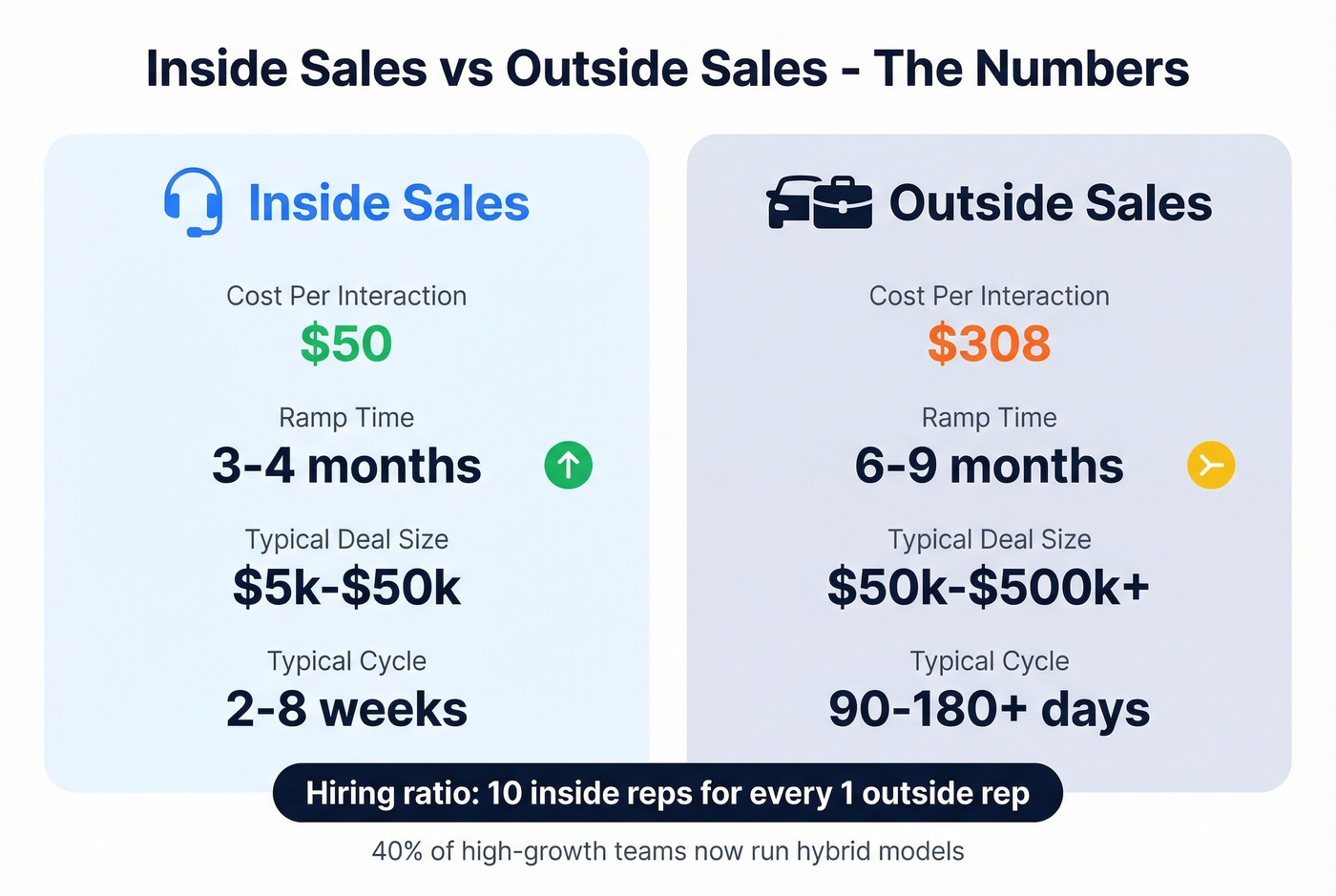
| Metric | Inside Sales | Outside Sales |
|---|---|---|
| Cost per interaction | ~$50 | ~$308 |
| Ramp time | 3-4 months | 6-9 months |
| Typical deal size | $5k-$50k | $50k-$500k+ |
| Typical cycle | 2-8 weeks | 90-180+ days |
Inside sales reps get hired at a 10:1 ratio compared to outside reps, which tells you where the market is heading. But 40% of high-growth teams now run hybrid models where inside reps qualify and outside reps close the high-value deals. The binary is dissolving.
Role Blending in Practice
The clean categories above rarely match what you'll actually do day-to-day. One practitioner on r/sales described their role as doing prospecting, account management, demos, and technical support - all in the same job. They'd moved from retail to travel to engineering to sales engineering to business development, and the role titles barely captured what they actually did.
The SDR/AE split is a SaaS invention, not a law of nature. In many industries, one rep owns the full cycle. The top-20%/bottom-80% account model is common: you own your best accounts directly while an inside partner handles the long tail.
Inbound vs. Outbound Sales
Inbound sales starts when the buyer comes to you - they've downloaded a whitepaper, requested a demo, or filled out a contact form. Outbound sales starts when you go find them - cold calls, cold emails, social outreach.
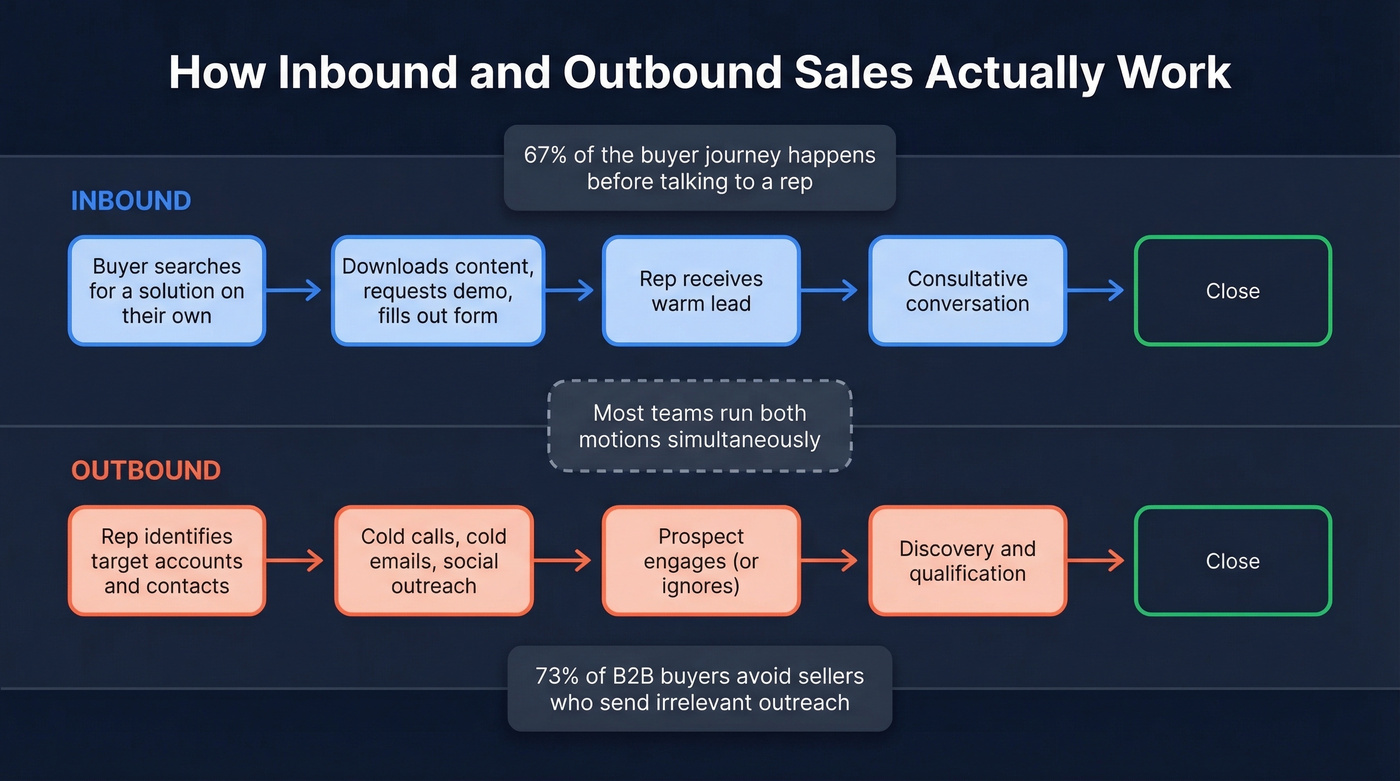
The distinction matters because 67% of the buyer journey now happens independently, before a prospect ever talks to a rep. And 73% of B2B buyers actively avoid sellers who send irrelevant outreach. That doesn't mean outbound is dead - it means lazy outbound is dead. Personalized, well-researched outbound still works, but only when you're reaching real people at current contact info. Stale data means wasted effort, which is why data freshness matters so much for outbound teams.
Most teams run both motions simultaneously. Product-led growth companies lean inbound; companies selling to enterprises lean outbound.
Channel, Partner, and Account-Based Sales
Channel sales means selling through intermediaries - resellers, distributors, VARs, or technology partners. You give up margin (typically 20-40%) in exchange for reach. It makes sense when expanding geographically or entering vertical markets where partners have existing relationships. The biggest challenge is channel conflict - when your direct sales team competes with your partners for the same deal.
Account-based sales flips the funnel. Instead of casting a wide net, you start with a defined list of target accounts - usually fewer than 500 - and coordinate sales and marketing to penetrate each one with personalized engagement. Done well, it improves cycle length, pipeline velocity, win rate, and deal size. The tradeoff is significant upfront research per account.
Cross-selling and upselling aren't standalone sales types - they're motions that overlay any type. An enterprise AE upselling an existing account and a retail associate suggesting a phone case are running the same play at different scales.
Social Selling and New Business Sales
Social selling - using platforms and professional networks to build relationships and create pipeline - isn't a separate sales type so much as a channel that overlays everything else. But the data supports taking it seriously: top performers who invest in social selling create 45% more opportunities and see 16% higher win rates.
New business sales - sometimes called "hunting" - focuses exclusively on acquiring net-new logos rather than expanding existing accounts. It's the most demanding motion in sales because you're building trust from zero, but it's also where companies invest the most in headcount and compensation.
Direct sales covers everything from DTC brands to single-level selling organizations. It's worth distinguishing legitimate direct sales, where you sell a product to consumers, from MLM structures, where recruiting is the real revenue model. Here's the thing: if the comp plan pays more for recruiting than selling, walk away.

B2B reps spend 70% of their time not selling. Prospeo's 300M+ verified profiles with 30+ filters - intent data, technographics, job changes - cut list-building from hours to minutes so you can focus on the actual selling motion.
Stop researching prospects. Start closing them.
Sales Approaches (How You Sell)
Hard Sell vs. Soft Sell
The type of sale you're in determines what you sell and to whom. Your selling approach determines how.
Transactional selling is negotiation-driven and fast. Best for short cycles and one-time purchases - retail, automotive, real estate. Transactional environments reward reps who can remove friction and close quickly.
Solution selling starts with diagnosis. The prospect knows they have a problem but not how to fix it. You map their pain to your product's capabilities. Longer cycle, higher ROI per deal.
Consultative selling goes deeper - it's relationship-first, trust-heavy, and requires experienced reps who can explore needs the prospect hasn't fully articulated. That 86% stat about buyers purchasing when reps understand their goals? That's consultative selling in a nutshell. This is the soft sell in action: guiding the buyer toward a decision without pressure, letting the value do the convincing.
Provocative selling is the hardest to execute. You're surfacing a problem the prospect doesn't even know they have, creating urgency from scratch. Powerful when business is slow and prospects aren't actively buying. This sits closer to a hard sell - you're pushing the buyer to act on a problem they haven't acknowledged, which requires conviction and strong evidence to avoid coming across as pushy.
Most experienced reps blend approaches depending on the situation. A high-touch motion common in enterprise and account-based deals leans heavily on consultative and solution selling, with multiple personalized touchpoints across a long cycle. A high-velocity inside sales role, by contrast, leans transactional for smaller deals and shifts to solution selling as deal size grows.
Methodologies - Pick One and Move On
Every sales methodology - Sandler, BANT, Challenger, MEDDIC, SPIN - boils down to the same fundamentals: understand the need, confirm the budget, map the stakeholders, and nail down the timeline. A popular r/sales thread put it bluntly: "They're all basically the same." That's an oversimplification, but it's not wrong.
The research behind the big ones is real, though. The Challenger Sale came from CEB research involving 6,000+ sales reps and found that reps who teach, tailor, and take control outperform relationship builders in complex deals. Xerox reported a 17% increase in sales and $65M in contract value after implementing it.
SPIN Selling was developed from 35,000+ sales calls across 20+ countries over 12 years - arguably the most rigorously researched methodology in existence. BANT (Budget, Authority, Need, Timeline) was created by IBM and remains useful as a qualification framework for high-velocity inbound. Think of it as the bouncer at the nightclub, not a comprehensive sales methodology.
The practitioner take is right: learn the fundamentals first, then adopt whatever methodology your company uses. Don't spend months agonizing over which framework is "best."
What Each Sales Role Pays
This is the section most people scrolled here for.
| Role | Base Salary | OTE (On-Target) |
|---|---|---|
| SDR/BDR | $45k-$65k | $70k-$100k |
| AE (SMB) | $60k-$80k | $110k-$150k |
| AE (Mid-Market) | $75k-$95k | $140k-$200k |
| AE (Enterprise) | $110k-$140k | $220k-$320k |
| AE (Strategic) | $130k-$160k | $260k-$380k+ |
| Sales Engineer | $110k-$140k | $160k-$230k |
| Sales Manager | Varies | $200k-$280k |
| VP/Director | Varies | $300k-$500k+ |
The pay mix matters as much as the total number. Closing roles typically run a 50:50 split between base and variable - half your paycheck depends on hitting quota. SDRs and sales engineers usually sit at 70:30 or 80:20, meaning more stability but less upside.
Enterprise pays the most, but it costs you the most. The ramp is longer, the quota pressure is relentless, and the emotional toll of losing a deal you've worked for 14 months is real. We've watched talented reps burn out in enterprise because the ceiling blinded them to the grind.
Mid-market is the most underrated segment in sales. Deals are big enough to pay well ($140k-$200k OTE) but short enough to keep momentum. You close enough deals per quarter to learn fast, and the work-life balance is dramatically better than enterprise. If your average contract value is under $50k, you probably don't need the enterprise playbook - and neither does your career.
How to Choose the Right Type
The decision comes down to four factors: personality, income goals, work-life balance, and risk tolerance.
If you're in car sales right now and want out, SaaS inside sales is the fastest on-ramp. The skills transfer directly - objection handling, reading people, closing under pressure - and the work-life balance improvement is immediate. No more Saturdays on the lot. We've seen reps make this jump in under three months when they target mid-market SaaS companies that value B2C closing experience.
SDR is the entry point, not the destination. Plan to spend 12-18 months there, learn the tech stack and the industry, then move to an AE role. Enterprise AE is the ceiling for individual contributors. Sales management and VP roles are where the real money lives, but they're a fundamentally different job.
One more factor: 81% of sales teams now use AI in some capacity - mostly for admin automation, lead scoring, and email drafting. That's reshaping every sales type, but especially inside sales and SaaS, where AI handles the repetitive work and frees reps to focus on conversations. The roles aren't disappearing, but the day-to-day is changing fast.
Skip enterprise if you're early in your career and don't have a mentor there. The ramp is brutal, the feedback loops are slow, and failing at enterprise can set your confidence back years. Build your skills in mid-market first, then make the jump with a track record behind you.
Real talk: the "best" sales type is the one where you can sustain high performance for years without hating your life. A $320k OTE means nothing if you're miserable and churning out after 18 months.
What Every Sales Type Shares
Every type we've covered - B2B, B2C, enterprise, SaaS, inside, outside, inbound, outbound - shares one dependency: you need to reach the right person with accurate contact information. It sounds basic. It's the thing that breaks most pipelines.
Reps spend 60% of their time on non-selling tasks. A huge chunk of that waste comes from chasing bad data - bounced emails, disconnected phone numbers, contacts who left the company six months ago. Bad data doesn't care what methodology you use or how good your pitch is.
Whether you're running consultative enterprise deals or high-velocity inside sales, your results depend on reaching real people at current contact info. Tools like Prospeo exist specifically for this - 98% email accuracy, 125M+ verified mobile numbers, and a 7-day data refresh cycle that keeps your lists from going stale.
If you're building lists at scale, data enrichment and lead enrichment are what keep your CRM usable.

Whether you're running inside sales, enterprise, or SaaS - bad data kills deals before they start. Prospeo delivers 98% email accuracy and 125M+ verified mobiles on a 7-day refresh cycle, at $0.01 per email. No contracts, no sales calls.
Every sales type needs accurate data. Only one platform refreshes it weekly.
FAQ
What are the main types of sales?
The major categories are B2B, B2C, inside, outside, inbound, outbound, enterprise, SaaS, channel, account-based, and direct sales. Most real-world roles blend several - a SaaS inside sales rep simultaneously does B2B, inside, and outbound. The labels are useful for understanding the landscape, but don't expect clean boundaries.
Which type of sales pays the most?
Enterprise account executives earn $220k-$320k OTE, with strategic AEs exceeding $380k. But cycles run 6-18 months and only 16% of reps hit quota. VP-level roles reach $300k-$500k+, though those are management positions, not individual contributor roles.
Is B2B or B2C better for beginners?
B2C - retail, car sales, DTC - has a lower barrier to entry and faster feedback loops. SaaS inside sales (B2B) offers faster earnings growth and better work-life balance for most people. The strongest career move for a B2C seller is transitioning to a B2B SDR role, then promoting to AE within 12-18 months.
What's the difference between a hard sell and a soft sell?
A hard sell uses urgency, scarcity, and direct pressure to push for an immediate decision - common in transactional environments like car lots. A soft sell uses education, relationship-building, and patience to let the buyer decide on their own terms. The right approach depends on deal complexity, buyer expectations, and cycle length.
What tools do I need regardless of sales type?
Three essentials: a CRM (HubSpot or Salesforce), a verified contact data source like Prospeo (75 free emails/month, 98% accuracy), and a sequencing tool for outreach (Outreach, Salesloft, or Instantly). Bad data is the #1 pipeline killer across every sales motion - fix that first, then optimize everything else.