Direct Dial Connect Rate: 2026 Benchmarks, Data, and How to Fix Yours
A RevOps lead we know ran a 3-tool bake-off last quarter. The "best" database had 40% of its direct dials ringing disconnected lines within 60 days. The cheapest one had better connect rates because the numbers were actually fresh. Your direct dial connect rate problem isn't a dialing problem - it's a data problem. The benchmarks prove it.
What Is Direct Dial Connect Rate?
This metric measures how many outbound calls actually reach a live human:
Live conversations / Total dials x 100 = Connect Rate
If your SDR team dials 200 numbers and gets 16 people on the phone, that's an 8% connect rate. But the type of number changes everything. Reaching a prospect through a switchboard takes roughly 22 minutes on average - navigating gatekeepers, getting transferred, hitting dead ends. A direct dial cuts that to about 5 minutes.
Don't confuse connect rate with conversion rate or answer rate. Connect rate specifically measures live human conversations, not voicemails, not IVR menus, not "the line rang."
The Quick Version
- Average teams connect on 4-6% of dials. Top teams hit 12-18%.
- The gap comes down to three systems: data freshness, caller ID reputation, and call timing.
- Mobile numbers consistently outperform office direct dials, especially in a remote-work world where office phones ring empty desks.
- You don't need a bigger team or more dials. You need better numbers and smarter dialing hygiene.
2026 Benchmarks by Dial Type, Day, and Time
This is the section worth bookmarking.
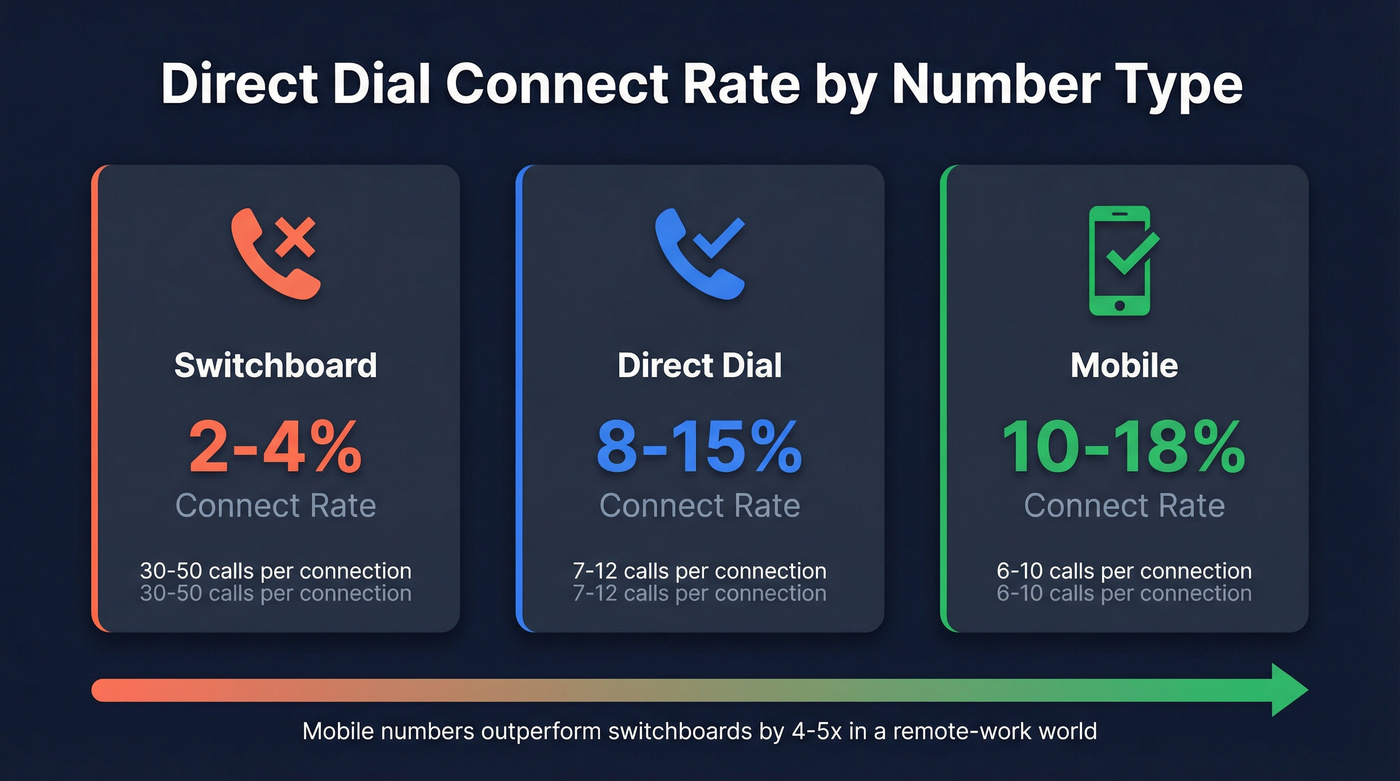
By Dial Type
| Dial Type | Connect Rate | Calls per Connection |
|---|---|---|
| Switchboard | 2-4% | ~30-50 |
| Direct dial | 8-15% | ~7-12 |
| Mobile | 10-18% | ~6-10 |
The canonical benchmark is 18 dials per connection across blended number types. That average masks a massive spread, though. Teams dialing switchboards burn 30-50 calls per conversation while teams with verified mobile numbers cut that to single digits.
Be wary of vendors promising guaranteed connect rates. They often hit those numbers by narrowing your addressable market to the easiest-to-reach prospects, which shrinks your TAM.
By Day of Week
ZoomInfo's 1.4M-call study gives us the clearest day-of-week picture:
| Day | Performance | Notes |
|---|---|---|
| Tuesday | Highest | Best connect rates overall |
| Wednesday | Strong | Tue + Wed = 44% of demos |
| Thursday | Good | Solid mid-week window |
| Monday | Mixed | High demo efficiency (1.19%) |
| Friday | Worst | Lowest across all metrics |
Tuesday and Wednesday alone account for 44% of total demos booked. Friday is a dead zone. If your team distributes dials evenly across the week, you're leaving conversations on the table.
By Time of Day
A 40,000-call study from LeadsAtScale provides the most granular time-block data we've seen:

| Time Block | Connect Rate |
|---|---|
| 8-10am | 12.3% |
| 10am-12pm | 18.7% |
| 12-2pm | 8.9% |
| 2-4pm | 15.2% |
| 4-5pm | 21.4% |
| After 5pm | 6.1% |
The 4-5pm window is 71% more effective than other time blocks. Executives and senior decision-makers are done with internal meetings and actually picking up. The lunch dead zone from 12-2pm is real and consistent across every dataset in our analysis.
Industry matters too. Technology companies average about 0.95% call-to-sale conversion - roughly 105 calls per sale - while service industries hit 2.85% at 35 calls per sale. Recognizable brands convert at 2.53% versus 0.85% for lesser-known companies.

Your connect rate is only as good as your data. Prospeo's 125M+ verified mobile numbers refresh every 7 days - not every 6 weeks like the industry average. Meritt tripled their connect rate to 20-25% after switching. At $0.01 per lead, bad data costs more than good data ever will.
Stop burning dials on disconnected lines. Start connecting.
Why Connect Rates Keep Falling
The environment is working against you. [52.8 billion robocalls](https://www.prnewswire.com/news-releases/us-consumers-received-nearly-4-4-billion-robocalls-in-december-52-8-billion-in-all-of-2024 - according-to-youmail-robocall-index-302348867.html) hit U.S. phones in 2024, and the fallout is brutal. 94% of people now believe unidentified calls are fraudulent. 95% of calls labeled "spam likely" go completely unanswered. 46% of unidentified calls go unanswered.
Here's the thing: 72% of cold calls don't reach a human at all. 80% go straight to voicemail. It now takes 8 attempts on average to reach a prospect, and cold calling success rates dropped to 2.3% in 2025. The trend line isn't improving.
The predictive dialer market is projected to hit $6.1B by 2034, reflecting how seriously organizations are investing in outbound infrastructure. Every spam call makes your next legitimate dial harder.
Seven Levers That Improve Connect Rates
Getting from average to top-performer isn't a mystery. It's a systems problem with seven specific levers.
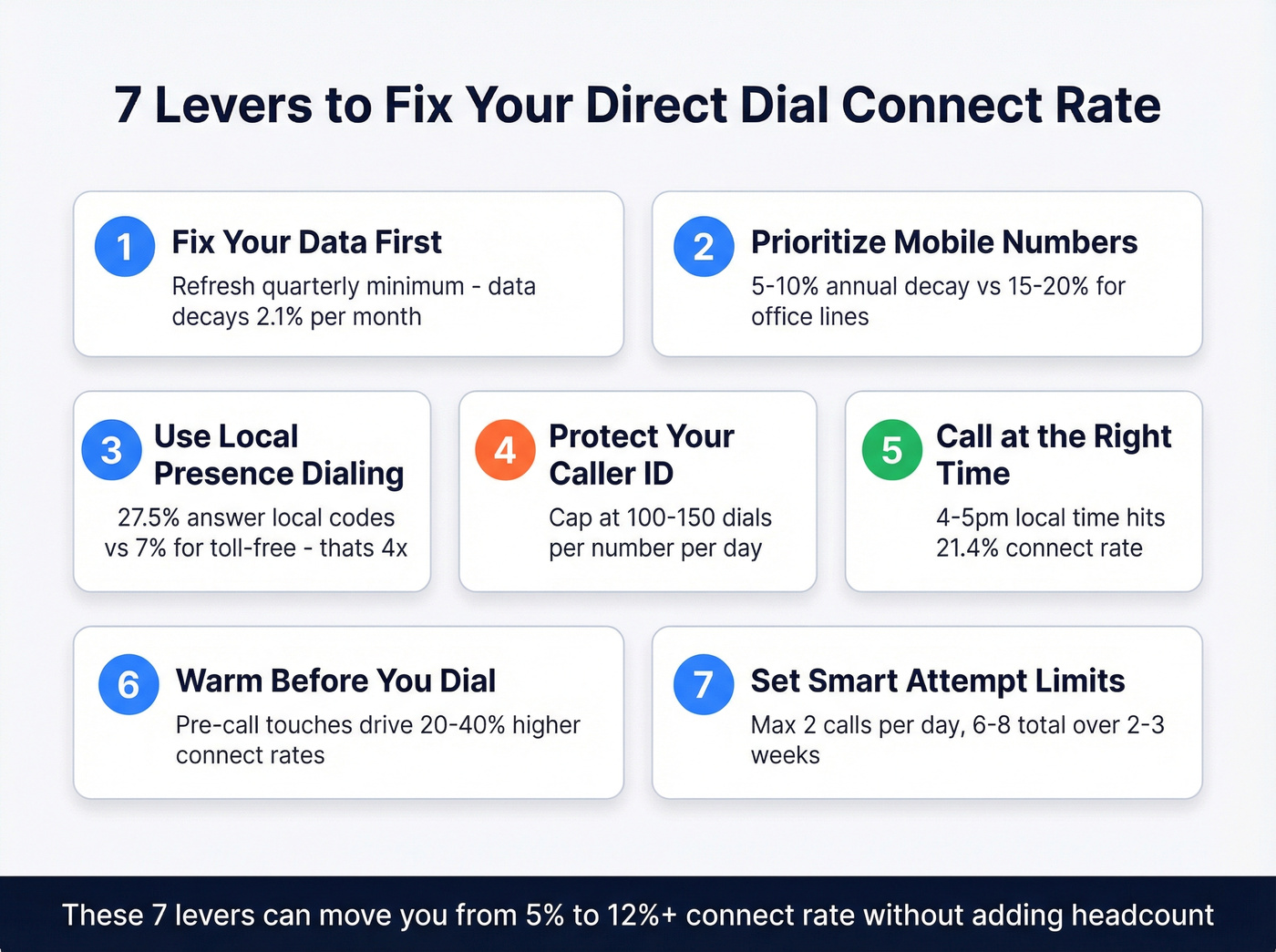
1. Fix Your Data First
This is the lever that matters most. B2B data decays at roughly 2.1% per month - 22.5% annually. Bad data costs U.S. businesses $611B per year. If you haven't refreshed your contact database in six months, a quarter of your numbers are ringing disconnected lines or the wrong person entirely.
The fix: refresh quarterly at minimum, monthly for high-value accounts. Teams running waterfall enrichment - sequentially validating numbers across multiple providers - consistently report 30-50% improvements in connect rates. In our experience, the single biggest unlock for outbound teams isn't a new dialer or a new script; it's cleaning the list they already have.
Prospeo's database of 125M+ verified mobile numbers refreshes every 7 days, compared to the 6-week industry average. Meritt tripled their connect rate to 20-25% after switching to Prospeo's data, going from $100K to $300K/week in pipeline. When your numbers are verified weekly instead of monthly, the math on data freshness pays for itself in the first week of dialing.
2. Prioritize Mobile Numbers
Mobile numbers decay at just 5-10% annually versus 15-20% for office direct dials. With remote and hybrid work now the default, office phones increasingly ring empty desks. Mobile-first prospecting isn't a preference - it's the only strategy that matches how people actually work in 2026.
If your average deal size is under $15k and your team is still buying office direct dials in bulk, you're burning budget. Mobile numbers cost more per record but deliver 2-3x the conversations. The per-conversation cost is lower every time.
3. Use Local Presence Dialing
27.5% of people answer calls from local area codes versus just 7% for toll-free numbers. That's a 4x difference from a single configuration change in your power dialer. Prospects are 77% more likely to answer when they recognize the area code. If your dialer supports local presence, turn it on today. It's the easiest win on this list.
4. Protect Your Caller ID
80% of people block calls from numbers they don't recognize. One study reported a 500%+ increase in answer rates after upgrading to A-level STIR/SHAKEN attestation, though results vary based on existing reputation. Attestation alone isn't enough, though. Carrier spam flagging is behavior-based: high-volume dialing from a single number, rapid successive calls, and parallel dialer dropped calls all trigger flags.
Keep outbound volume under 100-150 calls per number per day. Many teams cap at 30-50 dials per number to stay safe. 81% of businesses have lost revenue due to incorrect spam labeling, and 15% lost more than $100,000. Rotate numbers, monitor your reputation, and treat your caller ID like you treat your email domain - because the consequences of neglect are just as severe.
5. Call at the Right Time
Your best window is 4-5pm local time at 21.4%. Mid-morning from 10am-12pm is your second-best at 18.7%. Avoid the 12-2pm lunch dead zone. Stack your heaviest dial blocks on Tuesday through Thursday and give Friday a rest. This alone can move your connect rate 3-5 points without changing anything else.
6. Warm Before You Dial
Pre-call email and social touches drive 20-40% higher connect rates on the subsequent call. Warm follow-ups connect at 2-4x the rate of first-touch cold calls. A 30-second video message, a comment on their recent post, or a quick email the day before you call creates just enough familiarity that the prospect is more likely to pick up.
Cold outbound doesn't have to mean cold first contact. If you want a repeatable system, build it into your outbound calling strategy and your sales cadence.
7. Set Smart Attempt Limits
Cap at 2 calls per prospect per day and 6-8 total attempts over 2-3 weeks. More than that and you're burning caller ID reputation for diminishing returns. Parallel dialers increase volume but tank your number reputation through dropped calls when multiple prospects answer simultaneously. Sequential dialers are slower but protect your reputation. Skip parallel dialers unless your team has a disciplined process for managing dropped-call ratios - otherwise you'll solve a volume problem while creating a reputation problem that takes months to undo.
The Pipeline Math on Better Connect Rates
Let's break this down with real numbers. Take 10 BDRs dialing 50 calls per day.

At a 5% connect rate, that's 25 conversations per day across the team. At 12%, it's 60. If 15% of conversations book a meeting, the 5% team generates 3.75 meetings per day. The 12% team generates 9.
That's 2.4x more pipeline from the exact same dial volume. You don't need more reps. You don't need more dials. You need better data and better dialing hygiene. The ROI on fixing your direct dial connect rate dwarfs the ROI on hiring another SDR - and it's a lot faster to implement. If you want to pressure-test the rest of your funnel, map it against common sales pipeline challenges.
Compliance Essentials
None of the tactics above matter if you're violating telemarketing law:
- TCPA violations run $500-$1,500 per call with class-action exposure.
- Federal calling window: 8am-9pm recipient local time.
- DNC scrubbing: every 31 days against the National Do Not Call registry.
- PEWC is required for automated marketing calls to cell phones. An established business relationship isn't a substitute.
- State-level rules can be stricter than federal. Check your target states.
The penalties are per-call. A 10-rep team making 500 dials a day can rack up catastrophic liability fast if the process isn't clean. If you're operationalizing this, treat it like B2B sales best practices, not a one-off enablement doc.
Mobile numbers hit 10-18% connect rates vs 2-4% for switchboards. Prospeo gives you 125M+ verified mobiles with a 30% pickup rate across all regions - backed by 5-step verification that catches spam traps, honeypots, and catch-all domains before they tank your caller reputation.
Dial fewer numbers. Reach more humans. That's the math.
FAQ
What is a good direct dial connect rate?
Average B2B teams connect on 4-6% of dials. Top-performing teams hit 12-18% by combining verified mobile numbers, local presence dialing, and disciplined call timing. Below 4% usually signals a data quality problem.
How many cold calls to get one connection?
The blended benchmark is 18 dials per connection across mixed number types. With verified mobiles and proper timing, top teams cut that to 6-8 dials per live conversation.
What's the best time to cold call?
The 4-5pm local time window hits 21.4% in a 40,000-call study. Mid-morning from 10am-12pm is second-best at 18.7%. Avoid the 12-2pm lunch dead zone entirely.
Direct dial vs. mobile - which connects better?
Mobile numbers outperform office direct dials in nearly every scenario, especially with remote work. They also decay slower - 5-10% annually versus 15-20% for office lines - making them more cost-effective over time.
How do I stop calls from getting flagged as spam?
Keep volume under 50 dials per number per day, rotate numbers regularly, register for STIR/SHAKEN A-attestation, and use branded caller ID. Dialing verified, active numbers instead of disconnected lines also reduces carrier red flags. Fewer dead numbers means fewer spam triggers - which is why weekly-refreshed mobile data matters more than most teams realize.