

Direct Sales Leads: How to Get Ones That Actually Convert
You bought 1,000 leads last quarter. Three hundred phone numbers were disconnected, another two hundred bounced on the first email, and your SDRs spent a week chasing ghosts. The lead vendor model is broken - and the fix is simpler than most teams realize.
Building your own direct sales leads with verified data beats buying recycled lists every time.
What Are Direct Sales Leads?
Direct sales leads are contacts your team reaches out to proactively through cold calls, cold emails, direct mail, or one-to-one messages. They're distinct from marketing leads who come inbound through content or ads because you chose them based on fit, not because they raised their hand.
You'll hear terms like MQLs, SQLs, and PQLs tossed around. For direct outbound, what matters is whether the contact matches your ICP and has a real path to a buying decision. The global lead generation industry is projected to hit $295B by 2027 - no shortage of people selling you leads. The question is whether those leads are worth anything.
What You Need (Quick Version)
- Build your own list instead of buying shared leads. A B2B data platform lets you search by ICP filters and export verified contacts in minutes - no middleman, no recycled data.
- Verify every contact before outreach. High bounce rates don't just waste time; they torch your domain reputation (see email bounce rate benchmarks and fixes).
- Qualify before you chase. 61% of marketers say generating quality leads is their top challenge. The problem isn't volume - it's wasting cycles on contacts who were never going to buy.
Buy vs. Build: Which Approach Works?
Here's the thing: purchased lead lists still have a place, but the shared-lead model is a relic. On r/smallbusiness, one owner reported getting roughly 1 good customer out of every 20-30 shared leads from a marketplace - spending hundreds of dollars for the privilege.
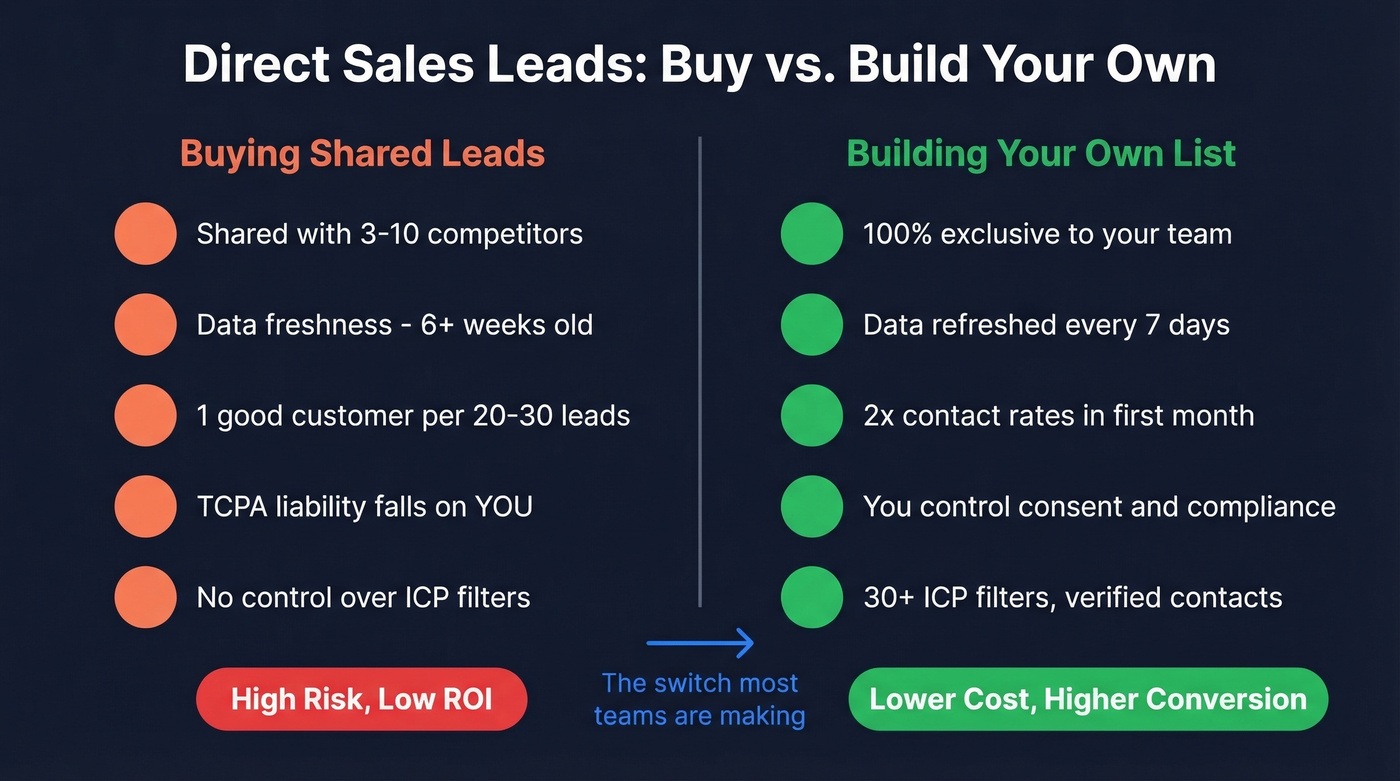
Shared leads go to 3-10 competitors simultaneously. You're not buying a prospect; you're buying a lottery ticket. And under TCPA, using automated dialing on purchased leads without proper consent exposes you to $500-$1,500 per violation.
In our experience, teams that switch from shared leads to self-built lists see contact rates double within the first month. If you do buy, demand exclusivity, proof of consent, and data freshness under 30 days. But the better move is to stop buying entirely and build your own list with a sales prospecting database that lets you control every filter.

Every shared lead you buy goes to 3-10 competitors. Prospeo lets you build your own direct sales list with 30+ ICP filters, 300M+ profiles, and 98% email accuracy - refreshed every 7 days, not every 6 weeks. Meritt made the switch and tripled pipeline from $100K to $300K/week.
Own your leads instead of renting them. Start free today.
Channels That Produce Outbound Leads
Not all outbound channels perform equally. Here's what benchmarks actually look like:
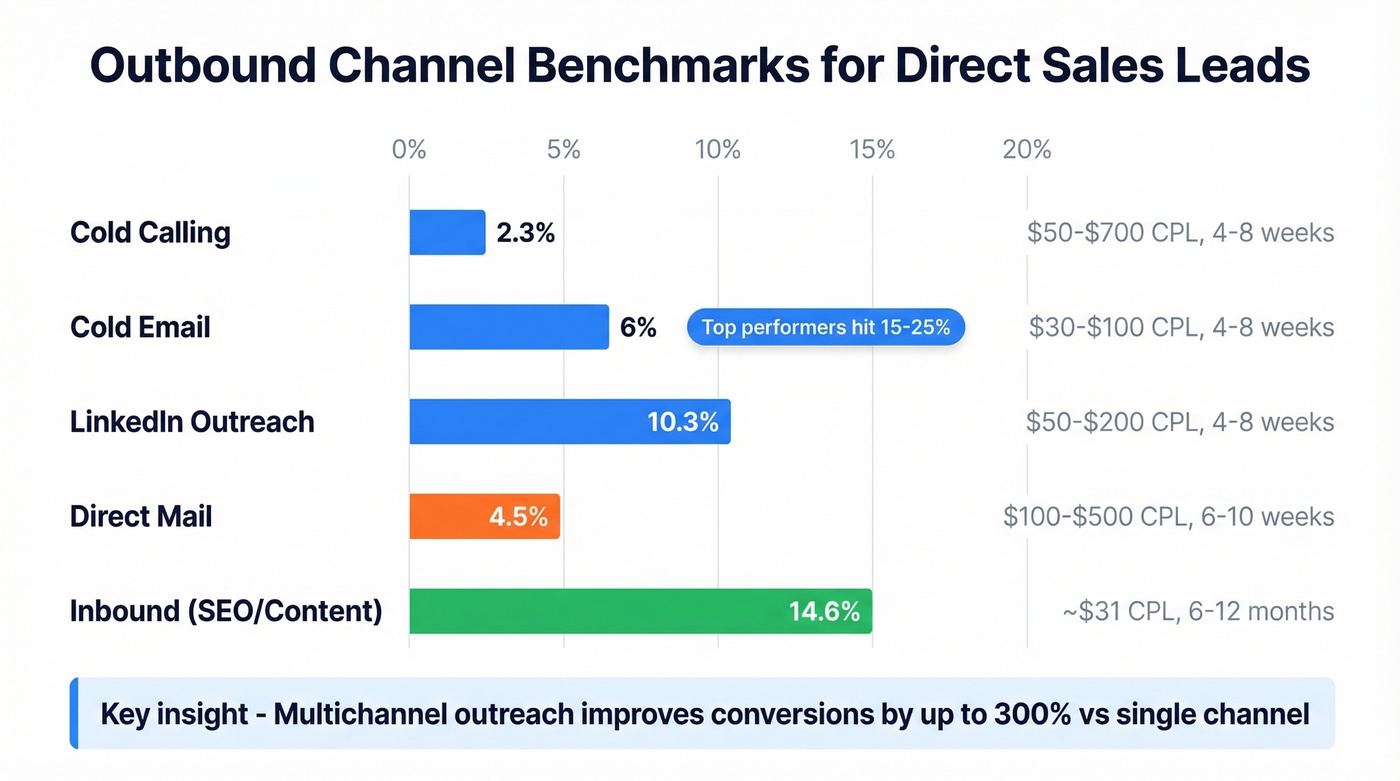
| Channel | Avg Response Rate | CPL Range | Time to Results |
|---|---|---|---|
| Cold calling | ~2.3% | $50-$700 | 4-8 weeks |
| Cold email | 5-6% (top performers: 15-25%) | $30-$100 | 4-8 weeks |
| LinkedIn outreach | ~10.3% | $50-$200 | 4-8 weeks |
| Direct mail | 4-5% | $100-$500 | 6-10 weeks |
| Inbound (SEO/content) | 14.6% conversion | ~$31 (SEO) | 6-12 months |
The standout insight: multichannel outreach improves conversion rates by up to 300% versus single-channel strategies. Running cold email alone is leaving money on the table. Layer in calls, LinkedIn touches, and direct mail for high-value accounts - the compounding effect is real, and we've seen it firsthand with outbound campaigns that stall on one channel but take off once a second or third is added.
For sourcing the contacts behind these channels, B2B data platforms range widely in cost. Prospeo runs about $0.01/lead with a free tier. Apollo starts at $49/mo per user. ZoomInfo contracts typically land in the $15,000-$35,000+/year range. Cognism sits around $1,000/user/year, and Lusha starts from $36/mo for teams with different regional coverage needs.
The Data Quality Problem
Leads go bad fast. People change jobs, phone numbers rotate, companies get acquired. The typical data refresh cycle is around six weeks - by the time you're calling, the VP you targeted might already be somewhere else.
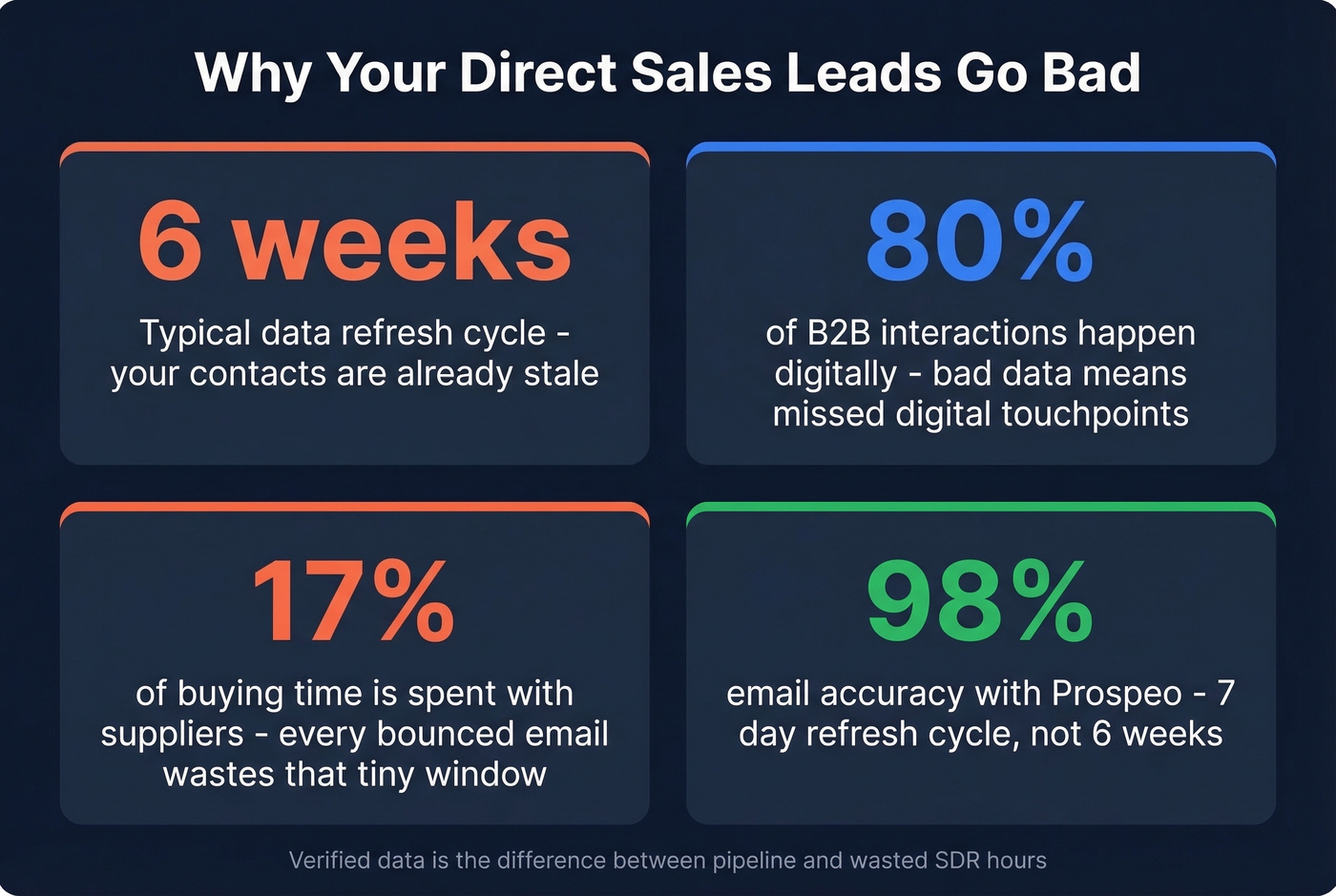
80% of B2B interactions now happen digitally, buyers use roughly 10 channels, and they spend only 17% of their buying time with suppliers. Every bounced email is a missed shot you can't afford. We've watched teams burn through entire sending domains in a single quarter because they didn't verify their data before hitting send.
Prospeo addresses this with a 7-day data refresh cycle, 98% email accuracy across 300M+ profiles, and 125M+ verified mobile numbers with a 30% pickup rate. One customer, Meritt, switched and watched their bounce rate drop from 35% to under 4% while pipeline tripled from $100K to $300K per week.

Multichannel outreach only works when every contact is real. Prospeo gives you 98% accurate emails and 125M+ verified mobile numbers with a 30% pickup rate - so your SDRs spend time selling, not chasing disconnected numbers. Starts at $0.01/lead with a free tier.
Replace dead contacts with direct dials that actually pick up.
Compliance Basics for Direct Outreach
Direct outreach carries real legal exposure. Skip this section at your own risk.
TCPA: Prior express written consent is required for telemarketing via autodialer, prerecorded voice, or ringless voicemail. Violations run $500-$1,500 each. Florida and Texas have stricter consent standards than federal law, and several states maintain their own DNC lists and calling-hour restrictions.
CAN-SPAM: Include a physical address, honor opt-outs within 10 days, and don't use deceptive subject lines.
DNC checking: Scrub every list against the National Do Not Call Registry before dialing. Every single time.
If you're buying leads from a vendor who can't provide consent documentation, you're carrying all the liability. That's not a gray area.
Qualify Before You Chase
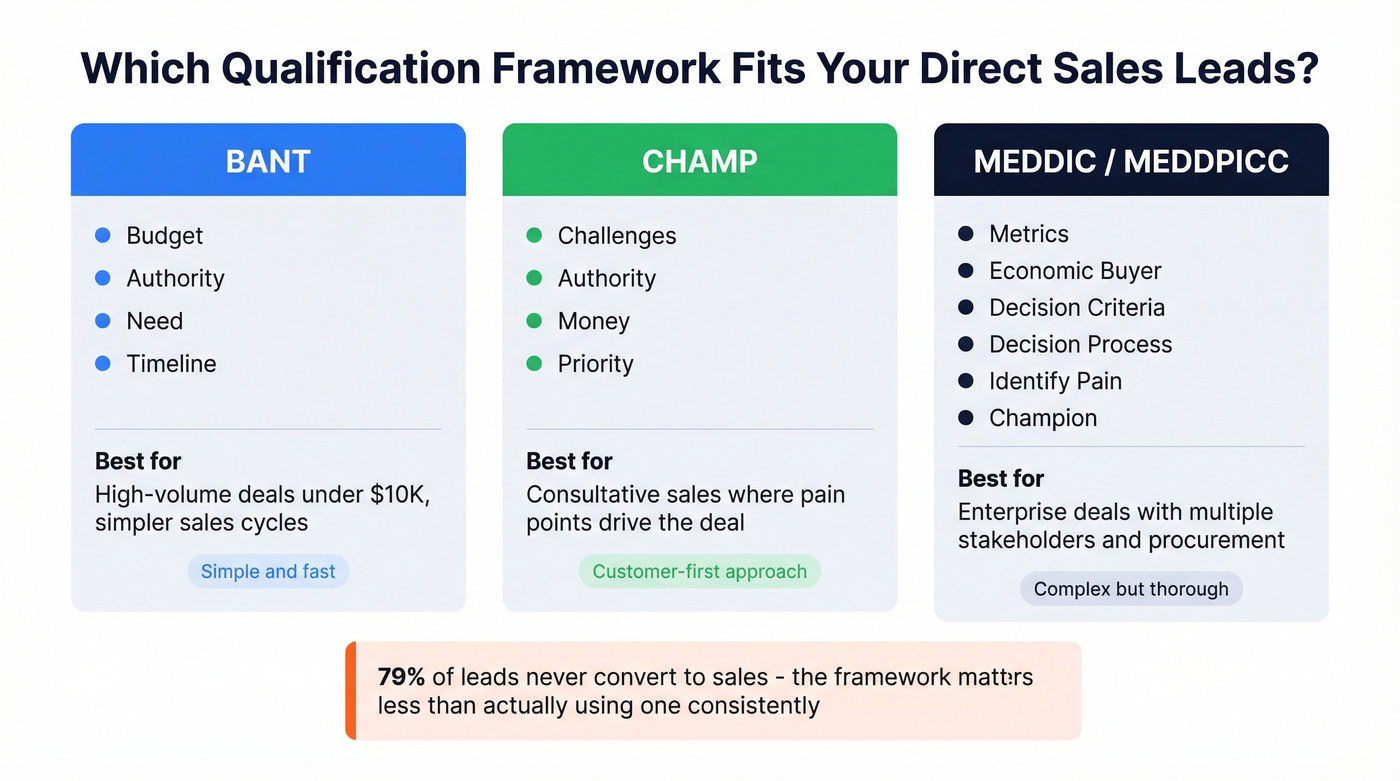
Having verified contacts is step one. Knowing which ones to prioritize is step two. 79% of leads never convert into sales, largely due to poor qualification. For context, B2B SaaS teams typically convert 39% of leads to MQLs and 38% of MQLs to SQLs - meaning only about 15% of your raw leads become sales-qualified. That math should make you very selective about where your reps spend their time.
| Framework | Best For | Key Focus |
|---|---|---|
| BANT | High-volume, simpler deals | Budget, Authority, Need, Timeline |
| CHAMP | Consultative sales | Challenges first, then Authority, Money, Priority |
| MEDDIC/MEDDPICC | Enterprise, multi-stakeholder | Metrics, Economic Buyer, Decision Process |
BANT works fine for deals under five figures. Once you're selling into enterprise with multiple decision-makers and procurement cycles, MEDDIC earns its complexity (use these MEDDIC discovery questions to keep it practical).
Look, the framework you pick matters less than actually using one consistently. Most teams don't qualify at all - they just chase whoever responds first, burn through their list, and wonder why pipeline stalls (common sales pipeline challenges show up exactly like this).
FAQ
How much do direct sales leads cost?
CPL varies by channel: SEO averages ~$31, email ~$53, outbound calls $50-$700. Self-built lists via B2B data platforms run from about $0.01 per lead up to $1+ depending on the provider and whether you need emails, mobile numbers, or intent data.
Are exclusive leads worth the premium?
Exclusive leads convert at 3-5x the rate of shared leads because you're the only team calling. Shared leads get sold to 3-10+ competitors, creating a race where the fastest caller wins regardless of fit. Pay more per lead, close more deals.
How many touchpoints convert a B2B lead?
Most B2B deals require 5-12 touchpoints across multiple channels. Up to 50% of sales go to the first vendor to respond, so speed on the initial touch matters as much as persistence over the full sequence.
What's a good free tool for building lead lists?
Prospeo's free tier includes 75 email credits and 100 Chrome extension credits per month - enough to test a targeted outbound campaign. Apollo and Lusha also offer limited free plans, though accuracy rates vary significantly between providers.