

DiscoverOrg vs Gigasheet: Apples to Spreadsheets
Here's the thing - this matchup is misleading. DiscoverOrg is a retired brand, and Gigasheet is a big-data spreadsheet tool. They solve completely different problems, and if you need B2B contact data for outbound, neither is the most direct path.
Let's sort it out.
DiscoverOrg No Longer Exists
ZoomInfo acquired DiscoverOrg in 2019 for $735M, and the DiscoverOrg brand was retired as a standalone offering. Legacy features like org charts, department-level contacts, Scoops alerts, and Bombora intent data all live inside ZoomInfo now. So the real question becomes "ZoomInfo vs Gigasheet," and that comparison still doesn't make sense - they're different categories entirely.
30-Second Verdict
ZoomInfo (formerly DiscoverOrg): A full sales intelligence platform with intent data, org charts, and direct dials - if you've got $15K+/year to spend.
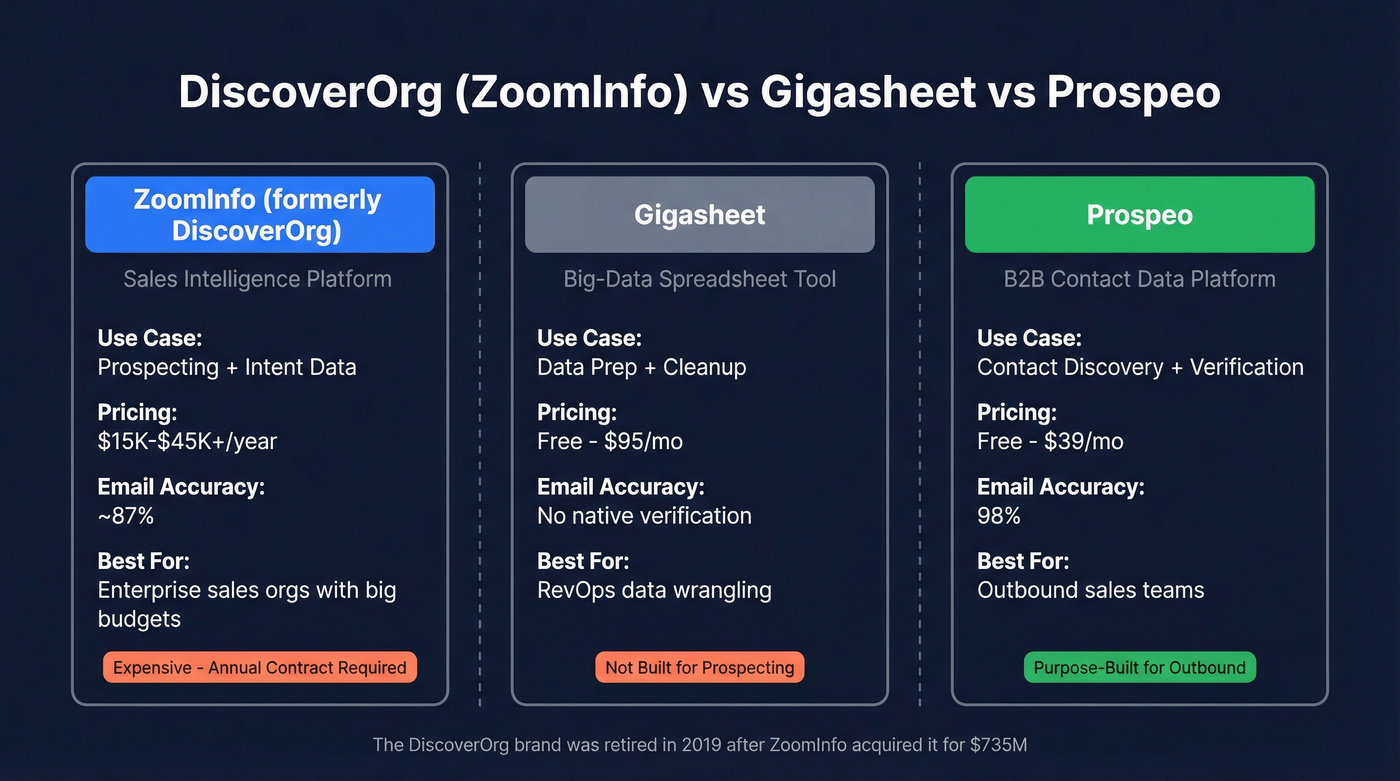
Gigasheet: A browser-based spreadsheet for cleaning, merging, or analyzing massive datasets (25M+ rows) with light enrichment add-ons.
What Each Tool Actually Does
ZoomInfo (Formerly DiscoverOrg)
ZoomInfo is an enterprise sales intelligence platform with a database of business contacts, direct dials, verified emails, org charts, technographics, and intent signals. It includes prospecting workflows and integrations with major CRMs, and it's rated in the mid-4s on G2 with thousands of reviews - the default for large sales orgs with big budgets.
The tradeoff is price. Professional typically runs $15k-$18k/year, and enterprise contracts often land in the $50k-$100k+ range. We've talked to teams who signed annual deals only to realize they were using maybe 20% of the platform's features.
Gigasheet
Gigasheet is a no-code, browser-based spreadsheet built for massive datasets - up to 25M rows per sheet on the Premium plan. RevOps teams use it to clean CRM exports, merge CSVs, deduplicate records, and standardize formats without writing code. It integrates with Salesforce, HubSpot, and Zapier.
Its G2 rating sits at 4.9/5 with 23 reviews. Reviewers consistently praise its ability to handle files that crash Excel, though some note features that were once free now require a paid plan.


DiscoverOrg is gone. Gigasheet wasn't built for prospecting. If you need verified B2B contact data, Prospeo gives you 300M+ profiles with 98% email accuracy and a 7-day refresh cycle - at roughly $0.01 per email. No $15K annual contract. No spreadsheet hacks.
Start with 75 free verified emails - no credit card required.
Side-by-Side Feature Comparison
| ZoomInfo | Gigasheet | Prospeo | |
|---|---|---|---|
| Category | Sales intelligence | Big-data spreadsheet | B2B data platform |
| Primary use | Prospecting + intent | Data prep + cleanup | Contact discovery |
| Pricing | ~$15k-$45k+/yr | Free-$95/mo | Free-$39/mo |
| Data access | Contact database | Partner enrichments | 300M+ profiles |
| Email accuracy | ~87% | No native verification | 98% |
| Enrichment | Built-in | Credits (1/row) | Built-in + API |
| Best for | Enterprise sales orgs | RevOps data wrangling | Outbound teams |
Where They Actually Overlap
The narrow overlap is B2B contact enrichment.
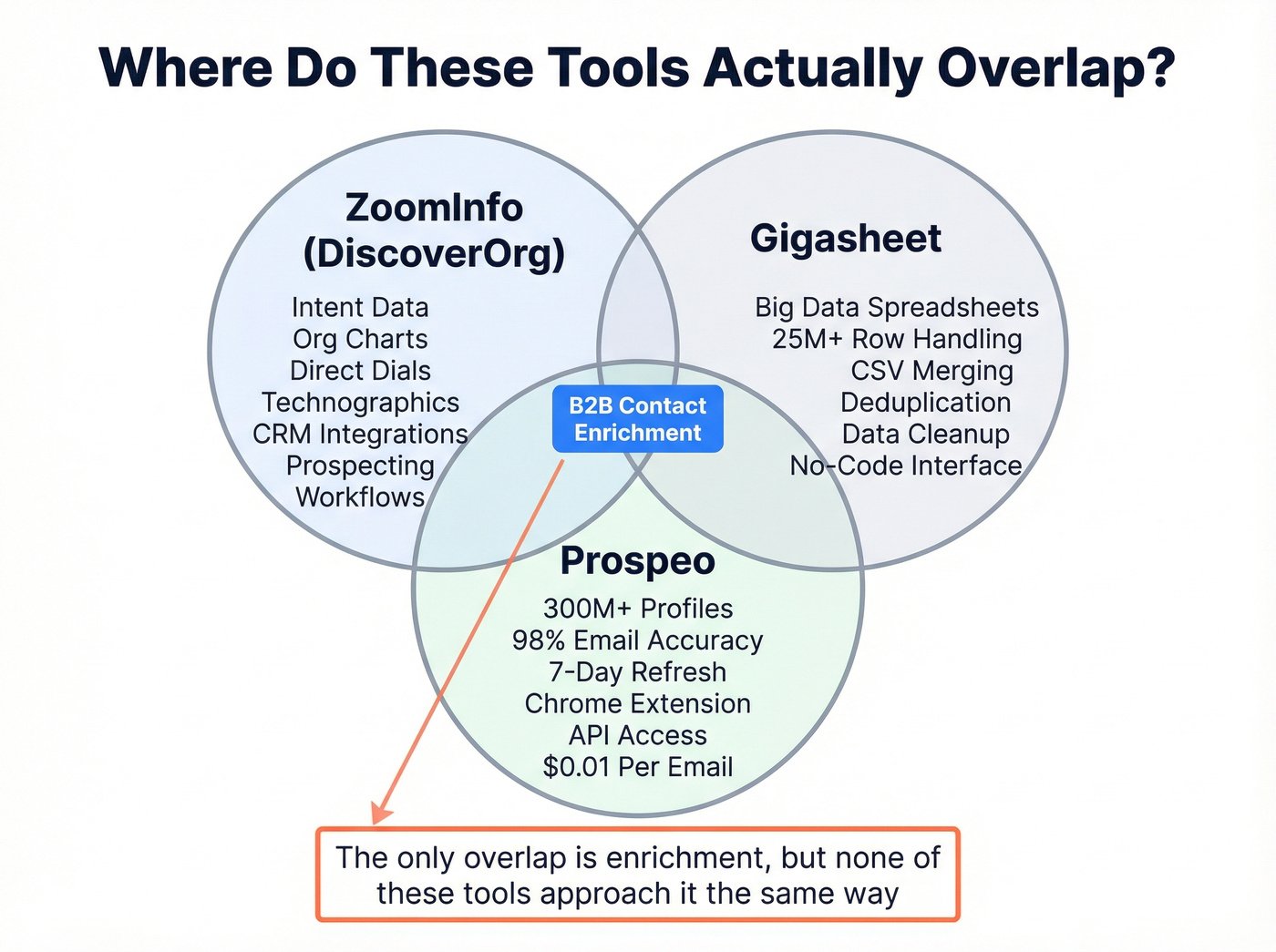
Gigasheet lets you enrich rows using credits with providers like RevenueBase, Apollo, Hunter, and People Data Labs. The official pricing page lists 100 enrichment credits/month on Premium at $95/mo, while their RevenueBase integration post shows Premium at 10,000 credits/month - the discrepancy is worth checking before you commit. On r/revops, people evaluate Gigasheet specifically as a Clay alternative for this enrichment workflow.
ZoomInfo is typically sold on annual contracts starting around $15k/year. Quote-based pricing tells you a lot about who it's built for.
Neither tool is purpose-built for finding and verifying outbound contact data at scale. Gigasheet is a spreadsheet with enrichment add-ons, and ZoomInfo is a full GTM suite where enrichment is one feature among dozens you're paying for.
The Better Option for Contact Data

In our experience, teams that switch from ZoomInfo cut their data spend by around 90% while maintaining high deliverability. One customer, Snyk, dropped their bounce rate from 35-40% to under 5% across 50 AEs - and saw AE-sourced pipeline jump 180%. The free tier includes 75 emails and 100 Chrome extension credits per month, no credit card required.
If you're optimizing for deliverability, it also helps to track your email bounce rate and follow a solid email deliverability guide before scaling volume.
Snyk's 50 AEs dropped their bounce rate from 35-40% to under 5% and grew AE-sourced pipeline 180% after switching. That's what happens when your data is verified every 7 days instead of every 6 weeks.
Stop paying enterprise prices for contact data that bounces.
Which Should You Choose?
Three scenarios, three answers.
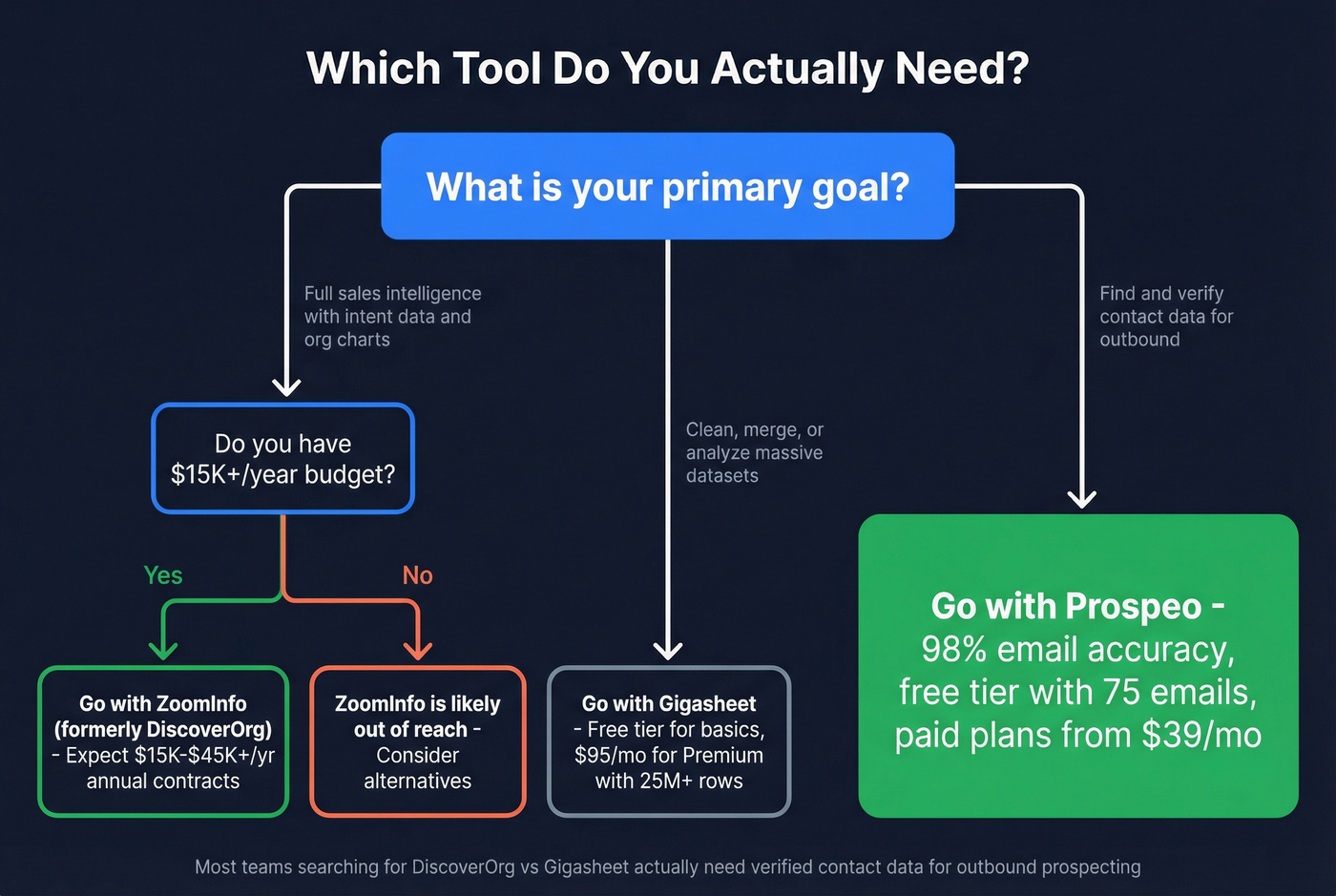
You need a full sales intelligence platform with intent data, org charts, and enterprise workflows - go with ZoomInfo, if the budget allows. Expect $15k-$45k+/year for common packages, with enterprise contracts often higher, and an annual commitment.
You need to clean, merge, or analyze massive datasets in a spreadsheet interface - Gigasheet. The free tier handles basic jobs; Premium at $95/mo unlocks serious scale.
You need verified contact data for outbound prospecting - that's where Prospeo fits. It's built for exactly this job, with higher email accuracy at a fraction of the cost. The DiscoverOrg vs Gigasheet debate becomes irrelevant once you realize neither was designed for this use case.
FAQ
Is DiscoverOrg the Same as ZoomInfo?
Yes. ZoomInfo acquired DiscoverOrg in 2019 for $735M, and the brand was retired. Legacy features like org charts, Scoops alerts, and intent data now live inside ZoomInfo's unified product suite.
Can Gigasheet Replace ZoomInfo for Prospecting?
No. Gigasheet is a big-data spreadsheet with enrichment add-ons via partners like RevenueBase and Apollo. It handles data prep well, but it won't give you prospecting workflows, intent signals, or a direct-dial database.
What's the Cheapest Way to Get Verified B2B Emails?
Prospeo offers a free tier with 75 verified emails per month and paid plans at roughly $0.01 per email - about 90% cheaper than ZoomInfo, with 98% email accuracy and a 7-day data refresh cycle. No annual contract required.