

Discovery Sales: Benchmarks, Frameworks, and the Process Top Reps Follow
The call lasted eleven minutes. The prospect answered three questions with one-word responses, said "we're all set for now," and hung up. The AE stared at the screen, wondering what went wrong. What went wrong was simple: the call felt like an interrogation, not a conversation. And when 54% of initial meetings require more than five touchpoints just to book, burning the one you get is expensive.
Discovery sales is the highest-leverage skill in B2B. It's also the one most teams train the least.
The Cheat Sheet
Before we go deep, here's the quick version:
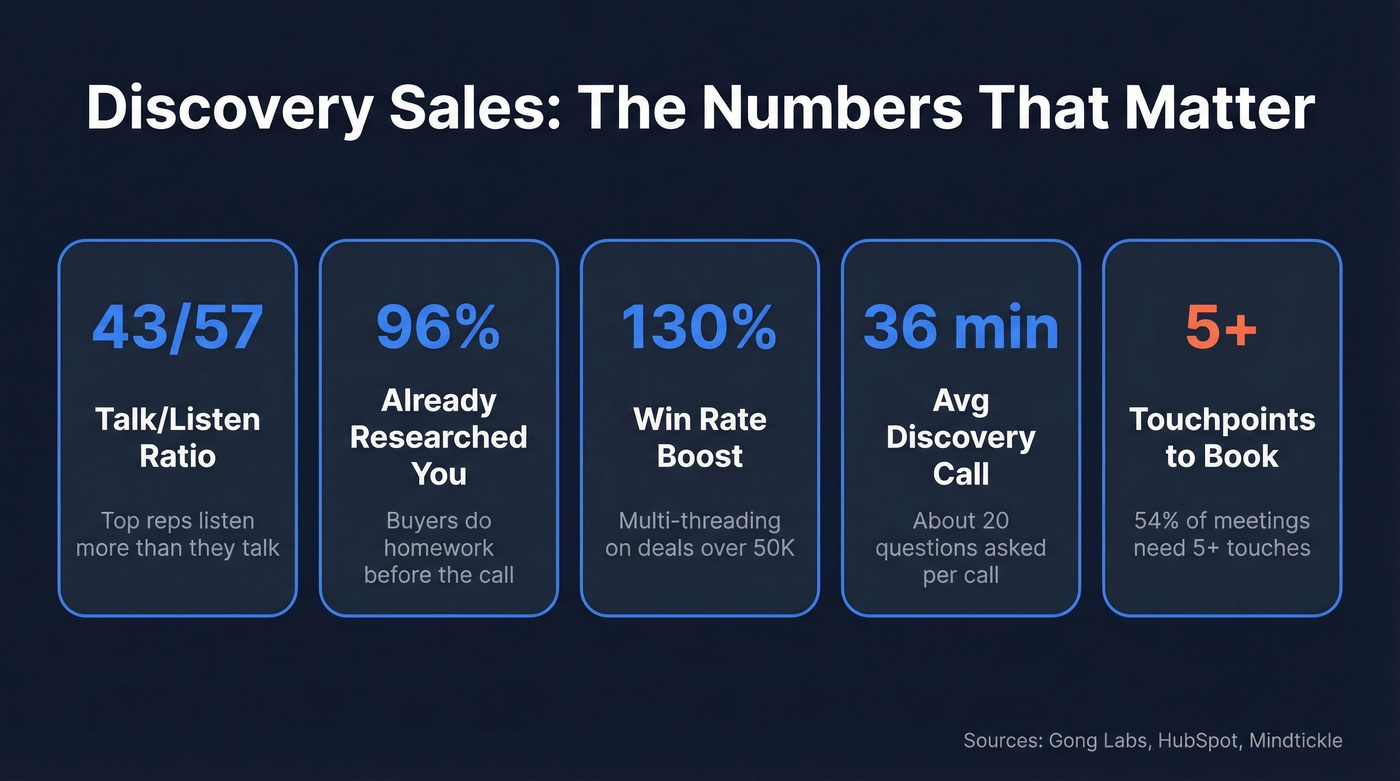
- Benchmark to aim for: A 43/57 talk-listen ratio is the historical target, but consistency matters more than the exact number. Low performers swing wildly between won and lost deals. Top performers don't.
- Framework to pick: BANT for deals under $10K with short cycles. MEDDIC for enterprise deals over $50K. SPICED for mid-market SaaS where transformation is the sale.
- The contrarian rule: Master 5 questions with deep follow-ups. Don't memorize 20 surface-level ones.
- The prep that changes everything: 10 minutes of research with verified contact data before every call. Flying blind is disrespectful to the prospect and to yourself.
- The stat that reframes discovery: 96% of buyers already researched you before the call. Show up prepared or don't show up.
What Is Discovery in Sales?
Discovery is the process of understanding a prospect's situation, pain, stakeholders, and decision process deeply enough to determine whether and how you can help. It's not a single call. Salesforce positions discovery as a constant from lead to close, and that's the right framing - complex deals require multiple sessions with different stakeholders across weeks.
The distinction from qualification matters. Qualification filters: fit or no fit, budget or no budget. Discovery understands: why now, who cares, what's broken, what happens if nothing changes. Great discovery includes qualification, but qualification alone isn't discovery. And here's a point that doesn't get enough attention: disqualifying a prospect during discovery is a win, not a failure. Every hour you don't spend on a dead deal is an hour you can spend on a real one.
There's also a behavioral distinction worth calling out. On cold calls, the talk ratio flips to roughly 55% talk / 45% listen because the goal is booking the meeting, not exploring pain. Openers matter there - asking "How've you been?" produces a 6.6x higher meeting-booking rate than jumping straight to a pitch. But a discovery call is the opposite. You're there to listen. Confusing the two is one of the most common mistakes reps make.
What the Data Says
Here are the benchmarks that separate top performers from everyone else. These aren't opinions - they're patterns from millions of analyzed opportunities and calls.
Talk-Listen Ratio
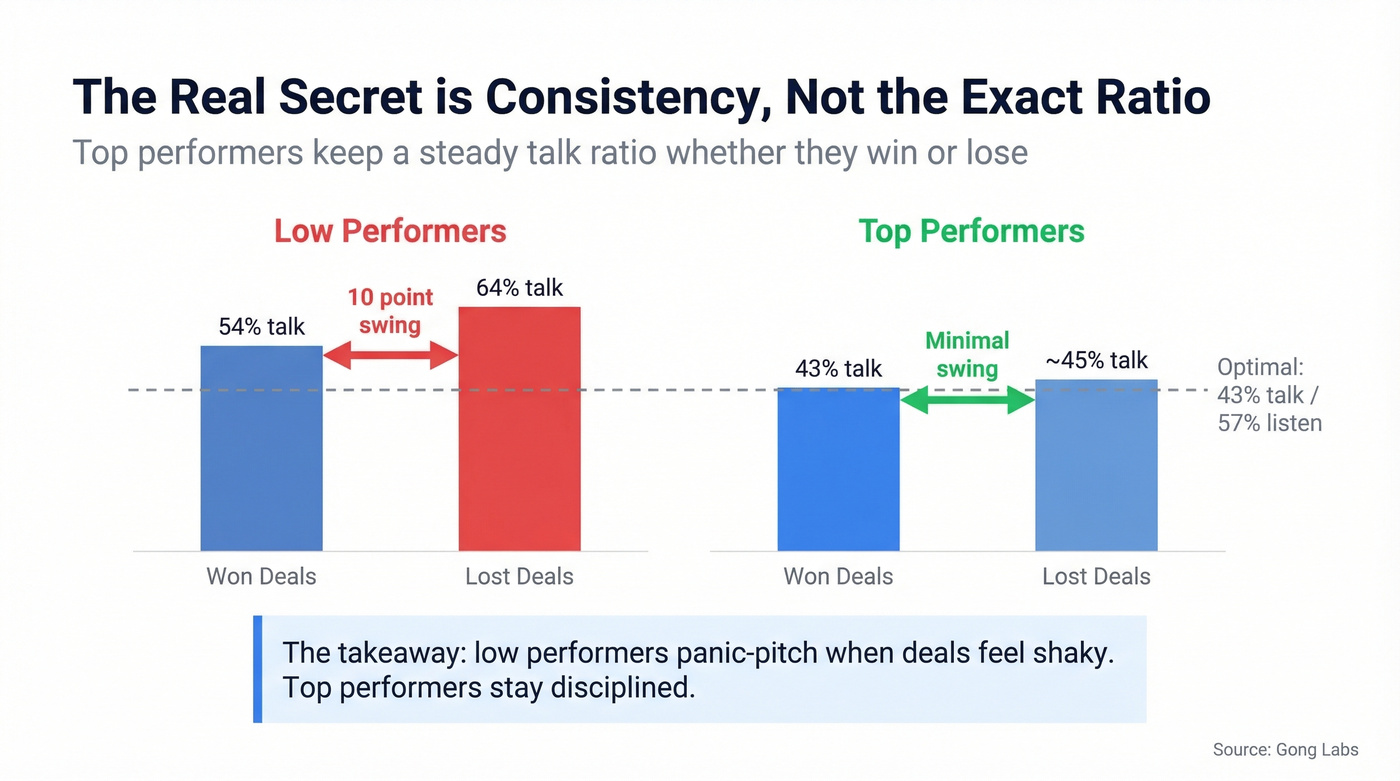
Gong Labs' historically optimal ratio is 43% talk / 57% listen. But their analysis revealed something more nuanced: the bigger separator isn't the exact ratio - it's consistency. Low performers' talk time swings by about 10 percentage points, hitting 54% on won deals but ballooning to 64% on lost deals. High performers keep a steady ratio regardless of outcome. They don't panic-pitch when a deal feels shaky.
Multi-Threading
An analysis of 1.8M opportunities found that 77% of deals involve multiple contacts, and closed-won deals have roughly 2x as many buyer contacts as closed-lost. For strategic enterprise deals, buying groups average 17 contacts. Multi-threading boosts win rates by 130% in deals over $50K.
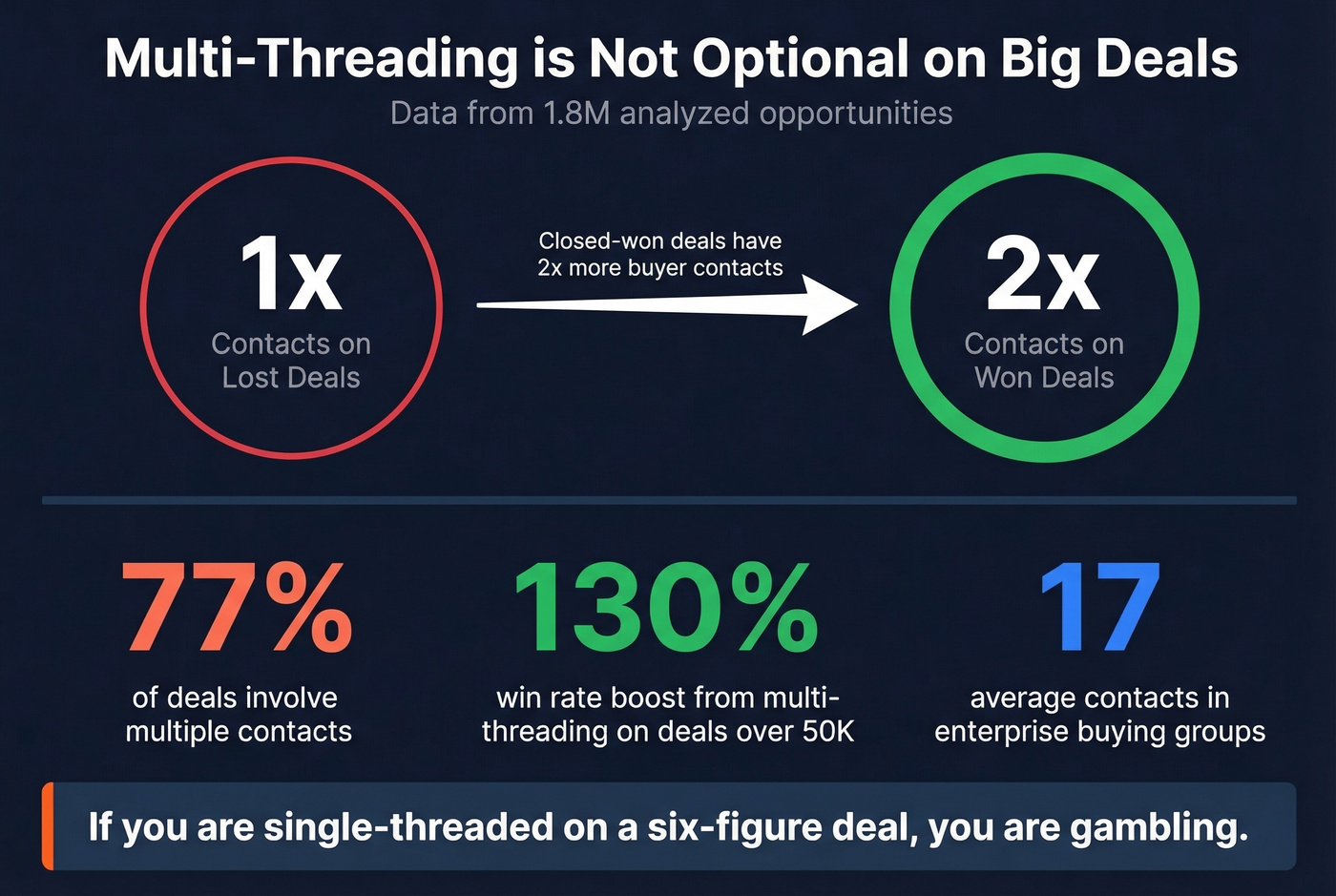
If you're single-threaded on a six-figure deal, you're gambling.
Team Selling
Selling teams on closed-won deals are 67% larger than on lost deals. Bringing in a sales engineer during enterprise deals lifts win rates by up to 30%. Discovery isn't a solo sport once deal complexity rises - 85% of business leaders believe they need more shared responsibility for customer experience, and that starts with bringing the right people into the conversation early.
The Modern Buyer
87% of business buyers expect sales reps to act as trusted advisors, not product pitchers. And 96% already researched your product before the call. Mindtickle's analysis puts the average discovery call at about 36 minutes with roughly 20 questions asked - though 15-30 minutes is more typical for mid-market deals. Question quality matters far more than quantity.
Which Framework Should You Use?
Every sales org eventually picks a framework. The right one depends on your deal complexity, cycle length, and how many stakeholders you're navigating.
BANT - Know When to Graduate
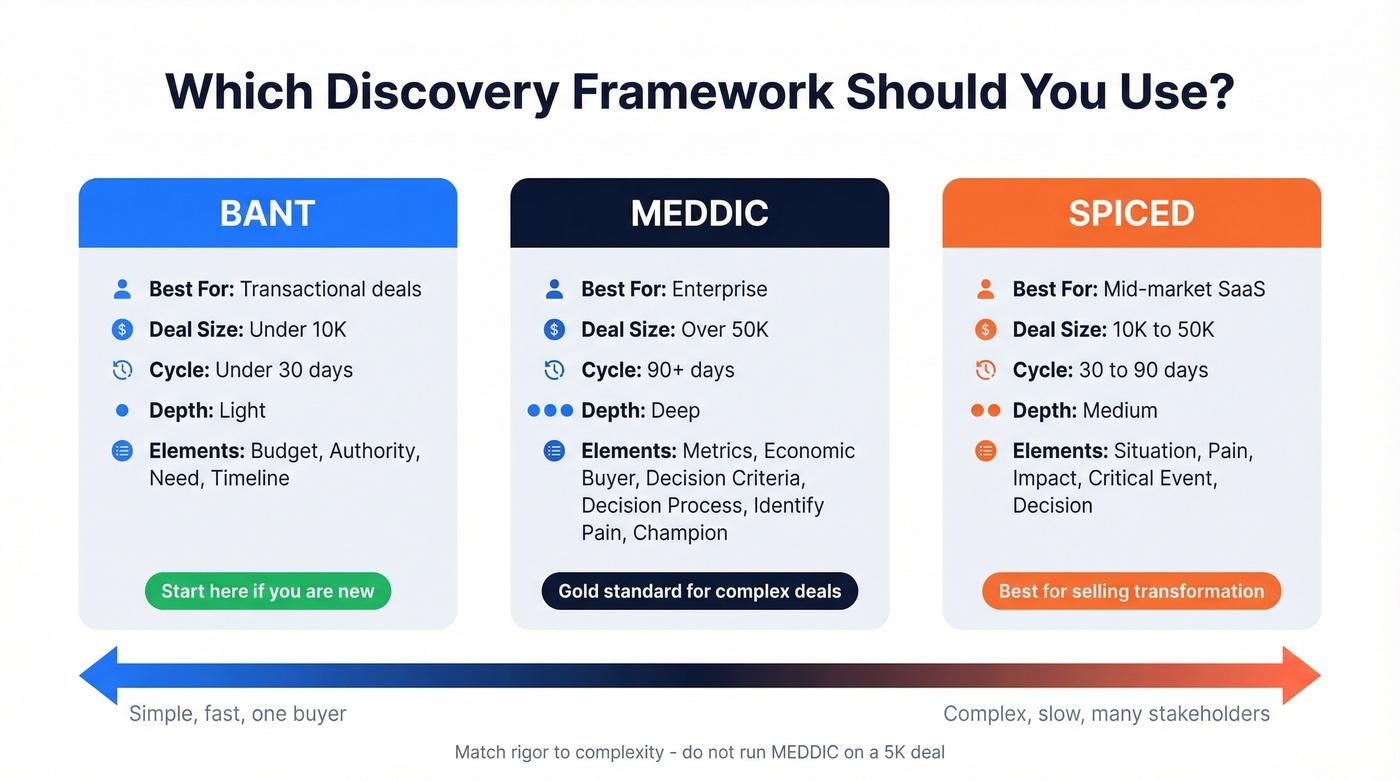
Budget, Authority, Need, Timeline. BANT is the original qualification framework, and it still works for fast-moving deals under $10K with cycles under 30 days. But here's the warning sign that you've outgrown it: you can't identify the actual approver, the timeline is "maybe this year," or the prospect keeps adding stakeholders to calls. When those signals appear, BANT is holding you back. Skip it and move to something with more structure.
MEDDIC - The Enterprise Standard
We once watched a team cut their "stalled deal" rate by nearly half just by requiring MEDDIC fields before a deal moved to Stage 3. Metrics, Economic Buyer, Decision Criteria, Decision Process, Identify Pain, Champion - the framework originated at PTC in the 1990s and remains the gold standard for enterprise software sales. The needs analysis baked into MEDDIC forces reps to quantify pain before proposing solutions.
Use MEDDIC when deals exceed $50K, cycles stretch past 90 days, and procurement has a seat at the table. Its strength is that it forces you to map the buying process, not just the pain. You can't fake MEDDIC completion - either you know who the economic buyer is and what their decision criteria look like, or you don't. There's no partial credit.
SPICED - Selling the Transformation
Most mid-market SaaS deals aren't about swapping a vendor. They're about changing how the prospect works. That's what SPICED is built for. Situation, Pain, Impact, Critical Event, Decision - it forces you to build the business case before you pitch the product.
SPICED pairs well with MEDDIC later in the cycle. Use SPICED to build the business case, then layer MEDDIC when you need to navigate approvals and procurement. For deals between $10K and $50K with 30-90 day cycles, this is the framework we'd start with.
Framework Comparison
| Framework | Best For | Deal Size | Cycle Length | Depth |
|---|---|---|---|---|
| BANT | Transactional | Under $10K | Under 30 days | Light |
| MEDDIC | Enterprise | Over $50K | 90+ days | Deep |
| SPICED | SaaS / mid-market | $10K-$50K | 30-90 days | Medium |
Salesforce also publishes a POWERFUL framework - an 8-element model covering everything from problem identification to executive influence. It's thorough but heavy. Most teams find MEDDIC or SPICED more practical to operationalize.
The real rule: match rigor to complexity. Don't run MEDDIC on a $5K deal with one buyer. Don't run BANT on a $200K enterprise opportunity with 12 stakeholders.

The article says 10 minutes of pre-call research changes everything. Prospeo gives you 50+ data points per contact - job changes, tech stack, intent signals - so you walk into every discovery call knowing exactly what to ask. 98% email accuracy means you're reaching the right people in the first place.
Stop flying blind into discovery calls. Start with verified data.
Discovery Call Questions That Work
Stop memorizing 20 questions. Master 5-7 and get insanely good at follow-ups. The 3-level depth model from Outreach is the best organizing framework we've found for structuring conversations that actually go somewhere.
Level 1 - Foundational
These questions establish context. You're building a map of how things work today.
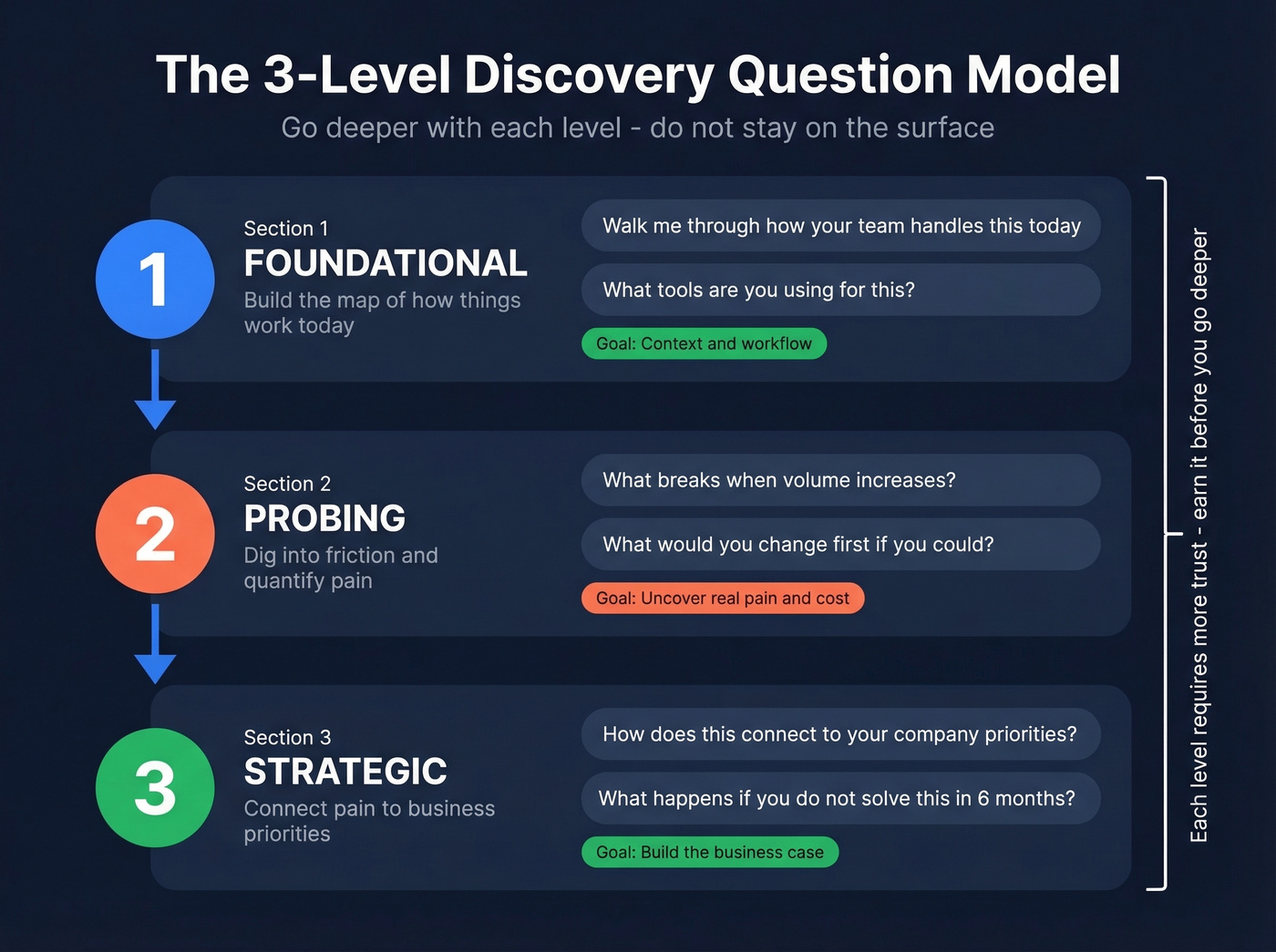
- "Walk me through how your team currently handles [process]." Open-ended, non-threatening, and it reveals workflow, tools, and team structure in one answer. Listen for workarounds - they signal pain the prospect won't articulate directly.
- "What tools are you using for this today?" Tech stack tells you about budget, sophistication, and integration requirements. If they're on a competitor, you know the switching cost conversation is coming.
- "How many people touch this process?" Headcount reveals complexity and potential multi-threading opportunities.
Level 2 - Probing
Now you're digging into friction. These questions require trust, so don't lead with them. One technique that works well: ask permission first. "I'd like to ask some direct questions about what's not working - some might be uncomfortable. Is that okay?" This signals respect and almost always gets a yes. This phase is where needs discovery separates reps who understand the buyer from those who just check boxes.
- "What breaks when volume increases?" This surfaces scaling pain that the prospect lives with daily but hasn't framed as a "problem." Follow up with: "How often does that happen?" and "What does that cost you when it does?"
- "If you could change one thing about how this works today, what would it be?" The constraint to "one thing" forces prioritization. Their answer tells you what they'll actually buy for. Then ask: "What's prevented you from fixing that so far?"
- "What's the gap between where you are and where you need to be by [quarter/year-end]?" This connects current pain to a timeline. If they can't articulate the gap, they aren't ready to buy.
Level 3 - Strategic
These questions separate AEs from SDRs. They connect individual pain to organizational priorities, and they're where most calls either become consultative or stay stuck at surface-level qualification. Quantification is the key skill here - tying every pain point to a dollar figure or measurable business outcome.
- "How does this initiative connect to [company's stated priority]?" Reference something from their earnings call, press release, or job postings. This shows you did your homework and elevates the conversation from tactical to strategic. The signal to watch for: whether your champion can articulate the connection. If they can't, they'll struggle to sell internally.
- "Who else would need to be involved in evaluating a change here?" This is your multi-threading entry point. Don't ask "who's the decision maker" - that's confrontational. Ask who else would benefit from the conversation, then propose including them in the next session.
- "What happens if you don't solve this in the next 6 months?" The cost of inaction question. If the answer is "nothing, really," you don't have a deal. If the answer involves lost revenue, compliance risk, or competitive disadvantage, you have urgency.
The 25-Minute Call Template
Here's a minute-by-minute structure. Adjust the timing for your deal complexity, but the sequence matters.
Minutes 0-2: Rapport + Agenda Setting. "Thanks for making time. My goal for the next 25 minutes is to learn about your situation, understand what's working and what isn't, and figure out whether it makes sense to keep talking. Sound good?" This sets expectations and gives the prospect permission to be honest.
Minutes 2-5: Context Questions (Level 1). Map the current state. Who's involved, what tools they use, how the process works today. Don't rush this - the context you gather here shapes every question that follows.
Minutes 5-15: Pain and Impact Deep-Dive (Level 2-3). This is the core of the call. Go deep on 2-3 pain points. Use follow-up ladders: "Tell me more about that" → "How often does that happen?" → "What does that cost you?" → "How does that connect to [broader initiative]?"
Minutes 15-20: Stakeholders + Process. Map the buying process. Who else needs to be involved? What does evaluation look like? Have they bought something like this before, and what worked or didn't? You're learning how the organization actually makes decisions, not just how the org chart says it should.
Minutes 20-25: Next Steps. Here's where most reps drop the ball. Data from 7.1M analyzed opportunities shows the fastest deals spend 53% more time discussing next steps in the first meeting compared to average deals. Never end a call without a calendar invite for the next conversation. Propose a specific date and time, not "I'll send you some times." (If you need copy, steal from these sales follow-up templates.)
Enterprise discovery often spans multiple sessions with different stakeholders. Don't try to cram everything into one call.
Five Mistakes That Kill Deals
Sales leaders preach "do better discovery" but never give their team a scorecard. Here are the five mistakes we see most often, each paired with the data that explains why it matters.
1. Talking too much. Low performers hit 64% talk time on lost deals. They panic, they over-explain, they fill silence with features. The fix isn't "talk less" - it's to record yourself and aim for consistency. If your talk ratio swings 10+ points between calls, you're reacting instead of running a process.
2. Skipping pre-call research. 96% of buyers already researched you. Showing up without knowing their company's recent funding round, tech stack, or org structure isn't just lazy - it's disrespectful. The fix: a 10-minute pre-call ritual covering company news, recent hires, tech stack, and org chart. You can't research a prospect if you can't find their verified contact info, which is why data enrichment matters before discovery even starts.
3. Getting technical too early. A CFO disengages in 30 seconds when you start talking about API endpoints. Lead with business outcomes, risk, and financial impact. Save the technical deep-dive for practitioners in a separate session. Ask yourself "would a non-technical executive care about this?" before every statement in the first call.
4. Failing to multi-thread. Won deals have 2x the buyer contacts of lost deals. Single-threading a complex deal is the most predictable way to lose it - your one contact goes on vacation, changes roles, or loses internal influence, and your deal dies. Always ask "who else would benefit from this conversation?" and propose a broader session.
5. No clear next steps. The fastest deals spend 53% more time on next steps. Yet most reps end calls with "I'll follow up with some info" - which is code for "this deal is going to stall." Never end a discovery call without a calendar invite. "Based on what we discussed, a 30-minute demo with your team lead would be the right next step. Does Thursday at 2 work?" (Use this product demo checklist to keep it tight.)
Pre-Call Prep: 10 Minutes That Change Everything
The best discovery call in the world doesn't matter if you can't reach the right person. And even when you do, showing up unprepared wastes the meeting you spent five touchpoints earning.
Here's the thing: if your average deal is under $10K, you don't need a 45-minute research deep-dive. But you absolutely need 10 minutes of verified data. The ROI on those 10 minutes is absurd compared to winging it.
The pre-call checklist covers four areas. First, company context - recent funding, earnings, press releases, new hires in the target department. This takes 3 minutes and gives you Level 3 question ammunition. Second, tech stack - what tools are they running? This tells you about budget, sophistication, and potential integration requirements. Third, org chart - who reports to your contact, who do they report to, and who else might be involved in a buying decision. Fourth, contact verification - confirm you have a working email and direct dial. A bounced follow-up email after a great discovery conversation kills momentum instantly. (If you're troubleshooting deliverability, start with email bounce rate benchmarks and fixes.)
This is where data quality becomes a pipeline issue, not just a data issue. When Snyk rolled out Prospeo to 50 AEs, their bounce rate dropped from 35-40% to under 5%, and AE-sourced pipeline jumped 180% with 200+ new opportunities per month. That's what happens when reps stop flying blind.

Multi-threading boosts win rates by 130% on deals over $50K. But you can't multi-thread if you don't have verified contact data for every stakeholder. Prospeo's 30+ filters let you map entire buying committees - by department, seniority, and intent - at $0.01 per email.
Find every stakeholder before your competitor finds one.
Tools That Make Discovery Easier
You need two things to run great discovery: accurate contact data so you can actually reach and research the right people, and conversation intelligence so you can coach on what happens during the call. Everything else is nice to have.
Conversation intelligence. Gong is the enterprise standard and typically lands around $100-200/user/month depending on package and volume. Their analysis of 7.1M opportunities found that sellers who frequently use AI generate 77% more revenue than those who don't. Chorus is often sold alongside ZoomInfo packages, and enterprise contracts for data plus conversation tooling commonly run $15K-$40K+/year depending on seats and modules. Both tools let you review calls, track talk-listen ratios, and coach reps on specific moments.
Sales enablement and coaching. Mindtickle and Highspot help standardize discovery processes across teams and are typically sold on annual contracts with pricing that scales by seats and modules. For teams where the problem is inconsistency - some reps run great discovery, others wing it - these tools create the repeatable framework you need. (If you're building a repeatable system, borrow from these sales training tips.)
Let's be honest: most teams overthink the tool stack. Get your contact data right, record your calls, and review them weekly. That covers 80% of the improvement opportunity. (For more on building pipeline consistently, use these sales prospecting techniques.)
FAQ
What is a sales discovery call?
A sales discovery call is a structured conversation where a rep explores the prospect's situation, pain points, stakeholders, and decision process to determine fit and build a business case. It's not a pitch - it's a diagnostic session that sets the foundation for every subsequent interaction in the deal.
How long should a discovery call last?
Plan for 15-30 minutes on mid-market deals, with 20-25 minutes as the sweet spot. Enterprise discovery spans multiple sessions across weeks - don't compress a complex buying process into one call.
What's the difference between discovery and qualification?
Qualification filters prospects into fit or no-fit buckets using criteria like budget and authority. Discovery maps the full picture: pain, context, stakeholders, decision process, and urgency. Use BANT for quick qualification on smaller deals; layer MEDDIC or SPICED when you need true depth.
How many questions should I ask?
Master 5-7 core questions and go 2-3 levels deep on each answer. Average calls include around 20 questions, but a 10-question call with great follow-ups beats a 20-question interrogation every time.
What tools help with discovery prep?
A contact data platform like Prospeo for verified emails, direct dials, and company intel before the call - its 98% email accuracy and 7-day refresh cycle mean you're never working with stale data. Pair that with a conversation intelligence tool like Gong to review past calls and coach on specific moments.