

Domain Email Search: How It Actually Works (And Which Tools Get It Right)
You paste a domain into an email finder, hit search, get back 40 "verified" contacts, load them into your sequencer - and 20% bounce on the first send. Your domain reputation tanks. Deliverability craters. You're back to square one.
The gap between what domain email search tools promise and what they deliver is where most outbound budgets go to die. We've spent real time testing these tools, measuring actual bounce rates, and comparing results across thousands of contacts. Here's how domain email search really works, which tools get accuracy right, and a framework for picking one without burning through a month of free trials.
Our Picks (TL;DR)
- Prospeo - Best for accuracy and bulk domain search. 98% email accuracy, 7-day data refresh, native bulk domain search. Free tier: 75 emails/month.
- Hunter - Best as a verification layer. Smaller database, but the verification engine is reliable and the free tier is generous enough to evaluate.
- Snov.io - Strong for international leads on a budget. Decent coverage outside the US and built-in email automation if you want prospecting and sequencing in one platform.
What Is Domain Email Search?
Domain email search finds professional email addresses associated with a specific company domain. You input "acme.com" and the tool returns contacts - ideally with names, titles, and verified email addresses.
It's different from name-based lookup, where you search "Jane Smith at Acme," and different from scraping professional profiles. A domain-level search operates at the company level: give me everyone reachable at this domain, filtered by role or department. The email finder tools market is projected to hit $5.6B by 2032, growing at roughly 10-15% CAGR. Tools now combine pattern prediction with email verification, but the core accuracy problem hasn't gone away.
How the Search Pipeline Works
Most tools follow a similar pipeline, even if they describe it differently.
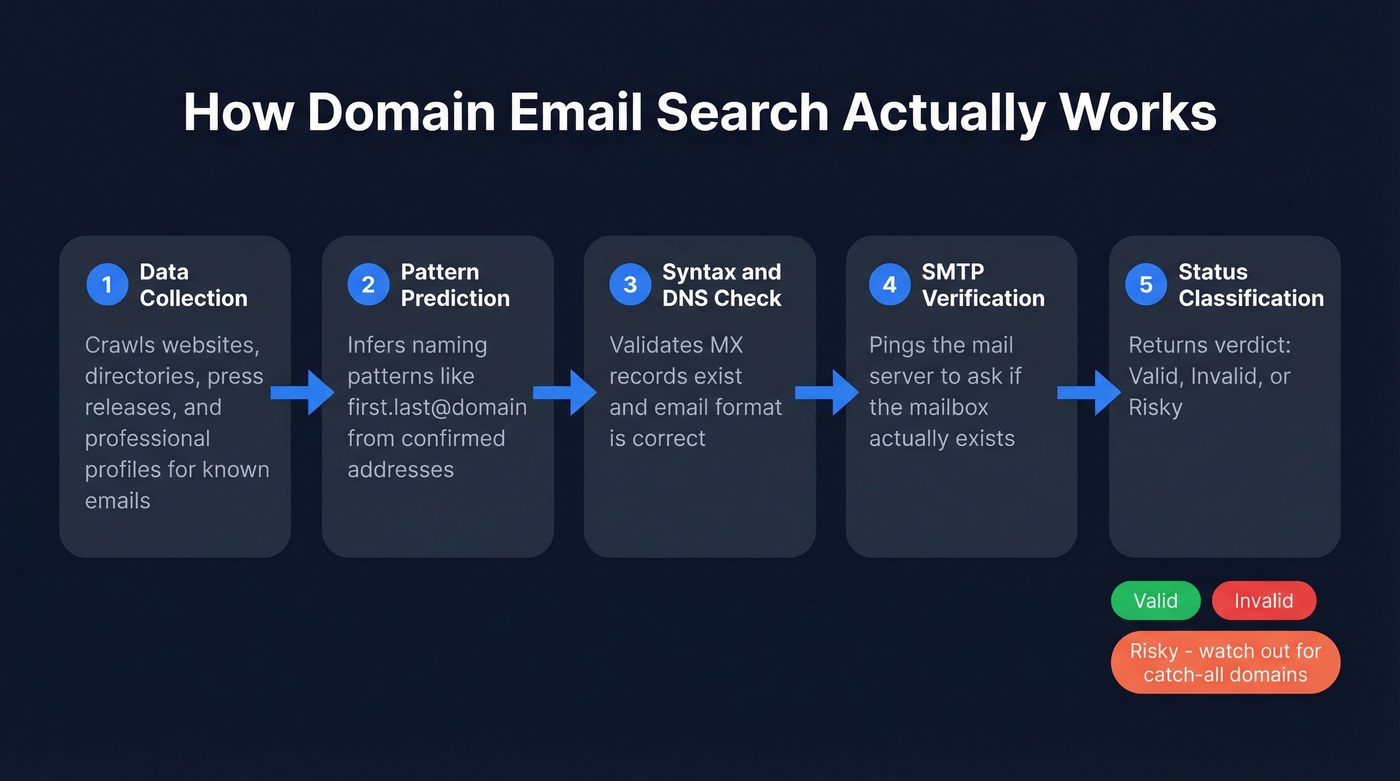
1. Data collection. The tool crawls public sources - company websites, directories, press releases, professional profiles - to build a baseline of known email addresses at a domain. Some tools also purchase data from third-party providers.
2. Pattern prediction. Once a tool has a few confirmed addresses at a domain, like john.smith@acme.com and jane.doe@acme.com, it infers the pattern (first.last@domain) and generates candidate addresses for other contacts.
3. Domain and syntax validation. The tool checks that the domain has valid MX records, confirming it can receive email, and that the generated address follows proper syntax. This catches obvious errors but doesn't confirm the address actually exists.
4. SMTP verification. This is the critical step. The tool pings the mail server and asks, essentially, "Does this mailbox exist?" without actually sending an email. A valid response means the address is likely real. An invalid response means it bounces.
5. Status classification. The tool returns a verdict: valid, invalid, or risky. That "risky" category is where most accuracy problems hide.
Here's the thing: "verified" doesn't always mean deliverable. Catch-all domains accept every email address sent to them, so SMTP verification returns "valid" for addresses that don't actually have a mailbox behind them. A tool that doesn't flag catch-all domains will show inflated accuracy numbers - and your bounce rate will tell the real story.
The Accuracy Problem Nobody Talks About
Most email finder tools market accuracy in the mid-to-high 90s. The reality is far less impressive.
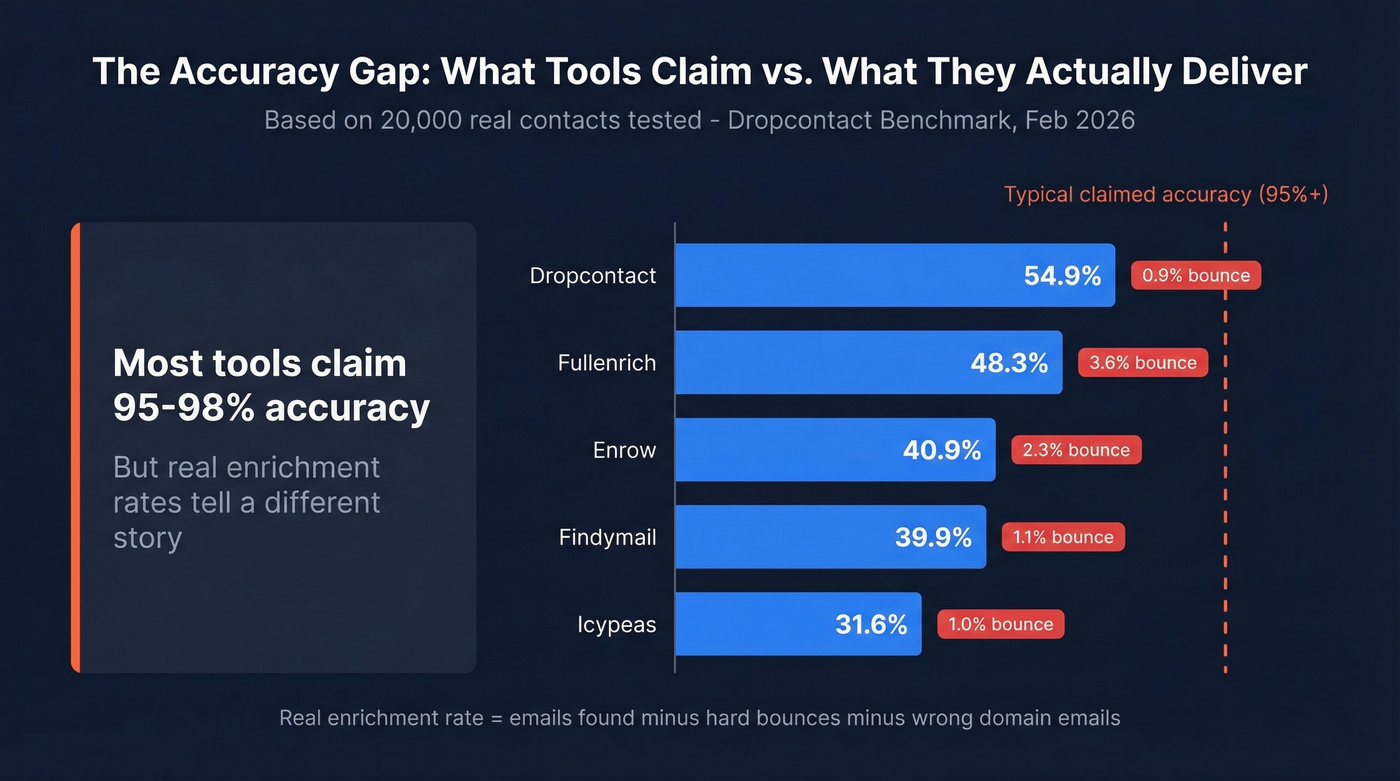
A benchmark by Dropcontact (February 2026) tested 15 tools against 20,000 real contacts - 9,800 US, 9,700 European, and 500 from the rest of the world - and measured "real enrichment rate": emails found, minus hard bounces, minus emails sent to the wrong domain entirely.
| Tool | Real Enrichment Rate | Hard Bounce Rate | Wrong Domain Rate |
|---|---|---|---|
| Dropcontact | 54.9% | 0.9% | 1.0% |
| Fullenrich | 48.3% | 3.6% | 11.7% |
| Enrow | 40.9% | 2.3% | 5.8% |
| Findymail | 39.9% | 1.1% | 5.2% |
| Icypeas | 31.6% | 1.0% | 5.8% |
Real enrichment rates of 30-55% vs. claimed 95-98%. That's not a rounding error - it's a different universe. Dropcontact topped their own test, so take the rankings with that context, but the methodology - actually sending emails and measuring bounces - is more rigorous than most vendor claims.

A common complaint on r/coldemail is "verified" emails still bouncing at 20%+. Data freshness compounds the problem. Contacts change jobs, companies restructure, and tools that refresh data every six weeks serve you stale addresses that were valid three months ago. If you want to benchmark your own list quality, start with bounce rate and work backward.

That gap between claimed accuracy and real enrichment rates? Prospeo closes it. Our proprietary email-finding infrastructure - not third-party data - plus catch-all detection and a 7-day refresh cycle delivers 98% email accuracy across 300M+ profiles.
Search any domain and get contacts that actually deliver - starting at $0.01/email.
Best Tools for Finding Emails by Domain
Prospeo
Prospeo's domain search pulls from 300M+ professional profiles and returns contacts with 98% email accuracy. The platform runs its own email-finding infrastructure rather than relying on third-party email providers, which gives it more control over verification quality.
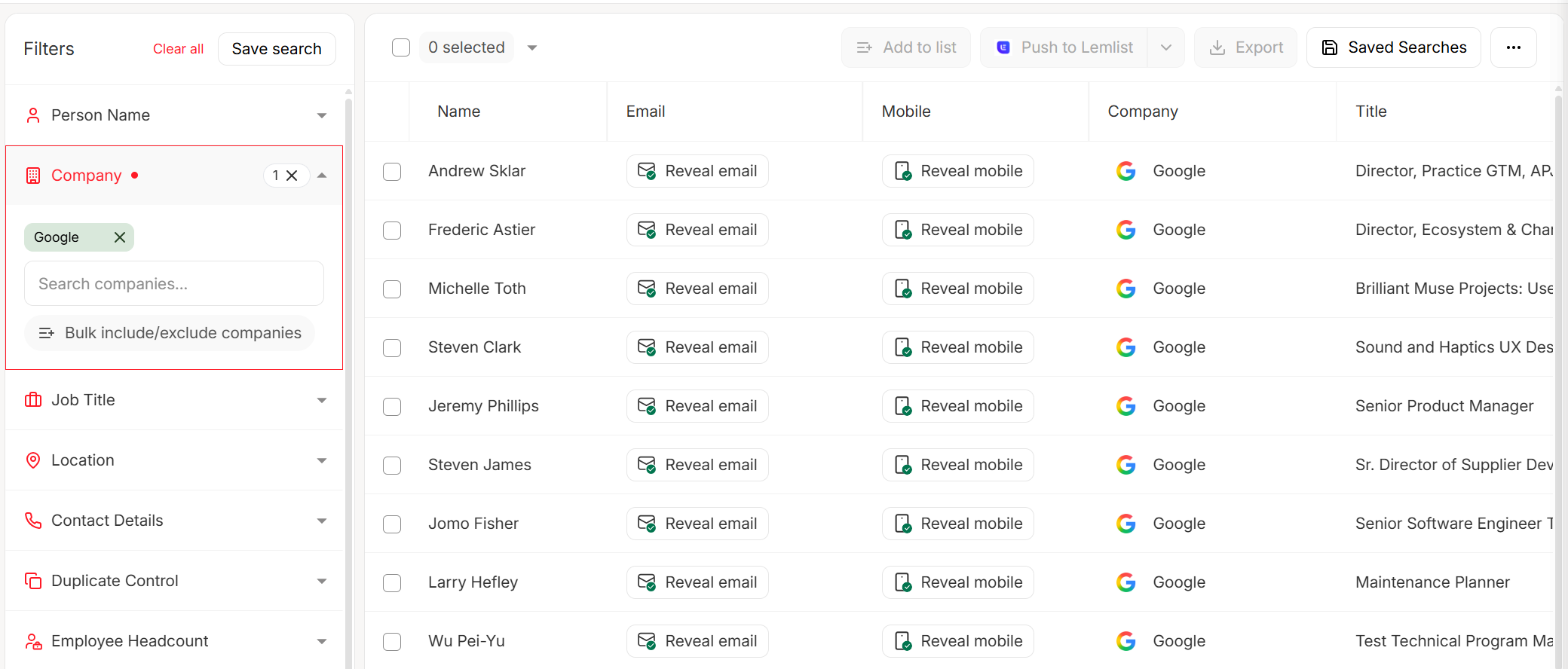
The free tier gives you 75 emails per month - enough to run a real test. Paid plans work on credits at roughly $0.01 per email, making it about 90% cheaper than ZoomInfo at scale. Bulk domain search is native, not bolted on, so you can upload a list of domains and get verified contacts back with email type and verification status in one workflow. The 7-day refresh cycle means you're not sending to someone who left the company two months ago. For agencies where domain reputation is everything, that freshness matters more than database size.
Hunter
Hunter is the tool most people think of first when they hear "email finder," and that brand recognition isn't accidental - they've been around since 2015 and the UX is clean.

The free tier includes 50 credits per month. Starter runs $49/mo for 500 credits, or $34/mo billed annually. The verification engine is genuinely good - practitioners consistently call out Hunter's solid verification accuracy. But the database is smaller than competitors, and multiple practitioners describe it as better suited as a verification layer than a primary contact source. If you're comparing options, see our breakdown of Hunter alternatives.
Use this if: You need reliable verification to complement another data source, or you're doing low-volume, high-precision outreach.
Skip this if: You need to discover decision-makers at scale without already knowing their names.
Snov.io
Snov.io hits a sweet spot for teams that need international coverage without enterprise pricing. The Starter plan runs $29.25/mo billed annually with 1,000 credits. The Pro tier at $74.25/mo includes 5,000 credits plus more automation features.
The database covers markets outside the US well for this price range. Reddit users on r/agency flag Snov.io as "good for international leads" with "affordable credits." It also bundles email automation, so if you want prospecting and sequencing in one platform, you can skip buying a separate tool.
Accuracy isn't best-in-class, though. We've seen Snov.io return more "risky" results on catch-all domains than tools with more aggressive verification. For US-only outbound, you'll find better options. For a team prospecting across EMEA, LATAM, and APAC on a budget, it's worth testing.
GetProspect
GetProspect offers a generous free tier - 50 valid emails and 100 verifications - and scales cleanly. Starter at $49/mo includes 1,000 valid emails; Growth at $99/mo jumps to 5,000. The standout feature is CSV uploads up to 50,000 rows for bulk enrichment. If you're running large domain lists through a tool, GetProspect handles the volume without choking. Verification accuracy is decent but not exceptional - a mid-tier option that punches above its weight on bulk workflows.
Anymail Finder
Anymail Finder only charges for valid (verified) emails, which sounds great until you realize the credit math gets weird. Pricing starts at $9/mo annually for 600 credits/year - low volume. Standard at $32/mo gets you 12,000 credits/year. Works well for one-off lookups and small batches. Best for freelancers or solo SDRs who want to pay only for results.
RocketReach
RocketReach earned a specific callout on Reddit: one user called it "most accurate so far" after testing multiple tools, reporting their bounce rate "dropped a lot." The database is solid for US contacts and the interface is straightforward. Pricing typically starts around $49/mo for individual plans and increases for teams.
Tomba
Tomba is a lightweight domain search tool with a free tier of 25 searches/month. Paid plans start at $441/year (about $37/mo). Fine for occasional lookups, but the database and verification depth don't compete with top-tier options.
Apollo
Apollo's database covers 250M+ contacts and it has a free tier. But Reddit threads consistently flag stale data - as one user put it, "biggest database but contacts feel out of date." Better as a prospecting platform than a dedicated email-by-domain lookup tool. If you're building a broader stack, compare it against other sales prospecting databases.
Comparison Table
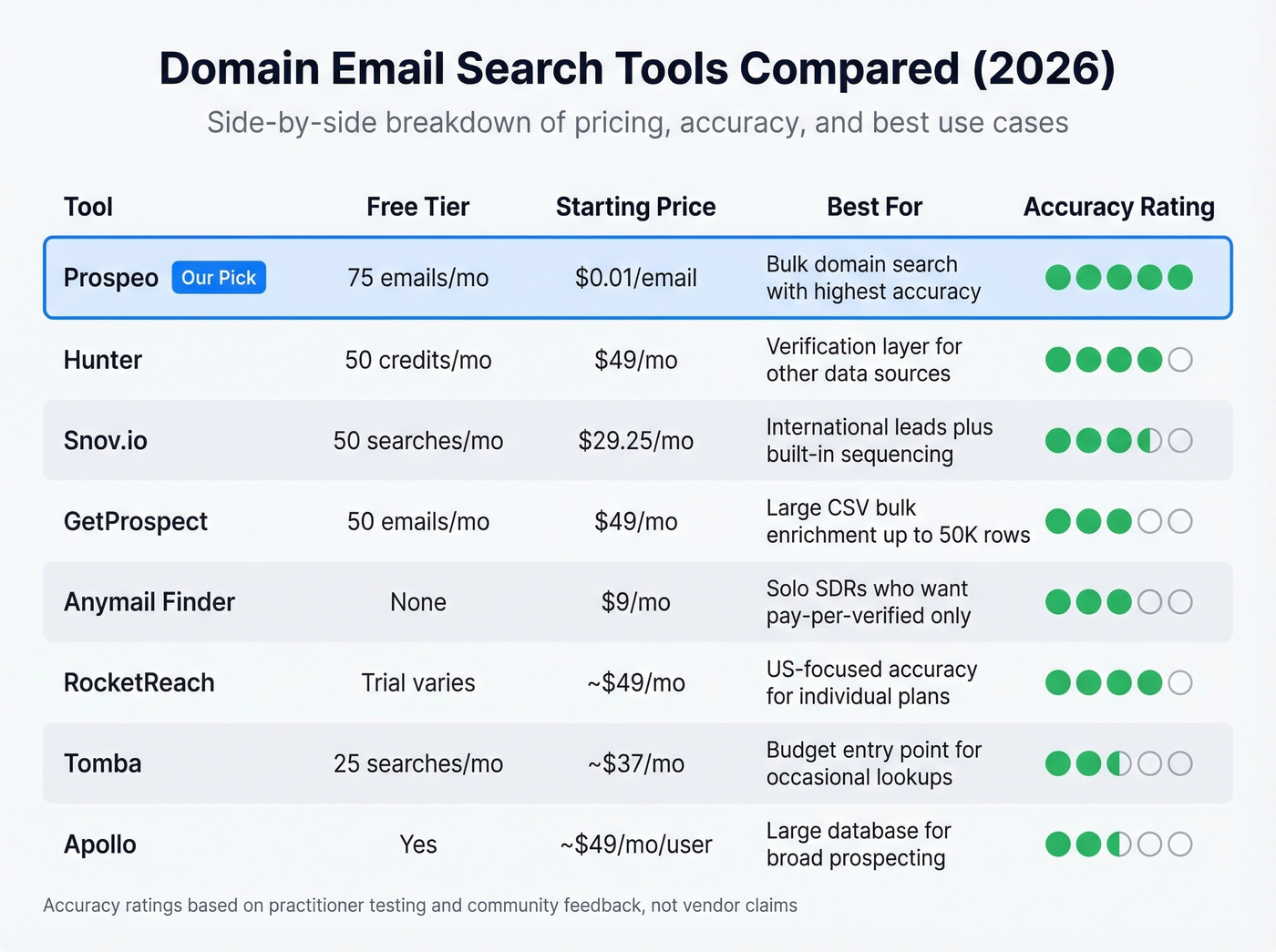
| Tool | Free Tier | Starting Price | Bulk Domain | Key Strength |
|---|---|---|---|---|
| Hunter | 50 credits/mo | $49/mo (500 credits) | Yes | Verification engine |
| Snov.io | 50 searches/mo | $29.25/mo (1K credits) | Yes (20K domains) | International + automation |
| GetProspect | 50 emails/mo | $49/mo (1K emails) | Yes (50K CSV) | Bulk volume |
| Anymail Finder | No | $9/mo (600/yr) | Limited | Pay-per-verified model |
| RocketReach | Trial varies | ~$49/mo | Yes | US accuracy |
| Tomba | 25 searches/mo | ~$37/mo (yearly) | Yes | Budget entry point |
| Apollo | Yes | ~$49/mo/user | Limited | Database size |
Bulk domain search shouldn't mean bulk bounces. Upload your entire domain list and get back verified contacts with email type, role, and verification status in one workflow. 75 free emails/month, no sales call required.
Run your first domain search in 30 seconds - zero credit card, zero bounces.
Bulk Domain Email Search
Here's the scenario that breaks most tools: you've got 4,000 target domains from a conference attendee list, an ICP filter, or a competitor's customer page. You need decision-maker emails by Friday. That's not a "search one domain at a time" workflow - it's a bulk operation, and surprisingly few tools handle it well.
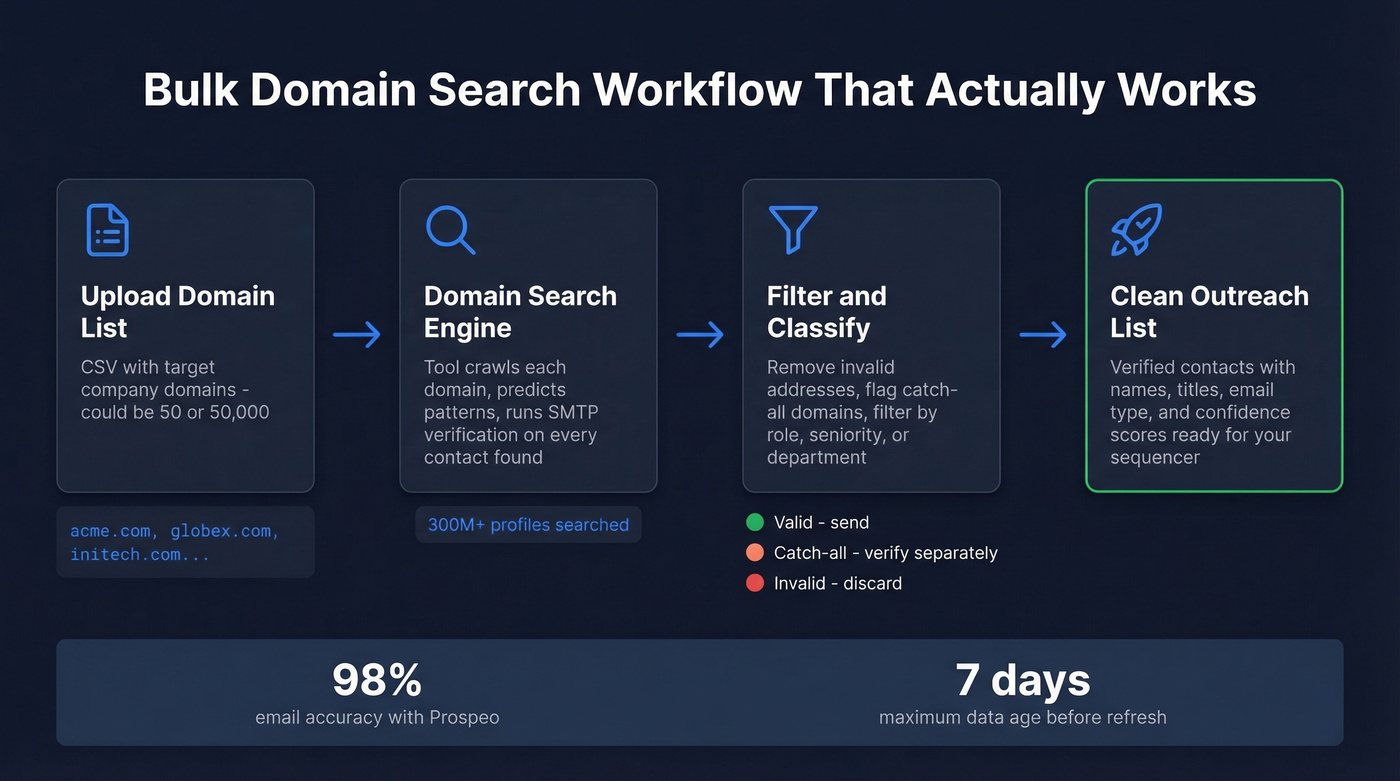
Apollo's CSV enrichment doesn't natively support a clean "domain list in, contacts out" workflow, which frustrates users who have domains but not names. Snov.io handles up to 20,000 domains in a bulk search. GetProspect supports CSV uploads up to 50,000 rows.
Before you run any bulk job, check these boxes:
- Catch-all flagging - does the tool tell you which domains are catch-all?
- Export format - can you get results as CSV with verification status per contact?
- Rate limits - some tools throttle bulk searches on lower-tier plans
- Deduplication - will you get the same contact twice from different searches?
How to Choose the Right Tool
The right tool depends on three things: your volume, your geography, and your bounce tolerance.
| If you need... | Consider... |
|---|---|
| <500 lookups/month, US-focused | Hunter free tier or Anymail Finder |
| Bulk domain search (1,000+ domains) | Snov.io or GetProspect |
| International leads (EMEA, APAC) | Snov.io or Cognism (~$1,000-3,000/mo) |
| Agency running 500-1,000 emails/day | Prospeo + dedicated sending tool |
| Enterprise with compliance needs | Cognism (typically five-figure annual contracts) |
Let's be honest about something: if your average deal size is under $10k, you probably don't need a tool with 250M+ contacts. You need a tool with 50M contacts that are actually current. The biggest database rarely wins on deliverability - we've seen this pattern repeatedly in bake-offs. A tool refreshing data weekly will outperform one refreshing quarterly, every time, regardless of database size. If you're scaling sends, pair your finder with an email deliverability guide and keep a close eye on email velocity.
Instantly's Lead Finder is worth mentioning here too. It uses waterfall enrichment and claims 450M+ contacts, but it's best evaluated as part of the Instantly cold email platform rather than a standalone domain search tool.
Don't pick a tool based on the comparison table alone. Take 30 minutes, run 50 of your actual target contacts through two or three free tiers, and measure which one returns the most valid, deliverable addresses. That test is worth more than any benchmark.
GDPR and Compliance
Using domain email search for B2B outreach is legal in most jurisdictions, but GDPR has teeth. EUR 5.88B in total fines across 2,245 cases since 2018, with 363 breach notifications filed per day throughout 2024-2025. Email marketing violations account for roughly 15-20% of enforcement actions, with average fines for medium violations running EUR 450k-800k. If you're unsure where the line is, start with Is It Illegal to Buy Email Lists?.
Three rules keep you on the right side:
Legitimate interest basis. B2B cold email is generally permissible under GDPR's legitimate interest provision, but you need a defensible reason for contacting someone. "They're a VP of Sales at a company that fits our ICP" works. "We scraped every email at their domain" doesn't.
Opt-out in every email. Non-negotiable. Every cold email needs a clear, functional unsubscribe mechanism. CAN-SPAM requires this in the US too.
Data retention limits. Don't hoard contact data indefinitely. Set a clear retention window and purge stale records you're no longer using.
FAQ
Is domain email search legal?
Yes, for B2B outreach. GDPR permits cold email under the legitimate interest basis, provided you offer opt-out in every message and handle data responsibly. In the US, CAN-SPAM is less restrictive - you mainly need accurate sender info, a physical address, and a working unsubscribe link.
How accurate are these tools really?
Marketing claims hover around 95-98%, but the Dropcontact benchmark found real enrichment rates between 30-55% when measuring actual deliverability. Always verify before sending and expect 3-5% hard bounces even with the best tools.
What's a catch-all domain and why does it matter?
A catch-all domain accepts email sent to any address at that domain, whether the mailbox exists or not. SMTP verification returns "valid" for completely fabricated addresses. Tools that don't detect catch-all domains show inflated accuracy. Look for tools that explicitly label catch-all results as "risky" and include honeypot filtering.
Can I search thousands of domains at once?
Yes - tools like Snov.io (up to 20,000 domains), GetProspect (50,000-row CSV uploads), and Prospeo (native bulk search) support this workflow. Apollo's CSV enrichment doesn't support a clean domain-only-in, contacts-out process. For bulk jobs over 1,000 domains, confirm your tool supports native batch processing rather than one-at-a-time lookups.
Are free email finder tiers worth using?
Free tiers - typically 25-75 lookups per month - are genuinely useful for testing accuracy before committing budget. Prospeo offers 75 free emails monthly, Hunter gives 50 credits, and GetProspect includes 50 valid emails. Run your actual target contacts through two or three free tiers and compare deliverability before you spend a dollar. For real campaigns, you'll need a paid plan.