

Eblast Open Rate Industry Standards: What the Benchmarks Actually Mean in 2026
Your boss asks about the eblast open rate industry standard. You check five benchmark reports and get five different numbers: 21.5%, 35.63%, 42.35%, 31%, 39.26%. They're all from reputable sources. They all conflict. The problem isn't that someone's lying - open rate itself is broken as a metric, and most benchmark reports don't adjust for that.
The quick answer: Reported averages range from 21-42% depending on the source. After adjusting for Apple Mail Privacy Protection, the real human open rate for most eblasts is closer to 15-25%.
What Is an Eblast?
An eblast is a standalone promotional email with a single CTA, sent to a large list all at once. It's not a newsletter, which is recurring and multi-topic. It's not a drip sequence or a transactional email. It's the "one message to everyone" format - a product launch, a flash sale, an event announcement.
That simplicity is both the appeal and the risk. Without segmentation, eblasts are one of the least targeted email formats, and the benchmarks reflect that.
2026 Benchmarks by Industry
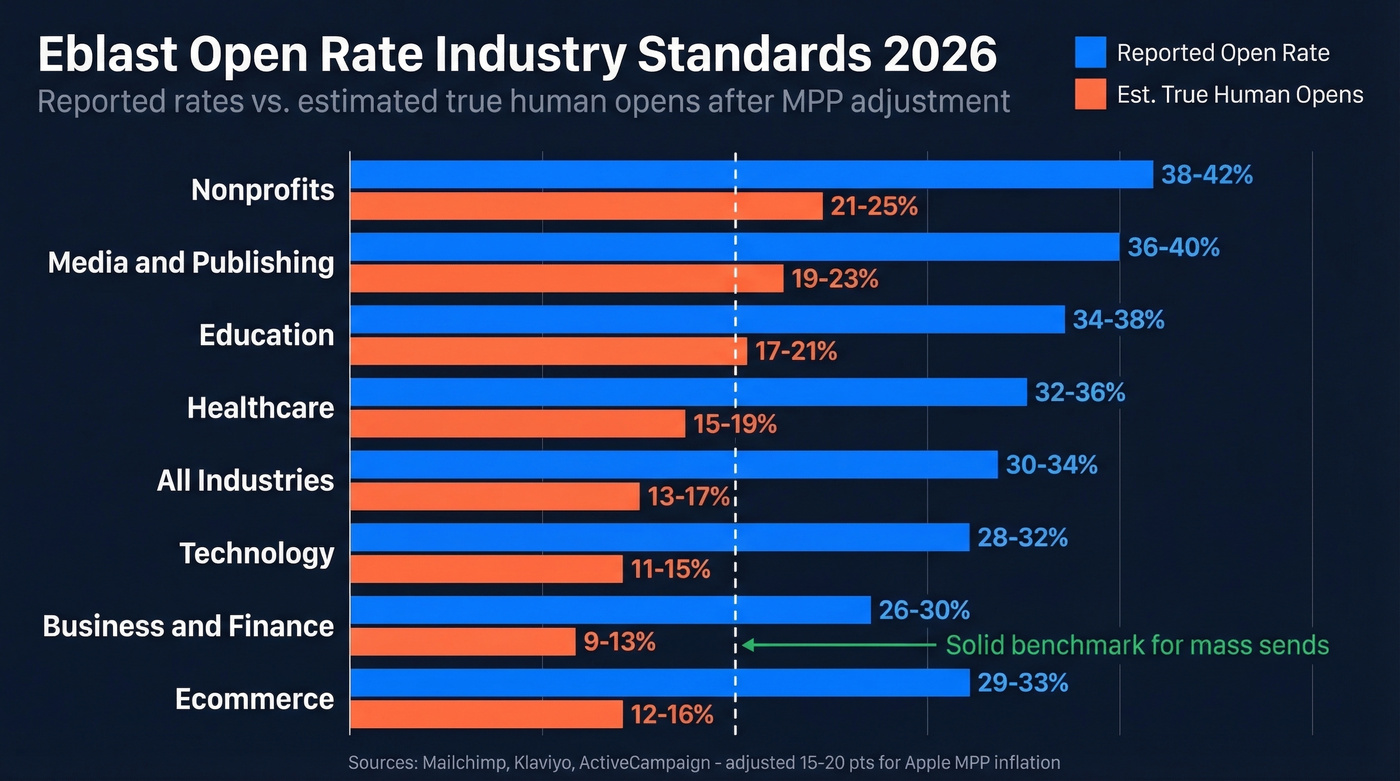
Most benchmark tables you'll find report inflated numbers. We've added an adjusted column estimating true human opens after subtracting 15-20 points for MPP inflation - the most useful data in this table.
| Industry | Reported Open Rate | CTR | Est. True Open Rate |
|---|---|---|---|
| All Industries | 35-42% | 2.0-2.6% | 17-25% |
| Business & Finance | 31-36% | 2.5-2.8% | 11-21% |
| Ecommerce | 29-34% | 1.7-2.1% | 9-19% |
| Nonprofits | 38-43% | 3.0-3.3% | 18-28% |
| Healthcare | 33-41% | 2.3-5.6% | 13-26% |
| Education | 35-39% | 3.0-6.4% | 15-24% |
| Media & Publishing | 34-43% | 3.0-7.3% | 14-28% |
| Technology | 30-36% | 2.0-6.7% | 10-21% |
| Retail | 29-36% | 1.7-5.1% | 9-21% |
This table combines the most recent benchmark datasets from Mailchimp, Klaviyo, and ActiveCampaign, with a 15-20 point adjustment for Apple Mail Privacy Protection inflation.
That adjusted column is the one that matters. If your average email blast open rate after MPP adjustment hits ~20% true human opens, you're doing fine for a mass send.
Why These Numbers Are Misleading
Apple Mail Privacy Protection, rolled out with iOS 15 in September 2021, preloads tracking pixels via proxy servers - firing an "open" even when nobody reads the email. MPP is enabled on roughly 97% of iPhones and inflates reported open rates by 15-20 points.
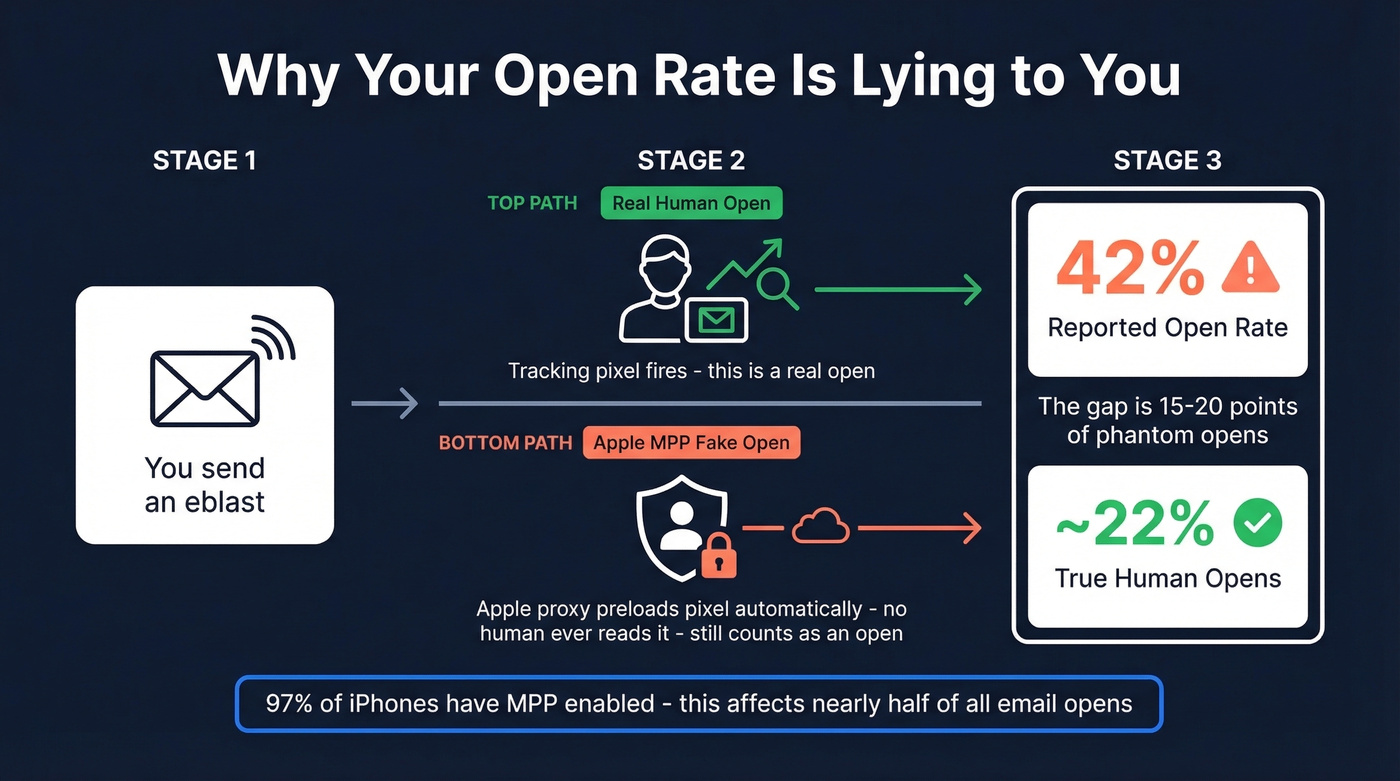
The distortion isn't subtle. One newsletter operator averaging 28% open rate saw it spike to 55% out of nowhere after MPP adoption - zero change in actual readership. It's not just Apple, either. A practitioner on r/Emailmarketing reported their 6K-subscriber newsletter dropped from 35% to 18% opens after July 2024 Gmail security updates, despite full DMARC compliance. We've seen this pattern repeatedly - teams celebrating 40%+ open rates that collapse to ~20% when you filter out MPP noise.
Each ESP also reports different numbers because they're measuring their own user base. Mailchimp's "All Users" average of 35.63% reflects emails sent through Mailchimp, not the industry at large. That's why the average you see in one report can differ by 15+ points from another - the sample populations are completely different.

Every benchmark report agrees on one thing: bad data kills deliverability before your subject line gets a chance. Prospeo's 5-step verification catches spam traps, honeypots, and catch-all domains across 143M+ verified emails - at 98% accuracy and $0.01 per email.
Stop optimizing open rates on a list that's 23% decayed.
Eblasts vs. Automated Emails
Here's the thing: eblasts are structurally the lowest-performing email format, and most teams send too many of them.
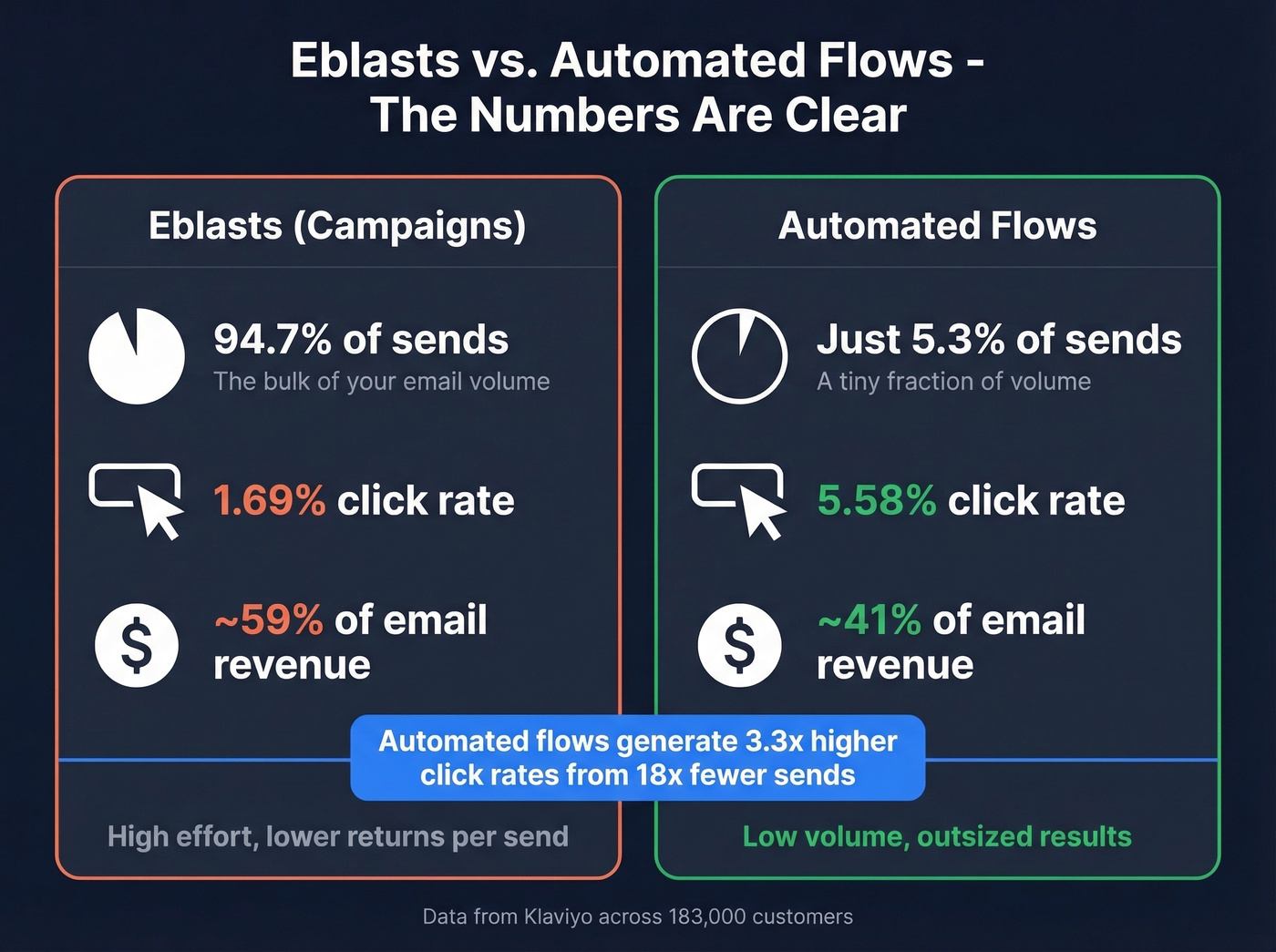
Klaviyo's data across 183,000 customers is damning. Automated flows generate ~41% of total email revenue from just 5.3% of sends, with flow click rates of 5.58% versus 1.69% for campaigns. Eblasts aren't useless - they have a place for time-sensitive announcements - but if they're your entire email strategy, you're leaving most of the revenue on the table. Let's be honest: a well-built welcome sequence will outperform your best eblast every single time.
What to Track Instead
Open rate isn't dead, but it's no longer your primary KPI. Skip it as a standalone metric and focus here:
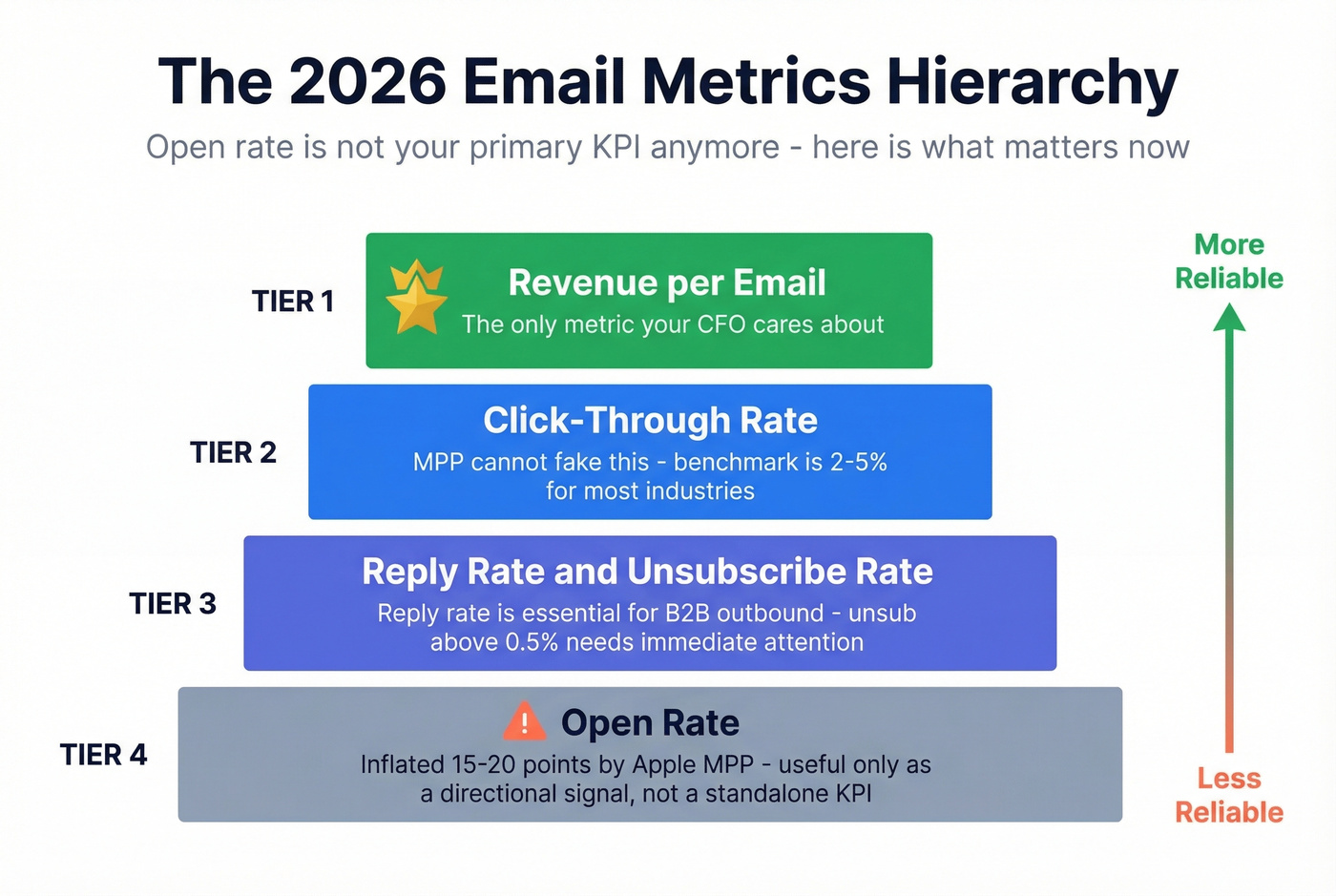
- Click-through rate: The metric MPP can't fake. CTR benchmarks typically land at ~2-5%, and promotional emails often sit at ~1-3%. (If you want the math, use this click rate formula.)
- Conversions and revenue per email: The only metric your CFO cares about.
- Reply rate: Essential for B2B outbound. Opens mean nothing if nobody responds. (More on improving it in follow-up email reply rate.)
- Unsubscribe rate: A rising unsub rate signals your content or frequency is off. Anything above 0.5% per send deserves immediate attention.
How to Improve Your Eblast Performance
Even with MPP distortion, the fundamentals still move the needle on actual engagement.
Verify your list before every major send. Email lists decay at roughly 23% per year. Invalid addresses cause bounces, which damage sender reputation, which reduces inbox placement - suppressing opens before anyone even sees your subject line. In our experience, list verification is the single highest-ROI pre-send step, and it takes minutes. Prospeo's 5-step verification catches invalid emails, spam traps, and honeypots at 98% accuracy, with catch-all handling included. (If bounces are already creeping up, start with email bounce rate.)

Authenticate everything. SPF, DKIM, and DMARC aren't optional if you care about deliverability. We've watched teams troubleshoot open rates for weeks only to discover they never set up DMARC. (Use this email deliverability guide and check DMARC alignment if you're still landing in spam.)
Segment even within blasts. Splitting a 50K list into five 10K segments by engagement level isn't a drip campaign - it's still a blast, just a smarter one. One scenario we see constantly: a SaaS company sends the same product update to their entire list, gets a 1.2% CTR, and blames the copy. They segment by last-click date, send the same email, and CTR jumps to 3.4%. Same message, different targeting.
Test subject lines on clicks, not opens. A/B testing on open rate is meaningless when MPP inflates both variants equally. If you need ideas, pull from these email subject line examples.
Invest in the channel. Companies dedicating over 15% of marketing budget to email are 2x more likely to hit 40%+ reported open rates - which often translates to ~20-25% true opens once you account for MPP inflation. That's not just tools; it's people, strategy, and content quality.
MPP inflates your open rates by 15-20 points, but it can't fake a reply. Prospeo gives you 300M+ verified contacts with a 7-day data refresh cycle so your eblasts reach real inboxes - not dead addresses dragging down your sender reputation.
Fix the list first. The metrics follow.
FAQ
What's a good eblast open rate in 2026?
After adjusting for MPP inflation, 18-25% true human opens is solid for a mass send. Reported rates will look higher (35-42%), but click-through rate is a more reliable engagement signal since Apple can't inflate it.
How is email open rate calculated?
Unique opens divided by emails delivered, multiplied by 100. Apple Mail Privacy Protection inflates this metric by 15-20 points since September 2021, making raw open rates unreliable for performance tracking on their own.
Does list quality affect open rates?
Directly and significantly. Lists decay ~23% per year, and invalid addresses cause bounces that damage sender reputation. Verifying your list before every major send is the fastest way to protect deliverability and improve inbox placement.