

Ecommerce Email Open Rates: 2026 Benchmarks, MPP Reality, and What Actually Matters
You pull up your Klaviyo dashboard, see a 38% open rate on last week's campaign, and wonder: is that good? The honest answer is frustrating - ecommerce email open rates range from 25% to 35.66% depending on the source, methodology, and whether Apple's Mail Privacy Protection is padding the numbers. Which benchmark you trust changes the answer completely.
Quick Version
- Campaign open rates for ecommerce sit between 25-36% across major platforms in recent 2026 benchmark reports.
- Automated flows run much higher - around 50-65% for abandoned cart - and they typically outperform campaigns on clicks, conversion, and revenue per recipient.
- Apple MPP inflates reported opens by 15-20+ percentage points. If your click rate doesn't match, your opens are lying.
- Revenue per recipient is the metric that actually correlates with business outcomes.
2026 Campaign Benchmarks by Source
Four major sources publish ecommerce email benchmarks. They all disagree, and the reasons matter.
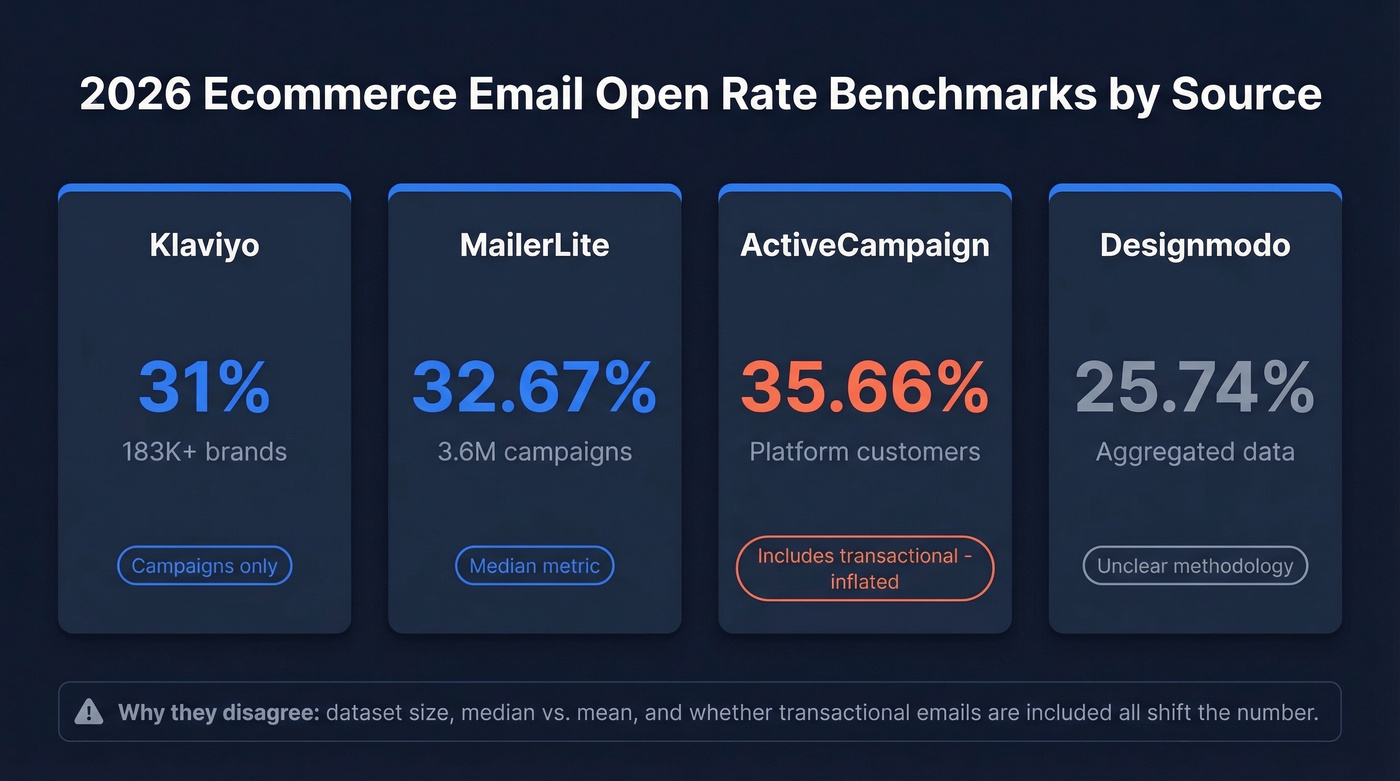
| Source | Open Rate | Dataset | Methodology |
|---|---|---|---|
| Klaviyo (2026) | 31% | 183K+ brands | Average, campaigns only |
| MailerLite (2025) | 32.67% | 3.6M campaigns | Median, campaigns only |
| ActiveCampaign (2025) | 35.66% | Platform customers | Average, includes transactional/other types |
| Designmodo (aggregated 2025 data) | 25.74% | Aggregated | Unclear methodology |
Klaviyo isolates marketing campaigns from 183,000+ brands - the cleanest ecommerce dataset available. MailerLite uses median instead of mean, which resists outlier skew. ActiveCampaign blends transactional emails into the mix, naturally inflating opens since order confirmations get opened at much higher rates. Designmodo's methodology isn't transparent enough to evaluate.
Sub-verticals vary too. Klaviyo's 2026 data breaks it down: clothing & accessories at 33.1%, health & beauty at 30.5%, home & garden at 32.5%, food & beverage at 31.2%, and mass merchant at 28.7%. If you're a mass merchant comparing yourself to a boutique skincare brand, you're measuring against the wrong baseline.
Campaigns vs. Automated Flows
Here's the thing: campaign open rates are the wrong conversation for most ecommerce teams. The real gap is between campaigns and automated flows, and it's enormous.
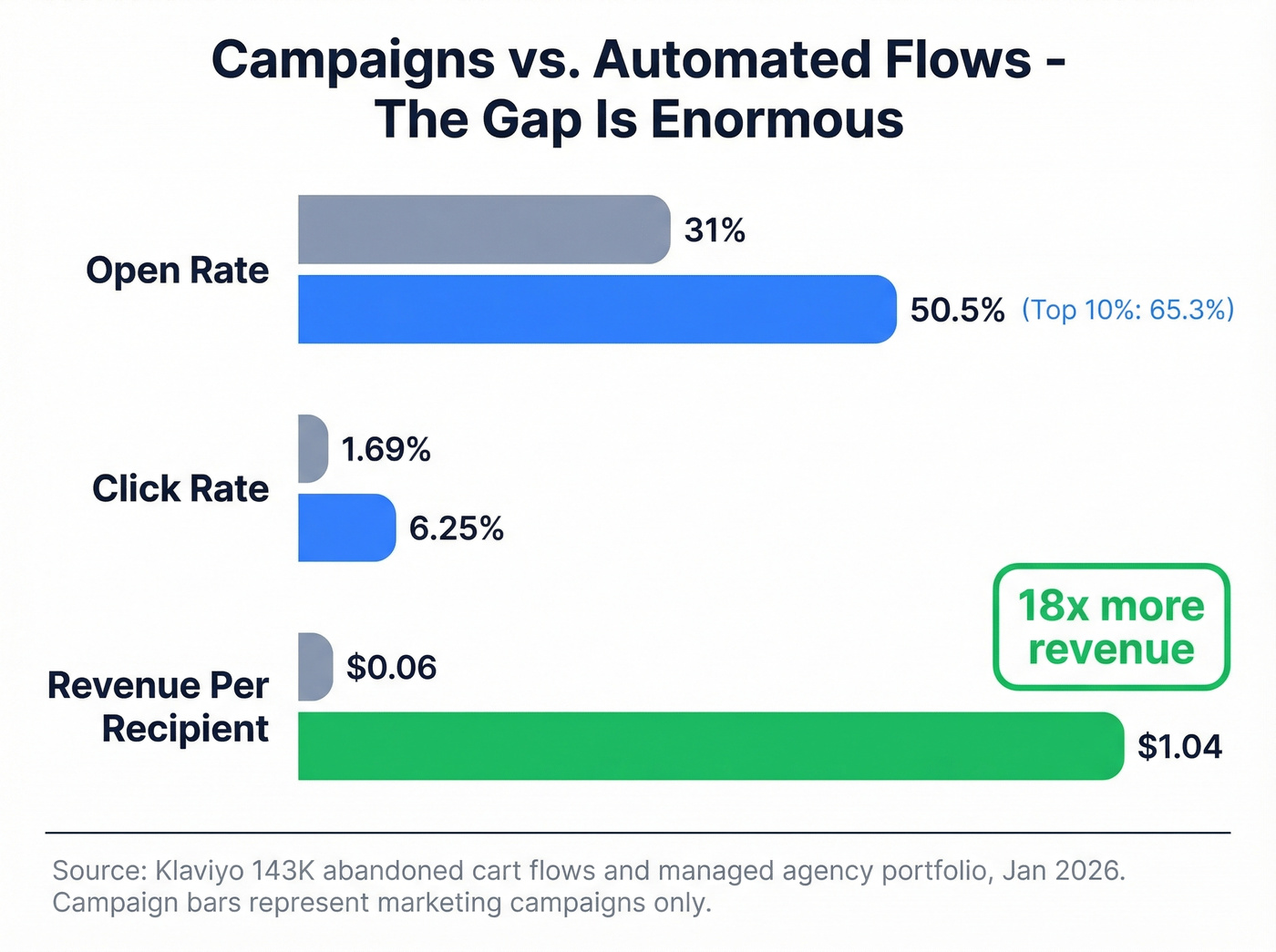
Klaviyo's analysis of 143K abandoned cart flows found an average open rate of 50.5%, with the top 10% hitting 65.34%. Abandoned cart click rates run 6.25%, versus 1.69% for campaigns. Placed order rates tell an even starker story: flows convert at 2.11% versus 0.16% for campaigns.
Abandoned cart flows alone average $3.65 RPR, with top performers reaching $28.89. One managed agency portfolio tracked this across 7.1M recipients in January 2026 and found campaign RPR of $0.06 versus flow RPR of $1.04 - an 18x gap. If you're spending 80% of your email time on campaigns, you've got the ratio backwards.

Automated flows drive 18x the revenue per recipient - but only if your emails actually land. A bounce rate above 2% tanks your sender reputation and kills inbox placement across every flow and campaign. Prospeo's 5-step verification catches invalid addresses, spam traps, and honeypots at 98% accuracy for ~$0.01/email.
Fix deliverability upstream so your open rates reflect real engagement.
Why Your Open Rate Is Probably Wrong
Apple Mail Privacy Protection pre-fetches tracking pixels, registering an "open" regardless of whether anyone actually read the email. MPP is active on roughly 49.29% of all email opens and inflates reported rates by 15-20+ percentage points.
Quick diagnostic: if your campaign open rate is 40%+ but your click rate sits below 1.5%, MPP is doing the heavy lifting. We've seen this pattern repeatedly across teams we work with - people celebrate open rates that are mostly Apple's proxy server reading their emails for them. One marketer on r/emailmarketing reported 35%+ opens after switching ESPs and immediately suspected iOS inflation. That's the right instinct.
Apple also changed its prefetching behavior in April 2024, reducing how often tracking pixels fire. Apple's proxy share dropped from roughly 77% to 70% of pixel loads. If your opens dropped suddenly around that time but clicks stayed flat, the change was in Apple's reporting, not your actual engagement.
BFCM Seasonal Benchmarks
Don't panic if November open rates crater. Mailgun's bot-filtered BFCM data shows Black Friday opens at 13% and Cyber Monday at 15% - dramatically lower than annual averages. November email volume runs 13.6% higher than October, and BFCM weekend sends climbed 15% year-over-year. Everyone's sending more, which means everyone's open rates compress.
Despite lower opens, email remains the preferred channel: 61% of consumers prefer it for promotions, 75% for transactional messages. Judge BFCM performance against BFCM benchmarks, not your September numbers.
What Actually Moves Open Rates
Before you A/B test another emoji in your subject line, check the fundamentals. We've watched teams obsess over subject line tweaks while sending from domains with trashed reputations. That's optimizing the paint job on a car with no engine.
Deliverability compliance. Gmail and Yahoo now require SPF, DKIM, and DMARC for anyone sending 5,000+ emails per day. Spam complaints must stay below 0.3%. One-click unsubscribe headers are mandatory, with opt-outs processed within two days. Fail any of these and your emails hit spam folders, which tanks opens regardless of how clever your copy is. If you need a full checklist, start with an email deliverability guide and then validate your DMARC alignment.
List hygiene. A bounce rate above 2% is a red flag, and the cascade is predictable: bad emails lead to bounces, which damage sender reputation, which kills inbox placement, which craters opens. Prospeo's 5-step verification catches invalid addresses, spam traps, and honeypots before they reach your ESP - at 98% accuracy, it's the upstream fix for a downstream open rate problem. If you're troubleshooting, compare against current email bounce rate benchmarks and use email reputation tools to spot issues early.
Segmentation. Klaviyo's data shows a clear revenue-to-segment correlation. Under $100K revenue: roughly 13 segments. $100K-$1M: 30 segments. $1M-$10M: 44. Over $10M: 134. More segments means more relevant sends, which means higher engagement across every metric. Skip this if you're still sending the same blast to your entire list - fix that first, then worry about benchmarks. For a practical framework, see targeted email campaigns and intent based segmentation.
The Metric You Should Track Instead
Revenue per recipient can't be faked by a privacy proxy.
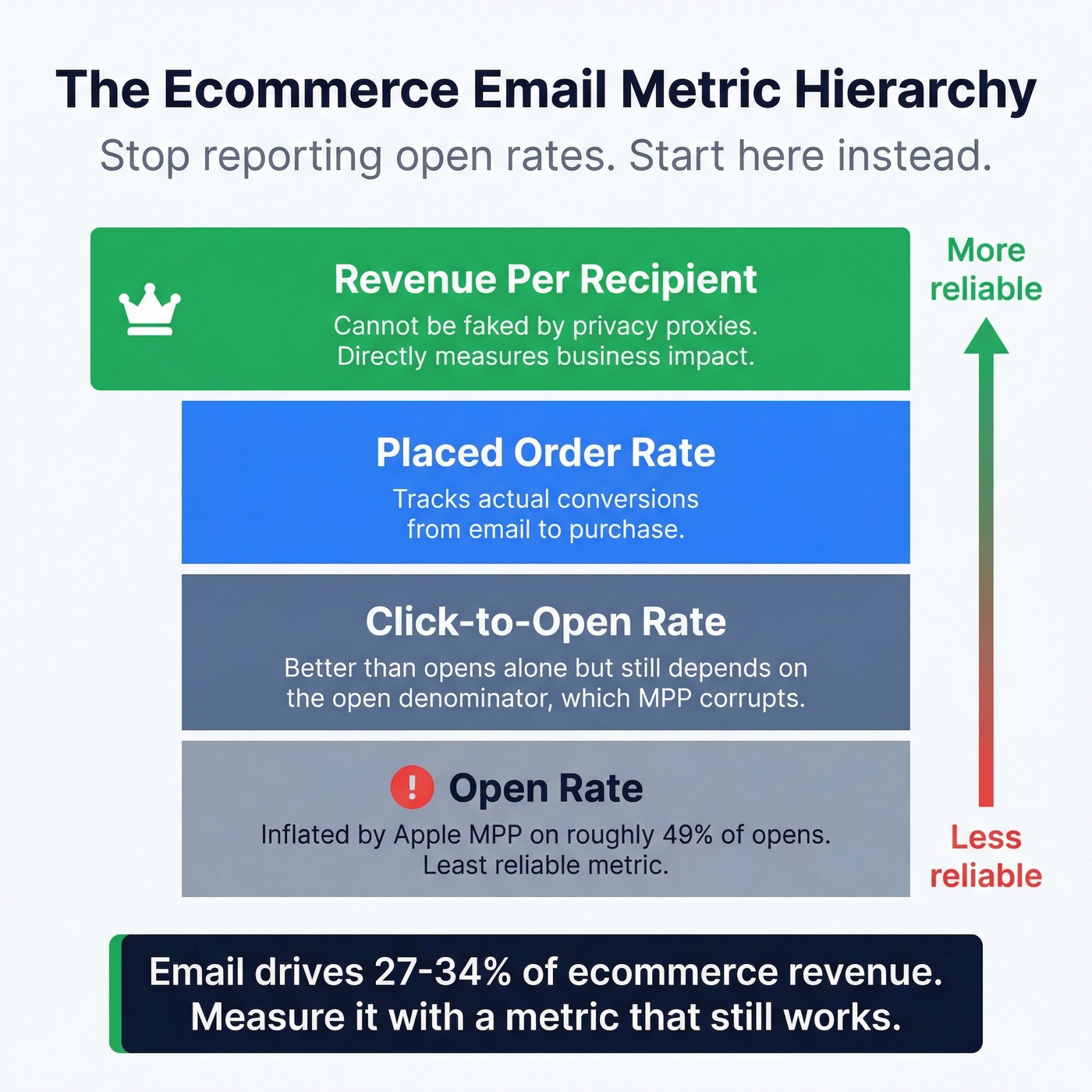
The hierarchy should be: RPR > placed order rate > click-to-open rate > open rate. CTOR is popular in competing guides, but it still depends on the open denominator, which MPP corrupts. RPR sidesteps the problem entirely. If you're still reporting opens, compare your numbers to a broader standard email open rate and understand what a tracking pixel can (and can't) measure post-MPP.
Let's be honest: if your average order value is under $50 and you're running an ecommerce store, stop reporting open rates to stakeholders altogether. Report RPR and flow revenue share instead. Email drives roughly 27-33.7% of total ecommerce store revenue - Klaviyo's historical data pegs it at about 27%, while managed portfolios optimizing for flows push closer to 33.7%. The channel matters. Measure it with a metric that still works.
You just read that email drives 27-34% of ecommerce revenue - but only when it reaches real inboxes. Teams using Prospeo cut bounce rates from 35%+ to under 4% and tripled pipeline output. Run your subscriber exports through 5-step verification before your next campaign or BFCM push.
Stop letting bad data sabotage your highest-ROI channel.
FAQ
What's a good ecommerce email open rate in 2026?
Campaign open rates between 28-35% are healthy based on Klaviyo and MailerLite data. Automated flows run 45-65%. If campaign opens exceed 40%, Apple MPP is likely inflating the number - check your click rate to confirm real engagement.
Why did my open rate drop suddenly?
Apple changed its email prefetching behavior in April 2024, reducing how often tracking pixels fire. If opens dropped but click rates held steady, the change is in Apple's reporting, not your actual subscriber engagement.
How do I improve ecommerce email open rates?
Verify emails before importing to keep bounce rates under 2%. Authenticate with SPF, DKIM, and DMARC. Segment aggressively and prioritize automated flows, which outperform campaigns on every metric including revenue per recipient.
Is revenue per recipient better than open rate?
Yes. RPR directly measures email-driven revenue and can't be inflated by Apple's Mail Privacy Protection. For ecommerce, expect campaign RPR around $0.06 and flow RPR around $1.04 - that 18x gap is why flows deserve most of your optimization time.