

The Best Email Automation Services in 2026: Honest Picks, Real Pricing
You're paying $49/mo for an email platform that promises "powerful automation," but the welcome sequence you built maxes out at five steps and can't branch based on behavior. So you upgrade. Now you're on a mid-tier plan, and you're still sending to a list where 20% of the addresses bounce. That's the email automation trap - the tool works fine, but the foundation underneath it doesn't.
You don't need 15 platforms on a spreadsheet. You need two, maybe three - a clean data source, an automation engine that actually lets you build conditional workflows, and the discipline to not overcomplicate things. We've tested and compared 12 platforms below with real pricing at scale, the billing gotchas nobody puts on their landing pages, and a framework for picking the right stack without burning a month on free trials.
Our Picks at a Glance
| Tool | Best For | Starting Price | Free Plan | Automation on Free |
|---|---|---|---|---|
| Prospeo | B2B data + outbound | ~$0.01/email | Yes (75 emails/mo) | Yes |
| ActiveCampaign | Automation engine | $19/mo (1K) | No | N/A |
| Brevo | Best free plan | $8/mo | Yes (100,000 contacts) | Yes |
| Klaviyo | Ecommerce | $30/mo (1K) | Yes (250 profiles) | Yes |
| MailerLite | Beginners | $9/mo | Yes (500 subs) | Yes |
| Omnisend | Budget ecommerce | $11/mo | Yes (250 contacts) | Yes |
| HubSpot | All-in-one CRM | $9/mo/seat (annual) | Yes (limited) | No |
| GetResponse | Funnels | $15/mo | Yes (500 contacts) | No |
| Sender | Budget | $7/mo | Yes (2,500 subs) | Yes |
| Drip | DTC brands | $39/mo | No | N/A |
| Kit (ConvertKit) | Creators | $25/mo | Yes (10K subs) | Limited |
| Mailchimp | Legacy choice | $13/mo | Yes (250 contacts) | No |
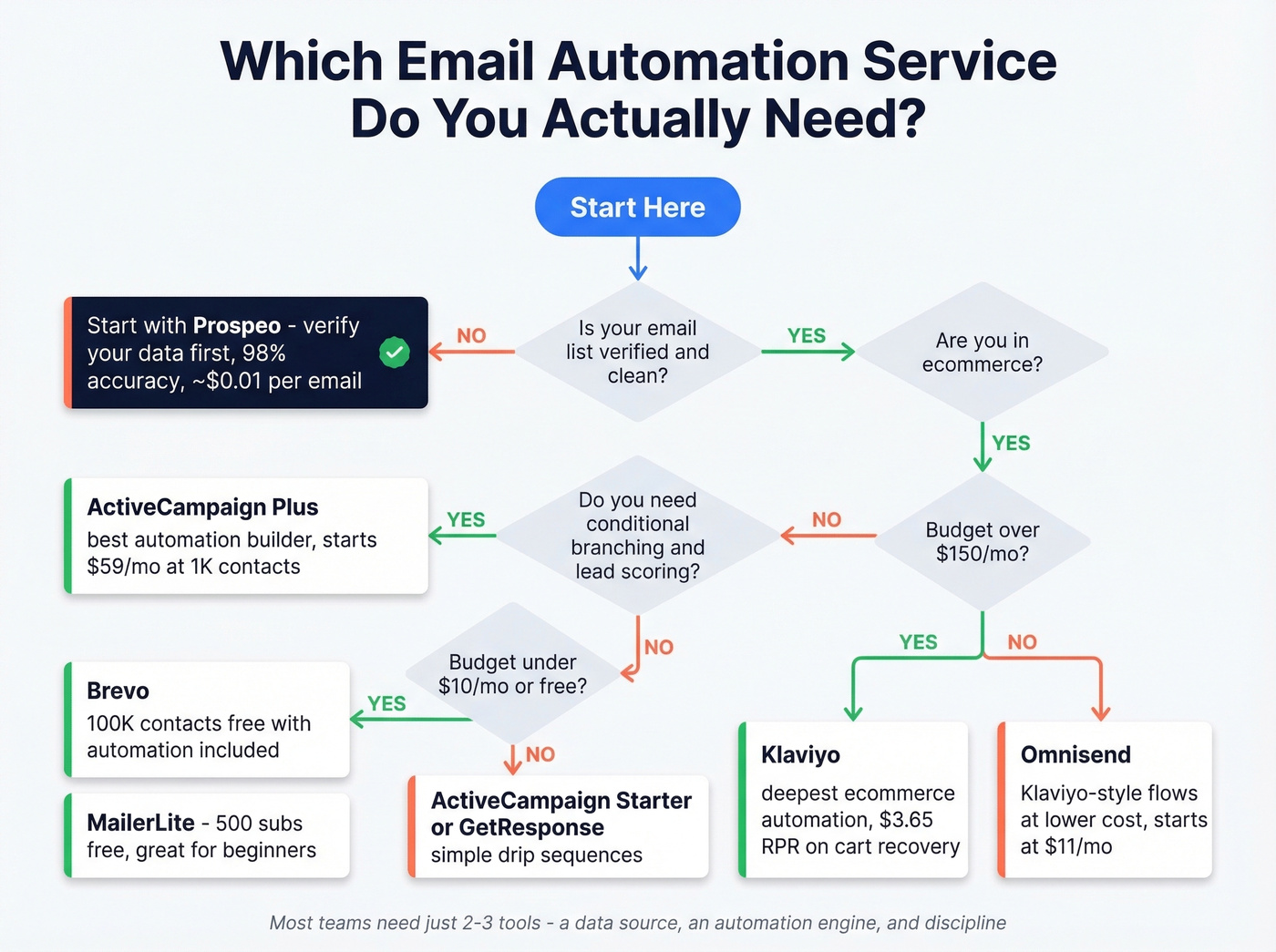
Three standouts: Prospeo handles the data layer - verified emails and phones before anything gets automated. ActiveCampaign has the deepest automation builder for the price. Brevo gives you 100,000 contacts and automation on a free plan, which is absurd value.
Why Automation Beats Manual Campaigns
The gap between automated flows and manual campaigns isn't marginal. It's a different category of performance entirely, and benchmarks drawn from 183,000+ ecommerce customers make this painfully clear.
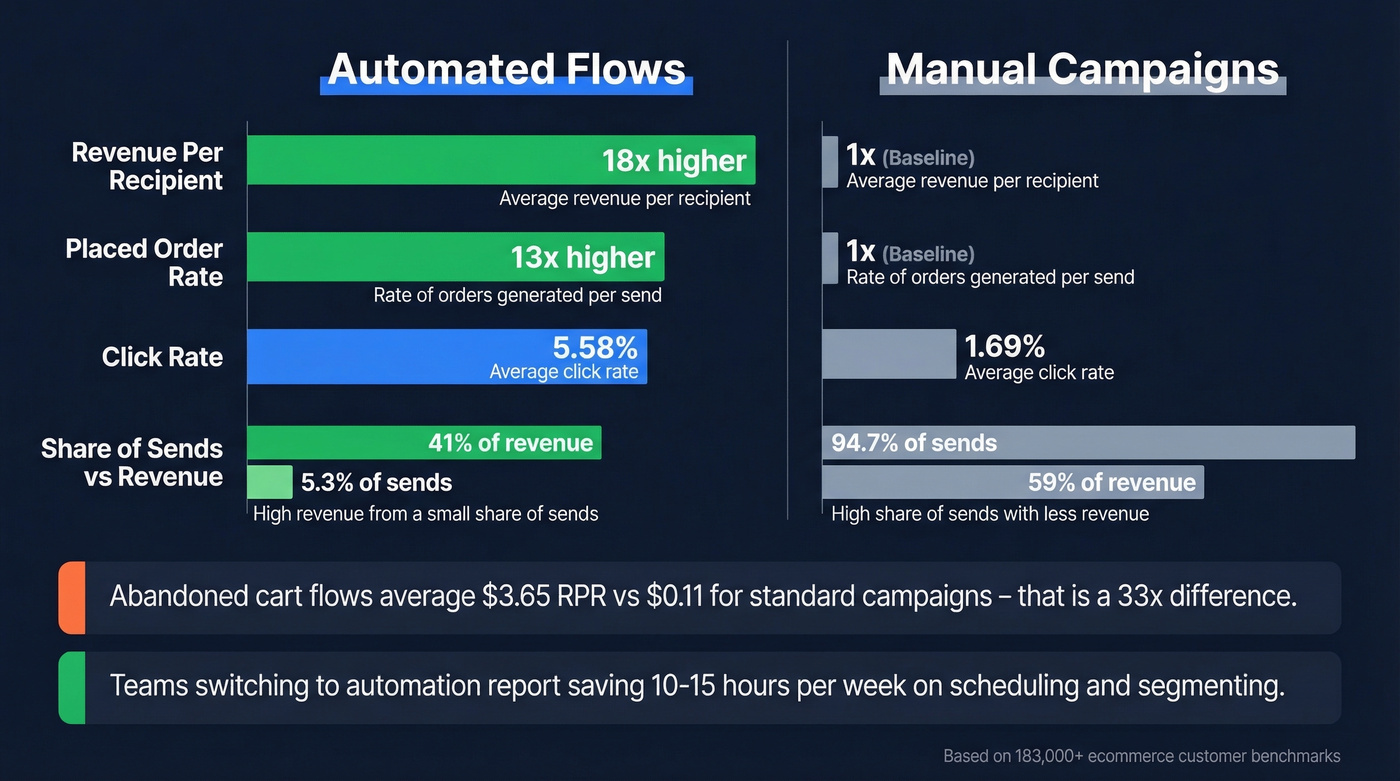
Automated flows generate roughly 41% of total email revenue from just 5.3% of sends. Revenue per recipient runs about 18x higher for flows versus campaigns, and placed order rates are 13x higher. Click rates tell the same story: 5.58% for flows versus 1.69% for campaigns - more than 3x the engagement from messages that fire based on behavior rather than a calendar.
The ecommerce numbers get even more dramatic. Abandoned cart flows average $3.65 RPR compared to $0.11 for standard campaigns. Welcome flows pull $2.65 RPR, and the top 10% of welcome sequences hit a placed order rate of 10.53%. Post-purchase emails see a 61.68% open rate - the highest of any flow type. Nearly 48% of flow-driven revenue comes from new buyers, compared to just 16% for campaigns, making automation the single best acquisition channel in email.
These aren't small optimizations. This is the difference between email as a cost center and email as a revenue engine. The time saved by replacing manual sends with behavioral triggers compounds every month - teams that switch report reclaiming 10-15 hours per week that used to go toward scheduling and segmenting by hand. The catch? Automation only works when the data feeding it is clean. Bad addresses don't just bounce. They poison your sender reputation and drag down deliverability for every email that follows.
Drip Campaigns vs True Automation
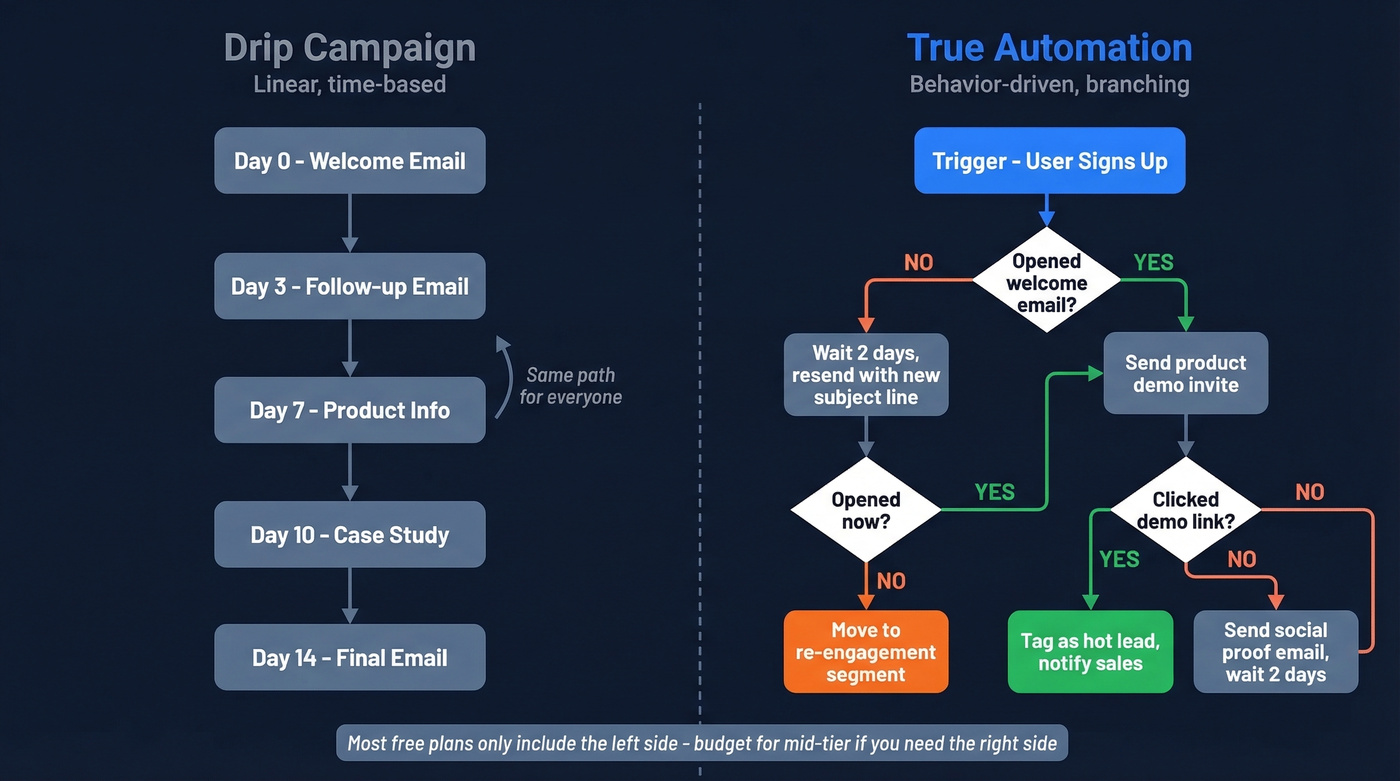
Most cheap plans advertise "automation" but only deliver drip sequences. This is a common frustration in reviews and on r/emailmarketing: tools that promise automated workflows on their free plan but actually deliver linear drip sequences with no branching logic.
| Drip Campaigns | True Automation | |
|---|---|---|
| Trigger | Time-based | Behavior/action-based |
| Structure | Linear sequence | Conditional branching |
| Personalization | Segment-level | Individual-level |
| Complexity | Low | Medium to high |
| Timing | Pre-set intervals | Dynamic, event-driven |
A drip campaign sends Email 2 three days after Email 1 regardless of what the recipient did. True automation checks whether they opened, clicked, visited a page, or abandoned a cart - then routes them down a different path.
Why this matters for plan selection: tools like ActiveCampaign's Starter plan and GetResponse's free tier technically include "automation," but they cap actions or strip out branching logic. If you need conditional paths, you're paying for mid-tier plans everywhere. Budget accordingly. For teams just starting out, a drip-capable tool is fine. Once you need behavioral branching and lead scoring, you've graduated to true automation platforms like ActiveCampaign or Klaviyo.
The 12 Best Platforms Reviewed
Prospeo - Best for B2B Data
Every automation tool on this list assumes you're starting with clean data. Most B2B lists don't qualify - double-digit bounce rates are common when lists are pulled from generic databases. When a big chunk of your emails bounce, your sender reputation tanks, and even the perfectly crafted welcome sequence lands in spam.
Prospeo solves this at the source. The platform covers 300M+ professional profiles with 143M+ verified emails, all refreshed on a 7-day cycle (the industry average is six weeks). Email accuracy runs 98%, backed by a 5-step verification process with catch-all handling, spam-trap removal, and honeypot filtering. That's not a marketing claim - Stack Optimize built from $0 to $1M ARR using Prospeo data, maintaining 94%+ deliverability and under 3% bounce across all clients with zero domain flags.
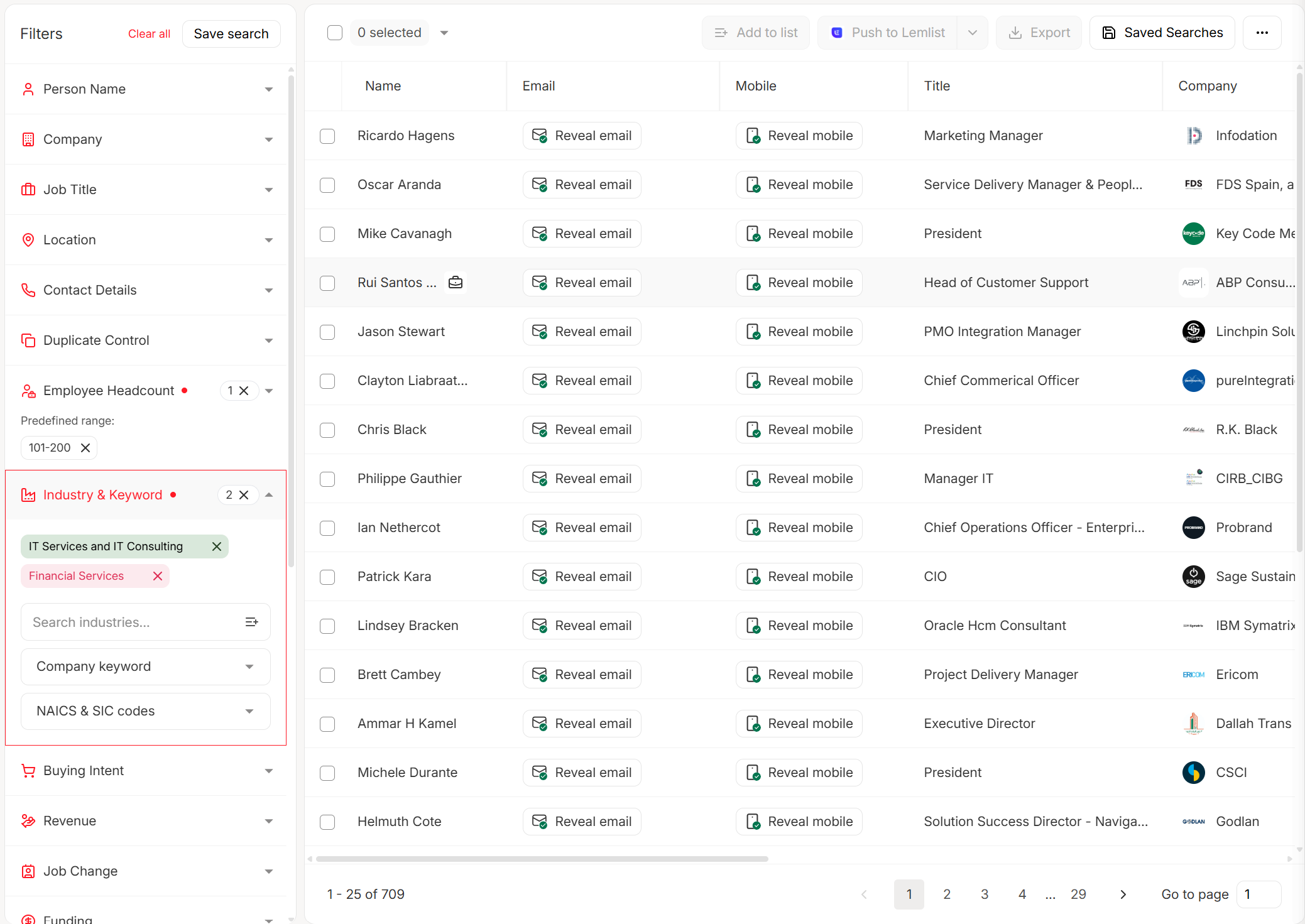
The free tier gives you 75 verified emails and 100 Chrome extension credits per month. Paid plans run about $0.01 per email - a fraction of what you'd pay for a database subscription. Native integrations with Salesforce, HubSpot, Smartlead, Instantly, Lemlist, Zapier, and Make mean verified contacts flow straight into whatever automation platform you're running. Think of it as the data layer that makes everything below actually work.
ActiveCampaign - Best Automation Engine
Use it if: You need conditional branching, lead scoring, and multi-step workflows that go beyond "send email, wait, send another email." The automation builder on Plus and above is the best on this list - full stop. You can split paths based on engagement, site visits, custom fields, and CRM data. A/B test entire automation branches, not just subject lines.
Skip it if: You're looking at the Starter plan and thinking it'll be enough. Starter caps automations at 5 actions with no branching or conditional logic. That's not automation - it's a drip sequence with a fancy UI. The real product starts at Plus: $59/mo at 1,000 contacts, $179/mo at 5,000, $239/mo at 10,000.
One more thing worth flagging: since November 2025, ActiveCampaign charges new accounts for all contacts - including unsubscribed, bounced, and unconfirmed. Older accounts may be grandfathered, but new signups pay for dead weight. Clean your list before importing, or you're paying for contacts who'll never see an email.
Brevo - Best Free Plan
Brevo's free tier is genuinely hard to beat: 300 emails per day, 100,000 contacts, and automation included. No other platform on this list comes close to that contact limit at zero cost. Paid plans start at $8-9/mo and scale based on emails sent rather than contacts stored - a billing model that rewards list growth instead of punishing it.
The automation builder supports multi-condition segmentation and dynamic list assignment, which puts it ahead of Mailchimp on workflow flexibility. For teams running newsletters alongside transactional sequences, Brevo handles both without forcing you into separate products. The UI isn't as polished as ActiveCampaign's, and the template library is smaller, but for the price - especially free - the tradeoffs are easy to accept.
Where Brevo really earns its spot is list management. Unlike Mailchimp's audience-based structure where the same contact on two lists means paying twice, Brevo treats contacts as unified records. Segment them however you want without billing surprises.
Klaviyo - Best for Ecommerce
Use it if: You're running a Shopify or WooCommerce store and want the deepest ecommerce automation available. Klaviyo's pre-built flows are the benchmark everyone else copies - cart recovery averaging $3.65 RPR, welcome flows at $2.65 RPR, browse abandonment click rates of 5.48%. The top 10% of stores on the platform hit a 10.53% placed order rate on welcome sequences. AI product recommendations average a 3.75% click rate, with top performers hitting 8.79% - a feature that practically pays for itself at scale.
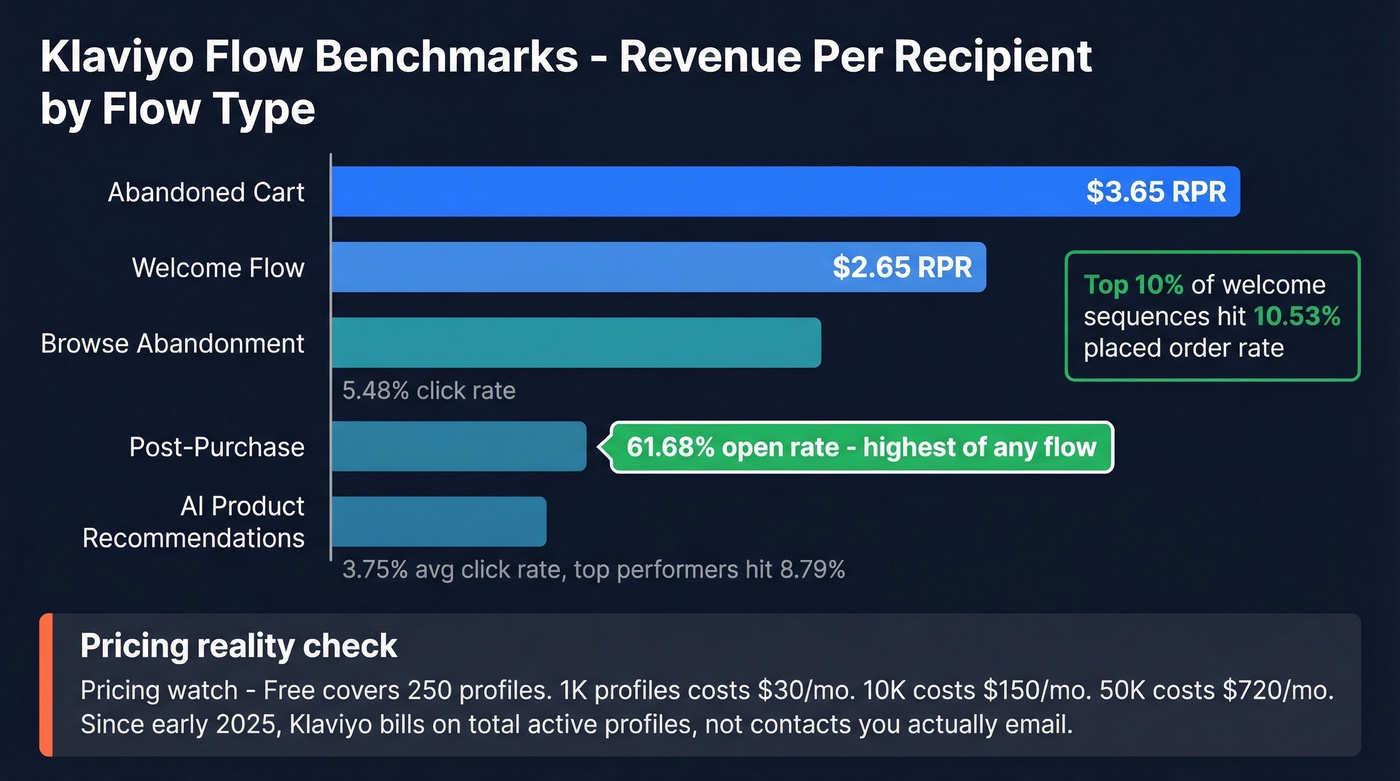
Skip it if: You're not in ecommerce, or your list is growing fast and you haven't budgeted for the pricing shift. Free plan covers 250 profiles and 500 emails. Paid starts at $30/mo for 1,000 profiles, $150/mo at 10,000, and $720/mo at 50,000. In early 2025, Klaviyo switched from billing based on contacts you actually emailed to billing on total active profiles. Existing customers got capped at a 25% increase, but new accounts pay the full rate.
MailerLite - Best for Beginners
MailerLite is what Mailchimp used to be before it got complicated. The free plan covers 500 subscribers and 12,000 emails per month with automation included. Paid plans start at $9/mo and unlock unlimited emails.
The drag-and-drop automation builder won't win awards for depth, but it handles welcome sequences, engagement-based branching, and basic segmentation without a learning curve. For newsletters, simple drip campaigns, and teams that don't need enterprise-grade conditional logic, MailerLite gets you running in an afternoon. It's the tool we'd recommend to anyone sending their first automated sequence who doesn't want to read documentation for three hours.
Omnisend - Budget Ecommerce Pick
Use it if: You want Klaviyo-style ecommerce automation without Klaviyo-style pricing. Free plan covers 250 contacts and 500 emails. Standard starts at $11-16/mo with pre-built ecommerce workflows, SMS + email in one platform, and solid Shopify integration out of the box.
Skip it if: You need deep analytics or advanced segmentation. Omnisend's reporting is functional but thin compared to Klaviyo's revenue attribution. For stores under 10,000 contacts that want automation + SMS without juggling two platforms, it's a strong pick. Beyond that, you'll feel the ceiling.
HubSpot - All-in-One CRM
HubSpot is incredible if you're already in the ecosystem - and a very expensive entry point if you're not. Starter runs $9/mo per seat (annual) with 1,000 marketing contacts and 5,000 emails. That sounds reasonable until you need real automation, which lives in Professional at $800/mo plus a mandatory $3,000 onboarding fee. Enterprise jumps to $3,600/mo with a $7,000 onboarding fee.
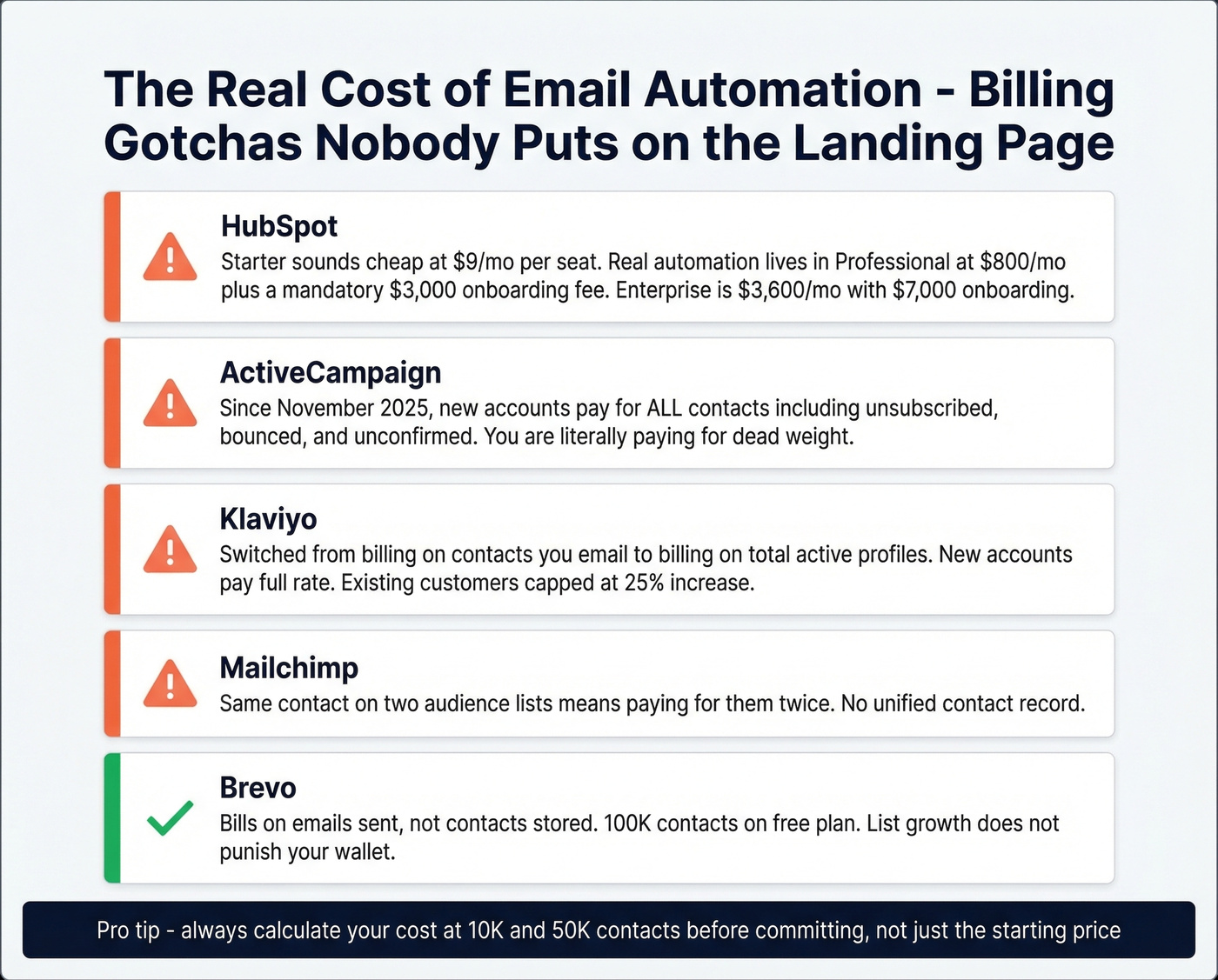
The $3,000 onboarding tells you the commitment level. If your CRM, sales sequences, and marketing all run through HubSpot, the automation works without friction. If you're just looking for an email platform, you're paying for a mansion when you need a studio apartment.
GetResponse - Best for Funnels
Use it if: You're running webinar-to-email funnels. GetResponse bundles webinar hosting and funnel building alongside email - a combination nobody else offers at this price point. The Marketer plan at $51/mo unlocks real automation with behavioral triggers and scoring.
Skip it if: You just need email sequences. The free plan covers 500 contacts but doesn't include automation, and Starter at $15-19/mo only gives you basic autoresponders. You'd be paying for webinar and funnel features you won't touch.
Sender - Best Value
Sender's free plan is quietly one of the most generous in the space: 2,500 subscribers, 15,000 emails per month, automation workflows, and a drag-and-drop editor - all at zero cost. Paid plans start at $7/mo. You won't get advanced analytics, design polish, or deep ecommerce integrations, but for growing lists on a tight budget - especially if you're pre-revenue or bootstrapping - it does the job without nickel-and-diming you on features that should be standard.
Drip - Best for DTC Brands
Drip starts at $39/mo for 2,500 contacts with unlimited emails. No free plan. What justifies the premium is purpose-built DTC automation with revenue attribution baked into every workflow.
Deep Shopify and WooCommerce integrations, segmentation designed around purchase behavior, and reporting that ties every automated email to actual revenue. It's more expensive than Omnisend at the entry level but more focused. If you're a DTC brand doing $1M+ in revenue and want attribution clarity, Drip earns its price. Below that threshold, Omnisend gives you 80% of the functionality at a fraction of the cost.
Kit (ConvertKit) - Best for Creators
Kit offers 10,000 subscribers and unlimited emails on its free plan - the highest subscriber cap of any free tier here. Automation is limited to one workflow on free; the Creator plan at $25-39/mo unlocks more. Built for newsletters, digital product sales, and paid subscriptions rather than ecommerce or B2B.
Mailchimp - Most Popular, Most Overrated
Here's the thing: Mailchimp's brand recognition doesn't justify the cost in 2026. The free plan gives you 250 contacts, 500 emails, and no automation. Essentials starts at $13/mo. The most common cost trap is Mailchimp's audience structure - one contact on three lists gets billed three times, a quirk that inflates costs quietly and catches teams off guard. Brevo and Sender both offer more for less.
Also considered: We evaluated Moosend, Zoho Campaigns, Constant Contact, and EmailOctopus. None offered enough differentiation to crack the top 12, but Moosend's all-features-on-every-plan pricing is worth a look for teams that hate feature gating.

Automation workflows can't fix bad data. When 20% of your list bounces, your sender reputation tanks and every email - automated or not - lands in spam. Prospeo's 98% email accuracy and 7-day data refresh cycle mean your sequences start on a clean foundation, not a crumbling one.
Stop automating emails to addresses that don't exist.
Real Pricing at Scale
Every pricing page shows "starting at $9/mo" in big friendly numbers. Here's what you'll actually pay when your list hits real-world sizes:
| Tool (Plan) | 1K Contacts | 5K Contacts | 10K Contacts |
|---|---|---|---|
| ActiveCampaign (Plus) | $59/mo | $179/mo | $239/mo |
| Klaviyo (Email) | $30/mo | ~$100/mo | $150/mo |
| Brevo (Starter) | ~$9/mo | ~$16/mo | ~$16/mo |
| MailerLite (Growing) | $9/mo | ~$32/mo | ~$69/mo |
| Mailchimp (Standard) | ~$20/mo | ~$75/mo | ~$110/mo |
| HubSpot (Professional) | $800/mo | $800/mo | ~$1,050/mo |
| Sender (Standard) | $7/mo | ~$25/mo | ~$47/mo |
The spread is enormous. At 10,000 contacts, you're paying anywhere from $16/mo to $1,050/mo. Most small businesses land in the $50-$300/mo range depending on tools and list size; enterprise teams with CRM requirements can easily hit $1,000+.
Hidden billing gotchas worth knowing:
- ActiveCampaign (since Nov 2025): new accounts pay for all contacts, including unsubscribed and bounced. Your "10,000 contact" plan might include 2,000 dead addresses.
- Klaviyo (since early 2025): switched from "contacts emailed" to "total active profiles." Existing customers capped at 25% increase; new accounts pay the full rate.
- Mailchimp: contacts on multiple audiences get billed per audience. One contact on three lists = three contacts on your bill.
- HubSpot: Professional requires a $3,000 onboarding fee. Enterprise requires $7,000. These are one-time but non-negotiable.
Budget 3-10x the "starting at" price for any tool where you need conditional workflows and a growing list.
Deliverability: The Factor Most Guides Skip
Your automation is only as good as your inbox placement. According to a 2026 independent test by EmailTooltester of 28 platforms over 90 days - 1,000 emails each, measured via Mail-Tester and GlockApps - inbox placement rates ranged from 79% to 94%. That 15-point gap translates to a 30-40% revenue difference. Two teams running identical sequences on different platforms can see wildly different results just from deliverability variance.
But here's what most guides miss: list hygiene and authentication often outweigh ESP choice. SPF tells receiving servers your ESP is authorized to send on your behalf. DKIM cryptographically signs your messages. DMARC ties them together with a policy for handling failures. Set up all three - it takes 30 minutes - and you've done more for deliverability than switching platforms ever will. (If you want the technical details, start with DMARC alignment and a working SPF record.)

The bigger lever is data quality. Bad emails tank sender reputation regardless of which platform you use. A bounce rate above 5% actively damages your domain, and once that reputation drops, every email you send - automated or manual - suffers. Before you automate a single email, verify your list. This is the single highest-ROI action you can take before launching any sequence. (If you're troubleshooting, use an email bounce rate guide to diagnose what’s happening.)
High-Impact Workflows to Build First
Don't try to automate everything at once. Start with four flows that cover the highest-impact moments in the customer lifecycle.
Welcome Series (highest ROI starting point)
Send Email 1 immediately after signup - deliver the promised value like a lead magnet, discount code, or account confirmation. Follow up on Day 2-3 with your brand story or top content. Day 4-5, layer in social proof: testimonials, a case study, customer logos. By Day 7, branch based on engagement. Engaged contacts get a product pitch. Disengaged ones enter a re-engagement path. The key is sending Email 1 within minutes, not hours - peak engagement happens in the first 15 minutes after opt-in, and welcome flows average $2.65 RPR with the top 10% converting at a 10.53% placed order rate.
Cart Recovery (highest per-email revenue)
Fire the first reminder 1-3 hours after abandonment with cart contents visible. At 24 hours, add urgency or social proof. At 3-5 days, offer an incentive like a discount or free shipping for holdouts. Cart recovery flows average $3.65 RPR versus $0.11 for standard campaigns - a 33x difference per recipient.
Re-engagement Flow: Trigger when a contact hasn't opened in 60-90 days. Give them a reason to come back or a clean way to unsubscribe. Keeping disengaged contacts on your list hurts deliverability for everyone else.
Post-Purchase Flow: Open rates hit 61.68% - the highest of any flow type. Cross-sell, ask for reviews, or deliver onboarding content while attention is at its peak.
Five Mistakes That Kill Results
Delaying the welcome email. Peak engagement is the first 15 minutes after opt-in. If your welcome email fires 24 hours later, you've already lost the moment. Set it to immediate.
Automating with dirty data. A bounce rate above 5% triggers spam filters and damages sender reputation. Every bounced email makes the next legitimate email less likely to land in the inbox. Verify before you import - we've seen teams cut bounce rates from 35% to under 4% just by running their list through verification before loading it into their ESP.
Overloading email + SMS simultaneously. Sending both channels at the same time feels aggressive. Delay SMS 6-12 hours after the email, and only trigger it if the email wasn't opened. Let each channel complement the other instead of competing.
"Launch and disappear" syndrome. Automation doesn't mean "set and forget." Review active campaigns weekly, evergreen sequences monthly, and run full workflow audits quarterly. Stale copy, broken links, and outdated offers accumulate silently.
Using segment-level personalization when you have individual-level data. If your platform supports dynamic content based on individual behavior - pages visited, products viewed, past purchases - use it. Segment-level personalization is the floor, not the ceiling.
How to Choose the Right Platform
Let's be honest: if your average deal size is under $15k, you probably don't need an all-in-one platform. Most teams are better served by two focused tools than one bloated suite that does everything at 60% quality.
B2B outbound: Prospeo for verified data paired with ActiveCampaign, Smartlead, or Instantly for sequencing. The data layer matters more than the sending layer - clean emails mean higher deliverability and more replies. This combination slashes time spent chasing bounced addresses so reps focus on prospects who actually receive the message. (If you're building outbound from scratch, start with a proven B2B cold email sequence.)
Ecommerce (serious): Klaviyo. The benchmarks, the Shopify integration, the revenue attribution - nothing else is as deep.
Ecommerce (budget): Omnisend. 80% of Klaviyo's functionality at 60% of the price.
Newsletter / creator: Kit or MailerLite. Simple, affordable, built for content-first businesses.
Budget-first: Brevo or Sender. Both offer automation on free plans with generous contact limits.
Enterprise / CRM-centric: HubSpot. But only if you're committing to the full ecosystem.
The right email automation services reduce manual effort across your entire funnel - from prospecting to post-purchase - so your team spends time on strategy instead of scheduling sends. A data verification layer plus a dedicated automation engine covers 90% of use cases better than any single all-in-one platform. (For adjacent tooling, compare sales funnel automation tools and broader outbound lead generation tools.)
Stack Optimize built a $1M agency on Prospeo data with 94%+ deliverability and under 3% bounce - zero domain flags. At $0.01 per verified email, you get the data layer that makes ActiveCampaign, Instantly, or any automation tool actually perform.
Feed your automation engine data it can trust for 1 cent per email.
FAQ
What's the best free email automation service?
Brevo offers the strongest free plan: 100,000 contacts, 300 emails per day, and automation included at no cost. Sender is the runner-up with 2,500 subscribers and 15,000 emails per month on free. Kit gives you 10,000 subscribers but limits automation to a single workflow.
How much do these platforms cost at 10,000 contacts?
Expect anywhere from ~$16/mo (Brevo) to $800+/mo (HubSpot Professional). ActiveCampaign Plus runs $239/mo, Klaviyo $150/mo, MailerLite ~$69/mo, and Sender ~$47/mo. Match the tool to your actual workflow needs rather than defaulting to the most popular name - the pricing spread is over 50x.
What's the difference between drip campaigns and automated workflows?
Drip campaigns send emails on fixed time intervals regardless of recipient behavior. True automated workflows use behavioral triggers - opens, clicks, page visits, purchases - to route contacts down conditional paths. Automation outperforms drip by 18x on revenue per recipient because messages arrive based on what someone did, not when they signed up.
Do I need to verify my email list before automating?
Yes. Bounce rates above 5% damage sender reputation and push future emails into spam folders. Cleaning your list is the single highest-ROI action before launching any sequence. Use verification with catch-all handling and spam-trap removal to catch bad addresses before they enter your workflows.
Can I switch email automation platforms easily?
Most platforms let you export contacts as CSV, so moving your list is straightforward. What you lose is automation workflows, templates, and engagement history - none of that transfers. Budget 2-4 weeks for migration and run both platforms in parallel during the transition to avoid gaps in active sequences.