

Email Checker: What It Actually Does, What It Costs, and Which One to Trust in 2026
It's 11 PM. You've got a 5,000-contact sequence launching at 8 AM, and someone on the team just asked, "Did anyone verify this list?" Nobody did. Roughly one in six emails never reaches the inbox, and email databases decay by at least 25% every year. That launch is about to torch your sender reputation - unless you run the list through an email checker first.
What Is an Email Checker?
An email checker tests whether an email address is real and deliverable without actually sending a message. You upload a list or paste individual addresses, and the tool runs a series of checks: syntax validation, domain verification, MX record lookup, SMTP deliverability probes, and spam trap identification. The output categorizes each address as valid, invalid, risky, or unknown.
No email is sent during verification. The tool simulates a delivery handshake with the recipient's mail server, then backs off before any message goes through. Think of it as knocking on a door to see if anyone's home, without leaving a package.
Quick pick:
- Tightest budget, list verification only - EmailListVerify ($24/10K)
- Best balance of accuracy and price - Bouncer ($45/10K)
- Enterprise compliance requirements - ZeroBounce ($64/10K)
How Email Verification Actually Works
The Simple Version
Every verification tool follows the same basic pipeline, regardless of what they charge:
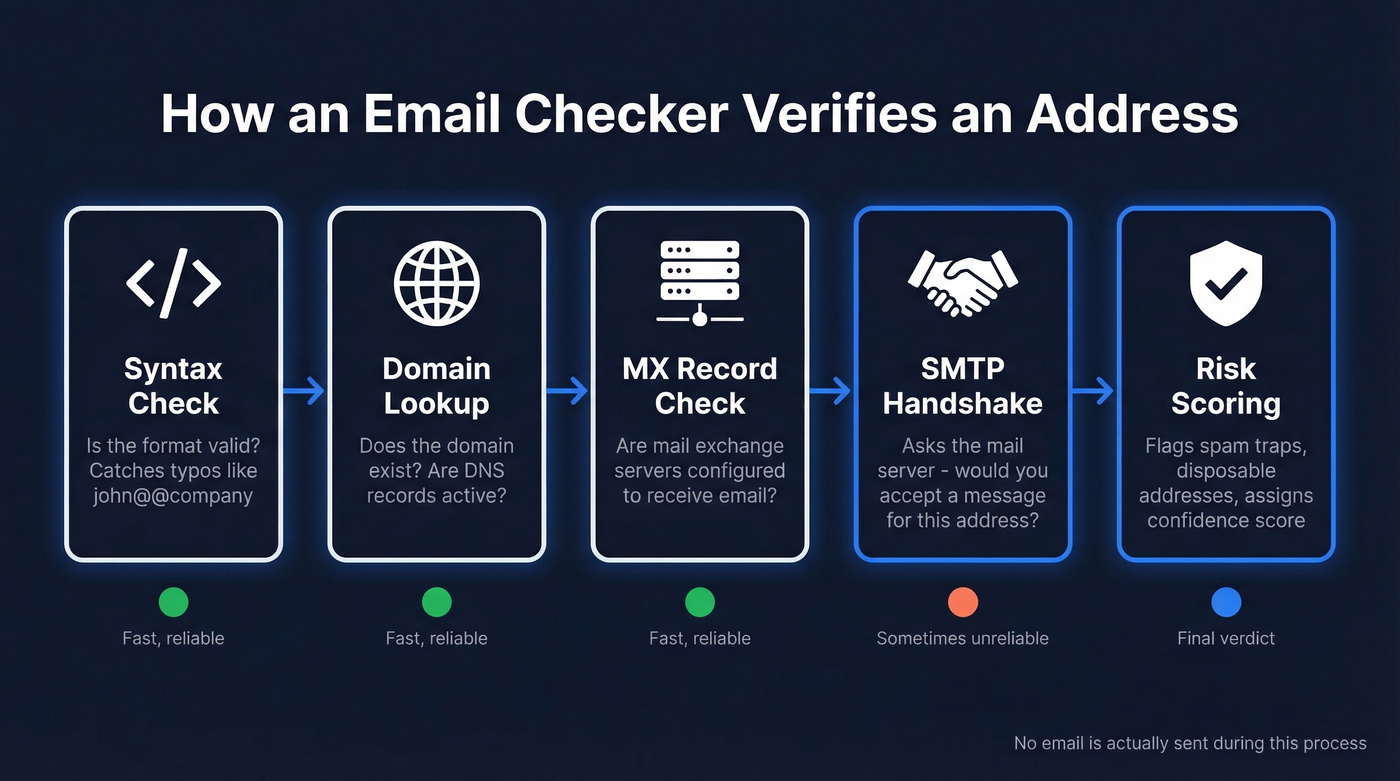
- Syntax check - Is the format valid?
john@company.compasses.john@@companydoesn't. - Domain lookup - Does the domain exist? Does it have active DNS records?
- MX record check - Does the domain have mail exchange servers configured to receive email?
- SMTP handshake - The tool connects to the mail server and asks, "Would you accept a message for this address?" The server responds yes, no, or something ambiguous.
- Risk scoring - The tool evaluates signals from all previous steps, flags spam traps and disposable addresses, and assigns a confidence score.
That's the clean version. Reality is messier.
Why Results Are Sometimes Wrong
The SMTP handshake is where things get unreliable. Mail servers don't always tell the truth.
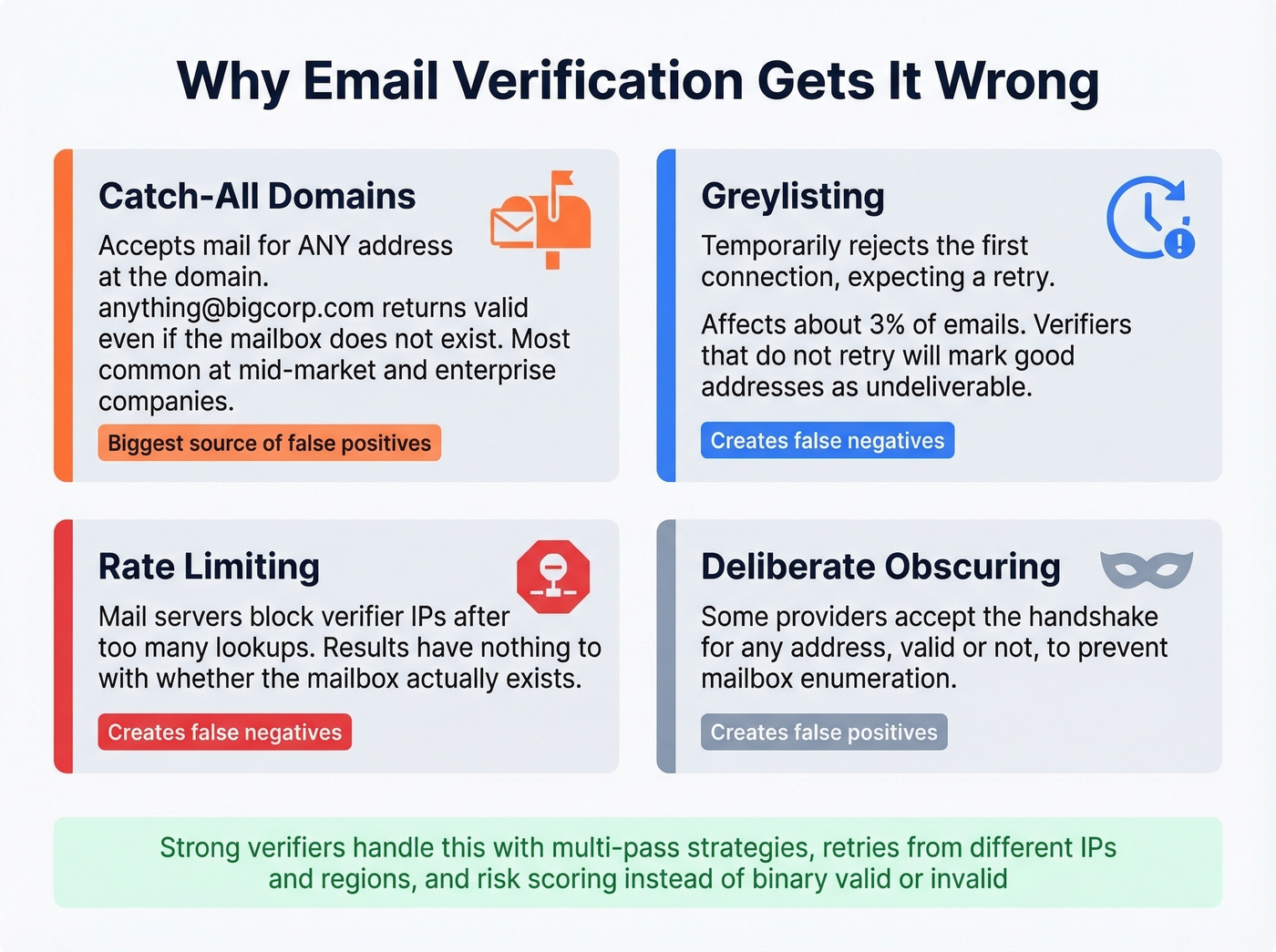
Catch-all domains accept mail for any address at the domain - anything@bigcorp.com returns "valid" even if the specific mailbox doesn't exist. This is common at mid-market and enterprise companies, and it's the single biggest source of false positives.
Greylisting) temporarily rejects the first connection attempt, expecting legitimate senders to retry. It impacts around 3% of emails, but a verifier that doesn't retry will mark a perfectly good address as undeliverable. Rate limiting blocks verifier IPs after too many lookups, creating false negatives that have nothing to do with whether the mailbox exists. And some providers deliberately obscure mailbox existence to prevent enumeration - they'll accept the handshake for any address, valid or not.
Strong verifiers handle this with multi-pass strategies: retries from different IPs, different regions, different times. They use risk scoring rather than a binary valid/invalid output, which gives you more to work with when making send decisions. But even the best verification is a point-in-time check. An address that's valid at 2 PM can bounce at 6 PM if the recipient's account gets deactivated.
Why Checking Emails Matters More Than You Think
Deliverability isn't just about whether your email leaves your server. It's about where it lands.
| ISP | Inbox | Spam | Missing |
|---|---|---|---|
| Gmail | 87.2% | 6.8% | 6.0% |
| Microsoft | 75.6% | 14.6% | 9.8% |
| Yahoo/AOL | 86.0% | 4.8% | 9.2% |
| Apple Mail | 76.3% | 14.3% | 9.4% |
Gmail's inbox placement dropped from 89.8% to 87.2% through 2024, driven by stricter bulk-sender rules and engagement-based filtering. Microsoft is even tougher - nearly 1 in 4 emails either hits spam or vanishes entirely.
Bounce rates under 2% are considered healthy. Above 5%, you're actively damaging your sender reputation and triggering ISP red flags. The global hard bounce average sits at just 0.19%, meaning if you're bouncing more than that, you're already below the baseline.
Here's the thing: a single bad send can cascade. High bounces trigger ISP scrutiny, which reduces inbox placement on your next send, which tanks engagement rates, which further reduces placement. It's a death spiral, and it starts with unverified lists. (If you need a full playbook, start with this email deliverability guide.)

The best email checker benchmarked at 70% accuracy. Prospeo's proprietary 5-step verification delivers 98% - because emails are verified before they ever reach your list. At ~$0.01 per email, you pay less to bounce less.
Stop checking bad data. Start with data that's already clean.
Accuracy Benchmarks - What the Data Shows
The Benchmark Numbers
We've run lists through multiple verifiers side by side, and the accuracy gap between tools is real. Hunter's 2026 benchmark of 15 email verification tools quantifies it: 3,000 real business emails segmented by company size, plus 300 known-invalid addresses - over 40,000 total verifications, standardized through Clay integrations to eliminate configuration differences.
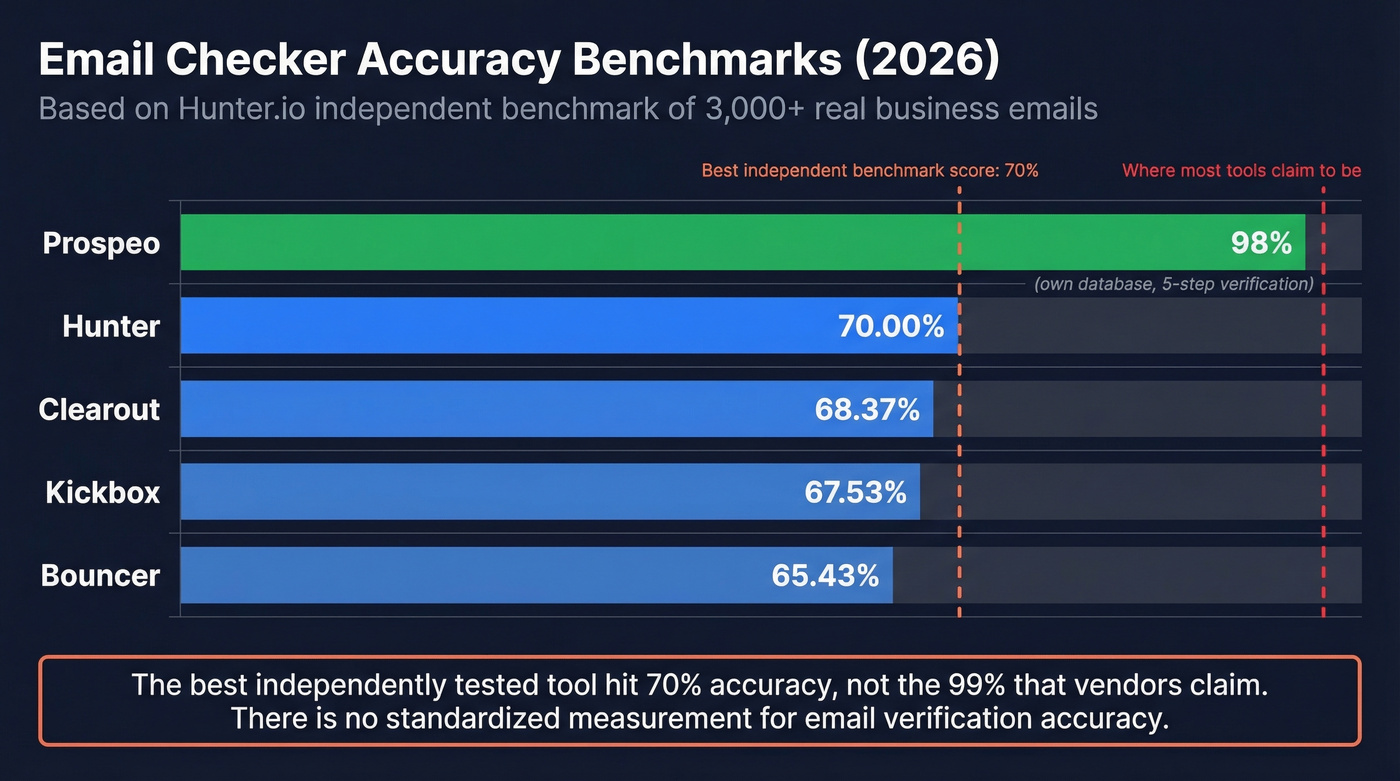
The top performers:
| Tool | Overall Accuracy |
|---|---|
| Hunter | 70.00% |
| Clearout | 68.37% |
| Kickbox | 67.53% |
| Bouncer | 65.43% |
Let that sink in. The best tool in the benchmark hit 70%. Not 99%. Not 95%. Seventy percent.
Accuracy drops further on mid-market and enterprise domains, where stricter mail server configurations and catch-all setups make verification harder. Accept-all and unknown results are unavoidable - they're a feature of how email infrastructure works, not a bug in the verifier.
Why "99% Accuracy" Is Marketing
There's no standardized measurement for email verification accuracy. When a tool claims "99% accuracy," they're using their own dataset, their own definition of accuracy, and their own methodology. As emailvendorselection.com notes, most accuracy and speed figures in the market are self-reported.
Hunter's benchmark has its own bias - the dataset comes from "authentic email activity patterns observed recently on Hunter," which likely advantages Hunter's own tool. But at least they published the methodology and raw data. That's more transparency than you'll get from most vendors.
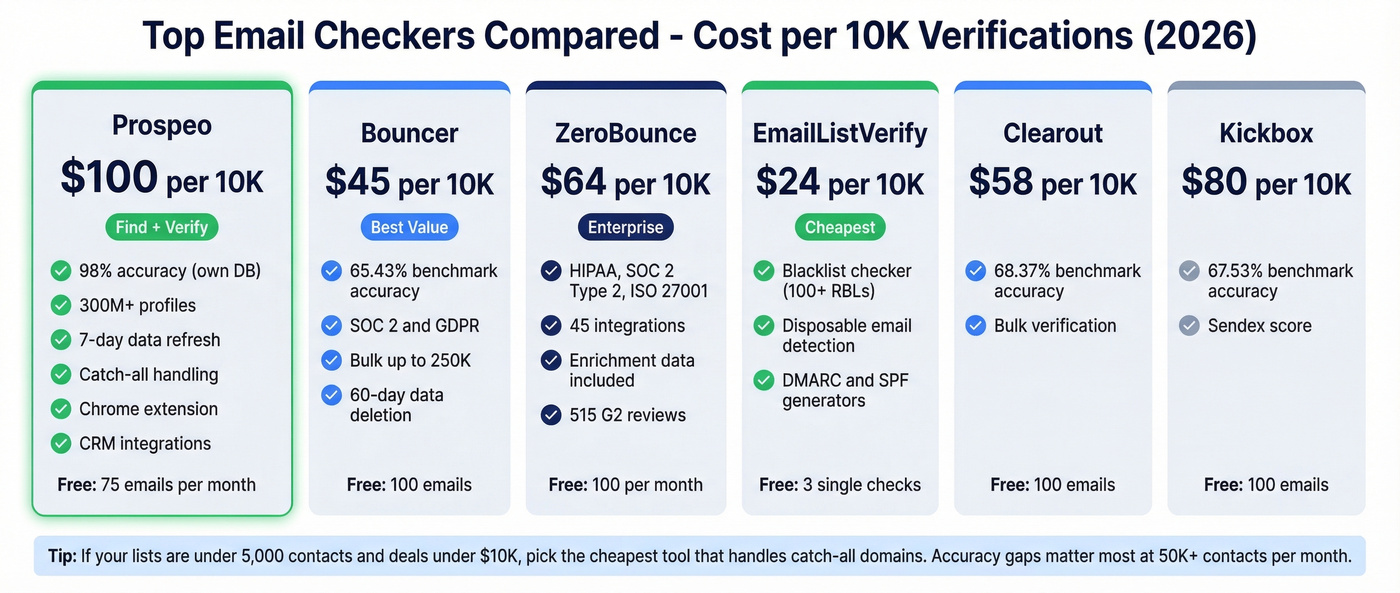
If your average deal size is under $10K and your lists are under 5,000 contacts, the difference between a 65% and 70% accurate verifier won't move the needle. Pick the cheapest tool that handles catch-all domains and move on. Where accuracy truly matters is at scale - 50K+ contacts per month - where a 5-point accuracy gap means thousands of extra bounces compounding against your sender reputation.
Best Email Checkers Compared (2026)
| Tool | Cost/10K | Free Tier | Benchmark Accuracy | Best For |
|---|---|---|---|---|
| Prospeo | ~$100/10K | 75/mo | 98% (own DB) | Finding + verifying |
| Bouncer | $45 | 100 | 65.43% | Overall value |
| ZeroBounce | $64 | 100/mo | Not in benchmark | Enterprise compliance |
| EmailListVerify | $24 | 3 single | Not in benchmark | Budget bulk |
| Emailable | $50 | 250 | Not in benchmark | Credit flexibility |
| Clearout | $58 | 100 | 68.37% | Raw accuracy |
| Kickbox | $80 | 100 | 67.53% | Accuracy at premium |
| NeverBounce | $50 | 10 | Not in benchmark | Bulk pricing |
| Hunter | $149 | 50-100/mo | 70.00% | Email finding users |
| MillionVerifier | $37/mo | - | Not in benchmark | Budget subscription |
| Verifalia | Free online | Free online checker | Not in benchmark | Free single checks |
Prospeo - Find and Verify in One Step
Most verification tools solve a downstream problem: you already have bad emails, and now you need to clean them. Prospeo solves the upstream problem instead. Its database of 300M+ professional profiles includes 143M+ verified emails, all run through a 5-step verification process with catch-all handling, spam-trap removal, and honeypot filtering. You get verified data at the point of collection, not someone else's mess to clean up afterward.
The 7-day data refresh cycle matters because the industry average is 6 weeks. Most databases serve you contacts who changed jobs a month ago. Weekly refresh keeps the data current enough that re-verification becomes maintenance, not triage. The Chrome extension (40,000+ users) lets you verify emails one at a time from any website, and native integrations with Salesforce, HubSpot, Smartlead, Instantly, Lemlist, Clay, Zapier, and Make slot into existing workflows.
Pricing runs about $0.01 per email, with a free tier of 75 emails plus 100 Chrome extension credits monthly. No contracts, self-serve signup.
Bouncer - Best Overall Value
Use this if: You need a reliable standalone verifier with SOC 2 and GDPR compliance, bulk uploads up to 250K emails, and data deletion after 60 days. The compliance story matters if you're in regulated industries or selling into the EU.
Skip this if: You need email finding bundled with verification. Bouncer is verification-only - you'll need a separate data source.
At $45 per 10K verifications, Bouncer scored 65.43% in Hunter's independent benchmark - top four. G2 ratings of 4.8/5 across 232 reviews and Capterra at 4.9/5 across 233 reviews confirm real user satisfaction. It's the tool we'd hand to someone who says "just tell me what to buy for list cleaning." (If you're comparing options, see Bouncer alternatives.)
ZeroBounce - Enterprise Compliance
ZeroBounce is the tool you pick when your legal team has opinions about your tech stack.
Healthcare orgs needing HIPAA compliance. Finance teams requiring SOC 2 Type 2 and ISO 27001. Government-adjacent companies where a security questionnaire is longer than the sales cycle. If none of those describe you, Bouncer gives you 80% of the compliance story at 70% of the price.
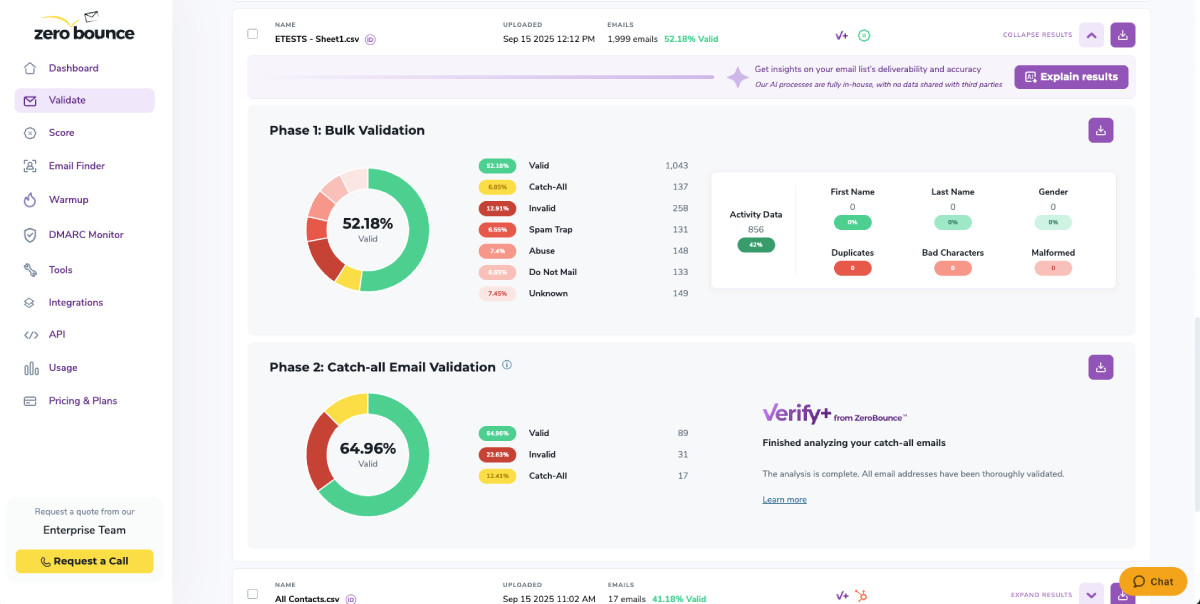
At $64 per 10K, it's one of the most enterprise-ready standalone verifiers on the market, with 45 integrations and enrichment data (name, gender, IP location) bundled into results. The 100 free monthly verifications let you test before committing. ZeroBounce also publishes an annual email statistics report that's genuinely useful for benchmarking. G2 rating of 4.7/5 across 515 reviews.
EmailListVerify - Best Budget Option
At $24 per 10K verifications, EmailListVerify is the cheapest bulk option by a wide margin. The free tier is stingy - just 3 single-email checks - but the paid pricing is hard to beat for large lists on a tight budget. The broader toolbox includes a disposable email checker, blacklist checker against 100+ RBLs, MX lookup, and DMARC/SPF generators. (If you're tightening deliverability, pair this with email reputation tools.)
The tradeoff: EmailListVerify wasn't included in Hunter's benchmark, so there's no independent accuracy data. In our experience, it performs adequately on clean B2B lists, but catch-all handling is less sophisticated than Bouncer or ZeroBounce.
Emailable - Best Credit Policies
Credits never expire, unknown results get refunded back to your balance, and subscriptions save 15% over pay-as-you-go. At $50 per 10K, it's mid-range on price, with the most generous free tier among standalone verifiers at 250 credits. Speed is a differentiator too - Emailable processes 10K verifications in 2-3 minutes. If you're running verification on an irregular schedule, like quarterly list cleans rather than daily API calls, the never-expire credit policy saves you from wasting prepaid verifications.
Clearout
Strong accuracy - 68.37% in Hunter's benchmark, second overall. At $58 per 10K with subscriptions from $21/mo, it's competitively priced for its accuracy tier. A solid middle-ground pick when accuracy matters more than price. 100 free verifications to start.
Kickbox
$80 per 10K puts Kickbox at the premium end for a tool that scored 67.53% - third overall. Accurate, but Bouncer delivers similar benchmark performance at nearly half the cost. Hard to justify unless you're already locked into Kickbox's ecosystem.
NeverBounce
$50 per 10K with bulk rates starting at $0.008/email. Only 10 free verifications, barely enough to test. The consensus in r/software threads is that it's a solid pick, though no independent benchmark data is available to confirm.
Hunter
Hunter scored highest in its own benchmark at 70%, but verification costs $149 per 10K - the most expensive option on this list by far. That pricing only makes sense if you're already using Hunter for email finding and want everything in one platform. For verification-only use cases, you're overpaying significantly. (If you're shopping around, check Hunter alternatives.)
MillionVerifier
Budget subscription option starting at $37/mo. Reddit users in r/software have ranked it as a top pick for high-volume use. Limited independent benchmark data, so accuracy is harder to evaluate. Worth testing if you're processing high volumes and need predictable monthly costs.
Verifalia
Claims 30+ verification steps, including support for internationalized email addresses. No independent benchmark data, and pricing scales steeply for bulk use. Best as a free spot-check tool rather than a production verifier.
What to Do With Your Results
Valid and Invalid - Easy Calls
Valid emails go into your sequence. Invalid emails get removed immediately - no exceptions, no "let's try anyway." Every invalid address you send to is a hard bounce that chips away at your sender reputation. Delete them from your CRM or suppress them permanently. (For deeper benchmarks and fixes, see email bounce rate.)
Risky, Unknown, and Catch-All
This is where most teams make mistakes.
A "risky" result means the tool detected something concerning but couldn't confirm the address is dead. Segment these contacts separately and send with careful monitoring - watch bounce rates in real time and pull the segment if bounces spike above 2%.
Unknown results mean the mail server wouldn't cooperate during verification. Re-verify these in 48 hours - greylisting and rate limiting often resolve on retry. If they come back unknown a second time, exclude them from cold campaigns. The risk isn't worth it.
Catch-all addresses are the trickiest category. The domain accepts everything, so the verifier can't tell if the specific mailbox exists. In our testing, catch-all domains account for 20-40% of enterprise prospect lists. Treat these as risky: send only to high-value prospects where you've confirmed the email pattern through other signals, and track engagement closely.
Data quality at the source determines how much triage you'll do here. Tools that handle catch-all verification and spam-trap removal before you ever see the email reduce the volume of ambiguous results dramatically. Instead of cleaning up 30% risky results from a cheap database, you start with data that's already been through the hard verification steps.
How Often Should You Verify?
Email databases decay by at least 25% annually. People change jobs, companies get acquired, mail servers get reconfigured. A list that was clean in January can lose a big chunk of validity within months.
The minimum re-verification cadence for any active outbound team is quarterly. For daily sequences, monthly is better. And if you're running high-volume cold email - thousands of contacts per week - verify every list before every send. The cost of verification is trivial compared to the cost of rebuilding a burned domain. (If you're scaling outbound, also watch email velocity.)
Let's be honest: the best approach is one where you rarely need a standalone checker at all. If your data source refreshes weekly and verifies at collection, you're maintaining list quality rather than rescuing it. The results speak for themselves: Meritt went from a 35% bounce rate to under 4% and tripled pipeline from $100K to $300K per week. Snyk dropped from 35-40% bounce rates to under 5% across 50 AEs, generating 200+ new opportunities per month. Both fixed the data source rather than bolting on more verification after the fact.
Catch-all domains, greylisting, and decaying lists shouldn't be your problem. Prospeo refreshes 300M+ profiles every 7 days - not every 6 weeks - so the emails you pull are verified and current before you hit send.
Launch your next sequence without the 11 PM panic.
FAQ
Are free email checkers accurate enough?
Free tiers - typically 3 to 250 checks - work fine for spot-checking individual addresses before manual outreach. For lists over 1,000 emails, paid verification is essential. Free tools lack bulk processing and multi-pass catch-all handling. Prospeo's free tier (75 emails/month) includes full verification; Emailable offers 250 credits. Either beats a damaged sender reputation.
What's the difference between email verification and email validation?
The terms are used interchangeably across the industry. Technically, "validation" checks format and syntax while "verification" confirms the mailbox exists via SMTP. Every modern tool does both steps automatically. The distinction is marketing, not functional - don't let a vendor upsell you on one when you're already getting both.
Can an email checker guarantee zero bounces?
No. Verification is a point-in-time check. A valid email today can bounce tomorrow if the recipient changes jobs, the mailbox fills up, or the domain changes its server configuration. Quarterly re-verification is the minimum mitigation. Even then, expect a small percentage of bounces on any send.
How do I verify an email address without sending a message?
Use any SMTP-level verification tool - paste the address, and it connects to the recipient's mail server, simulates the delivery handshake, and reports whether the mailbox exists. No actual email is delivered. This protects your sender reputation while giving you a deliverability signal in seconds.
Do email checkers work with catch-all domains?
Most tools flag catch-all domains as "accept-all" without further analysis - unhelpful when 20-40% of enterprise prospect lists sit on catch-all domains. Better tools use risk scoring and pattern analysis to differentiate likely-valid from likely-invalid addresses. If you're selling into mid-market or enterprise, catch-all handling should be a top selection criterion.
Verify before you send, or better yet, start with data that's already verified. The tools exist. The benchmarks are public. The only thing standing between you and a clean list is the 10 minutes it takes to run your contacts through a reliable email checker.