

Email Checker Info: What Free Verification Tools Actually Get Right (and Wrong)
You pasted an email address into a free checker, hit verify, and got back "unknown." Not invalid. Not valid. Just... unknown. If you've been trying to figure out what went wrong, the answer is probably none of the above - and the real problem is more interesting than you'd expect.
What You Need (Quick Version)
- EmailChecker.info works for quick spot-checks but lacks API access, integrations, and published accuracy data. It's fine for one address. It's not a workflow.
- The largest published benchmark shows the best email verifiers top out at ~70% accuracy - not the 99% every tool claims.
What Is EmailChecker.info?
Use this if you need to quickly check a single contact's email before sending a message. Paste it in, get a result, move on. It's free, requires no signup, and does exactly what you'd expect - pings the mail server and checks whether the mailbox exists.
Beyond single checks, EmailChecker.info offers bulk verification, email extraction from domains and websites, and list-cleaning features like spam-trap removal. There's also a grab bag of unrelated tools - QR generators, YouTube Shorts downloaders, link extractors - which tells you this isn't a focused verification company. It's a free-tools aggregator.
Skip this if you need API access, CRM integrations, deliverability analytics, or any kind of support. EmailChecker.info doesn't publish clear accuracy methodology, and it doesn't provide much in the way of privacy, retention, or company details on the main checker experience. Bouncer's assessment calls out these gaps directly. If you're handling prospect data under GDPR or similar regulations, uploading lists to a tool without documented data-handling policies is a risk you shouldn't take.
Don't confuse EmailChecker.info with email-checker.net. They're separate tools with different interfaces and verification approaches, but they show up interchangeably in search results, which causes real confusion. Email-checker.net publishes a clearer verification flow explanation and includes a privacy assurance that submitted addresses aren't shared.
How Email Verification Works
Most verification tools - free or paid - run some version of the same five-stage pipeline. Some advertise "30+ verification steps," but those are sub-checks within these core stages. What separates tools is execution quality, not step count.
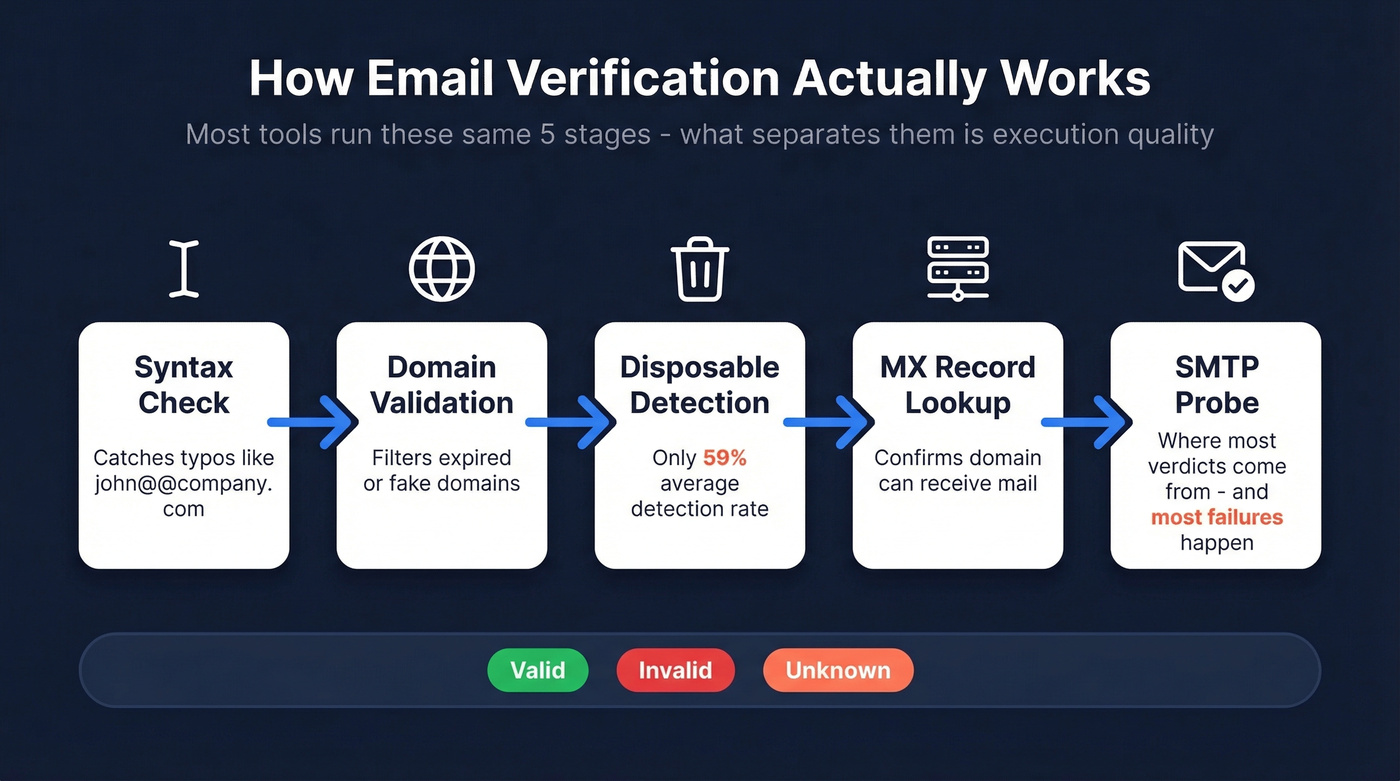
- Syntax check. Does the address follow valid formatting rules? Catches typos like "john@@company.com" or missing domains.
- Domain validation. Does the domain exist? Filters out expired or nonexistent domains.
- Disposable detection. Is this a throwaway address from Guerrilla Mail or Temp Mail? A Reddit benchmark of 17 tools found the average detection rate is just 59%.
- MX record lookup. Does the domain have mail exchange records configured to receive email?
- SMTP probe. The tool simulates sending a message and reads the server's response. This is where most verdicts come from - and where most failures happen.
Some tools use 18 different status classifications, while others reduce everything to valid/invalid/unknown. That's one reason the same email gets different labels across tools.
If you're comparing tools, it's also worth separating verification from broader email deliverability work (sender reputation, authentication, throttling, etc.).
Why Checkers Return "Unknown"
That "unknown" result isn't a bug. It's the tool admitting it can't tell.
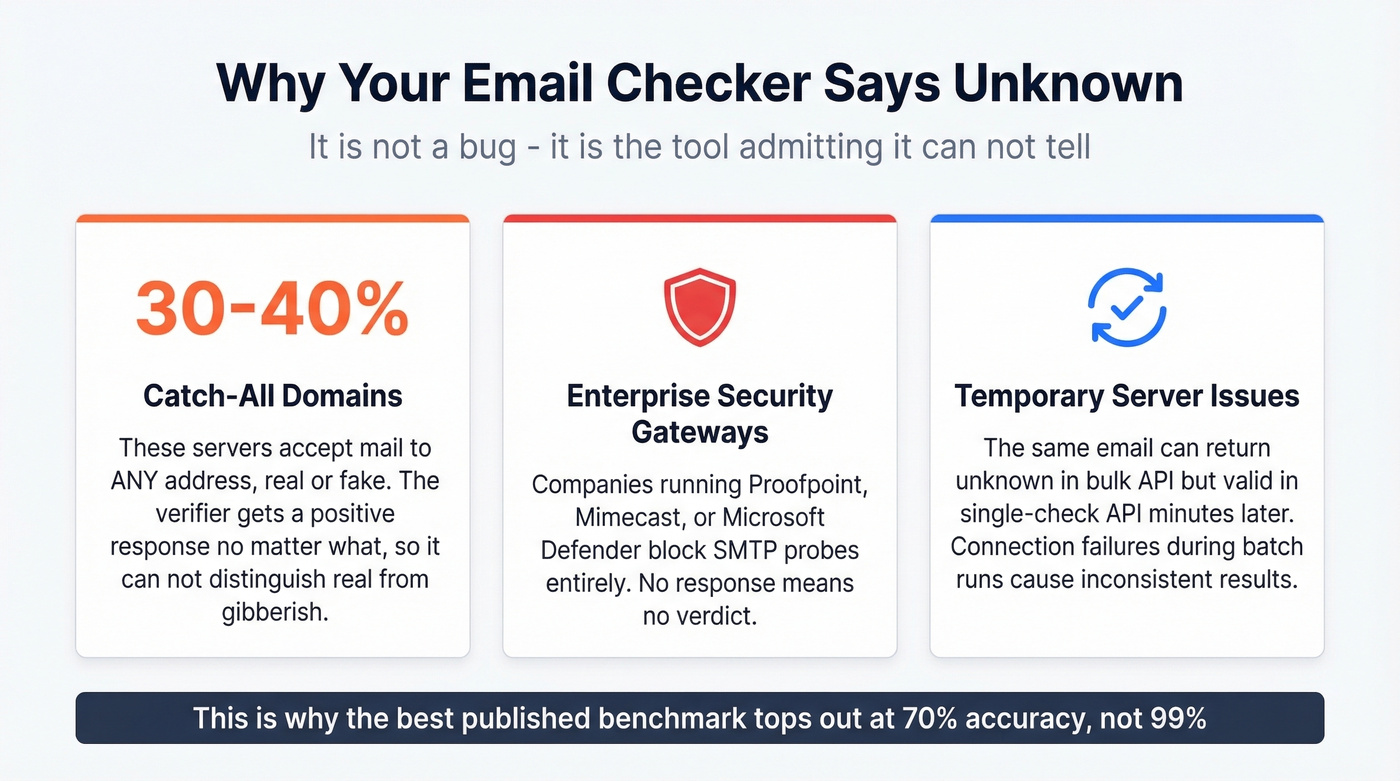
Catch-all domains are the biggest culprit. Between 30 and 40 percent of B2B email addresses sit on catch-all domains - servers configured to accept mail sent to any address, real or fake. The verifier sends an SMTP probe, the server responds "250 OK" regardless, and the tool can't distinguish john.smith@company.com from gibberish@company.com. That's not a tool failure. It's a protocol limitation.
Enterprise security gateways block probes. Companies running Proofpoint, Mimecast, or Microsoft Defender often block SMTP verification attempts entirely. The verifier never gets a response, so it can't make a determination.
Temporary server issues create inconsistencies. One Reddit user documented a known-valid Yahoo address returning "unknown" in MillionVerifier's bulk API but "ok" in their single-check API. MillionVerifier's support confirmed the discrepancy was due to a temporary connection failure during the bulk run. Same tool, same email, different results minutes apart.
If you keep seeing inconclusive results, it helps to understand how to check if an email exists and when "unknown" is the expected outcome.

Catch-all domains, unknown results, 70% accuracy ceilings - these problems exist because you're verifying emails after the fact. Prospeo's 143M+ emails are pre-verified through a proprietary 5-step process with catch-all handling, spam-trap removal, and honeypot filtering. 98% accuracy. Refreshed every 7 days.
Stop cleaning bad data. Start with emails that are already verified.
How Accurate Are Free Verification Tools?
Here's the thing every verification tool's marketing page conveniently omits: the largest published benchmark shows a top accuracy of 70%, not 99%.
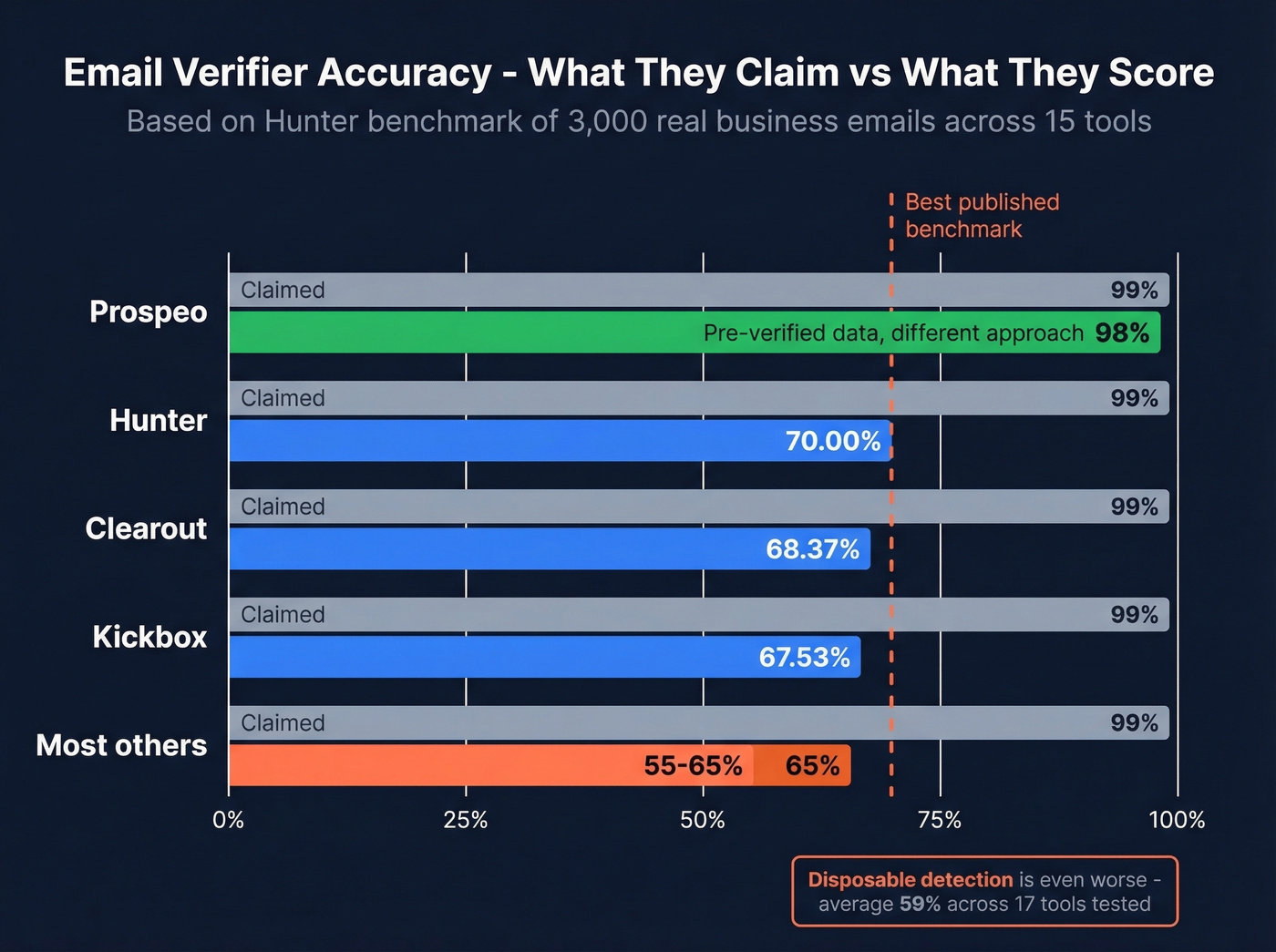
Hunter benchmarked 15 verifiers using 3,000 real business emails segmented by company size. Hunter scored 70.00%, Clearout hit 68.37%, Kickbox came in at 67.53%. Everyone else was lower. In our testing, the gap between claimed and actual accuracy is even wider on enterprise domains - precisely because those companies run the security gateways and catch-all configurations that defeat SMTP probes.
Disposable detection is even worse. That Reddit benchmark of 17 tools found only 1 out of 17 caught all 16 disposable providers tested. The average was 59%. Several expensive enterprise tools - including NeverBounce and MillionVerifier - performed worse than free alternatives in that disposable-detection test.

Look, if your bounce rate is already under 2%, you probably don't need a standalone verification tool at all. You need cleaner source data. The entire verification industry exists because prospecting tools ship bad emails - then charge you again to clean them up. That's a tax on bad data, not a real solution.
If bounces are your main pain, start with the mechanics of email bounce rate and what actually moves it.
What Checkers Actually Cost
| Tool | Free Tier | Cost per 1K | Best For |
|---|---|---|---|
| EmailChecker.info | Free single checks | Not public | Quick spot-checks |
| Hunter | 100/mo | ~$24.50 | Small-biz prospecting |
| ZeroBounce | 100 credits | $10 (2K min) | Marketing list hygiene |
| NeverBounce | 1,000 credits | $8 | Mid-volume pay-as-you-go |
| Bouncer | 1,000 credits | $7 | Budget verification |
| BriteVerify | None | ~$10 | Enterprise compliance |
| MillionVerifier | None | ~$3.70 | Cheapest bulk option |
| DeBounce | None | $1.50-2 | Budget high-volume |
| Prospeo | 75 emails/mo | ~$10 | Pre-verified outbound data |
Prospeo's pricing model works differently - you pull emails that are already verified from a 143M+ database refreshed every 7 days, rather than uploading a list and paying to clean it.
The Reddit sentiment on verification pricing is blunt. One highly upvoted thread calls the market "a scam," citing $25-$75 to validate 10K emails. That frustration makes sense when 30-40% of B2B lists sit on catch-all domains, driving "unknown" results no matter which verifier you use.
If you're evaluating vendors, a broader comparison of data enrichment services can help you decide whether to verify, enrich, or replace the source list entirely.
How to Use Checkers Correctly
Even the best verification tool won't save you if you use it wrong.
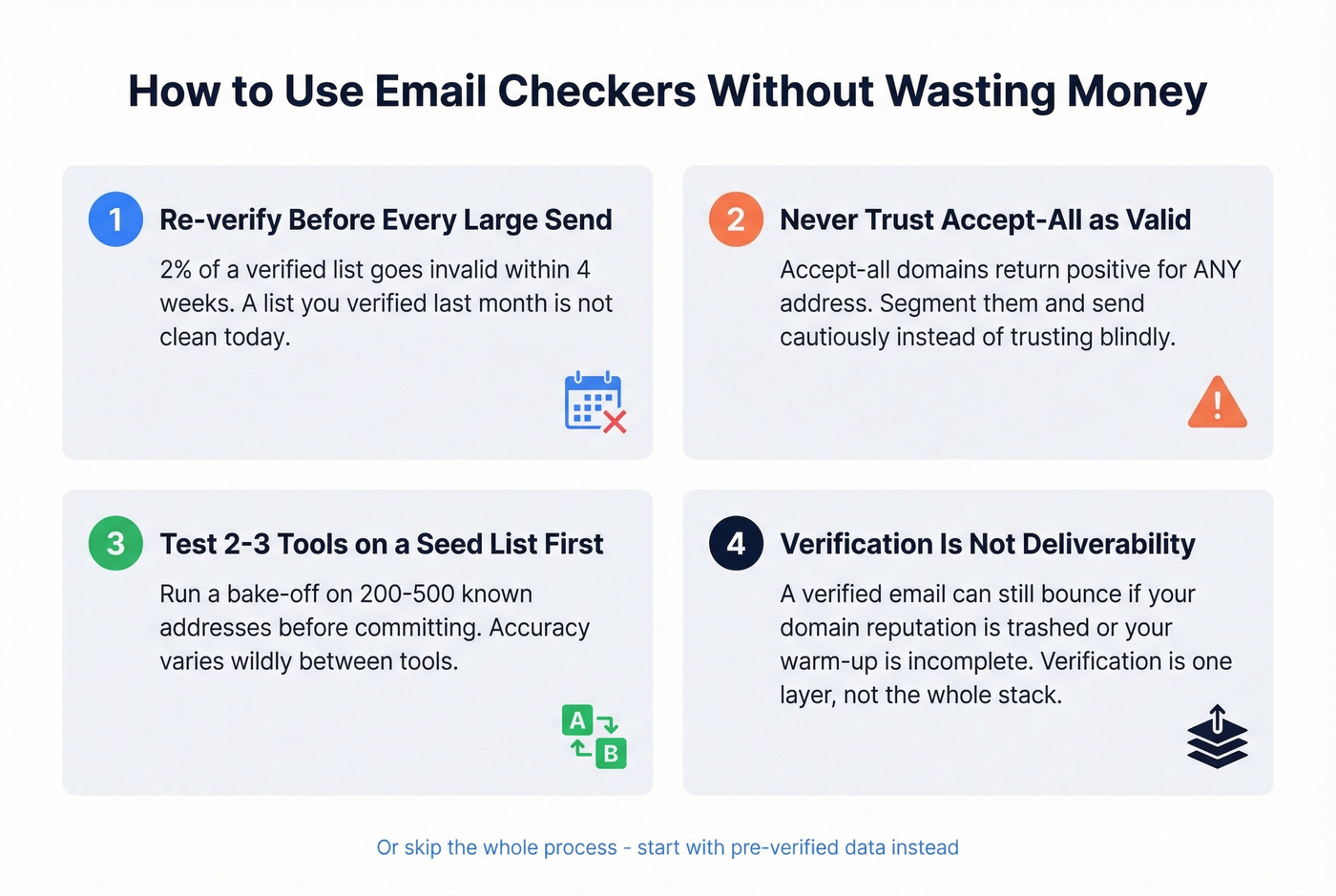
Re-verify before every large send. About 2% of a verified list goes invalid within four weeks due to job changes and deactivated accounts. A list you verified last month isn't clean today. Industry benchmarks vary - Business & Finance averages a 0.55% bounce rate, while Construction runs 1.28% - so your threshold depends on your vertical.
Don't treat "accept-all" as "valid." Accept-all domains return a positive result for any address. Segment them and send cautiously rather than trusting the result blindly.
Test 2-3 tools on a seed list before committing. Given the accuracy variance between tools, running a small bake-off on 200-500 known addresses saves you from picking the wrong one. We've seen teams skip this step and regret it within a week.
Verification isn't deliverability. A verified email can still bounce if your domain reputation is trashed or your warm-up is incomplete. Verification is one layer, not the whole stack.
If you're sending cold outbound, it also helps to control email velocity so you don't create deliverability problems that verification can't fix.
Better Alternatives to Free Checkers
Prospeo
Stop thinking about email verification as a separate step. Prospeo's 143M+ verified email database means you pull contacts that have already passed a 5-step verification pipeline - including catch-all handling, spam-trap removal, and honeypot filtering. The 98% accuracy rate comes from proprietary infrastructure and a 7-day data refresh cycle, not SMTP probes against unknown servers.
Stack Optimize built from $0 to $1M ARR using Prospeo data, maintaining 94%+ deliverability and under 3% bounce rates across all clients with zero domain flags. That's what pre-verified data looks like in production.
Free to start - 75 emails/month, no credit card. Paid plans run ~$0.01/email with no contracts.
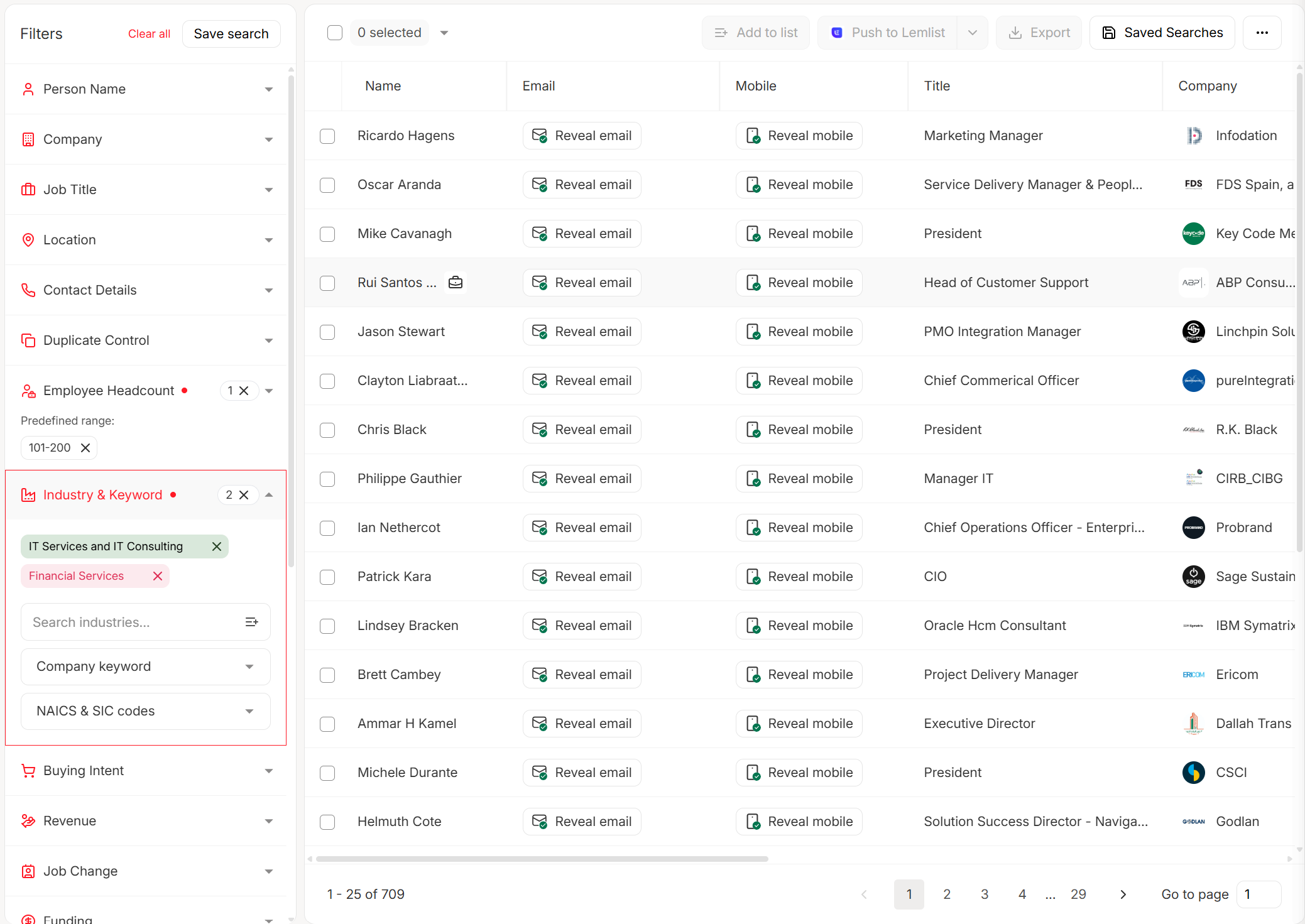
If you're building outbound lists at scale, compare this approach to traditional sales prospecting databases that still require cleanup.
Hunter
At $24.50 per 1K verifications, Hunter is expensive for pure verification - but the bundled email finder makes it useful if you're already in their ecosystem. They scored highest in their own benchmark at 70%, and the 100 free verifications/month work for light usage. We've found it most valuable for small teams who want finding and verification in one tab.
If you're shopping around, see how other tools stack up in our Hunter alternatives breakdown.
ZeroBounce
Skip this for outbound prospecting. ZeroBounce shines for marketing teams focused on list hygiene - their AI-powered scoring system helps segment risky addresses rather than just flagging valid/invalid. At $10 per 1K with a 2K minimum purchase, it's mid-range. The 100 free credits let you test before buying.
Budget Options: Bouncer, MillionVerifier, DeBounce
These three cover the budget end. Bouncer ($7/1K) has generous 1,000 free credits. MillionVerifier ($3.70/1K) is the cheapest bulk option, though be aware of documented inconsistencies between their bulk and single-check APIs. DeBounce ($1.50-2/1K) is the rock-bottom choice for high-volume jobs where you'll trade some accuracy for price.
If you're specifically comparing verification vendors, our guide to Bouncer alternatives is a good starting point.
You're paying twice - once for prospecting tools that ship bad emails, then again for verification tools to clean them up. Prospeo eliminates both steps at ~$0.01 per email. Pre-verified data from 300M+ profiles, no separate cleaning step required.
Kill the verification tax. Get accurate emails from the source.
FAQ
Is EmailChecker.info safe to use?
For a quick single-address spot-check, it's fine - but the site doesn't publish clear privacy, data-retention, or company details. Don't upload sensitive prospect lists or anything covered by GDPR without documented data-handling policies.
What does "catch-all" mean in verification?
A catch-all domain accepts mail to any address, real or fake, so SMTP probes can't distinguish valid mailboxes from nonexistent ones. Results come back "unknown" or "accept-all." This affects 30-40% of B2B emails, making it the single biggest source of inconclusive results.
How often should I re-verify my email list?
Re-verify before every large send, or monthly at minimum. About 2% of addresses go invalid within four weeks due to job changes and deactivated accounts. Keep total bounces under 2%, ideally below 1%.
Free vs. paid - when does it matter?
Free checkers handle one-off spot-checks well. At 500+ contacts, the cost of bounces - domain reputation damage, ESP suspension risk - far exceeds $5-10 for proper verification. Prospeo's free tier bridges the gap for small teams who need verified data without upfront cost.
Why do different checkers give different results for the same email?
Temporary server outages, rate limiting, catch-all configurations, and enterprise security gateways all cause tools to disagree. Testing the same address minutes apart can produce different verdicts on the same tool. Always cross-check critical addresses with 2-3 tools.