Email Deliverability Specialist: What They Do, What They Cost, and Whether You Need One
Your SDR team just sent 5,000 cold emails. 1,800 landed in spam. Another 200 bounced outright. The sequences look great, the copy is sharp, and the targeting is dialed - but none of it matters when three out of five emails never reach a human inbox.
That's not a hypothetical. Across millions of tests, only 60% of emails hit the visible inbox. The other 40% vanished into spam folders, got blocked, or simply disappeared. An email deliverability specialist exists to fix exactly this problem - and with Gmail tightening filters every quarter, demand for these experts is at an all-time high.
What You Need (Quick Version)
What does a deliverability specialist do?
They diagnose why your emails hit spam, fix the technical and reputational issues causing it, and monitor ongoing inbox placement.
What do they cost?
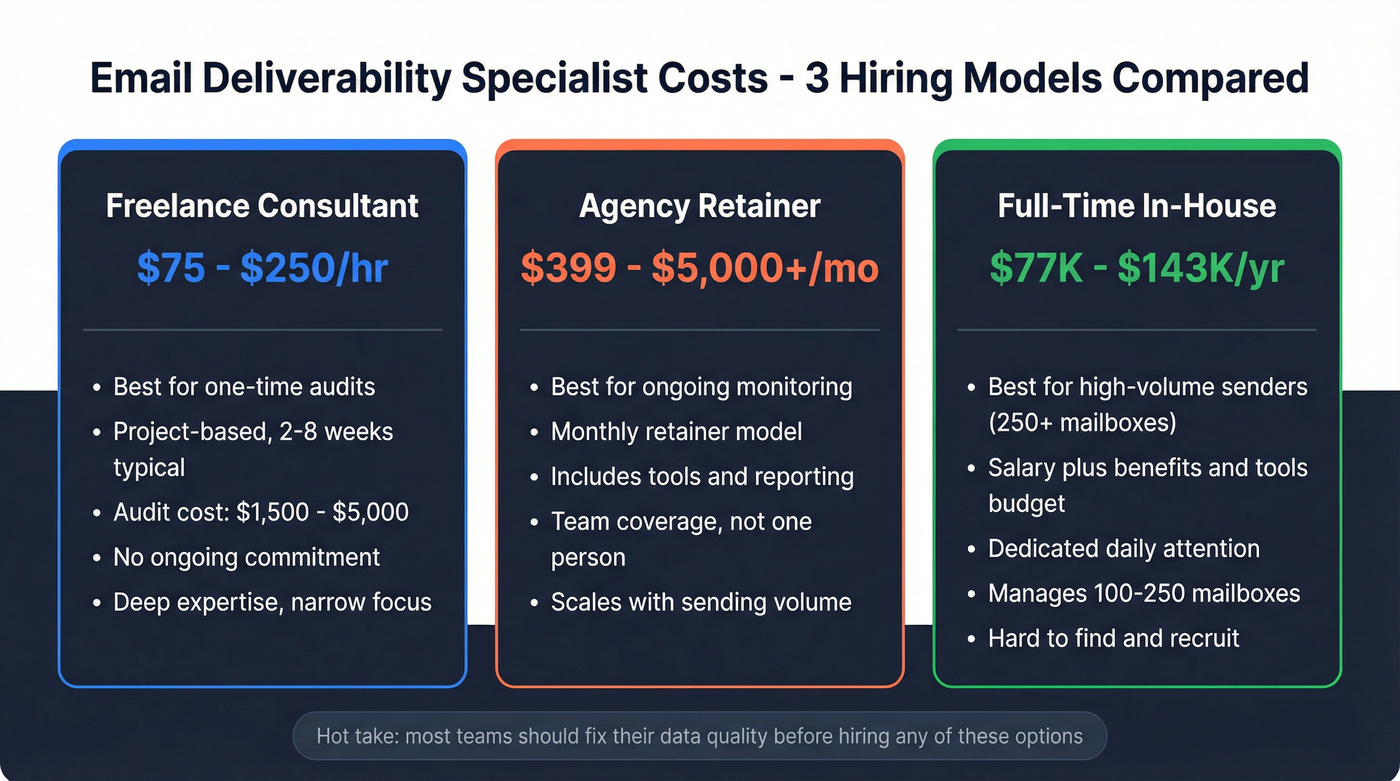
Freelancers run $75-$250/hr. Agencies often start around $399/mo on retainer and can run $5,000+/mo depending on volume and scope. A full-time hire costs $77K-$143K/yr total comp.
Do you need one?
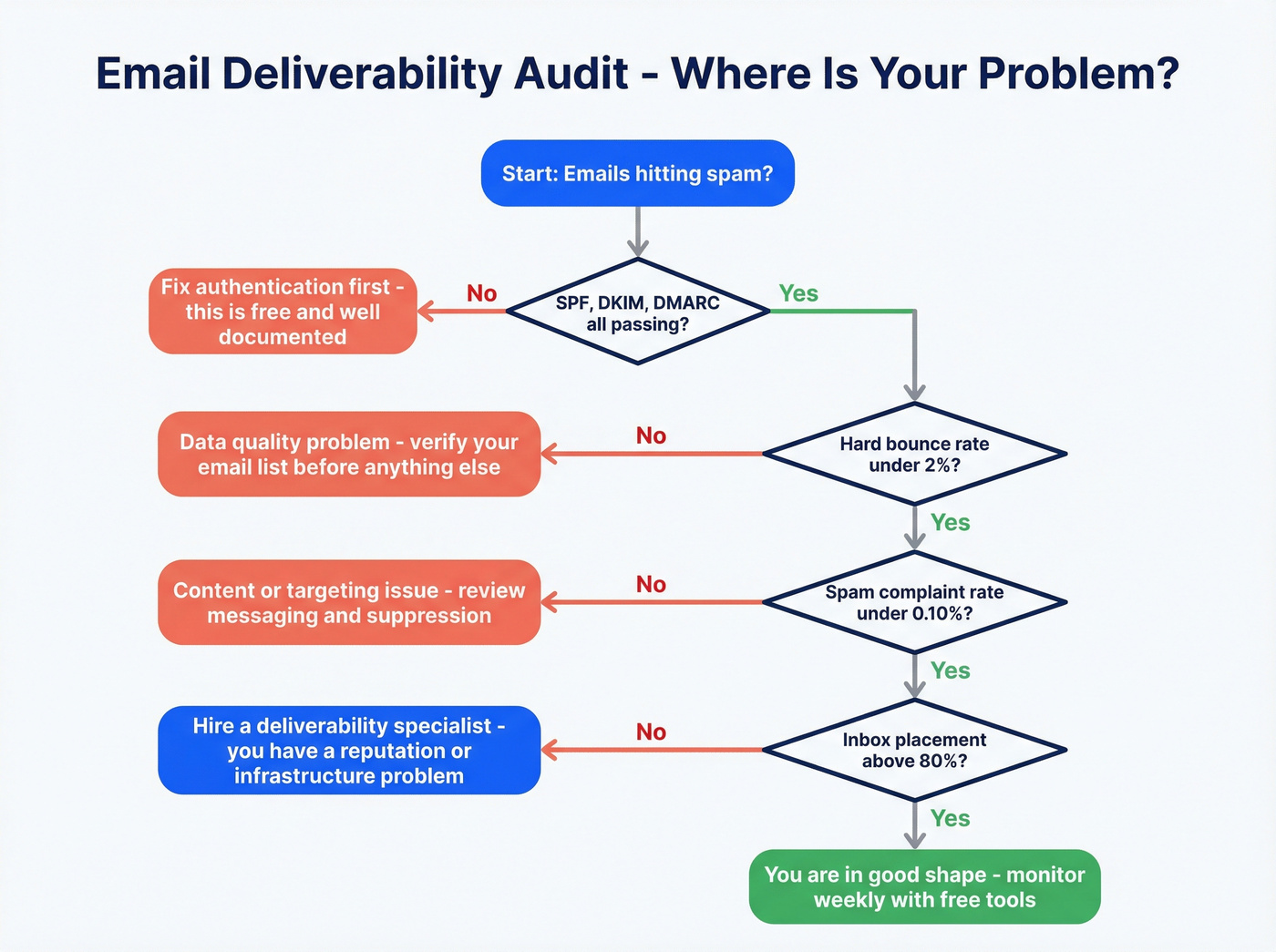
If your hard bounce rate is above 2%, your spam complaint rate exceeds 0.10% on Gmail, or your inbox placement has dropped below ~80%, yes.
What Does This Role Actually Involve?
An email deliverability specialist is a technical role focused on one thing: making sure your emails reach the recipient's visible inbox, not their spam folder or the void.
The critical distinction most people miss is delivery versus deliverability. Delivery means the receiving server accepted your email at the SMTP level - it didn't hard bounce. Deliverability means the email actually landed in the inbox where a human can see it. You can have a 98% delivery rate and still watch 36% of your mail get routed to spam.
That gap is exactly what the 2026 benchmark dataset revealed: senders scored an average health score of 86 out of 100, yet only 60% of emails reached the visible inbox. The health score looked fine. The inbox placement was terrible. A deliverability expert lives in the space between those two numbers, working across authentication protocols like SPF, DKIM, DMARC, and sometimes BIMI, while also managing sender reputation, list hygiene, ISP relationships, and compliance frameworks. It's part sysadmin, part data analyst, part diplomat.
Why Deliverability Expertise Matters More in 2026
The Numbers Are Ugly
The benchmark data from millions of email tests tells the story plainly: 60% inbox, 36% spam, 4% blocked or missing. More than a third of all emails tested ended up in spam.
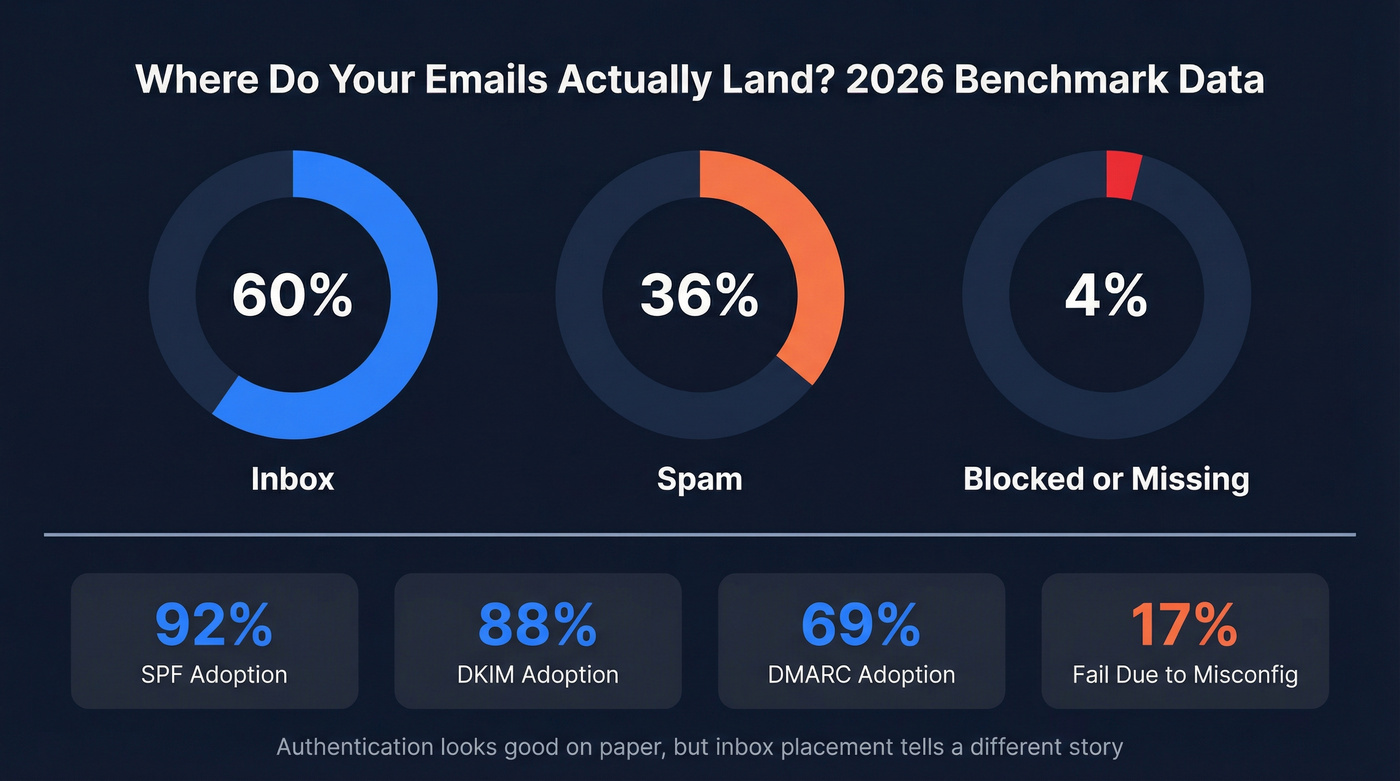
Here's the paradox. Authentication adoption is actually high - SPF sits at 92%, DKIM at 88%, DMARC at 69%. Senders are doing the "right things" on paper. Yet even fully authenticated mail still saw 30%+ spam placement in many cases. Nearly 17% of emails fail to reach inboxes due to misconfigured protocols, meaning even senders who think they've set things up correctly often haven't. Authentication is necessary but nowhere near sufficient.
The other stats are worse. Only 26% of emails passed HTML structure compliance checks, and poor structure made emails 18-25% more likely to land in spam. List-Unsubscribe header adoption? Just 14% compliant. These aren't edge cases. They're the majority of senders failing basic hygiene.
Gmail and Yahoo Forced a Compliance Overhaul
In February 2024, Gmail and Yahoo rolled out bulk sender requirements that reshaped the rules for anyone sending more than 5,000 emails per day. SPF, DKIM, and DMARC became mandatory - not recommended, mandatory. Spam complaint rates got a hard ceiling of 0.3%, with Gmail recommending under 0.10%. One-click unsubscribe via RFC 8058 became required, with unsubscribes honored within two days.
Enforcement has only tightened since. Gmail's inbox placement rate peaked at 87.5% in early 2025, then declined to 63.5% by December 2025. The filters are getting stricter, not looser. That's why the deliverability consultant role has shifted from "nice to have" to "your outbound program depends on this."
Here's our hot take: most outbound teams don't actually have a deliverability problem - they have a data quality problem masquerading as one. They hire a specialist to fix infrastructure when the real issue is they're sending to 30% invalid addresses from a stale list. Fix the data first. If inbox placement is still bad, then bring in a consultant.
Day-to-Day Work of a Deliverability Expert
Proactive and Reactive Modes
The work breaks into two modes: proactive monitoring and reactive firefighting.
On the proactive side, a specialist watches dashboards daily. Google Postmaster Tools, Microsoft SNDS, and Yahoo Sender Hub are the free trifecta - every deliverability professional has these open. They're tracking domain and IP reputation, bounce rates, spam complaint rates, and authentication pass rates across providers.
When something goes wrong - and something always goes wrong - the reactive work kicks in:
- Blacklist monitoring and remediation
- Diagnosing sudden spam placement spikes
- Managing IP and domain warming for new sending infrastructure
- Running list hygiene passes to suppress invalid contacts
- Contacting ISP postmasters directly to resolve blocking issues
A single experienced specialist typically manages 100-250 mailboxes, depending on sending volume and infrastructure complexity. If you're running more than that, you need a team, not a person.
What a Specialist Can't Do
Let's set realistic expectations before you hire. A specialist can't force ISPs to inbox your mail - no one can. They can't guarantee 100% inbox placement, and they can't fix fundamentally bad content or targeting. If your emails are spammy, no amount of infrastructure tuning will save them. The specialist optimizes the technical envelope; you still own the message inside it.
The Deliverability Audit Checklist
Here's what a consultant checks during an audit, with the pass thresholds that matter:
| Category | Check | Pass Threshold |
|---|---|---|
| SPF | DNS lookups | ≤10 lookups, end with -all or ~all |
| DKIM | Key strength + alignment | ≥1024-bit (2048 recommended), aligned to From |
| DMARC | Policy level | p=quarantine or p=reject |
| Domain | Age | 30+ days (90+ preferred) |
| Warmup | Ramp schedule | 14+ days, start 10-20/day |
| Bounces | Hard bounce rate | Under 2% |
| Complaints | Spam complaint rate | Under 0.10% (0.3% ceiling for bulk senders) |
| List hygiene | Inactive suppression | 90-180 day window |
| Headers | List-Unsubscribe | Present + RFC 8058 |
| Unsubscribes | Processing time | Within 2 days |
If you're failing three or more of these checks, you don't need a specialist to tell you there's a problem. But you might need one to fix it without making things worse.

You read it above: hard bounce rates above 2% destroy sender reputation. Prospeo's 5-step email verification - with catch-all handling, spam-trap removal, and honeypot filtering - delivers 98% accuracy. That's why teams using Prospeo cut bounce rates from 35%+ to under 4%.
Stop hiring specialists to fix what clean data prevents.
Tools Every Specialist Uses
Free Monitoring Tools
Every deliverability professional starts with the same free stack: Google Postmaster Tools for Gmail reputation and spam rate data, Microsoft SNDS for Outlook/Hotmail delivery metrics, Yahoo Sender Hub for Yahoo/AOL feedback loops, and Sender Score for a quick IP reputation check. These four cover the biggest consumer mailbox ecosystems. If you're not using all four, that's your first action item.
Paid Platforms
For deeper diagnostics, deliverability teams layer in paid tools:
| Tool | Category | Starting Price |
|---|---|---|
| GlockApps | Inbox placement testing | ~$85/mo |
| MXToolbox | Monitoring + alerts | ~$129/mo |
| Everest (Validity) | Analytics + monitoring | ~$29/mo |
| Mailtrap | Email testing | ~$15/mo |
| SendForensics | Deliverability scoring | ~$49/mo |
| Folderly | Warmup + repair | ~$200+/mo |
| InboxAlly | Inbox placement | ~$149/mo |
| Smartlead | Warmup + sending | ~$39/mo |
| TrulyInbox | Warmup tool | ~$29/mo |
| ZeroBounce | Email verification | ~$49/mo |
Most specialists don't use all of these. A typical stack is one inbox placement tester like GlockApps or Everest, one monitoring platform like MXToolbox, and one verification tool.
Data Quality: The Upstream Fix
Here's the thing most deliverability articles won't tell you: the cheapest deliverability fix is clean data. Every bounce from an invalid email chips away at your sender reputation. Every message that hits a spam trap can tank your domain for weeks. And 39% of senders rarely or never clean their lists - which explains a lot about that 60% inbox placement average.
A deliverability consultant can spend months remediating damage that a verified email list would've prevented in the first place. The pattern we keep seeing in outbound orgs is the same: team buys a cheap list, blasts it, tanks their domain reputation, then pays $5K-$15K for an audit and remediation. Prospeo's 5-step verification with catch-all handling, spam-trap removal, and honeypot filtering prevents those upstream problems entirely - Stack Optimize built to $1M ARR while maintaining 94%+ deliverability, under 3% bounce, and zero domain flags across all their clients using it.
Signs You Need a Deliverability Consultant
Not every deliverability problem requires a specialist. Some patterns, though, are clear signals you've outgrown DIY fixes.
Hire a specialist if:
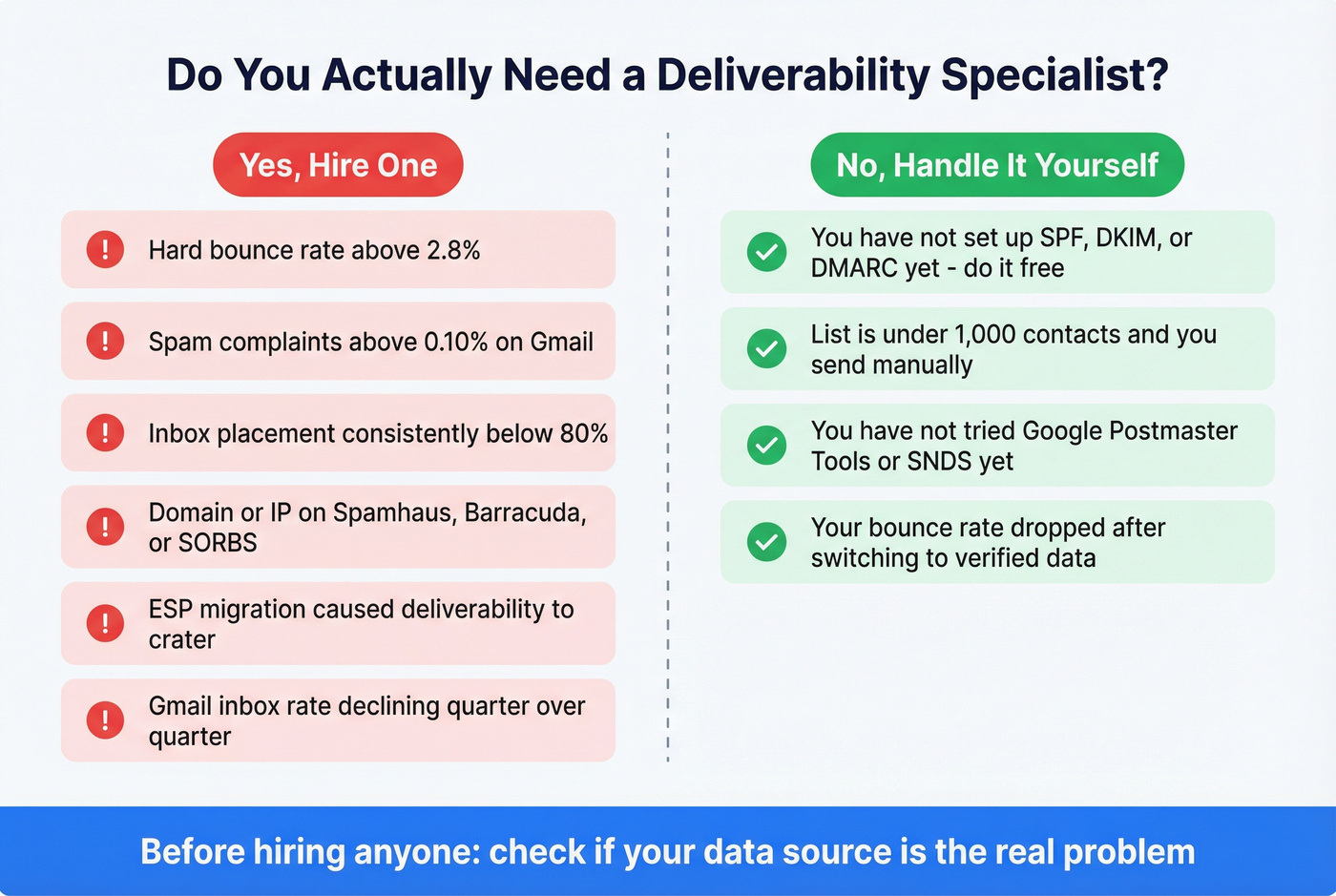
- Your hard bounce rate exceeds 2.8% - that's the danger line where ISPs start throttling
- Spam complaint rate is above 0.2%, or above 0.10% on Gmail specifically
- Inbox placement has dropped below 80% consistently
- Your domain or IP has landed on a major blacklist like Spamhaus, Barracuda, or SORBS
- You've migrated ESPs or sending infrastructure and deliverability cratered afterward
- Your Gmail inbox rate is declining - the broader trend went from 87.5% to 63.5% through 2025
Skip the specialist if you haven't set up SPF, DKIM, and DMARC yet - do that first, it's free and well-documented. Same goes if your list is under 1,000 contacts and you're sending manually, or if you haven't tried the free monitoring tools yet. Handle the basics before paying someone.
Industry context matters too. Inbox placement varies wildly by sector: Travel hits 68%, Retail 62%, Software 58%, Financial 57%. If you're in software and hitting 55%, you're actually close to the industry norm - a deliverability expert can still help, but calibrate your expectations.
Before hiring a specialist, check your data source. We've seen outbound teams cut bounce rates from 35%+ to under 4% just by switching to a verified data provider. Sometimes the problem isn't your infrastructure - it's your data.
Before you spend $250/hr on a deliverability consultant, ask yourself: is this an infrastructure problem or a data problem? Prospeo refreshes every record on a 7-day cycle - not the 6-week industry average - so you never send to stale, invalid addresses that spike your bounce rate and tank your domain reputation.
Clean data costs $0.01 per email. Domain recovery costs months.
How to Hire a Deliverability Specialist
Freelancer vs. Agency vs. In-House
| Hiring Model | Cost Range | Best For | Timeline |
|---|---|---|---|
| Freelancer | $75-$250/hr | Mid-market, one-time audits | 2-4 weeks |
| Agency retainer | $399-$5,000+/mo | Ongoing monitoring, 100K+/mo volume | Monthly |
| One-time audit | $2K-$15K | Diagnosis + remediation plan | 2-6 weeks |
| In-house hire | $77K-$143K/yr | Enterprise, 500K+ emails/mo | Permanent |
| ESP-embedded | Often included | Teams already on Mailtrap, etc. | Immediate |
For most mid-market companies sending 50K-200K emails per month, a one-time audit ($2K-$5K) followed by a quarterly check-in is the sweet spot. You don't need a full-time hire until you're sending at serious enterprise volume.
What to Ask Before Hiring
ISP relationships matter most. A deliverability agent who can contact a postmaster at Microsoft or Google directly is worth twice what one without those contacts charges. Ask for specifics - which ISPs have they worked with, and how recently?
Demand before/after inbox placement data. If they can't demonstrate measurable improvement from past engagements, keep looking. Vague claims about "improving deliverability" without numbers are a red flag.
They should audit your data sources, not just infrastructure. The best deliverability experts look upstream at where your contacts come from, not just how you're sending to them. If they never ask about your list sources, they're solving half the problem.
Expect up to two weeks for the initial audit and 2-6 weeks for full remediation. Make sure they understand your specific ESP too - a Salesforce Marketing Cloud specialist and a Smartlead specialist are solving different problems.
Salary and Career Path
What Deliverability Specialists Earn
| Metric | Amount |
|---|---|
| Median total comp | $102,261/yr |
| Total comp range (25th-75th) | $77K-$143K |
| Base pay range | $59K-$110K |
| Additional pay | $18K-$34K |
| Remote average | $71,348/yr |
| Top earners (90th pct) | $115,500 |
The Glassdoor data draws from a small sample of 12 submissions, but it's the cleanest role-specific benchmark available. ZipRecruiter's remote figures skew lower because they capture a wider range of experience levels.
The Career Ladder
The typical progression runs from email marketing specialist ($77K) to deliverability specialist ($102K) to manager ($103K) to director ($127K). Deliverability is a high-value lateral move for anyone already in email marketing - the technical depth commands a premium, and experienced specialists are scarce relative to demand. If you can demonstrate measurable inbox placement improvement with before/after data, you'll never struggle to find work in this space.
FAQ
How long does a deliverability audit take?
An initial audit typically takes up to two weeks, covering authentication checks, reputation analysis, list hygiene review, and infrastructure assessment. Full remediation runs 2-6 weeks depending on severity. Monthly monitoring after that catches problems before they compound.
What's a good inbox placement rate?
Anything above 80% is healthy for most verticals. The global average is only 60% based on benchmark data from millions of tests. Industry variation is significant - Travel averages 68%, Software 58%, Financial 57%. Measure against your vertical, not just the global number.
Can I fix deliverability problems without hiring a specialist?
Yes, for the basics. Setting up SPF, DKIM, and DMARC is free and well-documented. Monitoring Google Postmaster Tools and keeping spam complaints under 0.10% are DIY-friendly. Hire a consultant when you've done the fundamentals and still can't crack 80% inbox placement - that's when the problem runs deeper than configuration.
What's a good free tool for preventing bounce-related reputation damage?
Prospeo offers a free tier with 75 verified email credits per month, including spam-trap removal and catch-all handling at 98% accuracy. ZeroBounce and NeverBounce also offer limited free verification. For teams sending under 5,000 emails monthly, a free verification tier is often enough to keep bounce rates under the 2% danger line.