GDPR Consent and Email Marketing: What You Actually Need to Do in 2026
You just acquired 10,000 email addresses from a webinar co-host. Your marketing team wants to add them to the newsletter. Your legal team says no. Legal is right, and it's not even close. Those contacts didn't consent to hear from your organization, and adding them to your list violates GDPR before you send a single email.
Most guides on GDPR consent for email marketing are written by lawyers or compliance vendors. They tell you what the law says. They don't tell you what happens when you try to implement it at 9 AM on a Monday with a campaign deadline at noon. This one does.
The Quick Version
- Email marketing is governed by two laws: GDPR sets the consent standard, and the ePrivacy Directive (plus each country's implementing law) governs the act of sending. You need to satisfy both. (If you’re running outbound too, see our practical GDPR for Sales and Marketing playbook.)
- Marketing email programs usually rely on opt-in consent, the ePrivacy soft opt-in for existing customers, or legitimate interests for limited processing activities - with ePrivacy rules still applying to the send itself.
- Double opt-in isn't legally required in most countries, but lists using it see 35.72% open rates vs. 27.36% without it.
- Your consent records must include who, when, what they saw, how they consented, and withdrawal status.
The Two-Layer Compliance Rule
Here's the thing most marketers miss: there isn't one law governing email marketing. There are two, and they operate on different layers.
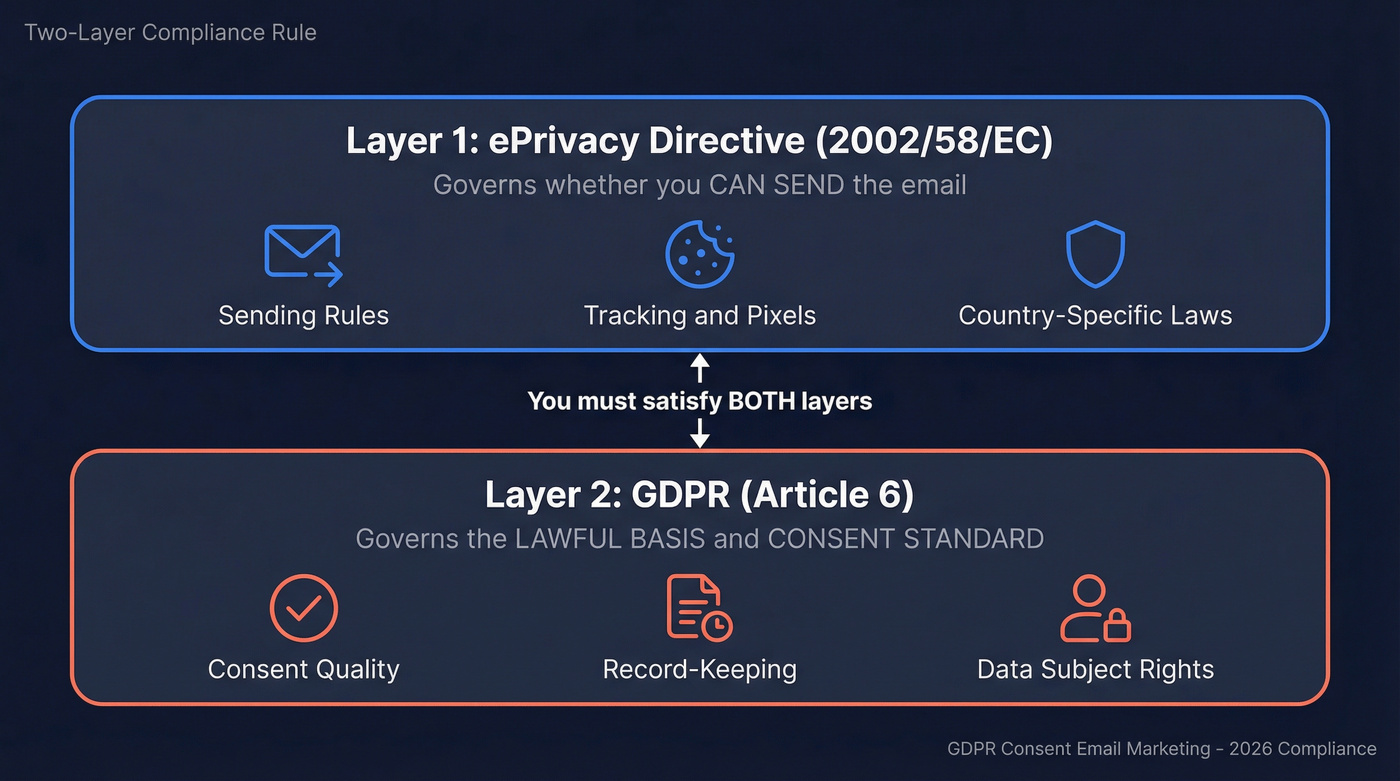
The ePrivacy Directive (2002/58/EC) governs whether you can send the email. GDPR (specifically Article 6) governs the lawful basis and the standard of consent you collect. You can nail one and still violate the other.
The ePrivacy Regulation - supposed to modernize these rules - was withdrawn by the European Commission in February 2025 after years of failed negotiations. As of 2026, the original ePrivacy Directive still applies with no agreed replacement in force, and member-state implementations vary country to country. EDPB Guidelines 2/2023 also explicitly cover modern tracking methods like URL and pixel tracking, so if you're using open-tracking or click-tracking in your campaigns, that's within scope too. (If you want the deliverability angle, read our guide on email tracking and what it changes operationally.)
Three Lawful Opt-In Paths for Marketing Emails
1. Explicit Consent
This is the default for cold prospects and new contacts. Consent must be an affirmative action - no pre-ticked boxes, no bundled consent buried in terms of service. It needs to be specific, informed, and unambiguous, and the person must be able to withdraw as easily as they gave it. (If you’re building sequences, align this with your outbound email campaign workflow.)
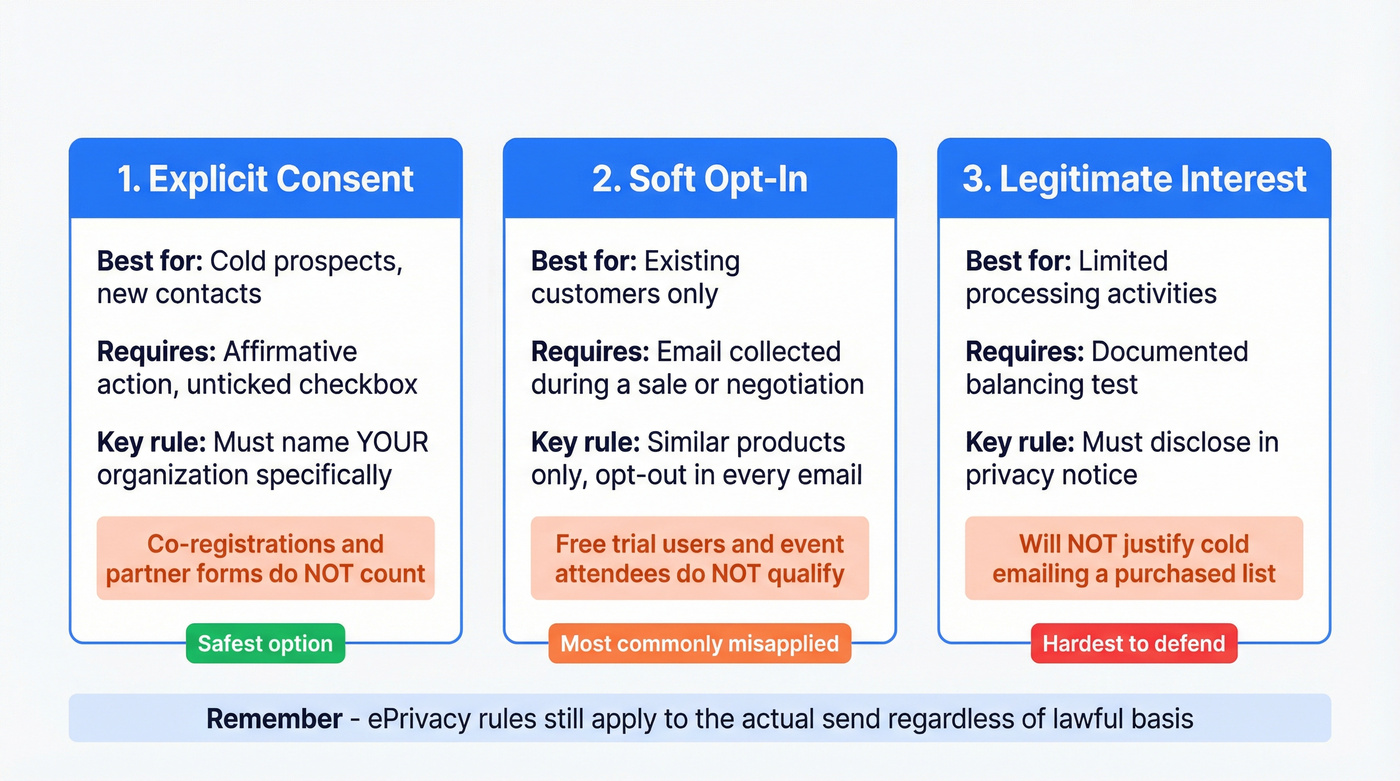
A question we get constantly: do webinar co-registrations count as consent? They don't. Co-registrations and content downloads don't equal consent to your marketing unless the form clearly named your organization and included a separate, unticked opt-in checkbox specifically for your emails. If the form just said "our partners may contact you," that's not specific enough under GDPR Article 7.
2. Soft Opt-In (Existing Customers Only)
Article 13(2) of the ePrivacy Directive allows emailing existing customers about similar products without fresh consent, but only when all four conditions are met:
- You collected their email during a sale or negotiation of a sale
- You're marketing your own similar products or services
- They had a clear opt-out opportunity at collection and didn't take it
- Every subsequent email includes an opt-out mechanism
In our experience, the soft opt-in is the most commonly misapplied rule in email marketing. Free trial users who never converted, event attendees, and inquiry-only contacts don't qualify - yet teams stretch this definition constantly. Misclassifying a contact's status can turn a compliant campaign into a violation overnight, and we've watched it happen more than once. (This is also where CRM hygiene breaks or saves you.)
3. Legitimate Interest
Common mistake: treating legitimate interest as a blanket justification for cold email. Recital 47 of the GDPR acknowledges that direct marketing can qualify, but the ICO is clear - you must demonstrate necessity, run a balancing test, document the outcome, and disclose it in your privacy notice.
Some guides frame this too broadly. If you're trying to justify cold emailing a purchased list, legitimate interest won't save you. The balancing test almost always fails when the recipient has no prior relationship with your organization and didn't expect to hear from you. (For a deeper breakdown, compare this with our guide on cold email vs spam.)

Bad data doesn't just hurt deliverability - it creates compliance risk. Every bounced email from an unverified list raises flags with ISPs and regulators alike. Prospeo's 5-step verification with spam-trap removal and catch-all handling delivers 98% email accuracy, so your GDPR-compliant campaigns actually reach real inboxes.
Stop risking your domain reputation on unverified contact data.
Double Opt-In: Not Required, But Decisive
GDPR doesn't mandate double opt-in. The performance data makes the decision for you. (If you’re auditing the whole program, use our email marketing audit checklist.)
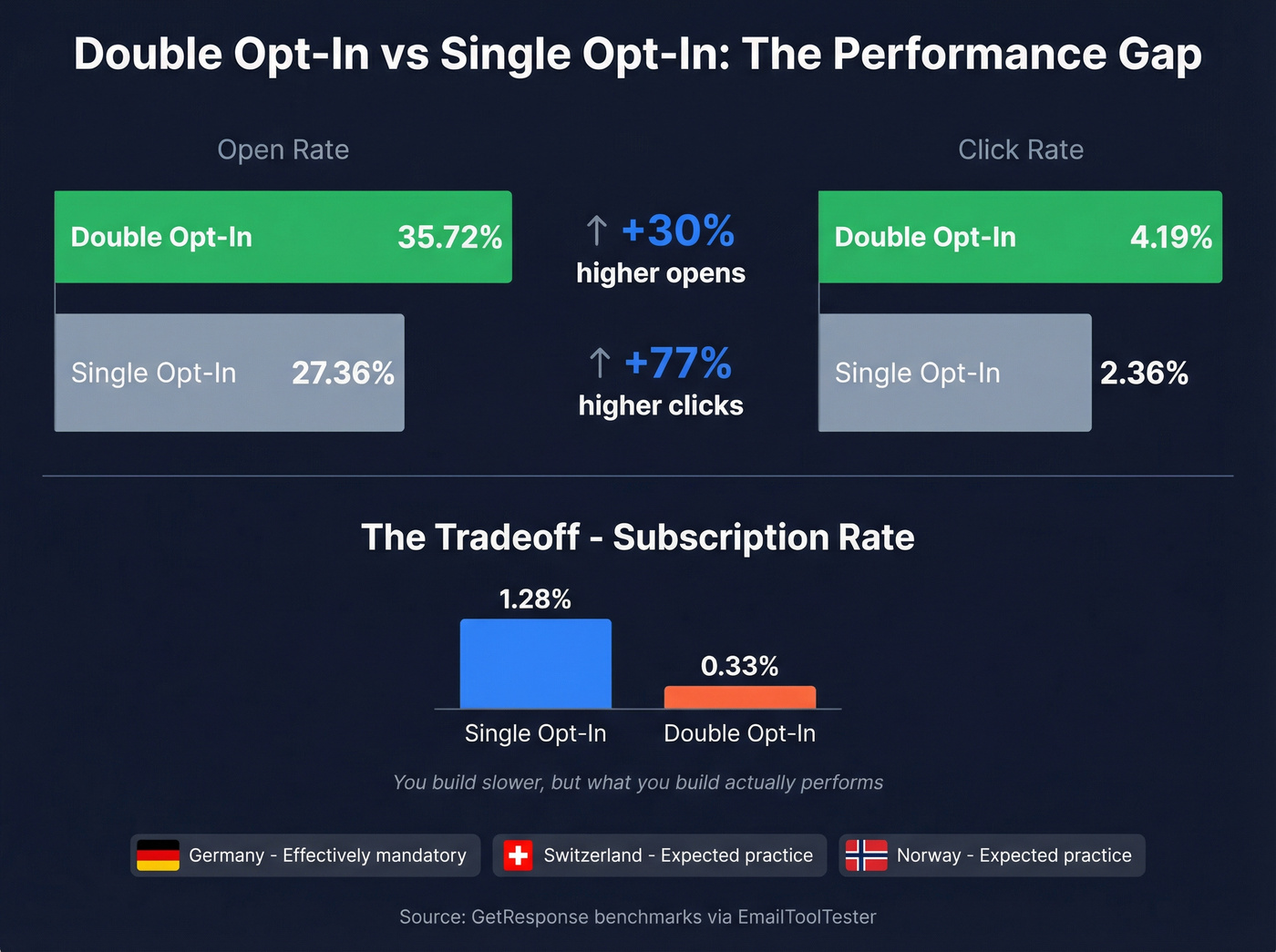
GetResponse benchmarks show DOI lists hitting 35.72% open rates versus 27.36% for single opt-in, with click rates of 4.19% versus 2.36%. That's not marginal - it's a completely different engagement tier.
The tradeoff is subscription rate: 0.33% versus 1.28%. You'll build slower, but what you build actually performs. In Germany, courts treat double opt-in as effectively mandatory, ruling consistently that single opt-in doesn't provide sufficient proof of consent. Switzerland, Greece, and Norway consider it expected practice. Everywhere else it's a performance call, and the numbers make it an easy one.
Let's be honest: if your list is under 5,000 contacts and you're not using double opt-in, you're optimizing for the wrong metric. Volume means nothing with a 27% open rate.
B2B vs. B2C: Where the Rules Diverge
The UK offers the clearest B2B carve-out. Under PECR, email marketing rules don't apply to corporate subscribers - limited companies and LLPs. Sole traders and some partnerships get full individual protection.
Even when PECR doesn't apply, UK GDPR still governs whenever you're processing personal data. A named employee's email qualifies. Under Article 21, contacts can object to direct marketing at any time, and you must honor it. ICO guidance has been under review since the Data (Use and Access) Act took effect in June 2025, so expect updates through 2026. (If you’re doing outbound at scale, pair this with an email deliverability checklist so compliance doesn’t get undermined by infrastructure issues.)
For teams operating across the EU, the safest approach is to treat B2B contacts the same as B2C unless you've confirmed the specific member-state rules where your recipients are based. The cost of over-compliance is a few extra opt-in forms. The cost of under-compliance is a fine and a trashed sender reputation.
Consent Record-Keeping Checklist
If your consent records are a checkbox column in a spreadsheet, you're not compliant. We've seen teams fail audits over exactly this. A regulator won't accept "they opted in" - they'll ask for specifics.
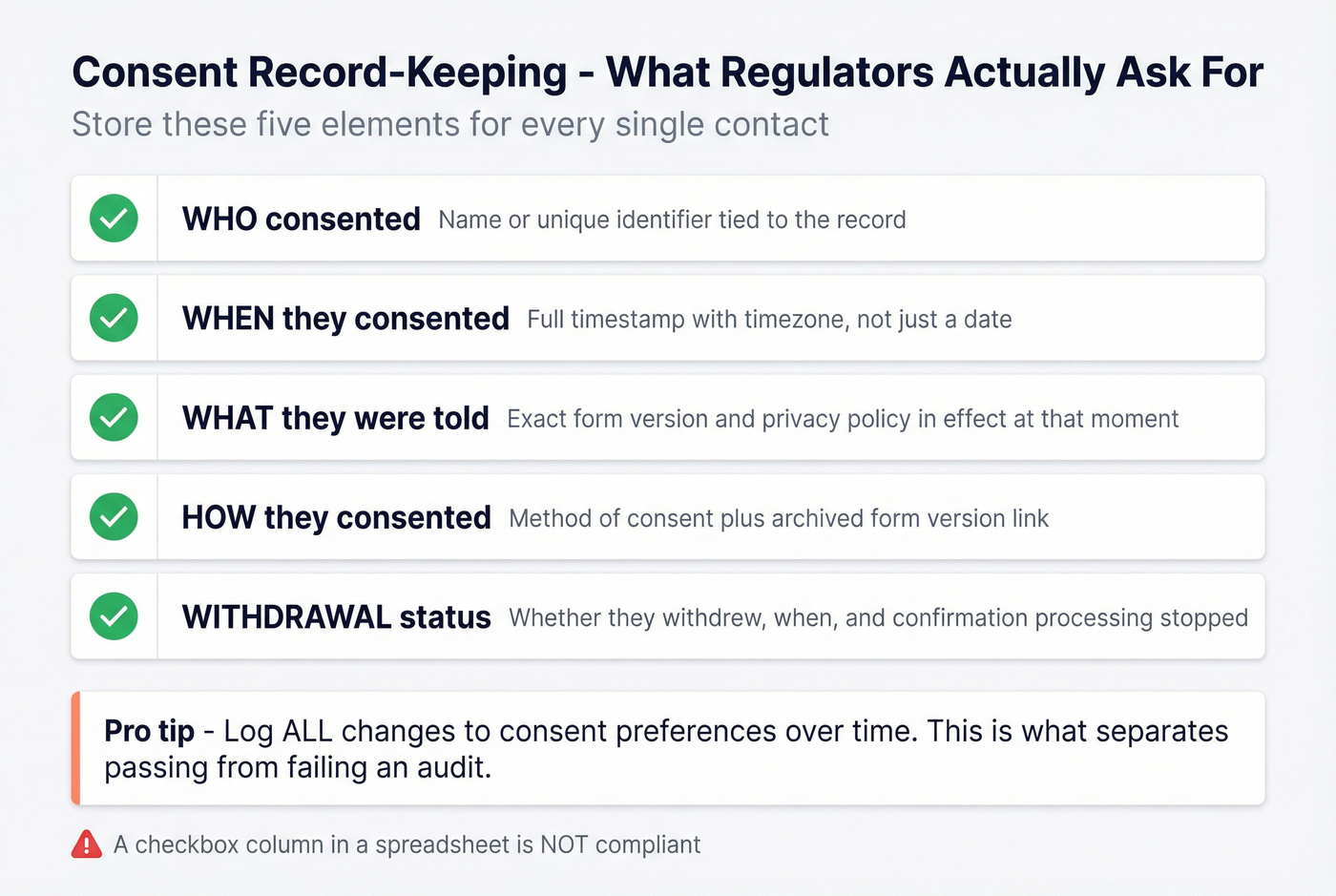
Store these for every contact:
- Who consented - name or unique identifier
- When - timestamp with timezone, not just a date
- What they were told - exact form version and privacy policy in effect at that moment
- How - method of consent plus a link to the archived form version
- Withdrawal status - whether they withdrew, when, and confirmation that processing ceased
Per Usercentrics' guidance, log all changes to consent preferences over time. This is what separates passing from failing an audit. Every marketing email you send should trace back to a documented, verifiable consent event in your records. (Operationally, this is much easier if you standardize CRM lead source tracking.)
What Happens If You Don't Comply
GDPR fines run on two tiers: up to EUR10M or 2% of global annual turnover for less severe violations, and up to EUR20M or 4% for serious ones. Global enforcement totals are now in the multi-billion range across all violation types.
But fines aren't the only risk - and honestly, they're not even the most immediate one.
Sending to non-consented or unverified addresses tanks your deliverability. Bounces spike, spam complaints accumulate, and your domain reputation takes damage that can take months to recover. We've seen teams lose an entire quarter of sender reputation over a single imported list that should never have been loaded. (If you’re troubleshooting bounce spikes, start with our guide to hard bounces.)
For outbound teams building prospect lists, starting with verified data eliminates the bounce-rate risk before it starts. Prospeo's 98% email accuracy and 7-day data refresh cycle keep you working with contacts that won't wreck your deliverability - with GDPR compliance and opt-out enforcement built in. (If you’re evaluating vendors, compare options in our roundup of email ID validators.)
FAQ
Can I email contacts from a purchased list under GDPR?
No. Purchased lists almost never carry valid consent tied to your organization. You'd need to obtain fresh, explicit opt-in before sending any marketing emails, which defeats the purpose of buying the list in the first place. Skip the purchased list entirely and build from verified sources.
Is double opt-in legally required?
In Germany, courts treat it as effectively mandatory - single opt-in doesn't provide sufficient proof of consent. Switzerland, Greece, and Norway consider it expected practice. Everywhere else it's optional, but DOI lists see roughly 35% open rates versus 27%, so the performance data makes the call for you.
How do I build a compliant prospect list from scratch?
Source verified emails through a GDPR-compliant provider, then obtain explicit consent before sending marketing emails. Verified data means fewer bounces and a clean sender reputation from day one. The r/sales consensus is that bad data is the fastest way to burn a domain - starting clean is non-negotiable.
What's the difference between consent and legitimate interest for email?
Consent requires an explicit opt-in action from the recipient before you send. Legitimate interest lets you process data without consent if you pass a documented balancing test - but the ePrivacy Directive still requires consent or soft opt-in for the actual send in most EU countries. For marketing programs, consent is safer and simpler.
You just built a double opt-in list with pristine consent records. Don't waste it on stale data. Prospeo refreshes 300M+ profiles every 7 days - not the 6-week industry average - so the verified emails you send to are current, active, and deliverable. GDPR compliance means nothing if your emails bounce.
Pair compliant consent with data that's actually fresh.