SMB Go-to-Market Strategy: The 90-Day Playbook for Lean Teams
Three months of GTM planning. Zero pipeline. That's the default outcome when SMB teams copy enterprise playbooks - and it happens constantly. The strategy deck looks beautiful. The CRM stays empty.
Here's the reality: building an SMB go-to-market strategy demands a fundamentally different approach. There are 34.7 million small businesses in the US, making up 99.9% of all American companies, yet 90% of brands struggle to identify and connect with actual SMB decision-makers. The opportunity is massive. The execution window is tiny. You get 90 days to prove the motion works or pivot - and most SMB GTM plans die in the gap between strategy and execution because teams build beautiful ICP docs but never instrument their CRM to track whether outbound is actually converting.
How SMBs Actually Buy
SMB buying behavior breaks every enterprise assumption you've internalized. The owner is usually the decision-maker - no procurement team, no six-person buying committee. Below 50 employees, you're selling to someone who's also managing payroll, hiring, and putting out fires.
Your pricing page will be your most heavily trafficked page. 47% of small businesses actively seek guidance on technology investments, and they trust peer reviews over analyst reports. A former CMO of Nextiva and RingCentral put it bluntly: even a $5/month price difference can swing an initial decision at the SMB level. Make pricing clear, make it public, and make it easy to say yes. If your site says "talk to sales" for a $200/month product, you've already lost most SMB buyers before they reach out.
Pick Your GTM Motion
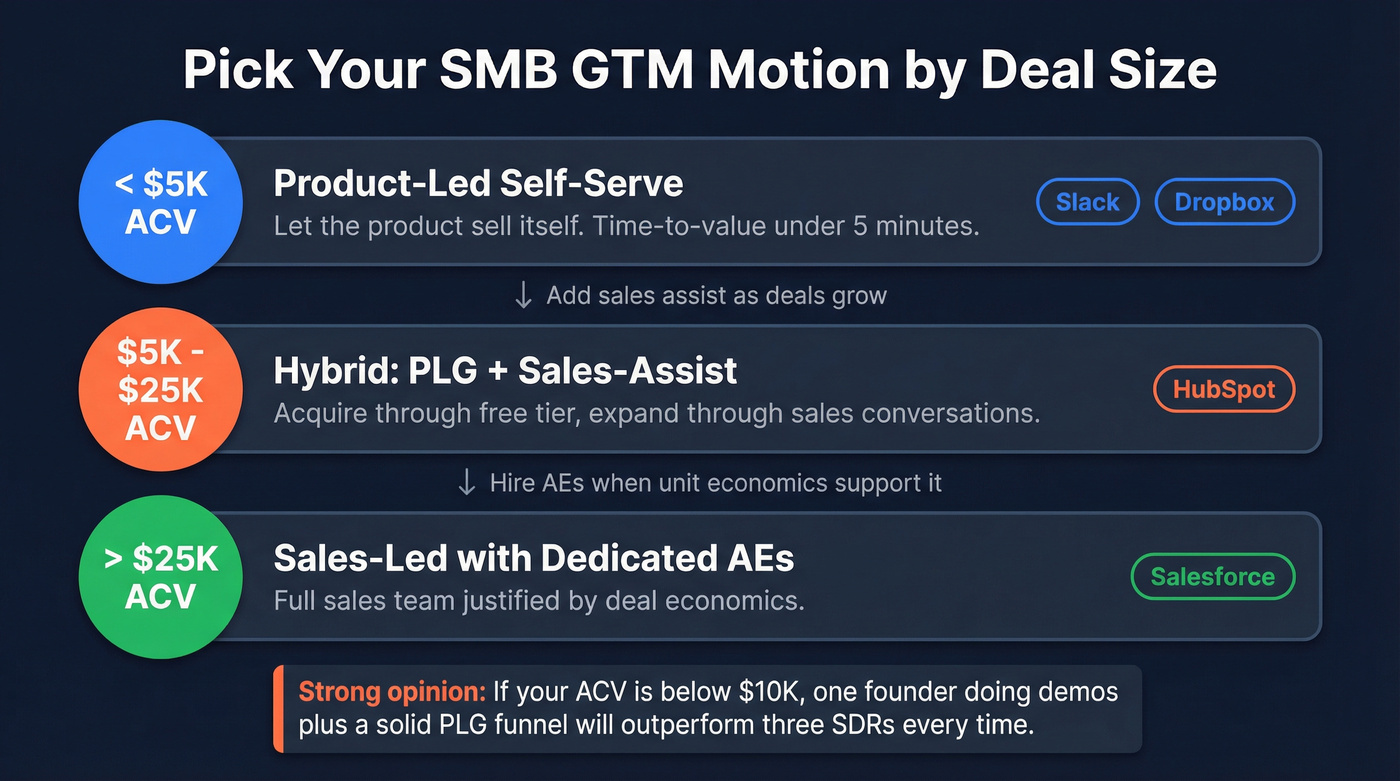
The single most important decision is matching your motion to your deal size. Companies spend roughly $2 in sales and marketing for every $1 of new ARR right now. Pick the wrong motion and you'll burn through cash before you find product-market fit.
| ACV Range | Motion | Example | Key Metric |
|---|---|---|---|
| < $5K | Product-led, self-serve | Slack, Dropbox | Time-to-value < 5 min |
| $5K-$25K | Hybrid: PLG + sales-assist | HubSpot | Free-to-paid conversion rate |
| > $25K | Sales-led | Salesforce | AE pipeline coverage |
Slack grew by being useful inside teams before anyone talked to sales. HubSpot built a freemium CRM that funnels users into paid tiers. The pattern is clear: for sub-$5K deals, let the product sell itself; for mid-market, acquire through self-serve and expand through sales conversations. Only invest in dedicated AEs when deal sizes justify the cost.
Most SMB SaaS falls in the PLG or hybrid range. If you're building a sales-led motion for a $3K ACV product, you're going to lose the unit economics game before you start.
Our strong opinion: if your average contract value sits below $10K, you almost certainly don't need a full sales team. One founder doing demos plus a solid PLG funnel will outperform three SDRs every time. The consensus on r/SaaS backs this up - founders who hire SDRs before nailing their own pitch consistently report worse results than those who stayed hands-on through the first 50 deals.

Your 90-day GTM playbook lives or dies on data quality. One bad list torches your domain and kills the motion before week three. Prospeo delivers 98% email accuracy with a 7-day refresh cycle - so every contact in your sequencer is current and verified. At ~$0.01/email, your entire first month of outbound experiments costs less than lunch.
Build your first SMB prospect list free - 75 verified emails, no credit card.
Where to Spend First
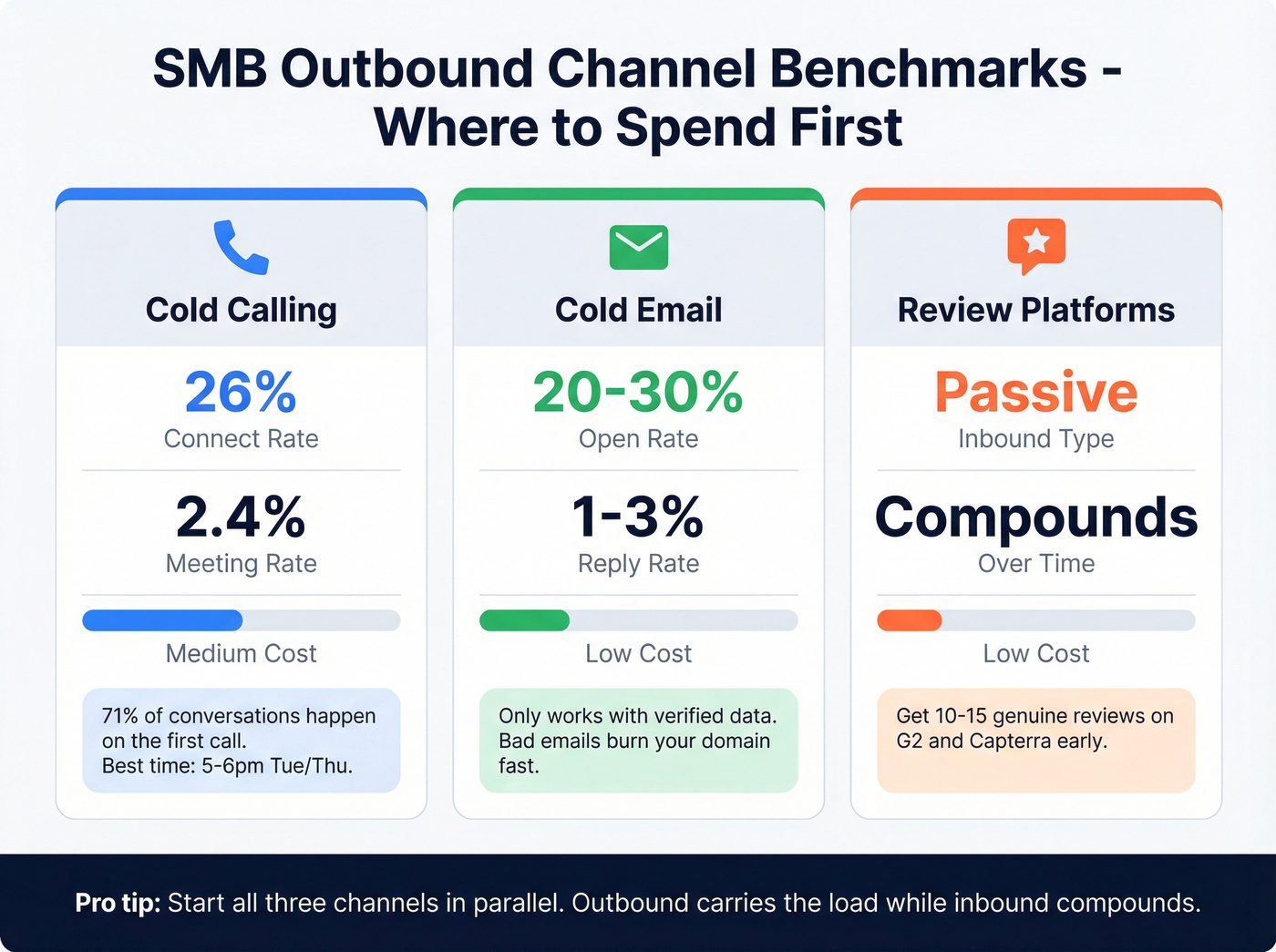
Your budget is limited. Here's where the highest-signal opportunities actually are.
| Channel | Connect / Open Rate | Meeting Rate | Relative Cost |
|---|---|---|---|
| Cold calling | 26% connect rate | 2.4% | Medium |
| Cold email | 20-30% open rate | 1-3% reply | Low |
| Review platforms (G2, Capterra) | Passive inbound | Compounds over time | Low |
Cold calling still works for SMB. A Cognism dataset of nearly 100,000 SMB calls found 71% of conversations happen on the first call - follow-up calls have sharply diminishing returns. Tuesday and Thursday are your best days. Best time slot: 5-6pm. Worst? 8am. Don't waste dials on early morning. If you want a tighter operating system, start with a simple outbound calling strategy and iterate from there.
Cold email is cheaper but noisier. The catch: outbound email only works with clean data. Bad emails mean bounced campaigns, which mean burned domain reputation - and once your domain is flagged, you're starting over. We've seen teams torch their sending infrastructure in week two because they scraped unverified lists. Invest in verified data from the start. If you're building this channel, use a deliverability-first outbound email campaign setup and keep a tight email deliverability checklist.
Get 10-15 genuine reviews on G2 and Capterra early. That inbound trust layer compounds quietly while you're running outbound. For more ideas that compound over time, borrow a few inbound lead generation examples.
The Lean SMB Tech Stack
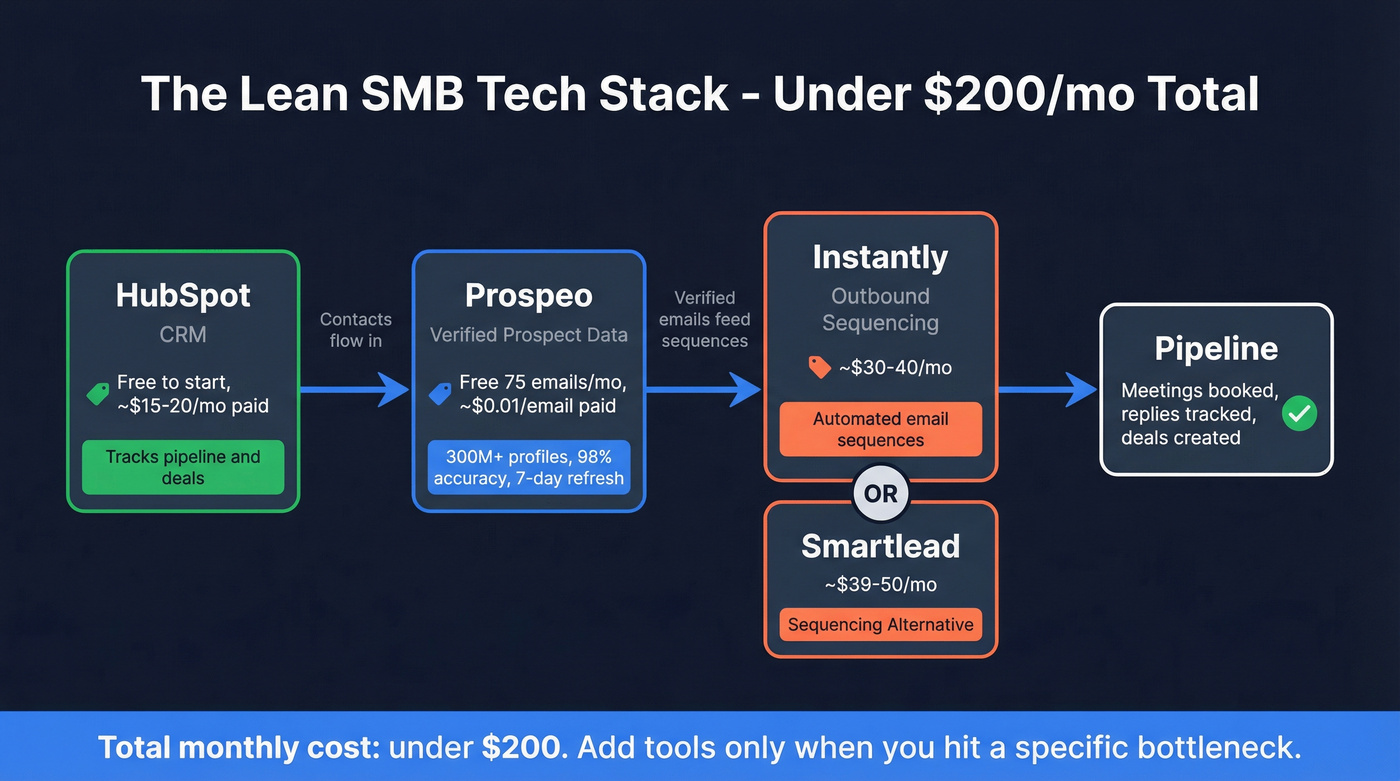
You don't need a $40K/year data platform to run effective SMB outbound. You need three tools.
| Tool | Purpose | Starting Price |
|---|---|---|
| HubSpot | CRM | Free; paid from ~$15-$20/mo |
| Prospeo | Verified prospect data | Free 75 emails/mo; ~$0.01/email on paid |
| Instantly | Outbound sequencing | ~$30-$40/mo |
| Smartlead | Sequencing alternative | ~$39-$50/mo |
Total: under ~$200/month. That's your entire GTM infrastructure for the first 90 days. Prospeo handles the data layer - 300M+ professional profiles with 98% email accuracy at roughly a penny per lead, with data refreshing every 7 days versus the 6-week industry average. The free tier gives you 75 verified emails per month, enough to run initial experiments without spending a dollar. Stack Optimize used exactly this kind of lean setup to build from $0 to $1M ARR while keeping client bounce rates under 3%. If you're pressure-testing vendors, compare options in our guide to sales prospecting platforms and keep an eye on prospect data accuracy.

Add tools only when you hit a specific bottleneck. Need a dialer? Add one when cold calling volume justifies it. Don't pre-buy infrastructure for problems you haven't encountered yet. If your CRM starts getting messy, prioritize CRM hygiene before you add anything else.
The 90-Day Validation Timeline
Stop planning. Start testing.
Weeks 1-2: ICP and Messaging
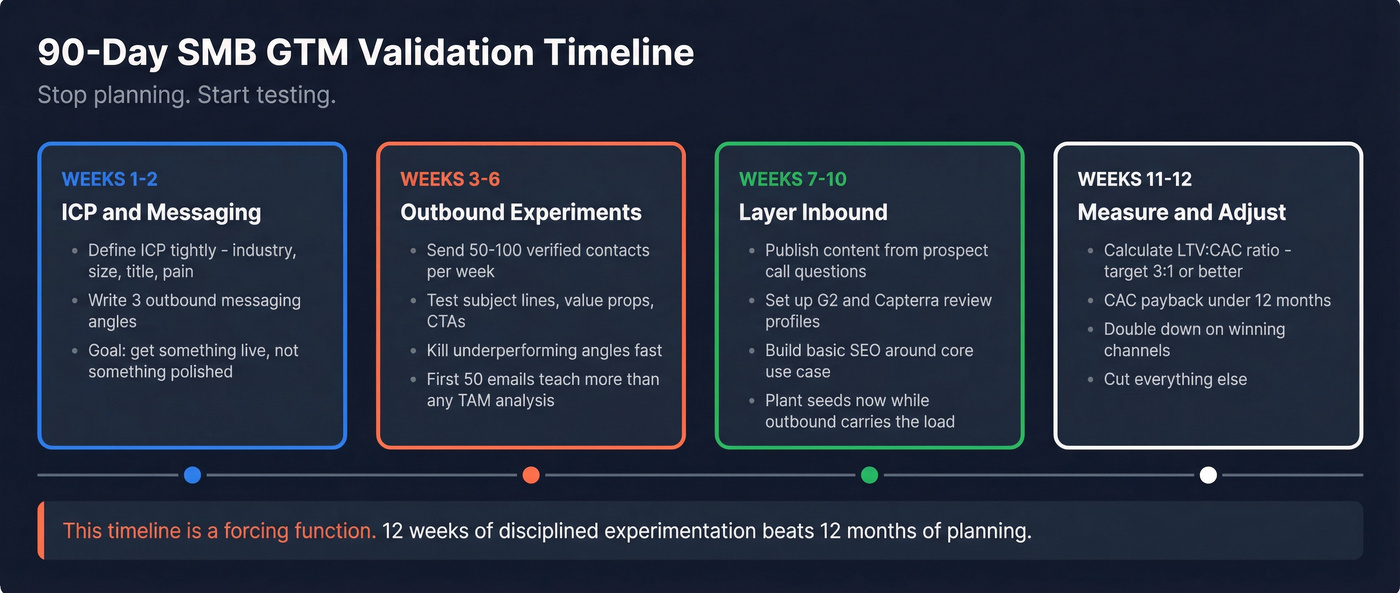
Define your ideal customer profile tightly - industry, company size, title, pain point. Write three outbound messaging angles. Don't agonize over perfection; you're going to iterate. The goal is to get something live, not something polished. If you need a starting point, use a SaaS go-to-market strategy template.
Weeks 3-6: Outbound Experiments
Send 50-100 verified contacts per week through your sequencer. Test subject lines, value props, and CTAs. Track reply rates and meeting conversion by segment. Kill underperforming angles fast. For faster iteration, keep a backlog of cold email tactics you can test one at a time.
In our experience, the first 50 outbound emails tell you more about your ICP than any TAM analysis ever will. One team we worked with discovered their best-converting segment wasn't the persona they'd spent two weeks profiling - it was a completely different title they'd added as an afterthought to a B-list. You won't find that in a spreadsheet.
Weeks 7-10: Layer Inbound
Publish content addressing questions your prospects ask on calls. Set up review profiles on G2 and Capterra. Build basic SEO around your core use case. Inbound takes months to compound, so plant seeds now while outbound carries the load.
Weeks 11-12: Measure and Adjust
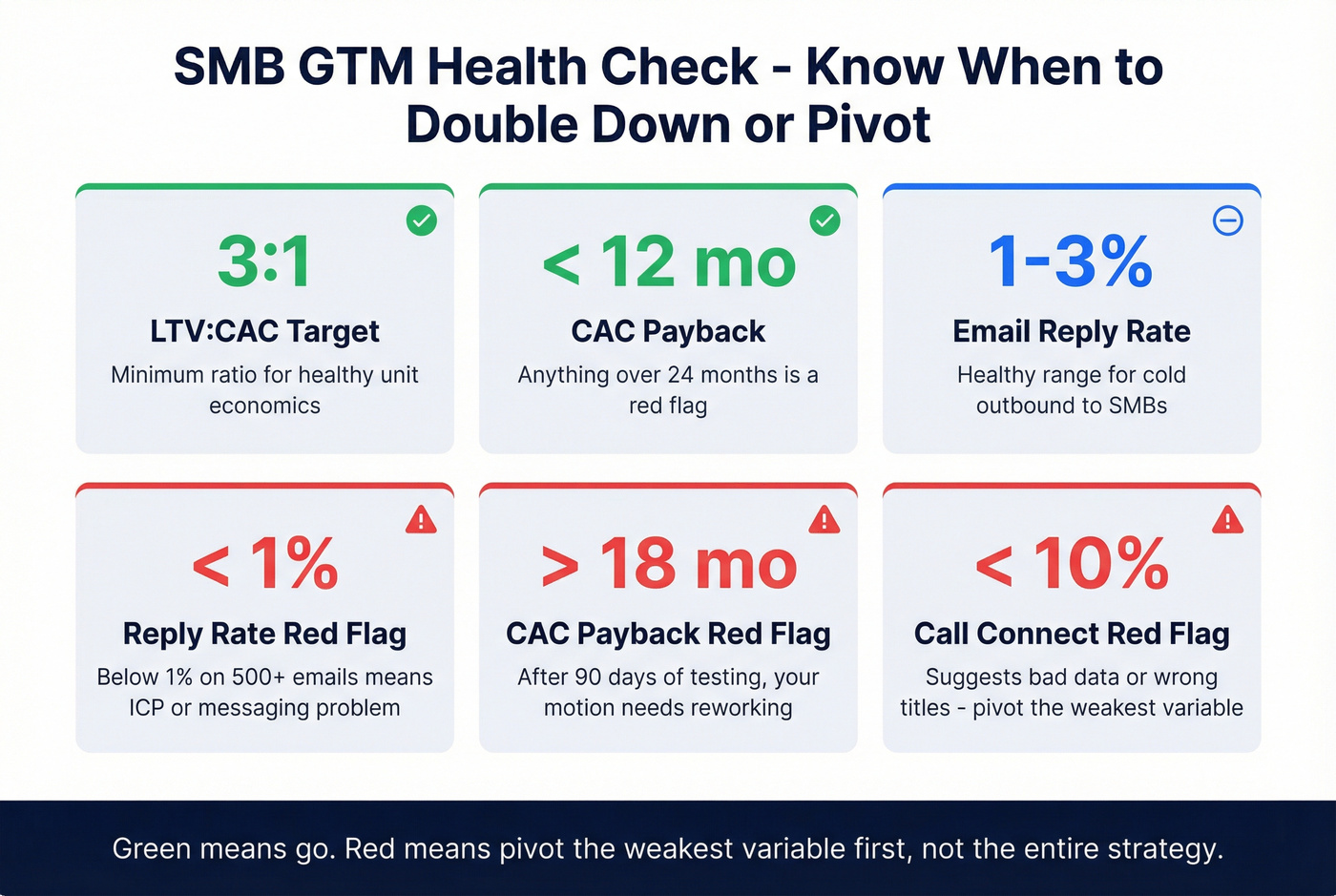
Calculate your LTV:CAC ratio - target 3:1 or better. CAC payback should be under 12 months; anything over 24 months is a red flag that demands immediate attention. Double down on channels and segments hitting those benchmarks. Cut everything else.
Let's be honest about what this timeline really is: it's a forcing function. Twelve weeks of disciplined experimentation will teach you more than twelve months of planning ever could. The teams that win aren't the ones with the best strategy decks - they're the ones who shipped outbound in week one and iterated from real data.
Stack Optimize built from $0 to $1M ARR on lean outbound with bounce rates under 3%. The difference wasn't strategy - it was verified data. Prospeo gives you 300M+ profiles, 30+ filters to nail your SMB ICP, and data that refreshes every 7 days instead of the 6-week industry average. That's how you validate a GTM motion in 90 days, not 90 weeks.
Stop planning your SMB GTM strategy and start sending to verified contacts today.
FAQ
What's the biggest GTM mistake SMB teams make?
Copying enterprise playbooks that assume six-month sales cycles and multi-threaded buying committees. Run 90-day experiments instead - validate ICP and messaging with outbound, measure CAC and conversion, then double down on what works. Planning without shipping is the fastest way to burn runway.
How much should an SMB spend on a GTM tech stack?
Under ~$200/month covers a free CRM, verified prospect data, and one outbound sequencer - everything you need for the first quarter. A free data tier plus Instantly or Smartlead gets you live outbound for under $50. Add tools only when a specific bottleneck demands it.
Should SMBs use product-led or sales-led growth?
Under $5K ACV, go product-led - no question. Between $5K and $25K, run a hybrid motion with self-serve acquisition and sales-assisted expansion. Only invest in dedicated sales reps when average deal sizes exceed $25K. Most SMB SaaS should default to PLG.
When should I pivot my go-to-market approach?
If CAC payback exceeds 18 months after 90 days of testing, your motion needs reworking. Reply rates below 1% on 500+ emails signal a messaging or ICP problem. Connect rates under 10% on cold calls suggest bad data or wrong titles. Pivot the weakest variable first, not the entire strategy.