

Email Domain Validator: How It Works in 2026
Your ESP just suspended your sending account. Bounce rate hit 4.2% on a 5,000-email campaign - more than double the 2% threshold most providers enforce. The domain you spent three months warming up is now flagged. That's what happens when you skip running an email domain validator, and it takes about 48 hours to undo months of deliverability work.
Entirely preventable. Globally, one in six emails never reach the inbox. Every bounced email was a signal you could've caught before hitting send. The tools exist, they're cheap (some are free), and the best ones take minutes to run. Here's exactly how domain validation works, where the tricky edge cases hide, and which tools are worth your money this year.
What You Need (Quick Version)
An email domain validator checks whether a domain can receive mail and whether a specific mailbox exists. Most free tools only handle the first part. For B2B outbound, you need both - plus catch-all handling, which is where cheap tools fall apart.
Three quick picks based on what we've tested:
- Prospeo - finds and verifies emails in one step. 98% accuracy, 5-step verification with catch-all handling, ~$0.01/email. Free tier of 75 emails/month plus 100 Chrome extension credits/month.
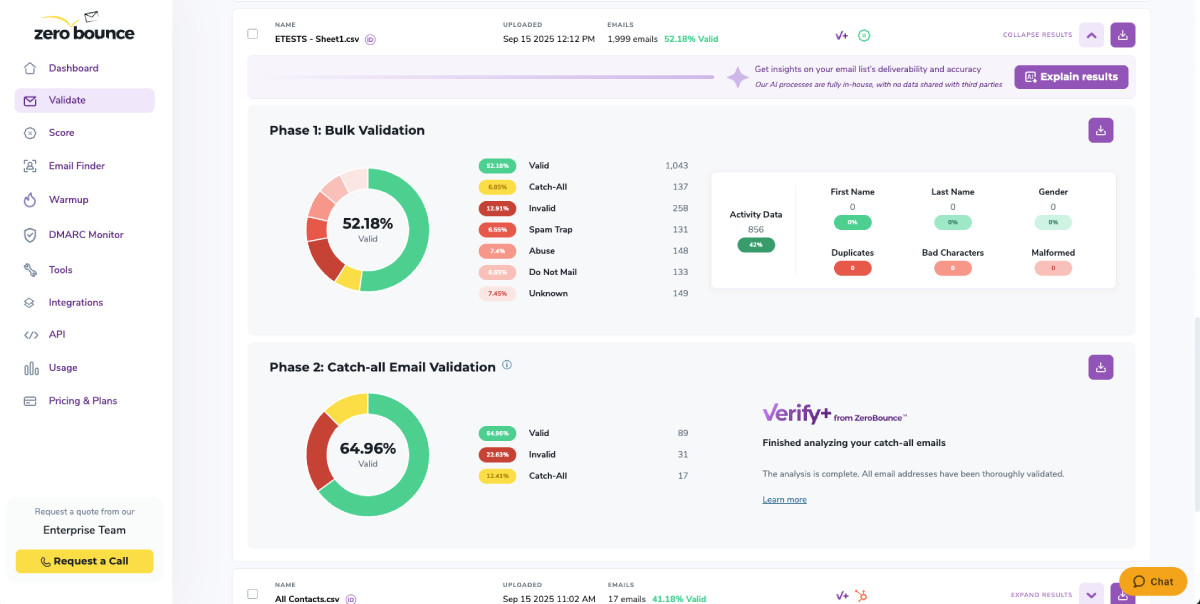
- ZeroBounce - strongest independent accuracy score (97.8% in a 10,000-email bake-off), solid catch-all resolution, ~$65 per 10k.
- MillionVerifier - the budget king at ~$6 per 10k for pure bulk list cleaning. Accuracy is lower, but nothing touches the price-to-volume ratio.
What Is Email Domain Validation?
Three terms get thrown around interchangeably, and they shouldn't. They describe different things and require different tools.
Domain validation checks whether a domain (the part after the @) is configured to receive email. It queries DNS records - specifically MX records - to confirm a mail server exists. This tells you "mail could be delivered here" but says nothing about whether john@example.com is a real person.
Email verification goes further. It checks the specific mailbox via an SMTP handshake: does john@example.com actually exist on that server? Can it receive messages? This catches typos, former employees, and deactivated accounts.
Domain authentication is something else entirely - SPF, DKIM, and DMARC protocols you configure on your sending domain to prove you're not a spammer. If that's what you need, tools like Spamhaus for reputation/blacklists and DMARC analyzers are the right starting point, not the tools covered here.
When someone searches for a domain validator, they usually need email verification - the address-level check. Here's how the three compare:
| Domain Validation | Email Verification | Domain Authentication | |
|---|---|---|---|
| What it checks | MX records, DNS | Specific mailbox existence | SPF, DKIM, DMARC |
| Who needs it | Developers, form builders | Sales, marketing, ops | Email senders (you) |
| Example tools | MXToolbox, dig/nslookup | ZeroBounce, NeverBounce | DMARC analyzers |
How Domain Validation Works
Every verification tool runs roughly the same four-layer process, though the depth of each layer separates cheap tools from good ones.
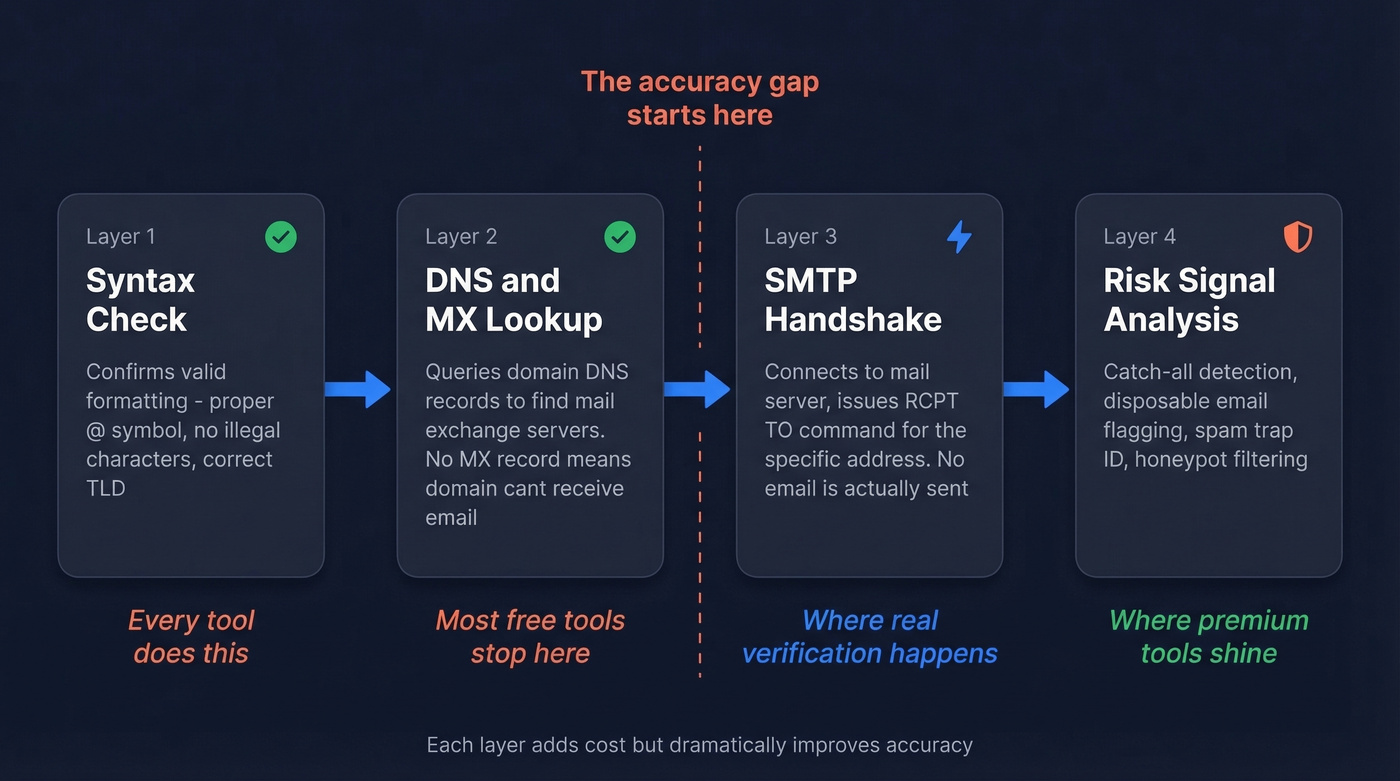
Layer 1: Syntax check. The tool confirms the email follows valid formatting rules - proper use of @, no illegal characters, correct TLD. This catches obvious garbage like "john@@company..com" but nothing sophisticated. Every tool does this. It's table stakes.
Layer 2: DNS and MX record lookup. The tool queries the domain's DNS records to find its mail exchange servers. No MX record means the domain can't receive email, and the address is immediately flagged invalid. This is what most free validators do - and where they stop.
Layer 3: SMTP handshake. Here's where real verification happens. The tool connects to the mail server and initiates an SMTP conversation, issuing a RCPT TO command for the specific address. The server's response reveals whether the mailbox exists. No email is actually sent - the tool disconnects before delivering any message.
Layer 4: Risk signal analysis. Better tools layer on catch-all detection, disposable email flagging, spam trap identification, and honeypot filtering. This is where tools differentiate themselves, and it's where the accuracy gap between a $6/10k service and a $65/10k service shows up.
Layers 3 and 4 are where enterprise domains get tricky. Secure Email Gateways like Proofpoint, Mimecast, and Barracuda actively block SMTP probes through greylisting and rate limiting. The server doesn't reject the address - it just refuses to answer, producing an "unknown" result even for perfectly valid mailboxes.
The Catch-All Problem
Catch-all domains are the single biggest headache in email verification, and they're everywhere. Roughly 30-40% of B2B email addresses sit on catch-all domains - servers configured to accept mail for any address at that domain, whether the mailbox exists or not.
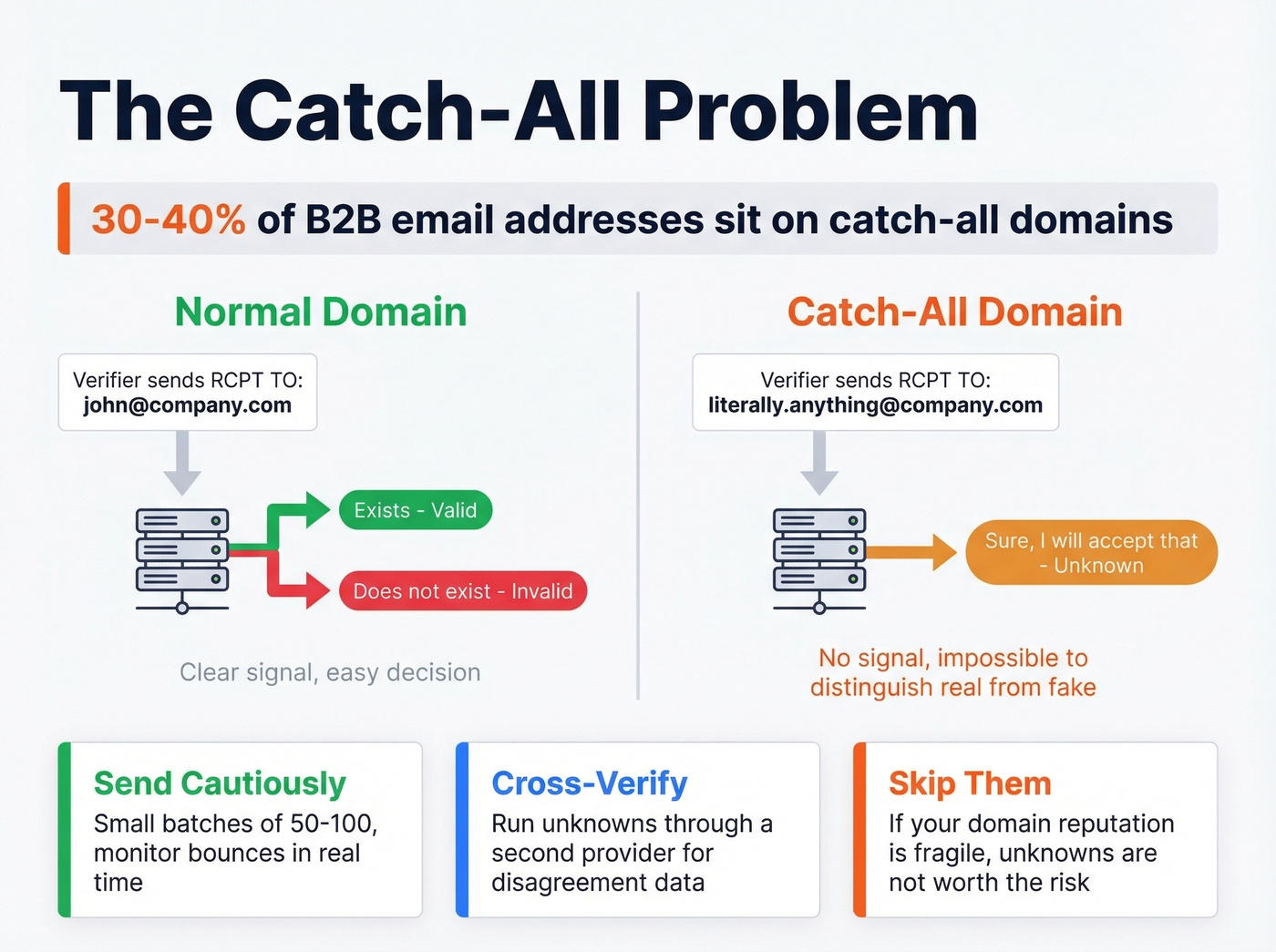
This breaks the SMTP handshake completely. When a verifier sends a RCPT TO command for a nonexistent address, a catch-all server responds "sure, I'll accept that." The tool can't distinguish real from fake, so it returns "unknown," "accept-all," or "risky." The consensus on r/email and in self-hosting circles is that catch-all false positives are the number-one pain point with verification tools, and it's hard to disagree.
Combine this with SEG greylisting - where enterprise mail servers deliberately delay or reject verification probes - and a huge chunk of your B2B list comes back as unresolvable through basic SMTP checks alone.
So what do you do with "unknown" results?
- Send cautiously - small batches of 50-100, monitor bounce rates in real time, pull the plug if you cross 2%.
- Cross-verify - run unknowns through a second provider. Different tools use different probe logic and often disagree on catch-all addresses. That disagreement is useful data.
- Skip them - if your domain reputation is fragile or you're early in a warm-up, unknowns aren't worth the risk.
Here's the thing: if your average deal size is under five figures, you probably don't need to fight the catch-all battle at all. The time spent chasing uncertain addresses is better spent writing better emails to the verified ones. Save catch-all resolution for high-value accounts where one meeting justifies the risk.

Prospeo doesn't just validate domains - it finds and verifies the email in one step. 98% accuracy, catch-all handling, spam-trap removal, and honeypot filtering built into every lookup. At ~$0.01 per email, you get Layer 4 verification without the Layer 4 price tag.
Start with 75 free verified emails - no credit card, no contracts.
How to Read Validation Results
Different tools use different labels, but every result maps to one of four categories:
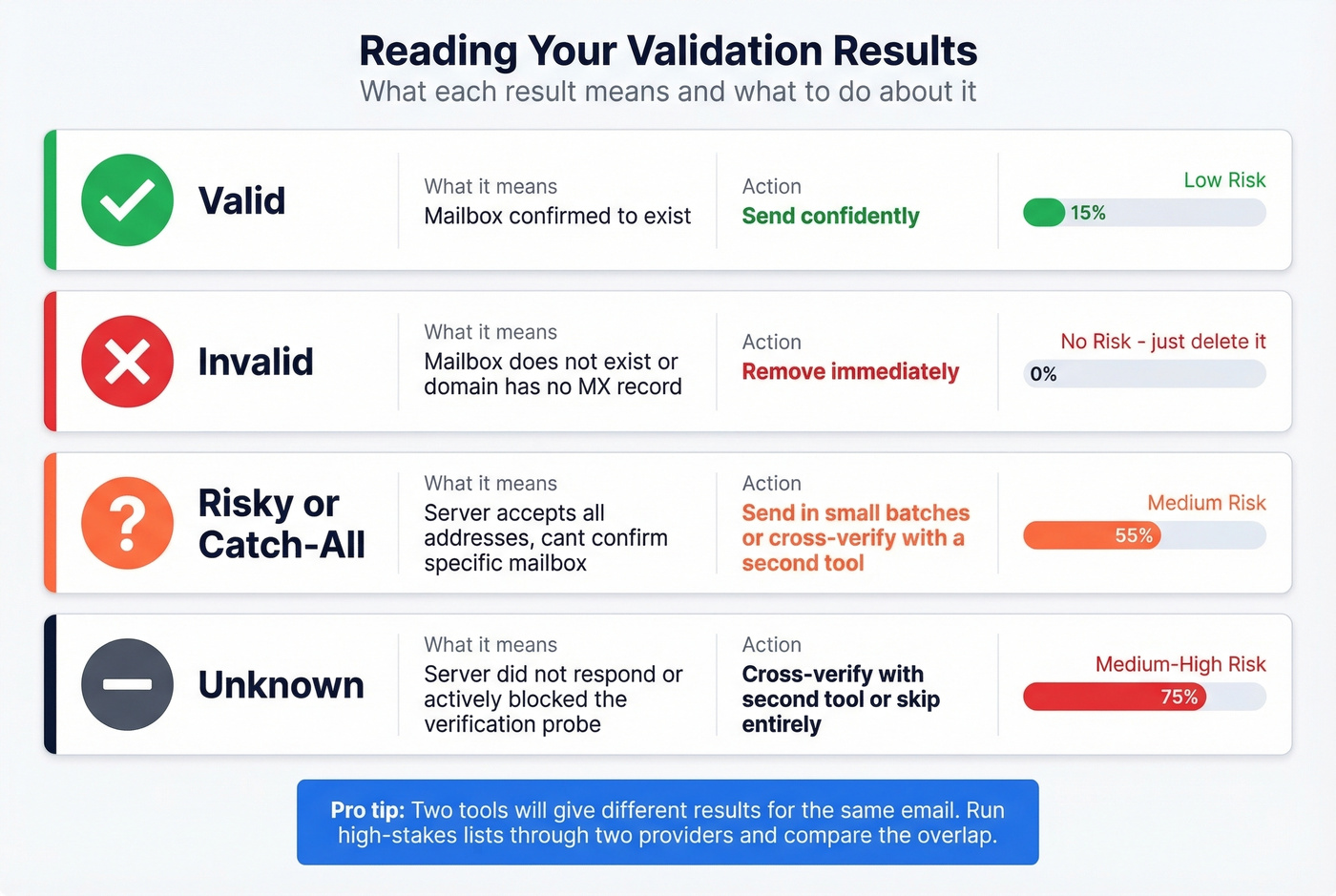
| Result | What It Means | Action | Risk Level |
|---|---|---|---|
| Valid | Mailbox confirmed to exist | Send confidently | Low |
| Invalid | Mailbox doesn't exist or domain has no MX | Remove immediately | None - just delete it |
| Risky / Catch-All | Server accepts all addresses; can't confirm | Send in small batches or cross-verify | Medium |
| Unknown | Server didn't respond or blocked the probe | Cross-verify with second tool or skip | Medium-High |
Two tools will give different results for the exact same email address. This is normal, especially on catch-all domains. No two tools use identical SMTP probe logic, retry timing, or risk-scoring algorithms. If you're verifying a high-stakes list, running it through two providers and comparing the overlap is the smartest move you can make.
Best Email Domain Validator Tools in 2026
Here's how the top tools stack up on the metrics that actually matter:
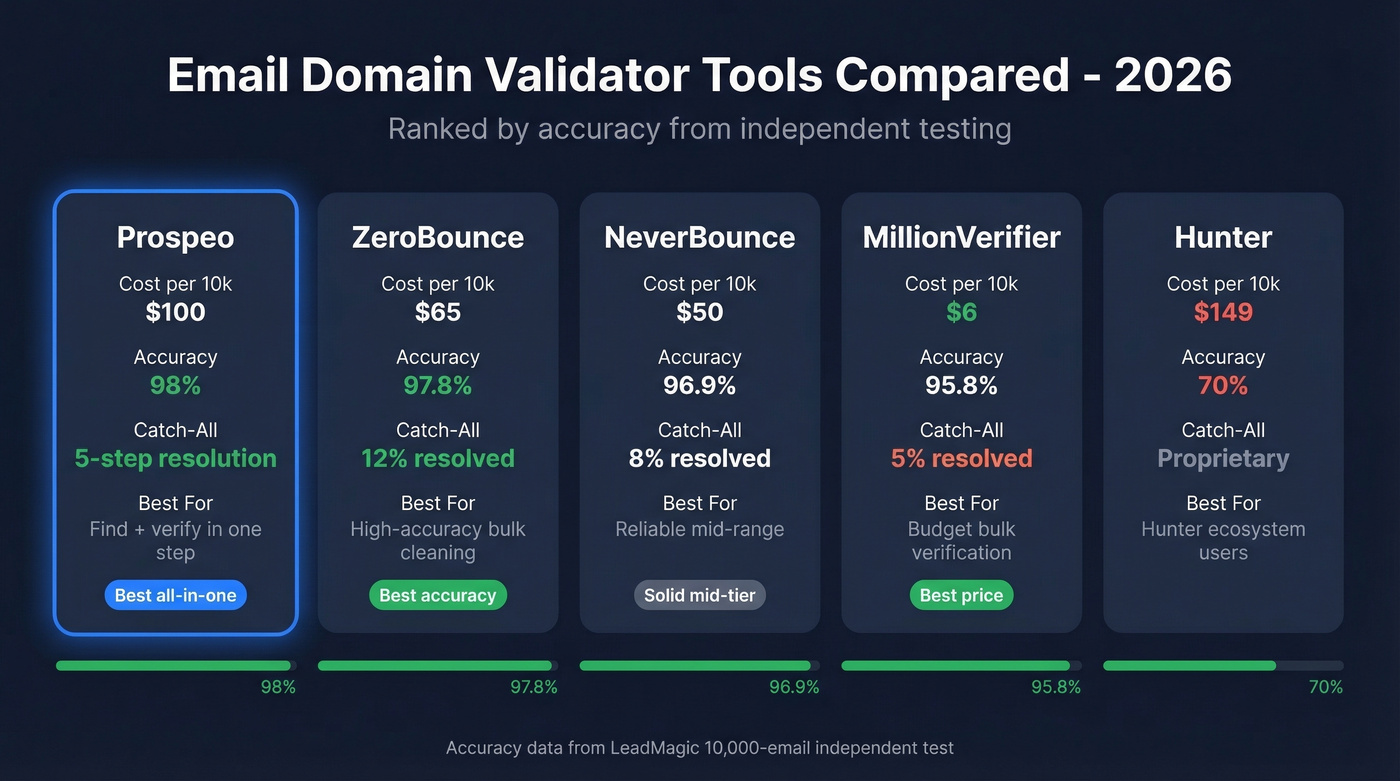
| Tool | Cost/10k | Accuracy | Catch-All Handling | Best For |
|---|---|---|---|---|
| Prospeo | ~$100 | 98% | Yes - 5-step | Find + verify in one step |
| ZeroBounce | ~$65 | 97.8% | Yes - 12% resolved | High-accuracy bulk cleaning |
| MillionVerifier | ~$6 | 95.8% | Limited - 5% resolved | Budget bulk verification |
| Hunter | ~$149 (Growth) | 70% | Yes - proprietary | Hunter ecosystem users |
| NeverBounce | ~$50 | 96.9% | Moderate - 8% resolved | Reliable mid-range cleaning |
| Verifalia | ~$10-200+/mo | Not benchmarked | Basic | Low-volume free checks |
| Email Hippo | Free (100/day) | Not benchmarked | Basic | Quick free spot-checks |
Prospeo
Most verification tools solve one problem: is this email valid? Prospeo solves two - finding the email and verifying it in a single workflow. You search by filters, get verified results, and push them straight to your sequencer. No export-upload-redownload dance.
The 5-step verification process runs every email through syntax validation, MX/DNS checks, SMTP handshake, catch-all resolution, and spam-trap/honeypot filtering. The result is 98% email accuracy across 143M+ verified addresses. Snyk dropped bounce rates from 35-40% to under 5% after switching, and their AE-sourced pipeline jumped 180%.
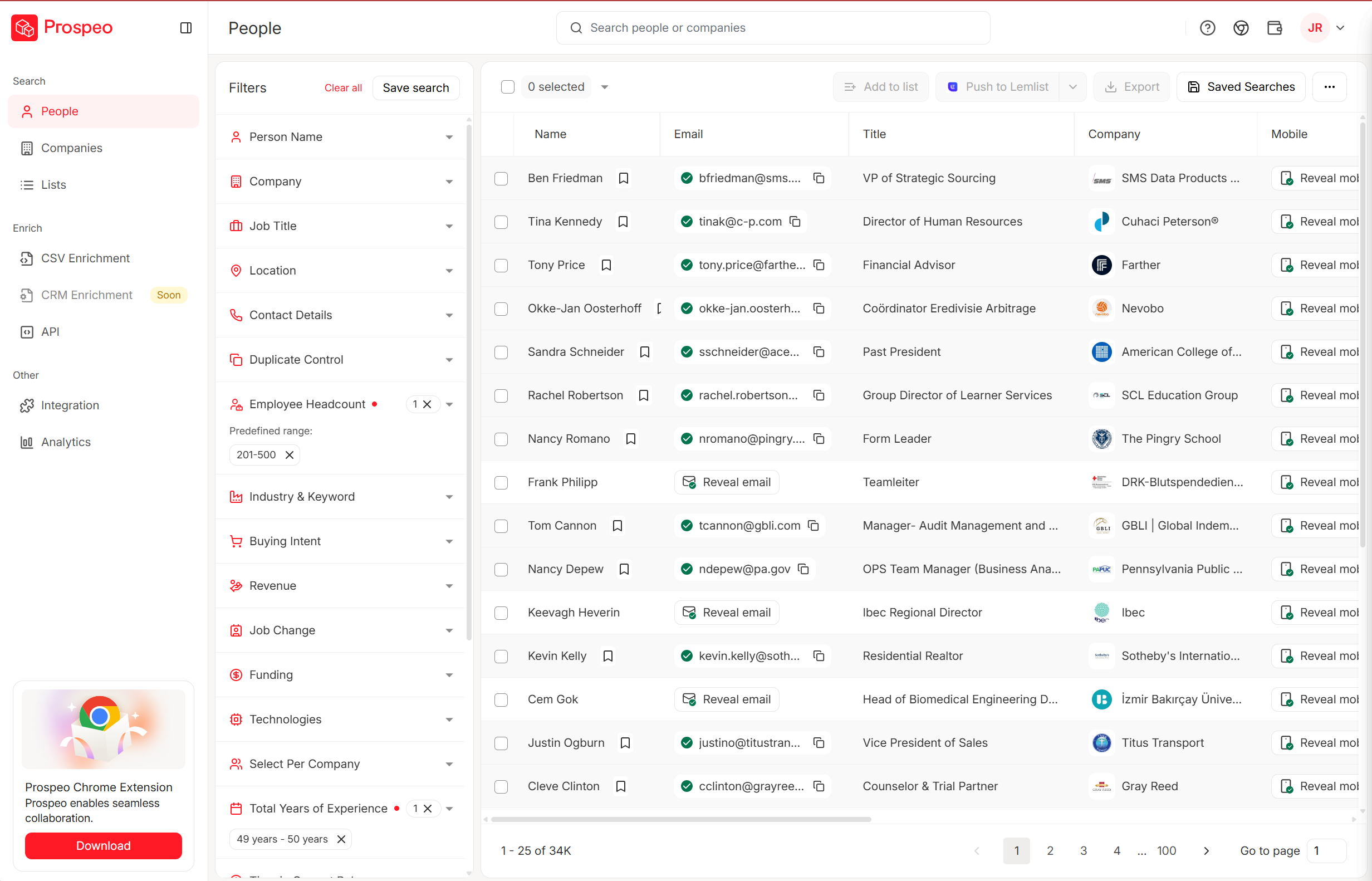
Pricing runs ~$0.01 per email with a free tier of 75 emails/month plus 100 Chrome extension credits/month. No annual contracts, no sales calls. The cost per email is higher than verification-only tools, but you're paying for two tools in one - finding and verifying. For B2B teams running outbound, that eliminates the two-tool tax most workflows require.
Use this if: you're prospecting and verifying in the same workflow and don't want to stitch together multiple tools. For more on building lists end-to-end, see sales prospecting techniques.
ZeroBounce
ZeroBounce posted the highest accuracy in the LeadMagic 10,000-email bake-off - 97.8% with a 0.9% false positive rate and 1.3% false negative rate. It also resolved 12% of catch-all addresses, the best in that test. We've used it for cleaning inherited lists from clients, and the results are consistently solid.
Pricing is ~$0.0129/email at the 10,000-credit PAYG tier, with volume discounts at higher tiers. The subscription plan runs $99/mo for 10,000 credits with bundled add-ons. Free tier gives you 100 validations/month.
Skip this if: you need email finding built in. ZeroBounce is primarily a verification tool - you'll still need a separate source for the addresses themselves (or use a Best Email ID Finder workflow).
MillionVerifier
MillionVerifier exists for one reason: cleaning massive lists at rock-bottom prices. At $0.0003/email in bulk, you're paying roughly $6 to verify 10,000 addresses. Nothing else comes close on cost.
The tradeoff is accuracy and catch-all handling. The LeadMagic test showed 95.8% accuracy - solid, but below ZeroBounce and NeverBounce. Catch-all resolution was just 5%. If you're cleaning a 500,000-record legacy database and need a first pass before running survivors through a more precise tool, MillionVerifier is the right call. For your primary outbound list, pair it with something stronger on catch-alls.
Hunter
Hunter ran its own benchmark of 15 email verifiers on 3,000 real business emails. Their methodology penalizes "unknown" results as incorrect and includes large-company domains where stricter server configurations inflate unknowns - which helps explain the 70% accuracy figure. Hunter's real value is the ecosystem: if you're already using their email finder and campaigns, the verifier is a natural add-on. Free tier gives you 50 credits/month; the Growth plan at $149/mo gets you 10,000 credits.
NeverBounce
NeverBounce hit 96.9% accuracy in the LeadMagic test with 8% catch-all resolution - a solid middle ground between ZeroBounce's precision and MillionVerifier's price. At ~$50 per 10,000 emails, it's competitively priced. Reddit threads on r/software consistently rank it in the top three for sales use cases, and we've seen it perform reliably on mid-size lists. No free tier, but the PAYG model means no commitment. If you're already running cold email through Instantly, their built-in verification is also worth a look.
Verifalia
Verifalia offers 25 free verifications per day with a quality-level credit system where Standard checks cost 1 credit, High costs 2, and Extreme costs 4. Paid plans scale from 250 to 25,000 daily credits at roughly $10-200+/month. Decent for developers who want API-level control over verification depth, but not built for high-volume outbound.
Email Hippo
Free tool with a 100-verification daily cap, resetting at midnight UTC. Good for quick spot-checks on individual addresses - not for list cleaning at any meaningful scale.
Catch-all domains break most validators. Prospeo's proprietary 5-step verification process handles them - resolving unknowns that cheaper tools punt on. That's how 15,000+ companies keep bounce rates under 2% without babysitting every send.
Stop losing domains to bad data. Verify before you send.
Free vs. Paid Validators
The right tool depends entirely on volume. Under 100 emails a day, free tools work fine - Email Hippo, Verifalia's free tier, or ZeroBounce's 100/month cover light prospecting and form validation. Between 1,000 and 10,000 emails a month, you need a paid PAYG plan. ZeroBounce or NeverBounce at their respective PAYG rates keeps costs under $80/month while delivering real accuracy. Above 10,000 a month, subscription or bulk pricing makes sense - MillionVerifier for first-pass cleaning, then a higher-accuracy tool for the final verified list.
For signup form validation with real-time API checks, you need sub-second response times and a reliable API. Validating domains at the point of capture is the fastest way to keep garbage out of your CRM before it compounds into deliverability problems. Teams that need ongoing domain health monitoring rather than one-time verification should also look at MXToolbox, which runs frequent domain tests and checks mail servers against large blacklist sets. If you're troubleshooting broader inboxing issues, pair this with an email deliverability guide and dedicated email reputation tools.
One pattern from Reddit practitioners worth adopting: stack two providers for critical lists. Run your list through MillionVerifier first (cheap), then push the "valid" and "unknown" results through a second tool for another opinion. The overlap between two tools' "valid" verdicts is your highest-confidence segment. If you're doing this at scale, it helps to track email bounce rate and email velocity together.
Pro Tips
Stack two providers for high-stakes lists. No single tool gets everything right, especially on catch-all domains. Run unknowns through a second verifier - if both say "valid," you're in good shape. If they disagree, send cautiously or skip. The cost of a second verification pass is trivial compared to a burned domain.
Validate at the point of entry. One Reddit user reported a 96% reduction in invalid emails after adding real-time verification to their signup form. Catching bad addresses before they enter your database is far cheaper than cleaning them out later. If you're enriching leads as they come in, consider data enrichment services.
Re-validate lists older than 30 days. Email addresses decay at roughly 2-3% per month due to job changes, company shutdowns, and domain migrations. A list that was 98% valid six months ago could be 85% valid today. We've seen teams skip this step and wonder why their bounce rates crept up - the list aged out from under them.
FAQ
What does an email domain validator actually check?
It checks whether a domain's DNS has valid MX records, confirming the domain can receive mail. Advanced validators go further - running SMTP handshakes to verify specific mailboxes, then layering catch-all detection, spam trap filtering, and disposable email flagging. Most modern tools combine all steps automatically.
Why do different tools give different results for the same email?
Catch-all domains and greylisting cause tools to interpret server responses differently. Each provider uses its own SMTP probe logic, retry timing, and risk-scoring algorithms. Two tools disagreeing on a catch-all address isn't a bug - it's the nature of the problem. Cross-referencing results from two providers is the best workaround.
Can I validate emails without sending them?
Yes - all modern validators use SMTP handshake probes that initiate a connection and issue a RCPT TO command but disconnect before delivering any message. No email is sent during verification. The mail server never receives actual content.
How often should I re-validate my email list?
Every 30 days for active outbound lists. Email addresses decay at roughly 2-3% per month as people change jobs and companies shut down domains. For dormant lists, re-validate before any campaign launch regardless of age.
What's a good free option for low-volume validation?
Prospeo's free tier gives you 75 email verifications per month plus 100 Chrome extension credits - enough for light prospecting with full catch-all handling. Email Hippo offers 100 free checks per day for quick spot-checks, and Verifalia provides 25 daily verifications with adjustable quality levels. For anything above a few hundred emails monthly, paid PAYG plans from ZeroBounce or NeverBounce are more practical.