

Best Email Finder APIs in 2026: Benchmarks, Pricing, and Honest Verdicts
You just sent 5,000 "verified" emails through your email finder API and 1,100 bounced. Your domain reputation tanked, your sequences stalled, and now every contact in your CRM looks suspect. The problem is simple: "verified" means wildly different things depending on who's selling it.
Here's what three independent benchmarks and our own testing reveal.
Why Most Email Lookup APIs Fail You
B2B contact data decays at roughly 30% per year. If your provider refreshes its database every six weeks - or worse, every quarter - you're building sequences on stale data.
The #1 complaint on r/coldemail is exactly this: tools label emails "verified" but users still see 20%+ bounce rates. Industry guidance puts the target at under 2% hard bounces. Anything above 5% means your provider's verification is shallow, running syntax and MX checks only, or it's matching against data that's months old. That's why choosing a reliable email finder API matters more than choosing the cheapest one.
Our Top 3 Picks
Best for accuracy and data freshness: Prospeo. 98% email accuracy, 92% API match rate, 7-day data refresh cycle. Free tier at 75 emails/mo, paid from $39/mo.
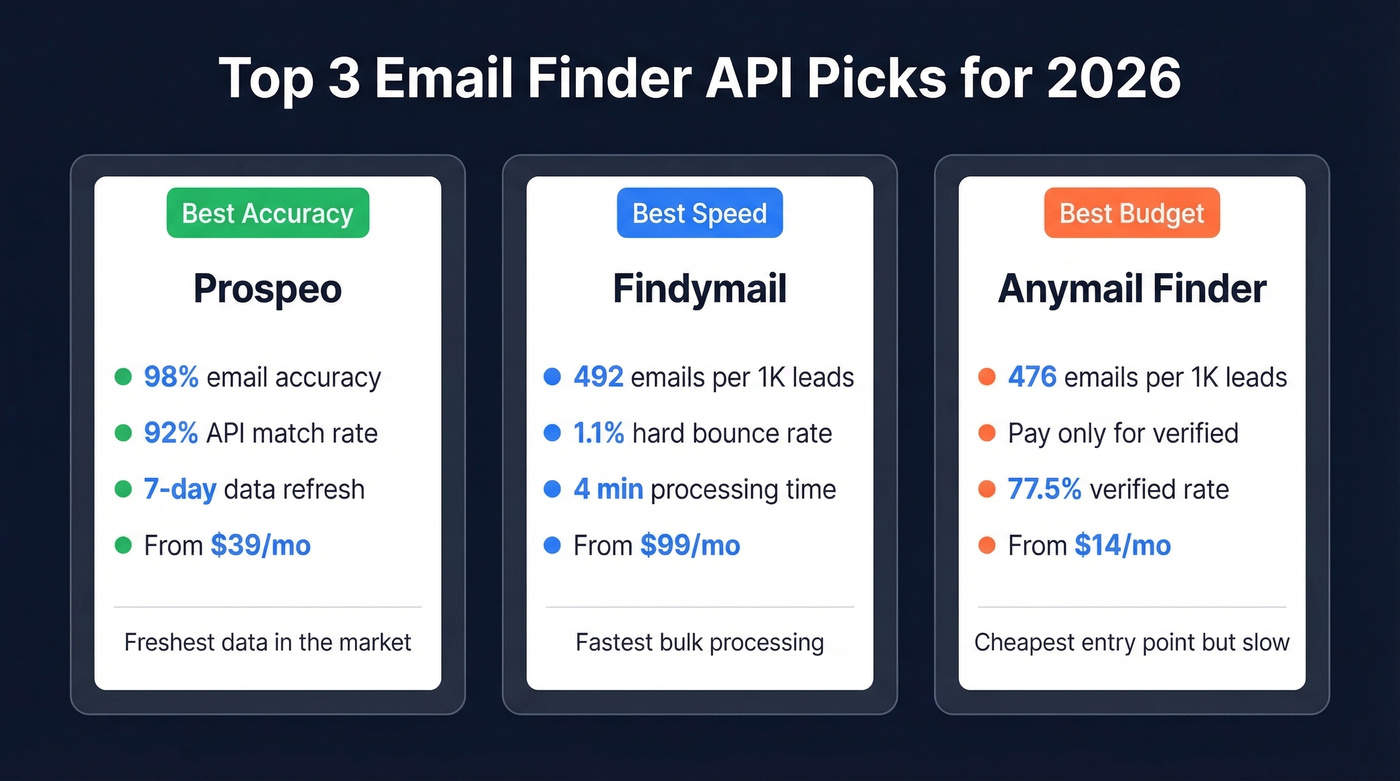
Best for speed at scale: Findymail. 492 emails found per 1,000 leads in 4 minutes. In the 20,000-contact benchmark, Findymail posted a 1.1% hard bounce rate. Starter plan is $99/mo.
Best for budget teams: Anymail Finder. Pay only for verified results. $49/1K emails, plans from $14/mo. The tradeoff: it's slow - 155 minutes per 1,000 leads.
How We Evaluated
We cross-referenced three independent benchmarks: a 20,000-contact live-sending test across 15 tools, a 5,000-contact verified-rate comparison across 8 tools, and a 1,000-lead developer benchmark measuring cost, speed, and find rate across 9 APIs.
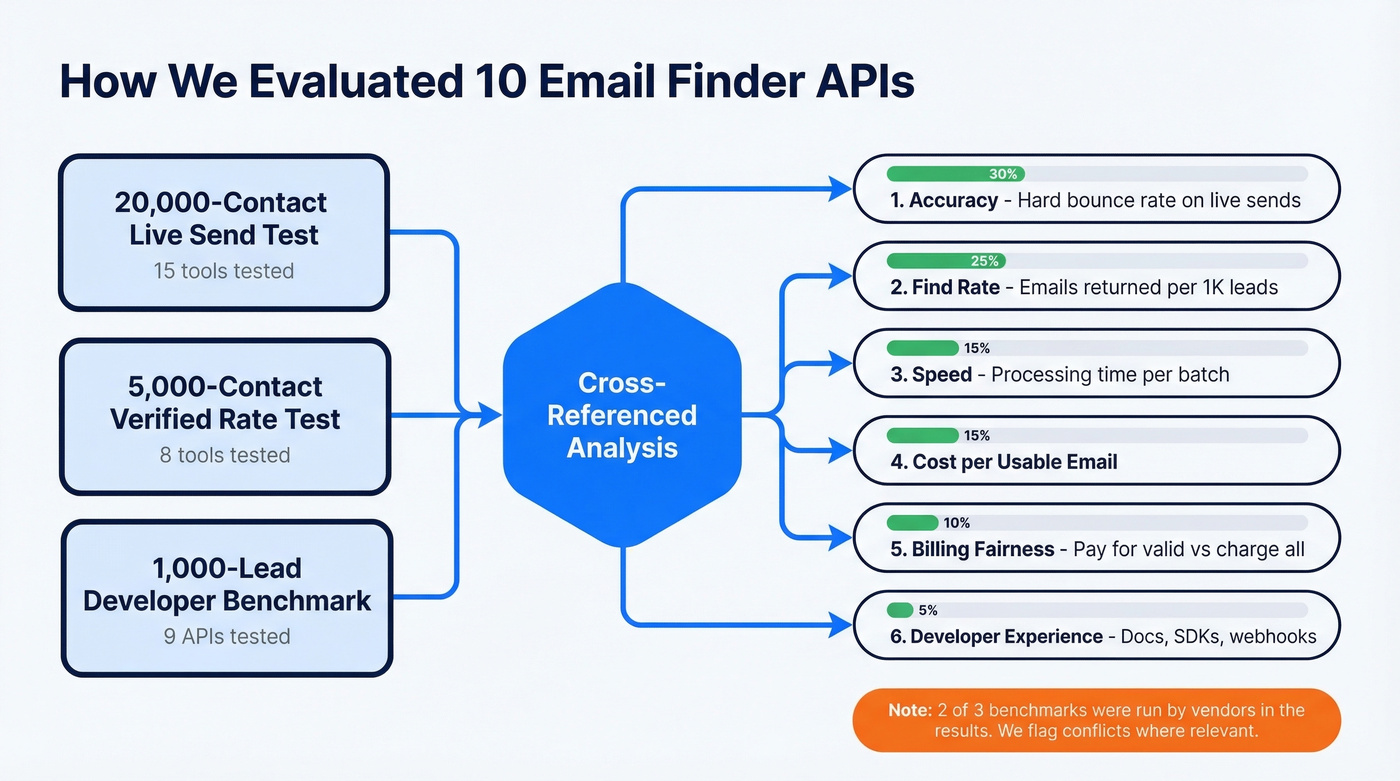
We weighted accuracy (hard bounce rate on live sends), find rate (emails returned per 1,000 leads), speed, cost per usable email, billing fairness, and developer experience. Two of the three benchmarks were run by vendors who appear in the results - we note that where relevant, but the methodologies hold up.
10 Providers Compared
Prospeo
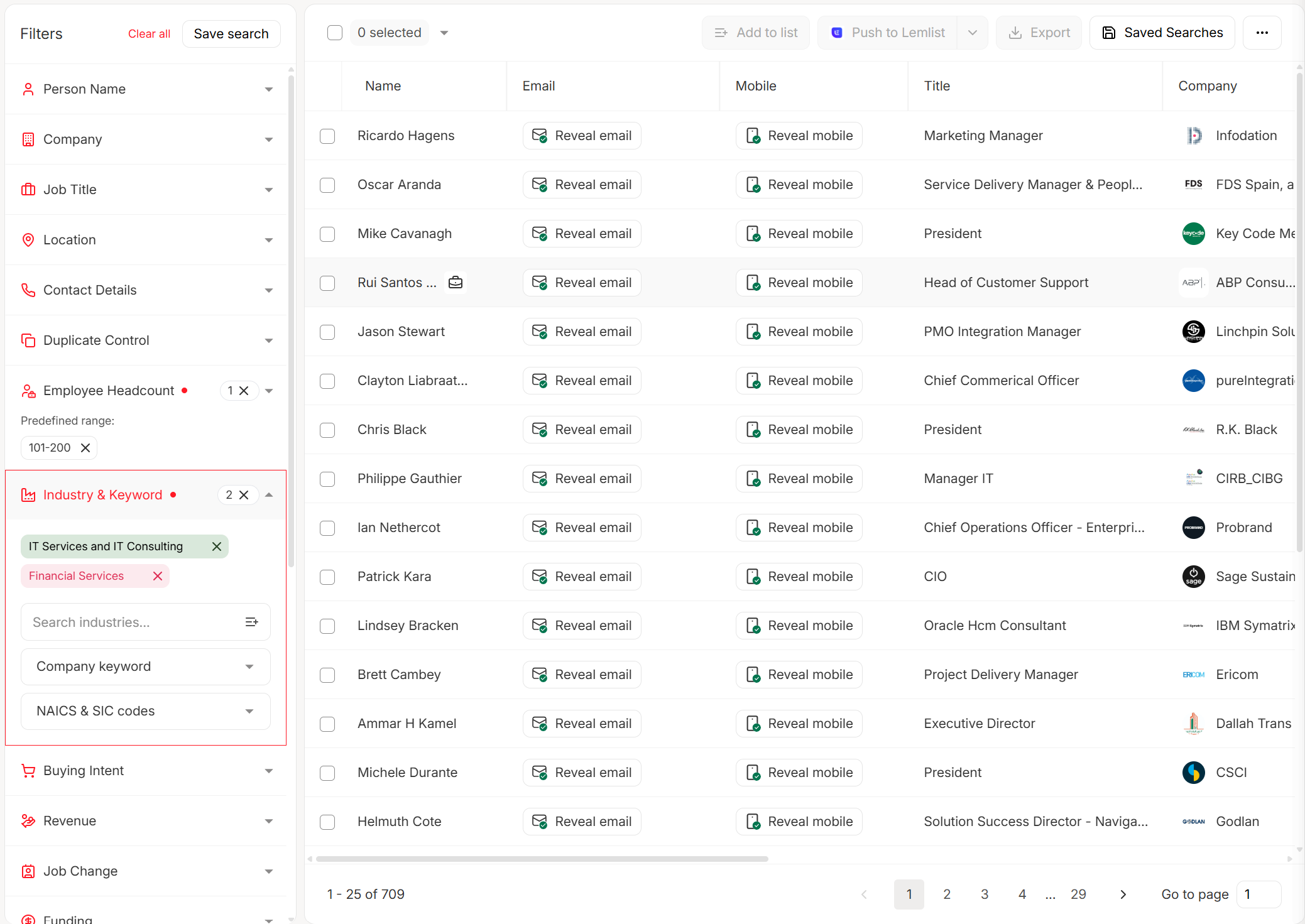
Most email finder APIs are reselling someone else's data. Prospeo builds its own. The API draws from 300M+ professional profiles and 143M+ verified emails through a proprietary infrastructure that doesn't rely on third-party providers.
The 7-day data refresh cycle is what separates it from the pack. The industry average is six weeks - that gap translates directly into bounce rates. Prospeo delivers 98% email accuracy and a 92% API match rate through a 5-step verification process covering catch-all handling, spam-trap removal, and honeypot filtering. We've run it against our own internal contact lists and the numbers hold.
A quick curl example shows how straightforward the contact search endpoint is:
curl -X POST https://api.prospeo.io/email-finder \
  -H "Authorization: Bearer YOUR_API_KEY" \
  -H "Content-Type: application/json" \
  -d '{"first_name":"Jane","last_name":"Doe","company":"acme.com"}'
The REST API supports bulk lookups with webhook integration and native connectors for Salesforce, HubSpot, Clay, Zapier, Make, Instantly, and Lemlist - making integration straightforward regardless of your stack. Pricing lands around $0.01 per email, with a free tier at 75 emails/month and paid plans from $39/mo. No contracts, no sales calls.

Most email finder APIs refresh data every 6 weeks. Prospeo refreshes every 7 days - that's why it holds 98% accuracy and a 92% API match rate across 300M+ profiles. No third-party data reselling. No stale contacts tanking your domain.
Get 75 free emails and see your bounce rate drop below 2%.
Findymail
Findymail is the speed king. In the lobstr.io benchmark, it found 492 emails per 1,000 leads and processed them in 4 minutes flat. The 20,000-contact live-sending test showed a 1.1% hard bounce rate - comfortably under the 2% threshold.
You only pay for verified results. One email costs one credit, but phone numbers cost 10 credits - a multiplier that catches people off guard. The Starter plan runs $99/mo for 5,000 finder credits plus 5,000 bonus verifier credits. Unused credits roll over, capped at 2x your monthly allotment.
Rate limits are generous at 300 concurrent requests with no daily caps. The wrong-domain rate of 5.2% in the Dropcontact benchmark means roughly 1 in 20 found emails goes to the wrong company - worth a verification pass at high volume.
Use this if you need fast, high-volume email finding with low bounces. Skip this if phone numbers are a priority. That 10x credit multiplier adds up fast.
Anymail Finder
Here's the thing about Anymail Finder: you never pay for emails that can't be verified. In the 5,000-contact benchmark, it hit a 77.5% verified rate - the highest in that test. The lobstr benchmark showed 476 emails found per 1,000 leads at $49/1K.
But it's slow. Processing 1,000 leads took 155 minutes - over two and a half hours versus Findymail's four minutes. For real-time enrichment in a sequence tool, that latency kills you. For batch processing overnight? Fine. Plans start at $14/mo.
Hunter.io
Everyone's heard of Hunter, but the benchmarks tell a mixed story. It found only 281 emails per 1,000 leads in the lobstr test, and the 5,000-contact benchmark showed a 37.6% verified rate. Reddit sentiment consistently positions it as solid for verification and limited for finding.
Use it as a verification layer, not a primary finder. The API is well-documented, the free tier gives 50 credits/month, and paid plans run from $49/mo to $299/mo. Verification costs just 0.5 credits per email - genuinely cheap for a cleanup pass.
If you're comparing options in this category, see our breakdown of Hunter alternatives.
Apollo
Apollo looks like the cheapest option at $11.8 per 1,000 emails, with 430 found per 1,000 leads and 8-minute processing in the lobstr benchmark. But the Reddit consensus is brutal: users report they can't trust the addresses, see lots of bounces on older contacts, and run into catch-all issues with larger companies.
One practitioner on r/SaaS recommends scraping Apollo results via Apify at $1.20/1K leads, verifying with MillionVerifier, then filling gaps with pay-only-for-found finders. That workflow drops bounces to sub-2%, but it's a lot of duct tape for a "cheap" tool. Per-seat pricing is the #1 complaint from agency buyers - it makes costs unpredictable as teams scale.
If you're building a broader outbound stack, our guide to outbound lead generation tools can help you avoid mismatched pricing models.
Clearout
Clearout documents sync lookups, bulk queue processing, and webhook callbacks clearly - the API docs are above average. The credit system is transparent: 4 credits per non-role email find, 2 for role-based addresses, no charge when nothing's found. Credits never expire on purchased plans. Free tier starts at 100 credits, paid plans from around $20/mo.
FullEnrich
FullEnrich's waterfall model routes enrichment across 15 data sources. In the 20,000-contact benchmark, it found 483 emails per 1,000 leads but posted a 3.6% hard bounce rate and an 11.7% wrong-domain rate. That 15.3% overall error rate is hard to overlook.
Better as a second pass after your primary finder misses than as a standalone solution. Plans from $29/mo.
If you’re evaluating broader enrichment beyond email, compare vendors in our roundup of data enrichment services.
Snov.io
Snov.io is cheap at scale, dropping to around $7.40 per 1K in the lobstr benchmark, but entry pricing in that same benchmark was $39 per 1,000 emails. The 5,000-contact benchmark showed just a 20.1% verified rate - the lowest in that test. There's also a hard limit of 200 requests per hour. Decent for international leads on a tight budget, but find rates are low.
ZeroBounce
Primarily a verification tool that added email finding. Starts at roughly $0.008 per credit with 100 free monthly credits and plans from $16/mo. Use it as a verification layer after your primary finder, not as the finder itself.
For more options in this category, see our list of Bouncer alternatives for email verification.
Dropcontact
Dropcontact posted the highest real enrichment rate in its own benchmark (54.9%) with just 0.9% hard bounces - impressive numbers, though the conflict of interest is obvious. The cost is steep at around $65/1K emails, and processing took 149 minutes per 1,000 leads. EU-based, which matters for European data residency requirements.
Honorable mentions: People Data Labs (premium at roughly $280/1K, 450/1K found in the lobstr benchmark) and Icypeas (around $16.50/1K, EU-based) are worth evaluating if none of the above fit.
Your outbound stack is only as good as the data feeding it. Prospeo's Email Finder API plugs into Salesforce, HubSpot, Clay, Zapier, and Make - with 5-step verification that catches spam traps, honeypots, and catch-all domains before they wreck your deliverability.
Start finding verified emails at $0.01 each - no contracts, no sales calls.
Pricing Comparison
| Tool | Free Tier | Starting Price | Cost/1K | Billing Model | Gotcha |
|---|---|---|---|---|---|
| Prospeo | 75 emails/mo | $39/mo | ~$10 | Pay for valid | None |
| Findymail | First 10 emails (trial) | $99/mo | ~$49 | Pay for valid | 10x credits for phones |
| Anymail Finder | Trial | $14/mo | ~$49 | Pay for valid | Very slow processing |
| Hunter.io | 50 credits/mo | $49/mo | ~$50 | Credits (charged per lookup) | Charged for misses |
| Apollo | Plan-dependent | ~$49/mo/seat | ~$12 | Per seat + credits | Per-seat costs add up |
| Clearout | 100 credits | ~$20/mo | ~$25 | Per credit, no-find free | 4x credits for non-role finds |
| FullEnrich | 50 credits | $29/mo | ~$35 | Waterfall, no-find free | 11.7% wrong-domain rate |
| Snov.io | 50 searches/mo | $39/mo | ~$39 (down to ~$7.40 at scale) | Credits | 20.1% verified rate |
| ZeroBounce | 100 credits/mo | $16/mo | ~$8 | Per credit | Finder is secondary feature |
| Dropcontact | Trial | ~$50/mo | ~$65 | All results | Slow + expensive |
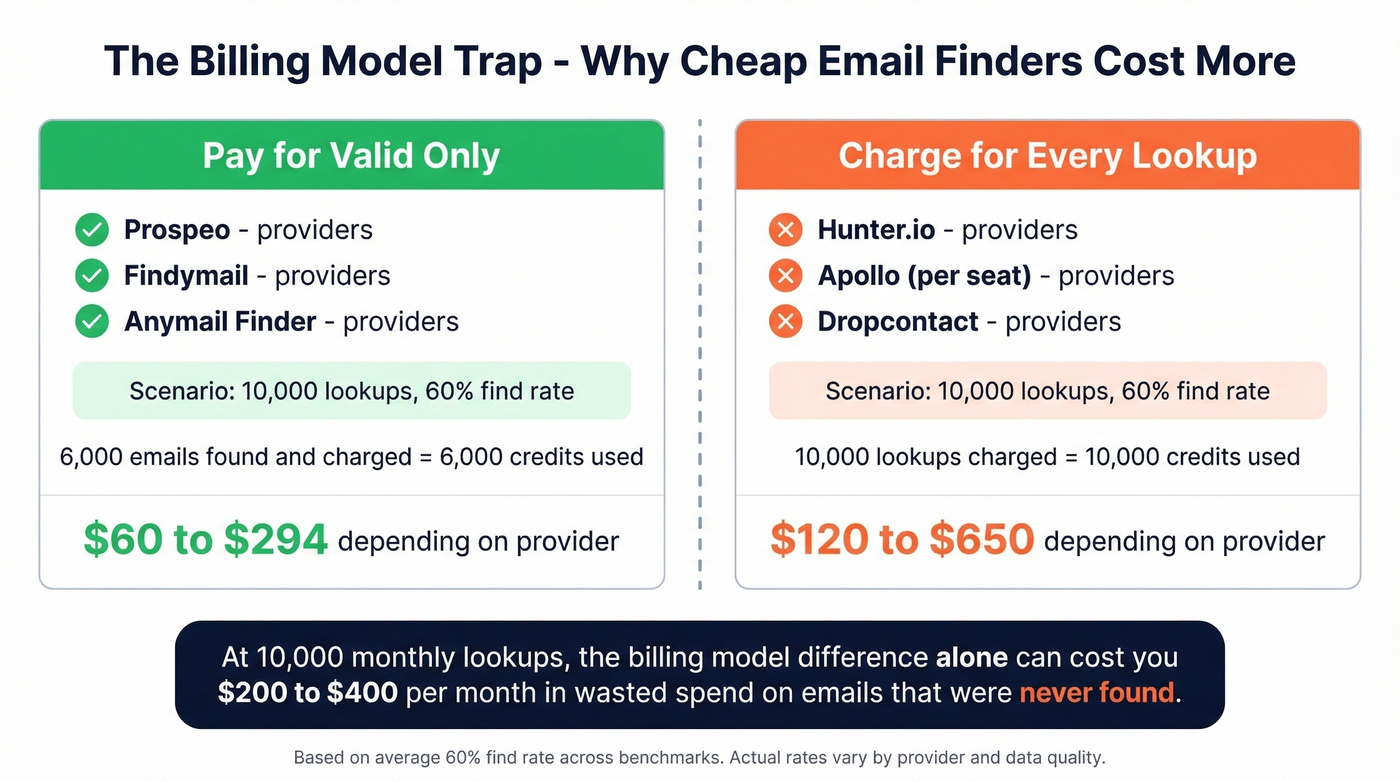
The "Gotcha" column is where the real money hides. Pay-for-valid providers only charge when they return a verified email. Charge-all providers bill you whether the email exists or not. Over thousands of lookups, that difference compounds fast.
If you want a deeper dive into cost drivers, see our guide to lead enrichment.
What Benchmarks Reveal About Accuracy
| Tool | Find Rate | Hard Bounce | Cost/1K | Speed/1K |
|---|---|---|---|---|
| Findymail | 492/1K | 1.1% | $49 | 4 min |
| FullEnrich | 483/1K | 3.6% | ~$35 | Variable (waterfall) |
| Anymail Finder | 476/1K | ~3% (vendor-claimed) | $49 | 155 min |
| Apollo | 430/1K | High bounce complaints | ~$12 | 8 min |
| Dropcontact | 383/1K | 0.9% | $65 | 149 min |
| Hunter.io | 281/1K | - | $50 | 30 min |
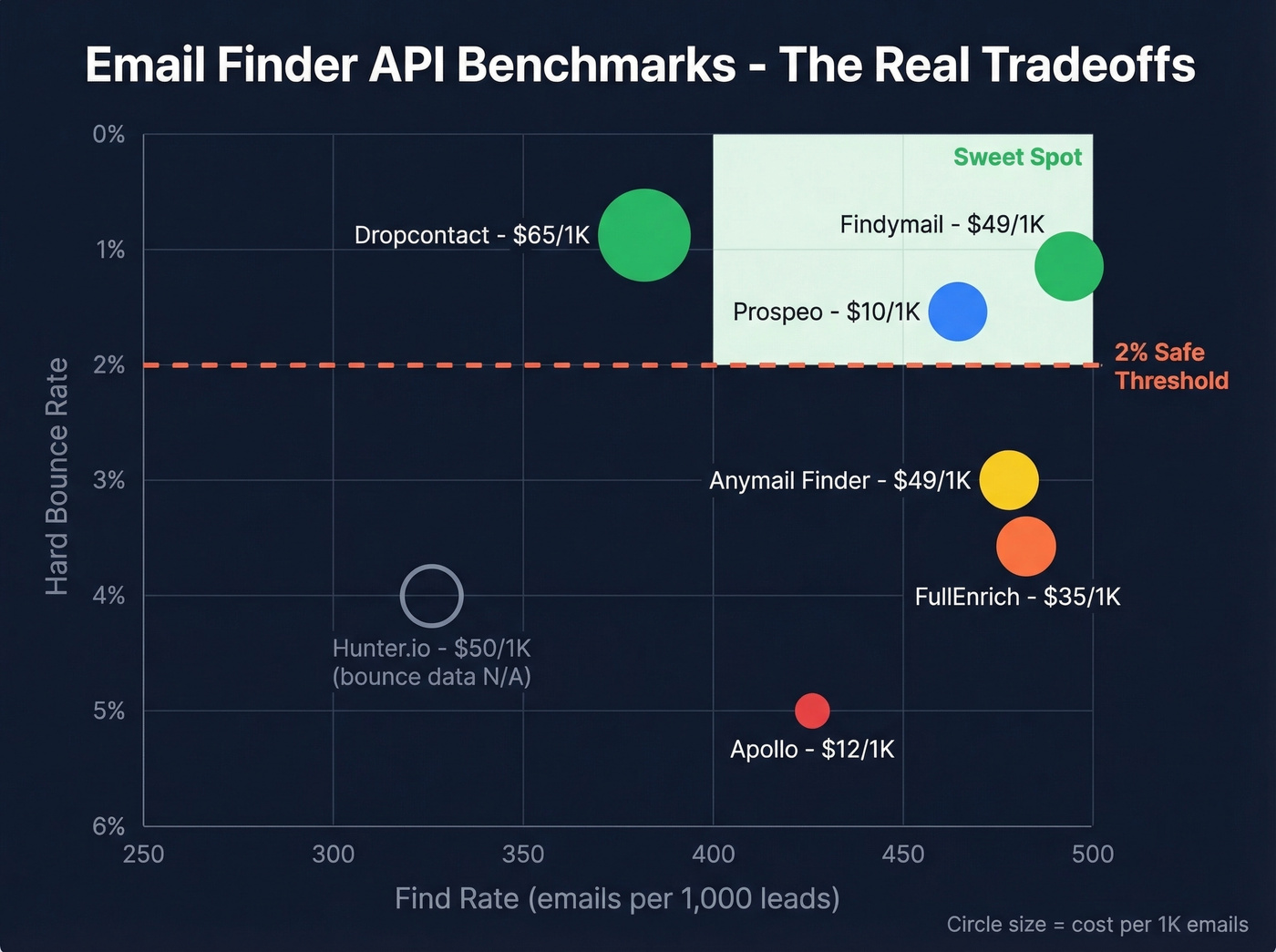
Let's be honest: the cheapest option is almost never the cheapest in practice. We've watched teams pick the $12/1K tool, send 20,000 emails, and torch a domain in a week. A $12/1K tool with 5% bounces costs more than a $49/1K tool with 1% bounces once you factor in domain recovery, lost pipeline, and the two weeks you spend warming a replacement domain. Cost per usable email - not cost per found email - is the only metric that matters.
If you’re troubleshooting bounces specifically, see our email bounce rate benchmarks and fixes.
Waterfall Enrichment via API
Waterfall enrichment means querying multiple providers sequentially - if Provider A misses, you try Provider B, then C. No single database covers every contact, and provider overlap is lower than you'd think.
Building this yourself takes at least a week of dev time and $1,000-$10,000 in salary costs, plus ongoing maintenance. Managed options like FullEnrich and Clay handle the orchestration, but you're trusting their provider selection and routing logic.
The smarter play for most teams: start with a high-accuracy primary finder, then route misses to a secondary provider. Two providers in sequence typically gets you to 85%+ coverage without the complexity of a full waterfall stack.
If you’re implementing this inside outbound sequences, our cold email API guide covers common pitfalls.
Choosing the Right Provider for Agencies
If you're running outreach for multiple clients, the calculus changes. An email finder API for agencies needs flexible billing, multi-workspace support, and the ability to segregate data by client. Per-seat pricing models like Apollo's become a dealbreaker fast when you're onboarding new accounts every month.
Credit-based billing that scales with volume rather than headcount is a much better fit for agency workflows. Look for providers with API keys that can be scoped per client or workspace, and prioritize pay-for-valid billing so you're not eating costs on misses across dozens of campaigns.
For the broader system around this, see our lead generation workflow guide.
GDPR and Compliance
GDPR enforcement has reached EUR 5.88B in fines through 2025, with 2,245 penalties issued since 2018. The EUR 27.8M TIM fine for aggressive email campaigns is the cautionary tale every outbound team should know.
For B2B email finding, Article 6(1)(f) - legitimate interest - is the typical legal basis. You need to honor opt-outs, provide a Data Processing Agreement, and ideally work with providers that offer EU data residency. If your provider can't answer "where is my data stored?" in one sentence, that's a red flag. The ICO's guidance on legitimate interest is worth bookmarking.
For more on staying out of trouble, see our guide on is it illegal to buy email lists.
FAQ
Are email finder APIs legal?
Yes, under GDPR's Article 6(1)(f) for B2B outreach. You need to honor opt-outs, maintain a DPA with your provider, and restrict lookups to professional addresses. Most reputable providers offer DPAs and enforce global opt-out lists by default.
What bounce rate should I expect?
Top-tier APIs deliver under 2% hard bounces on fresh data. Anything above 5% signals stale records or shallow verification. Findymail posted 1.1% and Dropcontact 0.9% in the 20,000-contact benchmark.
What's a catch-all domain and why does it matter?
A catch-all domain accepts all incoming emails regardless of whether the specific address exists. Many APIs can't distinguish real from fake addresses on these domains, so you get charged for undeliverable emails. Prospeo's 5-step verification includes catch-all handling to filter these out before billing.
What is a name-to-domain lookup?
A name-to-domain lookup takes a person's name and their company domain as inputs and returns the most likely professional email address. Most email finder APIs use this pattern as their primary endpoint. Expect 40-50% hit rates on cold domains and 80%+ on well-indexed companies.
Which email finder API has the best accuracy?
Prospeo delivers 98% email accuracy with a 7-day data refresh cycle - the fastest in the market. Findymail also performs well, posting 1.1% hard bounces in the 20,000-contact benchmark. For most outbound teams, either is a safe primary choice. Mailtrap's deliverability guide has more context on why accuracy matters so much downstream.