

Email List vs Email Leads: Why the Difference Costs You Pipeline
The gap between an email list and email leads isn't semantic - it's the reason 80% of new leads never convert into sales. Your marketing team imports 10,000 contacts from a trade show and calls it a "lead generation list." Sales works it for two weeks. Bounce rates spike, reply rates crater, and your domain reputation takes damage. Those weren't leads. They were names on a list.
The Short Version
An email list is a container. Email leads are the qualified people inside it. Treating them the same tanks deliverability, wastes sales hours, and risks compliance fines up to $51,744 per violation. The fix: verify your list, score your contacts, and segment before you send.
What's the Actual Difference?
An email list is a collection of addresses - scraped, imported, purchased, or organically collected. Whether it's a cold list from a data vendor or a spreadsheet from last year's conference, it tells you nothing about whether those people want to hear from you, fit your ICP, or are even still at that company.
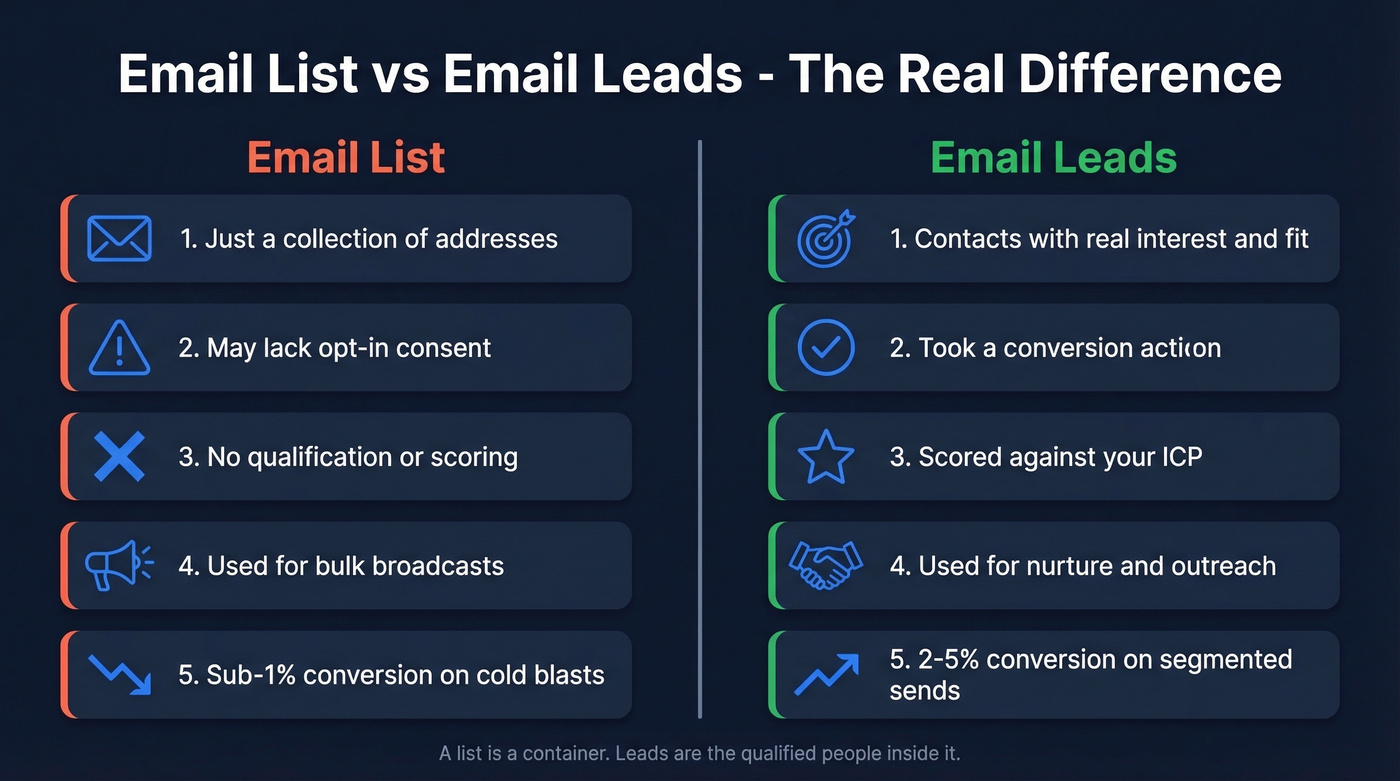
An email lead is a contact who's demonstrated interest and fits your target profile. In most frameworks, subscribing counts as a conversion action, but it's the minimum threshold. A real lead has taken a meaningful step - downloading a resource, requesting a demo, visiting your pricing page - and matches the firmographic and role criteria you actually sell to. Buyers don't reach out until 57% of their purchase decision is already made, which means a contact who hasn't engaged is nowhere near ready for outreach.
The average conversion rate across 14 industries is 2.9%, where "conversion" means a qualified lead - not just a captured email. That gap between "captured" and "qualified" is exactly where most teams lose money.
| Dimension | Email List | Email Lead |
|---|---|---|
| What it is | Collection of addresses | Contact with interest + fit |
| Consent | May lack opt-in | Took a conversion action |
| Qualification | None - raw data | Scored against ICP |
| Typical use | Broadcasts, newsletters | Nurture sequences, outreach |
| Conversion rate | Sub-1% on unqualified blasts | 2-5% on segmented sends |
Subscribers vs Prospected Contacts
Every contact in your database sits somewhere on a progression, and understanding where they are determines whether you should email them at all. Subscribers enter at the top through opt-in, while contacts found through prospecting tools need verification and scoring before they earn a place in your pipeline.
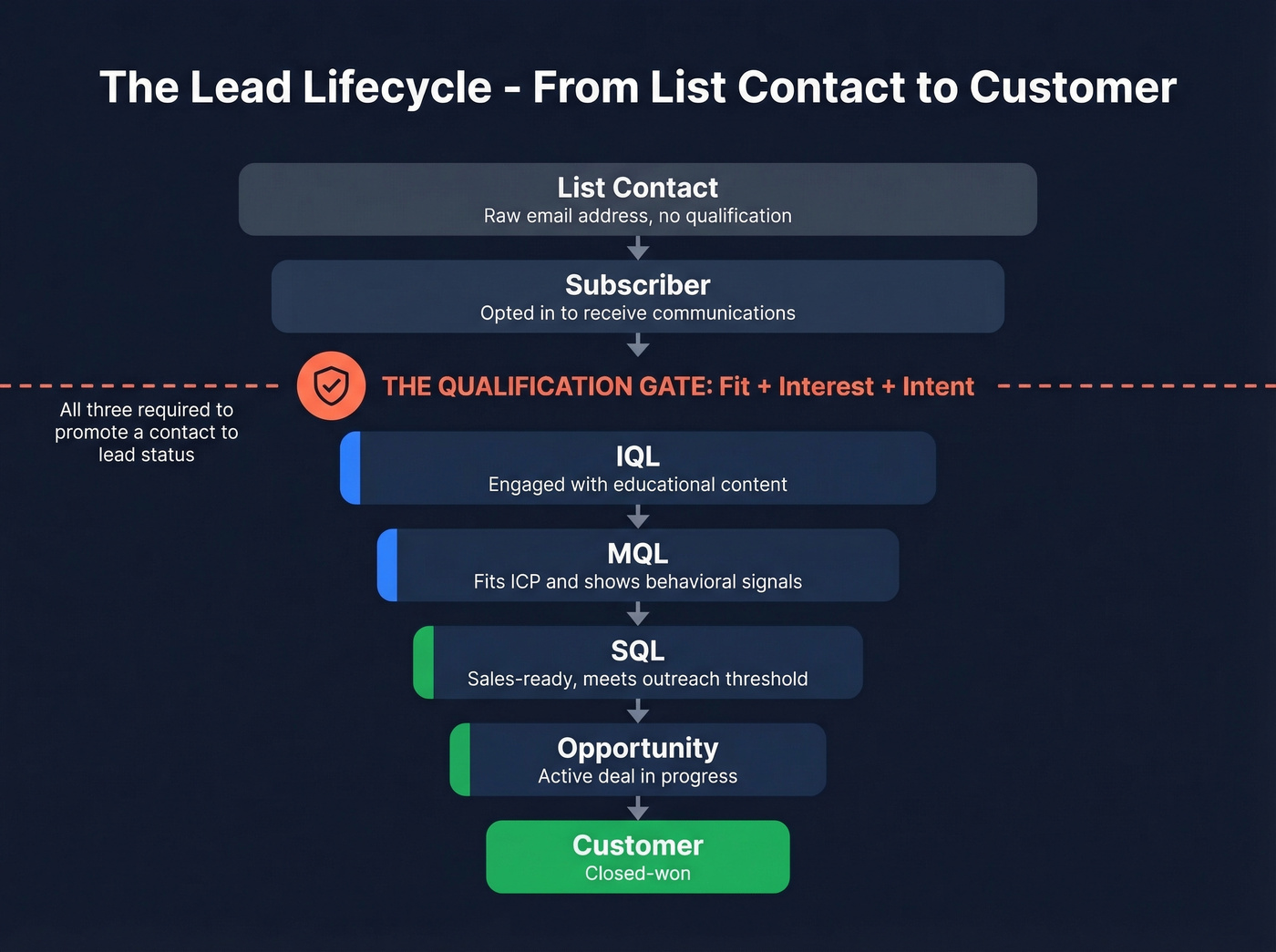
- List Contact - raw email address, no qualification
- Subscriber - opted in to receive communications
- IQL - engaged with educational content
- MQL - fits ICP and shows behavioral signals
- SQL - sales-ready, meets threshold for outreach
- Opportunity - active deal in progress
- Customer - closed-won
The critical gate between "contact" and "lead" is a three-point check: Fit + Interest + Intent. A contact who fits your ICP but hasn't engaged isn't a lead. A contact who's engaged but doesn't fit your ICP isn't one either. You need all three before promoting someone from list contact to qualified lead. Skip this gate and you're handing sales a list of strangers.

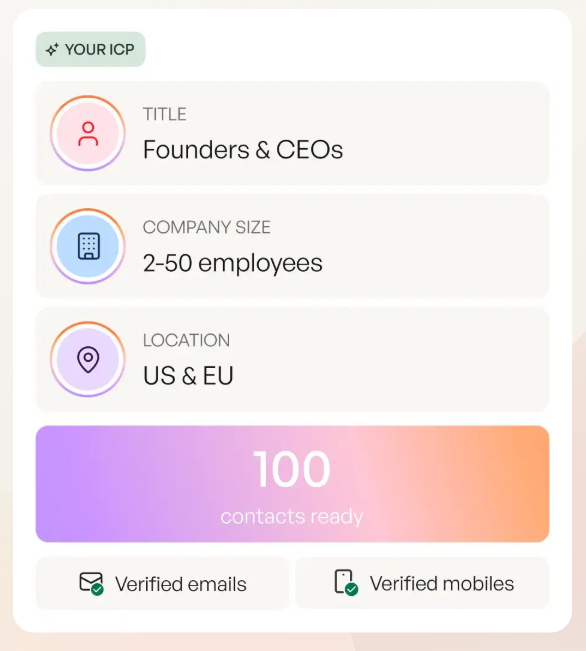
Your list decays 23% per year. Prospeo's 5-step verification and 7-day refresh cycle turn stale email lists into qualified leads - 98% accuracy, catch-all handling included, at roughly $0.01 per email.
Clean 10,000 contacts for $100 and stop burning your domain on dead addresses.
Why It Matters for Performance
Here's the thing: your email list is rotting. At least 23% of an email list degrades every year - people change jobs, companies fold, inboxes get abandoned. If your hard bounce rate exceeds 2% on any campaign, your list needs immediate verification. Full stop.
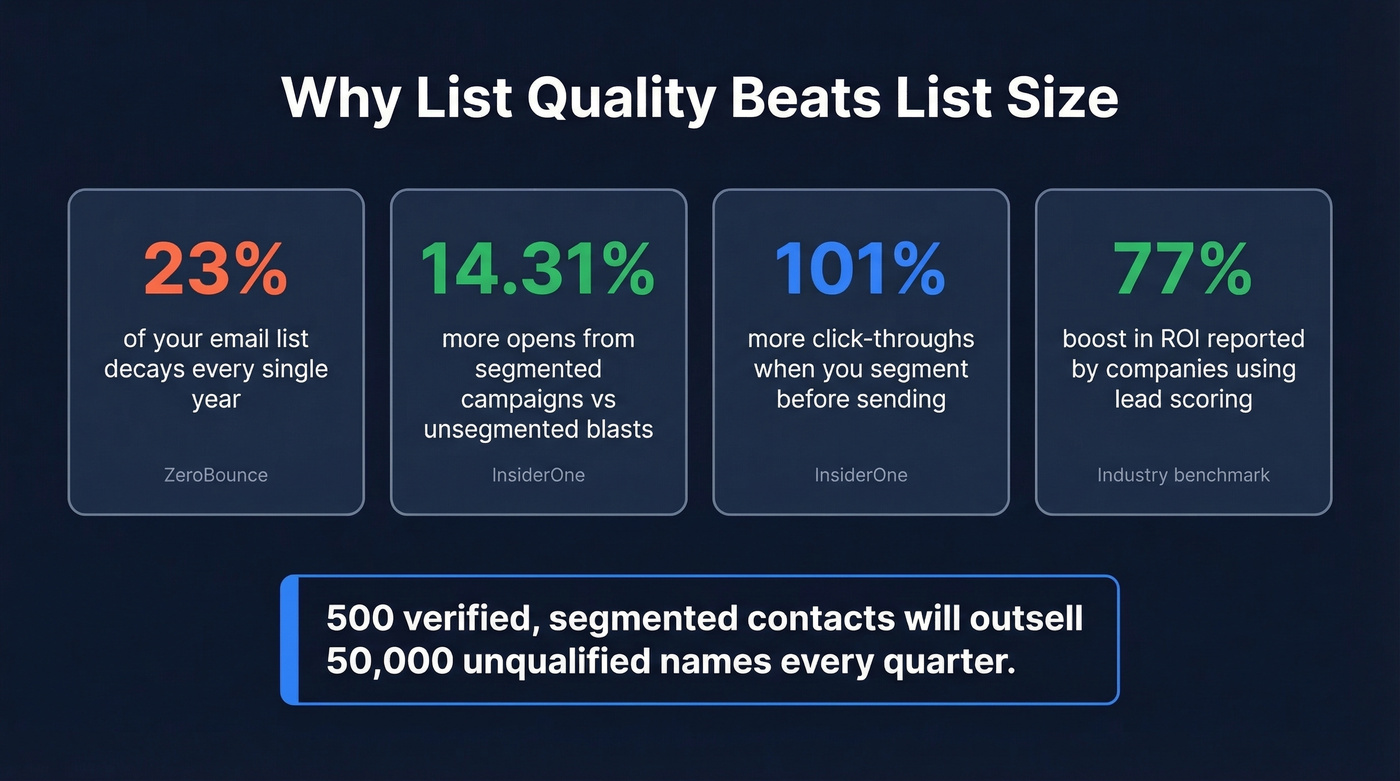
Segmented campaigns generate 14.31% more opens and 101% more click-throughs compared to unsegmented blasts. That's not marginal. It's the difference between a campaign that generates pipeline and one that generates spam complaints. Targeted, segmented lists consistently outperform generic blasts because relevance drives engagement at every stage of the funnel.
Let's be honest about what we see in B2B sales communities on Reddit and elsewhere: the most common mistake is teams obsessing over list size when they should obsess over list quality. A 500-person verified, segmented list outperforms a 50,000-name purchased database every single time. The team with 500 right contacts will outsell the team with 50,000 wrong ones every quarter.
Compliance and Legal Teeth
Purchased lists lack valid consent under GDPR - recipients didn't agree to receive marketing from you specifically. Under CAN-SPAM, emailing purchased contacts is technically legal, but you'll destroy your sender reputation in the process.
Double opt-in isn't explicitly required by GDPR, but it's the strongest evidence of consent you can produce. If you're sending into the EU without auditable consent records - timestamps, source URLs, form versions - you're gambling with fines that can reach EUR 20M or 4% of global revenue. That's not a hypothetical risk; enforcement actions have accelerated sharply since 2024.
| Framework | Opt-in? | Max Penalty | Key Rule |
|---|---|---|---|
| CAN-SPAM (US) | No, honor opt-outs | $51,744/violation | Physical address + unsub |
| GDPR (EU) | Yes, explicit | EUR 20M or 4% revenue | Auditable consent records |
| CASL (Canada) | Yes, express | CA$10M/violation | Must retain consent proof |
How to Turn a List Into Leads
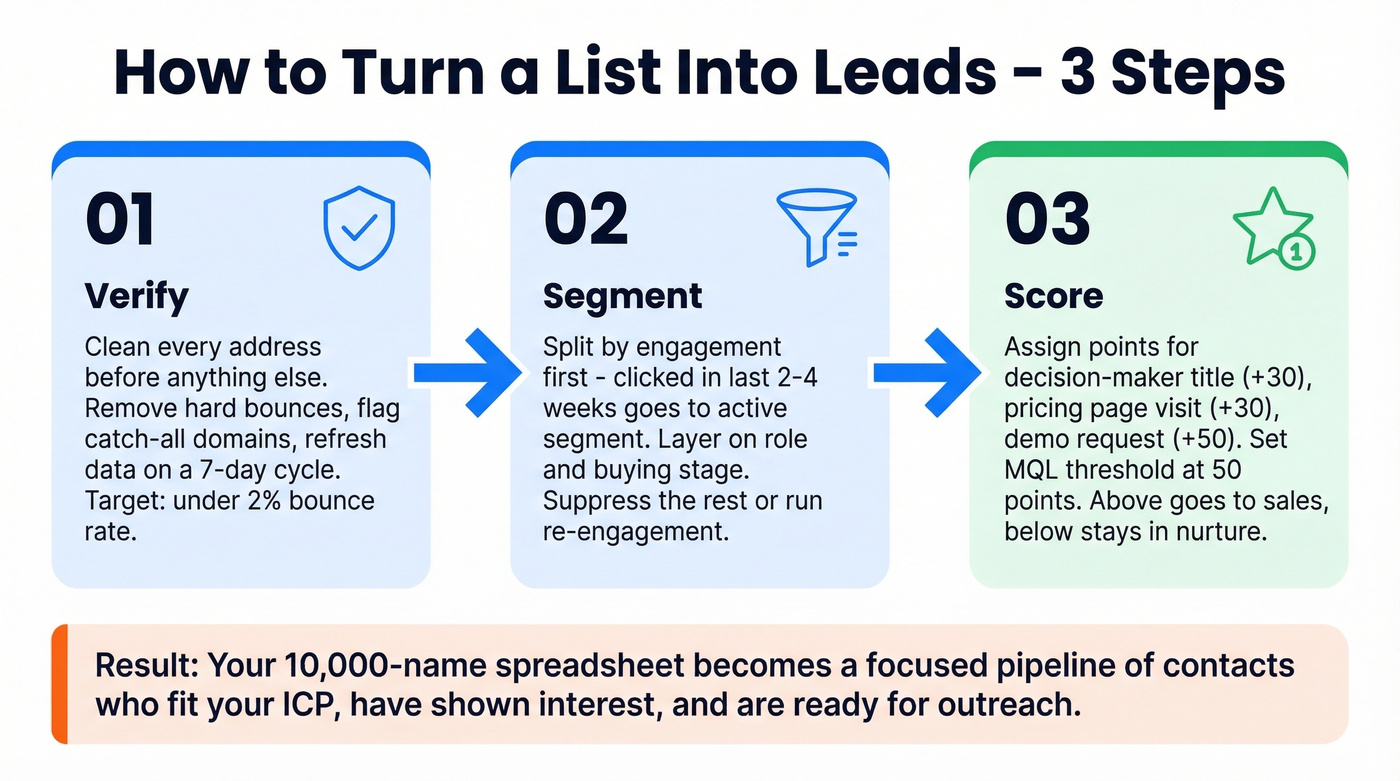
The gap between "list" and "leads" is a three-step process: verify, segment, score.
Step 1: Verify
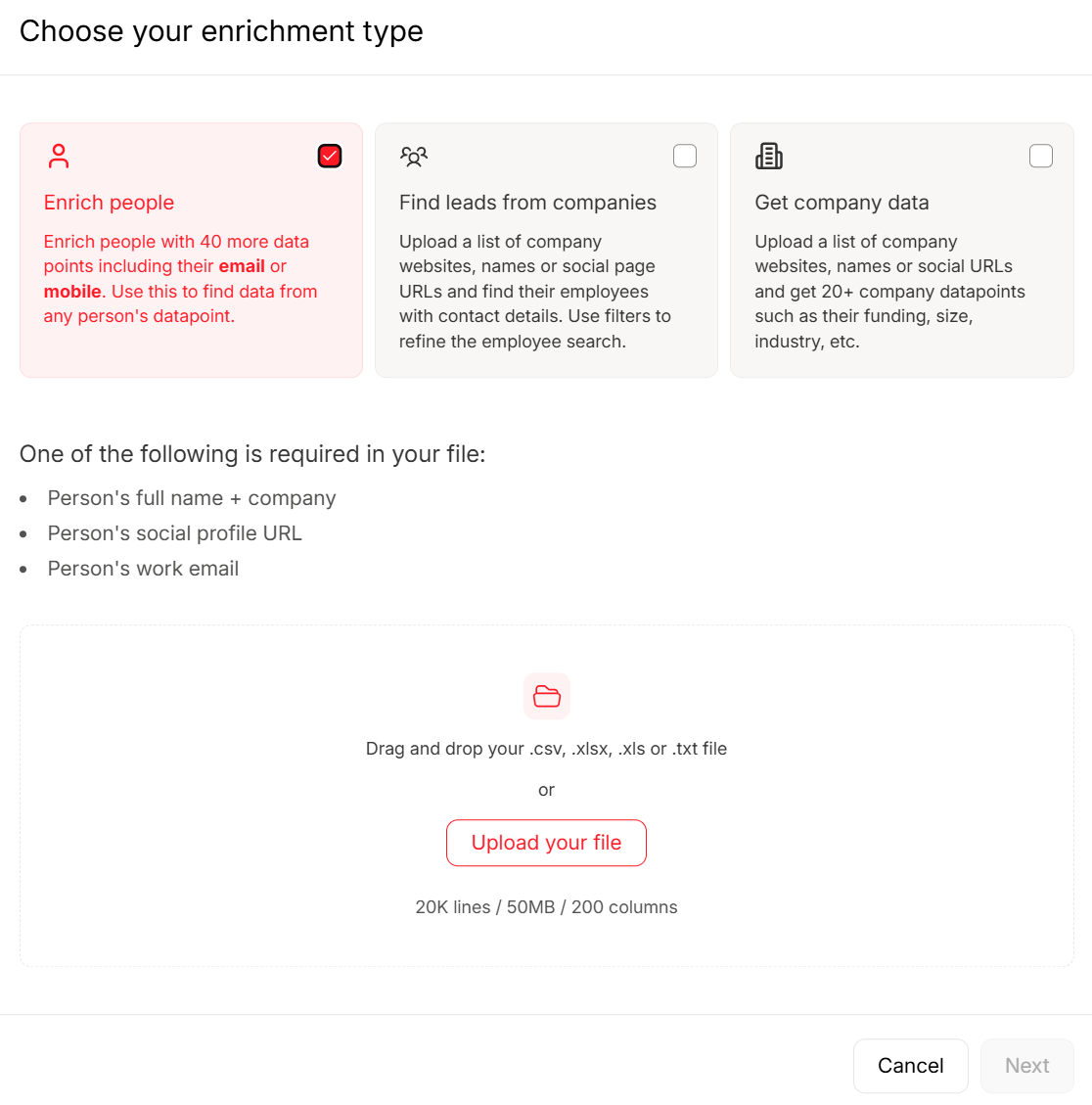
Nothing else matters if 23% of your list is already dead. Before you segment, before you score - verify every address. Prospeo's 5-step verification process delivers 98% email accuracy with catch-all handling that flags risky domains instead of letting them slip through. At roughly $0.01 per email, you can clean a 10,000-contact list for about $100, with data refreshed on a 7-day cycle so records don't go stale between campaigns.
If you want a deeper breakdown of tools and tradeoffs, start with email verification and then work backward into your email deliverability setup.
Step 2: Segment
Don't blast your entire verified list with the same message. Start with engagement: anyone who's clicked a link within the last 2-4 weeks goes into your "engaged" segment. Everyone else gets a re-engagement sequence or gets suppressed.
Then layer on role and stage. A VP of Sales who visited your pricing page last week gets a different email than a marketing coordinator who downloaded a whitepaper six months ago. We've tested this across dozens of campaigns, and the engagement-based segment alone accounts for 80%+ of replies - that single split does more for performance than any fancy automation workflow.
If you're building outbound sequences, pair segmentation with proven sales follow-up templates and a clean B2B cold email sequence.
Step 3: Score
| Signal | Points |
|---|---|
| Decision-maker title | +30 |
| Pricing page visit | +30 |
| Demo request | +50 |
| Competitor employee | -30 |
| Hard disqualifier | -50 |
Set an MQL threshold at 50 points to start. Anything above goes to sales; anything below stays in nurture. Companies using lead scoring report a 77% boost in ROI, and more importantly, your sales team stops wasting time on contacts who were never going to buy.
Remember the three-point gate from the lifecycle section: Fit + Interest + Intent. Your scoring model is just that gate, quantified. Review it quarterly - conversion data will tell you which signals actually predict closed deals and which ones are noise.
One caveat worth flagging: if your average deal size is under $10k, you probably don't need a complex scoring model at all. Verify, segment by engagement, and let your reps work the engaged list. Overengineering lead scoring at low ACV is a productivity trap disguised as sophistication.
Fit, interest, and intent - you need all three to turn a list contact into a real lead. Prospeo's 30+ filters and Bombora intent data across 15,000 topics let you score and segment contacts before a single email goes out.
Build a 500-person list that outsells someone else's 50,000.
FAQ
Is an email subscriber automatically a lead?
No. A subscriber has opted in, which makes them a potential lead - not a qualified one. They become a lead only when they also fit your ICP and show intent signals like visiting your pricing page or requesting a demo. Subscription is the minimum threshold, not the finish line.
Should I buy an email list to generate leads?
Skip this if you care about deliverability. Purchased list recipients didn't consent to hear from you, which violates GDPR and destroys sender reputation even where it's legal under CAN-SPAM. The consensus on r/coldemail is pretty clear: purchased lists rarely convert and almost always spike bounces. Build your list organically, verify addresses, and segment before outreach.
How often should I clean my email list?
At minimum, quarterly. Email lists decay at 23% per year, so run verification before every major campaign. A 7-day data refresh cycle - like the one Prospeo uses - keeps records current between cleanings and prevents the bounce spikes that damage domain reputation.
Can email signature lead generation actually work?
Yes - it's one of the most underrated passive channels. Adding a clear CTA in your email signature, whether that's a booking link, case study, or free resource, turns routine correspondence into low-friction lead capture. It won't replace dedicated campaigns, but it compounds over time, especially for teams sending hundreds of emails daily.