

Best Free Email Locator Tools in 2026, Ranked
Every free email locator tool promises unlimited finds and 98% accuracy. Then you sign up and discover your "free" plan caps out at 50 lookups, charges credits for catch-all results that bounce, and gates verification behind a paywall. The gap between the marketing page and the actual free tier is where most people get burned.
We reviewed eight popular tools that let you locate email addresses for free and tracked what you actually get - real credit limits, what consumes those credits, whether verification is included, and what happens when you need to scale. The spread is wider than you'd expect: credit-based free tiers range from 50 to 100 per month, and one tool's "free credits" expire in seven days.
Our Picks (TL;DR)
| Use Case | Pick | Why |
|---|---|---|
| Best for email accuracy | Prospeo | 98% accuracy, 75 free verified emails/mo, 7-day data refresh |
| Most free credits | Skrapp | 100 credits/mo with rollover - no expiry |
| Best all-in-one platform | Snov.io | Finder + verifier + sequences + CRM in one tool |
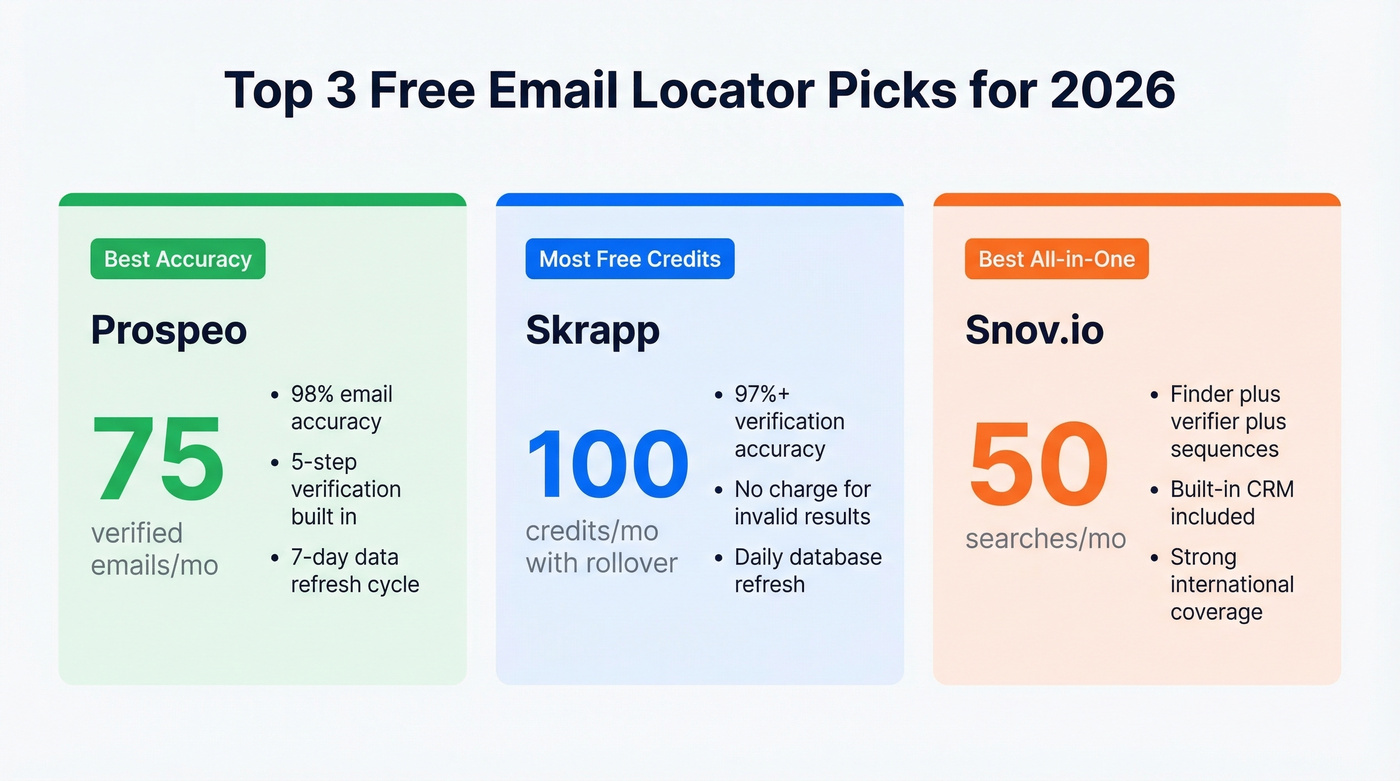
Prospeo gives you 75 verified emails every month with built-in verification that filters catch-all risk, spam traps, and honeypots. Skrapp wins on raw volume with 100 rollover credits. Snov.io is the pick if you want to find emails and run sequences from the same dashboard.
Free Email Locator Comparison
The differences in credit consumption rules matter more than the headline number. Here's what each free plan actually includes.
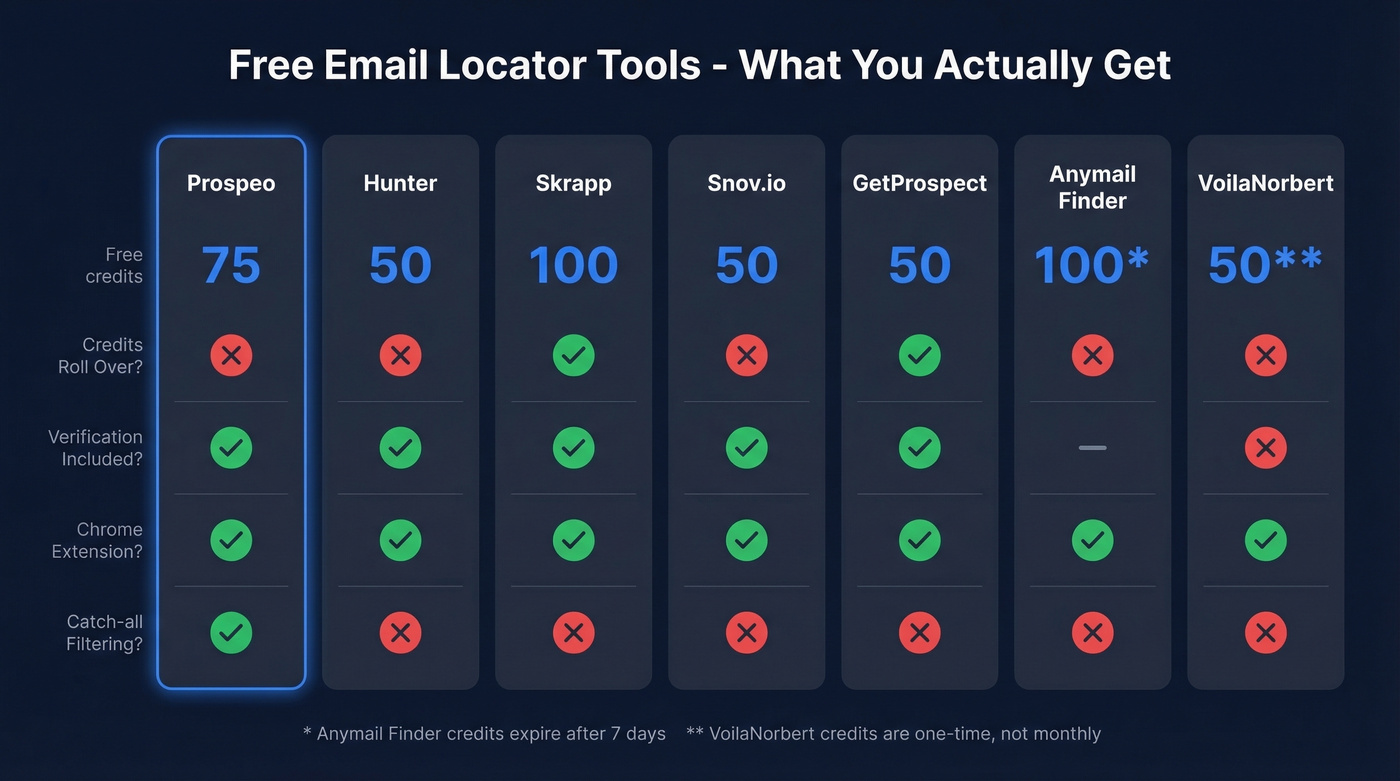
| Tool | Free Emails/Mo | Rollover? | What Costs a Credit | Verification? | Extension? |
|---|---|---|---|---|---|
| Hunter | 50 | No | Finder/Domain Search use credits; Verifier costs 0.5 credit | Yes (costs credits) | Yes |
| Skrapp | 100 | Yes | Valid + catch-all | Yes (built-in) | Yes |
| Snov.io | 50 | No | Searches | Yes (uses credits) | Yes |
| GetProspect | 50 + 100 verif. | 1 month | Valid emails | 100 verifications (separate allowance) | Yes |
| Anymail Finder | 100* | 7-day expiry | Valid finds only | Yes (0.2 credits/verification) | Yes |
| VoilaNorbert | 50 (one-time) | N/A | Successful finds | Yes (PAYG verification $0.003/email) | Yes |
| Mailmeteor | Unlimited | N/A | Nothing - it's free | No | No |
*Anymail Finder's 100 free credits expire after 7 days. That's a trial, not a free plan.
Best Free Tools to Locate Emails
Prospeo
Prospeo's database covers 300M+ professional profiles with 143M+ verified emails, and the free tier gives you 75 verified emails per month plus 100 Chrome extension credits. Every email goes through a 5-step verification process - catch-all handling, spam-trap removal, honeypot filtering - before it's returned.
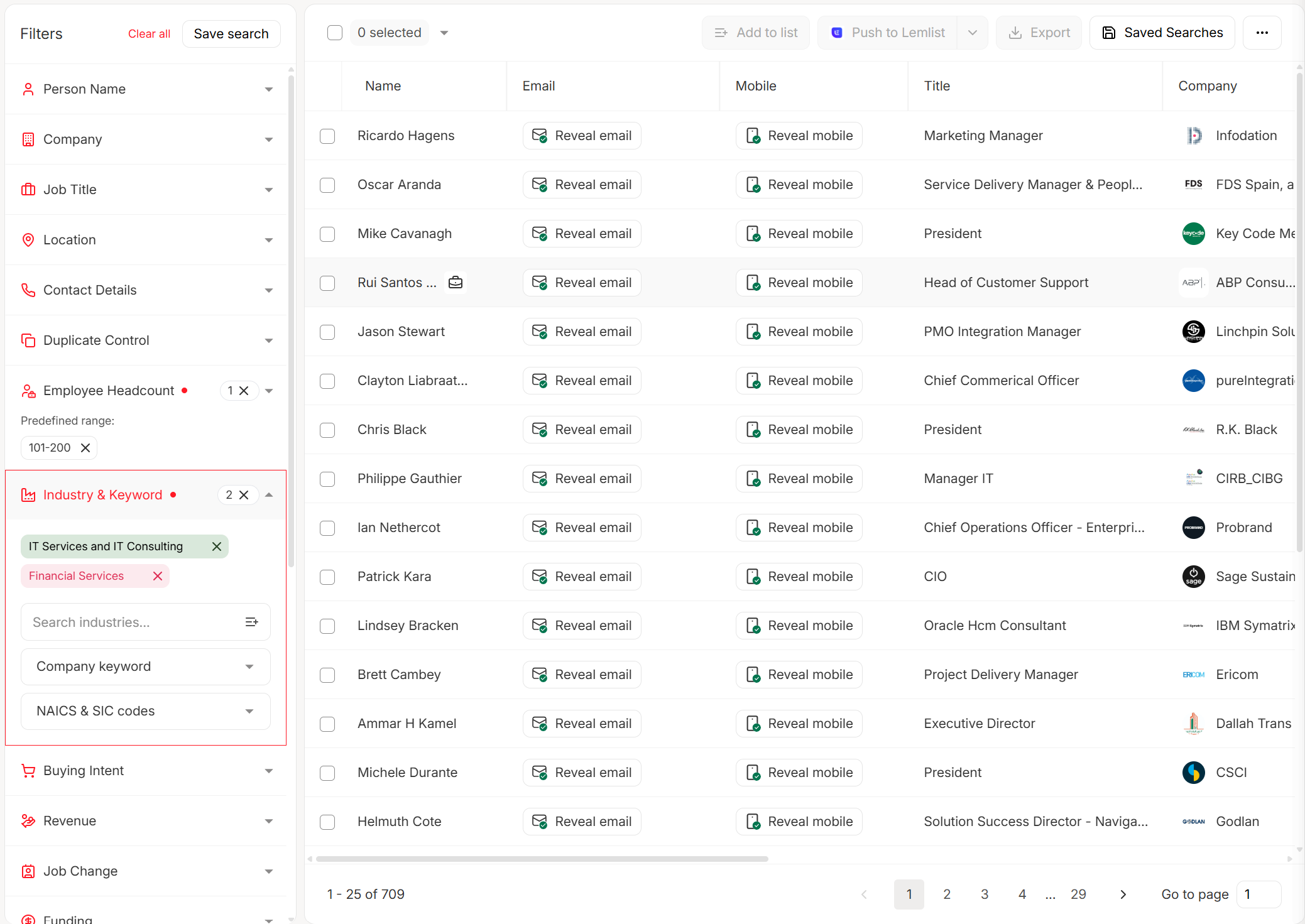
Use it if you care about deliverability above everything else. The 98% email accuracy is backed by real outcomes: Stack Optimize built to $1M ARR using Prospeo with client deliverability consistently above 94%, bounce rates under 3%, and zero domain flags. The 7-day data refresh cycle means you're not emailing someone who left the company six weeks ago. Integrations push directly into Salesforce, HubSpot, Smartlead, Instantly, Lemlist, and more.
Skip it if you need 100+ free lookups per month and don't care about verification quality. Skrapp gives you more raw credits. But if even one bounced email costs you a domain reputation hit, 75 verified emails are worth more than 100 unverified ones.
Paid plans run ~$0.01/email with no contract. Self-serve, cancel anytime.
Hunter
Hunter is the name most people think of first when they hear "email finder," and the free plan reflects that brand recognition - functional but tightly gated.

The free plan includes 50 credits per month, with verification costing just 0.5 credits per email. That means you can verify 100 emails for free if you're not using credits on finding. The Chrome extension, Google Sheets add-on, and API access are all included - generous for developers and spreadsheet warriors.
One thing Hunter does well: it shows confidence scores for the emails it finds, so you can quickly decide what's safe to send and what needs a second pass.
The tradeoffs: Hunter is widely seen as a strong verifier with a more limited database than the biggest prospecting platforms. The free plan excludes automatic lead verification, link tracking, AI writing, premium Discover filters, and caps CSV exports at 10 emails per domain. Paid plans start at $49/mo for 2,000 credits.
If you want more options in the same category, see our breakdown of Hunter alternatives.
Skrapp
Skrapp quietly offers the most generous free tier on this list: 100 email credits per month with rollover. That's double what Hunter and Snov.io give you, and unlike Anymail Finder, those credits don't vanish after a week.
Who it's for: Teams running low-volume outbound who want to stretch a free email lookup as far as possible. Skrapp charges credits for Valid and Catch-all results but doesn't charge for Invalid or Unknown - so you're not burning credits on dead ends. They report a 92% search success rate and 97%+ verification accuracy, with the database refreshed daily.
The catch-all problem: Catch-all results still consume a credit, and those emails are inherently unverifiable. For teams sending to enterprise domains (which are disproportionately catch-all), this adds up fast. Paid plans start at just $30/mo for 1,000 credits - one of the cheapest upgrade paths on this list.
If you're comparing plans and credit rules, our full Skrapp pricing guide goes deeper.
Snov.io
Snov.io is the Swiss Army knife of this category. The free plan gives you 50 searches per month, but the real value is that you get email finding, verification, drip sequences, and a lightweight CRM in one platform.
International lead coverage is where Snov.io separates from the pack. It's widely used for non-US prospecting, and the built-in automation means you don't need to bolt on Instantly or Lemlist for sequences. The tradeoff: 50 free searches won't last long if you're doing any real volume. Paid plans start at $99/mo for 25,000 recipients.
If you're building outbound systems, pair this with proven sales prospecting techniques.
GetProspect
GetProspect gives you 50 valid emails and 100 separate email verifications on the free plan, with unused credits rolling over for one month. The split between finder credits and verification credits is unusual - most tools bundle them - but it means you can verify emails from other sources without burning your finder allowance.
Paid plans start at $49/mo for 1,000 valid emails. The standout feature is their verification credit packs: 10,000 verifications for $29, scaling up through larger tiers. If you already have lists that need cleaning, those packs are genuinely cheap. In PhantomBuster's test of 1,000 profiles, GetProspect hit a 65% match rate - respectable, though not chart-topping.
Anymail Finder
Here's the thing about Anymail Finder: the pay-per-valid model is excellent, but the "free" tier is misleading. You get 100 credits that expire after 7 days, and a $1 card authorization is required. That's a trial.
Once you accept that framing, the economics are solid. You only pay for valid emails - not-found results are free, duplicates are free, and credits roll over up to 2x your plan size on paid tiers. Domain searches return up to 20 valid emails for a single credit, which is strong value for company-level prospecting. They also offer a refund if your bounce rate exceeds 3% with proof - a trust signal you don't see elsewhere. The Starter plan runs $9/mo billed yearly for 600 credits/year. In Lobstr's 1,000-lead API test, Anymail Finder found 476 emails per 1,000 leads at $49 per 1,000 - competitive on both hit rate and cost.
If you're doing enrichment at scale, compare approaches in our guide to data enrichment services.
VoilaNorbert
VoilaNorbert gives you 50 free credits on signup - one-time, not monthly. After that, paid plans start at $49/mo for 1,000 leads. The real draw is PAYG verification $0.003/email, dropping to $0.001 above 500K. Best suited for teams with existing lists that need bulk verification on a budget.
Mailmeteor
Mailmeteor's email finder is completely free with no signup required. No credits, no limits, no paid tier for the finder itself. The catch: it's lightweight. Don't expect the database depth or verification rigor of dedicated tools. Good for a quick one-off lookup, not for building prospecting workflows.
If you need more $0 options beyond finders, start with our list of free lead generation tools.

Most free email locators burn your credits on catch-all results and unverified guesses. Prospeo's 75 free emails/month go through 5-step verification - catch-all handling, spam-trap removal, honeypot filtering - so every credit returns a real, deliverable address.
Stop wasting free credits on emails that bounce.
Pricing at Scale
When you outgrow the free tier, costs diverge fast. Here's what the first paid step looks like:
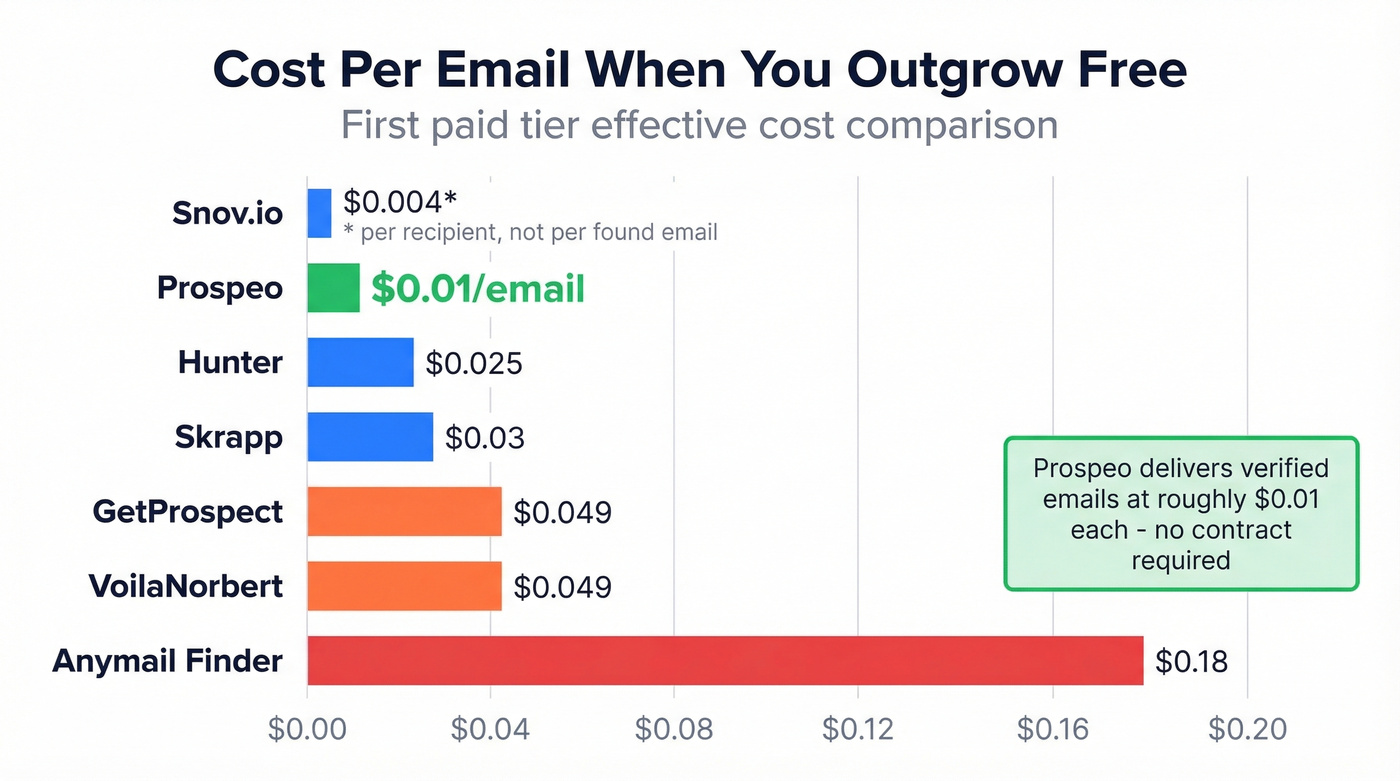
| Tool | Free/Mo | First Paid Tier | Eff. Cost/Email |
|---|---|---|---|
| Prospeo | 75 verified | ~$39/mo | ~$0.01 |
| Hunter | 50 credits | $49/mo (2K credits) | ~$0.025 |
| Skrapp | 100 credits | $30/mo (1K credits) | $0.03 |
| Snov.io | 50 searches | $99/mo (25K recip.) | ~$0.004* |
| GetProspect | 50 valid | $49/mo (1K valid) | $0.049 |
| Anymail Finder | 100 (7-day) | $9/mo yearly (600/yr) | ~$0.18 |
| VoilaNorbert | 50 (one-time) | $49/mo (1K leads) | $0.049 |
| Mailmeteor | Unlimited | N/A | Free |
*Snov.io's figure is cost per recipient, not per found email, since its plan limits are recipient-based.
How Accurate Are Free Email Locators?
Every tool on this list claims 95-98% accuracy. Independent testing tells a different story.
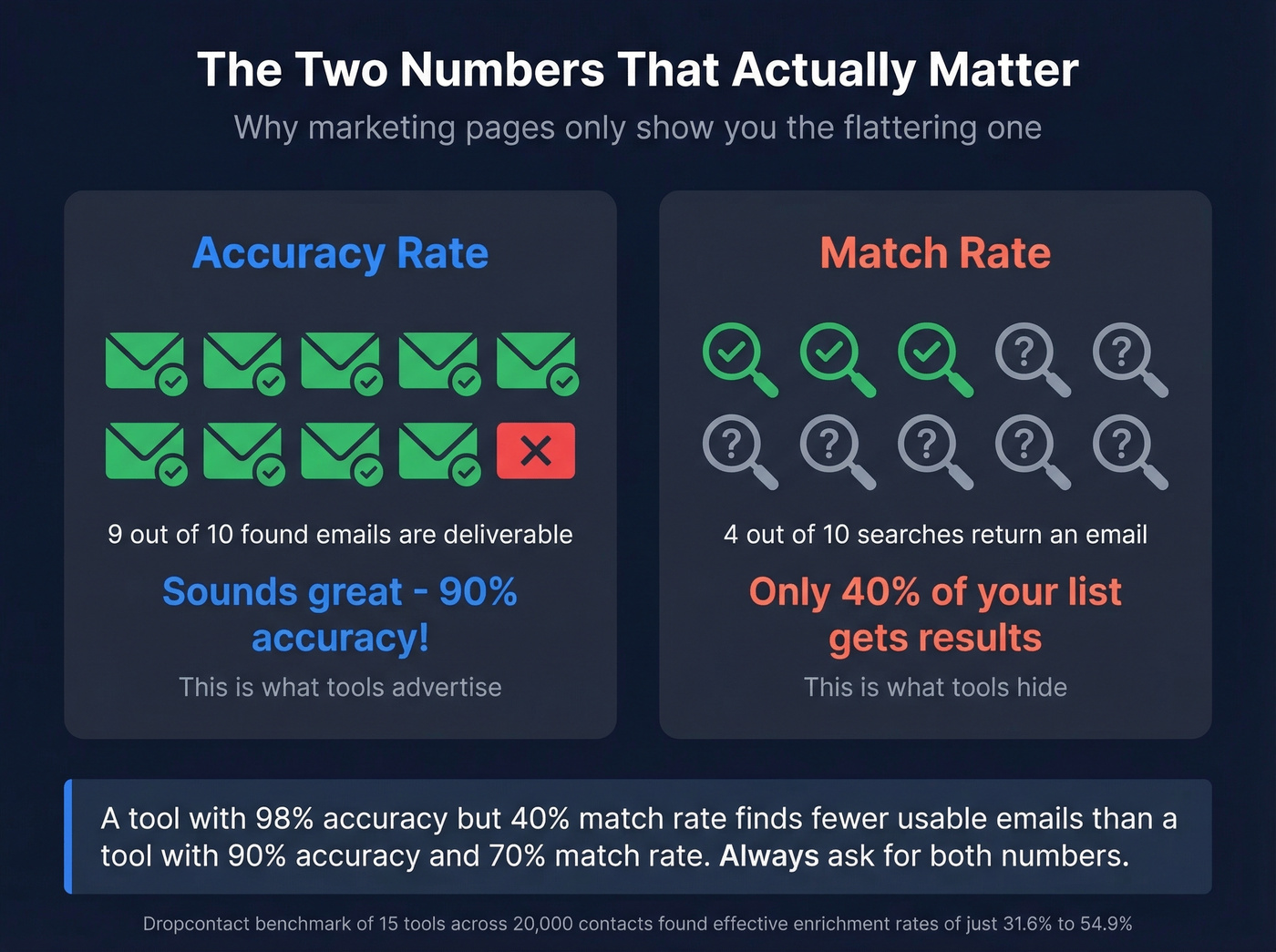
The gap between "accuracy of found emails" and "match rate" is where the confusion lives. Accuracy measures what percentage of returned emails are actually deliverable. Match rate measures what percentage of your searches return an email at all. A tool can have 98% accuracy but only find emails for 40% of your list. Both numbers matter, and most marketing pages only show you the flattering one.
A Dropcontact benchmark testing 15 tools across 20,000 real contacts found effective enrichment rates - adjusted for hard bounces and wrong domains - ranging from just 31.6% to 54.9%. That's a far cry from the 95%+ numbers on marketing pages. The dataset split roughly 50/50 between US and European contacts, with input limited to first name, last name, and company name. No domain, no profile URL. Real-world conditions.
PhantomBuster's smaller test of 1,000 profiles showed Hunter at 68% and GetProspect at 65% match rates, with Dropcontact hitting 72%. These are match rates, not accuracy - the emails that were found generally verified well.
Let's be honest: if you're closing deals under $15K, you probably don't need 98% accuracy. A 90% tool with double the match rate will generate more pipeline than a perfect tool that only finds half your list. But if you're selling six-figure contracts and a single bounced email to a VP means a burned domain and a lost quarter, accuracy is the only metric that matters.
The waterfall strategy. Here's a tactic no vendor will tell you about: stack multiple free tiers in sequence. Run your list through one tool, take the misses, and feed them into a second. We've seen teams combine two or three free plans to hit 70-80% coverage without spending a dollar. The consensus on r/sales backs this up - different tools have different database strengths, and the overlap is smaller than you'd think.
Don't trust any single tool's self-reported accuracy. Run your own test with 200-500 known contacts and measure both match rate and bounce rate. That's the only benchmark that matters for your specific ICP.
Protect Your Domain
Finding emails is the easy part. Not destroying your sender reputation with bad data is harder. Five rules that'll keep you out of deliverability trouble:
- Verify close to send time. Databases decay constantly. An email found three months ago has a meaningful chance of bouncing. Verify within a month of sending.
- Separate infrastructure for risky emails. Catch-all and "accept-all" results should go through secondary sending domains. Never risk your primary domain on unverifiable addresses.
- Run an external verifier on top of your finder. Even if your email locator includes verification, a second pass with a dedicated verifier can cut your valid list by up to 20%, according to Anymail Finder's research.
- Never send to purchased lists. Bought lists are full of outdated contacts, duplicates, and honeypot traps. They're the fastest way to land on a blocklist.
- Learn verification statuses. Valid means confirmed reachable. Catch-all means the server accepts everything, so you can't confirm the specific address exists. Invalid means don't send. Unknown means the server didn't respond. Treat Catch-all and Unknown as risky, not safe.
If you're seeing deliverability issues already, start with email bounce rate diagnostics and a plan to improve sender reputation.
Free tiers with stale data cost you more than credits - they cost you domain reputation. Prospeo refreshes its 300M+ profiles every 7 days, not every 6 weeks. At 98% accuracy and ~$0.01/email when you scale, it's the cheapest path from free plan to real pipeline.
One bounced email can flag your domain. 75 verified ones can fill your pipeline.
FAQ
Are free email locator tools legal?
Yes - these tools find publicly available business email addresses. GDPR and CAN-SPAM compliance depends on how you use the data: you need legitimate interest or consent for outreach and must honor opt-out requests immediately.
How do email locator tools find addresses?
They combine pattern matching (guessing formats like first.last@domain.com), SMTP verification against mail servers, database lookups of indexed records, and web scraping of public sources. The best tools layer multiple methods and verify results before returning them.
What's a catch-all email?
A catch-all domain accepts every email sent to it, regardless of whether the specific address exists. Verification tools can't confirm deliverability because the server says "yes" to everything. Some tools charge credits for catch-all results; others filter them out. Sending to them carries higher bounce risk.
Which free email locator gives the most lookups?
Skrapp leads with 100 rollover credits per month. Prospeo follows with 75 verified emails plus 100 Chrome extension credits - a better deal if deliverability matters more than raw volume. Mailmeteor is technically unlimited but lacks verification depth.
Can I locate an email address free without signing up?
Mailmeteor lets you search with no account required. For verified results and higher match rates, tools like Prospeo and Skrapp require a free signup but deliver significantly more reliable data in return.