

Best Email Outreach Platforms in 2026 - And the Stack That Makes Them Work
You burned a domain last quarter. Maybe two. The sequences looked fine, the copy was sharp, but 18% of your list bounced and Gmail started routing everything to spam. The platform wasn't the problem - the data underneath it was.
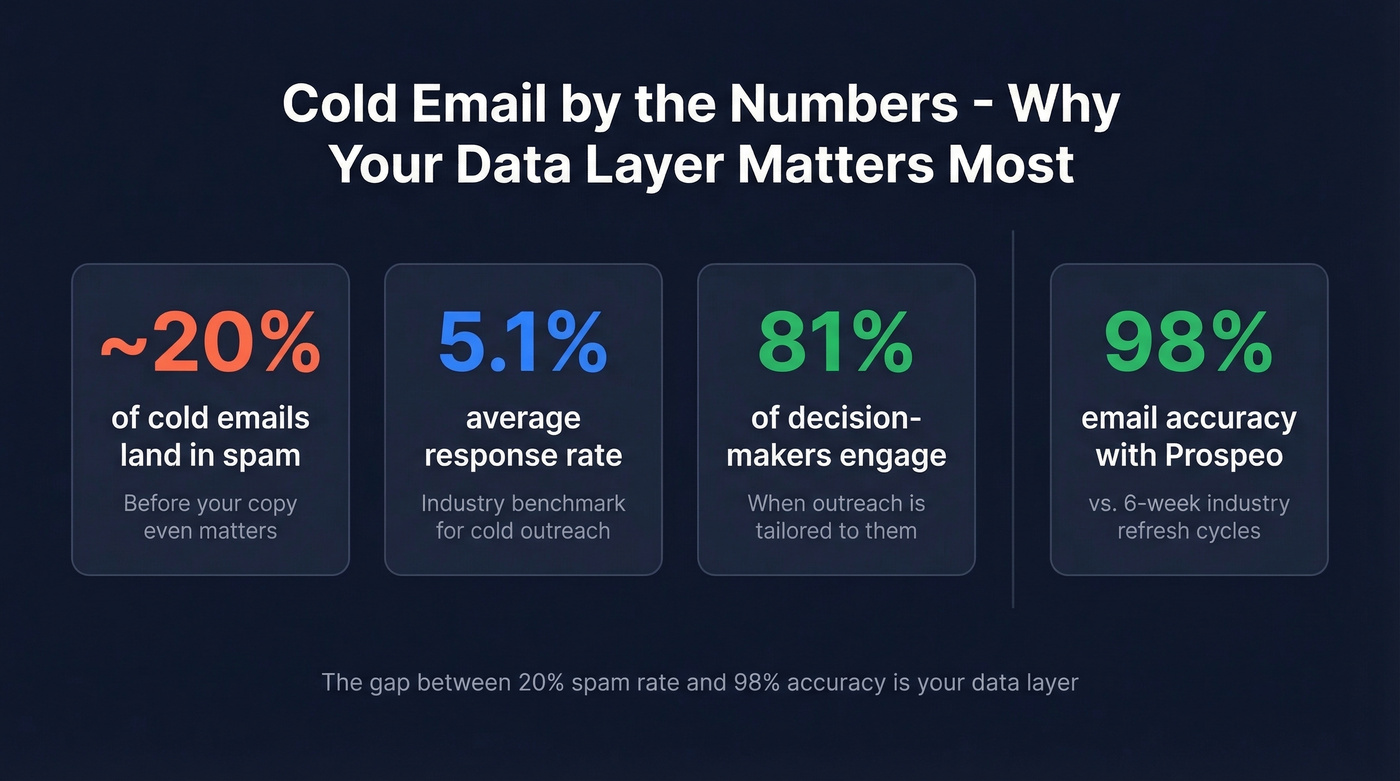
That's the gap most articles about email outreach platforms ignore: they review the sequencer and skip the foundation. Nearly 20% of cold emails get flagged as spam, and the average response rate sits at 5.1%. Yet 81% of sales and marketing decision-makers engage with cold outreach when it's tailored to them. The difference between a campaign that hits those numbers and one that craters your sender reputation comes down to what happens before you press send.
Here's how the stack actually works, which cold outreach tools deserve your money in 2026, and the true cost once you add up the line items nobody puts on the landing page.
Our Picks
| Use Case | Pick | Why |
|---|---|---|
| Data accuracy & verification | Prospeo | 98% accuracy, 7-day refresh |
| High-volume sending | Instantly | Unlimited email accounts, simple UI |
| Deliverability control | Smartlead | Inbox rotation, placement testing |
| Multichannel outreach | Lemlist | Email + phone + social in one flow |
| All-in-one for beginners | Apollo | Database + sequencer, generous free tier |
How Outreach Platforms Actually Work
Most teams evaluate the sequencer - the tool that sends emails - and stop there. That's like reviewing a car engine without checking if there's gas in the tank.
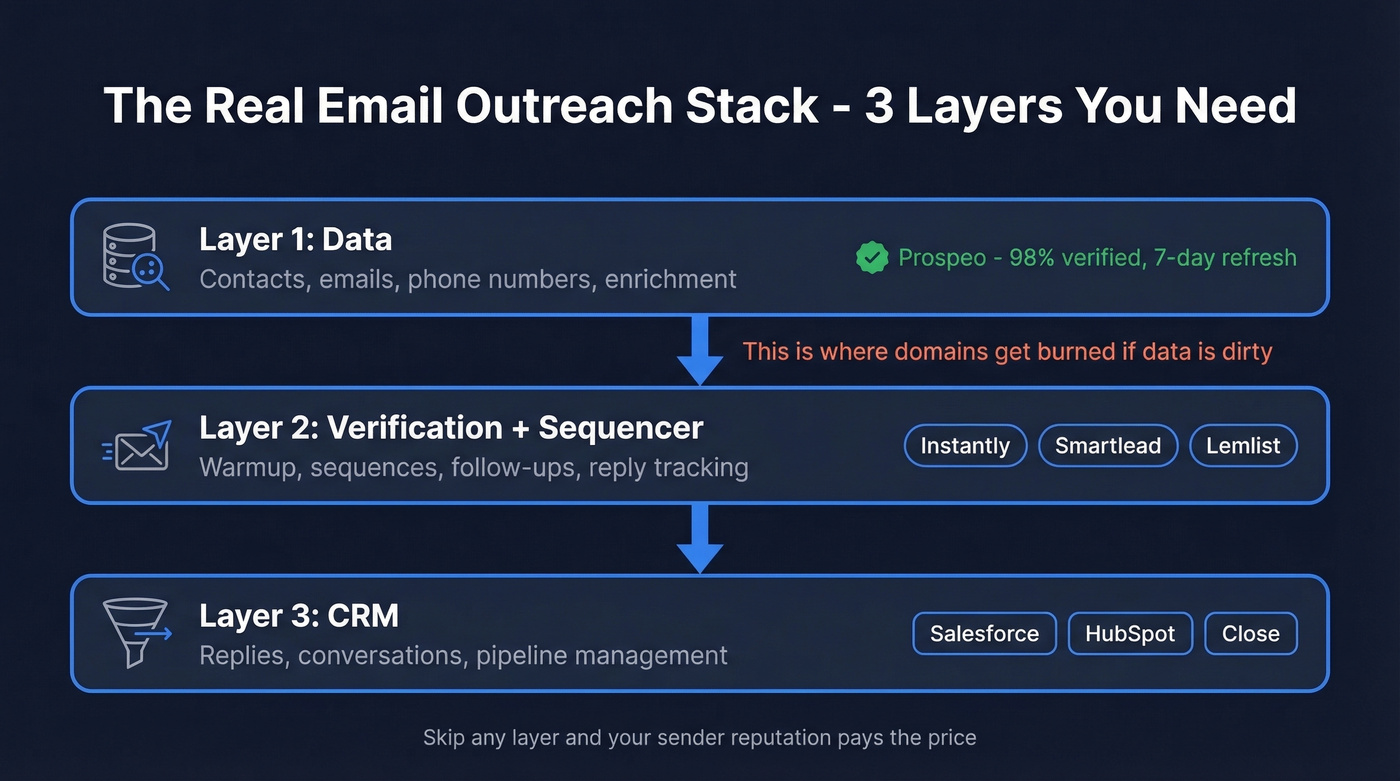
The real outreach stack has three layers, and skipping any of them is how domains get burned.
Layer 1: Data. Where your contacts come from. The database, the enrichment tool, the list. If this layer is dirty, everything downstream fails. Bad emails bounce, bad phones waste dials, and your sender reputation takes the hit before you've even written a subject line.
Layer 2: Verification + Sequencer. Your sending platform lives here. It warms up inboxes, sends sequences, handles follow-ups, and tracks replies. But it can only work with what Layer 1 gives it.
Layer 3: CRM. Where replies and conversations land. Salesforce, HubSpot, Close - whatever your team uses to manage pipeline.
In a recent r/coldemail tool-stack thread, one practitioner listed a setup that mirrors this exactly: a lead source, a sending platform, and separate verification tools. Prospeo collapses Layer 1 and the verification piece of Layer 2 into a single platform - 300M+ profiles with 98% verified emails, plus native integrations with Instantly, Smartlead, Lemlist, Salesforce, HubSpot, and automation connectors like Zapier and Make. Your sequencer receives pre-verified contacts instead of raw data you still need to clean.
Best Cold Outreach Tools Compared
Prospeo - Best for Data Accuracy
Prospeo isn't a sequencer. It's the data layer that makes your sequencer actually work. The database covers 300M+ professional profiles, 143M+ verified emails, and 125M+ verified mobile numbers - all refreshed on a 7-day cycle. The industry average refresh is six weeks. That gap matters when you're emailing people who changed jobs last month.

The verification pipeline runs multiple steps: catch-all handling, spam-trap removal, honeypot filtering, and proprietary infrastructure that doesn't rely on third-party email providers. The result is 98% email accuracy. Stack Optimize built from $0 to $1M ARR using Prospeo as their data layer - 94%+ deliverability, bounce under 3%, zero domain flags across all clients. Snyk's 50 AEs saw bounce rates drop from 35-40% to under 5%, with AE-sourced pipeline climbing 180% and 200+ new opportunities per month.
Search filters go deep: 30+ options including buyer intent powered by Bombora (15,000 topics), technographics, job changes, headcount growth, and funding signals. There's also a Chrome extension used by 40,000+ users for on-the-fly prospecting from any website or CRM. Pricing runs ~$0.01 per email with a free tier of 75 emails/month + 100 Chrome extension credits/month. No contracts, no sales calls.
Use it if you need verified data that won't torch your domains, and you want a single platform for emails, mobiles, and enrichment.
Skip it if you need a built-in sequencer - pair it with Instantly, Smartlead, or Lemlist for the sending layer.
Instantly - Best for High Volume
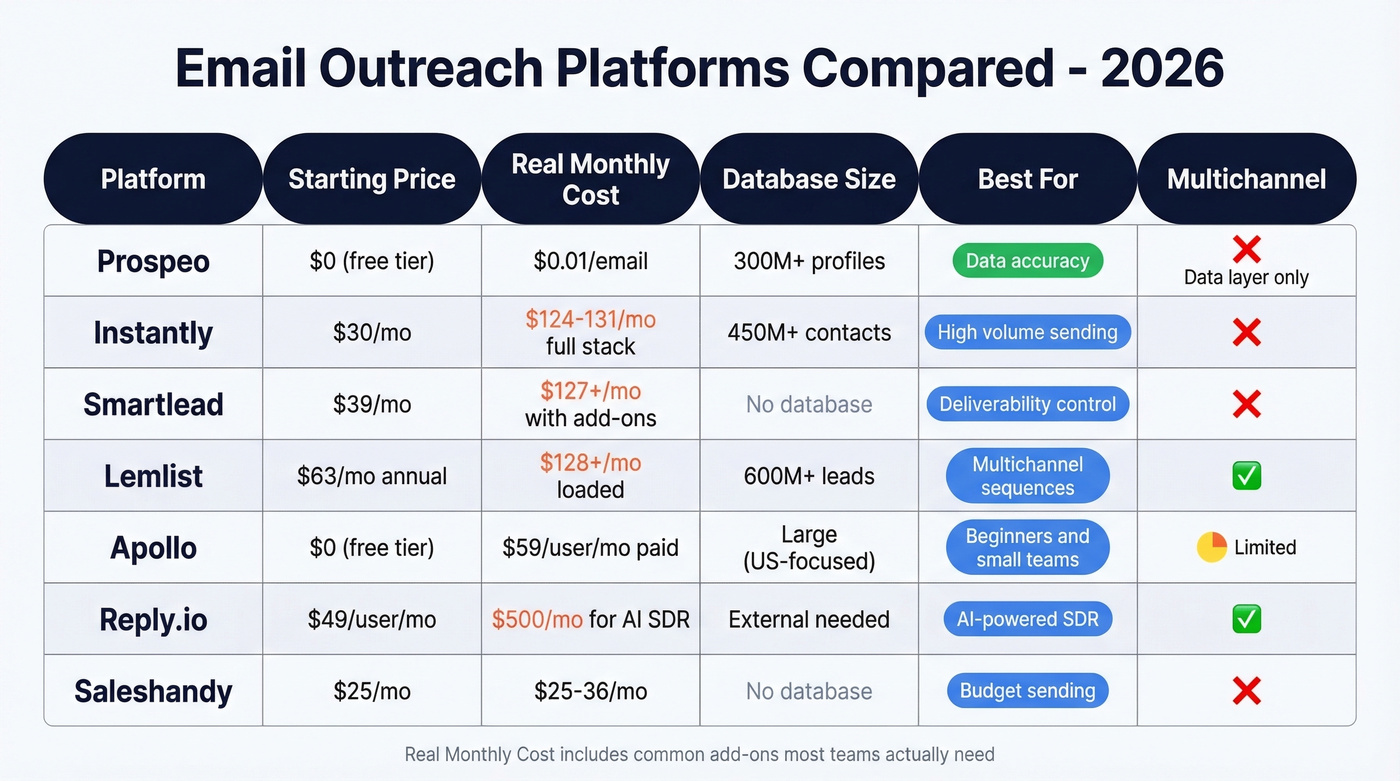
Instantly is the go-to for teams that want to scale volume fast. Unlimited email accounts, unlimited warmup, clean UI, and a sequence builder that doesn't require a PhD in workflow automation. The Growth plan starts at $30/mo (annual) or $37/mo (monthly) for up to 5,000 emails/month.
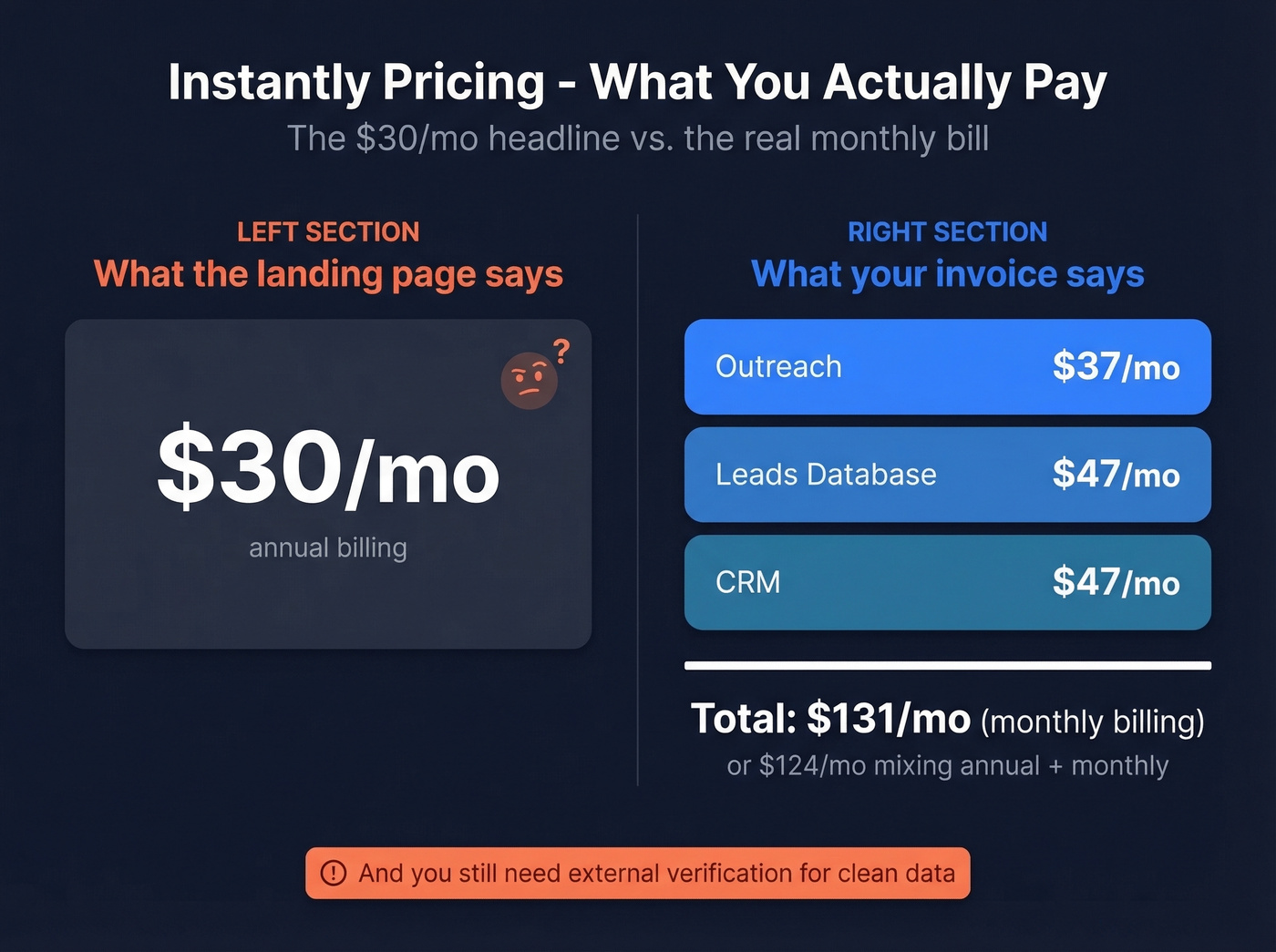
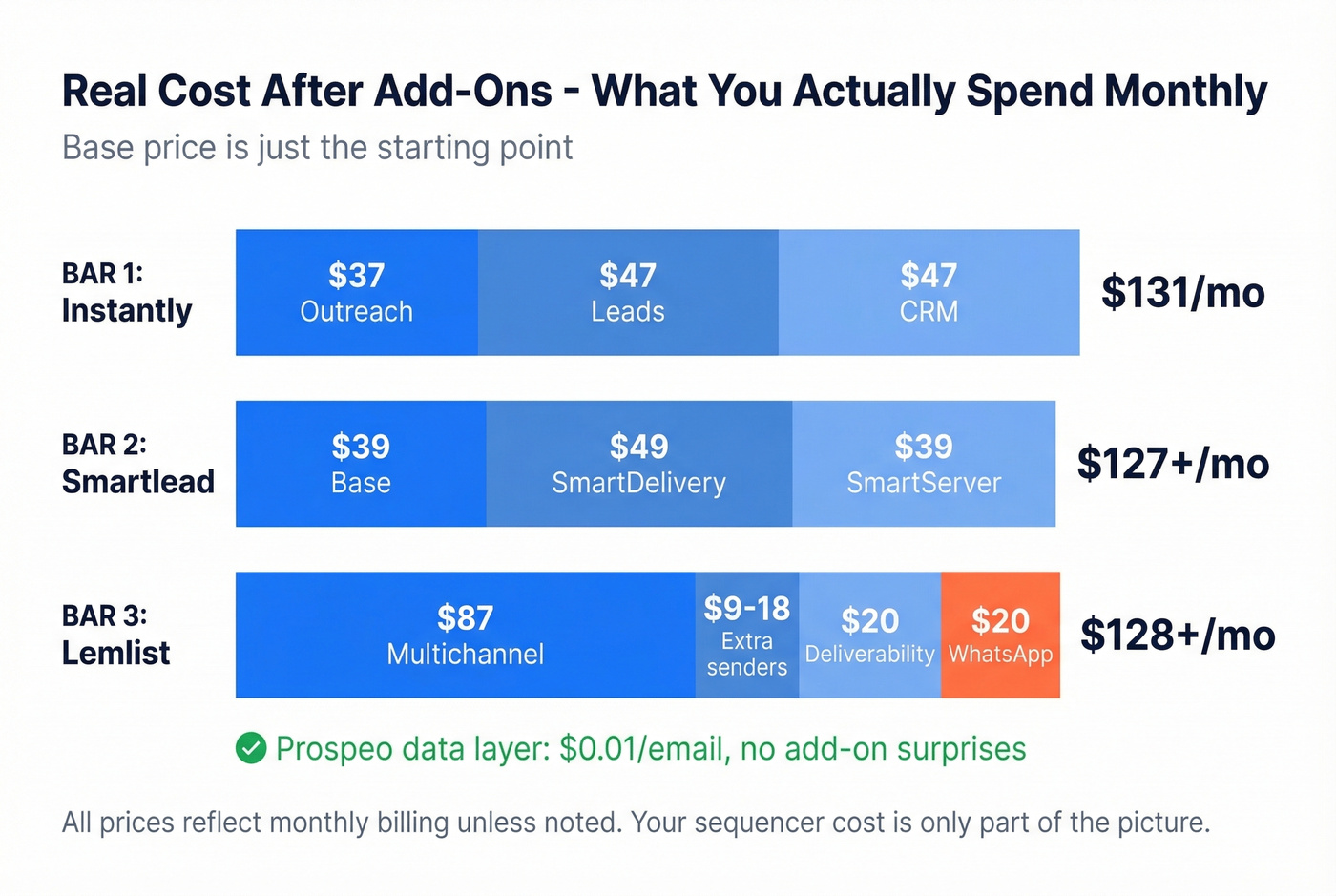
Here's the thing about that $30 headline price: it's just the Outreach product. Instantly splits into three separate products - Outreach, Leads, and CRM - each priced independently. Buy everything month-to-month and you're looking at $37 + $47 + $47 = $131/mo. Pay Outreach annually but keep Leads + CRM monthly, and it's $30 + $47 + $47 = $124/mo.
The Leads database covers 450M+ contacts, but the verification quality doesn't match a dedicated data platform. We've tested it - expect higher bounce rates on Instantly-sourced lists than on pre-verified data from a tool like Prospeo.
Use it if you're running high-volume cold email and want the simplest path to connecting dozens of email accounts with automated warmup.
Skip it if you need multichannel (no native calling or social steps) or you're expecting the $30 price to cover your full stack.
Smartlead - Best for Deliverability
Smartlead is for teams that obsess over inbox placement. The core platform starts at $39/mo ($32.5/mo annual) with unlimited email accounts and warmup - similar to Instantly on the surface. Where Smartlead pulls ahead is the deliverability tooling.
SmartDelivery ($49/mo add-on) lets you run inbox placement tests across up to 50 sender accounts per test on the Growth add-on. SmartServers ($39/server/mo) give you dedicated sending infrastructure. The inbox rotation engine distributes sends across mailboxes automatically, reducing the chance any single inbox gets flagged.
The catch: a production-ready Smartlead setup runs $127+/mo once you add SmartDelivery and a server. The base plan alone (2,000 contacts, 6,000 emails/month) is tight for serious outbound. Most teams land on the Pro tier ($94/mo) or higher.
Use it if you've burned domains before and want granular control over deliverability metrics, warmup schedules, and inbox placement testing.
Skip it if you want multichannel or a built-in lead database - Smartlead is a pure sending engine.
Lemlist - Best Multichannel Option
Lemlist is the platform on this list that most cleanly combines email, phone, and social outreach in a single workflow builder. The Multichannel Expert plan ($109/mo or $87/mo annual) includes automation for social touches, a built-in call dialer, and VoIP integrations alongside email sequences. Email Pro runs $79/mo ($63/mo annual) if you don't need the multichannel features.
The 600M+ leads database plus built-in enrichment credits mean you can prospect and send from one tool. Email Pro includes 200 free enrichment credits/month, while Multichannel Expert includes 400. Beyond those, enrichment runs $0.01/credit - 5 credits per verified email, 20 per phone number.
But the add-ons stack up fast. Extra email senders beyond the included 3-5 cost $9/mo each, deliverability protection is $20/mo, and WhatsApp automation adds another $20/mo. A fully loaded Lemlist seat hits $128+/mo before you blink.
Use it if your outreach strategy requires phone, email, and social touches in coordinated sequences - and you want one platform instead of three.
Skip it if you're email-only and price-sensitive. Email Pro at $63/mo annual is solid but pricier than Instantly or Smartlead for pure email.
Apollo - Best All-in-One for Beginners
Apollo is the obvious starting point for teams that want database + sequencer in one tool without a big upfront investment. The free plan gives you 100 credits/month and basic sequences. Paid plans start at $59/user/mo, with the Organization tier at $149/mo (minimum 3 seats). Apollo holds a 4.7/5 on G2 from 9,000+ reviews - the community loves the breadth.
The database is massive and the Chrome extension is solid. For US-focused prospecting, the data coverage is good. But email accuracy drops noticeably outside North America. We've seen bounce rates climb to 15-20% on EMEA lists pulled straight from Apollo without secondary verification. For small deal sizes under $10k, Apollo's free tier might be all you need. Once you hit volume or go international, you'll want a dedicated data layer underneath it.
Reply.io - AI-Powered Sequences
Reply.io leans hard into the AI SDR angle. The email-only plan starts at $49/user/mo, multichannel runs $89-99/user/mo, and the AI SDR product - which autonomously handles prospecting and initial outreach - starts at $500/mo.
The multichannel capabilities are strong. The AI SDR is interesting for teams that want to automate the top of funnel without hiring. But it's expensive at scale: a 5-seat multichannel setup runs $450-500/mo before you add the AI features. You'll likely need an external data source regardless, so budget accordingly.
Saleshandy - Budget-Friendly Sending
Saleshandy is a budget-friendly entry point for cold email. It handles sequences, mail merge, and basic analytics without the complexity of Instantly or Smartlead. The interface is clean and it works well for agencies managing multiple client accounts. Pricing starts around $25-36/mo on annual billing, with a 7-day free trial.
The tradeoff is feature depth. No inbox placement testing, no built-in lead database, and the warmup capabilities are more basic than the Tier 1 tools. You get what you pay for - which, at this price point, is still a lot of value for early-stage teams.
Woodpecker, Mailshake, and GMass
Woodpecker starts around $20-24/mo and targets SMBs that want simple, reliable cold email without the complexity of a full-stack platform. Clean UI, solid deliverability, limited feature depth.
Mailshake runs $85/mo on annual billing and positions itself for mid-market teams. The biggest drawback: no free trial. We don't recommend tools you can't test before buying.
GMass is the Gmail-native option at $25-55/mo. It lives inside your Gmail inbox, which makes it dead simple for solo operators. The Spam Solver feature tests email variants for inbox vs. spam placement - a nice touch at this price point. Not built for team-scale outbound.

This article exists because bad data burns domains. Prospeo's 7-day refresh cycle and 98% email accuracy mean your sequencer - Instantly, Smartlead, Lemlist - gets pre-verified contacts instead of bounce-rate landmines.
Stop cleaning lists. Start with clean data.
True Cost Comparison
The headline price on a landing page is marketing. Here's what you actually pay once you add the data, add-ons, and infrastructure a real outbound operation needs.
| Tool | Base Price | + Leads/Data | + Add-ons | True Monthly |
|---|---|---|---|---|
| Prospeo | Free-$39/mo | Included | - | ~$39/mo |
| Instantly | $30-37/mo | +$47/mo (Leads) | +$47/mo (CRM) | $124-131/mo |
| Smartlead | $39/mo | Not included | +$49 +$39 | $127+/mo |
| Lemlist | $79/mo | Included (credits) | +$9-20/mo each | $128+/mo |
| Apollo | Free-$59/mo | Included | - | $59+/mo |
| Saleshandy | $25-36/mo | Not included | - | $25-36+/mo |
Instantly's Growth plan becomes $124-131/mo once you add Leads and CRM. Smartlead's $39 base becomes $127+ with SmartDelivery and a dedicated server. Lemlist's $79 Email Pro becomes $128+ with deliverability protection, WhatsApp automation, and an extra sender. The pattern is clear: the sequencer is cheap, but the full stack isn't.
Let's be honest - most teams overspend on the sequencer and underspend on data. A $30/mo sequencer fed with bad data will burn domains faster than a free-tier sequencer fed with verified contacts. If you're budget-constrained, spend on the data layer first and use a free sequencer until revenue justifies upgrading.
Deliverability Playbook
Your outreach tool doesn't control deliverability. You do. Here's the framework: data quality > authentication > warmup > monitoring. Get them right in that order.
Non-negotiables: SPF, DKIM, and DMARC authentication on every sending domain. If these aren't configured, nothing else matters - you're sending from an unverified domain and ESPs will treat you accordingly. (If you want a quick checklist, start with DMARC alignment.)
Warmup ramp schedule (per inbox, based on SuperSend's guidance):
| Week | Emails/Day per Inbox |
|---|---|
| 1-2 | 5-10 |
| 3-4 | 15-20 |
| 5-6 | 30-40 |
| 7+ | 50 max |
Metric thresholds to monitor:
- Bounce rate: under 2% (non-negotiable) - see bounce rate benchmarks
- Spam complaints: under 0.1%
- Reply rate target: 5%+
- Open rate: don't track it - tracking pixels hurt cold email deliverability. Focus on replies.
Domain rotation: For volume above 50 emails/day, add inboxes and domains rather than pushing a single inbox harder. Instantly and Smartlead support unlimited email account connections for exactly this reason. (More on safe sending limits in our email velocity guide.)
Free monitoring: Google Postmaster Tools gives you domain reputation, spam rate, and authentication status at no cost. Set it up before you send your first campaign.
Choosing the Right Platform for Your Team
Close's evaluation framework covers automation, integrations, personalization, sequences, and reporting. That's a solid starting point, but it's missing the most important criterion: data quality. In our experience, the ranking of what matters goes data quality first, then deliverability, then features, then price. Here's how that maps to team type.
| Team Type | Recommended Stack | Why |
|---|---|---|
| Solo founder | Apollo free tier + Instantly | Minimal budget, database + sending in fewest tools |
| SMB sales team (3-10 reps) | Prospeo + Smartlead + HubSpot | Verified data, deliverability control, CRM pipeline |
| Agency (multiple clients) | Prospeo + Instantly or Saleshandy | Client workspace separation, volume pricing, verified lists per client |
| Enterprise | Lemlist or Reply.io + Salesforce + enrichment API | Multichannel sequences, CRM integration, enrichment at scale |
The data layer isn't optional in any of these stacks. You can swap sequencers based on budget and feature needs. You can't swap out bad data - it just breaks everything downstream. The best email outreach platforms in 2026 are the ones built on verified contacts, not the ones with the flashiest sequence builder. (If you want a deeper framework for building lists, start with sales prospecting techniques.)
Stack Optimize hit $1M ARR with zero domain flags. Snyk's 50 AEs dropped bounce rates from 35% to under 5%. The difference wasn't the sequencer - it was the data layer feeding it. Prospeo gives you 300M+ profiles at ~$0.01/email with no contracts.
Your outreach platform deserves a foundation that won't crack.
FAQ
How many cold emails can I safely send per day?
After a 6-7 week warmup, cap at 50 emails per day per inbox. Scale volume by adding inboxes and domains, not by pushing a single inbox harder. Instantly and Smartlead support unlimited email account connections for this purpose.
Do I need a separate email verification tool?
Yes, unless your platform verifies above 95% accuracy natively. Most sequencers don't verify at the level needed to keep bounce rates under 2%. A dedicated data layer with built-in verification handles this before contacts ever reach your sequencer.
What's the difference between an outreach platform and a CRM?
An outreach platform automates cold email sequences to prospects who don't know you yet. A CRM manages relationships with contacts already in your pipeline. Most teams need both - the outreach platform generates conversations, the CRM tracks them through close.
What's a good cold email response rate?
The average is 5.1% according to Sopro's data, with most campaigns landing between 1% and 5%. Anything above 5% is strong. Below 1% means your list quality or messaging needs work - start by verifying your contacts and tightening your ICP targeting.
Is cold email still legal in 2026?
Yes, in most jurisdictions. CAN-SPAM requires an unsubscribe mechanism and a valid physical postal address. GDPR applies if you email EU residents - ensure you have a lawful basis and honor opt-outs promptly.