

The Best Email Personalization Tools in 2026: What Actually Works
Your SDR sent 500 "personalized" emails last week and got two replies. Half the list bounced, the rest landed in spam, and the AI-generated first lines congratulated a prospect on a funding round from 2023. That's not personalization. That's automation with a name tag.
Most email personalization tools promise AI-powered relevance but skip the data quality step entirely - then wonder why "hyper-personalized" outreach performs worse than a generic template. We've tested dozens of these tools, and the pattern is always the same: teams buy an AI writing tool, feed it stale data, and get output that's indistinguishable from a bad template.
The tools below are organized by what they actually do in your workflow - and which ones are worth your money. Cold outreach and marketing emails only. Not website personalization, not cross-channel orchestration.
Our Picks (TL;DR)
| Need | Pick | Why |
|---|---|---|
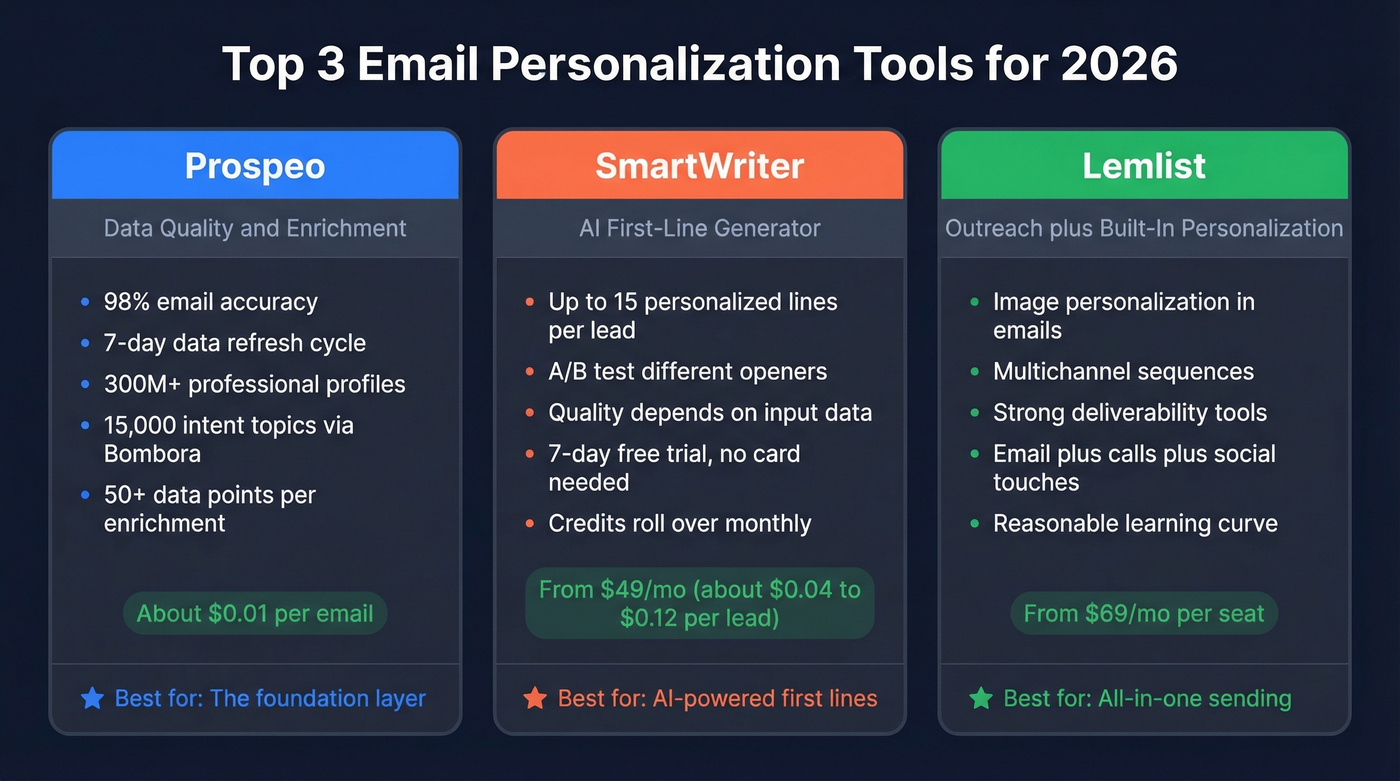
| Verified data + enrichment | Prospeo | 98% email accuracy, ~$0.01/email, intent data on 15,000 topics |
| AI-generated first lines | SmartWriter | Best standalone AI personalizer still alive, from $49/mo |
| Sending + built-in personalization | Lemlist | Image personalization, strong deliverability, multichannel |
Why Most Personalization Software Fails
Bad personalization is worse than no personalization at all. A generic "Hi {{first_name}}, quick question" template at least doesn't insult anyone's intelligence. A poorly researched first line that congratulates someone on a promotion they got two years ago actively damages your brand.
Here's what AI tools keep generating:
- Fake congrats on funding/promotions. "Congrats on the Series B, Sarah!" - Sarah's Series B closed 14 months ago. If the event is more than 30 days old, it reads automated because it is.
- "Saw your post about X." "Loved your take on AI in sales!" - unless you reference a specific insight, this is the cold email equivalent of "nice weather we're having."
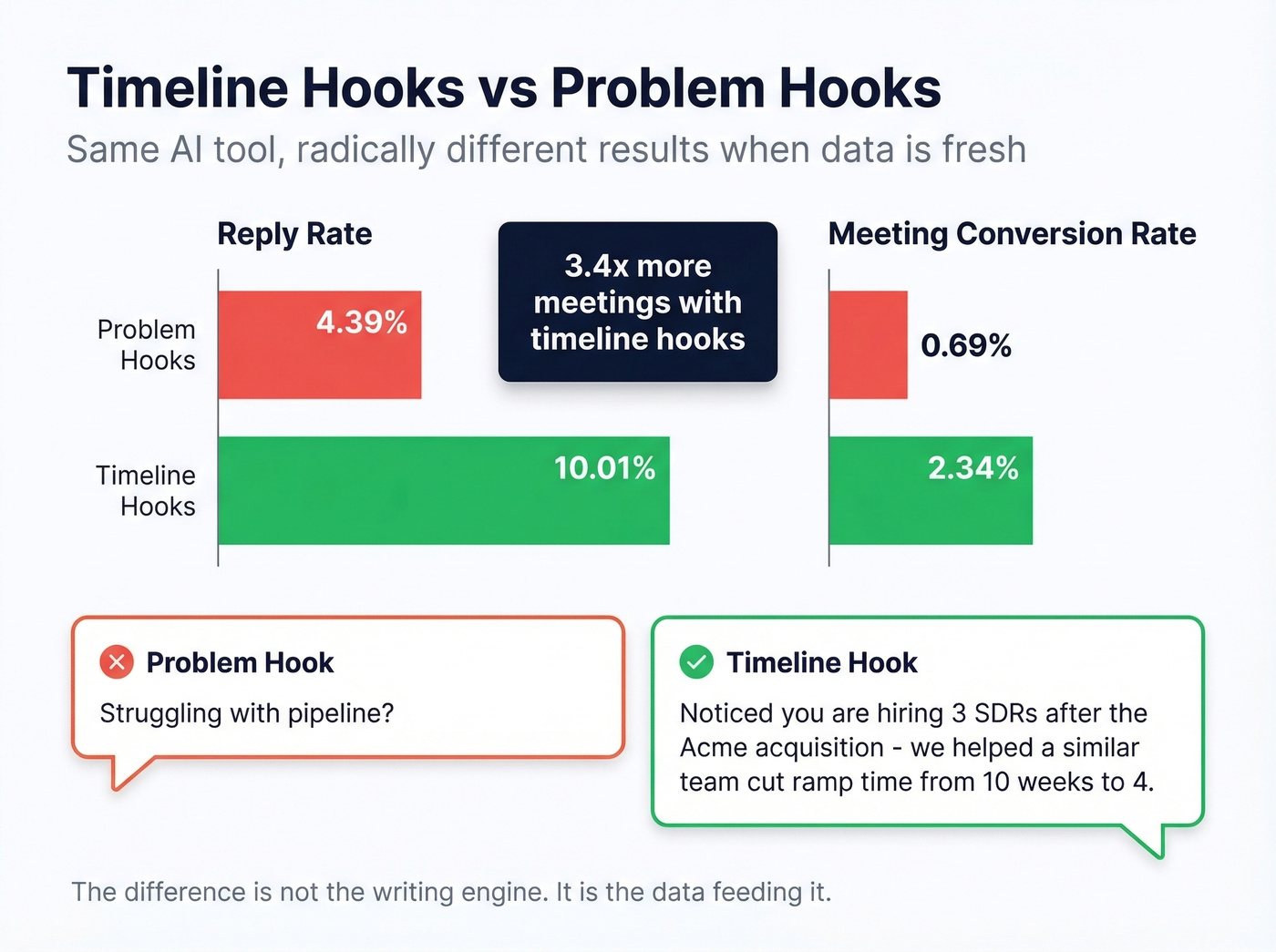
- Generic problem hooks. "Struggling with pipeline?" Problem-based hooks average a 4.39% reply rate. Timeline-based hooks - tied to a real trigger like a job change or funding event - hit 10.01%. Timeline hooks convert to meetings at 2.34% vs 0.69% for problem hooks. That's a 3.4x gap that compounds across your entire pipeline.
Now compare that to a first line built on fresh data: "Noticed you're hiring 3 SDRs after the Acme acquisition - we helped a similar team cut ramp time from 10 weeks to 4." Same AI tool, radically different output. The difference isn't the writing engine. It's the data feeding it.
Hunter's analysis of 11 million emails found that deeper personalization drives 52% higher reply rates, and segmenting into cohorts of 50 or fewer contacts increases reply rates by 2.76x. Smaller batches force better research, which produces relevant personalization, which gets replies.
Let's be honest about something most AI personalization vendors won't tell you: if your average deal size is under $10k, you probably don't need an AI personalization tool at all. You need better data. If your enrichment layer feeds accurate, timely signals - recent job changes, tech stack, funding events, hiring patterns - even a simple template outperforms a fancy AI first line built on stale data.

The Personalization Stack
Personalization isn't one tool. It's four layers, and most teams skip the first two then blame layer three.
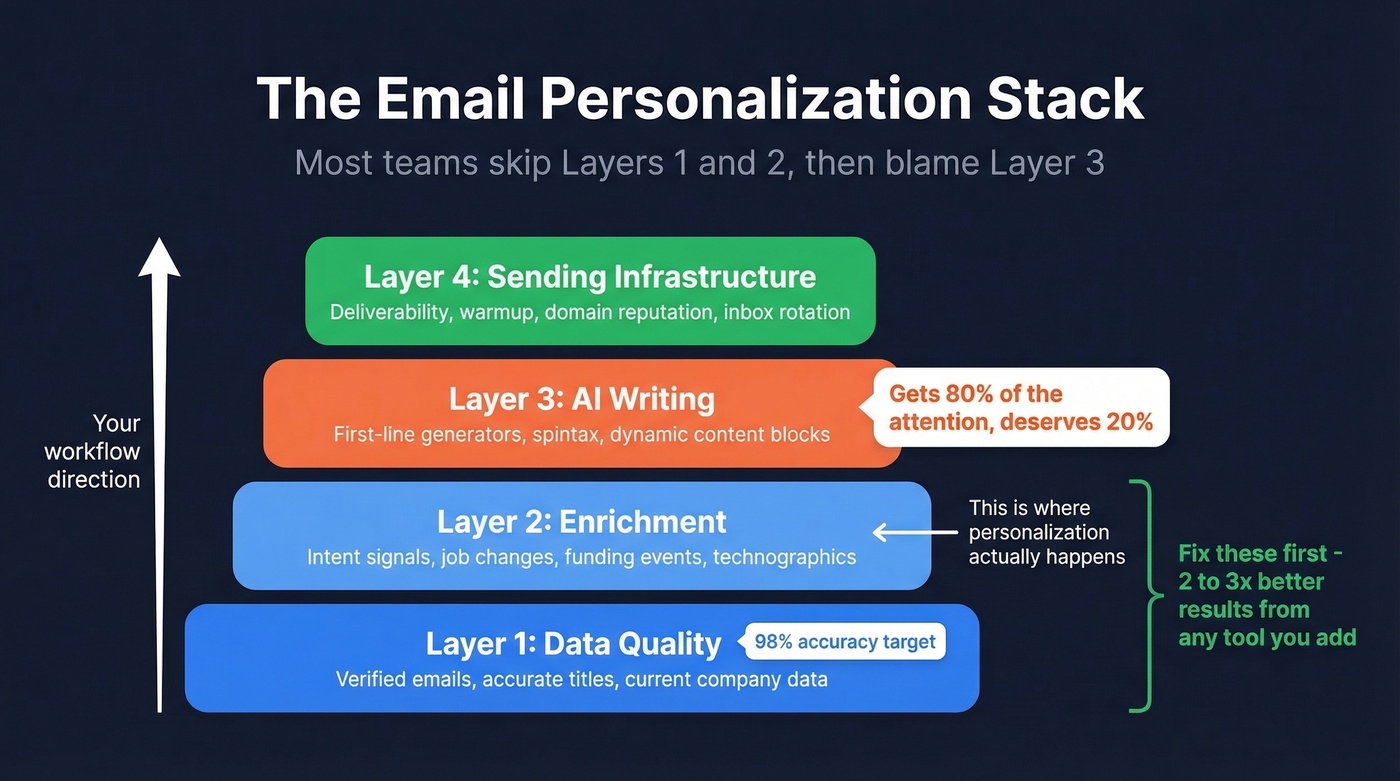
Layer 1: Data quality. Verified emails, accurate job titles, current company data. If this layer fails, nothing downstream matters - your AI-written masterpiece bounces.
Layer 2: Enrichment. Intent signals, technographics, job changes, funding events. This is the raw material your personalization runs on. Without it, AI tools hallucinate or default to generic hooks. In our experience, teams that fix their data layer first see 2-3x better results from any personalization tool they add later.
Layer 3: AI writing - first-line generators, spintax engines, dynamic content blocks - gets all the attention and deserves about 20% of it. Layer 4: Sending infrastructure - deliverability, warmup, domain reputation, inbox rotation - determines whether your emails reach a human inbox at all. The 3-7-7 follow-up cadence (follow-ups on days 3, 7, and 14) captures 93% of replies by Day 10, but only if you land in the primary tab. Sequences are shrinking to 3 steps max as late-step replies dry up.

Every personalization tool on this list performs better with accurate, fresh data underneath it. Prospeo's 7-day refresh cycle and 15,000 intent topics give your AI writers the job changes, funding events, and hiring signals that turn generic openers into booked meetings.
Stop personalizing on top of stale data. Start with the layer that actually matters.
9 Best Email Personalization Tools for 2026
1. Prospeo
Category: Data Quality & Enrichment
Prospeo covers 300M+ professional profiles with 98% email accuracy on a 7-day refresh cycle - the industry average is six weeks. That gap matters more than any AI first-line generator. Stale data means bounces, and bounces above 5% tank your domain reputation.
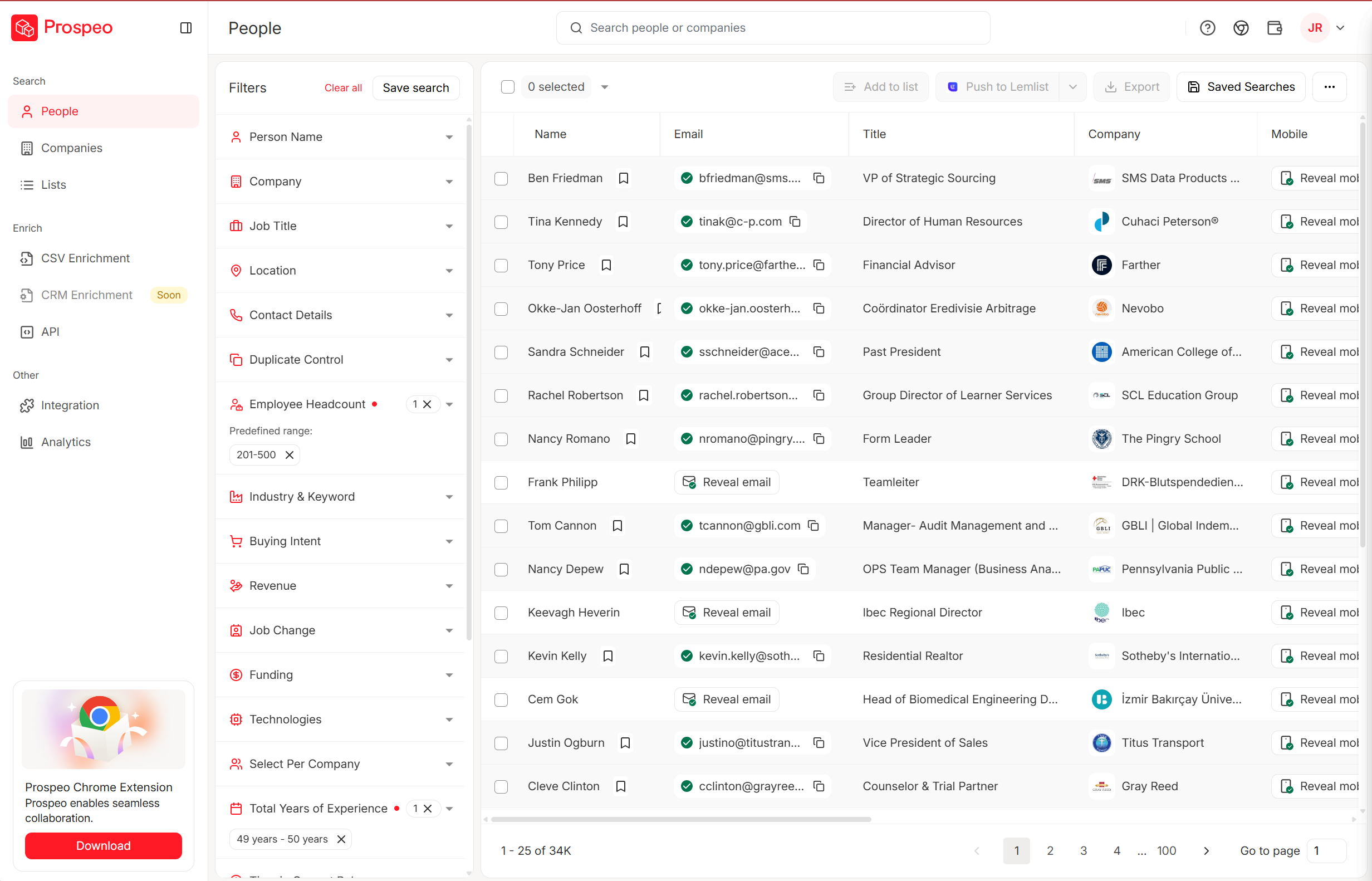
The platform returns 50+ data points per enrichment at an 83% match rate, with intent data tracking 15,000 topics via Bombora. You get 30+ search filters including buyer intent, technographics, job changes, headcount growth, and funding signals - the exact triggers that make personalization work. Native integrations with Instantly, Lemlist, Clay, and Smartlead mean verified contacts flow directly into your sending tool without CSV gymnastics.
Use this if: You want the data foundation right before spending on AI writing tools. Stack Optimize built from $0 to $1M ARR using Prospeo, maintaining 94%+ deliverability with bounce rates under 3% across all clients. Snyk's 50 AEs cut their bounce rate from 35-40% to under 5% and added 200+ new opportunities per month.
Pricing: ~$0.01/email. Free tier gives you 75 emails/month. No contracts, cancel anytime.
2. SmartWriter
Category: AI First-Line Generator
SmartWriter is the best standalone AI first-line generator still operating in 2026 - and one of the few cold email personalization tools in this category that's stayed relevant while competitors folded.
We've run SmartWriter with both rich and thin input data. The difference is night and day:
- Rich data input --> "Your recent shift from VP Sales at Drift to CRO at Gong - plus the 40% headcount jump - suggests pipeline velocity is top of mind."
- Thin data input --> "As the CRO of Gong, you know how important sales efficiency is."
Same tool. The first line books meetings; the second gets deleted. SmartWriter supports up to 15 personalized lines per lead, which is useful for A/B testing different openers across segments.
Pricing: $49/mo (Basic, 400 credits) to $129/mo (Pro, 3,500 credits). That's roughly $0.12 per lead on Basic, dropping to ~$0.04 on Pro. 7-day free trial, no credit card required. Unused credits roll over.
3. Clay
Category: Enrichment + AI
Clay is the power tool you'll either love or resent. It pulls from 150+ data sources, and Claygent's AI research agent can dig into prospects at a depth no other tool matches. But the consensus on r/sales is blunt: SDRs spend "hours in Clay tables" building workflows, and the credit burn adds up fast.
Best for: RevOps engineers building custom enrichment-to-personalization pipelines. Skip this if you're a solo founder or small team without a dedicated ops person - you'll spend more time configuring than selling.
Pricing: Free (100 credits/mo) to $800/mo (Pro). Enterprise is custom. Power users regularly hit $0.15-0.30 per enriched contact.
4. Lemlist
Category: Outreach + Built-In Personalization
Lemlist is the outreach tool that operators on r/coldemail consistently praise for combining personalization with actual sending infrastructure. The image personalization feature is genuinely slick - dynamic screenshots, personalized logos, custom thumbnails embedded right in the email body. Multichannel sequences (email + calls + social touches) are well-designed, and the learning curve is reasonable.
The catch: at $69/mo per seat, a 5-person SDR team pays $345/mo before integrations. That per-seat model gets expensive fast for growing teams.
Pricing: From $69/mo per seat.

5. Instantly
Category: Outreach
At $37/mo, Instantly is one of the cheapest ways to scale sending infrastructure. That flat-fee model with unlimited email accounts is a big reason it dominates high-volume outbound.
The risk: some teams are abandoning Instantly over shared infrastructure concerns at lower tiers, moving to alternatives like ManyReach. The SuperSearch lead database ($47-197/mo) is separate from outreach pricing, which catches people off guard.
Pricing: Outreach: $37/mo (Growth) to $358/mo (Light Speed). SuperSearch: $47-197/mo. Includes unlimited email accounts and warmup.
6. SmartReach
Category: Outreach
SmartReach earns its spot for teams that want everything in one ecosystem - time zone sending, multichannel drips, and the ability to buy domains and inboxes inside the tool instead of juggling registrars. A solid mid-market option that doesn't get enough attention. Starts at ~$29/mo.
7. Klaviyo
Category: Marketing Email Personalization
Klaviyo is the gold standard for ecommerce lifecycle emails - abandoned carts, post-purchase flows, win-back campaigns. Its behavioral triggers and advanced segmentation are best-in-class for marketing personalization. If you're doing cold outreach, this isn't your tool. Different workflow, different use case entirely.
Pricing: Free plan available. Paid plans from $20/mo, scaling with list size.
8. Omnisend
Category: Marketing Email Personalization
Klaviyo's lighter-weight competitor for smaller ecommerce brands that want email + SMS personalization without the complexity. Best for brands under 10,000 contacts that don't need Klaviyo's full segmentation engine. From $16/mo with a free plan.
9. Litmus Personalize
Category: Marketing Email Personalization
Litmus Personalize handles open-time dynamic content - countdown timers, live inventory feeds, weather-based imagery. Only worth it if your marketing team already uses Litmus for rendering and QA. Enterprise pricing, typically bundled with the Litmus email testing suite.
Tools to Avoid
Lyne.ai shut down in November 2024. Accounts froze, support went silent, and users couldn't run searches or get refunds. Before it died, the AI output quality was poor - users reported that the first lines were "terrible in 90% of cases." Don't mourn it.
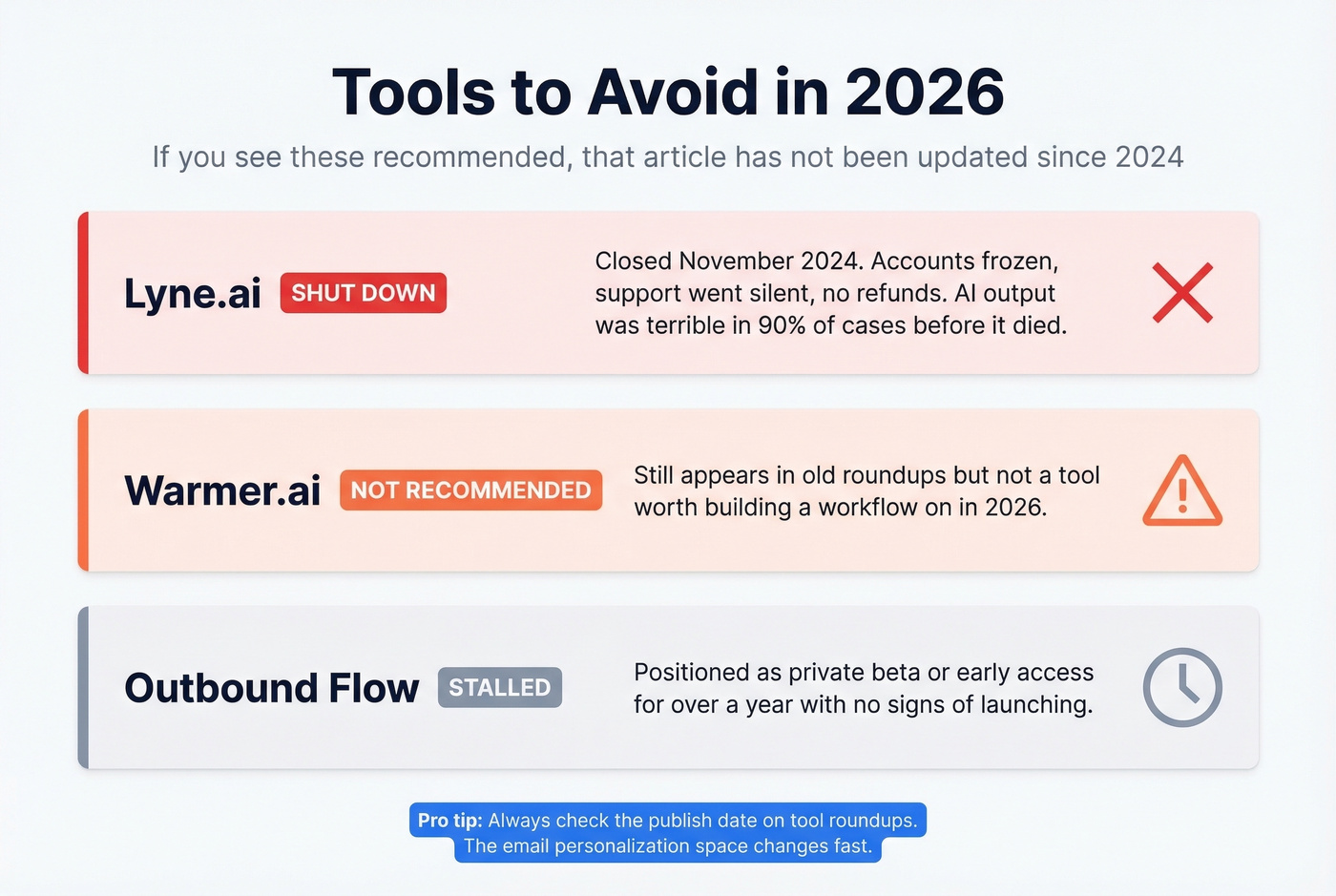
Warmer.ai still shows up in older roundups, but it's not a tool we'd bet a workflow on in 2026. Outbound Flow has been positioned as private beta/early access for over a year. If you see any of these recommended elsewhere, that article hasn't been updated since 2024.
Pricing Comparison
| Tool | Category | Starting Price | Credits/Contacts | Cost Per Lead | Free Tier? |
|---|---|---|---|---|---|
| SmartWriter | AI First Lines | $49/mo | 400-3,500/mo | $0.04-0.12 | 7-day trial |
| Clay | Enrichment/AI | $149/mo | Varies by workflow | $0.15-0.30 | 100 credits/mo |
| Lemlist | Outreach | $69/mo/seat | Unlimited sends | N/A (per seat) | No |
| Instantly | Outreach | $37/mo | Unlimited accounts | N/A (flat fee) | No |
| SmartReach | Outreach | ~$29/mo | Varies by plan | ~$0.03-0.06 | Trial |
| Klaviyo | Marketing | $20/mo | Scales with list | ~$0.002-0.01 | Yes |
| Omnisend | Marketing | $16/mo | Scales with list | ~$0.002-0.01 | Yes |
| Litmus Personalize | Marketing | Enterprise | Unlimited renders | N/A (bundled) | No |
The budget stack that actually works: Prospeo for verified data + SmartWriter Basic for AI first lines + Instantly Growth for sending = under $90/mo for a complete data-to-send workflow with personalization at every layer.
If you want plug-and-play messaging, start from proven cold email templates and then personalize with real triggers.
Deliverability: The Personalization Killer
None of this matters if your emails bounce. Bounce rates above 5% don't just waste your personalization effort - they tank your domain reputation, which tanks deliverability for every future campaign. We've seen teams with beautiful AI-written copy hitting 15% bounce rates because they skipped verification. All that personalization work, straight to the void.
In 2026 deliverability playbooks, teams are avoiding warmup services and ramping manually at 2-3 emails per day per inbox, scaling to 10-15/day over weeks. Sequences are shrinking to 3 steps max. Even the best email personalization tools can't save a campaign that never reaches the inbox.
When your data layer and sending layer talk to each other - verified contacts flowing directly into your sequencer via native integrations - bounce rates stay under 3% and your personalization actually reaches a human. If you need a full setup, follow a cold email setup checklist before scaling volume.
Snyk's 50 AEs dropped their bounce rate from 35-40% to under 5% - and added 200+ new opportunities per month. Stack Optimize hit $1M ARR with 94%+ deliverability. The difference wasn't their AI writing tool. It was 98% email accuracy at $0.01 per lead.
Get the data foundation right before you spend another dollar on AI first lines.
FAQ
Do email personalization tools actually improve reply rates?
Yes, when built on clean data. Timeline-based hooks average 10.01% reply rates vs 4.39% for generic problem hooks - a 2.3x lift. But bad personalization performs worse than no personalization. The tool is only as good as the enrichment data feeding it.
What's the difference between cold email and marketing personalization?
Cold email tools like SmartWriter and Lemlist generate unique first lines for outbound sales to strangers. Marketing tools like Klaviyo and Omnisend use dynamic content and behavioral triggers for lifecycle emails to existing subscribers. Different workflows, different compliance rules.
How much do the best tools cost?
A complete budget stack runs under $90/month: Prospeo for verified data (~$0.01/email, free tier available), SmartWriter Basic for AI first lines ($49/mo), and Instantly Growth for sending ($37/mo). Clay and enterprise options push costs to $800+/month.
Is Lyne.ai still working?
No. Lyne.ai shut down in November 2024. Accounts froze, support vanished, and refunds were refused. SmartWriter is the closest active alternative for AI-generated first lines.
What's a good free option for email personalization?
Prospeo's free tier includes 75 verified emails per month with full enrichment - enough to test a personalized outreach workflow without spending anything. Pair it with SmartWriter's 7-day trial and you can run a complete personalization test at zero cost.