

Cold Email Outreach: The Practitioner's Playbook for 2026
SimplerQMS, a life sciences QMS company, sent 15,700 cold emails over 60 days and generated $420K in pipeline. Not with AI-generated fluff or a ten-tool stack - with clean infrastructure, verified data, and emails short enough to read on a phone. That's the difference between cold email outreach that builds pipeline and outreach that gets your domain blacklisted.
Does Cold Email Still Work in 2026?
Yes, but only if your unit economics justify it. Cold email works best when your deal margin exceeds $500 and your payback period is under two months. If you're selling $29/month subscriptions, this isn't your channel.
The data tells a better story than the skeptics suggest. Smartlead's dataset of 14.3 billion cold emails shows a 42% open rate, 3% reply rate, and roughly 1% meeting-booking rate across all industries. Run the math: 12,000 emails a month at 3% reply generates 360 replies. Convert half to conversations, convert a quarter of those to meetings - that's 45+ meetings a month from a channel that costs a fraction of paid acquisition.
The outliers are more compelling. SimplerQMS hit a 4.4% reply rate with 21 qualified opportunities at $20K ACV. Cold email isn't dead. Lazy cold email is.
The consensus on r/coldemail and r/SaaS is clear: infrastructure and list quality are what actually matter. Teams that nail those two things consistently outperform teams obsessing over subject line A/B tests.
How Cold Email Outreach Actually Works
Three things separate campaigns that produce pipeline from campaigns that produce spam complaints:
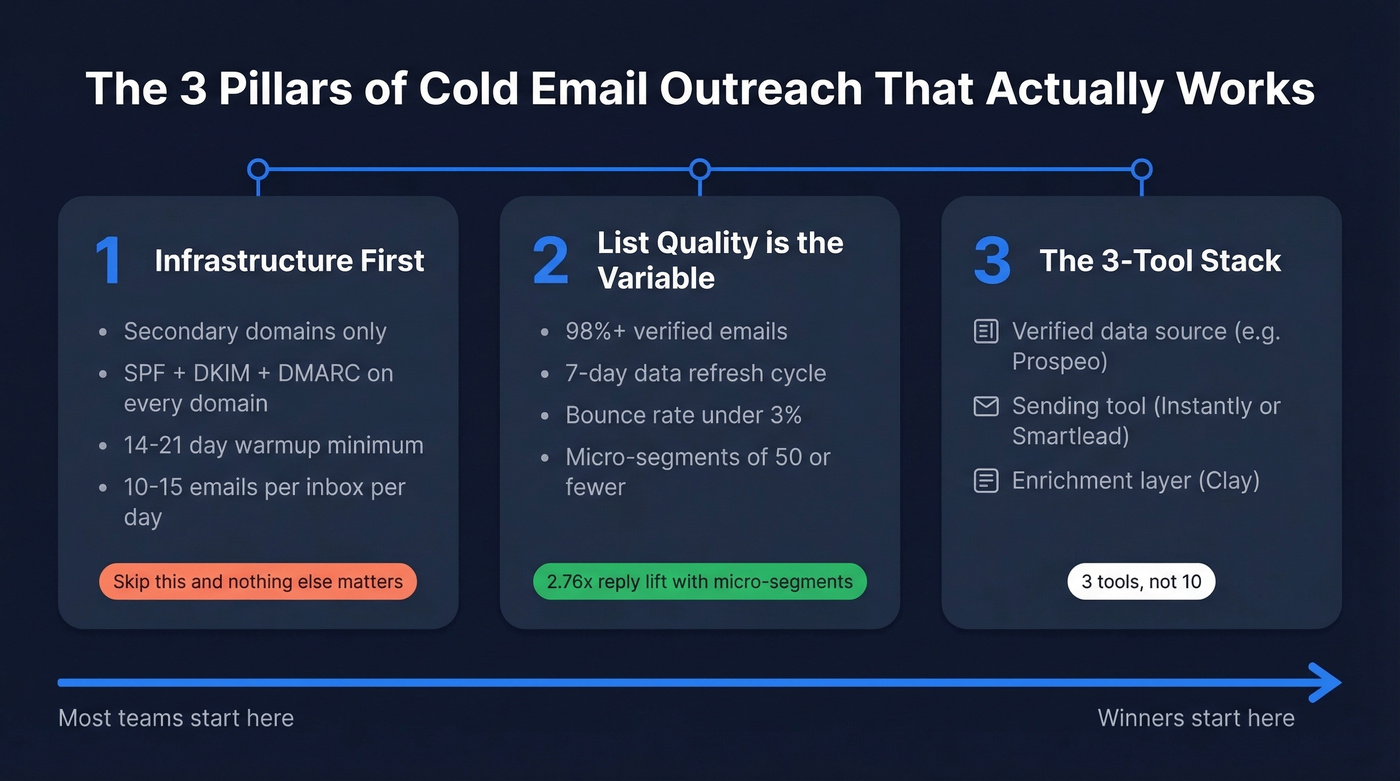
- Infrastructure first. Secondary domains, SPF/DKIM/DMARC on every one, 14-21 day warmup. Skip this and nothing else matters - not your copy, not your offer, not your AI personalization.
- Your list is the variable. 98%+ verified emails, 7-day data refresh, bounce rate under 3% or your domain reputation suffers. Most teams underinvest here.
- The stack that works. A verified data source, a sending tool like Instantly or Smartlead, and an enrichment layer like Clay. Three tools, not ten.
Infrastructure First
You can write the best cold email ever crafted, and it won't matter if it lands in spam. We've watched teams spend weeks perfecting copy only to discover their authentication was broken the entire time.
Authentication Is Non-Negotiable
Gmail and Yahoo started enforcing SPF, DKIM, and DMARC for bulk senders in February 2024. Outlook followed in May 2025, targeting domains sending 5,000+ daily emails to Outlook.com addresses. If you aren't authenticated, you aren't getting delivered.
Every sending domain needs all three configured. An SPF record for Google Workspace and Instantly looks like this:
v=spf1 include:_spf.google.com include:_spf.instantly.ai ~all
Set DMARC to at least p=none to start, then tighten to p=quarantine once you're confident in your setup.
Domain Math
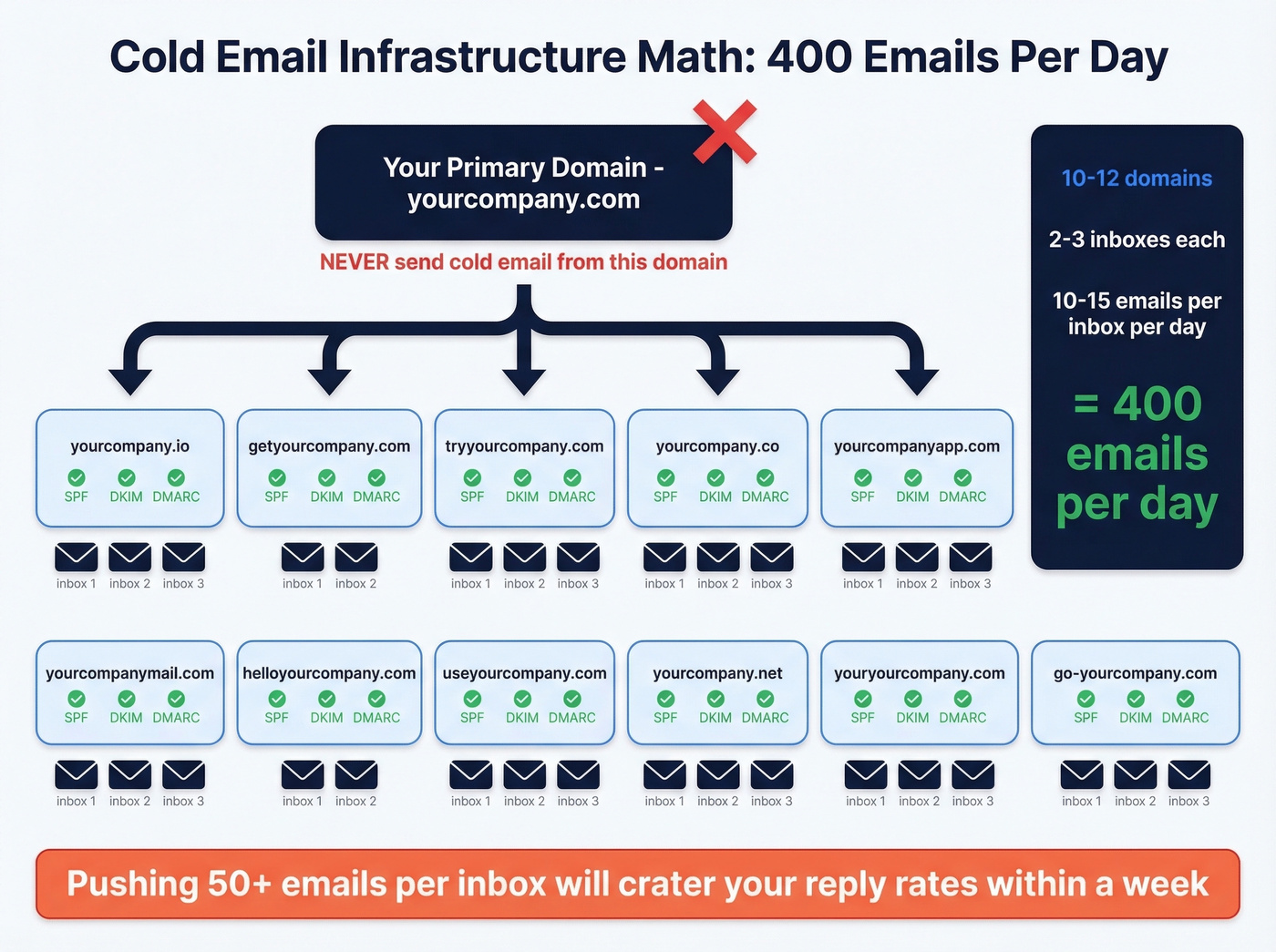
Never send from your primary domain. Buy secondary domains that are close to your brand - variations, abbreviations, different TLDs. For 400 emails per day, you need roughly 10-12 domains with 2-3 inboxes each, sending 10-15 emails per day per inbox. Exceeding these limits is the fastest way to tank deliverability. We've seen teams push 50+ emails per inbox and watch their reply rates crater within a week.
If you want a deeper walkthrough, follow a dedicated domain setup guide before you scale volume.
Warmup and Deliverability Testing
Start each new inbox at 10-15 emails per day. Increase volume by 10-20% weekly. Minimum warmup period is 14 days; 21 days is what we recommend. Keep warmup running even after you launch campaigns - it maintains the engagement signals ISPs look for.
Google has cracked down on automated warmup tools that use synthetic engagement. Stick with the built-in warmup from your sending platform; both Instantly and Smartlead include this.
If you’re building a repeatable process, use these email warmup best practices to avoid reputation swings.
Before launching any campaign, test deliverability with a tool like mail-tester.com or GlockApps. These show you whether your emails land in inbox, spam, or promotions before you burn real prospects on a broken setup.
Kill switch: If your bounce rate exceeds 5% or spam complaints exceed 0.1%, pause immediately and clean your list. Continuing to send on degraded reputation compounds the damage.
Your List Is the Real Variable
Here's the thing: most cold email failures aren't copy failures. They're data failures disguised as copy failures. The Smartlead dataset average bounce rate of 7.5% is already dangerous territory. In practice, 0-3% bounce is where you want to live, and getting under 3% consistently puts you ahead of most senders.
The problem with most data providers is freshness. The industry average refresh cycle is six weeks. People change jobs, companies get acquired, email servers get reconfigured. A six-week-old list is already stale.
Prospeo's 5-step verification process - catch-all handling, spam-trap removal, honeypot filtering - delivers 98% email accuracy across 143M+ verified addresses. The 7-day data refresh cycle means you're working with current data, not a snapshot from last month. Stack Optimize built from $0 to $1M ARR using Prospeo-powered lists, maintaining 94%+ deliverability and sub-3% bounce rates across every client campaign with zero domain flags.
If you’re auditing your process, it helps to understand email address verification and when it’s actually necessary.
There's a segmentation angle worth knowing too. Campaigns targeting cohorts of 50 contacts or fewer see a 2.76x reply rate lift compared to larger blasts. Micro-segmentation forces you to write relevant messages, and relevance drives replies.
Writing Emails That Get Replies
Copy matters - but less than most people think. The hierarchy is deliverability > list quality > offer > copy. Bad copy will waste a good list, but great copy won't save a bad one.
The biggest benchmark insight we've found: timeline-based hooks average a 10.01% reply rate versus 4.39% for problem hooks. A timeline hook ties your outreach to something happening now - a funding round, a hiring surge, a product launch. It signals relevance without being creepy.
Keep emails under 75 words. One CTA. Low friction - "worth a 15-min call?" beats "book a 45-minute demo on my Calendly." The Reddit consensus on r/SaaS backs this up: short, value-first emails with a single ask consistently outperform longer pitches.
For subject lines, stick to 3-6 words with no deception. The fake "Re:" trick might boost opens for a week, but it destroys trust and triggers spam filters. Something like "[company] + [specific topic]" or "[first name] - [timeline trigger]" works better long-term. The old "quick question" opener has been burned out - practitioners on r/coldemail note it now reads as a cold email signal rather than a genuine ask.
A/B test your subject lines and openers in batches of 100+. Small variations compound over thousands of sends, and you need statistical significance before drawing conclusions. (If you want a structured approach, use a dedicated guide on A/B testing email variations.)
Here’s a template that follows these principles:
Subject: {company} + [your value prop in 3 words]
Hi {first_name},
Noticed {company} just {timeline trigger - hiring, funding, expansion}. When teams hit that stage, {specific problem} usually becomes a bottleneck.
We helped [similar company] {specific result with number}. Would it make sense to chat for 15 minutes this week?
{Your name}
One more thing: company-context personalization beats personal-detail personalization. Referencing someone's recent post now reads as scraped and automated. Referencing their company's growth trajectory or tech stack feels researched.
If you want more options beyond one script, pull from these B2B cold email templates and adapt them to your segments.

The article says it plainly: most cold email failures are data failures. Prospeo's 5-step verification delivers 98% email accuracy across 143M+ addresses with a 7-day refresh cycle - not the 6-week industry average. Stack Optimize built a $1M agency on Prospeo data with sub-3% bounce rates and zero domain flags.
Stop burning domains on stale data. Start with emails that actually land.
The Follow-Up Sequence
Most replies don't come from the first email. 80% of replies come after the third touchpoint, and the 3-7-7 cadence framework captures 93% of replies by Day 10.
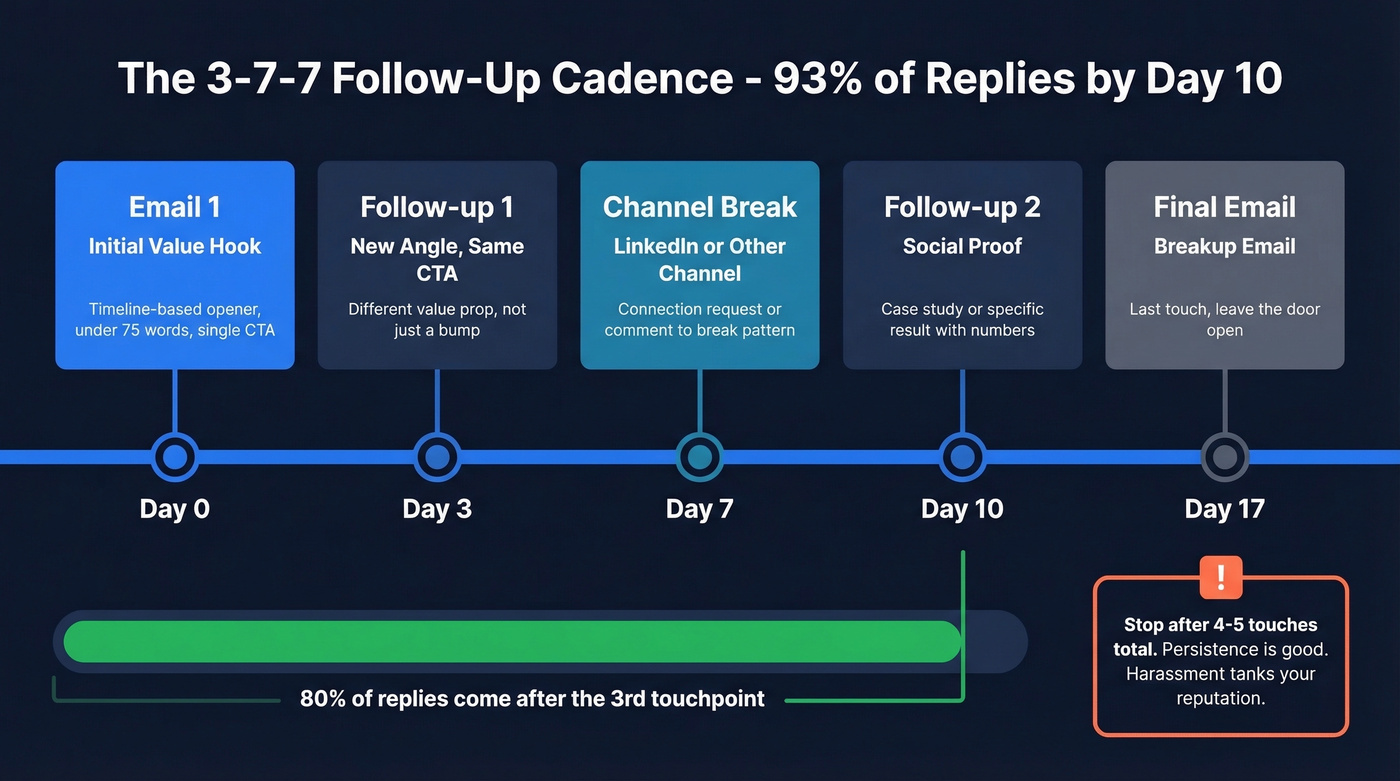
| Touchpoint | Day | Channel | Purpose |
|---|---|---|---|
| Email 1 | Day 0 | Initial value hook | |
| Follow-up 1 | Day 3 | New angle, same CTA | |
| Touchpoint 3 | Day 7 | Other channel | Break pattern |
| Follow-up 2 | Day 10 | Social proof or case study | |
| Final follow-up | Day 17 | Breakup email |
Each follow-up should bring new value - a different angle, a relevant case study, a specific insight about their business. Don't just "bump" the thread. Stop after 4-5 touches total. Persistence is good; harassment tanks your sender reputation and your brand.
For more tested patterns, compare your cadence to a proven cold email follow-up sequence.
Multi-channel sequencing - email, then a connection request, then email - consistently outperforms single-channel. Space touches 3-4 days apart to avoid triggering spam filters.
AI Personalization at Scale
Let's be honest: surface-level AI personalization is now a spam signal. Every prospect gets emails that reference their "impressive background" or "recent company news." That reads as automated because it is.
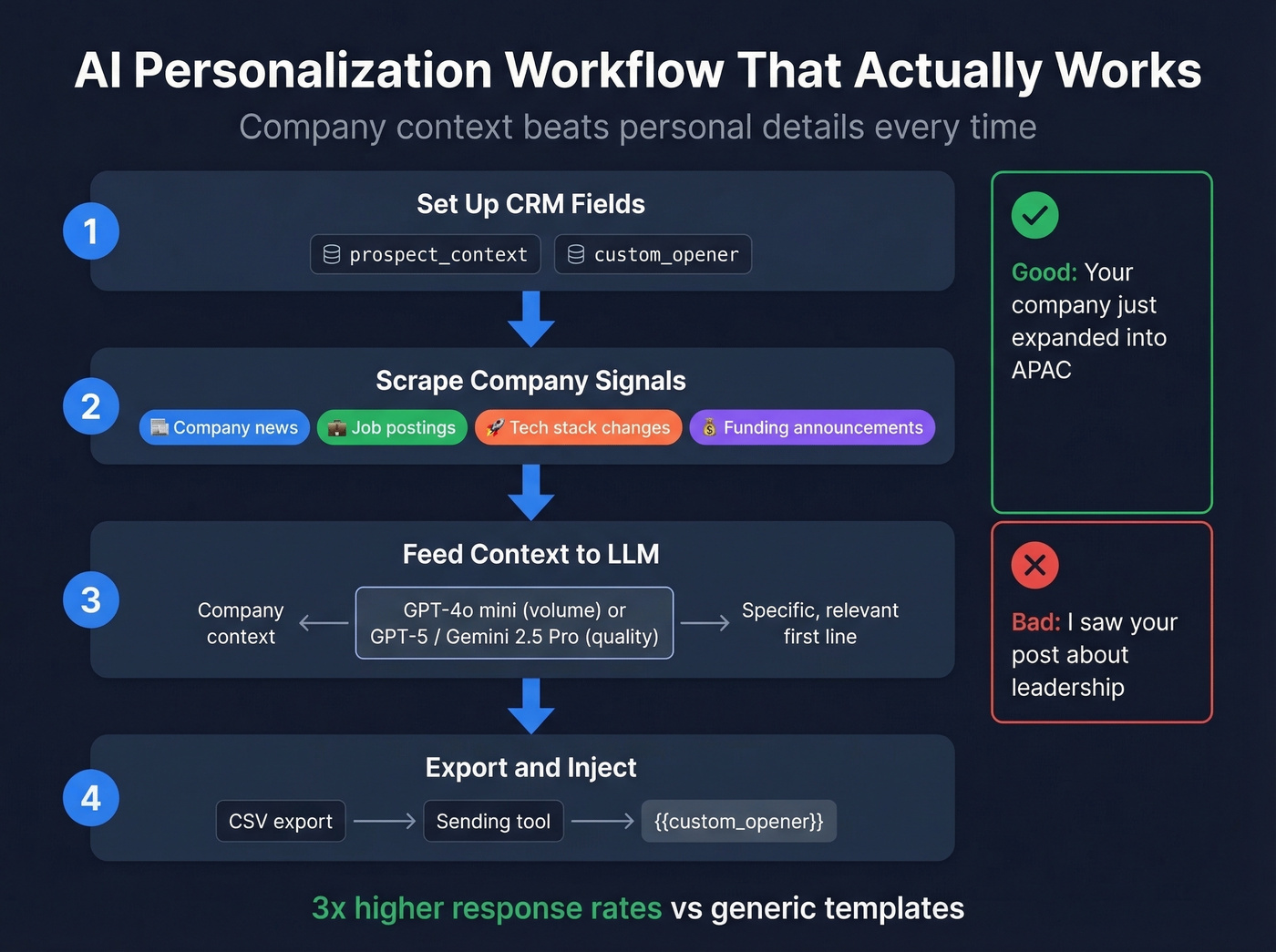
The workflow that actually moves the needle:
- Create CRM fields for
prospect_contextandcustom_opener - Scrape relevant prospect signals - company news, job postings, tech stack changes, funding announcements
- Feed context into an LLM (GPT-4o mini handles volume well, GPT-5 or Gemini 2.5 Pro for higher quality) with a prompt that generates a specific, relevant first line
- Export to CSV, import into your sending tool, inject as
{{custom_opener}}merge field
Teams running this workflow report response rates around 3x higher than generic templates. The key is feeding the LLM company-level context, not personal-detail context. "Your company just expanded into APAC" beats "I saw your post about leadership" every time.
If you’re trying to systematize this, start with a practical guide to how to personalize cold emails without turning it into spam.
Pretargeting: The Tactic Nobody Talks About
Run low-budget display or social ads to the same list you're about to email. When prospects see your brand name in their feed before your message hits their inbox, you shift from "random stranger" to "company I've seen around." Budget $5-10/day against a custom audience of your target list for 7-10 days before launching the email sequence. I've seen this single tactic lift reply rates by 20-30% on otherwise identical campaigns.
2026 Benchmarks
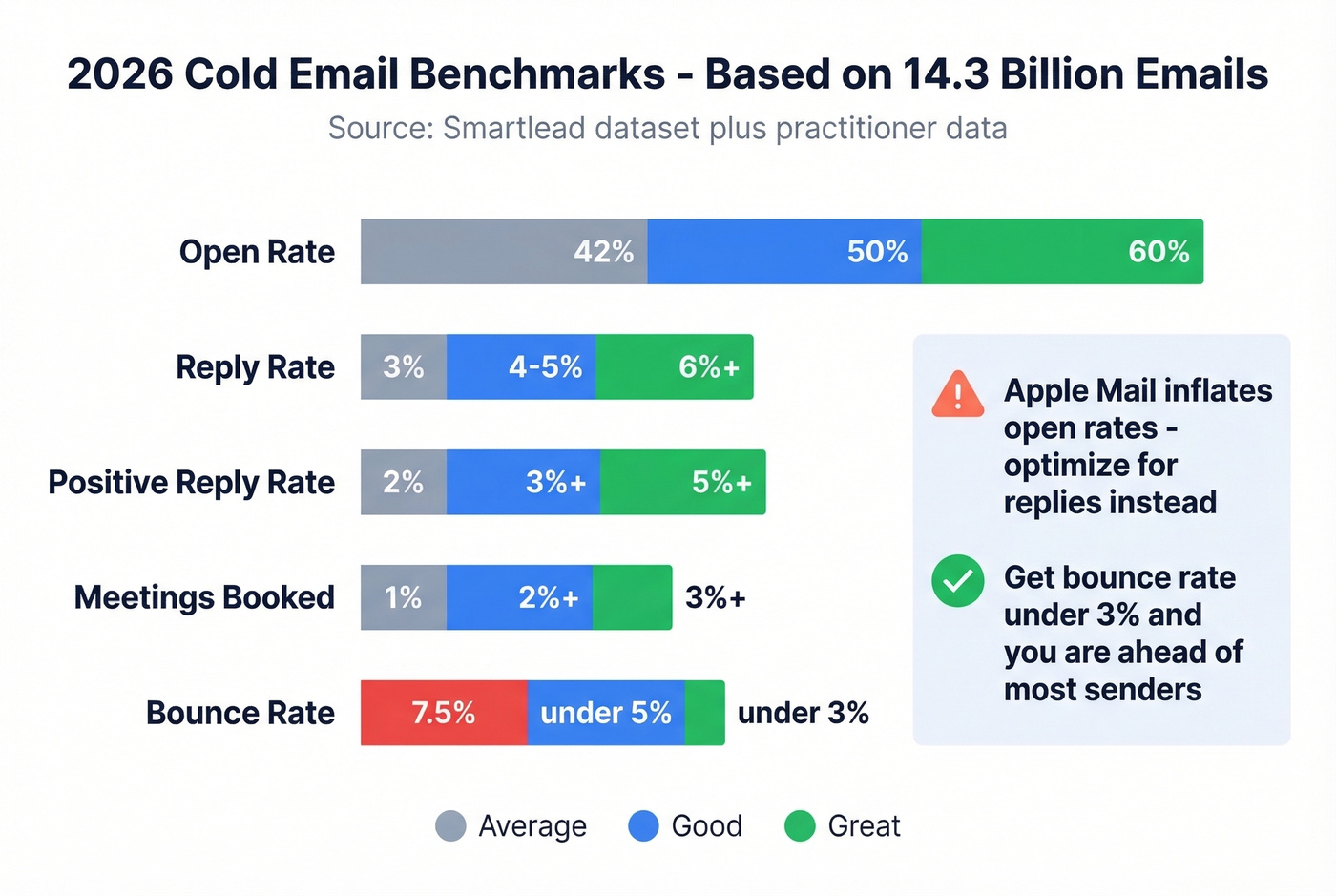
Ground your expectations with real numbers. These come from the Smartlead 14.3B-email dataset, supplemented with practitioner benchmarks:
| Metric | Average | Good | Great |
|---|---|---|---|
| Open rate | 42% | 50%+ | 60%+ |
| Reply rate | 3% | 4-5% | 6%+ |
| Positive reply | 2% | 3%+ | 5%+ |
| Meetings booked | 1% | 2%+ | 3%+ |
| Bounce rate | 7.5% | <5% | <3% |
A caveat on open rates: Apple Mail Privacy Protection inflates these numbers significantly. Don't optimize for opens - optimize for replies and meetings. At real scale, 2-4% reply rate is solid.
That 7.5% average bounce rate is a warning sign. It means most teams are sending to bad data. Get that under 3% and you're already ahead of the majority.
If you want to sanity-check your targets, use these cold email benchmarks as a baseline.
Compliance by Region
Cold email is legal in most markets - with conditions.
| Regulation | Region | Key Requirement | Max Penalty |
|---|---|---|---|
| CAN-SPAM | US | Opt-out within 10 days, physical address | $53,088/email |
| GDPR | EU | Legitimate interest for B2B | EUR 20M or 4% revenue |
| CASL | Canada | Express or implied consent | $10M CAD |
| PECR | UK | B2B outreach allowed under legitimate interest + opt-out | Up to GBP 500,000 |
The practical checklist that covers you everywhere:
- Include a working unsubscribe link in every email
- Use a real sender name and company identity
- Include a physical mailing address per CAN-SPAM
- Maintain consent records if operating under GDPR or CASL
- Authenticate every sending domain with SPF, DKIM, and DMARC
- Honor opt-outs immediately - don't wait the full 10 days
The US is the most permissive market for cold emailing. The EU allows B2B outreach under legitimate interest, but you need to articulate why you're contacting someone. Canada is the strictest - CASL requires some form of consent before you send.
Tools That Actually Work
You don't need ten tools. You need three categories covered: data/verification, sending/deliverability, and enrichment.
Data & Verification
Prospeo is our top pick. 300M+ profiles, 143M+ verified emails, 125M+ verified mobiles, with 30+ search filters including buyer intent and technographics. Native integrations with Instantly, Smartlead, Lemlist, and Clay mean your data flows directly into your sending stack. At ~$0.01 per email with a free tier of 75 emails/month, it's the data layer that keeps bounce rates under 3%.
If you’re comparing vendors, start with a shortlist of B2B list providers and prioritize verification + refresh rate over raw volume.
Apollo has a forever-free plan with 100 credits/month. Paid plans start at $59/user/month. Good for bootstrapped teams who want an all-in-one, but email accuracy runs lower than dedicated verification tools.
Clay handles enrichment and AI-powered personalization workflows. Free tier available; paid from ~$149/month. Best paired with a dedicated data source rather than used standalone.
Sending & Deliverability
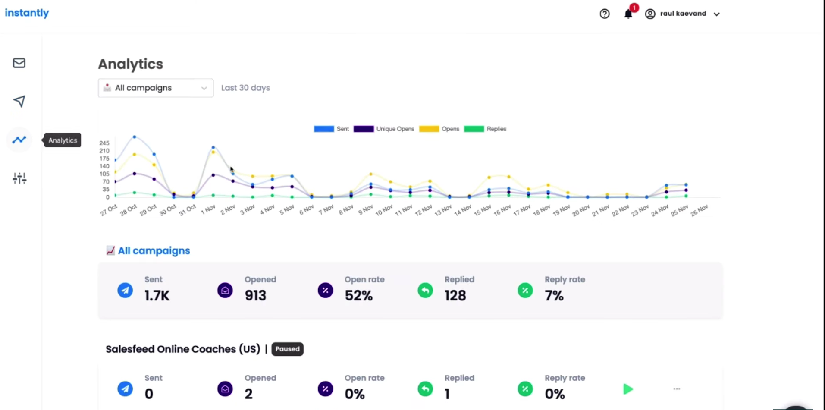
Instantly is the common default for teams sending at scale. Pricing starts around $30/month. Built-in warmup, inbox rotation, and a clean UI make it easy to run multi-inbox campaigns.
Skip Smartlead unless you need granular control. Unlimited inboxes on higher plans, strong deliverability features, $32.50/month on annual billing. It's the power-user tool - more knobs to turn, steeper learning curve.
Just getting started? Saleshandy starts at $25/month billed annually and covers the basics without overwhelming you. It won't scale to 10,000+ emails/month gracefully, but it's a solid entry point.
GMass is for Gmail-native senders only. $25/month, no warmup feature, best for low-volume outreach.
Lemlist adds multi-channel sequences starting at $59/month, with extra sending emails at $9/month each. Worth it if multi-channel is core to your workflow, overkill if you're email-only.
If you want a full comparison, see our tested list of cold email outreach tools.
The recommended stack: Prospeo for data, Instantly for sending, Clay for enrichment. Three tools, clean integrations, covered from list building through campaign execution.
The 3-tool cold email stack starts with verified data. Prospeo gives you 30+ filters - buyer intent, technographics, job changes, funding - to build micro-segmented lists of 50 contacts that drive 2.76x more replies. At $0.01 per email, 12,000 verified contacts costs less than a single bad month of bounced sends.
Segment smarter, send cleaner, book 26% more meetings than ZoomInfo users.
Proof in the Pipeline
The SimplerQMS campaign is one data point. The pattern is consistent across teams that invest in verified data: Stack Optimize built from $0 to $1M ARR maintaining 94%+ deliverability and sub-3% bounce rates across every client campaign. Verified data in, pipeline out. The teams that treat list quality as a cost center instead of a revenue driver are the ones writing "is cold email dead?" posts on Reddit.
Most teams don't have a cold email outreach problem. They have a data quality problem they've misdiagnosed as a copy problem, a deliverability problem, or a "cold email doesn't work anymore" problem. Fix the data and half your other issues disappear.
FAQ
How many cold emails can I send per day?
Safely, 10-15 per inbox and 30-45 per domain. To send 400 emails per day, you need roughly 10-12 domains with 2-3 inboxes each. ISPs flag sudden volume spikes as spam behavior.
What's a good reply rate for cold email?
At real scale, 2-4% is solid. The Smartlead 14.3B-email dataset shows a 3% average. Top-performing campaigns hit 4-5%+, but those require tight segmentation and strong offer-market fit.
Is cold emailing legal?
Yes, in most countries with conditions. The US requires an opt-out mechanism and physical address under CAN-SPAM. The EU and UK allow B2B cold email under legitimate interest. Canada's CASL requires implied or express consent before sending.
What tools do I need for cold email outreach?
Three: a verified data source for accurate emails, a sending tool like Instantly for deliverability and warmup, and an enrichment layer like Clay for personalization. That stack covers list building, sending, and customization without tool sprawl.
How long should I warm up a new inbox?
Minimum 14 days, ideally 21. Start at 10-15 emails per day and increase by 10-20% weekly. Keep warmup running after launching live campaigns to maintain sender reputation signals.