

B2B Cold Email Templates That Actually Get Replies in 2026
You've rewritten your cold email template for the third time this quarter. Reply rates keep dropping. The blunt take on r/coldemail is: "Most of what worked last year is dead now."
Here's the thing - your template probably isn't the real problem. Your list, your deliverability setup, and your send volume matter more than any subject line tweak. But you still need good templates, so let's cover both.
Cold Email Benchmarks for 2026
A 16.5M-email analysis across 93 business domains puts the average B2B reply rate at 5.8%, down from 6.8% the prior year - a 15% decline. Here's what the data says about what works now.
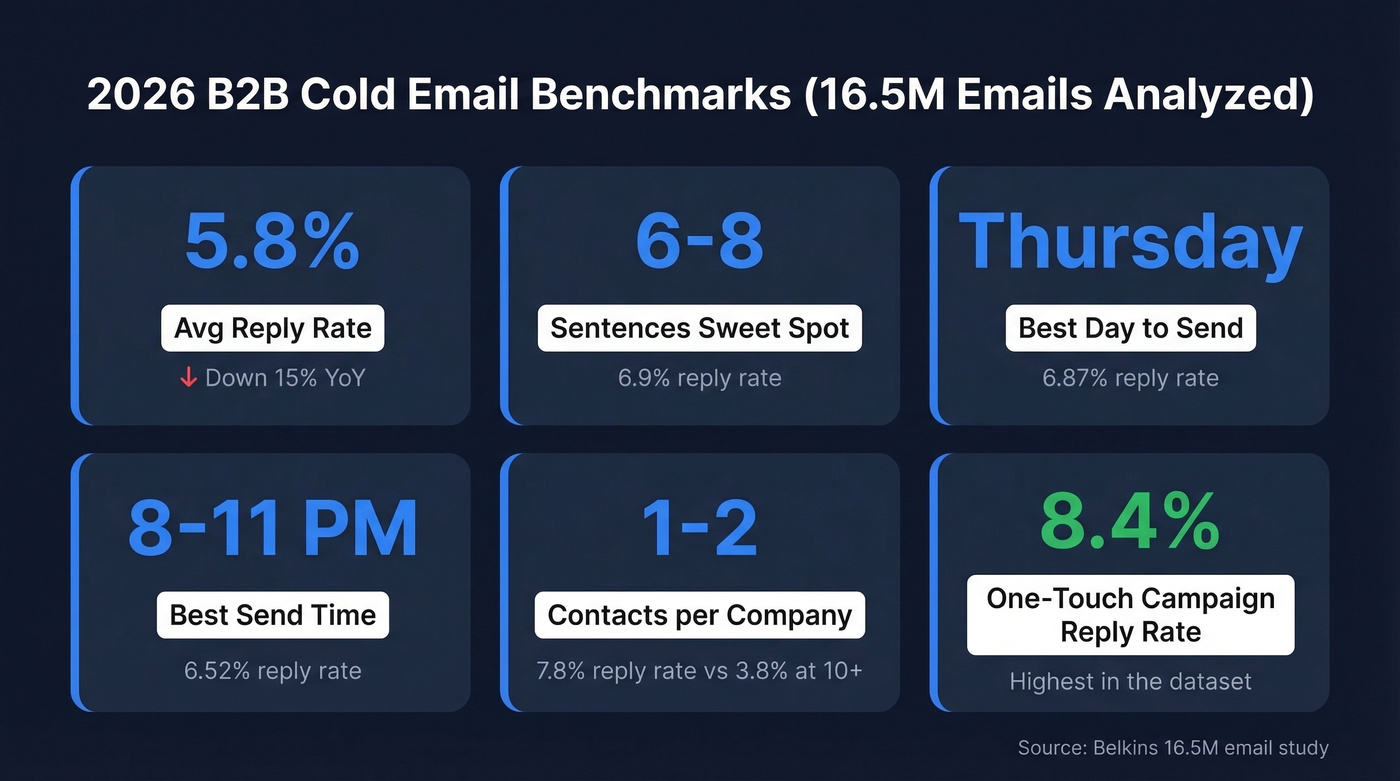
| Metric | Number | Context |
|---|---|---|
| Avg reply rate | 5.8% | Down 15% year-over-year |
| Best email length | 6-8 sentences | 6.9% reply rate |
| Best day to send | Thursday | 6.87% reply rate |
| Best send time | 8-11 PM | 6.52% reply rate |
| 1-2 contacts/company | 7.8% reply | vs 3.8% at 10+ contacts |
| One-touch campaigns | 8.4% reply | Highest in the dataset |
The evening send time surprises people, but it makes sense - your email sits at the top of the inbox when the prospect checks their phone before bed or first thing in the morning. The targeting data is equally clear: emailing fewer contacts per company at higher quality beats blasting entire org charts every time.
Open rates are increasingly unreliable. Pixel blocking and tracking backlash have made open data hard to trust. Don't optimize for opens. Optimize for replies.
Subject Lines That Get Opens
A separate 5.5M-email study on subject lines produced findings specific enough to act on today.
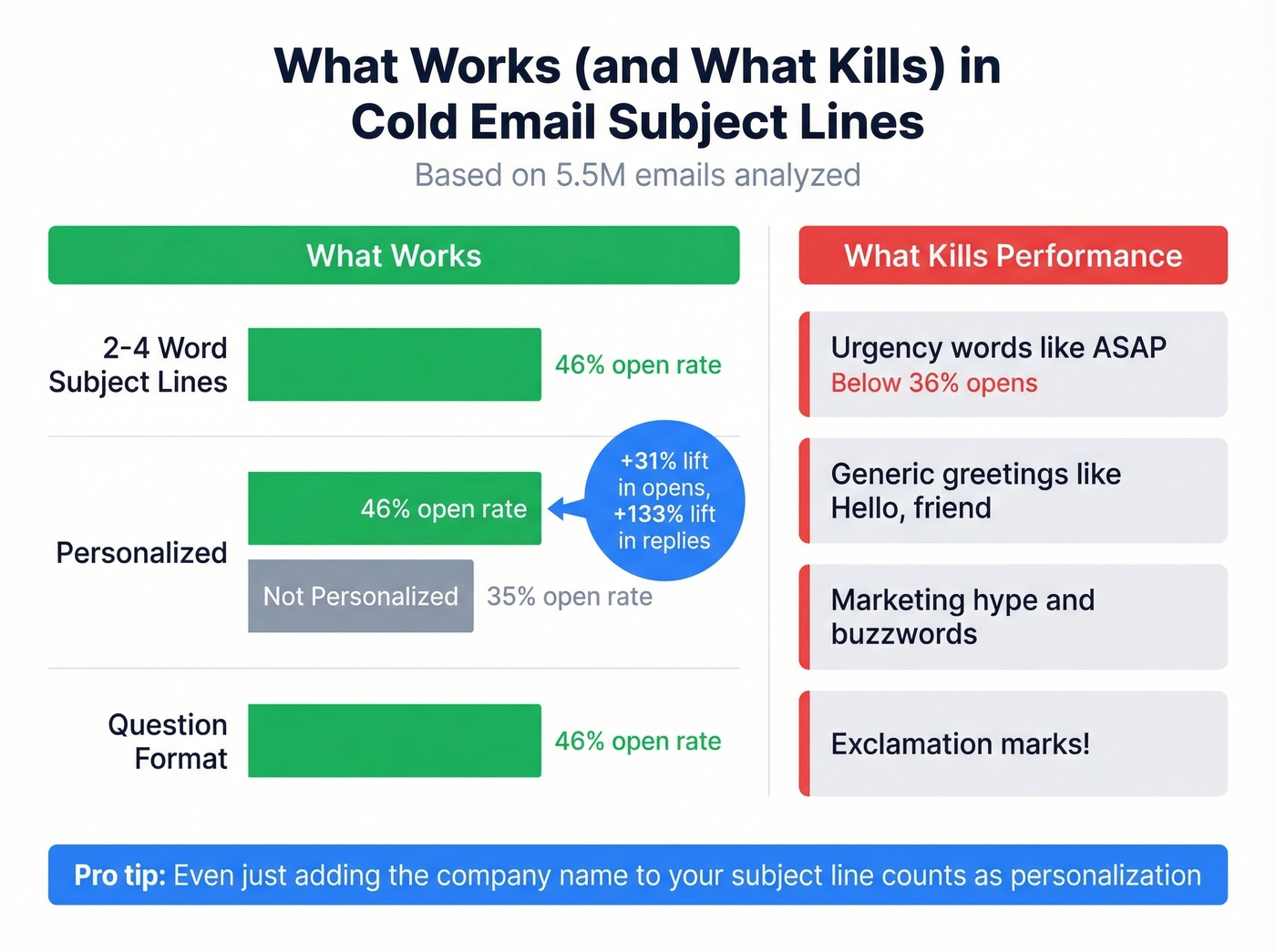
Length matters most. The sweet spot is 2-4 words, which hit a 46% open rate. Performance drops steadily after 7 words.
Personalization is the biggest lever. Personalized subject lines pulled 46% opens vs 35% without - a 31% lift. Reply rates jumped even more: 7% vs 3%, a 133% improvement. Even dropping the prospect's company name into the subject line counts.
Question-style subject lines averaged 46% opens. Something like "{{Company}} + outbound?" outperforms declarative alternatives.
What kills performance: "ASAP" and urgency language (below 36% opens), generic greetings like "Hello, friend," marketing hype, and exclamation marks.
12 B2B Cold Email Templates That Work
Every template below follows the modern format: short, specific, soft CTA. Format for mobile - most prospects read cold emails on their phone first. And don't copy-paste verbatim. As practitioners on Reddit keep pointing out, the templates everyone Googles are the same ones every SDR sends. Adapt them or they're worthless.
If you want a full multi-touch build (not just single emails), use this as a companion to a cold email sequence.
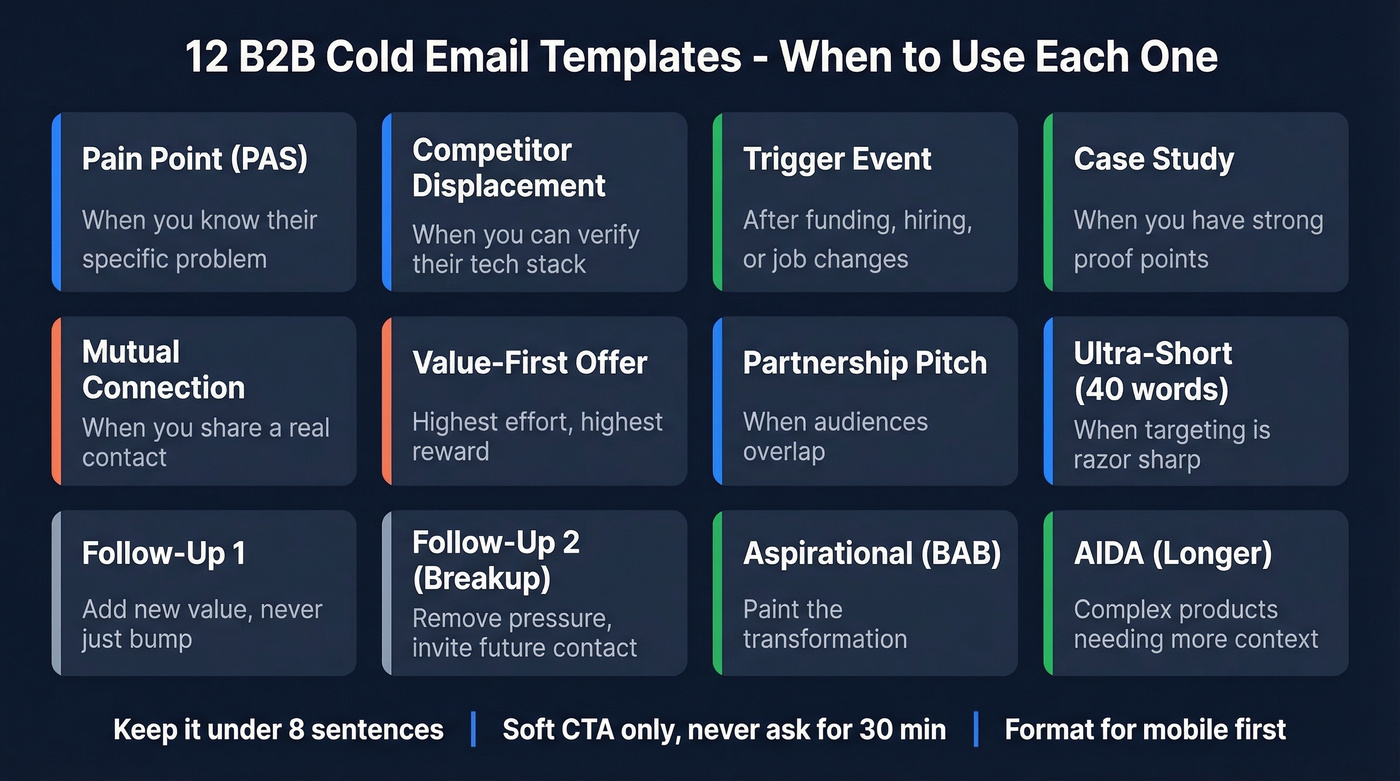
Common mistakes to avoid before you start: Don't open with "Hope this finds you well." Don't ask for 30 minutes. Frontload the first sentence with something relevant to the prospect. Aim for a 1-to-2 ratio of "I/my" to "you/your" - the email is about them, not you. (More on writing the ask: email call to action.)
Pain Point (PAS Framework)
Subject: {{pain point}} at {{Company}}?
Hi {{First Name}},
Most {{role}} teams at {{industry}} companies spend 6+ hours/week on {{pain point}} - and still miss targets. We helped {{similar company}} cut that by 70% in 3 weeks.
Worth a quick look?
Problem, agitate, solve. Keep the agitation to one sentence. The proof point is what sells.
Competitor Displacement
Subject: Switching from {{Competitor}}?
Hi {{First Name}},
Noticed you're using {{Competitor}}. Teams that switch to us typically see {{specific metric improvement}} within the first month - {{Customer}} cut their {{metric}} by {{number}}.
Open to a 10-minute comparison?
Only use this when you can confirm the tech stack via job postings or technographic data. Guessing wrong kills credibility instantly. Skip this template entirely if you can't verify.
Trigger Event + Case Study
These two templates work best in combination - the trigger gets the open, the case study closes the reply. Use the trigger version when timing is fresh, and the case study version when you have a strong proof point but no specific trigger.
Trigger: Subject: Congrats on the raise
Hi {{First Name}},
Saw {{Company}} just closed your Series {{X}}. When {{similar company}} hit that stage, they needed {{outcome you deliver}} fast - we got them there in {{timeframe}}.
Interested in hearing how?
Case Study: Subject: {{Result}} for {{similar company}}
Hi {{First Name}},
We helped {{Customer}} go from {{before state}} to {{after state}} in {{timeframe}}. They're in {{same industry}} and had the same {{challenge}} your team faces at {{Company}}'s stage.
Worth a conversation?
Job changes, funding rounds, and hiring surges are among the highest-converting triggers. The timing makes the pitch obvious. (If you need a system for this, see: track sales triggers.)
Mutual Connection
Subject: {{Mutual contact}} suggested I reach out
Hi {{First Name}},
{{Mutual contact}} mentioned you're working on {{initiative}}. We helped their team with {{related outcome}} - thought it'd be relevant for {{Company}} too.
Happy to share what worked for them if you're interested.
Value-First Offer
This is the format a lot of operators are running right now, and in our experience it's the highest-effort, highest-reward approach. The offer has to be genuinely valuable and low-friction - a Loom audit, a teardown, a benchmark comparison. A personalized outreach email like this one consistently outperforms generic pitches because the prospect can see you've done real homework.
Subject: Free audit of {{specific asset}}
Hi {{First Name}},
I recorded a 3-minute Loom breaking down your top 3 {{landing pages / outbound sequences / job posts}} with specific fixes. No strings - just thought it'd be useful.
Want me to send it over?
One practitioner trick: drop personalization into a P.S. line rather than the opener. One operator reported a +35% lift from this placement alone.
Partnership Pitch
Subject: {{Company}} + {{Your Company}}
Hi {{First Name}},
Your {{product/audience}} and our {{product/audience}} serve the same buyers. We've run co-marketing with {{partner example}} that drove {{result}} for both sides.
Worth exploring?
If you're specifically pitching alliances, this pairs well with a dedicated business partnership approach.
The Ultra-Short (40 Words)
Subject: Quick question
Hi {{First Name}},
We help {{role}} teams at {{company type}} do {{outcome}}. {{Customer}} saw {{result}} in {{timeframe}}.
Interested?
Forty words. One proof point. Soft ask. The 16.5M-email dataset shows 6-8 sentences performing best; practitioners are pushing even shorter at 40-60 words. Both point the same direction: shorter wins.
Follow-Ups: Two Max
Follow-Up #1 - reply to your original thread and add new value: a second proof point, a relevant article, a new angle. Never just say "following up."
Bumping this - wanted to add that {{Customer 2}} just hit {{new result}} using the same approach. Would a 10-minute call make sense this week?
Follow-Up #2 (Breakup) - this removes pressure, and some of the best-converting replies come from breakup emails.
Hi {{First Name}}, I'll assume the timing isn't right. If {{pain point}} becomes a priority down the road, happy to pick this back up. Either way - no hard feelings.
For more variations, see cold email follow-up templates.
Aspirational (BAB Framework)
Subject: {{Company}} in 6 months
Hi {{First Name}},
Right now, most {{role}} teams at your stage are stuck at {{current state}}. Six months from now, {{Customer}} was at {{after state}} - and the main change was {{your solution category}}.
Worth hearing the specifics?
Before, after, bridge. Paint the transformation, then offer the bridge.
AIDA (Longer Format)
Reserve this for complex products where the prospect needs more context. Keep it under 150 words.
Subject: {{Specific metric}} for {{industry}} teams
Hi {{First Name}},
{{Industry}} companies scaling past {{milestone}} consistently hit the same wall: {{problem}}. {{Customer}} faced exactly this - {{specific detail}}.
We built {{product}} specifically for this. In {{timeframe}}, they went from {{before}} to {{after}}, which translated to {{business impact}}.
I put together a quick breakdown of how it'd work for {{Company}}. Want me to send it?
If you want the underlying model, revisit the AIDA sales funnel.
A/B Testing Your Templates
Don't guess which template works - test it. Split your list so 20% gets the variant and 80% gets your current best performer. Run each test for at least 100 sends before drawing conclusions. Test one variable at a time: subject line, CTA, or opening line. Never all three at once, or you won't know what moved the needle. (Related: email preview text A/B testing.)

The 16.5M-email study proves it: fewer contacts at higher quality beats blasting org charts. Prospeo's 98% email accuracy and 7-day data refresh mean every template you send lands in a real inbox - not a bounce. Teams using Prospeo see bounce rates drop below 4%.
Fix your list before you rewrite your template one more time.
Follow-Up Strategy
Let's be honest: most SDR teams send too many follow-ups, and it's destroying their domains.
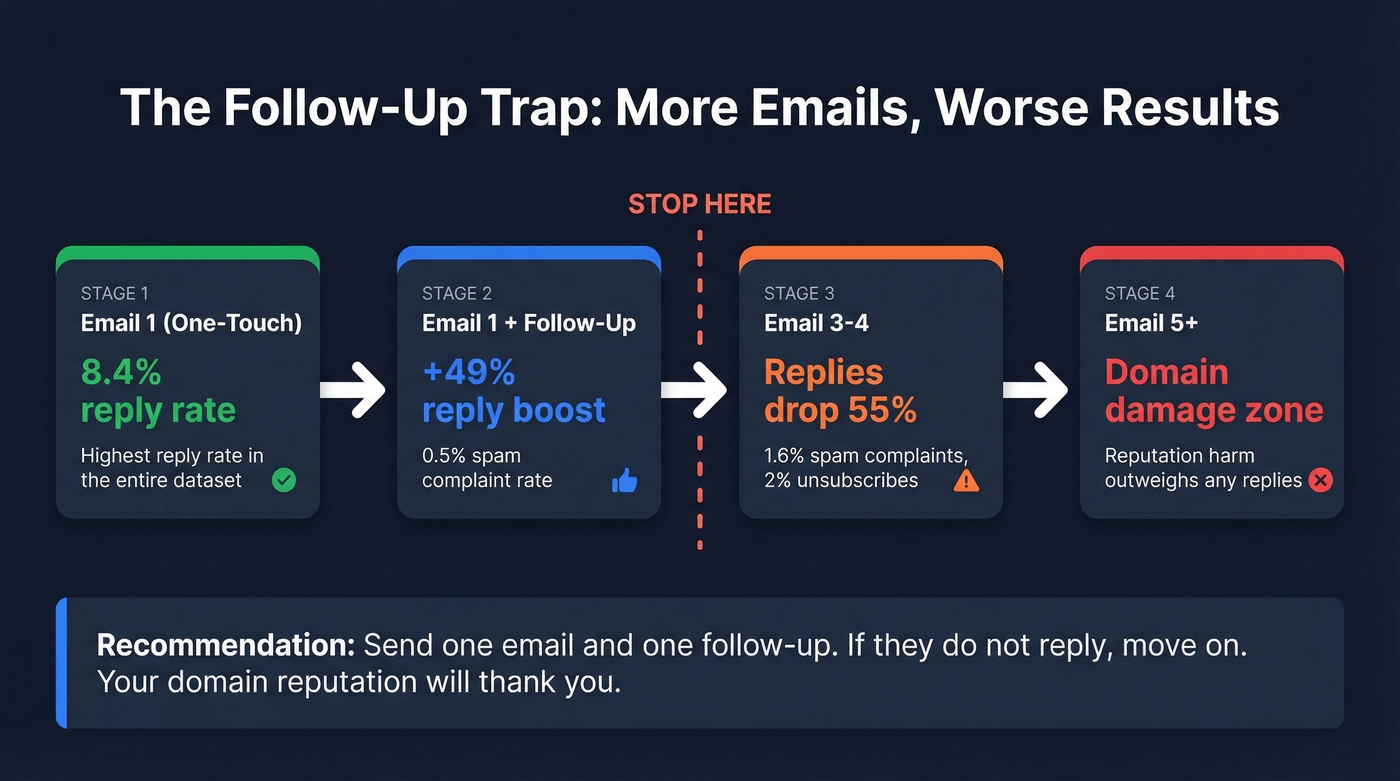
The first follow-up boosts replies by up to 49%. But by the fourth email, replies drop 55% and spam complaints hit 1.6% (up from 0.5% on the first email). Unsubscribe rates reach 2% by round four. You're actively damaging your domain reputation with every additional touch past two.
The most striking number in the dataset: one-touch campaigns - a single email, no follow-ups - produced an 8.4% reply rate. That's the highest of any sequence length measured. If your targeting and copy are sharp enough, one well-placed email beats a five-touch drip sequence.
Send one email and one follow-up. If they don't reply, move on to the next account. Your domain reputation will thank you. (If you're diagnosing issues, start with improve sender reputation.)
Deliverability Checklist
None of these templates matter if your emails land in spam. Here's the operational baseline cold email operators and deliverability guides agree on:
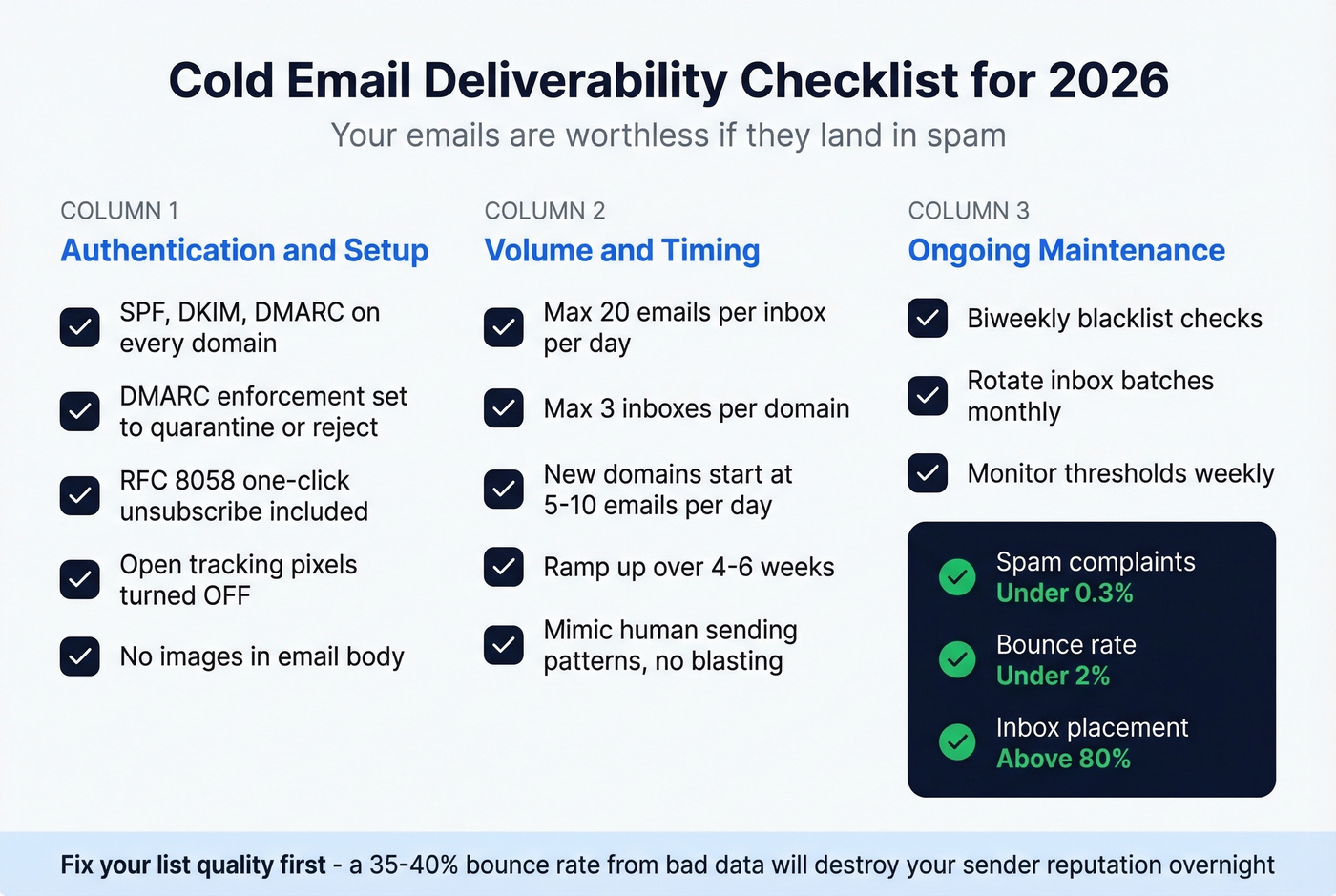
- Authentication: SPF, DKIM, and DMARC on every sending domain. DMARC enforcement (quarantine/reject) preferred. (Deep dive: DMARC alignment.)
- Volume: 20 emails or fewer per inbox per day. Max 3 inboxes per domain. (More detail: email velocity.)
- Email warmup: Start new domains at 5-10 emails/day, ramp over 4-6 weeks.
- Tracking: Turn off open tracking pixels. Avoid images in the body.
- Thresholds: Spam complaints under 0.3%, bounces under 2%, inbox placement 80%+.
- Unsubscribe: Include RFC 8058 one-click unsubscribe - required for bulk senders.
- Maintenance: Biweekly blacklist checks. Rotate inbox batches monthly.
- Spacing: Mimic human sending patterns. Blasting 20 emails in 30 seconds is a red flag.
Why Your Outreach Fails Upstream
You can nail every template, subject line, and send-time optimization above - and still get terrible results if your contact list is stale. This is the problem that kills campaigns before they start, and it's the one most template guides completely ignore.
Purchased or scraped lists can produce 35-40% bounce rates when they haven't been verified recently. Once you cross 2% bounces, deliverability drops fast. That reputation damage cascades - it tanks deliverability for every email you send afterward, including replies to warm prospects. (Benchmarks + fixes: email bounce rate.)

We've seen this pattern over and over: a team spends weeks perfecting their cold email template, launches the campaign, and watches their domain get flagged within days because 30% of their list was garbage. Prospeo's 5-step verification process - catch-all handling, spam-trap removal, honeypot filtering - delivers 98% email accuracy across 143M+ verified addresses, all refreshed on a 7-day cycle. The results are concrete: Meritt went from a 35% bounce rate to under 4% after switching, and Stack Optimize maintains 94%+ deliverability with bounce rates under 3% across all their clients.
Trigger emails and competitor displacement templates only work when your data is right. Prospeo tracks technographics, job changes, funding rounds, and buyer intent across 15,000 topics - so you know exactly which template to send and when. At $0.01 per verified email, scaling personalized outbound doesn't break the budget.
Send the right template to the right person with data you can trust.
CAN-SPAM and GDPR Quick Reference
CAN-SPAM applies to all commercial messages, including B2B - there's no exemption. Violations carry penalties of up to $53,088 per email. You must include a valid physical postal address, provide a clear opt-out mechanism, honor opt-out requests within 10 business days, and you're liable even if a third party sends on your behalf.
For GDPR, B2B cold email is permissible under legitimate interest, but you need a defensible reason for contacting the person and must honor removal requests promptly. Include an unsubscribe link and respect every opt-out immediately.
FAQ
Is cold emailing legal for B2B?
Yes. CAN-SPAM covers B2B in the US, and GDPR permits outreach under legitimate interest in the EU. Include an opt-out, a physical address, and honor removals within 10 business days.
What's a good cold email reply rate?
The current average across 16.5M emails is 5.8%. Top campaigns hit 8-15%. Below 3% usually signals a list quality or deliverability problem, not a copywriting problem.
How many follow-ups should I send?
Two maximum. The first boosts replies by up to 49%. By the fourth, replies drop 55% and spam complaints triple to 1.6%.
How long should a B2B cold email be?
Under 200 words. The best-performing emails were 6-8 sentences at a 6.9% reply rate. Practitioners are pushing even shorter - 40-60 words - for top-of-funnel outreach.
How do I stop cold emails going to spam?
Verify your list and keep bounces under 2%. Set up SPF, DKIM, and DMARC. Warm up new domains over 4-6 weeks. Cap volume at 20 emails per inbox daily. Tools like Prospeo catch invalid addresses, spam traps, and catch-all domains before you send - eliminating the number one cause of deliverability problems.