

How to Write a Cold Email for Business Partnership (That Doesn't Sound Like a Sales Pitch)
Your CEO wants to know why the partnership pipeline is empty. You've sent 200 cold emails this quarter using the same templates your SDRs use for outbound sales. Reply rate? Hovering around 1%. The problem isn't effort - it's framing. Partnership outreach follows different rules than sales outreach, and most teams never learn the difference.
The Short Version
Partnership cold emails fail for three reasons: wrong framing (sounds like a sales pitch), bad data (emails bounce or hit the wrong person), and missing infrastructure (lands in spam).
Here's the playbook in four moves. Define your Ideal Partner Profile before you write a single word. Verify every email address before sending - a high bounce rate tanks your domain reputation, which means even the emails that don't bounce land in spam. Write under 80 words. And never, ever use "Partnership opportunity" as your subject line.
Why Partnership Emails Aren't Sales Emails
Sales emails start from zero trust. You're a stranger asking for time and money. Partnership emails are different - you're proposing a relationship where both sides win. The partner.io team calls this "trust-borrowing": partnerships let you tap into someone else's credibility and audience, which means the pitch has to feel collaborative, not extractive.
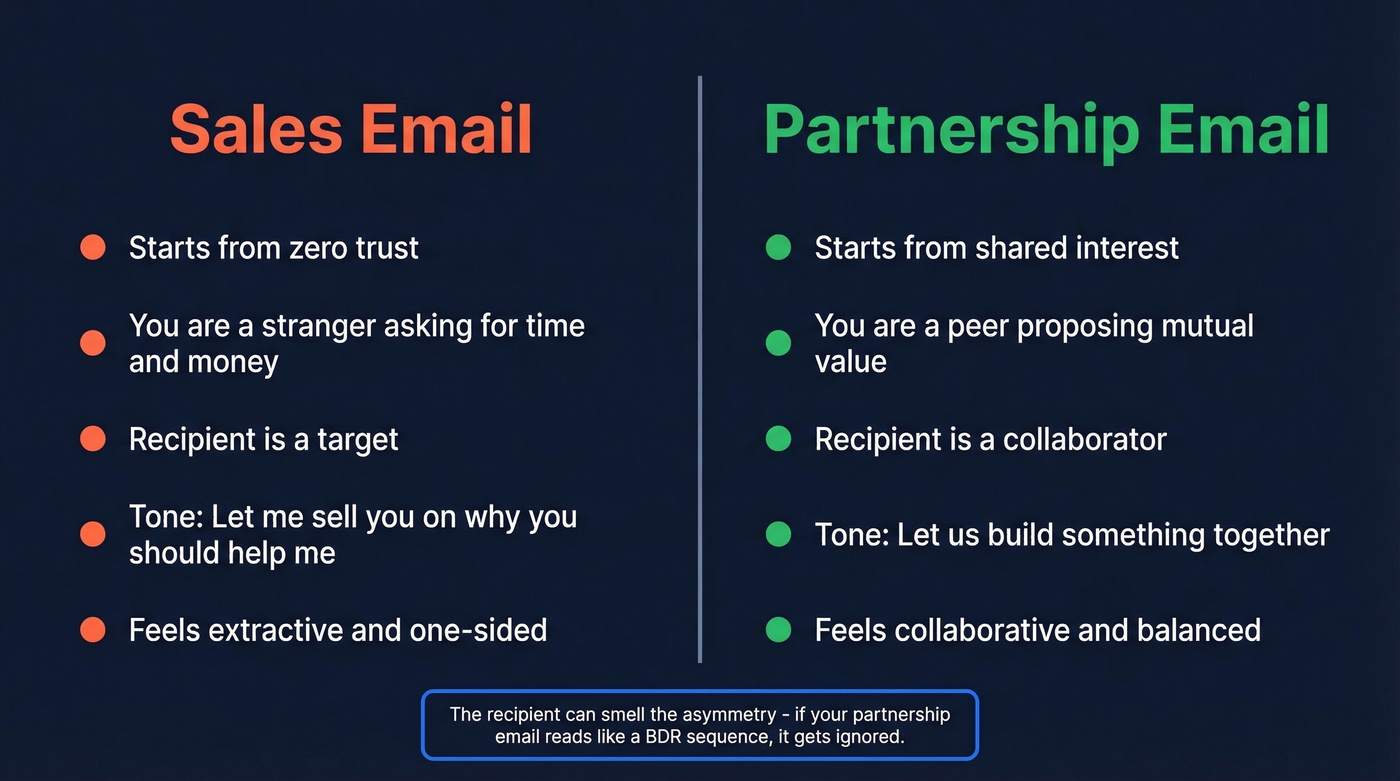
When you use a sales template for partnership outreach, you signal that you see the recipient as a target, not a peer. The tone shifts from "let's build something together" to "let me sell you on why you should help me." That's why partnership emails that read like BDR sequences get ignored. The recipient can smell the asymmetry.
A good partnership pitch reads like a note from a peer who's done their homework. It names a specific overlap, proposes a concrete collaboration, and makes it easy to say yes to a 15-minute call.
2026 Benchmarks
Before you write anything, calibrate expectations. Instantly's 2026 benchmark report analyzed billions of cold email interactions across thousands of workspaces:
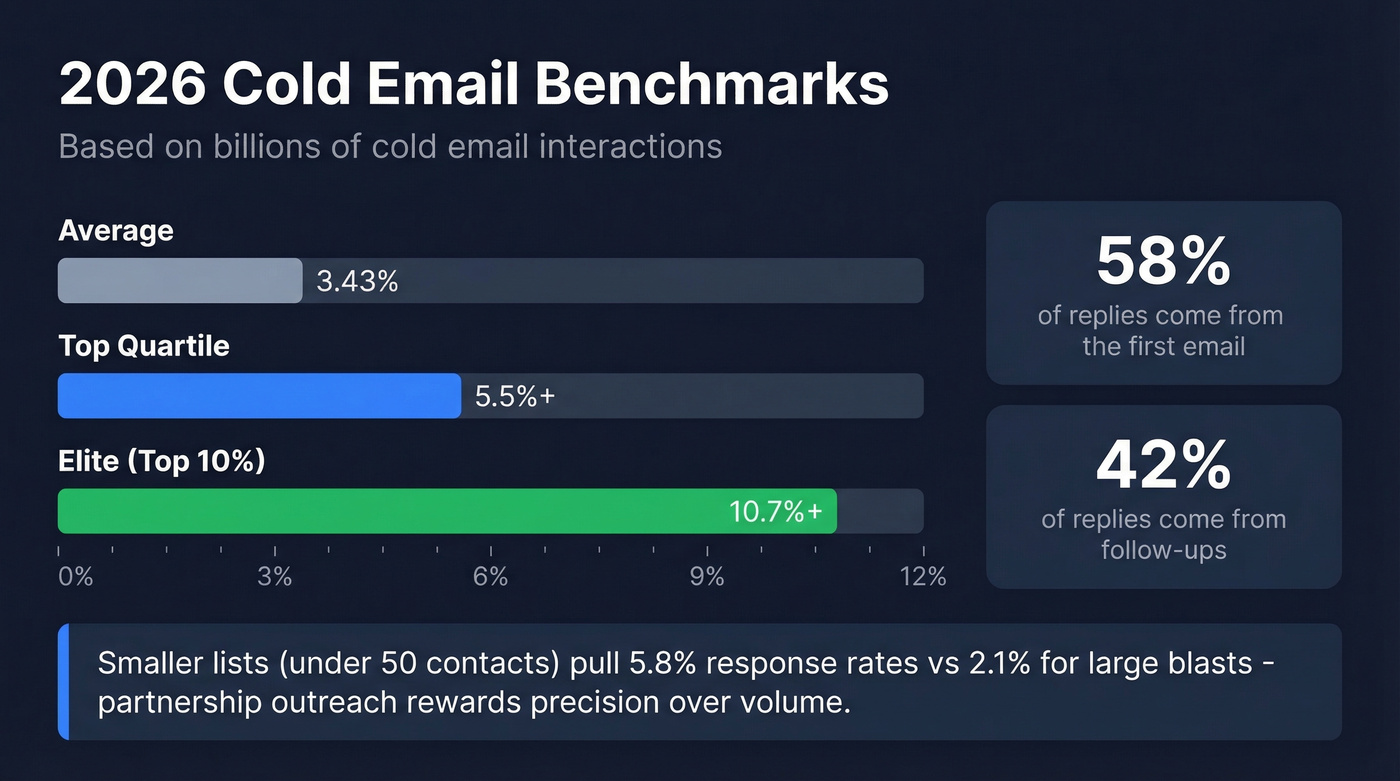
| Metric | Average | Top Quartile | Elite (Top 10%) |
|---|---|---|---|
| Reply rate | 3.43% | 5.5%+ | 10.7%+ |
| Replies from 1st email | 58% | - | - |
| Replies from follow-ups | 42% | - | - |
If you're running tight targeting and real personalization, getting into the 5%+ range puts you in top-quartile territory. Elite performers break 10%.
Smaller, targeted lists (under 50 recipients) pull 5.8% response rates vs. 2.1% for larger blasts - which is exactly why partnership outreach rewards precision over volume. The key variable isn't how many emails you send. It's how relevant each one is.
Mistakes That Kill Partnership Emails
No research on the partner. Sending a generic pitch without referencing their product, audience, or recent work is the fastest way to get deleted. BenchmarkOne's analysis of partnership outreach failures puts this at the top - emails without research feel "weak, insincere, and unprofessional."
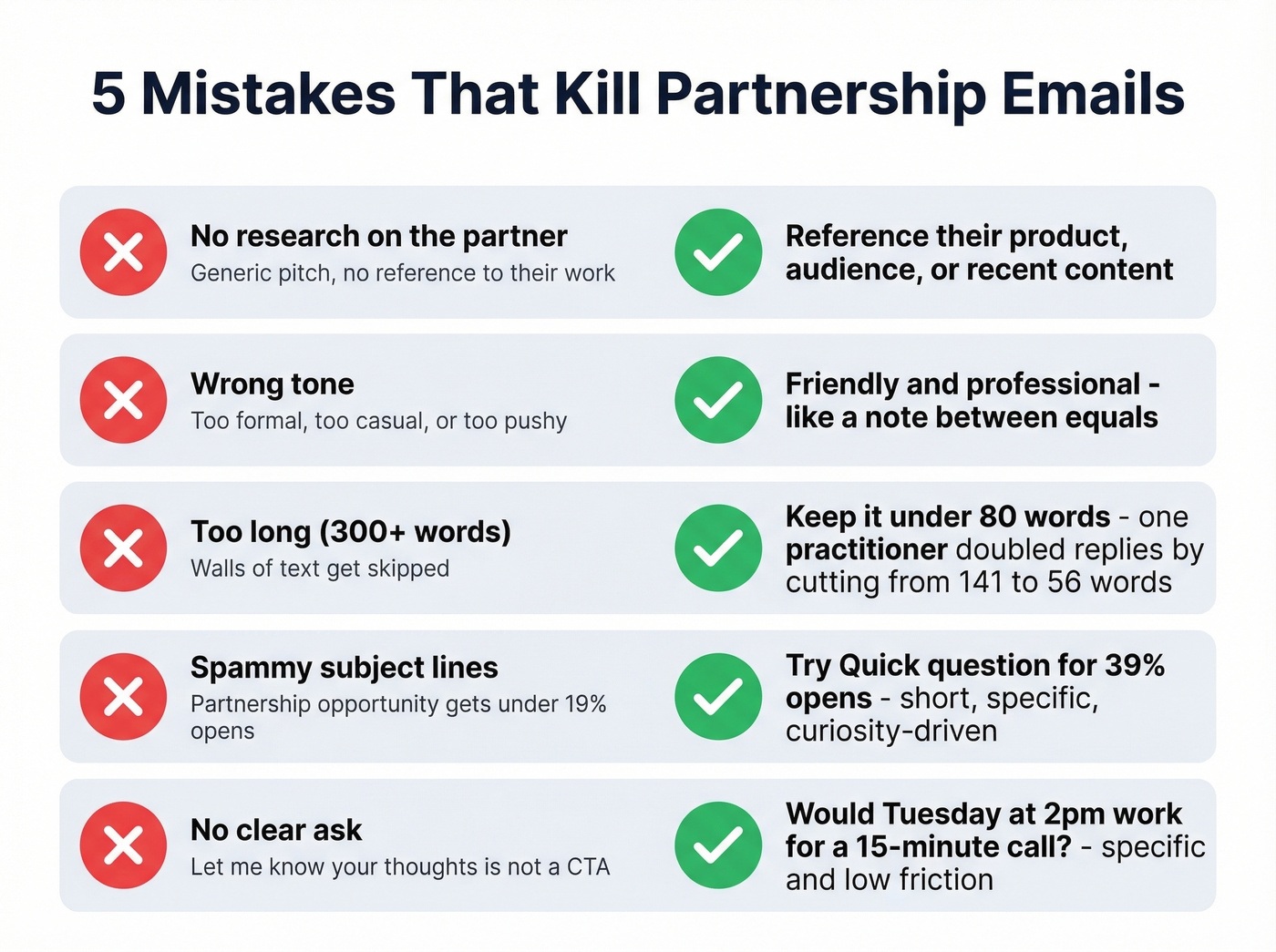
Wrong tone. Too formal reads like a legal notice. Too casual reads like spam. Too pushy reads like a sales pitch. The sweet spot is friendly and professional - you're proposing a collaboration between equals, not pitching a prospect.
Too long. The best-performing emails are under 80 words. If your partnership pitch is 300 words, you've already lost. One practitioner on r/Entrepreneur cut their emails from 141 words to 56 and doubled their reply rate.
Spammy subject lines. The same practitioner A/B tested subject lines and found "Partnership opportunity" pulled under 19% opens. "Quick question" hit 39%. Generic subjects that scream "mass email" are partnership killers. If you need more options, pull from these cold email subject line examples and test aggressively.
No clear ask. "Let me know your thoughts" isn't a CTA. "Would Tuesday at 2pm work for a 15-minute call?" is. Every partnership email needs a specific, low-friction next step - use these email call to action rules to keep it crisp.
Define Your Ideal Partner Profile
You wouldn't run outbound without an ICP. Partnership outreach needs the same rigor. Autobound's partnership targeting guidance emphasizes defining an Ideal Partner Profile around audience overlap, brand fit, and scale compatibility - plus mapping the decision-maker.
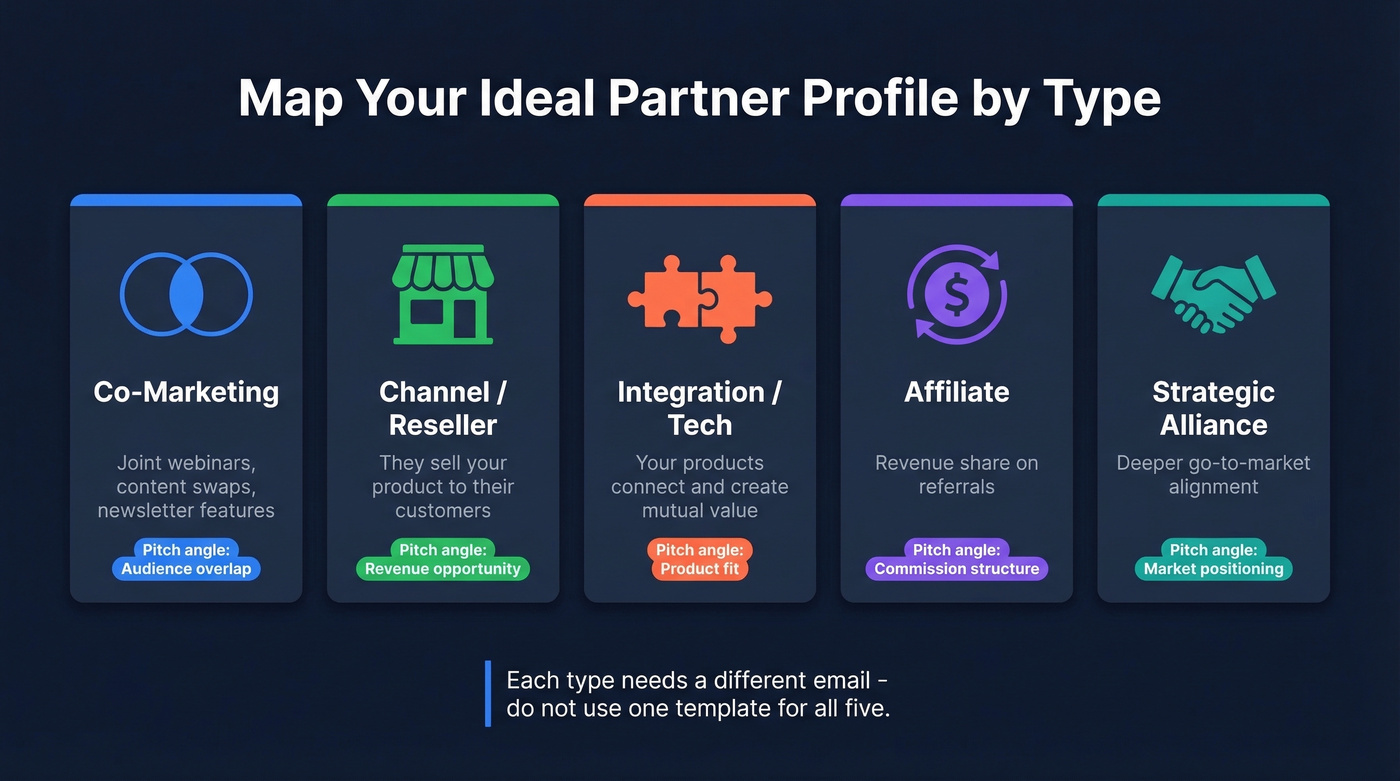
Segment your targets by partnership type before you write a single email:
- Co-marketing - joint webinars, content swaps, newsletter features
- Channel / reseller - they sell your product to their customers
- Integration / tech - your products connect and create mutual value
- Affiliate - revenue share on referrals
- Strategic alliance - deeper go-to-market alignment
Each type requires a different pitch angle. A co-marketing email emphasizes audience overlap. A channel email emphasizes revenue. An integration email emphasizes product fit. Don't use one template for all five.

Your Ideal Partner Profile is only as good as the contact data behind it. One bounced email tanks your domain reputation - and every future partnership pitch lands in spam. Prospeo's 98% email accuracy and 7-day data refresh mean you're reaching the right decision-maker with a verified address, not guessing.
Stop letting bad data kill your partnership pipeline before it starts.
How to Write the Email
Subject Lines
Subject lines with 6-10 words hit roughly 21% open rates. Personalization lifts opens by 50%. Including a number can boost opens up to 113%. Questions add another 21%.
Keep subjects under 45 characters - 47% of recipients check email on mobile, and long subjects get truncated. Company-name subjects pulled 33% opens in A/B tests, while generic "Partnership opportunity" cratered at under 19%. Some data suggests ultra-short subjects (2-4 words) can hit 46% opens, which is worth testing when your company name alone carries weight. If you want a bigger swipe file, use these email subject lines examples.
Test each subject line on 20% of your list, then deploy the winner to the remaining 80%.
Winning formulas: "[Their Company] + [Your Company] - quick idea" or "Question about [their recent initiative]." Short, specific, curiosity-driven.
The Email Body (Under 80 Words)
We've seen this over and over in our own outreach: reply rates climb when you cut ruthlessly. One documented case showed replies doubling after cutting from 141 to 56 words, with about 3 minutes spent per email crafting a personalized first line that references something specific about the recipient's company. That 3-minute investment is the highest-ROI activity in partnership outreach.
Use the BAB (Before-After-Bridge) framework adapted for partnerships. Before: name their current situation. After: paint the outcome of collaborating. Bridge: your specific proposal. The value proposition must be two-sided - every partnership email needs to answer "what's in it for them" before "what's in it for you." If you want to sharpen the writing itself, borrow from this email copywriting playbook.
End with a specific, low-friction CTA. Not "let me know if you're interested." Instead: "Worth a 15-minute call Thursday at 2pm ET?" Give them a date and time. Make saying yes easier than saying maybe.
Partnership Email Templates That Work
You need 3-4 great templates, not 20 generic ones. Each template below runs under 80 words with a personalized opener, mutual value prop, and specific CTA.
Co-Marketing Partnership
Subject: Datadog's audience + ours - quick idea
Hi Sarah, saw your Q3 observability report - the section on alert fatigue benchmarks was sharp. Our audiences overlap significantly - we serve platform engineering teams, and your content reaches the same buyers from a different angle. A co-branded webinar on incident response workflows could drive qualified leads for both of us. Would a 15-minute call Wednesday at 10am ET make sense to explore this?
Why this works: Opens with a specific detail that proves you read their content, then frames the collaboration as mutually beneficial with a concrete format (webinar) rather than a vague "let's partner."
Integration / Tech Partnership
Subject: Notion + Loom - integration idea
Hi Marcus, noticed Notion just shipped the embedded video blocks feature. Our customers keep asking for a native Loom connection - right now they're duct-taping it with Zapier. A proper integration would reduce churn for both of us and create a joint GTM story. Happy to share the customer requests we've logged. Does Thursday at 3pm work for a quick call?
Why this works: Leads with their recent product update (shows you're paying attention), then presents customer demand as evidence - not your opinion - that the integration makes sense.
Channel / Reseller Partnership
This template takes a different approach. Instead of proposing a call, it leads with proof and lets the numbers do the convincing.
Subject: Revenue idea for Pavilion
Hi Jordan, your team already sells to mid-market RevOps leaders - we see the same buyers from the data infrastructure side. Our channel partners typically earn 20% commission and get co-branded collateral plus dedicated support. One partner drove $140K in partner-sourced revenue last quarter. I put together a one-pager on the program - want me to send it over?
Why this works: The CTA is lower-friction than a calendar invite. Offering to send a document lets the recipient evaluate the opportunity on their own time, which matches how channel decisions actually get made.
Strategic Alliance
Subject: Congrats on the Series C
Hi Priya, congrats on the raise - $45M is a serious vote of confidence in the vertical SaaS analytics space. We're seeing strong demand from the same mid-market segment, and a strategic partnership could accelerate both our positions. Thinking joint go-to-market, shared case studies, and co-selling into enterprise accounts.
I mapped out a rough 90-day pilot framework. Worth 20 minutes next week to walk through it?
Why this works: Opens with genuine congratulations tied to a specific detail (the amount, the market), then immediately connects their news to a partnership rationale. Offering a pre-built framework signals you're serious, not just fishing.
The Infrastructure Most Guides Skip
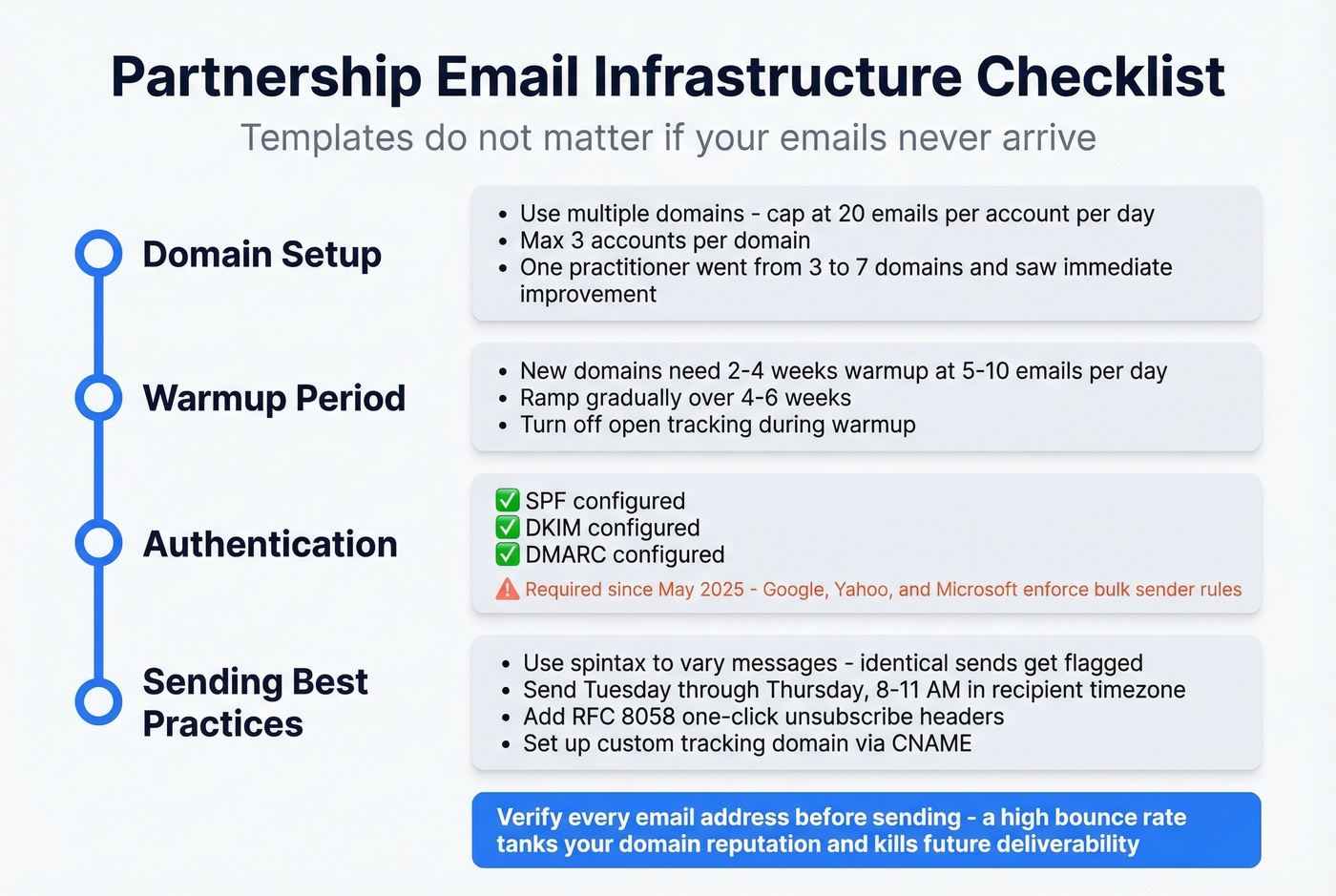
Here's the thing: templates don't matter if your emails never arrive. In our experience, this section moves the needle more than copywriting does. If you want the deeper technical checklist, start with this email deliverability guide.
Domains, Warming, and Sending Limits
One domain sending 100 emails a day will get flagged. The consensus on r/coldemail is clear - cap at 20 emails per account per day, max 3 accounts per domain. One practitioner moved from 3 domains to 7, capped each at 26 emails/day, and saw immediate deliverability improvements. If you want a more formal framework, follow these email velocity limits.
New domains need 2-4 weeks of warmup at 5-10 emails/day before production sends, then ramp over 4-6 weeks. Turn off open tracking. Use spintax to vary messages - identical sends across 500+ emails will get you flagged. Send Tuesday through Thursday, 8-11 AM in the recipient's timezone.
Authentication (SPF, DKIM, DMARC)
Since May 2025, Google, Yahoo, and Microsoft enforce bulk sender rules. You need SPF, DKIM, and DMARC configured correctly - no exceptions. You also need RFC 8058 one-click unsubscribe headers. Set up a custom tracking domain via CNAME so your tracking links live on your subdomain, not a shared one. If you’re unsure your setup is correct, use this guide to verify DKIM is working.
Skip this and nothing else in this guide matters.
Verify Your List Before Sending
One team dropped their bounce rate from 11% to under 2% after they stopped buying lists and started verifying every address. The operational guardrails are bounces under 2% and spam complaints under 0.3%. Exceed either and your domain reputation tanks - not just for partnership emails, but for everything you send from that domain. If you’re troubleshooting, start with these email bounce rate benchmarks and fixes.
Before you send a single outreach email, run every address through verification. Prospeo's real-time, 5-step verification process handles catch-all domains, removes spam traps, and filters honeypots - delivering 98% email accuracy. One customer, Meritt, cut their bounce rate from 35% to under 4% after switching. You only pay for valid addresses, so you're not burning credits on dead emails.
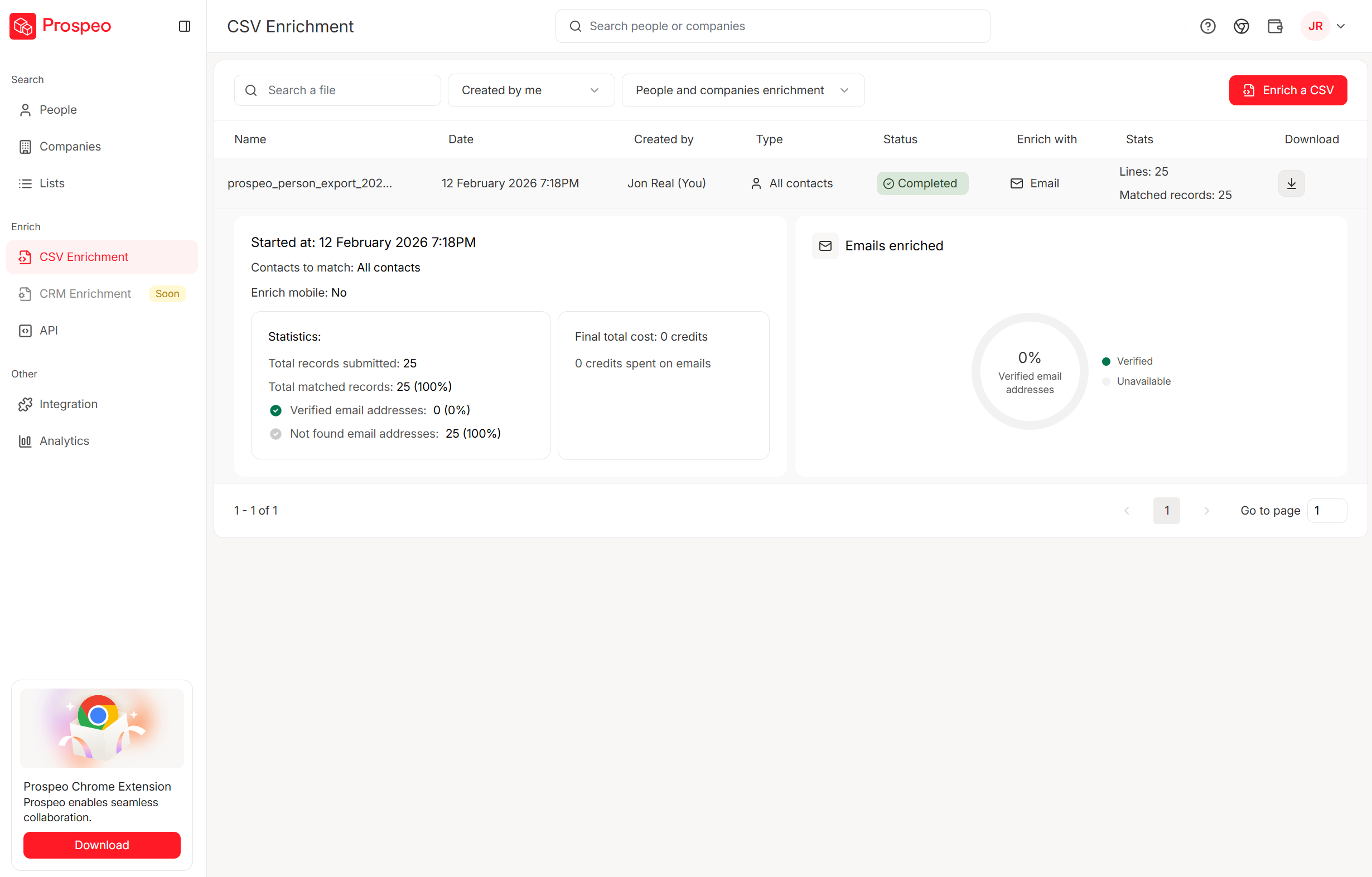
You just spent 3 minutes crafting a perfect personalized opener for a partnership target. Don't waste it on a dead email address. Prospeo verifies contacts across 300M+ profiles with 5-step verification and catch-all handling - so your co-marketing, channel, and integration pitches actually reach inboxes.
Find and verify any partner contact for $0.01 per email.
Follow-Up Cadence for Partnerships
58% of replies come from the first email, but 42% come from follow-ups. Sequences with 4-7 touchpoints produce 3x the reply rate versus 1-3 touches. If you want ready-to-send copy, adapt these cold email follow-up templates.
| Day | Touch | Content |
|---|---|---|
| Day 0 | Email 1 | Core partnership pitch |
| Day 3 | Email 2 | Case study or proof point |
| Day 7 | Email 3 | Mutual connection or event |
| Day 14 | Email 4 | Relevant industry news |
| Day 21 | Email 5 | New angle or value prop |
| Day 30 | Email 6 | Breakup - final touch |
Format your second email as a casual reply to your first - data shows this outperforms formal follow-ups by roughly 30%. Just hit reply, keep it to two sentences, and add one new piece of value.
Partnership follow-ups should be spaced wider than sales follow-ups. You're building trust, not creating urgency. Each follow-up must add new value - a relevant case study, a mutual connection, a piece of news about their market. "Just checking in" is never acceptable. If you don't have something new to say, don't send the email.
What to Do When They Reply
Most partnership outreach advice ends at "send the email." Getting a reply is where the real work starts.
Respond within 2 hours. Partnership interest is perishable. Propose a 15-30 minute discovery call with a clear agenda: mutual goals, audience overlap validation, and one specific pilot idea. Come to that call with a lightweight partnership proposal - a pilot program with defined success metrics, a 90-day timeline, and clear ownership on both sides.
The goal of the first call isn't to close a partnership. It's to validate that the overlap is real and agree on a small, low-risk first project. Start with a co-branded webinar or a newsletter swap before you propose a revenue share.
Let's be honest about something most guides won't say: if your deal sizes are under $15K, you probably don't need a formal partnership program at all. A Slack DM to a founder you admire, a genuine comment on their content, and a casual "we should do something together" will outperform any cold email template. Formal partnership outreach works best when the economics justify the infrastructure. For everyone else, just be a good community member and the partnerships will find you.
Recommended Tool Stack
| Category | Tool | Cost |
|---|---|---|
| Contact data & verification | Prospeo | Free: 75 emails/mo. Paid: ~$0.01/email |
| Sending platform | Instantly or Smartlead | Instantly: $97/mo. Smartlead: $39-$94/mo |
| CRM | HubSpot or Salesforce | Existing plan |
Total stack cost: typically $150-$500/month depending on how many inboxes and domains you run. One practitioner spent roughly $420/month on a similar setup and generated 16 qualified leads per month. For partnership outreach where deal sizes are larger and cycles are longer, even 2-3 qualified partner conversations per month can pay for the entire stack many times over.
FAQ
How many partnership emails should I send per day?
Cap at 20 per email account, with a maximum of 3 accounts per domain. New domains should start at 5-10 emails per day and ramp over 4-6 weeks. Partnership outreach rewards quality over volume - 50 well-researched emails will outperform 500 generic ones every time.
What reply rate should I expect?
The average cold email reply rate is 3.43% based on 2026 data. Strong targeting and personalization gets you into the 5%+ range. Top performers exceed 10%. If you're below 3%, your targeting or messaging needs work - go back to your Ideal Partner Profile and tighten it.
How long should a partnership pitch email be?
Under 80 words. Reply rates doubled in documented tests when emails were cut from 141 words to 56. Include a personalized opener (one sentence referencing their work), a mutual value prop (two sentences max), and a specific CTA with a date and time. If you're writing more than that, you're selling - and partnership emails that read like sales pitches get ignored.
How do I find the right person to email about a partnership?
Target Heads of Partnerships, BD leads, or co-founders. At smaller companies, the CEO or VP of Marketing often owns partnerships. Use Prospeo's search filters to find verified emails by job title, department, and company size - so you reach the decision-maker who can greenlight a collaboration, not a generic info@ address.