

Everything Reddit Taught Us About Cold Email (and What It Got Wrong)
You just sent 500 cold emails. Twelve bounced, three hit spam, and your domain reputation dropped a notch you won't notice until next month. The one reply you got? "Please remove me from your list."
If you've spent any time in r/coldemail looking for answers, the consensus is that it's a copy problem. It's not. It's an infrastructure problem - and that distinction separates teams that book meetings from teams that burn domains.
Cold email works in 2026 if you nail three things in order: verified data, deliverability infrastructure, and trigger-based personalization. The average reply rate across 16.5 million cold emails is 5.8%, down from 6.8% in 2023. Google and Yahoo's bulk sender rules raised the floor for everyone, and Microsoft followed with similar requirements. What actually died is lazy cold email - spray-and-pray campaigns over 1,000 recipients pull a 2.1% reply rate, while targeted campaigns under 50 recipients still hit 5.8%+. Some posters in r/SaaS have pivoted to Slack and Discord communities instead, but the data doesn't support abandoning outreach. It supports doing it right.
Here's a quick gut check before you invest in infrastructure: if your total addressable market is under 30,000 contacts or your customer LTV is below $800, cold email probably isn't your channel. One r/DigitalMarketing poster broke it down - $200/month average revenue times 4 months retention equals $800 LTV. Below that, the infrastructure costs eat your margin. Above it, cold email returns $42 for every $1 spent, which is better than almost any paid channel.
What Reddit Gets Right (and Wrong)
Reddit nails the copy basics. Keep emails under 75-90 words. Personalize with context, not flattery. One question per email, one CTA. Plain text outperforms HTML every time. Follow up 2-3 times max, then stop. A popular r/sales thread distills this into a framework most experienced senders agree on - essentially a free outreach course in thread form.
Reddit consistently misses infrastructure. SPF, DKIM, and DMARC configuration rarely gets mentioned in copy-focused threads. Email verification before sending is almost never discussed. Domain rotation math - you need around 14 domains to send 1,000 emails/day - is absent from most advice. One r/Emailmarketing poster's "things I'd never do" list included never including your website link at high volume and always adding a personalized P.S. line. Smart advice buried in a thread with 30 upvotes.
Turning off open tracking produces roughly 3% higher response rates. Warmup timelines of 4-6 weeks get glossed over as a footnote when they should be the headline. If you're serious about improving deliverability, start there - not with subject lines.
Benchmarks From 16.5M Emails
Belkins analyzed 16.5 million cold emails across 93 domains from January through December 2024. The numbers are worth studying.
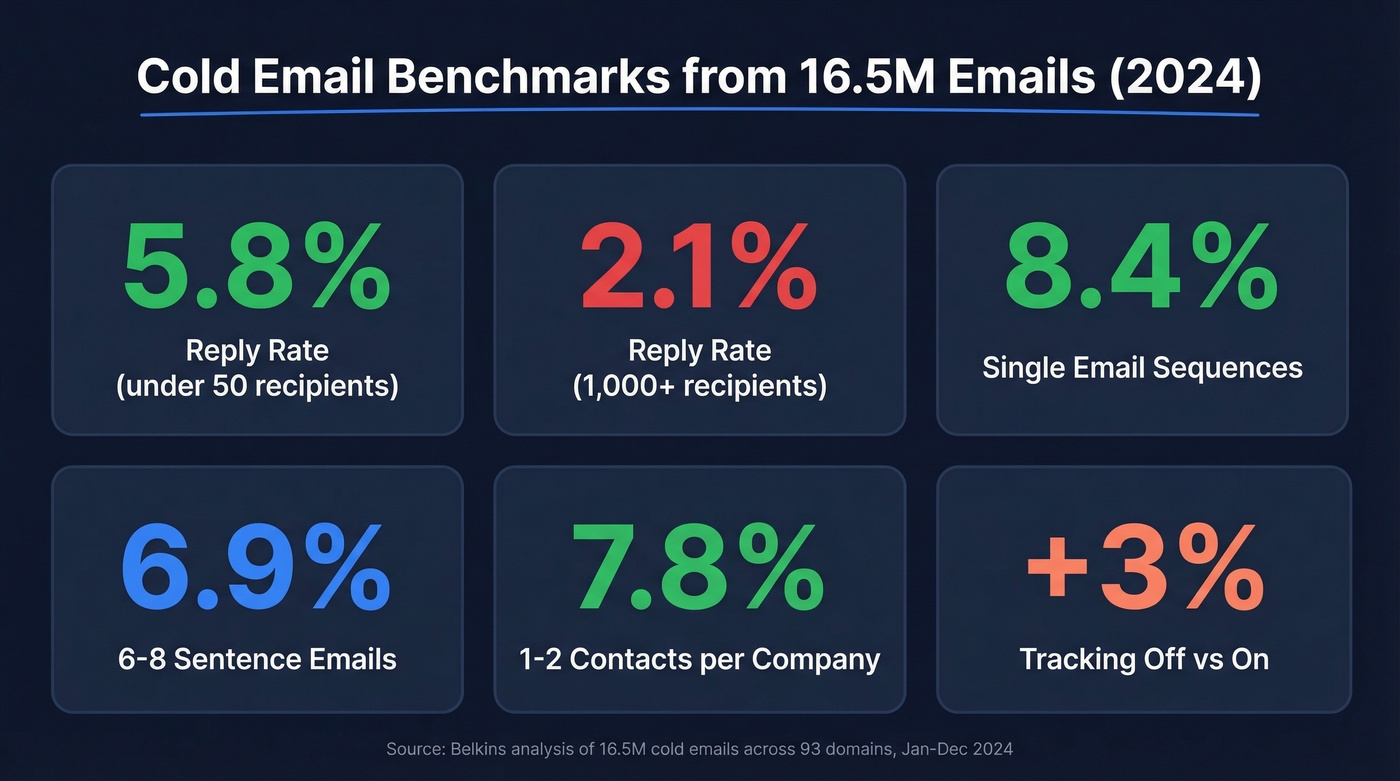
| Variable | Best Performer | Reply Rate |
|---|---|---|
| Campaign ≤50 recipients | Tight targeting | 5.8%+ |
| Campaign 1,000+ | Broad targeting | 2.1% |
| 1-2 contacts/company | Light touch | 7.8% |
| 10+ contacts/company | Heavy saturation | 3.8% |
| 1-email sequence | No follow-up | 8.4% |
| 6-8 sentence emails | Mid-length | 6.9% |
| Thursday sends | Best day | 6.87% |
| Monday sends | Worst day | 5.29% |
| Tracking off | No pixel | +3% vs tracking on |
Two things jump out. Emailing fewer contacts per company dramatically outperforms carpet-bombing an org chart. And single-email sequences - no follow-up at all - pulled the highest reply rate at 8.4%. That's counterintuitive, but it makes sense: one well-targeted email to the right person beats a five-touch drip to a mediocre list.
The email length finding also breaks Reddit consensus. Most threads say under 75-90 words is ideal, but 6-8 sentences (roughly 100-150 words) actually performed best. The sweet spot isn't "shortest possible." It's short enough to scan in under three seconds, long enough to establish relevance.
Infrastructure Before Copy
None of those benchmarks matter if your emails land in spam. Let's be honest - infrastructure is the prerequisite that Reddit's copy-obsessed threads skip entirely.
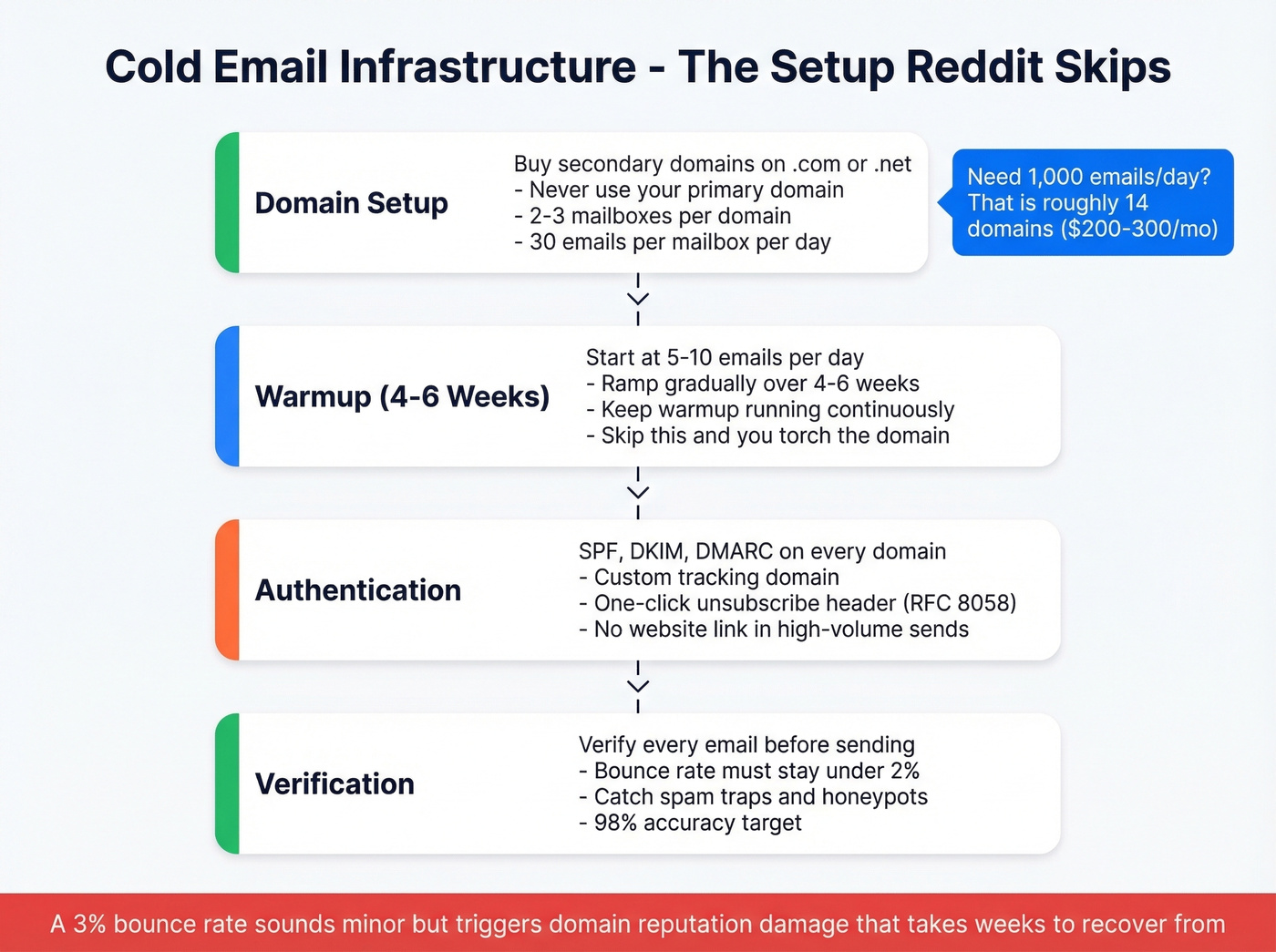
Domain Math
Never send cold email from your primary domain. Set up secondary domains on reputable TLDs (.com, .net). Each domain supports 2-3 mailboxes, each mailbox caps at around 30 cold emails per day. To send 1,000 emails daily, you need roughly 14 domains - $200-300/month in domains and inboxes alone.
Warmup Timeline
Start new domains at 5-10 emails per day. Ramp gradually over 4-6 weeks. Keep warmup running continuously even after you start cold sending. Skip this step and you'll torch a domain before it ever reaches a real prospect's inbox.
Non-Negotiables
SPF, DKIM, and DMARC configured on every domain. Spam complaints under 0.3%. Bounce rate under 2%. Custom tracking domain. One-click unsubscribe header (RFC 8058). And don't include your website link or company name in high-volume sends.
Verification
A 3% bounce rate sounds minor until it triggers domain reputation damage that takes weeks to recover from. Every email needs verification before it enters a sequence. We've seen teams run Prospeo's 5-step verification to catch invalid addresses, catch-all domains, spam traps, and honeypots before they touch sending infrastructure - 98% email accuracy. Stack Optimize built their agency to $1M ARR running client campaigns with 94%+ deliverability, under 3% bounce, and zero domain flags across all clients using this approach. (If you want the deeper technical checklist, see our email deliverability guide and email bounce rate benchmarks.)

Reddit's top threads all agree: tight targeting under 50 recipients crushes broad campaigns. Prospeo's 30+ search filters - buyer intent, technographics, job changes, headcount growth - let you build those hyper-targeted lists with 98% verified emails. No more torched domains from bad data.
Build the list Reddit wishes it had - 75 free emails, no credit card.
Templates That Get Replies
Reddit's copy advice is solid. Write at a 3rd-grade reading level, use 2-sentence paragraphs, ask one question, include one link at most. If you need more options, borrow from these cold email follow-up templates and email subject line examples.
The Short Intro (from r/sales):
Subject: quick question
Hi {first_name}, you handle {responsibility} at {company} so you probably care about {pain_point}. We helped {similar_company} {specific_result} in {timeframe}. Worth a quick chat?
The Video-First Offer: One Reddit poster sent 150 emails to e-commerce brands offering a custom strategy video - no link, just asked permission to send. Results: 51 replies (34% reply rate), 31 booked calls, 8 paying clients, roughly EUR 12K in revenue. Each custom video took about 10 minutes per prospect in Miro. That's the personalization tradeoff: time for quality.
The 2-word lowercase subject line ("quick question," "short video," "quick idea") keeps showing up in high-performing campaigns. It works because it looks like an internal email, not a marketing blast. In our experience testing across dozens of campaigns, this single tactic is one of the most consistently validated tips across Reddit threads and real-world data alike.
You need bounce rates under 2% to protect domain reputation. Prospeo's 5-step verification catches invalid addresses, spam traps, and honeypots before they touch your sending infrastructure. Stack Optimize ran client campaigns at 94%+ deliverability and zero domain flags using this exact workflow.
Stop burning domains. Verify every email before it enters a sequence.
Why AI Personalization Is Backfiring
The #1 complaint on Reddit right now isn't about cold email being dead. It's about AI personalization making it worse. Prospects detect GPT tone instantly, and generic compliments about someone's profile feel hollow. (If you're experimenting here, start with a systems approach to AI cold email outreach and keep your email copywriting fundamentals tight.)
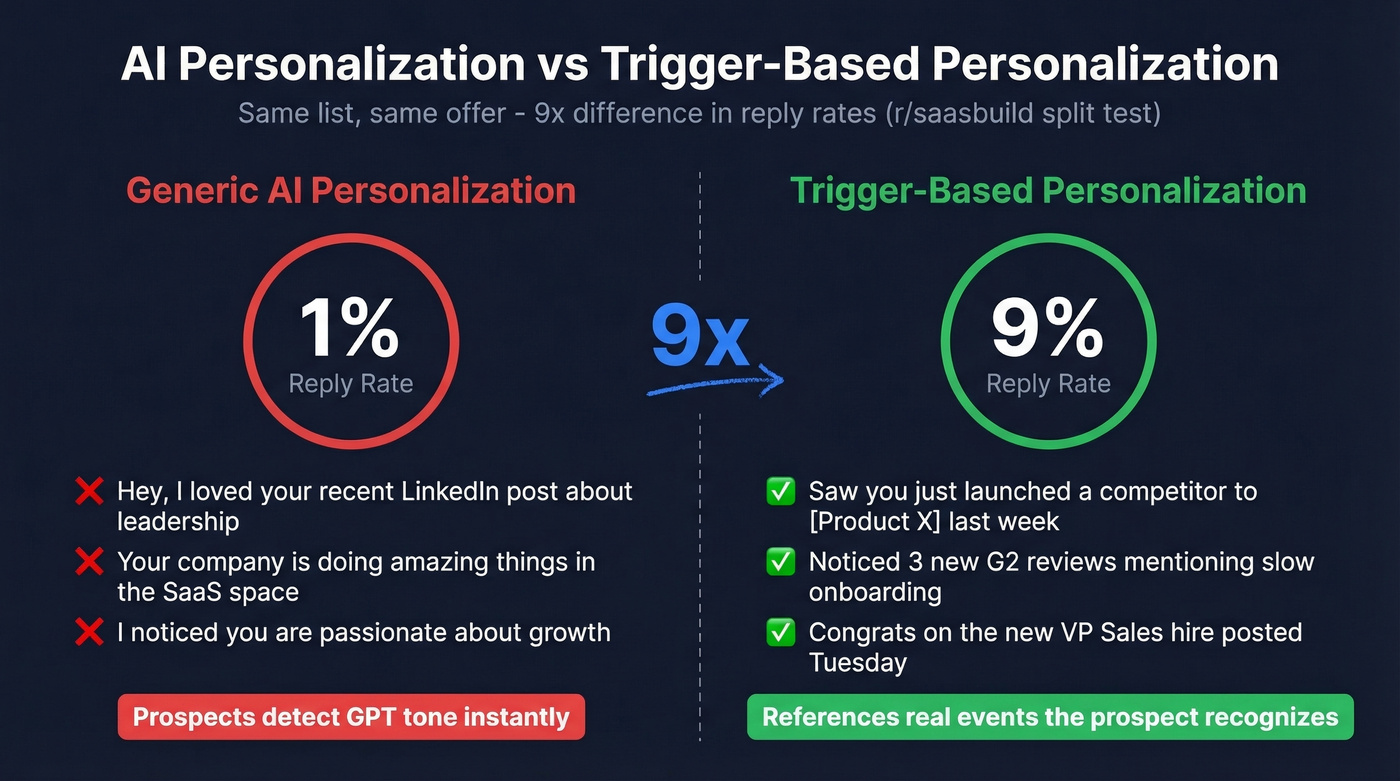
One split test on r/saasbuild tells the story: generic AI personalization pulled a 1% reply rate. Trigger-based personalization - referencing a competitor launch, a customer complaint on G2, a new hire posting - pulled 9%. That's a 9x difference from the same list.
The bottleneck is research time. Manually checking websites, news, and social profiles takes 10-15 minutes per lead. At 50-100 emails per week, that's a full-time job. Enrichment tools that return 50+ data points per contact - job changes, tech stack, funding signals - replace most of that manual research with actual triggers you can reference in your opening line. That turns cold outreach into warm-adjacent conversations.
Follow-Up Strategy
55% of replies come after the first email, and a well-timed first follow-up can lift reply rates up to 49%. But here's the thing: the third email drops rates by up to 20%, and spam complaints jump from 0.5% on the first email to 1.6% by the fourth. (For timing and copy, use these sales follow-up templates and benchmarks on when you should follow up on an email.)
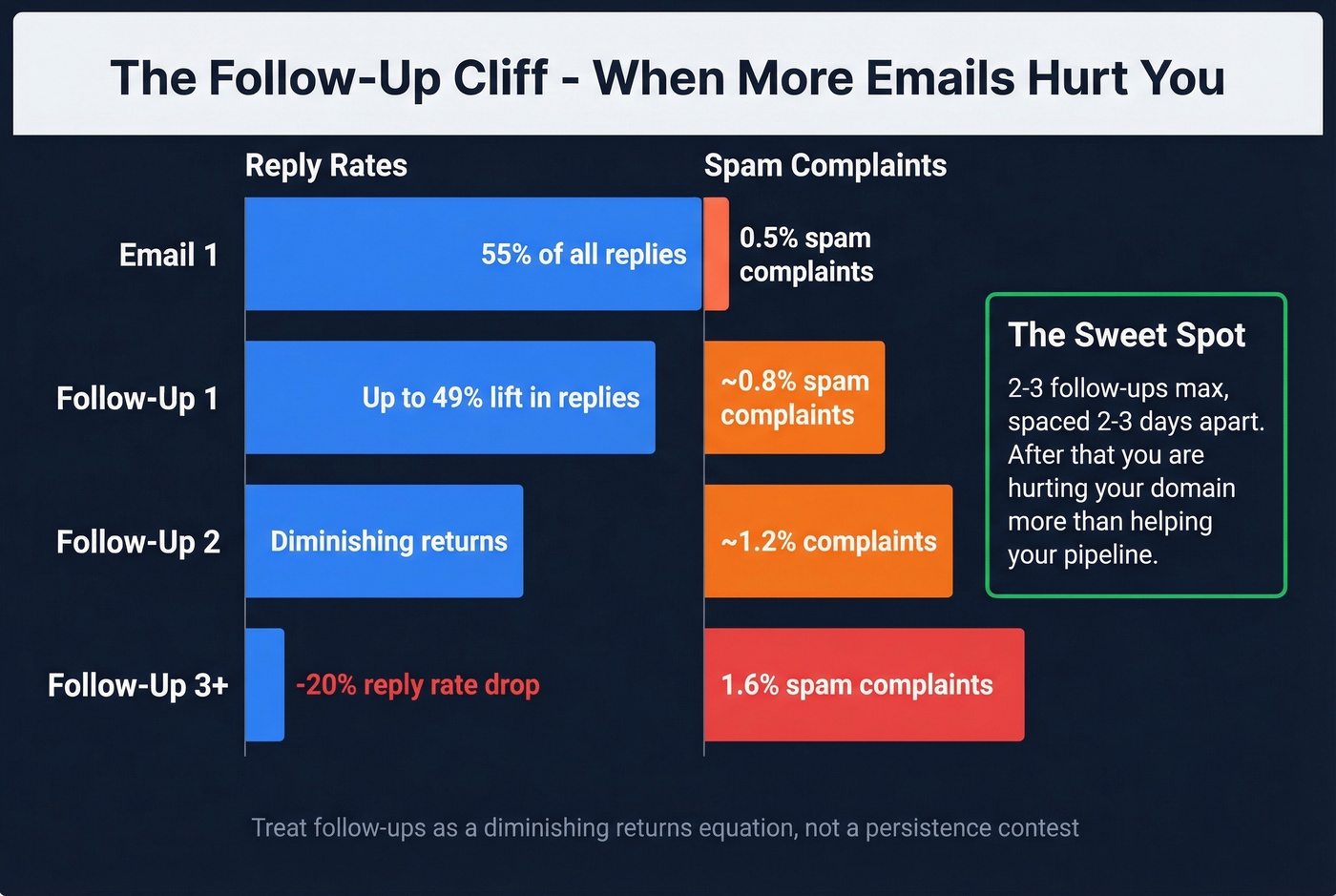
Two to three follow-ups max, spaced 2-3 days apart. After that, you're hurting your domain more than you're helping your pipeline. Treat follow-ups as a diminishing-returns equation, not a persistence contest. If someone hasn't replied after three touches, they're not interested - move on.
Is Cold Email Legal?
Yes - with guardrails. This matters especially for international outreach. (If you're buying lists, read this first: Is it illegal to buy email lists?.)
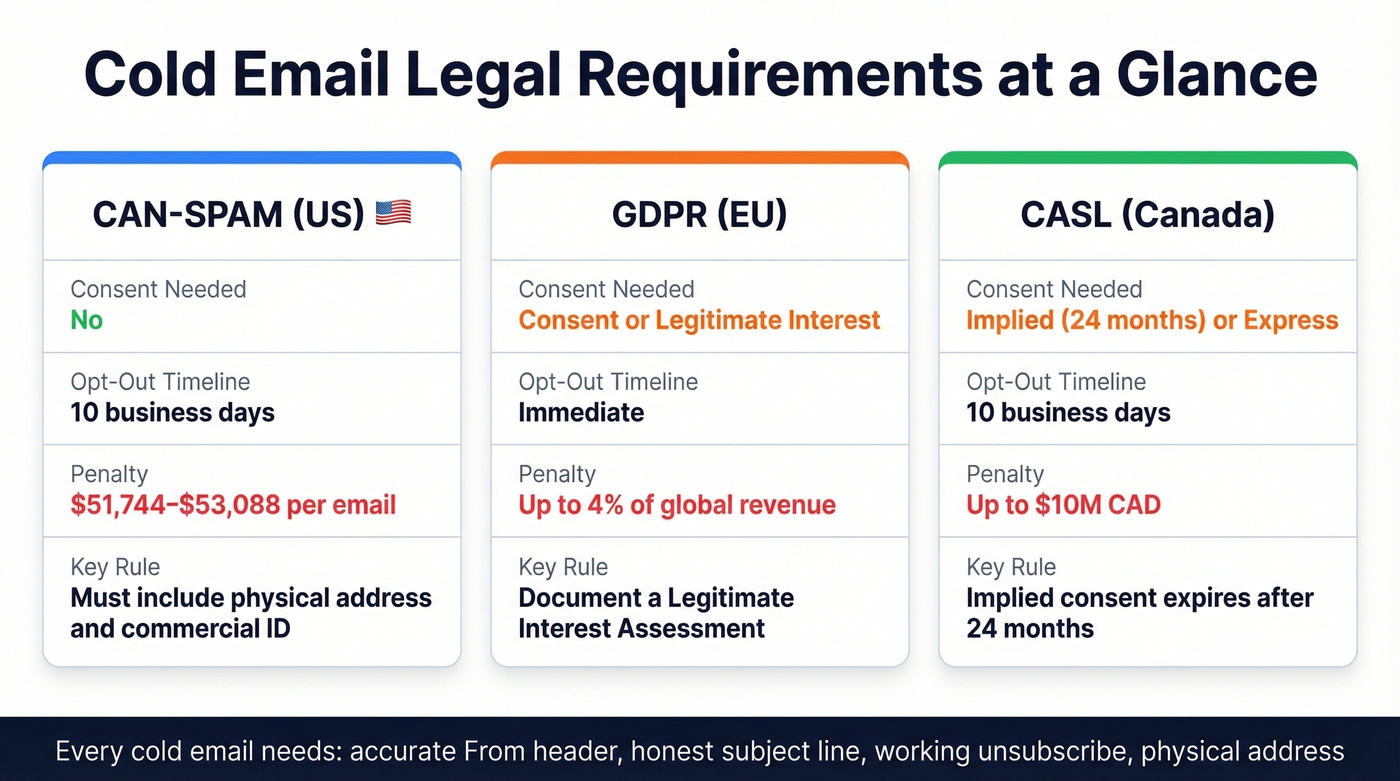
| Requirement | CAN-SPAM (US) | GDPR (EU) | CASL (Canada) |
|---|---|---|---|
| Consent needed? | No | Consent or legitimate interest | Implied (24 mo.) or express |
| Opt-out timeline | 10 business days | Immediate | 10 business days |
| Penalty per violation | $51,744-$53,088 per email | Up to 4% revenue | Up to $10M CAD |
Every cold email must include an accurate From header, non-deceptive subject line, commercial identification, working one-click unsubscribe, and a valid physical address. For GDPR, document a Legitimate Interest Assessment covering purpose, necessity, and balancing tests. Most teams skip the LIA and hope for the best. Don't be that team - the fines aren't theoretical.
The Outreach Stack for 2026
| Tool | Purpose | Starting Price |
|---|---|---|
| Prospeo | Verified prospect data | Free tier; ~$0.01/email |
| Instantly | Sending + warmup | ~$30-97/mo |
| Smartlead | Sending + warmup | ~$39-94/mo |
| Lemlist | Sequences + warmup | $32/user/mo |
| Woodpecker | Sending (SMB) | $29/mo |
| Domains + inboxes | Infrastructure | $200-300/mo |
Total stack cost runs $300-600/month depending on volume. That's real money, but at $42 return per $1 spent, outbound email outperforms most paid channels when the infrastructure is right. Plenty of free resources - cold email Reddit threads, YouTube breakdowns, and blog teardowns - can help you get started without paying for a course upfront. Skip the $997 "cold email masterclass" ads you see on Twitter. Everything you need is already out there. (If you're comparing options, start with free cold email software and the best way to send bulk email without getting blacklisted.)
FAQ
What reply rate should I expect?
Expect 5.8% on average across all campaigns. Targeted sends under 50 recipients consistently exceed that benchmark, while broad campaigns over 1,000 recipients drop to roughly 2.1%.
How many follow-ups should I send?
Two to three max. The first follow-up lifts replies up to 49%, but by the third email, spam complaints escalate from 0.5% to 1.6% - enough to damage your domain.
Do I need a separate domain?
Yes - always. Use secondary domains with SPF, DKIM, and DMARC configured. Warm them for 4-6 weeks before scaling to full volume. Budget $200-300/month for domains and inboxes.
How do I keep my bounce rate under 2%?
Verify every email before it enters your sequence. A 5-step verification process that catches catch-all domains, spam traps, and honeypots is table stakes in 2026. Stack Optimize runs all client campaigns under 3% bounce using this approach.
Is cold email legal in Europe?
Yes, under GDPR's legitimate interest basis (Article 6(1)(f)). You need a documented Legitimate Interest Assessment, a clear opt-out mechanism, and genuine relevance to the recipient's professional role. Penalties reach 4% of global revenue per violation, so don't wing it.