

Email Subject Lines to Introduce Yourself: What the Data Actually Says
Your Subject Line Is the Entire Audition
47% of recipients decide whether to open your email based on the subject line alone. Worse, 69% will flag you as spam based on nothing but those few words. Your intro email body could be brilliant - none of it matters if the subject line doesn't earn the open.
You don't need 150 templates to write a great email subject line to introduce yourself. You need four or five rules that make any subject line work. We've included 40+ templates below anyway, but the rules in the next section are the real value - internalize them and you'll never need a swipe file again.
What 85 Million Emails Tell Us
An analysis of 85M+ cold emails found that top-performing reps hit 58%+ open rates, which is 2.1x the average. The pattern is dead simple: shorter wins. The ideal subject line is 1-4 words. All-lowercase formatting produces the highest open rates. And [personalized subject lines get 22% more opens](https://www.marketingdive.com/news/study-personalized-email-subject-lines-increase-open-rates-by-50/504714/) than generic ones.
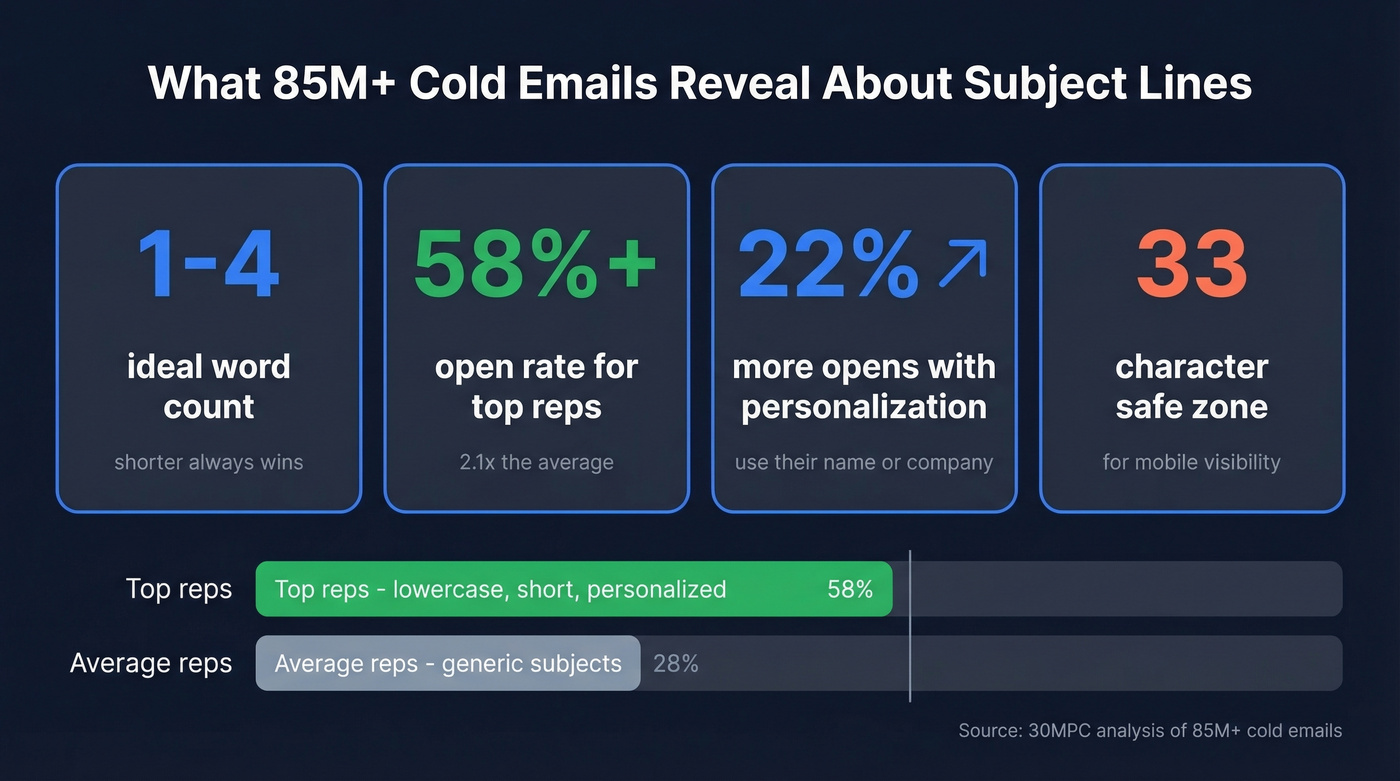
Typical cold intro reply rates land between 1-5% depending on list quality and offer, so every percentage point your subject line earns matters.
63% of recipients [open emails on mobile](https://www.emailmonday.com/mobile-email-usage-statistics/), which means your subject line gets truncated more often than not. [EmailToolTester ran device-by-device tests](https://www.emailtooltester.com/en/blog/email-subject-lines-character-limit/) and the "visible everywhere" safe zone is tighter than you'd think:
| Device | Subject Limit | Preheader Limit |
|---|---|---|
| Gmail (Pixel 7) | 33 chars | 37 chars |
| Gmail (iPhone 14) | 37 chars | 39 chars |
| Apple Mail (iPhone) | 48 chars | 99 chars |
| Gmail (desktop) | ~88 chars | varies |
| Outlook web (desktop) | ~51 chars | varies |
If your subject line is "Excited to connect about the partnership opportunity," half your audience sees "Excited to connect about th..." and deletes it. Put your most important words first and treat everything after 33 characters as bonus text.
One thing most benchmarking advice ignores: security bots at enterprise companies pre-click every link and "open" every email automatically. One marketer sending millions of monthly emails stopped A/B testing opens entirely because of bot noise. That's why we track reply rates on our own outreach, not opens.
Five Mistakes Killing Your Intro Emails
1. "Quick question" fatigue. We've seen this firsthand. "Quick question" and "Hey {firstname}" were effective in 2022. They're burned out now. The consensus on r/coldemail backs this up: prospects have seen them hundreds of times, pattern-match, and delete.
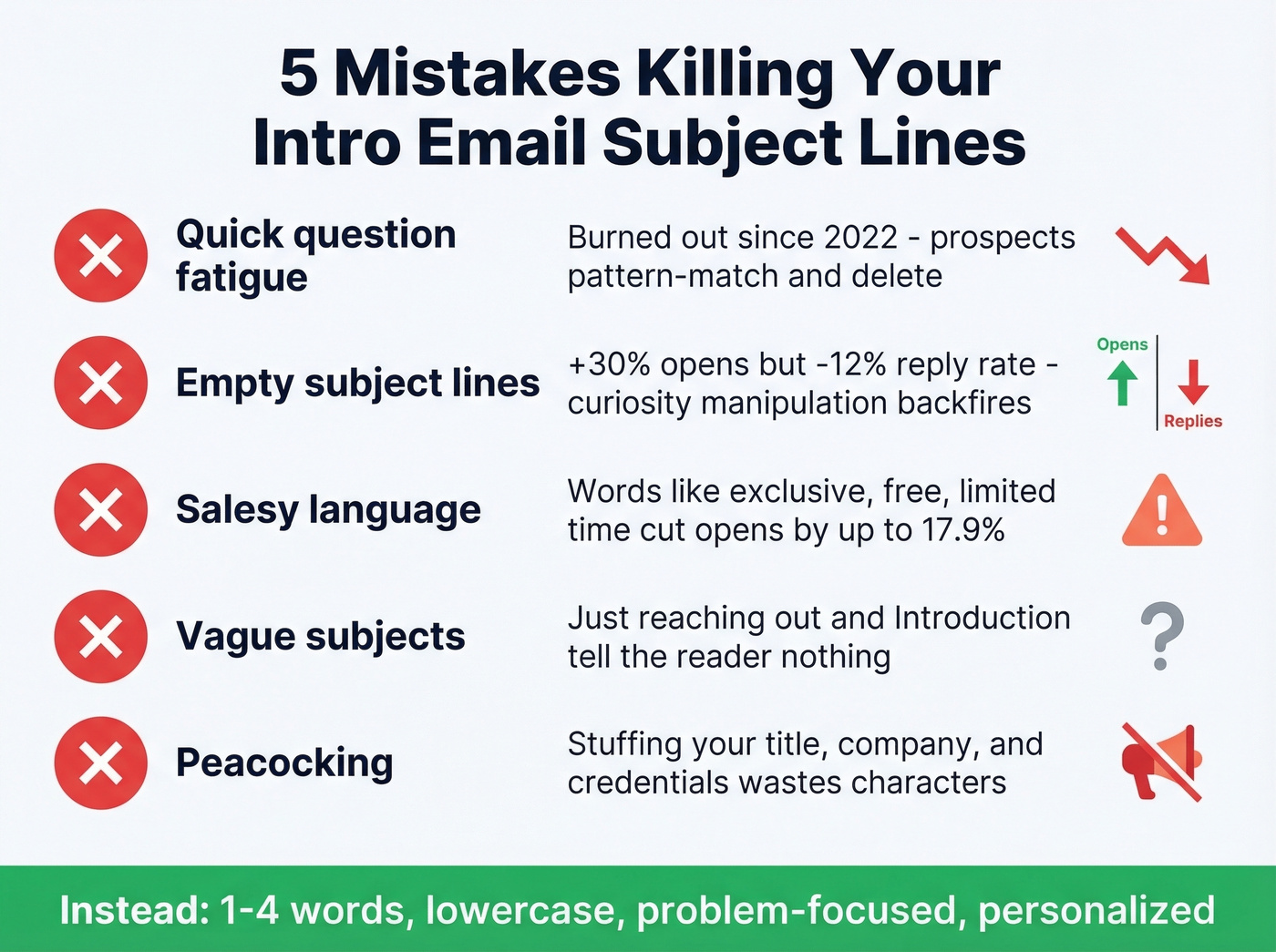
2. Empty subjects that tank replies. Blank subject lines boost opens by 30% but reduce reply rates by 12%. It's curiosity manipulation, and it works exactly once. Opens are vanity. Replies pay the bills.
3. Salesy language. Words like "exclusive," "limited time," and "free consultation" reduce open rates by up to 17.9%. Spam filters and human instincts both catch them.
4. Vague subjects. "Just reaching out" or "Introduction" tells the recipient nothing. A thread in r/Emailmarketing showed a classic example: "Greetings... introduce our company and services..." - it reads like a brochure nobody asked for. Choosing the right email subject for introducing yourself means giving the reader a reason to click, not a generic label.
5. Peacocking. Long subject lines stuffed with your title, company, and credentials. One CS practitioner on Reddit put it perfectly: lengthy background intros are "pointless at best and tacky peacocking at worst." State your role, state your value, move on.

You just learned that bad subject lines kill open rates. But sending a great subject line to a dead email address kills everything else. Prospeo's 5-step verification delivers 98% email accuracy - so your carefully crafted intro actually lands in a real inbox, not a bounce log.
Stop perfecting subject lines for email addresses that don't exist.
40+ Templates by Scenario
New Job or New Team
The recipient expects your email, so this is easy mode. Title case works fine since you're writing to colleagues, not cold prospects. Keep it warm but brief.
- Your new [Job Title] in [Department]
- Hi from [Your Name] - just joined [Team]
- New [Role] on the team - quick intro
- Excited to work with you, [Team Name]
- [Your Name], your new [Job Title]
- Joining [Company] as [Role] - hello!
- New face in [Department] 👋
- Quick intro - [Your Name], [Role]
Cold Outreach and Sales
Hard mode. You're competing with 50 other pitches in their inbox, and the 85M-email data is clearest here: shorter and lowercase wins. Every word needs to earn its spot. In our experience, problem-focused subjects outperform company-name-dropping every time - that's the difference between a reply and the trash folder. If you want more inspiration, browse these email subject line examples.
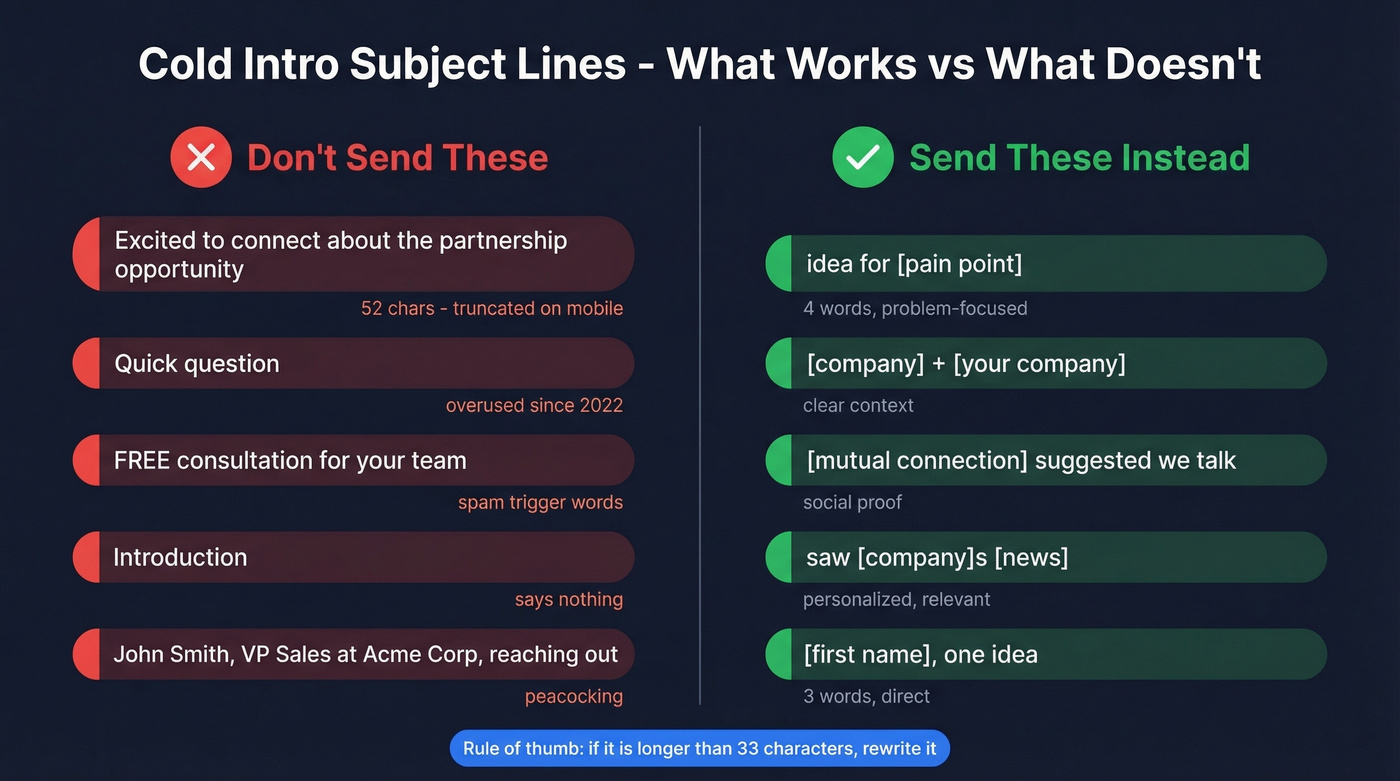
- [company name] + [your company]
- idea for [specific problem]
- [mutual connection] suggested we talk
- question about [their initiative]
- saw [company]'s [recent news]
- [their pain point]?
- for [first name]
- [first name], one idea
Networking and Event Follow-Ups
Anchor to the shared context - the event, the conversation, the mutual connection. It's the fastest way to jog someone's memory, and it immediately separates you from cold pitches. The more specific the detail, the better: "the espresso-machine conversation" beats "great chatting at the conference."
- Great meeting you at [Event]
- Following up from [Conference]
- [Mutual Contact] said we should connect
- Loved your talk on [Topic]
- [Event Name] follow-up - [Your Name]
- Continuing our [Event] conversation
- From [Event] - the [memorable detail] conversation
- Connected through [Person] - quick intro
Customer Success and Account Handovers
The customer wants three things: who you are, what you do for them, and how to reach you. That's it. Don't overthink the subject - clarity beats cleverness when someone just wants to know their new point of contact. For handover messaging, these handoff email templates can help.
- Your new point of contact at [Company]
- [Your Name] - taking over your account
- New CSM intro + next steps
- Hi [Name] - I'm your new [Role]
- Account update: meet [Your Name]
- Picking up where [Previous CSM] left off
- Your [Company] team just changed - here's who
Partnership and Collaboration
Lead with what's in it for them. A partnership email that opens with your company's story gets archived. We've tested this across dozens of outreach campaigns - subject lines that reference the prospect's initiative or metric outperform "let me tell you about us" by a wide margin.
- [Their Company] + [Your Company] collab idea
- Partnership idea for [specific goal]
- Saw [their initiative] - potential fit
- [Their Company]'s [metric] caught my eye
- Co-marketing idea - [specific angle]
- Idea to help [Their Company] reach [audience]
- [Mutual benefit] - worth 10 minutes?
Those 40+ templates are a starting point. But the rules from the data section matter more than any individual line. Internalize the rules, and you can write your own introduction email subject line for any scenario you run into.
Before You Hit Send
You've spent time crafting the right subject line. Don't waste it on a dead email address - especially if you're scaling cold email marketing or running a full B2B cold email sequence.
Quick-Reference Rules
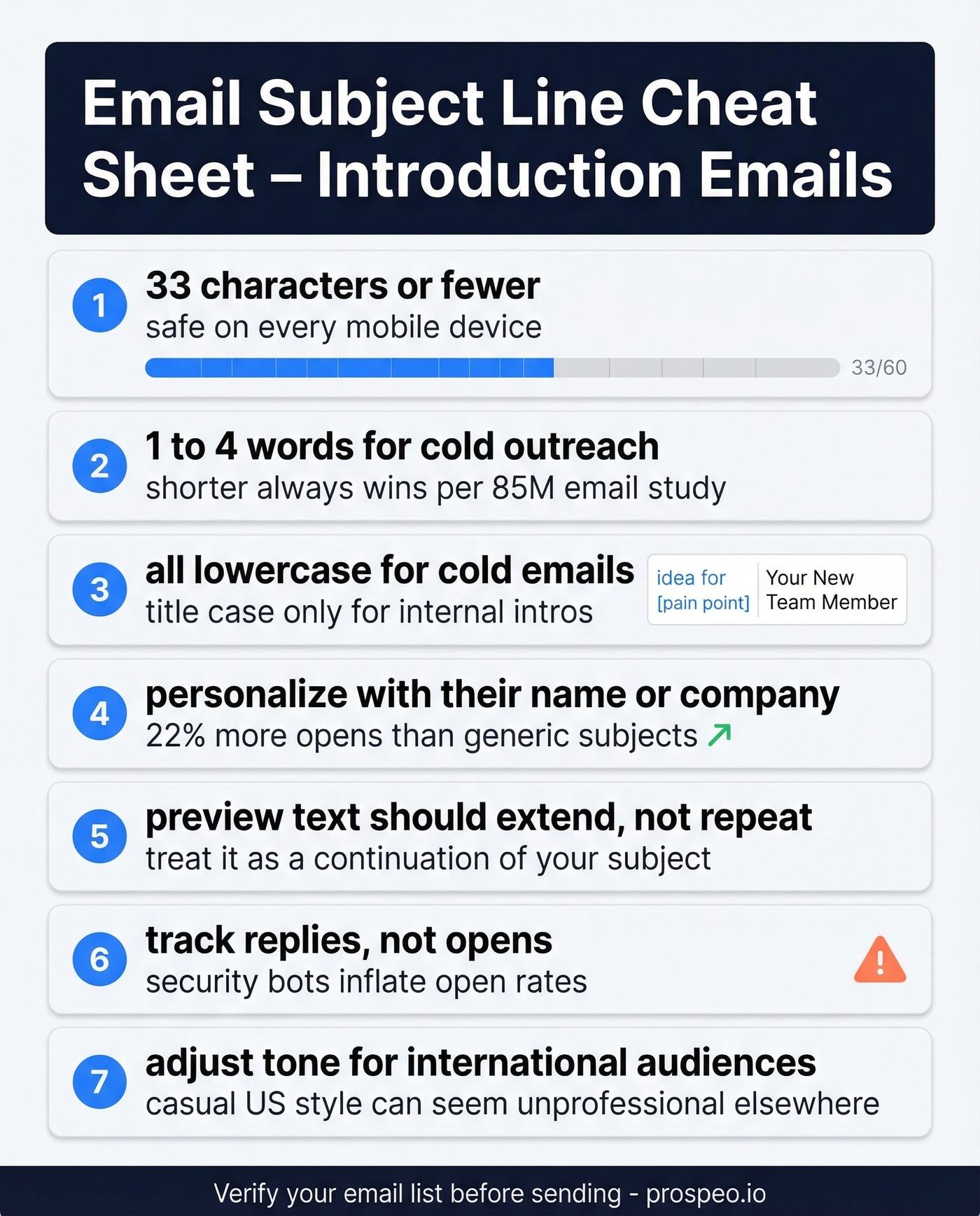
- 33 characters or fewer for universal mobile visibility
- 1-4 words is the ideal length for cold outreach
- All-lowercase for cold outreach; title case for internal intros
- Personalize with their name, company, or a mutual connection (more on personalized outreach)
- Align preview text with the subject - don't repeat it, extend it (see Email Preview Text A/B Testing)
- Track replies, not opens - bots inflate open rates, and opens don't close deals
- For international audiences, adjust tone - casual U.S.-style subjects can read as unprofessional in Germany or Japan
Let's be honest: if your average deal size is under $5k, you probably don't need a 10-step subject line optimization process. Pick one of the templates above, verify the email address, and send. Overthinking the subject line is the number-one way people procrastinate on actually doing outreach. If you're still stuck, use a subject line tester to sanity-check your options.
Those 40+ subject line templates only work if you're reaching the right person. Prospeo gives you 300M+ verified professional emails with 30+ filters - job title, intent signals, company size - so your intro email hits a decision-maker who actually cares about what you wrote.
Find the inbox worth introducing yourself to.
FAQ
How long should an email subject line to introduce yourself be?
Keep it to 1-4 words and under 33 characters for full visibility across all mobile devices. The 85M-email analysis found shorter subject lines consistently outperform longer ones, and EmailToolTester's device testing confirms 33 characters is the safe cutoff for Gmail on Android.
What's the best subject line for a cold introduction email?
The highest-performing cold intro subjects follow a formula: 1-4 words, all-lowercase, referencing either a mutual connection or a specific problem. Something like "idea for [their pain point]" or "[mutual connection] suggested we talk" consistently outperforms generic alternatives like "Introduction" or "Quick question."
Should I use my name in the subject line?
For internal intros and account handovers, yes - your name gives the recipient immediate context. For cold outreach, skip it. Your name means nothing to someone who doesn't know you, and it wastes precious characters. Use their name or company instead.
How do I verify email addresses before sending introduction emails?
Use a verification tool before every outreach campaign. Bounced emails damage your domain reputation, which tanks deliverability on every future send. Tools like Prospeo offer 98% email accuracy with a free tier - enough for most individual senders to get started without risk.
Does the best introduction subject line differ by industry?
Yes. In creative industries, casual and lowercase subjects tend to perform best. In finance, legal, or enterprise sales, a slightly more formal approach - like "[Your Name], new [Role] at [Company]" - signals professionalism without being stiff. Test what resonates with your specific audience rather than copying a one-size-fits-all template.