

Email Unsubscribe Best Practices: The 2026 Playbook
Most email unsubscribe guides were written before February 2024. That's a problem. Google, Yahoo, and Microsoft rewrote the rules for bulk senders between 2024 and 2025, and the enforcement has real teeth now. If you're still running a 10 business days unsubscribe window, you're out of step with what mailbox providers actually require - and you'll see more deferrals or outright rejections.
The Short Version
- Add RFC 8058 one-click unsubscribe headers to every marketing email. Gmail, Yahoo, and Microsoft require them for bulk senders. No headers, no inbox.
- Process unsubscribes within 48 hours - not the 10 business days the law allows. Mailbox providers don't care about your legal grace period.
- Stop obsessing over your unsubscribe rate. It more than doubled industry-wide in 2025. Obsess over your spam complaint rate instead and keep it under 0.1%.
Unsubscribe Rate Benchmarks in 2026
If your unsubscribe rate jumped in 2025 and you panicked, relax. Everyone's did.
MailerLite analyzed 3.6 million campaigns across 181,000 accounts from December 2024 through November 2025. The overall unsubscribe rate landed at 0.22% - more than double the 0.08% they measured in 2024. The biggest driver? Gmail made it easier to unsubscribe directly from the inbox UI, so users can opt out with less friction and sometimes without even opening the email. More visibility for the action means more unsubscribes. We track these benchmarks across our own sends and our customers' campaigns, and the pattern holds everywhere.
Rates by industry, via Mailchimp's benchmarks:
| Industry | Unsubscribe Rate |
|---|---|
| Business & Finance | 0.15% |
| Non-Profits | 0.18% |
| Education & Training | 0.18% |
| Ecommerce | 0.19% |
| All Users | 0.22% |
If you're in the 0.15-0.25% range, you're normal. Anything above 1% consistently deserves investigation.
Bulk Sender Rules That Changed Everything
Here's the timeline that matters:
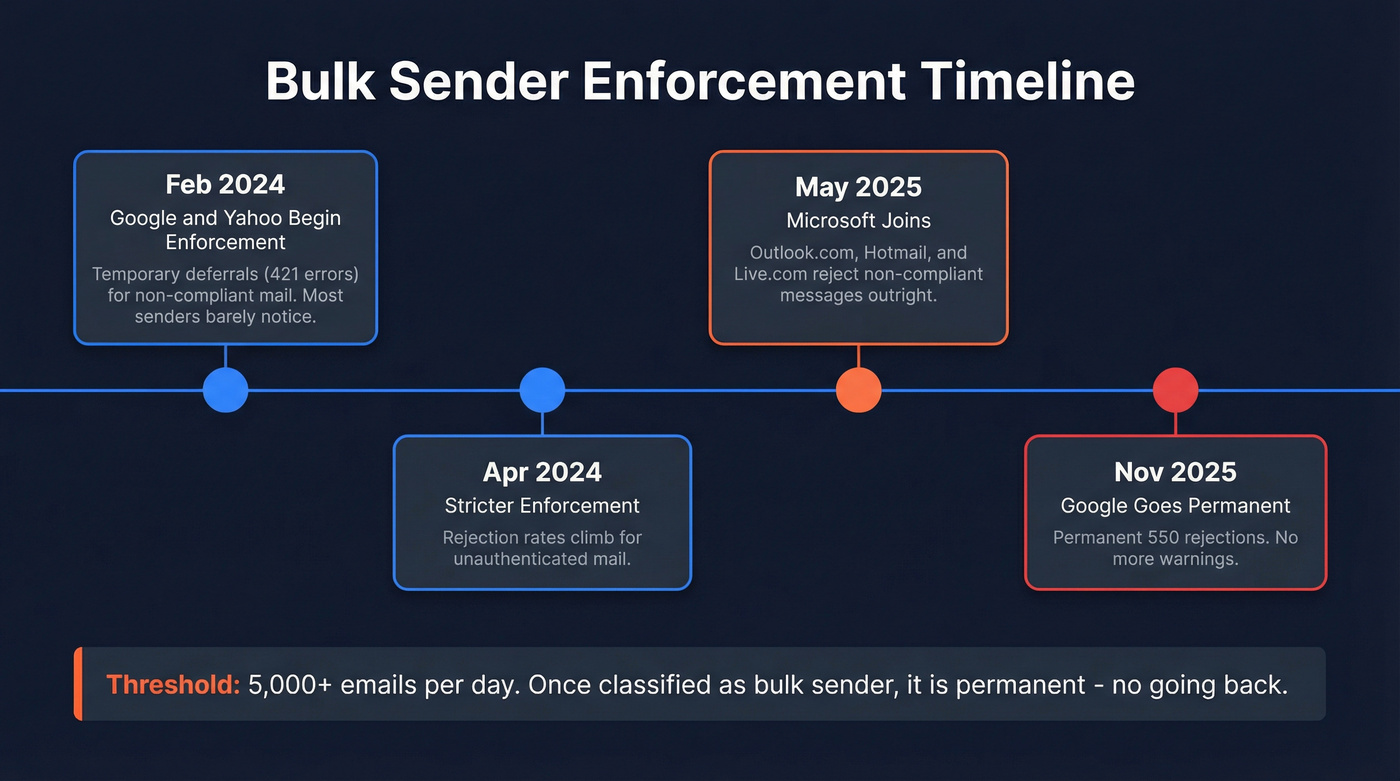
- Feb 2024: Google and Yahoo begin enforcement. Non-compliant mail gets temporary deferrals (421 errors). Most senders barely notice.
- Apr 2024: Stricter enforcement. Rejection rates climb for unauthenticated mail.
- May 2025: Microsoft joins. Outlook.com, Hotmail, and Live.com reject non-compliant messages outright.
- Nov 2025: Google ramps to permanent rejections (550 errors). No more warnings.
The threshold is 5,000+ emails per day to any of these providers' users. And here's the detail most people miss: Gmail classifies you as a bulk sender permanently once you've crossed that threshold from your primary sending domain. There's no going back to "small sender" status.
Bulk senders must authenticate with SPF, DKIM, and DMARC; include RFC 8058 one-click unsubscribe headers in every marketing email; keep spam complaint rates below 0.1%; and process unsubscribes within 48 hours. Transactional emails - order confirmations, password resets, shipping notifications - are exempt from the one-click unsubscribe requirement.
Global Compliance at a Glance
Different jurisdictions, different rules. But the practical move is the same: process unsubscribes within 48 hours regardless of which regulation applies.
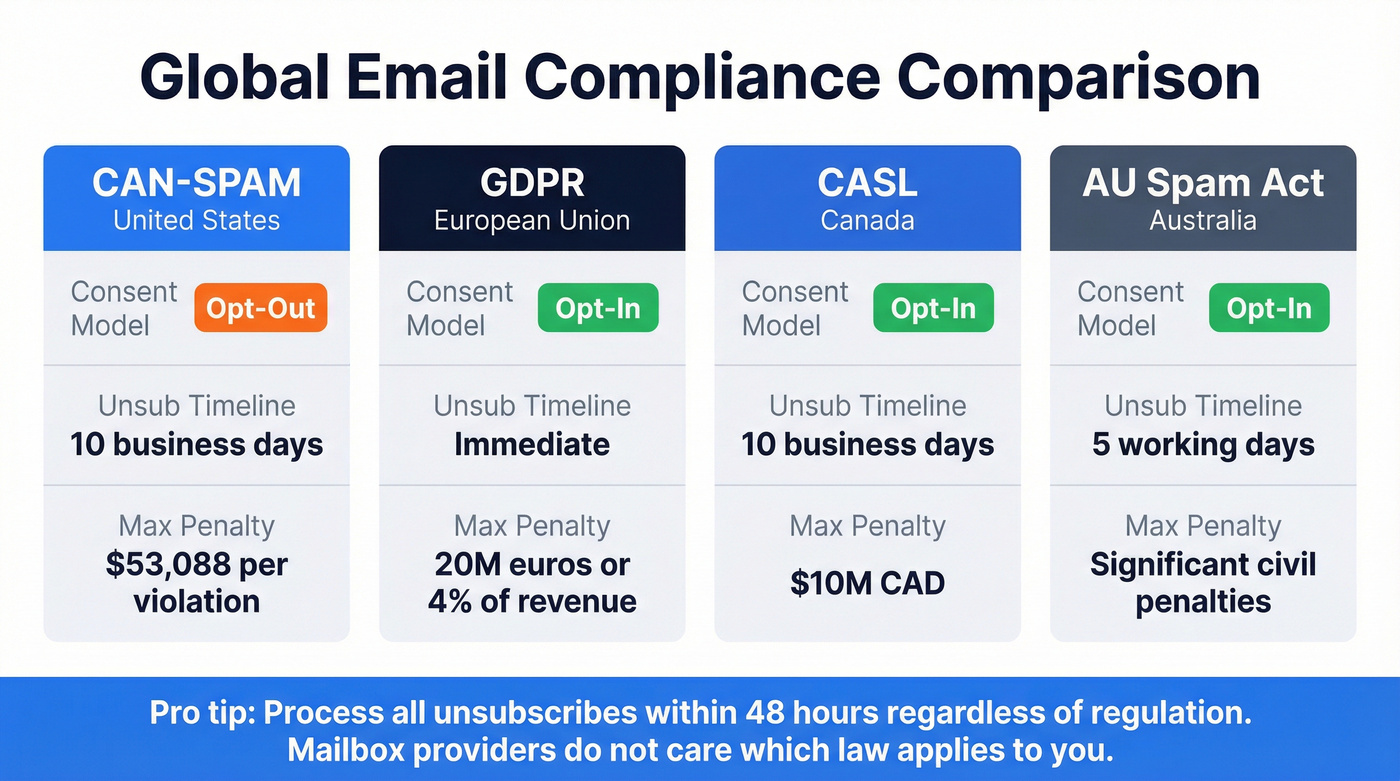
| Regulation | Consent Model | Unsub Timeline | Max Penalty |
|---|---|---|---|
| CAN-SPAM | Opt-out | 10 business days | $53,088/violation |
| GDPR | Opt-in | Immediate | €20M / 4% rev |
| CASL | Opt-in | 10 business days | $10M CAD |
| AU Spam Act | Opt-in | 5 working days | Significant civil penalties |
CAN-SPAM's opt-out model is the most permissive - you can email until someone says stop. GDPR and CASL require consent upfront. From a deliverability standpoint, though, mailbox providers don't care which law applies to you. They care about the unsubscribe header and your complaint rate.

High unsubscribe and complaint rates often start with bad data - wrong contacts, stale emails, people who never should have been on your list. Prospeo's 5-step verification and 7-day data refresh cycle means you're reaching real, relevant buyers from day one. 98% email accuracy. Under 4% bounce rates across customer campaigns.
Fix your deliverability at the source - start with better data.
The Opt-Out UX Checklist
Getting the technical headers right is only half the job. The subscriber-facing experience matters just as much, and this is where we see teams cut corners.
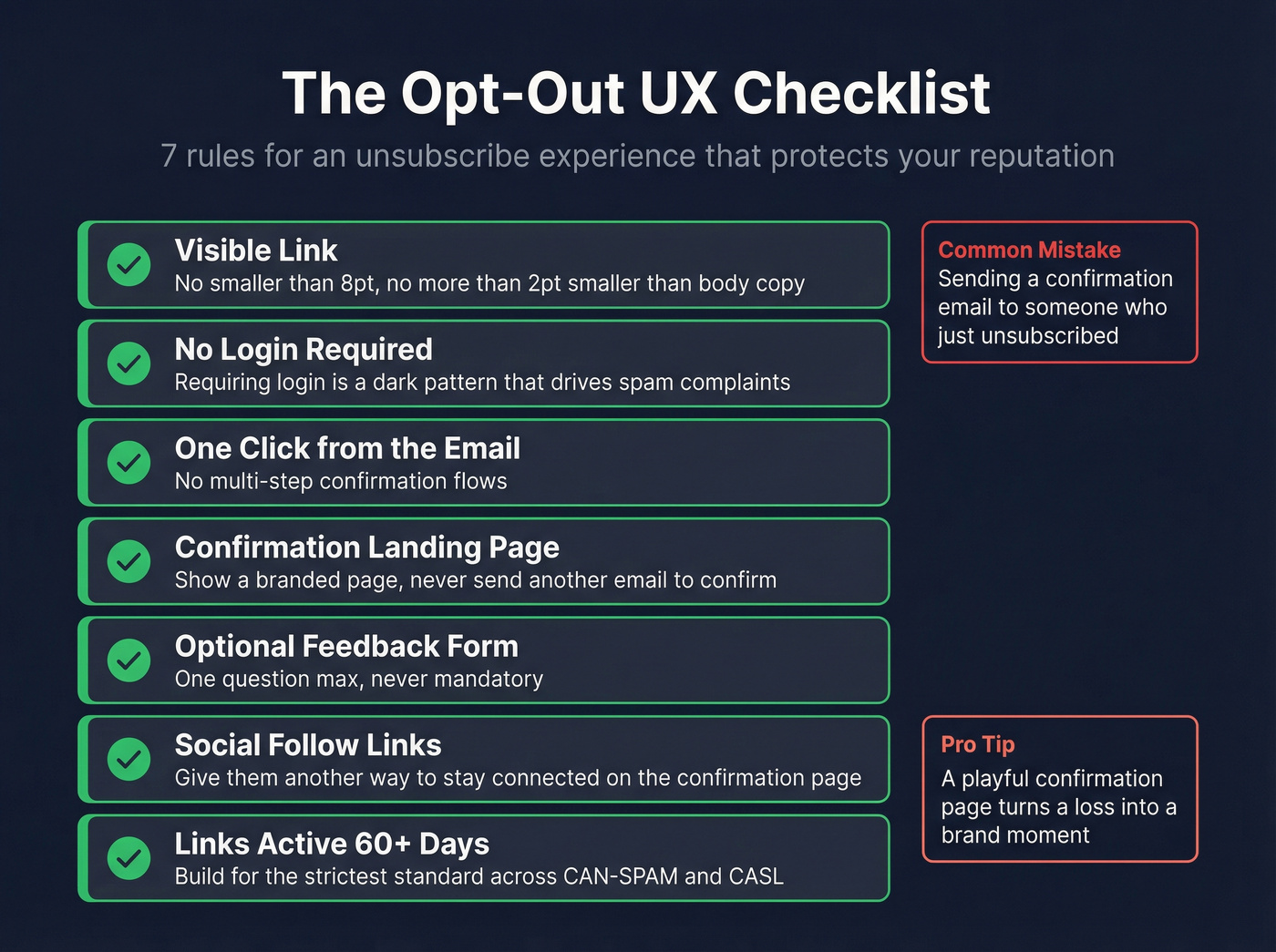
- Visible link. No smaller than 8pt, no more than 2pt smaller than body copy. Per the Internet Society's spec, it should be "clear and conspicuous."
- No login required. Making someone log in to unsubscribe is a dark pattern that drives spam complaints and likely violates GDPR.
- One click from the email. No multi-step confirmation flows.
- Confirmation landing page, not a confirmation email. Don't send another email to someone who just told you to stop. Litmus flags this as one of the most common mistakes. A branded, even playful confirmation page turns a loss into a brand moment - HubSpot's breakup-themed page is a good example.
- Optional feedback form. One question max. Never mandatory.
- Social follow links on the confirmation page. They left your email list - give them another way to stay connected.
- Keep unsubscribe links active for 60+ days. CASL expects 60 days; CAN-SPAM requires the opt-out mechanism to work for at least 30. Build for the stricter standard.
Preference Centers That Retain Subscribers
A well-designed preference center can reduce unsubscribes by up to 30%. Letting subscribers manage their preferences - rather than forcing an all-or-nothing choice - keeps more people on your list.
Include these: frequency controls (daily, weekly, monthly), topic selection, a 30- or 60-day pause option, and an email address update field. Frequency is one of the most common opt-out drivers, so giving people the dial often saves the relationship.
Skip these: burying the full unsubscribe option behind preference choices, pre-selecting all topics, or requiring a login. And a quick note on billing - if you're on a platform that charges per subscriber, unsubscribing someone is different from deleting them. A thread on r/emailmarketing put it well: keep unsubscribed contacts suppressed, not deleted, so you preserve their history and don't accidentally re-import them later.
One-Click Unsubscribe Headers: The Technical Setup
This is the piece that trips up engineering teams. Two headers, every marketing email:
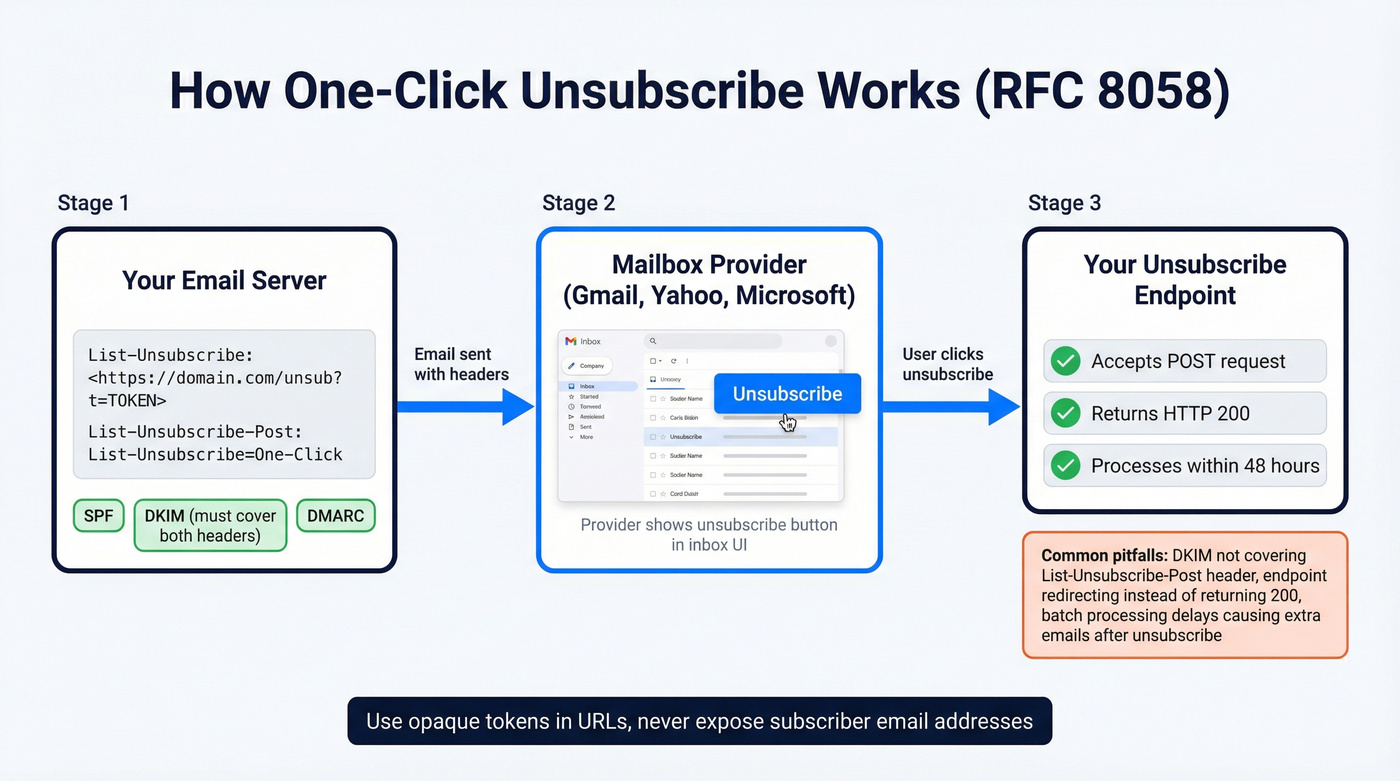
List-Unsubscribe: <https://yourdomain.com/unsubscribe?t=OPAQUE_TOKEN>

List-Unsubscribe-Post: List-Unsubscribe=One-Click
With a mailto fallback for older clients:
List-Unsubscribe: <https://yourdomain.com/unsubscribe?t=OPAQUE_TOKEN>, <mailto:unsub@yourdomain.com?subject=unsubscribe>

List-Unsubscribe-Post: List-Unsubscribe=One-Click
Use an opaque token. Don't put the subscriber's email address in the URL. Generate a unique, non-guessable token per recipient per send.
Your endpoint must accept POST and return HTTP 200. When Gmail or Yahoo fires the one-click request, they send a POST. Accept it, process the unsubscribe, return a 200. Don't redirect.
DKIM must cover both headers. Your DKIM signature needs to include both List-Unsubscribe and List-Unsubscribe-Post. If you're using PHPMailer with openDKIM, this is a known pitfall - List-Unsubscribe-Post often doesn't get included in the DKIM signature by default. Unsigned headers get ignored by Gmail entirely. (If you need a quick audit, see How to Verify DKIM Is Working.)
Let's be honest: if your marketing stack can't handle RFC 8058 headers natively in 2026, switch stacks. This isn't optional anymore, and duct-taping headers onto a legacy ESP will cost you more in deliverability damage than a migration ever will.
A common gotcha we've seen discussed on r/salesforce: teams running Salesforce Marketing Cloud where daily sync timing causes one extra email to go out after an unsubscribe. Audit your suppression pipeline end-to-end - the 48-hour window is tighter than it sounds when you factor in batch processing delays.
Protect Your Sender Reputation
An unsubscribe is a gift. Seriously.
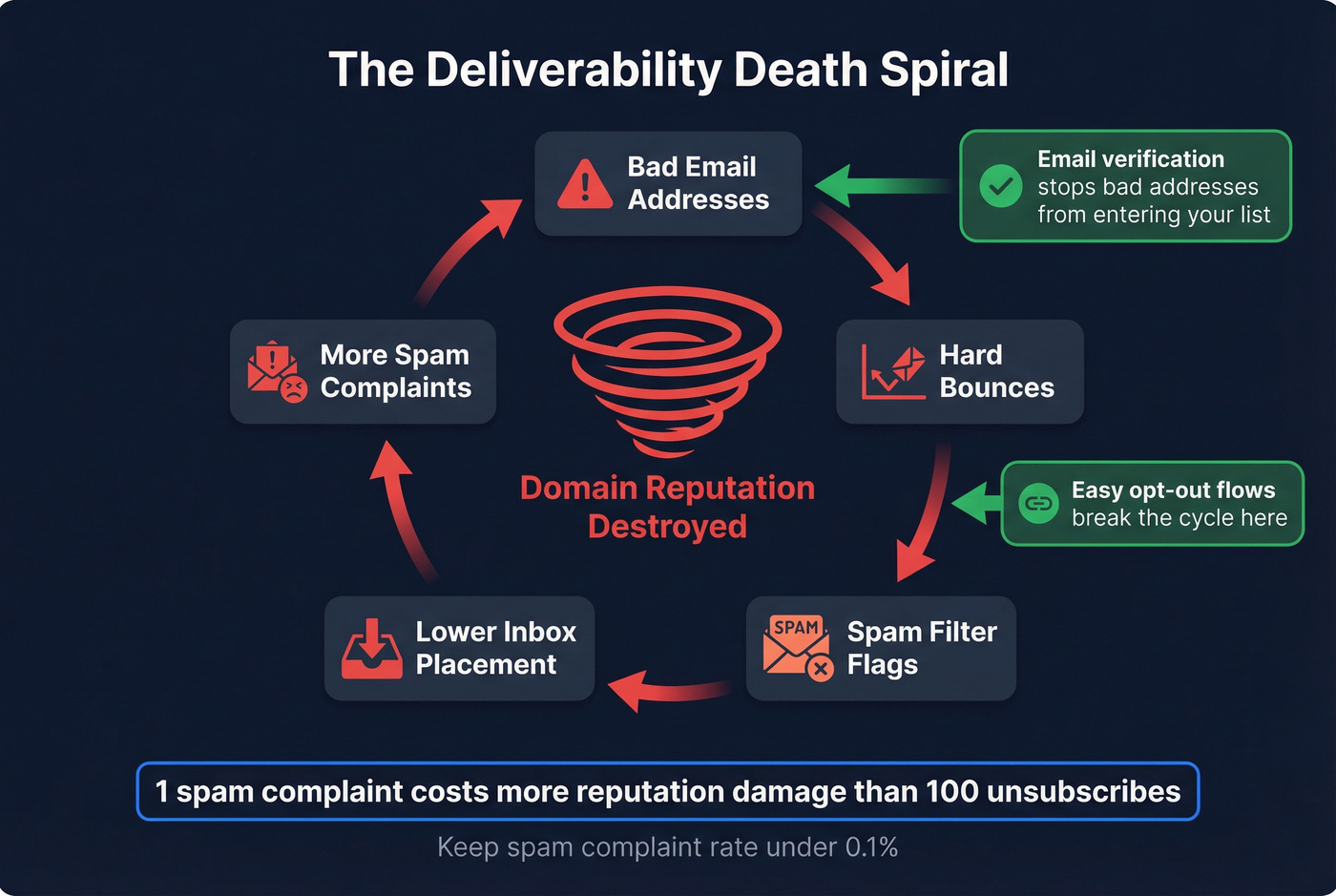
Someone who unsubscribes is telling you they're done. Someone who hits "Report Spam" is telling Google you're done. One spam complaint costs you more than 100 unsubscribes in reputation damage, and once your domain reputation tanks, clawing it back takes months.
The deliverability death spiral works like this: bad email addresses lead to hard bounces, which trigger spam filter flags, which lower inbox placement, which generate more spam complaints, which destroy your domain reputation. Easy opt-out flows break that cycle at the complaint stage. Strong personalization helps too - when content feels relevant, fewer people opt out in the first place. But the upstream problem, bad addresses entering your list, needs its own fix.
Run your list through a verification tool before every campaign. Prospeo's 5-step verification catches invalid, disposable, and spam-trap addresses before they bounce, with 98% email accuracy and records refreshed on a 7-day cycle. Aim for under 2% hard bounce rate per send (see Email Bounce Rate). For inactive subscribers who haven't opened in 90+ days, run a re-engagement sequence first - anyone who doesn't respond gets suppressed. If you're rebuilding deliverability from scratch, follow a full email deliverability guide and consider dedicated email reputation tools.

Staying under 0.1% spam complaint rates is nearly impossible when your list is full of outdated or mismatched contacts. Prospeo refreshes 300M+ profiles every 7 days - not every 6 weeks - so your outbound hits the right inbox, not the spam button. Teams using Prospeo cut bounce rates from 35%+ to under 4%.
Stop burning your domain reputation on bad data.
FAQ
Is one-click unsubscribe legally required?
Not by law. But Gmail, Yahoo, and Microsoft enforce it for senders pushing 5,000+ emails per day. Skip the header and your mail gets rejected - the practical requirement is stricter than the legal one.
Why did my unsubscribe rate spike in 2025?
Gmail's inbox-level unsubscribe buttons made it easier for users to opt out with less friction. Industry-wide, rates jumped from 0.08% to 0.22%. If your spam complaint rate stayed flat, you're fine.
Does personalization reduce unsubscribes?
Yes. Subscribers who receive content tailored to their interests, behavior, or lifecycle stage are significantly less likely to opt out. Segmented sends reduce both unsubscribes and spam complaints - expect 20-40% lower opt-out rates versus batch-and-blast.
How do I keep my list clean between campaigns?
Verify addresses before sending and target under 2% hard bounce rate. Combine verification with re-engagement campaigns for inactive subscribers, and suppress anyone who doesn't respond within 90 days.