

Email Validity Checker: What Works in 2026 (Tested)
A study analyzing nearly 1 billion email addresses across 23 industries found that only 80.94% were valid. One in five emails is dead weight - bounces waiting to happen, sender reputation waiting to crater. An email validity checker catches these before they do damage, and the damage is real: global inbox placement sits at roughly 83.5% according to the latest benchmark data. That means even legitimate emails from clean senders miss the inbox 1 in 6 times. Stack a dirty list on top of that, and you're torching your domain before the campaign warms up.
The fix is simple. Picking the right tool isn't.
Quick Picks
- Find + verify in one workflow: Prospeo - 98% email accuracy, 5-step verification with catch-all handling, ~$0.01/email.
- Best standalone verifier: Bouncer - 4.9 on Capterra, ~$45-$55 per 10K, consistently strong in independent tests.
- Best for enterprise transparency: ZeroBounce - ~$64-$65 per 10K, unknown results are free, credits never expire.
- Best budget option: MillionVerifier - ~$6 per 10K. Fine for consumer lists, risky for B2B.
How Email Verification Actually Works
People use "validation," "verification," and "email checker" interchangeably. Validation checks whether an address could exist - correct format, real-looking domain. Verification goes further and confirms the mailbox can actually receive mail. Most tools combine both into a single pipeline, so the distinction matters more for understanding what's happening under the hood than for choosing a tool.
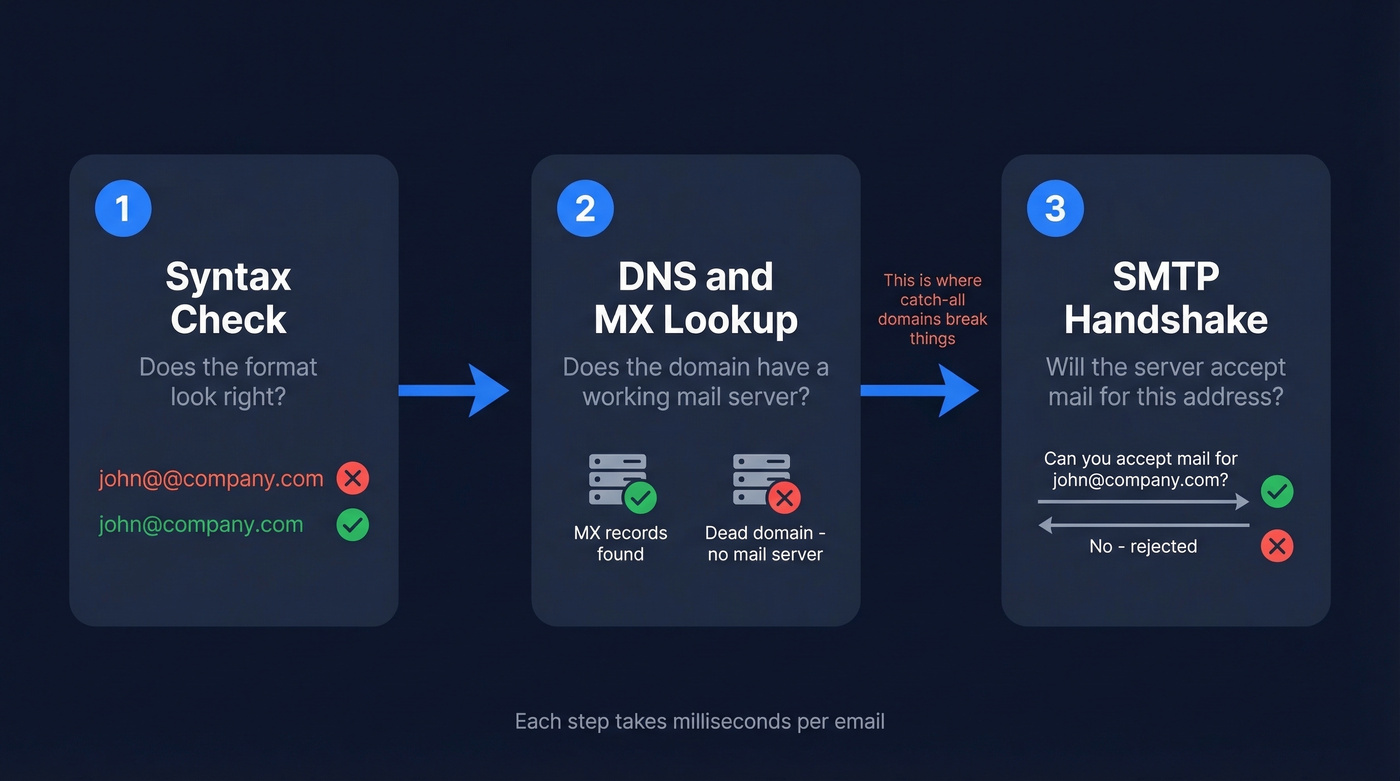
Nearly every checker runs three steps:
- Syntax check. Does the address follow valid formatting rules? Catches typos like "john@@company.com" or missing TLDs.
- DNS and MX lookup. Does the domain have mail exchange records pointing to an active mail server? This eliminates dead domains and parked pages.
- SMTP handshake. The tool connects to the mail server and asks "would you accept a message for this address?" A yes means valid. A rejection means invalid.
The whole process takes milliseconds per email. Where it gets complicated is step three - not every mail server plays along honestly.
Reading Your Results
Every address validator returns results in roughly five categories:
| Status | What It Means | What to Do |
|---|---|---|
| Valid | Mailbox confirmed active | Send confidently |
| Invalid | Mailbox doesn't exist | Remove immediately |
| Catch-All | Server accepts everything | Send cautiously (see below) |
| Unknown | Server didn't respond | Re-verify later or skip |
| Pending | Verification still processing | Wait for final result |
Valid and invalid are straightforward. The trouble lives in the middle three.
Catch-all results are the biggest headache in B2B outbound verification. Unknown usually means the mail server was temporarily unreachable or configured to block verification attempts. The actionable rule: send to valid, delete invalid, and treat everything else as a judgment call based on your bounce tolerance.
The Catch-All Problem
40-60% of B2B email addresses sit on catch-all domains. That's not a rounding error - it's potentially the majority of your list.
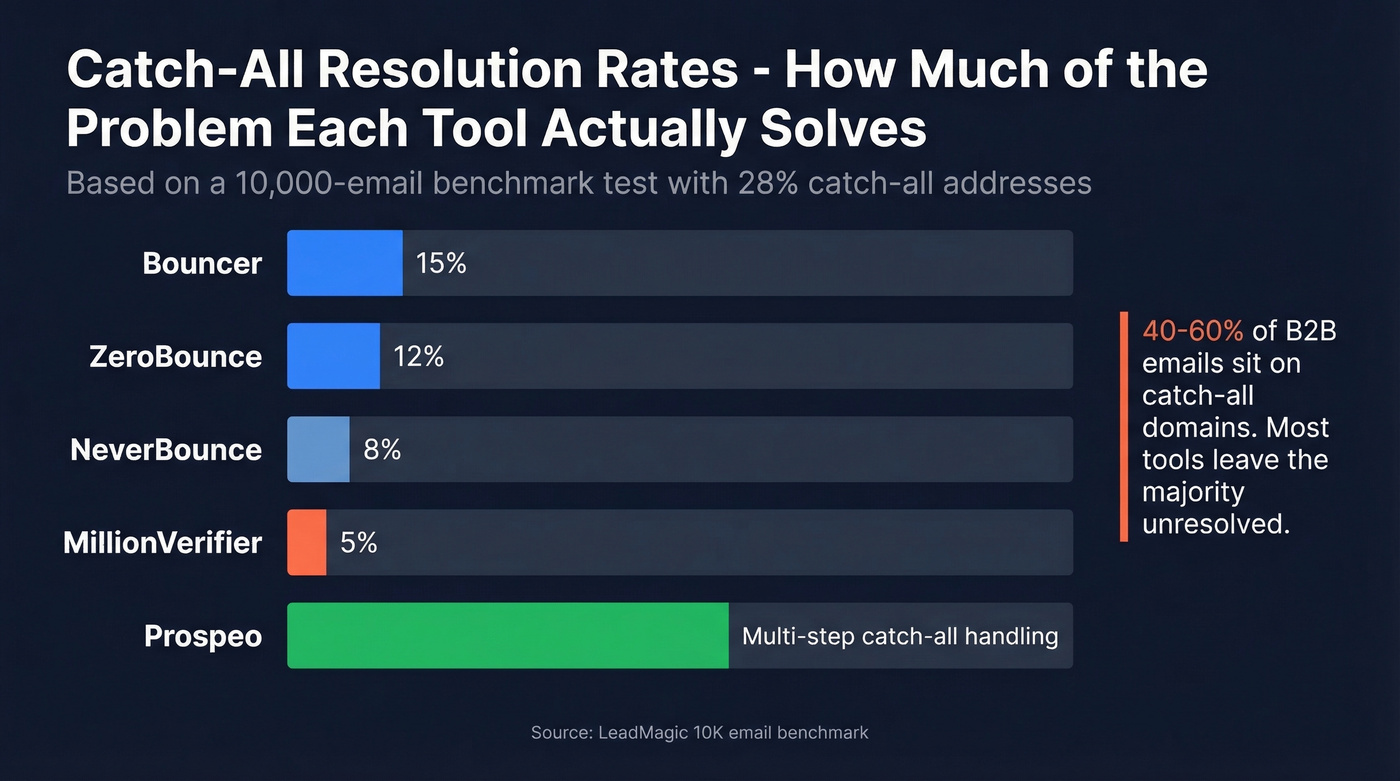
A catch-all domain accepts mail sent to any address, whether the mailbox exists or not. Send to "nobody@bigcorp.com" and the server says "sure, I'll take it." This completely defeats the SMTP handshake, because the server never rejects anything. Your verification tool can't distinguish a real person from a made-up address.
Most tools just label these "catch-all" and leave you to figure it out. In a 10,000-email benchmark test, catch-all resolution rates were grim: ZeroBounce resolved 12%, Bouncer managed 15%, NeverBounce hit 8%, and MillionVerifier scraped by at 5%. We've run lists through enough of these tools to know the catch-all problem is worse than most teams expect - it's the gap between "99% accuracy" marketing copy and real-world results.
Here's the thing: keep your overall bounce rate under 2%. If you're sending to catch-all addresses and bounces creep above that, pull back immediately.

Catch-all domains break most email validity checkers. Prospeo's 5-step verification handles catch-all detection, spam-trap removal, and honeypot filtering - built on proprietary infrastructure, not third-party providers. 98% accuracy at ~$0.01 per email.
Stop guessing on catch-all domains. Verify with 98% accuracy.
How Accurate Are They, Really?
Every verification tool's marketing page says 99%+ accuracy. Independent tests tell a different story.
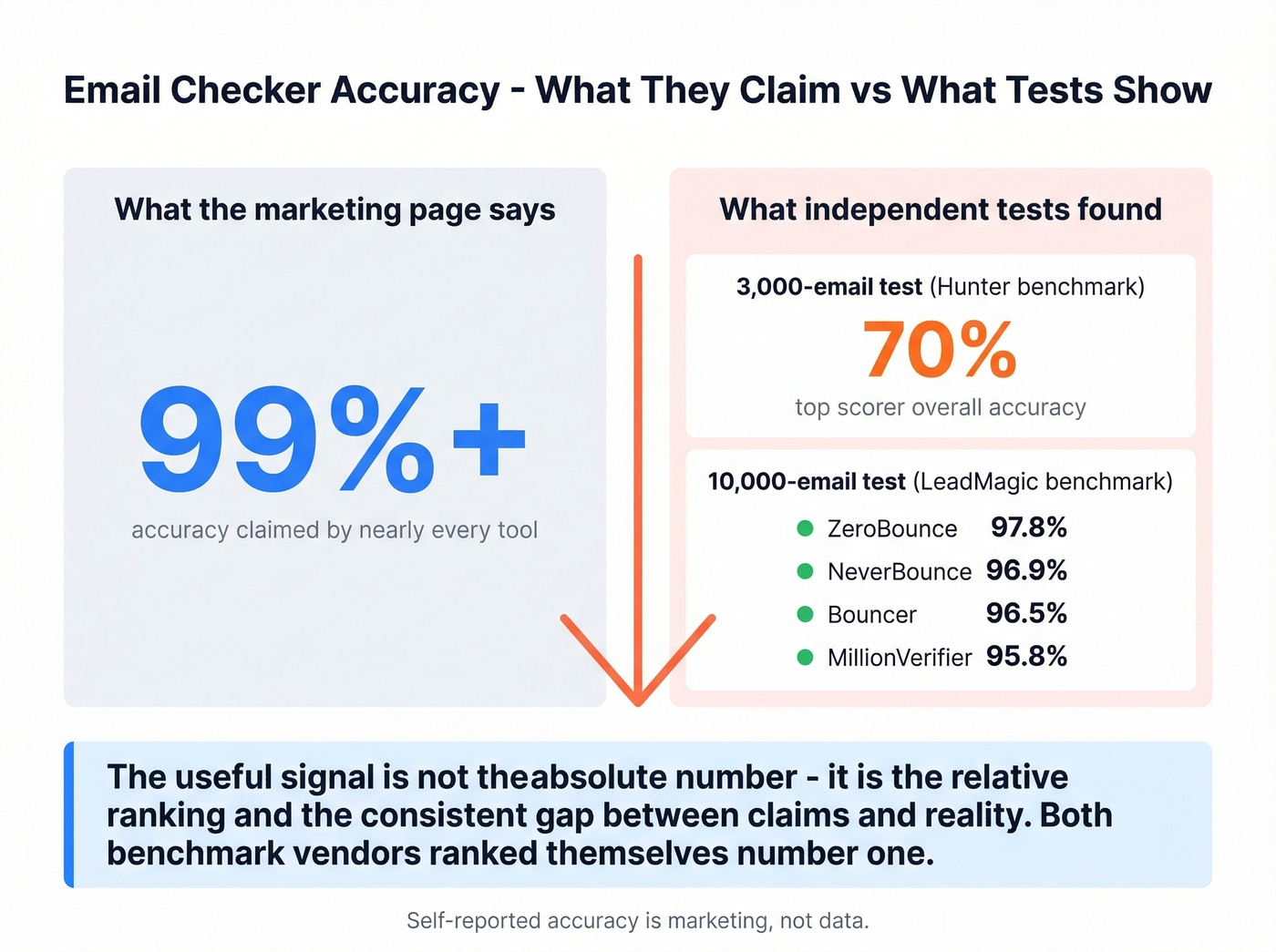
One benchmark tested 15 verification providers using 3,000 real business emails collected from recent outreach campaigns, plus 300 known invalid addresses, all executed inside Clay with default settings. The top scorer hit 70% overall accuracy. Not 99%. Seventy percent. Accuracy dropped further on mid-market and enterprise domains with stricter mail server configurations. The vendor running the test ranked themselves #1 and acknowledged potential bias in their ground-truth methodology - so take the absolute numbers with a grain of salt.
A separate 10,000-email test showed higher numbers: ZeroBounce at 97.8%, NeverBounce at 96.9%, Bouncer at 96.5%, and MillionVerifier at 95.8%. The dataset was 42% corporate emails, 28% catch-all, and 15% known invalid - a more realistic B2B mix. Again, the vendor running this test also ranked themselves #1.
Self-reported accuracy numbers are marketing, not data. The useful signal from these benchmarks isn't that any specific tool scored X% - it's the relative rankings and the consistent gap between claims and reality. If a tool says 99% and tests at 96%, that's fine. If it says 99% and tests at 70%, run.
Best Tools Compared for 2026
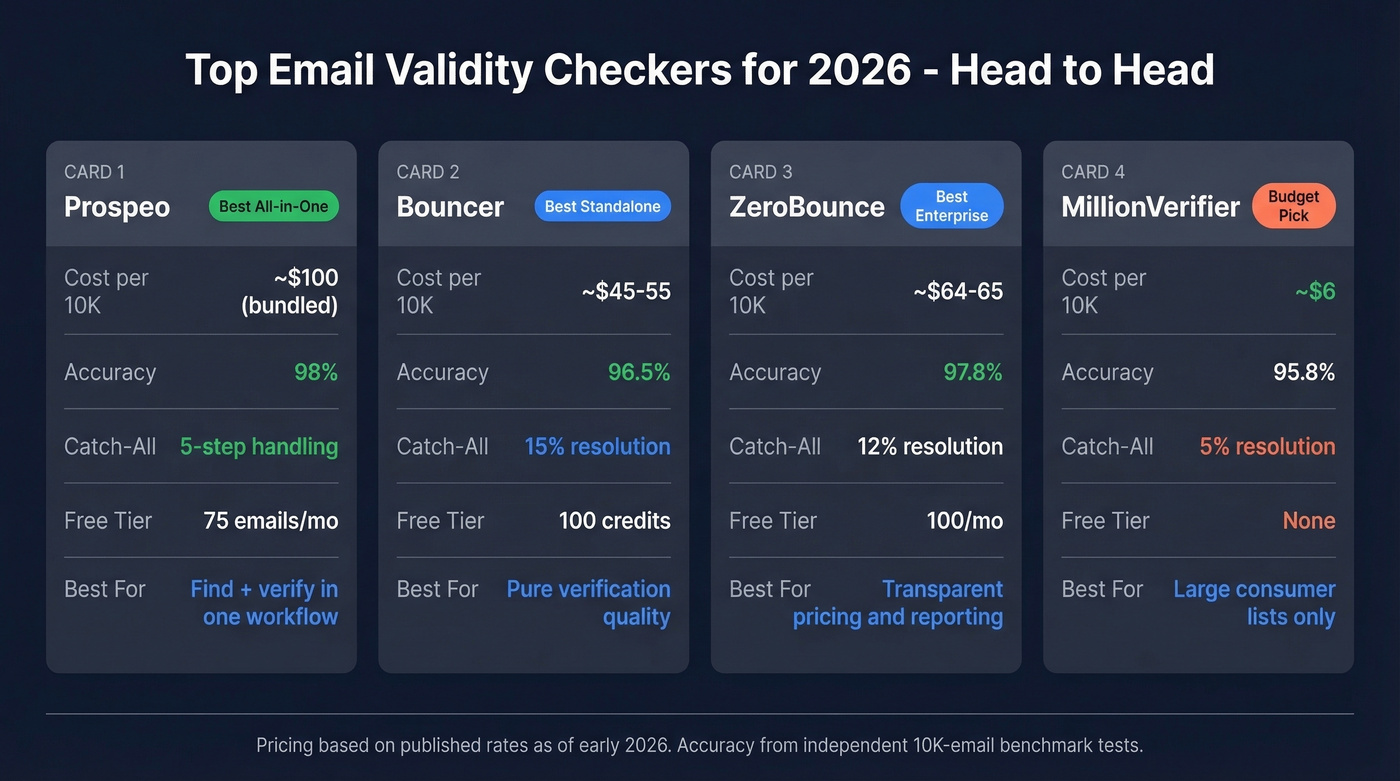
| Tool | Cost per 10K | Free Tier | Catch-All | Best For |
|---|---|---|---|---|
| Prospeo | ~$100 (bundled) | 75 emails/mo | Yes (5-step) | Find + verify |
| Bouncer | ~$45-$55 | 100 credits | Partial (15%) | Standalone quality |
| ZeroBounce | ~$64-$65 | 100/mo | Partial (12%) | Enterprise transparency |
| NeverBounce | ~$50 | 1,000 credits | Weak (8%) | Reliable mid-tier |
| MillionVerifier | ~$6 | None | Minimal (5%) | Budget consumer lists |
| EmailListVerify | ~$24 | 3 checks | Standard | High-volume budget |
| Hunter | ~$149 | 50/mo | Standard | B2B database + verify |
| Kickbox | ~$80 | 100 credits | Standard | Developer API |
| Emailable | ~$50 | 250 credits | Standard | Solid mid-range |
| Clearout | ~$58 | 100 credits | Yes | Feature-rich |
Prospeo
Most verification tools only check addresses you already have. Prospeo finds and verifies in a single platform - no sourcing emails from one tool, exporting a CSV, uploading to a verifier, and reconciling results. You search a 143M+ verified email database and get pre-verified contacts out the other end. The platform runs proprietary email-finding infrastructure rather than relying on third-party data providers, which is why the accuracy holds at 98%.
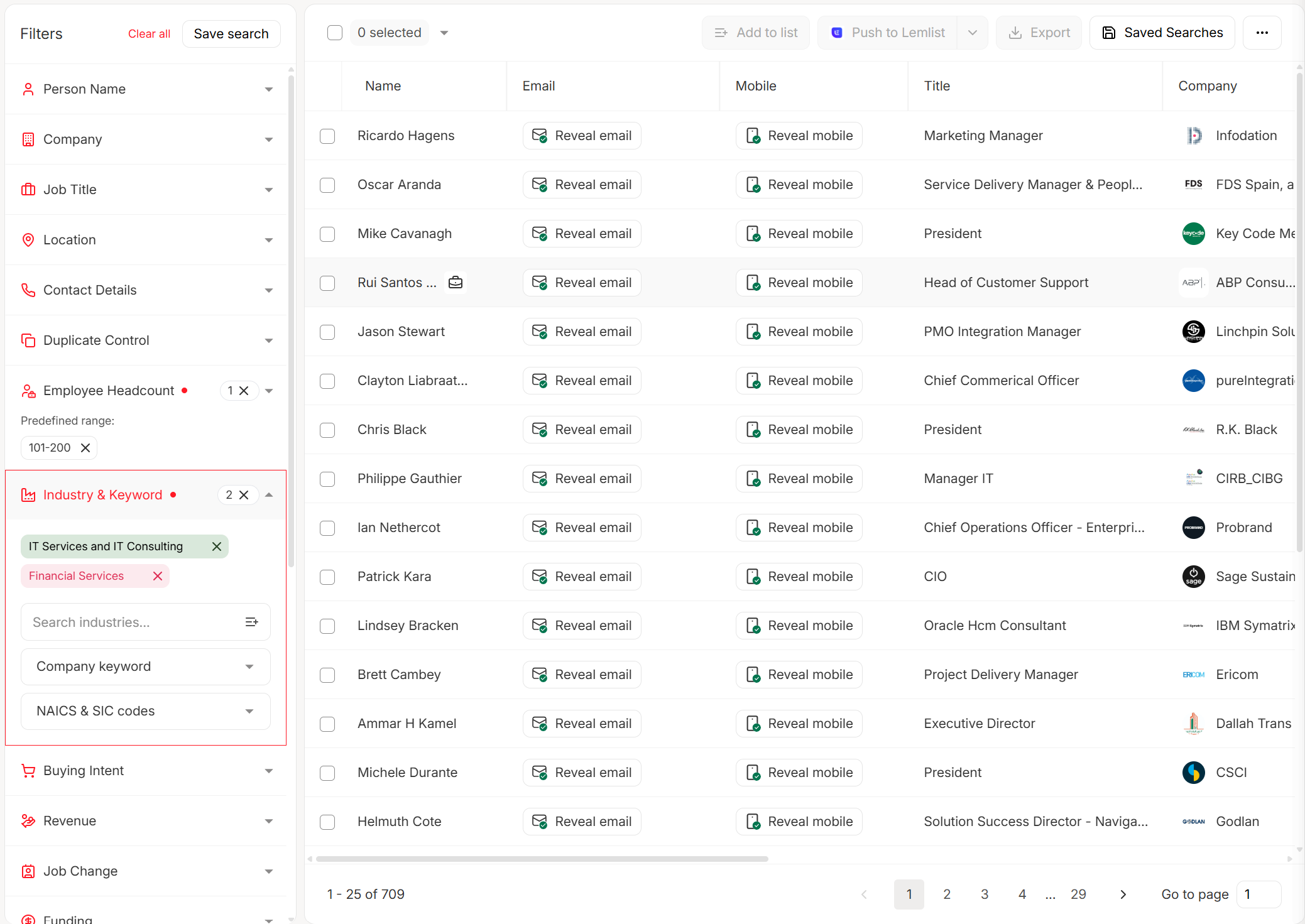
The 5-step verification pipeline includes catch-all handling, spam-trap removal, and honeypot filtering, all running on a 7-day data refresh cycle versus the six-week industry average. Meritt, a B2B agency, went from a 35% bounce rate to under 4% after switching. At ~$0.01 per email with 75 free emails per month plus 100 Chrome extension credits, the economics work for teams of any size.
Bouncer
4.9 on Capterra. 4.8 on G2. 465 reviews combined. Those are the highest ratings in the verification space, and they're earned. Bouncer doesn't try to be a platform - it does one thing and does it well.
In the 10K-email benchmark, it hit 96.5% accuracy with 15% catch-all resolution - above average for a standalone verifier. Pricing runs ~$45-$55 per 10K emails depending on volume, with 100 free credits to start. There's a native Woodpecker integration if you're running cold email through that platform. Skip Bouncer if you need email finding bundled in. It's verification-only, and that's a feature, not a limitation.
ZeroBounce
What makes ZeroBounce different isn't accuracy - it's the pricing model. ZeroBounce publishes a complete volume pricing ladder from $0.0195/credit at 2,000 emails down to $0.003199 at a million. Unknown results are free. Credits never expire. In an industry where most competitors hide behind "contact sales," that transparency matters.
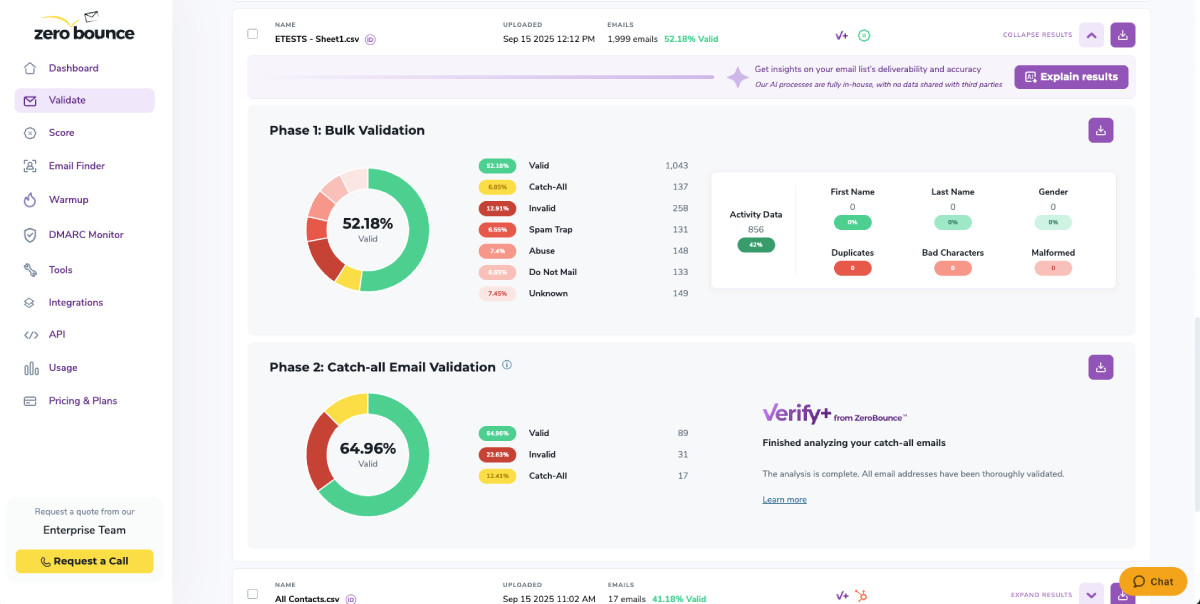
Accuracy-wise, ZeroBounce topped the 10K-email benchmark at 97.8% with 12% catch-all resolution. The ZeroBounce ONE subscription runs $99/mo ($79/mo annually) for 10K credits plus Email Finder searches. It's the enterprise pick for teams that want predictable costs and detailed reporting.
NeverBounce
NeverBounce lands in the reliable-but-unremarkable middle tier. It scored 96.9% accuracy in testing, costs ~$50 per 10K, and offers 1,000 free credits. The catch-all resolution rate of 8% is its weak point - for B2B-heavy lists with corporate catch-all domains, you'll get a pile of unresolved results. For mixed or consumer-leaning lists, it's a solid workhorse.
MillionVerifier
The cheapest option at ~$6 per 10K emails. The tradeoff: 95.8% accuracy in testing and only 5% catch-all resolution. For large consumer email lists where catch-all domains are rare, it's a legitimate budget pick. For B2B outbound where 40-60% of your list is catch-all? You'll save money on verification and spend it on damaged sender reputation.
Hunter, Kickbox, Emailable, Clearout
Hunter charges $149 per 10K - expensive for verification alone, but it bundles a B2B email database and 50 free monthly verifications. Worth it if you're already in Hunter's ecosystem. Kickbox runs $80 per 10K with 100 free credits and a well-documented API that developers prefer. Emailable sits at $50 per 10K with 250 free credits - solid mid-range with nothing to complain about. Clearout costs $58 per 10K and packs a lot of features into its dashboard. None of these are bad choices; they're just not the top picks for most teams.
Why source emails in one tool, export a CSV, upload to a verifier, and pray the data matches? Prospeo finds and verifies in one workflow - 143M+ pre-verified emails, 7-day data refresh, and bounce rates under 4% across 15,000+ companies.
Kill the CSV shuffle. Find and verify emails in one platform.
Mistakes That Kill Verification ROI
Treating verification as a one-time event. Annual professional workforce turnover runs around 41%. Nearly half the emails in a year-old list can be outdated. Re-verify every 3-4 months minimum.
Skipping real-time validation at capture points. Every form submission, webinar registration, and lead magnet download should hit a verification API before the email enters your system. Cleaning a dirty list is always harder than keeping it clean - running a check at the point of entry eliminates bad data before it ever touches your CRM.
Ignoring catch-all results. Labeling 40% of your B2B list as "catch-all" and sending anyway is gambling. Monitor bounce rates on catch-all segments separately and stop sending if they exceed 2%.
Choosing the cheapest tool by default. MillionVerifier at $6 per 10K looks great until you realize it resolved 5% of catch-all addresses versus Bouncer's 15%. The $44 you saved gets eaten by deliverability damage on your first campaign. We've seen this play out with multiple clients - the "savings" evaporate fast.
Not deduplicating before verifying. You're paying per email. Most tools charge for duplicates - ZeroBounce is a notable exception. Deduplicate first, verify second.
How to Choose the Right Tool
Your pick depends on three things: what you need, how much you're sending, and whether you already have the emails.
For teams that need to build lists and verify them, a bundled finder-verifier approach saves real time. One platform, one cost, no CSV juggling between tools.
When you already have emails and want the best standalone verifier, Bouncer is the pick. Highest ratings, strong accuracy, fair price.
Enterprise teams that need full pricing transparency should look at ZeroBounce. Volume discounts, unknowns are free, and credits don't expire - finance teams love that.
When budget is the only constraint, MillionVerifier works for consumer lists and EmailListVerify handles B2B volumes at a reasonable cost. For developer-friendly APIs, Kickbox and ZeroBounce both have well-documented endpoints with predictable response formats. And if you just need a quick online checker for one-off lookups, most tools offer a free single-email check on their homepage.
Let's be honest: for most B2B outbound teams, the real decision is between a bundled finder-verifier workflow or a dedicated standalone verifier like Bouncer. Everything else is a niche pick. The market has largely converged on the same handful of tools - the differences come down to catch-all handling, pricing mechanics, and workflow fit. Whichever email validity checker you land on, the important thing is that you're actually using one before every campaign.
If you’re tightening deliverability end-to-end, pair verification with sender reputation work, monitor bounce rate trends, and keep your authentication clean (start with DMARC alignment and SPF records).
FAQ
Is email verification legal?
Yes. Verification checks technical deliverability - it doesn't send marketing content or require consent under GDPR or CAN-SPAM. You're confirming whether a mailbox exists, not emailing anyone.
How often should I re-verify my list?
Every 3-4 months. With 41% annual workforce turnover, emails decay fast. Validate in real time at capture points and run bulk re-verification quarterly to keep bounce rates under 2%.
Can I verify catch-all emails?
Standard SMTP checks can't - the server accepts everything. Dedicated catch-all handling resolves some, but expect 5-15% resolution rates from most providers. Bouncer resolves about 15%, which is the high end for standalone tools.
What's the difference between validation and verification?
Validation checks format and syntax - does the address look right? Verification confirms the mailbox is active via MX and SMTP checks. Most email validity checkers combine both steps automatically, so you rarely need to worry about the distinction in practice.
Are free verification tools accurate enough?
For single-email spot checks, free tools like ZeroBounce's free verifier work fine. For bulk list cleaning, paid tools at $6-$65 per 10K are the practical minimum - free tiers cap at 50-250 credits, which won't cover a real campaign.