

Best Email Verifier Apps in 2026 - Tested and Ranked
You uploaded 50,000 contacts to your sequencer, hit send, and watched the bounce rate climb past 8% by morning. Your ESP flagged the domain. Three weeks of pipeline work, torched because the list was dirty.
That's the most common email ops failure we see, and it's entirely preventable with the right email verifier app. B2B email lists degrade by 20-30% per year as people change jobs, companies rebrand, and domains expire. Below 2% bounce rate, you're healthy. Above 5%, your sender reputation is actively degrading. The gap between those numbers is where your choice of verification tool matters most.
Here's the thing most listicles skip: "email verifier app" covers three completely different product categories. Let's sort that out before ranking anything.
Mobile App vs Extension vs Web Platform
People searching for an email verification app often want three very different things, and understanding which form factor you need saves you from picking the wrong tool entirely.
| Form Factor | Best For | Limitations | Examples |
|---|---|---|---|
| Mobile app | Quick single-email checks | No bulk, no API, no integrations | Various Android/iOS apps |
| Browser extension | Verifying while prospecting | Limited to one-at-a-time | Prospeo (40,000+ Chrome extension users) |
| Web platform | Bulk list cleaning + API | Requires desktop workflow | Bouncer, ZeroBounce, Emailable |
Mobile apps are fine if you need to check one address before sending a cold email from your phone - and that's it. No bulk upload, no API, no CRM push. For anything beyond a quick spot-check, you need a web platform or browser extension.
Our Top Picks
| Pick | Tool | Why |
|---|---|---|
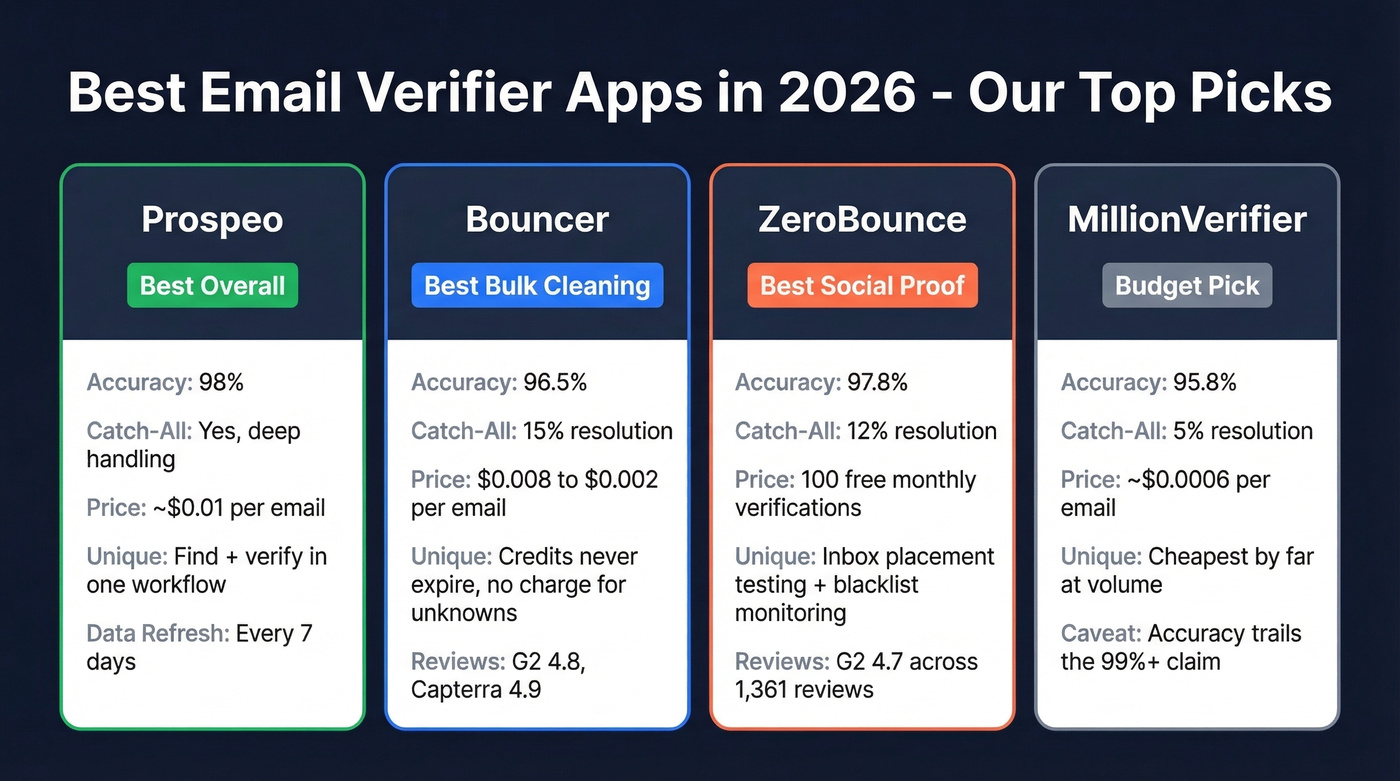
| Best overall (find + verify) | Prospeo | 98% accuracy, catch-all handling, 7-day refresh |
| Best bulk list cleaning | Bouncer | Credits never expire, no charge for unknowns, deep catch-all verification |
| Best for reviews + free monthly allowance | ZeroBounce | 100 free monthly verifications, G2 4.7/5 across 1,361 reviews |
| Budget pick | MillionVerifier | ~$0.0006/email at volume - cheapest by far, accuracy trails its "99%+" claim |
How Email Verification Works
Every verification tool runs some version of the same pipeline. The difference is how many steps they actually complete - and how they handle the hard cases.
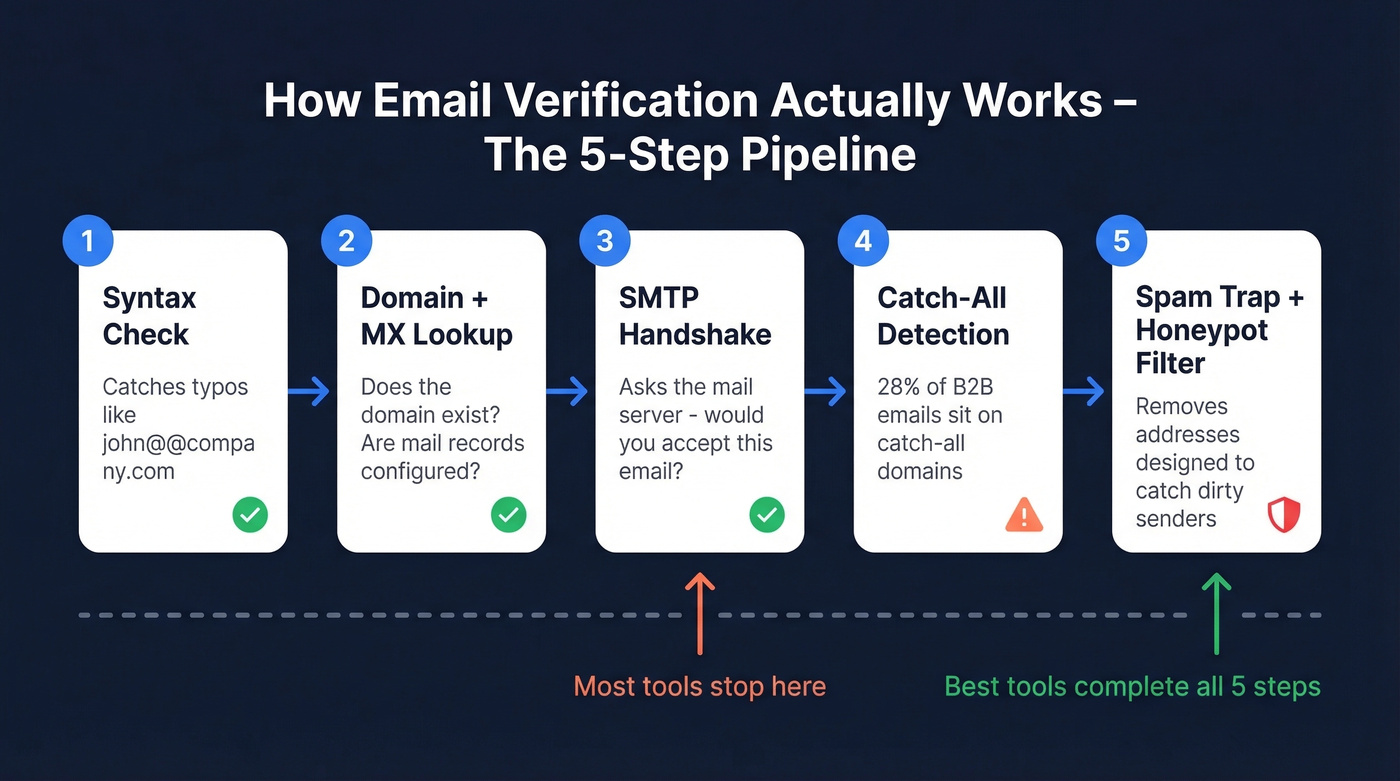
Step 1 - Syntax check. Does the address follow valid formatting rules? Catches typos like "john@@company.com" instantly.
Step 2 - Domain and MX lookup. Does the domain exist? Does it have mail exchange records configured? This eliminates dead domains.
Step 3 - SMTP handshake. The tool connects to the mail server and asks "would you accept mail for this address?" without actually sending anything. This is where most verification happens.
Step 4 - Catch-all detection. Some domains accept mail for any address - real or fake. About 28% of B2B emails sit on catch-all domains. Tools that stop here label these "unknown" and leave you guessing.
Step 5 - Spam trap and honeypot filtering. The best tools cross-reference against known spam traps and honeypot addresses that exist solely to catch senders with dirty lists.
Catch-all handling is where tools diverge most. In independent testing, catch-all resolution rates ranged from 5% to 94.2% across tools. That gap determines whether you're ignoring a quarter of your list or actually reaching those contacts.
One thing enterprise buyers should verify before signing: compliance posture. Ask about SOC 2 certification, GDPR data handling, and data retention policies. Not every tool in this space meets that bar.
Independent Accuracy Data
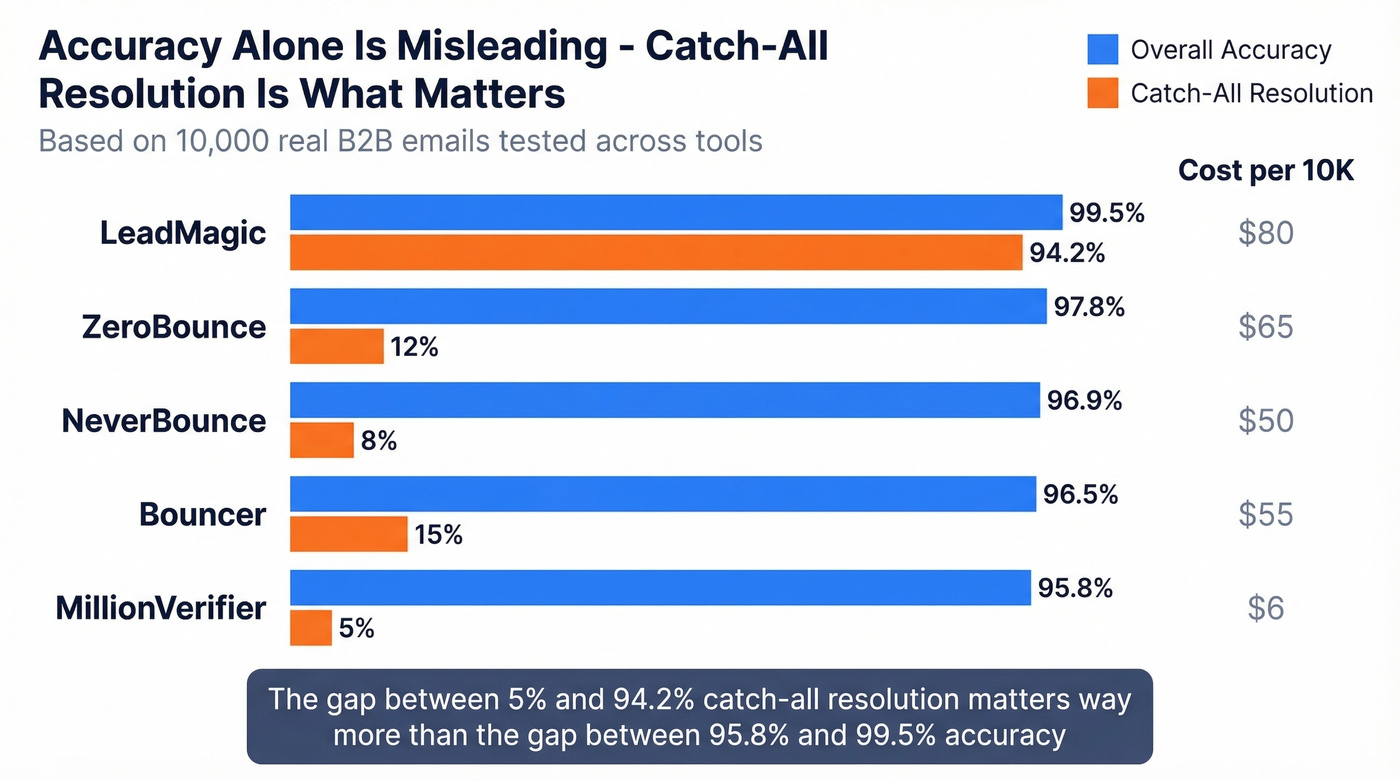
The most rigorous public test we've found comes from a LeadMagic bake-off that ran 10,000 real B2B emails across 10 tools within a 48-hour window. The email mix included 42% corporate, 28% catch-all, 15% known invalid, 5% disposable, and the rest role-based, free providers, and typo domains.
| Tool | Accuracy | Catch-All Resolution | Speed (10K) | Cost per 10K |
|---|---|---|---|---|
| LeadMagic | 99.5% | 94.2% | 14 min | ~$80 |
| ZeroBounce | 97.8% | 12% | 22 min | ~$65 |
| NeverBounce | 96.9% | 8% | 18 min | ~$50 |
| Bouncer | 96.5% | 15% | 25 min | ~$55 |
| MillionVerifier | 95.8% | 5% | 35 min | ~$6 |
Full transparency - LeadMagic built one of the tested tools and ranked themselves #1. Take that specific ranking with context. But the comparative data across the other tools is still the most rigorous publicly available benchmark we've seen.
Stop comparing tools by accuracy percentage alone. The difference between 95.8% and 97.8% matters less than the difference between 5% and 94.2% catch-all resolution. If 28% of your list sits on catch-all domains and your tool resolves only 5% of those, you're leaving a massive chunk of your pipeline unverified.
If your deal sizes are mostly in the SMB range, you probably don't need the most expensive verifier on this list. But you absolutely need one that handles catch-all domains. That's the line between "good enough" and "burning money."

Most verifier apps stop at step 3. Prospeo's 5-step pipeline handles catch-all domains, spam traps, and honeypots - the hard cases that wreck your sender reputation. 98% accuracy, 7-day data refresh, $0.01 per email.
Find and verify emails in one workflow - 75 free credits, no card required.
Best Email Verifier Apps Reviewed
Prospeo - Best for Find-and-Verify
Most verification tools assume you already have a list. Prospeo starts earlier - it finds the emails and verifies them in the same workflow. The database covers 300M+ professional profiles with 143M+ verified emails, all running through a 5-step verification pipeline that includes catch-all handling, spam trap removal, and honeypot filtering.
The 98% email accuracy rate comes from proprietary infrastructure. Prospeo doesn't farm verification out to third-party providers, which means verification quality stays consistent regardless of external infrastructure changes. Data refreshes every 7 days - the industry average is 6 weeks, which is an eternity in B2B where people change jobs constantly.
Native integrations push verified contacts directly into Salesforce, HubSpot, Smartlead, Instantly, Lemlist, Clay, Zapier, and Make. Pricing runs ~$0.01 per email with 75 free verifications per month. No contracts, no annual commitment.
Real-world proof: Meritt cut their bounce rate from 35% to under 4% after switching, tripling their pipeline from $100K to $300K per week.
Use it if: You're building prospect lists from scratch and want finding + verification in one workflow.
Skip it if: You already have a massive CSV and just need a bulk-only cleaner - pair with a tool like Bouncer for that.
Your list degrades 20-30% per year. Prospeo refreshes every 7 days - not 6 weeks like the industry average. Meritt cut their bounce rate from 35% to under 4% and tripled pipeline to $300K/week.
Stop cleaning stale data. Start with emails that are already verified.
Bouncer - Best for Bulk List Cleaning
Bouncer is the tool you reach for when you've already got the list and need it cleaned before launch day. Over 4 billion emails verified, less than 2% unknowns returned, and a credit policy that actually respects your budget: credits never expire, and you don't get charged for unknowns or duplicates.
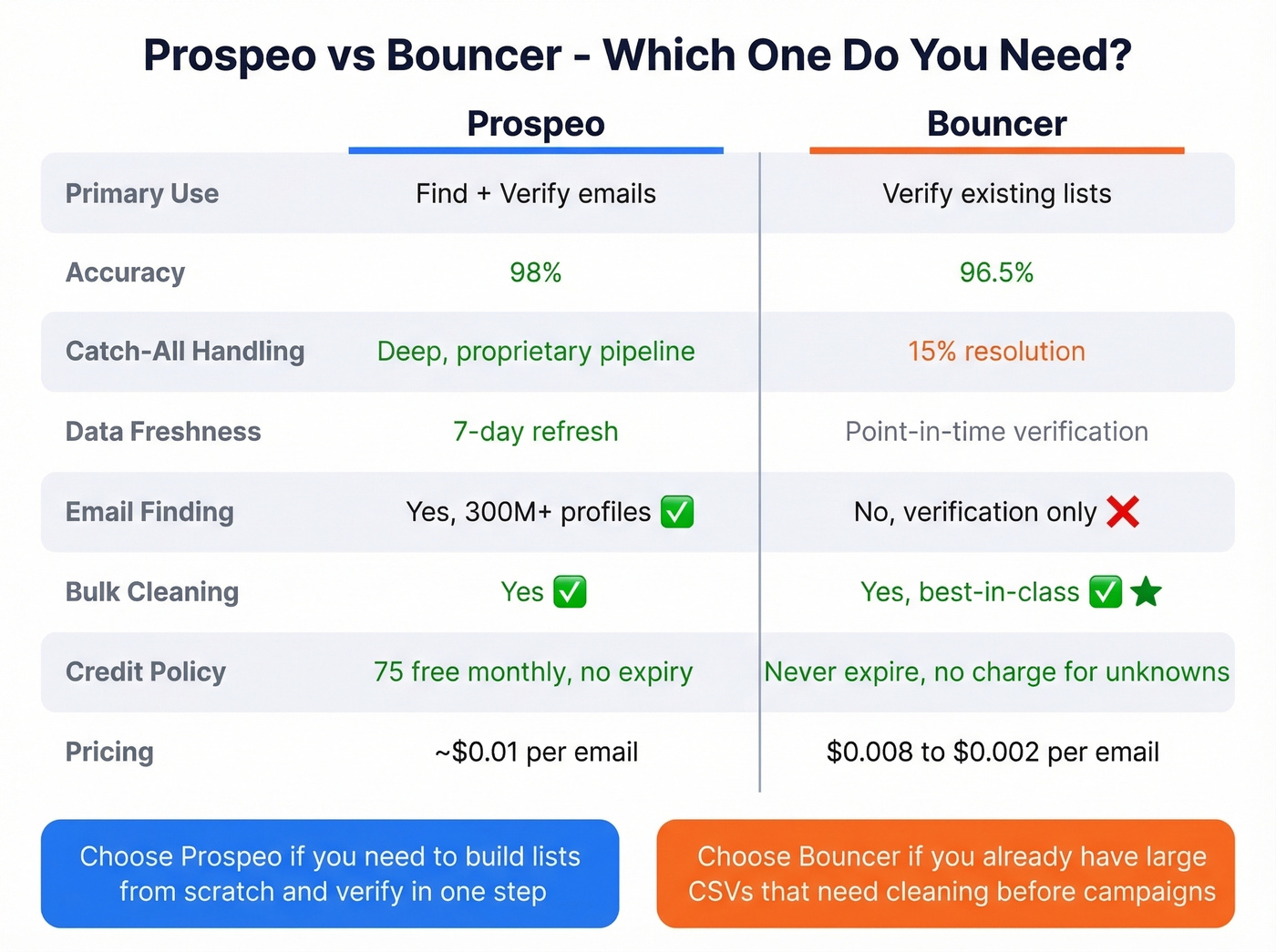
The deep catch-all verification feature is Bouncer's standout. In the LeadMagic bake-off, Bouncer hit 96.5% accuracy with 15% catch-all resolution - not the highest, but solid for a pure verification play. The toxicity check scores addresses on a 0-5 scale, flagging risky contacts before they tank your deliverability.
Pricing is straightforward: $8 per 1,000 emails, dropping to $2 per 1,000 at the million-email tier. G2 rating sits at 4.8, Capterra at 4.9 across 233 reviews - some of the highest scores in the category. We've used Bouncer for large list-cleaning jobs and the results are consistently reliable, though you'll want a separate tool for email finding since Bouncer is verification-only.
Use it if: You're cleaning large lists regularly and want a no-nonsense bulk verifier with fair credit policies.
Skip it if: You need email finding built in.
ZeroBounce - Social Proof Leader
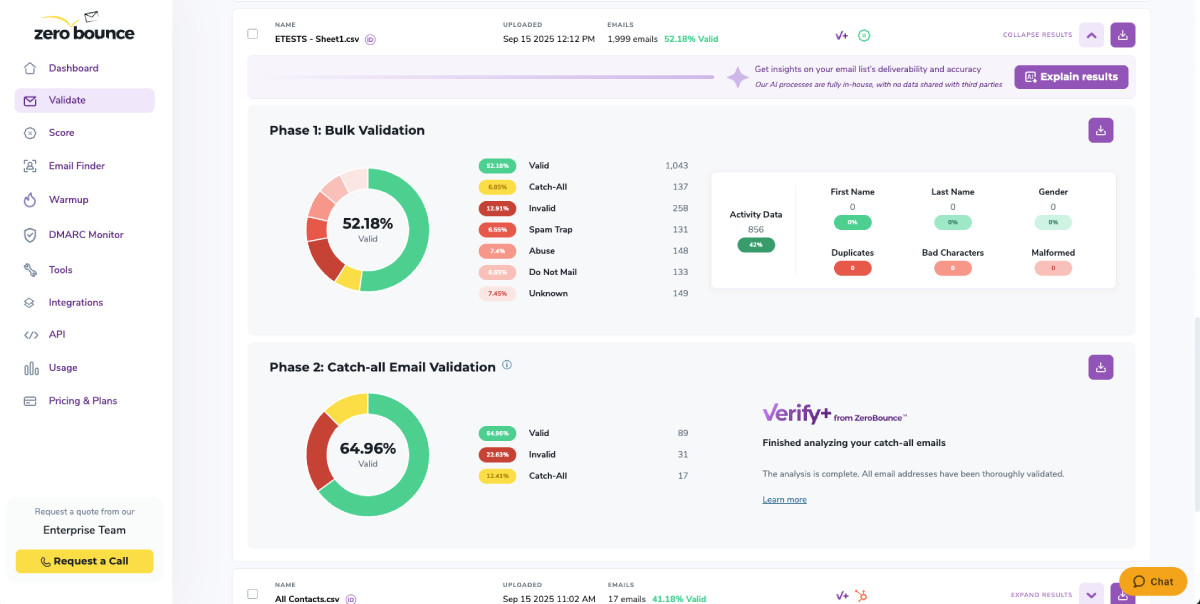
ZeroBounce is one of the most-reviewed standalone verifiers on G2 - 4.7/5 across 1,361 reviews - and that kind of social proof matters when you're trusting a tool with your sender reputation. The 100 free monthly verifications on a business domain, plus deliverability tools like inbox placement testing and blacklist monitoring, make it easy to start without commitment. Unknown results don't consume credits.
In the LeadMagic test, ZeroBounce posted 97.8% accuracy - second-highest overall - but only 12% catch-all resolution. That's a meaningful gap if your list skews toward catch-all domains. One thing to know: ZeroBounce's Email Finder feature consumes 20 credits per successful query, so budget accordingly if you're using it for both finding and verification.
A recurring friction point in reviews: some users get confused between pay-as-you-go and subscription billing. Support resolves it quickly, but worth knowing before you buy.
Use it if: You want a generous free monthly allowance with solid accuracy and built-in deliverability reporting.
Skip it if: Catch-all resolution is critical for your email mix - 12% won't cut it.
NeverBounce - Best for Automation
Here's the catch with NeverBounce that most reviews bury: credits expire after 12 months. If you're buying in bulk for quarterly campaigns, that clock is ticking. Bouncer and Emailable never expire your credits.
That said, NeverBounce earns its spot because the automation and sync features are genuinely best-in-class for teams running recurring list imports. Pricing runs $0.008 per email on pay-as-you-go, with a $49/month Growth plan covering 10,000 emails. In the bake-off, NeverBounce hit 96.9% accuracy but only 8% catch-all resolution. A separate Lemlist test pegged accuracy at 93% - notably lower than the vendor claim.
Use it if: You need automated, recurring verification synced to your CRM or ESP.
Skip it if: You buy credits in bulk and don't want them expiring on you.
Emailable - Fastest Bulk Processing
Speed is Emailable's headline feature: 30,000+ emails verified per minute, with 100,000 processed in under three minutes. You get 250 free credits to start, credits never expire, and unknowns are free. The 1% deliverability guarantee means they'll stand behind their "deliverable" verdicts.
Emailable also detects Secure Email Gateways like Proofpoint, Mimecast, and Barracuda, which is useful for outbound teams targeting enterprise accounts where gateway filtering can mess with verification results. Note that deliverability add-ons like Inbox Reports and Blacklist Monitors consume credits separately. Minimum purchase is 5,000 credits.
Use it if: Processing speed is your top priority and you're cleaning large lists on tight timelines.
Skip it if: You need a free tier larger than 250 credits to properly evaluate the tool.
Clearout - Strong Catch-All Handling
In a Reddit spot test where a user ran a known-working email through five tools, Clearout was one of only two that returned "valid" - the other three flagged it as invalid. Small sample, but it aligns with Clearout's reputation for accuracy on the hard cases. Pricing starts at $0.007 per email on pay-as-you-go, with monthly plans from ~$31.50. G2 rating: 4.7 across 307 reviews.
Use it if: Your list is heavy on catch-all domains and you need a verifier that doesn't punt on the hard addresses.
Skip it if: You need a broader platform with email finding built in.
Hunter - Best for Occasional Checks
Hunter is primarily an email-finding platform, but its built-in verification is solid for light use. You get 50 free verifications per month - enough for a founder doing manual outreach. Beyond that, pricing jumps to $49/month for 1,000 verifications or $149/month for 10,000. That makes Hunter one of the more expensive options at volume.
If you're already using Hunter for email finding, the verification is a convenient add-on. For anything at scale, look elsewhere.
Use it if: You're already in Hunter's ecosystem and verify fewer than 1,000 emails per month.
Skip it if: You need volume pricing - $149 for 10K emails is steep compared to Bouncer's $60.
MillionVerifier - Budget Pick
At ~$0.0006 per email at volume, MillionVerifier is the cheapest option by a wide margin. But the LeadMagic bake-off showed 95.8% accuracy and just 5% catch-all resolution - well below the "99%+" claim on their site. You get what you pay for.
Kickbox - Developer-First
Kickbox offers 100 free verifications and starts at $5 for 500 credits. It's an API-first tool popular with developers building real-time verification into signup forms and registration flows. Not built for bulk prospecting list cleaning.
Pricing Comparison
| Tool | Free Tier | Cost/1K | Cost/10K | Credits Expire? | Best For |
|---|---|---|---|---|---|
| Prospeo | 75/mo | ~$10 | ~$100 | Never | Find + verify |
| Bouncer | 100 | $8 | $60 | Never | Bulk cleaning |
| ZeroBounce | 100/mo | $8 | ~$65 | Never | Free allowance + reporting |
| NeverBounce | - | $8 | ~$50 | 12 months | CRM automation |
| Emailable | 250 | ~$5 | ~$40 | Never | Speed |
| Clearout | 100 | $7 | ~$60 | - | Catch-all domains |
| Hunter | 50/mo | $49 | ~$149 | - | Occasional checks |
| MillionVerifier | 0 | ~$0.60 | ~$6 | - | Budget |
| Kickbox | 100 | $10 | ~$80 | - | Developer API |
Most tools listed don't charge for unknown results, which is now table stakes. Credit expiry policies are where the real differences hide. Bouncer, Prospeo, and Emailable never expire your credits. NeverBounce gives you 12 months. If you're buying credits in bulk for quarterly campaigns, that difference adds up fast.
Why Verifiers Disagree
Run the same email through five verification tools and you'll get two "valid" results and three "invalid." A Reddit user documented exactly this - Hunter, Site24x7, and Mails.so all flagged a known-working address as invalid, while Verifalia and Clearout correctly returned "valid."
The culprit is dirty IP addresses. Verification tools connect to mail servers from their own IP pools. If those IPs have been flagged or burned from overuse, the receiving server rejects the connection - and the tool interprets that rejection as "invalid email." The email isn't bad. The verifier's infrastructure got blocked.
Our recommendation: Run your list through two or three verification tools. The overlap between "valid" results is your safest-to-send segment. The consensus on r/coldemail backs this up - multiple providers outperform any single one.
If you're still seeing bounces after verification, the issue is usually upstream: list source quality, targeting, or sending practices. Pair verification with a tighter lead generation workflow and better targeted email campaigns to keep deliverability stable.
Bounce Rate Benchmarks
Before you pick a tool, know what "good" looks like for your industry.
| Industry | Avg. Bounce Rate |
|---|---|
| Ecommerce | 0.19% |
| IT / Tech / Software | 0.90% |
| Financial Services | 1.20% |
| Government | 1.30% |
| Construction / Manufacturing | 2.20% |
Source: ListMint industry benchmarks.
Under 2% is healthy. Between 2% and 5% means your list needs cleaning. Above 5%, your sender reputation is actively degrading and ESPs will start throttling or blocking you. If you're in construction or manufacturing where the industry average already pushes 2.2%, monthly verification isn't optional - it's survival.
FAQ
What's a catch-all email and why does it matter?
A catch-all domain accepts mail sent to any address, including fake ones. Most verifiers label these "unknown" instead of resolving them. Since roughly 28% of B2B emails sit on catch-all domains, tools with dedicated catch-all handling save you from ignoring a quarter of your list.
How often should I verify my email list?
Monthly at minimum if you're actively sending. B2B lists degrade by 20-30% per year, so high-volume senders should verify weekly or use real-time verification at the point of collection.
Is a free email verifier app accurate enough?
Free tiers work for testing accuracy on a small sample. For production campaigns, free tools often lack catch-all handling, speed, and API access. Start free to confirm the tool fits your email mix, then upgrade for volume.
Can I verify emails on my phone?
Mobile email checker apps exist on Android and iOS, but they're limited to single-address lookups with no bulk upload, API, or CRM integration. For anything beyond a quick spot-check, use a web platform or browser extension.
Why do different verifiers give different results?
Verification tools use different IP pools to connect to mail servers. Flagged or overused IPs cause false "invalid" results. Different SMTP strategies and catch-all handling also produce varying outcomes. Running your list through two tools and keeping the overlap is the safest approach.