

Emailchaser vs Leadsforge: They Don't Do the Same Thing
These two tools aren't competitors. One sends cold emails. The other finds leads using AI. Comparing them is like comparing your sequencer to your database - different jobs entirely. But if you're weighing both, the real question isn't which one wins. It's whether either one solves the problem that actually kills your outbound: bad data.
30-Second Verdict
Budget cold email sending: Emailchaser's $1/mo Starter gets you one email account. The real plan is $297/mo.
AI-driven lead lists: Leadsforge's conversational ICP search is clever, but G2 reviewers rate Apollo, ZoomInfo, and Instantly as better at meeting requirements.
Feature Comparison Table
Here's how the three stack up on what actually matters.
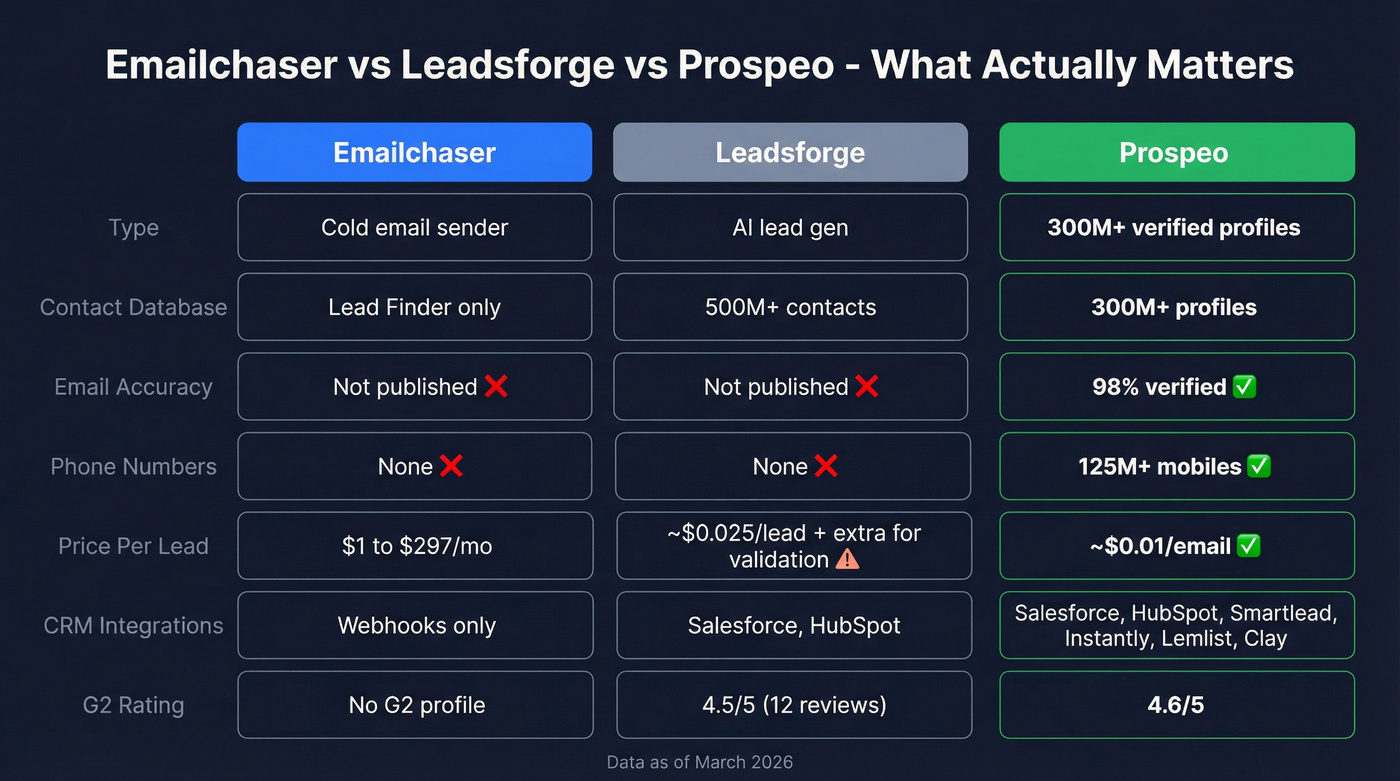
| Type | Cold email sender | AI lead gen | B2B data platform |
| Contact data | Lead Finder exports from professional profiles | 500M+ contacts | 300M+ professional profiles |
| Pricing | Starter $1/mo; Professional $297/mo | $49/mo+ (higher tiers $99-$199/mo) | ~$0.01/email |
| Email verification | Double verification (Enrichley + BounceBan) | Costs extra credits | 98% built-in |
| G2 rating | No profile | 4.5/5 (12 reviews) | 4.6/5 |
| Trustpilot | No profile | 4.0/5 (11 reviews) | - |
| Phone numbers | None | None | 125M+ mobiles |
| Integrations | Webhooks only | Salesforce, HubSpot | Native CRM + outreach tool integrations |
| Best for | Budget cold email sending | AI-driven ICP search | Verified contact data |
Emailchaser Overview
Use this if: You want a dead-simple cold email sender with unlimited seats and don't need complex conditional sequences. The $1/mo Starter and a free trial make it low-risk to test a single-account setup.
Skip this if: You need conditional follow-up logic or native CRM integrations. The only integration path is webhooks, and the founder argues email warm-up is unnecessary, so there's no built-in warm-up either.
Emailchaser markets inbox rotation, but third-party analysis has described it as lacking native inbox rotation. If that's critical for your workflow, verify it in-product before committing.
The pricing history is a mess. Woodpecker documented it at $37/$97 per month in late 2025. Now the pricing page shows $1/$297. We checked the founder's own comparison page and the pricing page on the same day - the comparison page says Professional costs "$1/month," while the pricing page shows Starter at $1/month and Professional at $297/month. That kind of inconsistency doesn't inspire confidence.
Reddit sentiment on r/coldemail isn't reassuring either. The most upvoted thread asks whether Emailchaser reviews are from real customers or the company itself.

Neither Emailchaser nor Leadsforge publishes an accuracy rate. Prospeo does: 98% verified emails, 5-step verification, catch-all handling, and spam-trap removal. At $0.01/email, you pay less than Leadsforge's per-lead cost - and you don't burn extra credits on validation.
Stop guessing about data quality. Start with 75 free verified emails.
Leadsforge Overview
Leadsforge takes a different approach: describe your ICP in plain language and get lead lists back. The conversational interface is genuinely different from traditional filter-based search, and you get 100 free credits on signup to test it. Unused credits roll over month to month, which is a nice touch.
The problems show up after that initial novelty. Email validation costs extra credits on top of the $49/mo base for 2,000 leads - a common complaint on Trustpilot. Higher tiers run $99-$199/mo. Multiple reviewers flag inconsistent export data, no phone numbers, and weak Latin American coverage. On G2, reviewers rate Apollo, ZoomInfo, Instantly, and Cognism as all "better at meeting requirements." One Trustpilot reviewer put it bluntly: "nothing really works, hard to cancel." Leadsforge hasn't replied to negative reviews.
Then there's the branding confusion: Salesforge, Leadsforge, Mailforge, Infraforge, Warmforge, Agent Frank. Separate products, one umbrella, maximum confusion. We've seen teams sign up for the wrong product in that ecosystem more than once.
The Data Quality Gap
Here's the thing: neither tool publishes a verified accuracy rate. And that's the gap that matters most.

Reddit users who've tested AI lead gen platforms report 19-31% bounce rates compared to 8% from manual prospecting. Even Apollo - the most popular lead database - delivers 32-38% bounce rates in user tests shared on Reddit. Emailchaser's double verification uses Enrichley and BounceBan. Leadsforge charges extra credits for validation and still delivers inconsistent data.
If you want a deeper benchmark on acceptable bounce rates, see our guide to bounce rates.
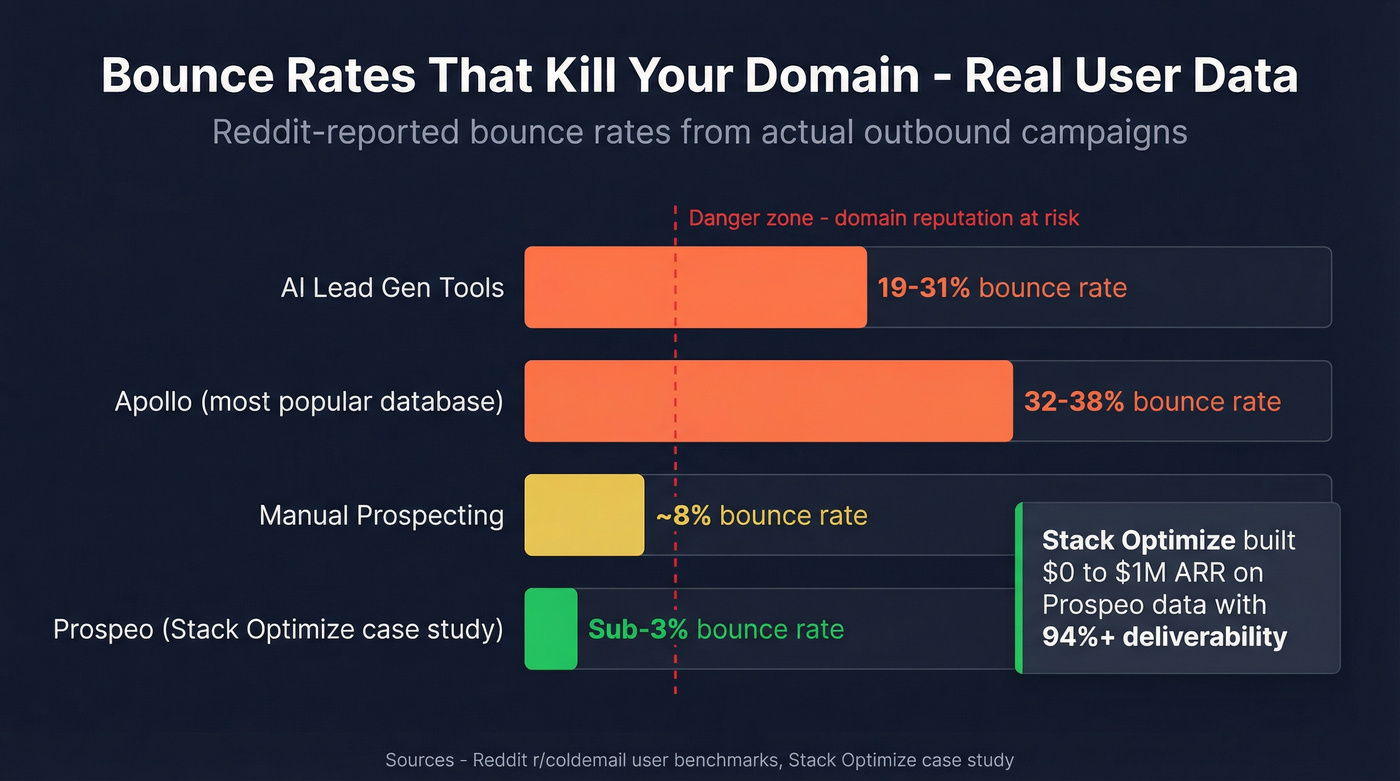
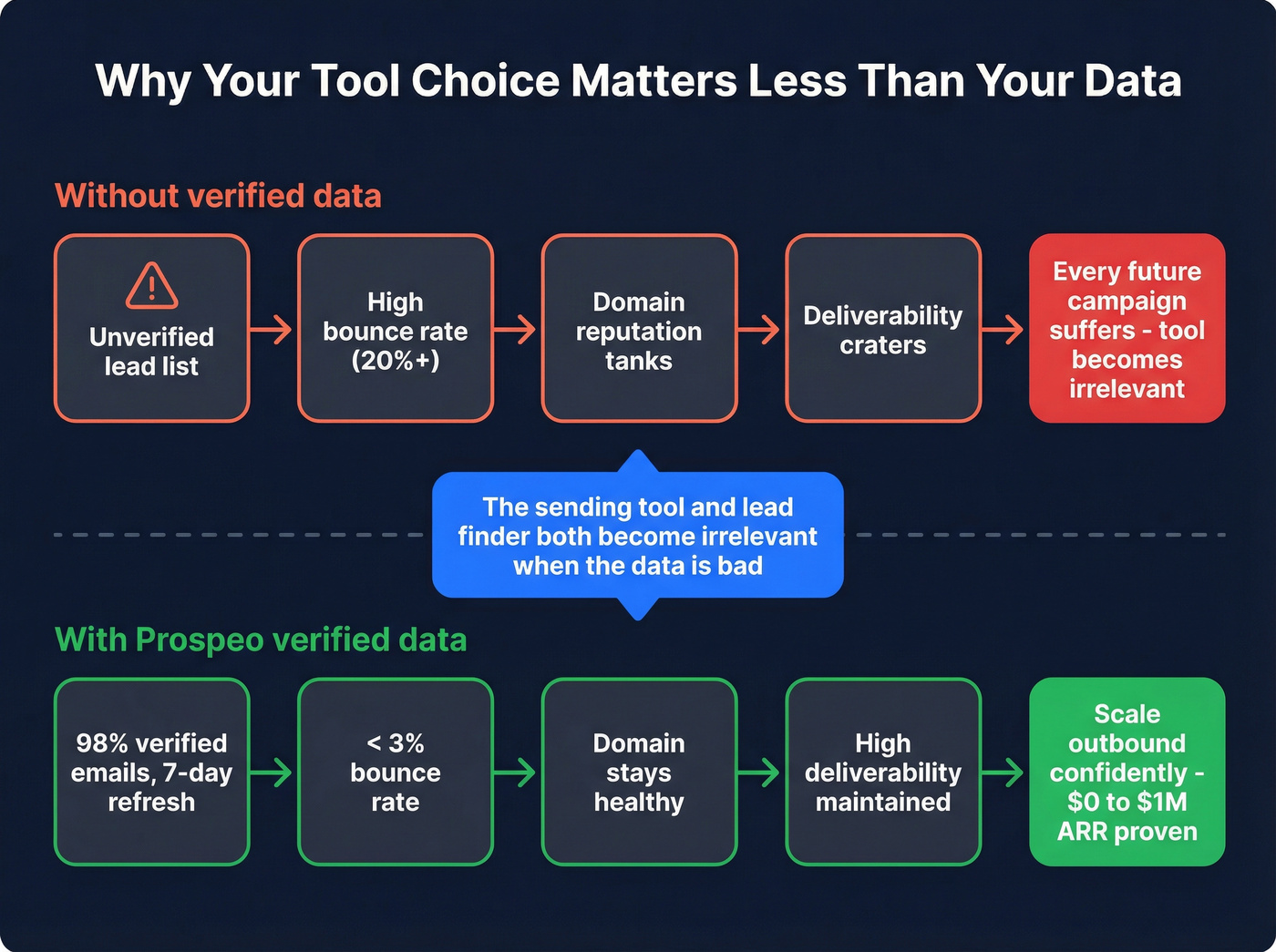
We've watched teams burn through domains because of exactly this kind of data quality gap. If your emails bounce at 20%+, your domain reputation tanks, deliverability craters, and every subsequent campaign suffers. The sending tool and the lead finder both become irrelevant when the underlying data is bad.
If you're troubleshooting deliverability end-to-end, start with an email deliverability checklist and then tighten your sender reputation controls.
Let's be honest: most teams weighing these two tools don't have a sending problem or a lead-finding problem. They have a data accuracy problem. Fix that first, and the tool choice downstream matters a lot less.
A Better Option for Contact Data
Prospeo's database handles the part both tools fumble. It covers 300M+ professional profiles with 98% email accuracy, verified through a 5-step process that includes catch-all handling and spam-trap removal. A 7-day data refresh cycle means you're not emailing people who changed jobs six weeks ago - compare that to the 4-6 week refresh at most competitors.
If you’re comparing vendors for enrichment, our roundup of data enrichment services breaks down what to look for.
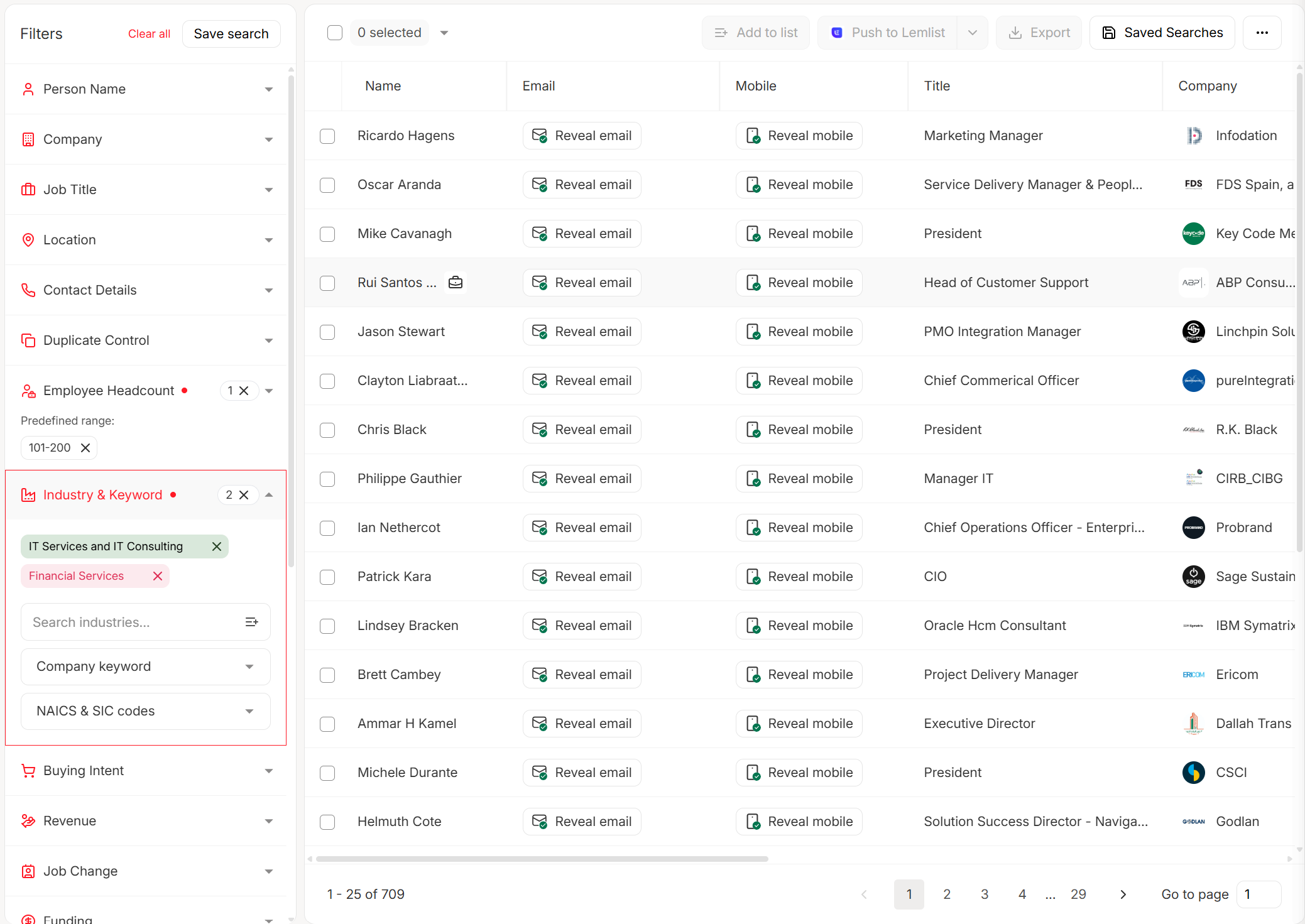
At ~$0.01/email, it costs less than half of Leadsforge's per-lead rate (~$0.0245 per lead at $49/2,000) before you even factor in Leadsforge's extra validation credits. Neither Leadsforge nor Emailchaser provides phone numbers. Prospeo has 125M+ verified mobiles with a 30% pickup rate.
If you’re building a full outbound stack, it helps to separate your sales prospecting techniques from your tooling choices (and pick the right SDR tools for execution).
Beyond raw data, you get 30+ search filters - buyer intent powered by Bombora, technographics, job changes, headcount growth, funding signals - so you can build targeted lists without the conversational AI gimmick. Native integrations with Salesforce, HubSpot, Smartlead, Instantly, Lemlist, and Clay mean no CSV exports or webhook workarounds. The free tier gives you 75 verified emails per month to test, no contract required.
If you’re doing list building in Clay specifically, see our Clay list building workflow.
For context on what that accuracy difference looks like in practice: one customer, Stack Optimize, built from $0 to $1M ARR using Prospeo data, maintaining 94%+ deliverability and sub-3% bounce rates across all their clients. That's the kind of downstream impact clean data creates.
Reddit users report 19-31% bounce rates from AI lead gen tools. Stack Optimize built to $1M ARR on Prospeo data with sub-3% bounces across every client. The difference is a 7-day refresh cycle and 125M+ verified mobiles - neither Emailchaser nor Leadsforge offers phone numbers at all.
Fix your data first. Everything downstream gets easier.
FAQ
Can you use Emailchaser and Leadsforge together?
Yes - Leadsforge finds leads and Emailchaser sends sequences. But there's no native integration between them, so you'll export CSVs manually. Pairing both with a verified data layer cuts bounce rates before emails ever leave your outbox.
Is Leadsforge the same as Salesforge?
No. Leadsforge is the lead generation product; Salesforge is the outreach platform. They share a parent company and billing ecosystem but are separate tools with separate subscriptions.
What's the most accurate B2B email finder in 2026?
Prospeo delivers 98% verified email accuracy with a 7-day refresh cycle, 125M+ verified mobile numbers, and 30+ search filters. Apollo and ZoomInfo are popular but test at 79% and 87% accuracy respectively in independent user benchmarks.