

7 Best EmailListValidation Alternatives in 2026
EmailListValidation does the basics fine - upload a list, get results, move on. But once you're running verification at any real volume, the cracks show. Six native integrations. No standout catch-all methodology. And at $59 per 10K emails, you're paying mid-range prices for a tool that doesn't do anything particularly well beyond basic list hygiene.
The seven options below fix at least one of those problems, and most fix all three. EmailListValidation does offer a Deliverability Toolkit with inbox placement reporting and blacklist monitoring, but you have to buy it separately.
Our Picks (TL;DR)
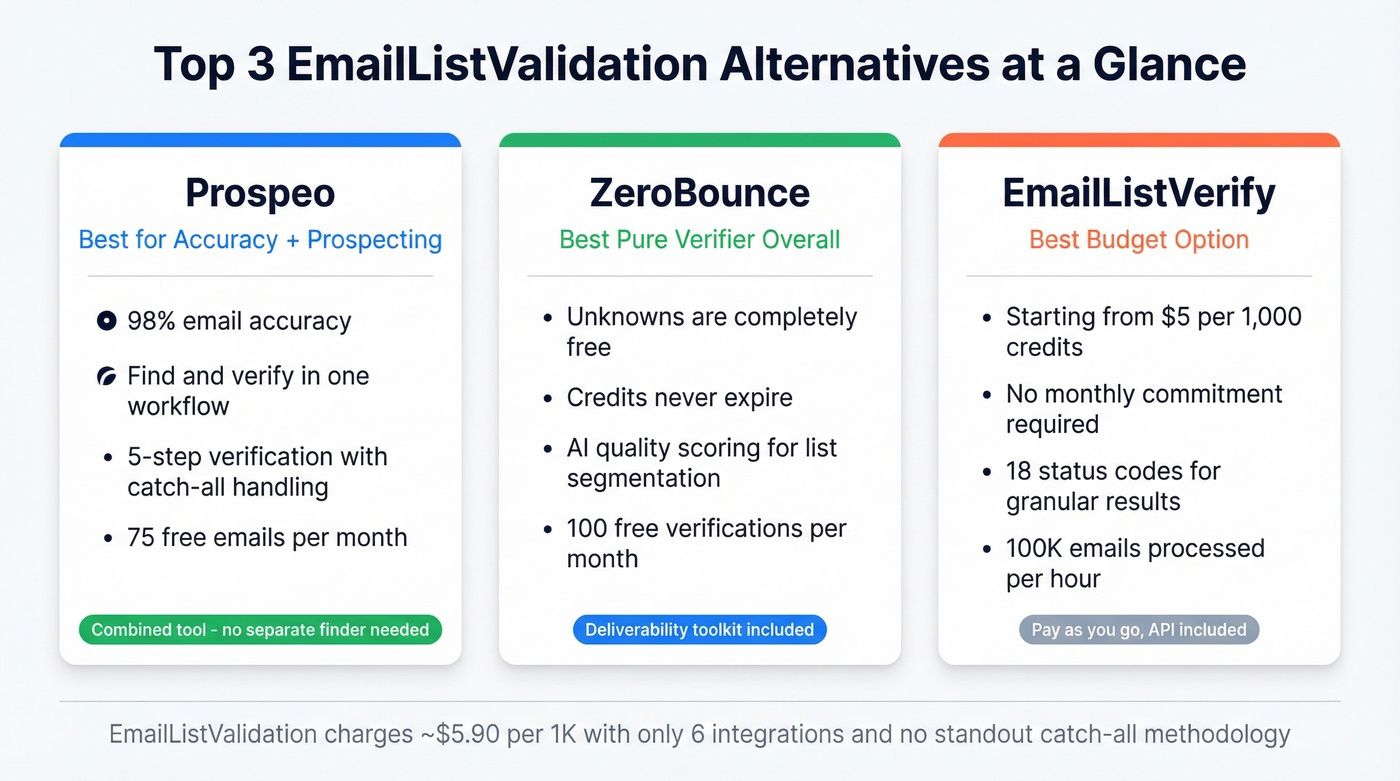
- Best for accuracy + prospecting combined: Prospeo - finds and verifies emails in one step, 98% accuracy, 5-step verification with catch-all handling
- Best overall pure verifier: ZeroBounce - unknowns are free, credits never expire, deliverability toolkit included
- Best budget option: EmailListVerify - low-cost pay-as-you-go, no monthly commitment, 18 status codes for granular results
Pricing and Credit Policies Compared
Credit policies matter more than per-email cost. A tool that charges you for inconclusive results and expires credits after 12 months will cost more in practice than one with a higher sticker price but fairer billing - and we've seen teams learn this the hard way after burning through a bulk purchase on catch-all domains (see also: spam trap removal).
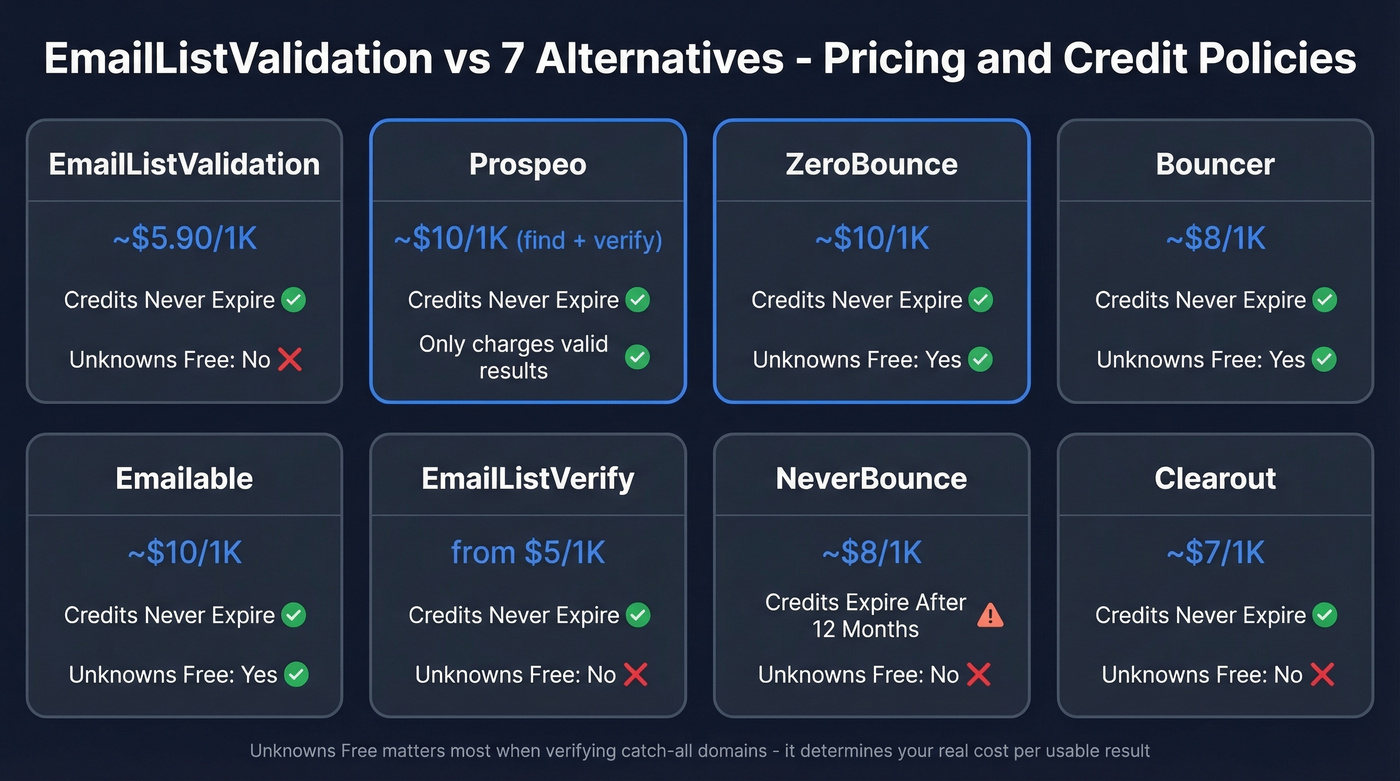
| Tool | ~Cost/1K | Credits Expire? | Unknowns Free? | Free Tier |
|---|---|---|---|---|
| EmailListValidation | ~$5.90 | No | - | 100 free credits |
| Prospeo | ~$10 (find + verify) | No | N/A (valid only) | 75 emails/mo |
| ZeroBounce | ~$10 | No | Yes | 100/mo |
| Bouncer | $8 | No | Yes | No CC needed |
| Emailable | ~$10 | No | Yes | 250 credits |
| EmailListVerify | from $5 | No | - | 100 credits |
| NeverBounce | $8 | Yes (12 mo) | Duplicates free | First list free (no CC) |
| Clearout | ~$7 | No | - | 100 credits |
The "unknowns free" column is the one most people overlook. When you're verifying catch-all domains - and you will be - a tool that doesn't charge you for inconclusive results saves a lot of wasted spend. (If you're tracking bounces closely, see email bounce rate.)

Every alternative on this list still requires a separate tool to find emails before you verify them. Prospeo skips that entirely - 300M+ profiles searched, emails found and 5-step verified in one workflow. 98% accuracy, catch-all handling included, no credits wasted on unknowns.
Find and verify emails in one step. 75 free emails to prove it.
The 7 Best Alternatives to EmailListValidation
ZeroBounce
Use this if you want the most complete pure-verification platform with fair credit policies and a deliverability toolkit built in.
Skip this if you need email finding and verification in one tool. ZeroBounce's email finder costs 20 credits per successful query, which adds up fast.
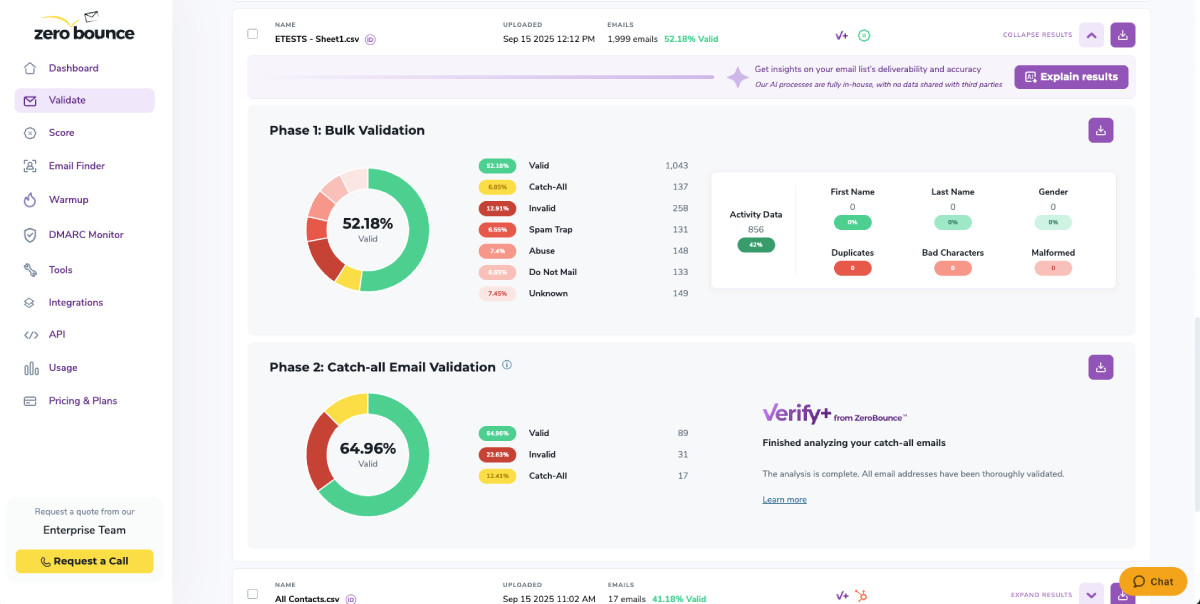
ZeroBounce gives you 100 free monthly verifications when you sign up with a business domain, credits that never expire, and zero charges for unknown results. That trifecta is hard to beat for a pure verifier. Their AI scoring system also assigns quality scores to valid addresses, which helps you segment lists beyond the binary valid/invalid split.
A real-world Reddit example backs up the "lists decay over time" reality: one user verified a 50K list and found validity ranged from roughly 75% for 2015-era emails to about 88% for recent ones. The same user reported only around 50% of catch-all emails came back valid - which tells you ZeroBounce isn't rubber-stamping everything as "good."
Prospeo
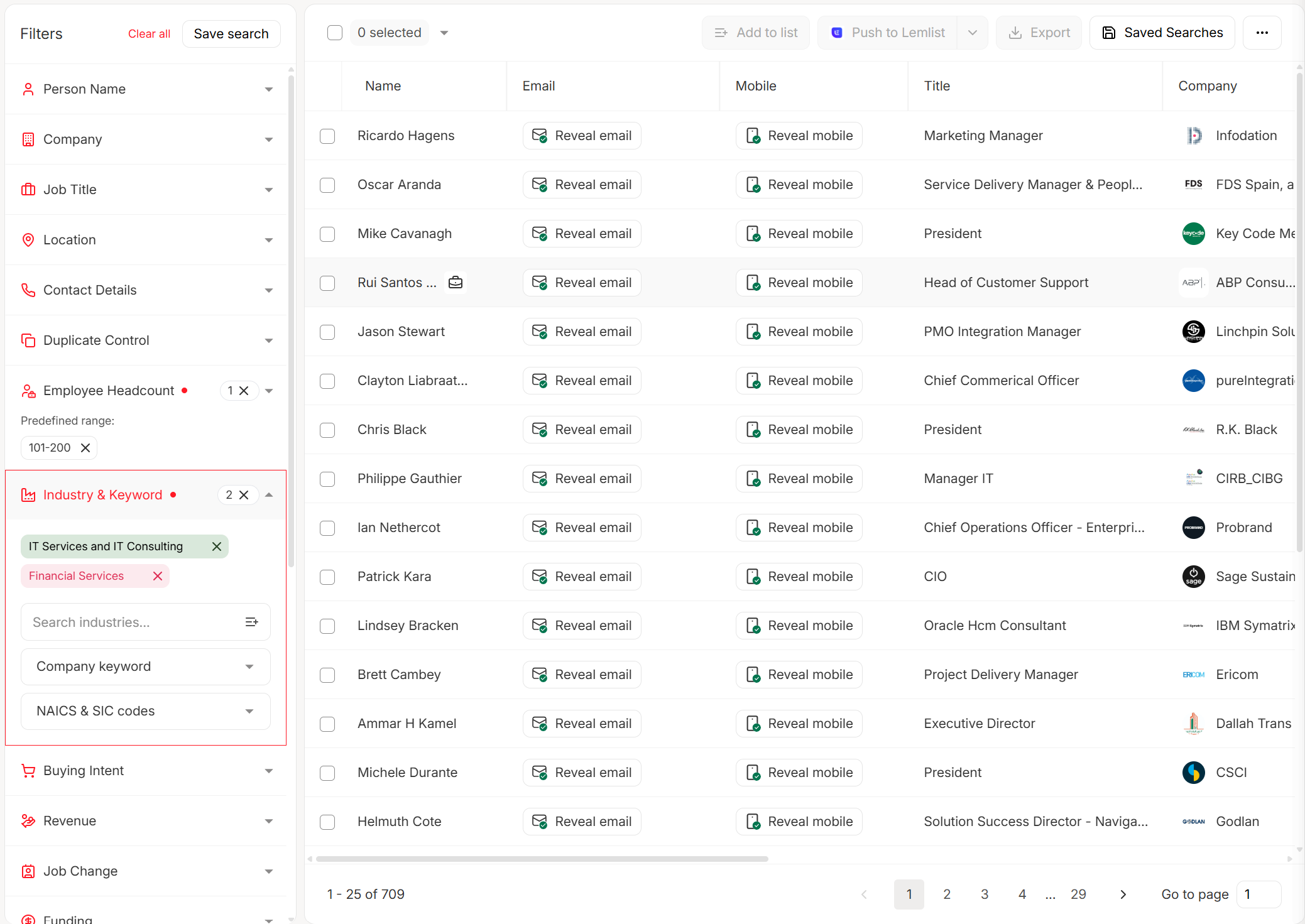
Most email verifiers solve half the problem. You still need a separate tool to find the emails, then export, reformat, upload, and verify. Prospeo collapses that into one workflow - search 300M+ professional profiles and 143M+ verified emails, find contacts, and export them after they've already passed 5-step verification including catch-all handling, spam-trap removal, and honeypot filtering.
If you're comparing it to other databases, start with sales prospecting databases and data enrichment services.
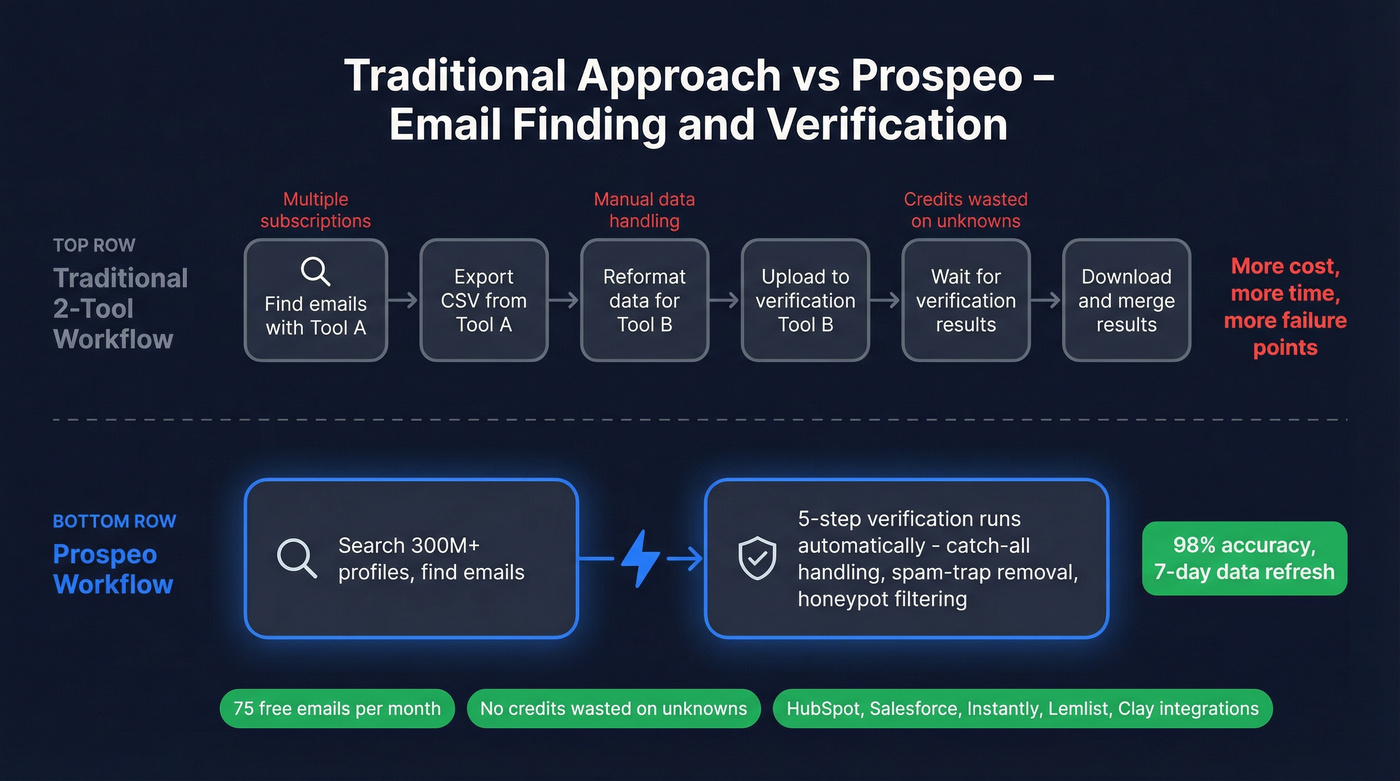
We've tested this head-to-head against the "find with Tool A, verify with Tool B" approach, and the time savings alone justify the switch for most outbound teams. Prospeo delivers 98% email accuracy through proprietary email-finding infrastructure with a 7-day data refresh cycle, while the industry average sits around 6 weeks. That freshness gap matters at scale - stale data is the number one reason bounce rates spike. Native integrations cover HubSpot, Salesforce, Instantly, Lemlist, and Clay. (If you're building lists in Clay, see Clay list building.) The free tier gives you 75 emails and 100 Chrome extension credits per month, no contracts required.
Bouncer
Use this if you verify in bursts - quarterly list cleans, pre-campaign scrubs, or seasonal sends. Bouncer starts at $8 per 1K emails, credits never expire, and you don't get charged for unknowns or duplicates. Perfect for teams that don't verify every week.
Skip this if you need a built-in email finder or deep integration ecosystem. Bouncer is a pure verifier.
In Lemlist's controlled test, Bouncer hit 99% accuracy with a sub-1% bounce rate, processing 1,000 emails in about 5 minutes. We've found it particularly reliable for pre-campaign scrubs where you need fast turnaround and don't want to worry about credit waste. The deliverability kit starts at $25/mo if you want inbox placement testing and domain monitoring on top of verification. (More options here: Bouncer alternatives.)

Emailable
Emailable is the speed champion. 10K emails in 2-3 minutes, or 250K in roughly 10 minutes per its own performance benchmarks. If you're cleaning large lists on tight deadlines, that processing speed alone justifies the switch.
The 90+ native integrations dwarf EmailListValidation's six, and unknowns and duplicates get refunded automatically. You'll need to buy at least 5K credits at a time, and credits roll over on monthly subscriptions. Start with 250 free credits to test. For teams already embedded in a complex martech stack, Emailable's integration library is worth browsing before you commit elsewhere.
EmailListVerify
The budget pick. EmailListVerify starts from $5 per 1,000 credits, with no monthly payments, API included, and credits that don't expire.
What sets it apart is the 18 status classifications. Where most verifiers give you valid/invalid/unknown, EmailListVerify breaks results into connection-related statuses, server responses, and risk categories. One Reddit user specifically called out this granularity as useful for deciding what to do with borderline addresses - and the consensus on r/Emailmarketing threads tends to agree that more status detail beats less. Processing speed hits 100K per hour.
NeverBounce
Solid verifier at $0.008 per credit, with a Growth plan at $49/mo for up to 10K verifications. Lemlist's test clocked it at 93% accuracy.
Here's the thing: credits expire after 12 months. If you're a steady-volume sender, that's fine. If you buy in bulk and verify sporadically, you'll lose unused credits. That policy alone makes it hard to recommend over Bouncer or ZeroBounce for teams with uneven sending patterns.
Clearout
Flexible billing - annual, monthly, or one-time purchases, all with credits that roll over. Starts around $21 for 3K credits, with 100 free to test. In Hunter's 2026 benchmark, Clearout scored 68.37% overall accuracy - second-highest among 15 verifiers tested. Not a bad showing, though that number should give you pause about the industry's accuracy claims in general.
(If you're also evaluating email-finding tools, compare options in our Hunter alternatives guide.)
Catch-all domains eat verification credits alive - unless your tool handles them properly. Prospeo's 5-step verification includes catch-all handling, spam-trap removal, and honeypot filtering, all refreshed every 7 days. That's 6x faster than the industry average.
Stop burning credits on stale data and catch-all guesswork.
How Catch-All Domains Affect Accuracy
Catch-all domains accept every email address sent to them, so verifiers can't definitively confirm whether a specific address is real. In our experience, catch-all rates vary wildly by industry - one ZeroBounce user found only about 50% of catch-all emails were actually valid, which tracks with what we've seen across B2B lists heavy on mid-market companies.
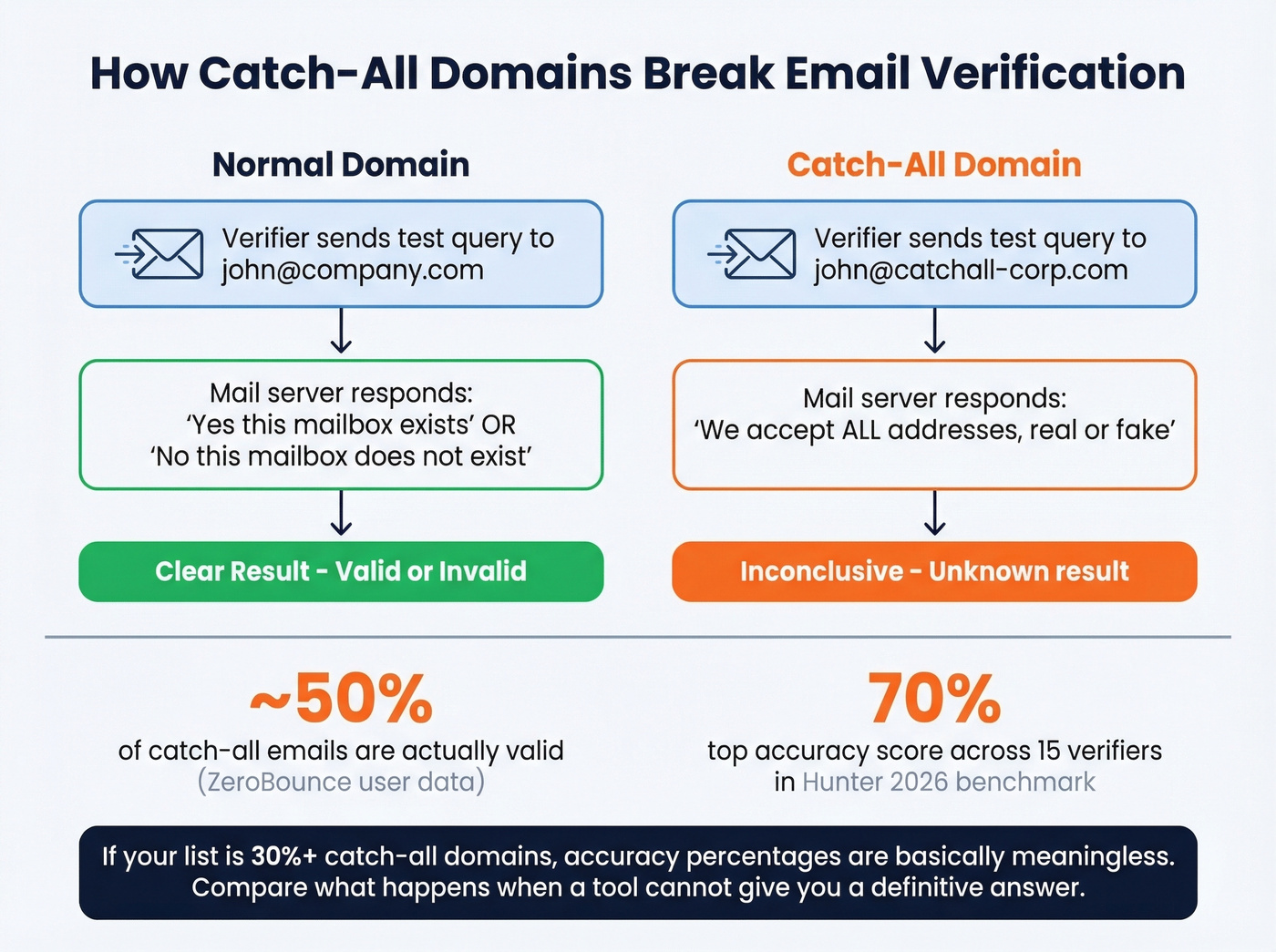
Hunter's benchmark of 15 verifiers showed the top scorer hitting just 70% overall accuracy, and it drops further on enterprise domains with stricter mail server configs. (If deliverability is the real goal, use an email deliverability guide alongside verification.)
Here's a detail no one talks about: how you verify can produce different results from the same tool. One Reddit user found MillionVerifier's bulk API marked a known-valid Yahoo address as "unknown" while the single-email check returned it as valid. That inconsistency is exactly why credit policies and catch-all handling separate good tools from mediocre ones.
Let's be honest - if your list is more than 30% catch-all domains, accuracy percentages are basically meaningless. Stop comparing accuracy marketing and start comparing what happens when a tool can't give you a definitive answer. That's where the real cost difference lives.
FAQ
Is EmailListValidation still worth using?
It's a decent mid-range verifier with a money-back guarantee, non-expiring credits, and an optional Deliverability Toolkit. But with only 6 native integrations and no standout catch-all methodology, most teams find better value elsewhere - especially at scale.
How accurate are email verification tools really?
Less than vendors claim. Hunter's 2026 benchmark of 15 verifiers found the top scorer at 70% overall accuracy, and many tools cluster in the mid-to-high 60s. Focus on credit policies and catch-all handling over accuracy marketing - those determine your real cost per usable result.
Can one tool handle both email finding and verification?
Yes. Prospeo combines finding and verification in a single workflow - 300M+ profiles, 98% accuracy, 5-step verification - so you skip the export-reformat-upload cycle entirely. For most outbound teams, one combined platform means fewer tools, fewer failure points, and lower total cost than stacking separate services.