

EmailListVerify vs GetProspect: Different Tools, Different Jobs
If you're weighing EmailListVerify against GetProspect, you're probably trying to solve one of two problems: clean a list you already have, or find new B2B contacts without tanking deliverability. Here's the thing - EmailListVerify is a dedicated email verification service. You hand it a list, it scrubs it. GetProspect is a lead generation platform with a 200M+ contact database and a verification feature bolted on. Comparing them head-to-head is like comparing a pressure washer to a garden hose that also sprays soap. They overlap on one function, but they're built for different jobs.
30-Second Verdict
Need to clean an existing email list? EmailListVerify. It's purpose-built, cheaper per verification, and offers 18 granular status codes with a 97% accuracy claim.
Need to find new B2B emails from scratch? GetProspect. But expect verified-email match rates around 62-65% in practice, even though GetProspect markets 95% data accuracy with credits back.
What Each Tool Actually Does
EmailListVerify does one thing well: verify email lists. Upload a CSV, get back a cleaned file with 18 different status classifications - including connection-related statuses that help you understand why an email failed, not just that it did. Processing speed runs north of 100,000 emails per hour. Pay-as-you-go credits never expire, and the email finder consumes 5 credits per lookup, charged only when results include at least one email with medium or higher confidence.
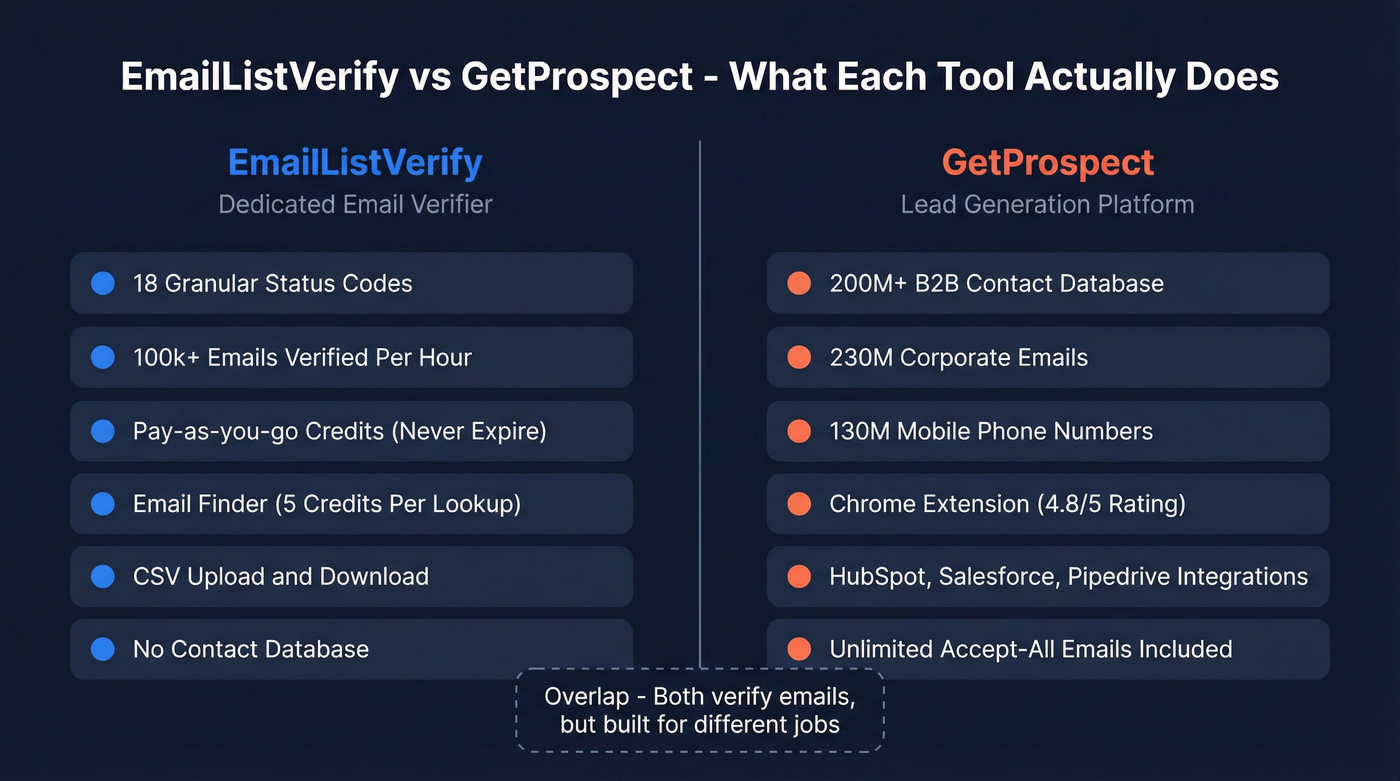
GetProspect is a different animal. It's a B2B contact database with 200M+ contacts, 230M corporate emails, and 130M mobile phone numbers across 26M international companies. The Chrome extension (4.8/5 with 1,000+ reviews) pulls contacts while you browse professional profiles. It integrates natively with HubSpot, Salesforce, and Pipedrive. One detail that trips people up: GetProspect includes unlimited accept-all emails on top of your valid email quota, which sounds generous until you realize accept-all addresses are higher-risk for bounces. We'll get to why that matters in the accuracy section.
Pricing Breakdown
GetProspect separates "valid emails" (search credits for finding new contacts) from "verifications" (credits for cleaning externally sourced lists). These are two different pools with two different price structures.
| EmailListVerify | GetProspect | |
|---|---|---|
| Primary function | List verification | Lead finding + verification |
| Database size | N/A (verifier only) | 200M+ B2B contacts |
| Stated accuracy | 97% | 95% (credits back) |
| G2 rating | 4.5/5 (59 reviews) | 4.0/5 (41 reviews) |
| Free tier | 100 free verifications | 50 valid emails + 100 verifications |
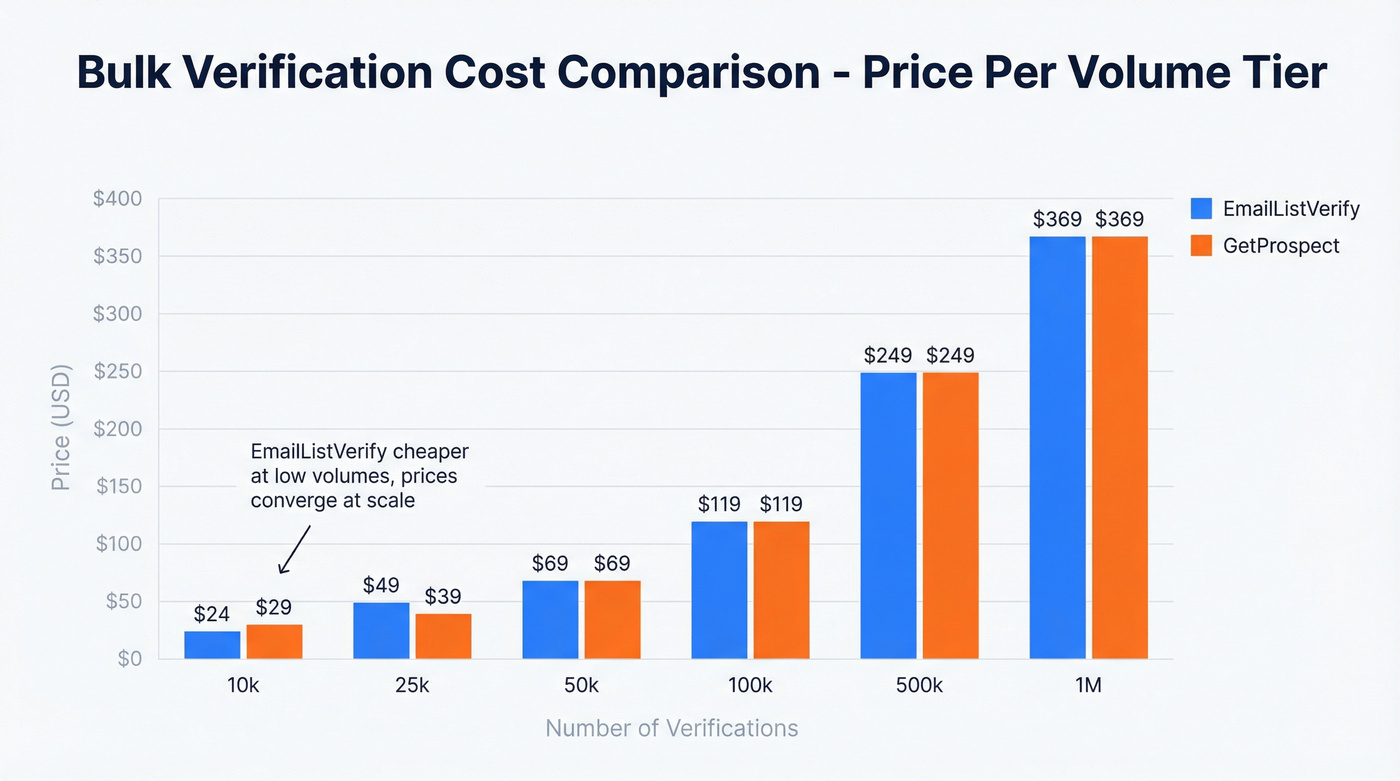
| Per 10k verifications | $24 | $29 |
| Billing model | Pay-as-you-go (no expiry) | Monthly plans + credit packs |
For bulk verification-only purchases, GetProspect's packs scale like this:
| Pack size | GetProspect price |
|---|---|
| 10k | $29 |
| 25k | $39 |
| 50k | $69 |
| 100k | $119 |
| 500k | $249 |
| 1M | $369 |
If you're using GetProspect to find emails too, that's a separate cost. The Starter plan runs $49/mo for 1,000 valid emails and 2,000 verifications. Growth plans scale from $99/mo (5k emails) to $399/mo (50k emails). Annual billing saves 30%, and credits roll over up to one month of your monthly allowance.
Let's be honest: if your average contract value is closer to a few thousand dollars than enterprise pricing, you probably don't need both a finder and a separate verifier. The export-import friction alone eats more time than most teams realize, and time is the cost nobody tracks. If you're building a lean stack, start with sales prospecting techniques that reduce wasted sends.

Paying $49/mo to find emails, then another $24 to verify them - and losing an hour per campaign to CSV gymnastics? Prospeo combines a 300M+ contact database with built-in 98% email verification, catch-all handling, and direct CRM pushes. One workflow, one cost, zero export-import friction.
Find and verify in one click - starting at $0.01 per email.
Accuracy and Deliverability
Stated accuracy and real-world performance are different conversations entirely.
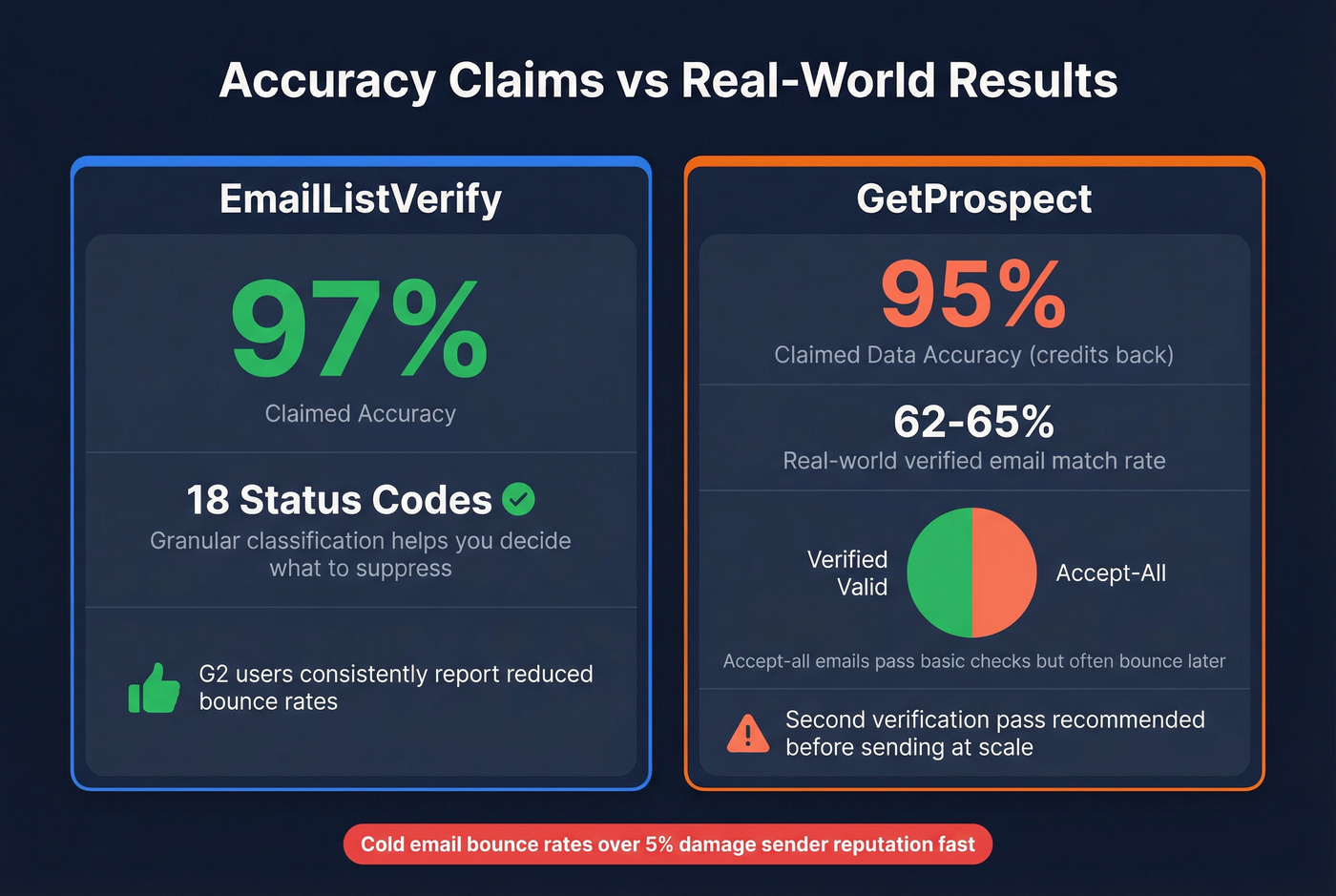
EmailListVerify claims 97% accuracy, and G2 reviewers consistently mention reduced bounce rates and improved deliverability. We've run lists through both tools, and EmailListVerify's 18 granular status codes are genuinely useful - they help you separate obvious bad addresses from catch-all domains and connection-related "unknown" scenarios. One practitioner on r/Emailmarketing called out the 18-status output as a key reason they preferred it over other verifiers.
GetProspect's numbers tell a more complicated story. Their own help center says the platform finds roughly 65% of email addresses on average, with approximately a 50/50 split between verified-valid and accept-all. Independent benchmarks land in the same neighborhood: a September 2025 test of 5,000 contacts measured a 61.9% verified rate, while a separate August 2025 test of 1,000 profiles landed at 65%.
One nuance worth calling out: GetProspect markets "97% deliverability" for its Bulk Email Verifier and "95% data accuracy or credits back" for its database. These are different metrics measuring different things, and they're easy to confuse. The 97% deliverability claim applies to the verification feature, not to the overall "how many verified emails you'll get back" when finding new contacts.
A cold email bounce rate over 5% is widely considered the threshold where sender reputation starts taking real damage, and spam filters get aggressive fast. If half your "found" results are accept-all, you'll want an extra filtering step - or a workflow that handles catch-alls more aggressively - before you send at scale. This is the part that frustrated us most when testing GetProspect for outbound campaigns: the accept-all volume meant we couldn't trust the list without a second pass. If you want a deeper breakdown of bounce thresholds and what they mean, see our email bounce rate guide.
What Users Say
EmailListVerify (G2 rating: 4.5/5, 59 reviews) earns consistent praise for speed and accuracy. Reduced bounces are the most common positive theme. Some users mention occasional data handling quirks, but the product is generally well-liked for what it does.
GetProspect (G2: 4.0/5, 41 reviews) gets the most love for its Chrome extension, which is genuinely smooth for pulling contacts from professional profiles. It's affordable compared to Apollo or ZoomInfo for small teams. The recurring complaint? Accuracy. Inconsistent results and occasional bounces on "verified" emails show up across multiple reviews. Database coverage also thins out in certain regions and industries, and the reporting is basic.
When You Need Both - and When You Don't
Running 10,000 prospects through GetProspect's Starter plan ($49/mo) then cleaning them with EmailListVerify ($24 per 10k) costs $73/month minimum - plus the time spent exporting, formatting, uploading, and re-matching results. In our experience, that export-import cycle adds 30-60 minutes of manual work to every campaign, and it compounds fast when you're running multiple sequences per week. If you're standardizing your process, it helps to map this into a repeatable lead generation workflow.
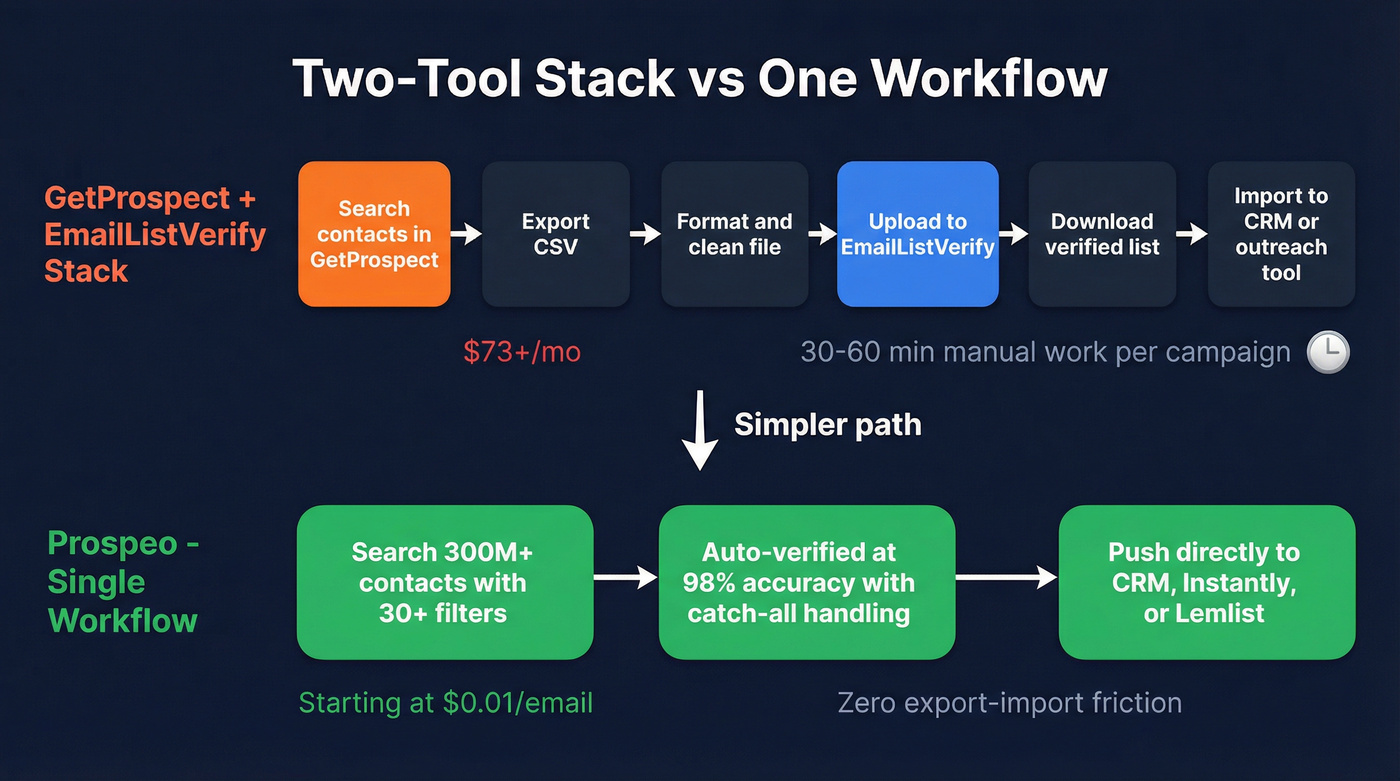
Prospeo eliminates that friction. It combines a 300M+ contact database with 98% email accuracy and a 7-day data refresh cycle, then pushes verified contacts straight to Instantly, Lemlist, or your CRM. You also get 30+ search filters, real-time verification with catch-all handling, and enrichment workflows that return 50+ data points per contact.

GetProspect's 50/50 split between verified and accept-all emails means half your list needs a second pass before you can send. Prospeo's 5-step verification with spam-trap removal and catch-all handling delivers 98% accuracy out of the box - refreshed every 7 days, not 6 weeks.
Stop running every list through a second verifier. Get it right the first time.
FAQ
Can I use EmailListVerify and GetProspect together?
Yes - find emails in GetProspect, export the list, then clean it through EmailListVerify. It's a common "starter stack" for small outbound teams. Expect at least one extra manual step per campaign (export, format, upload, re-import), plus roughly $24 per 10k emails on top of your GetProspect subscription.
Which is better for cold email deliverability?
EmailListVerify is the safer pick for deliverability because it's purpose-built for list cleaning and gives you 18 status codes to suppress risky addresses. For cold email, keep bounces under 5% - once you cross that line, sender reputation and inbox placement drop fast.
Why do accept-all emails matter?
Accept-all (catch-all) domains can't confirm whether a specific inbox exists, so they often "pass" basic checks but still bounce later. If a tool returns a large share of accept-all results - as GetProspect often does - you should segment them, send more slowly, and run additional verification before scaling volume.
What's a good all-in-one alternative?
If you want to find and verify in one workflow, Prospeo is the cleanest option we've found: 98% email accuracy, weekly data refreshes, and a free plan with 75 verified emails per month. It pushes verified contacts straight into outreach tools or your CRM without a separate cleaning step.
Bottom Line
If your decision is truly EmailListVerify vs GetProspect, pick based on workflow. EmailListVerify is the better choice for bulk list cleaning and deliverability control. GetProspect is better when you need a lightweight database and a browser-based prospecting flow. If you want one system that finds, verifies, and enriches without the export-import grind, Prospeo is the more direct path. If you're comparing broader options, our roundup of outbound lead generation tools can help you shortlist faster.