

End of Year Sales Tips: The Tactical Playbook for Closing Q4
It's November 15th. You're staring at your pipeline and the math doesn't add up. Seasonal burnout is setting in, half your champions are planning PTO, and the deals you forecasted in September haven't moved a stage in six weeks.
Here's the thing: most end of year sales tips are motivational fluff. You don't need a pep talk - you need a triage plan. Only 16% of reps hit quota, average win rates hover around 21%, and reps spend roughly 28-30% of their time actually selling. If you want to maintain sales momentum through the holidays, you need a system, not a slogan.
If You Read Nothing Else
Do these three things:
- Triage your pipeline with the give-get matrix - kill dead deals, double down on live ones
- Follow up 5+ times with new value on every touch - use the scripts below
- Build a Mutual Action Plan for every deal over $10K stuck in procurement
That's the entire article distilled. The rest is how.
Triage Your Pipeline First
The best Q4 performers do less - fewer deals, more follow-up on each, and a hard no to anything that won't close by mid-December. John Barrows' give-get matrix is the fastest way to sort your pipeline.
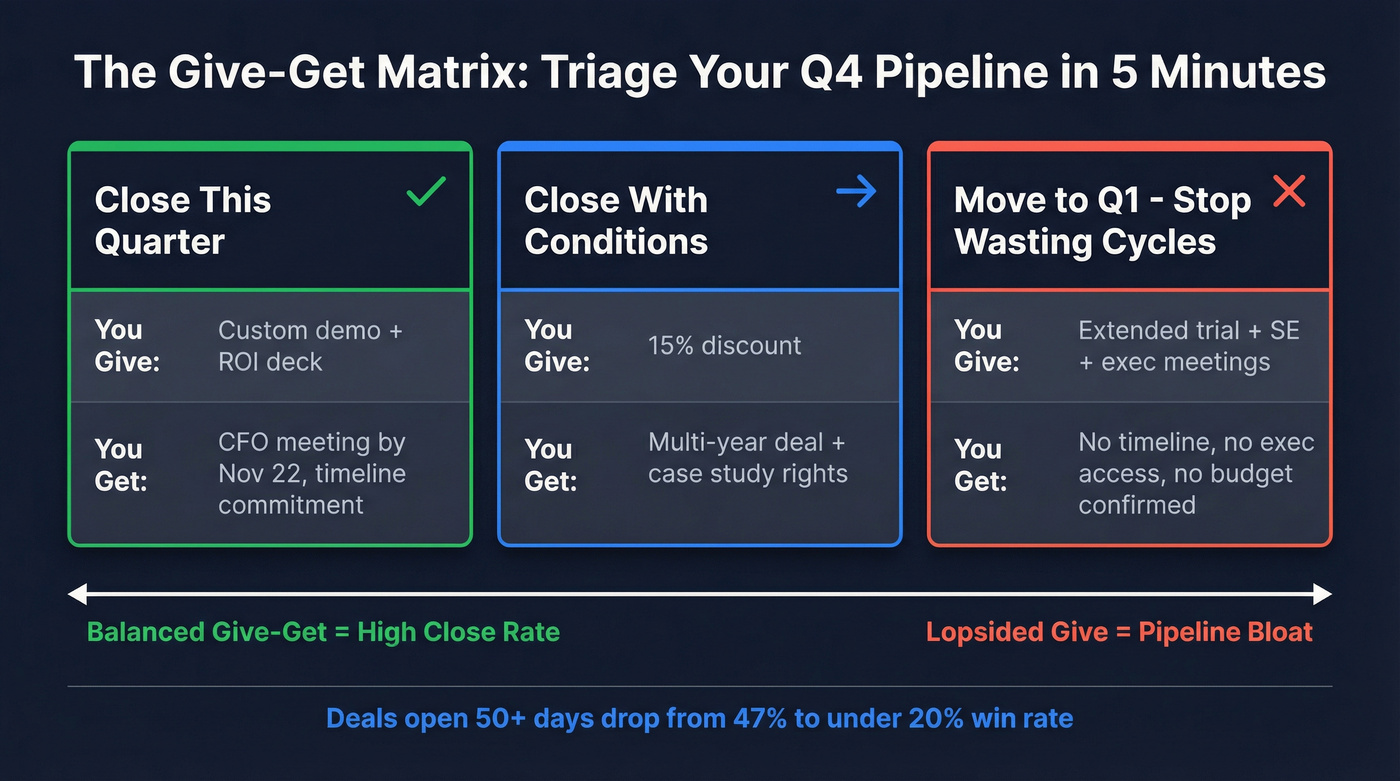
For every deal, list what you must give (demos, discounts, proposals, executive time) versus what you must get (access to the decision-maker, a timeline commitment, a signed NDA). Deals where the columns are balanced and short are your Q4 closers. Deals where the give column is three times the get column? Move them to Q1 and stop wasting cycles.
| Give (Your Investment) | Get (Buyer Commitment) | Q4 Close Likelihood |
|---|---|---|
| Custom demo + ROI deck | Meeting with CFO by Nov 22 | High |
| 15% discount | Multi-year + case study rights | Medium-High |
| Extended trial + SE time | No timeline, no exec access | Low - move to Q1 |
Before you run the matrix, hit each deal with three diagnostic questions. Has there been meaningful activity in the last 30 days? Is there a compelling event driving urgency? Do you have access to the economic buyer, or are you stuck with researchers who can't sign anything?
The data backs this up. Opportunities closed within 50 days carry a 47% win rate. After 50 days, that drops to 20% or lower. Deal slippage kills - especially in Q4, when every week lost to holiday schedules compounds the damage.
Follow Up Like the Data Says
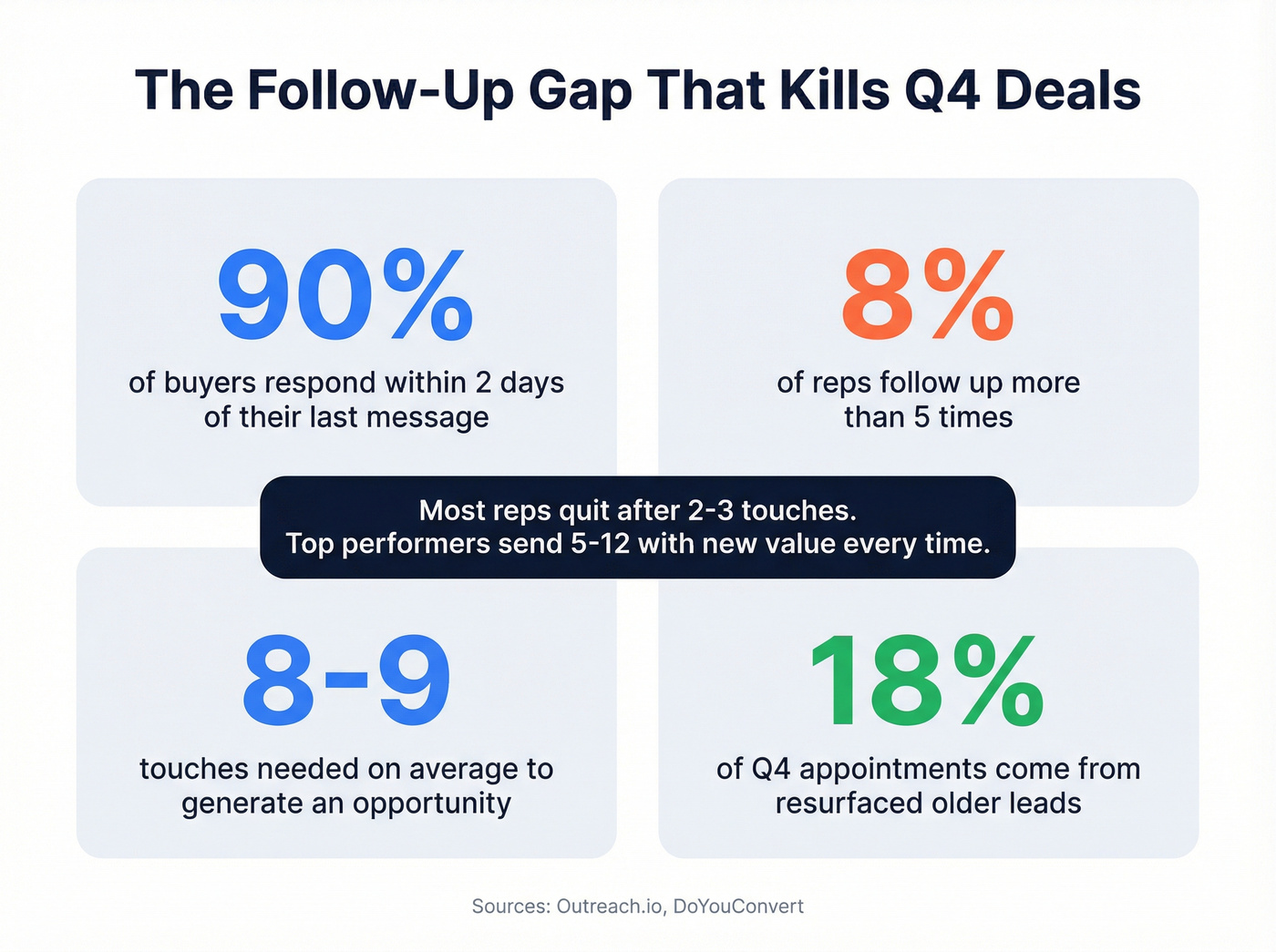
90% of buyers respond within two days of their most recent message. Yet only 8% of reps follow up more than five times, despite the fact that it takes an average of 8-9 touches to generate an opportunity. The gap between what works and what reps actually do is staggering.
Every follow-up needs this structure: relevant subject line, a two-sentence hook, new value, and a CTA. The key word is new. Each touch should bring something the prospect didn't have before - a benchmark, a case study, a competitive insight, a relevant news item. "Just checking in" is not a follow-up. It's a confession that you have nothing to say (and a sign you should use a better sales follow-up template).
Template 1: Value-Add Follow-Up
Subject: [Company]'s Q4 number vs. [competitor benchmark]
Hi [Name], saw [relevant trigger - earnings, hiring, product launch]. Thought this might be useful: [one-sentence insight or attached resource].
Worth a 15-minute call this week to see if this changes the math on your side?
Template 2: Breakup Email
Subject: Should I close your file?
Hi [Name], I've reached out a few times and haven't heard back - totally understand if the timing's off. If this isn't a priority right now, just say the word and I'll circle back in Q1. If something changed, I'm here.
Use low-commitment CTAs for cold or unresponsive leads - easy-to-answer questions work best. Save high-commitment CTAs like specific date-and-time proposals for deals with momentum. And don't ignore aged leads: 18% of Q4 appointments come from older leads resurfaced through prospecting.

Every follow-up template above is worthless if your emails bounce. 15% of pipeline contacts go stale each quarter from job changes alone. Prospeo's 7-day data refresh catches role changes other providers miss for 6 weeks - so your December sequences actually reach the right inbox.
Verify your entire Q4 pipeline at 98% accuracy for $0.01 per email.
Unstick Deals With a Mutual Action Plan
The biggest threat to your Q4 number isn't a competitor. It's "no decision."
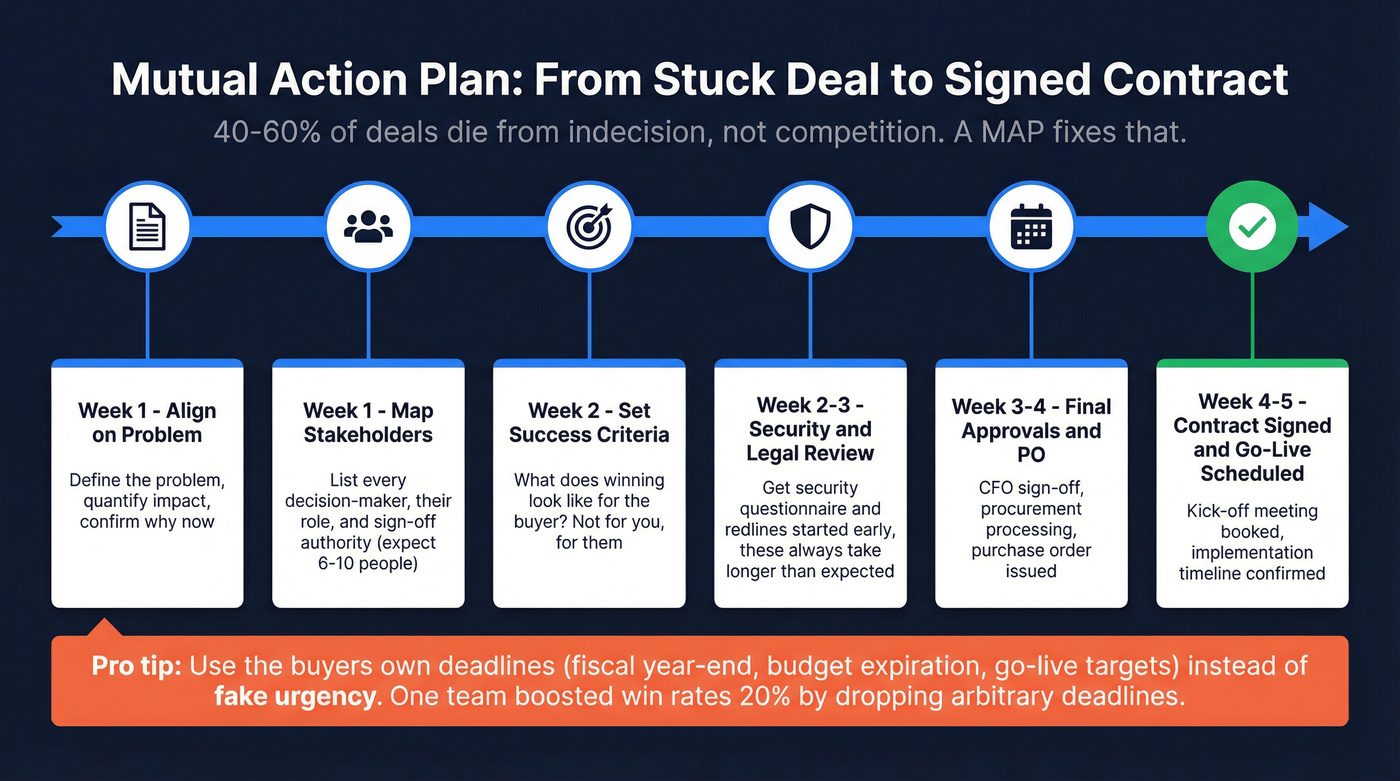
40-60% of deals end in indecision, not a loss to a rival vendor. Buying committees now average 6-10 people, and 77% of B2B buyers say the purchase process is "too complex." A Mutual Action Plan cuts through that complexity by giving everyone - your side and theirs - a shared document that maps every step from today to signed contract, with owners, dates, and success criteria.
| MAP Component | What Goes Here |
|---|---|
| Deal Context | Problem, impact, why now |
| Success Criteria | What "win" looks like for the buyer |
| Stakeholders | Names, roles, sign-off authority |
| Milestones + Dates | Security review, legal, PO, go-live |
| Next Steps | Who does what by when |
Let's be honest about something: fake urgency kills trust. Arbitrary "this offer expires Friday" deadlines push deals into no-decision limbo faster than anything else. One team increased their win rate by 20% over two quarters by replacing urgency CTAs with data-backed proposals and tailored value maps. Let the buyer's own deadlines - fiscal year-end, go-live targets, budget expiration - create the urgency. You don't need to manufacture it.
Discount Smart - Trade, Don't Concede
When a prospect asks for a discount, the only response is: "What are we getting in return?" Conceding without trading trains buyers to push harder. Every discount should come with a get.
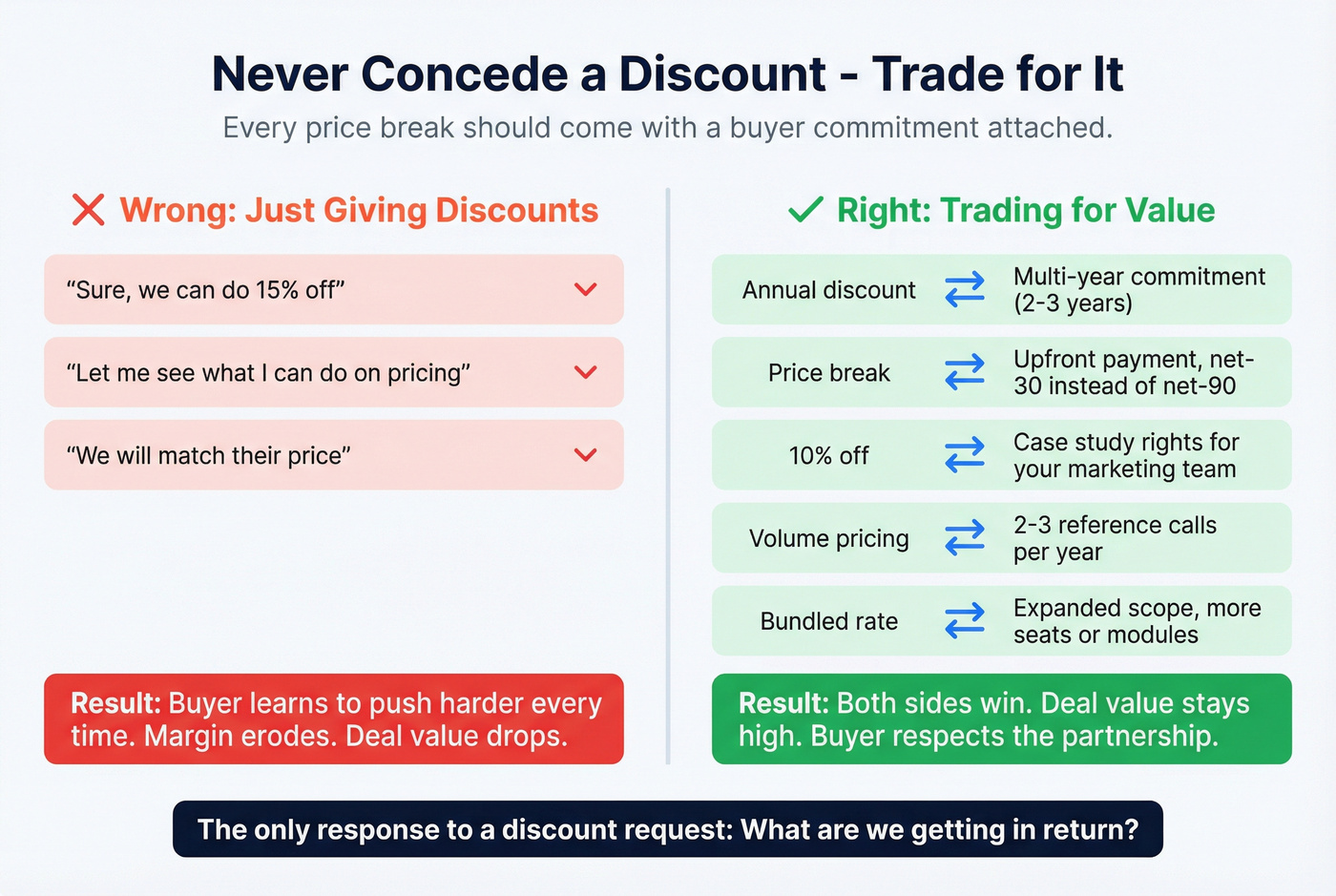
- Multi-year commitment - discount the annual in exchange for a 2-3 year term
- Upfront payment - net-30 instead of net-90 earns a price break
- Case study rights - marketing gets a win, buyer gets a discount
- Reference calls - 2-3 reference calls per year for prospects in their vertical
- Expanded scope - more seats or modules at a bundled rate
Never give without getting. That's the entire principle, and it's the one most reps forget under December pressure (set a clear walk away point before you negotiate).
Clean Your Data Before the Blitz
Every script, template, and framework above assumes your emails land and your phone numbers connect. If they don't, none of this matters.
We've seen this play out dozens of times: a team runs a flawless Q4 playbook - perfect breakup emails, tight MAPs, disciplined give-get triage - and still misses the number because 15% of their pipeline contacts bounced. Bad data is a bigger Q4 killer than bad technique. It's invisible until it's too late.
Verify your pipeline contacts before launching December sequences. We use Prospeo for this - bulk verification at 98% email accuracy with a 7-day data refresh cycle that catches job changes and restructures other providers miss for weeks. Even contacts verified recently go stale. People switch roles, companies reorganize. Run verification again before the December push. The free tier covers 75 emails and 100 Chrome extension credits per month, enough to clean your top-priority deals without spending anything (and if you're comparing vendors, start with these data enrichment services).
Skip this step if your CRM data was verified within the last two weeks and your bounce rate on recent campaigns was under 3%. Otherwise, it's non-negotiable.
You just triaged your pipeline and built MAPs for your best deals. Now make sure you can actually reach those champions and economic buyers. Prospeo gives you 98% verified emails and 125M+ direct dials - updated weekly, not monthly - so no Q4 outreach dies in a dead inbox.
Stop losing December deals to bad contact data.
Protect Q1 While Closing Q4
December desperation - forcing signatures to hit a number - creates buyer's remorse and January cancellations. That's worse than missing the number.
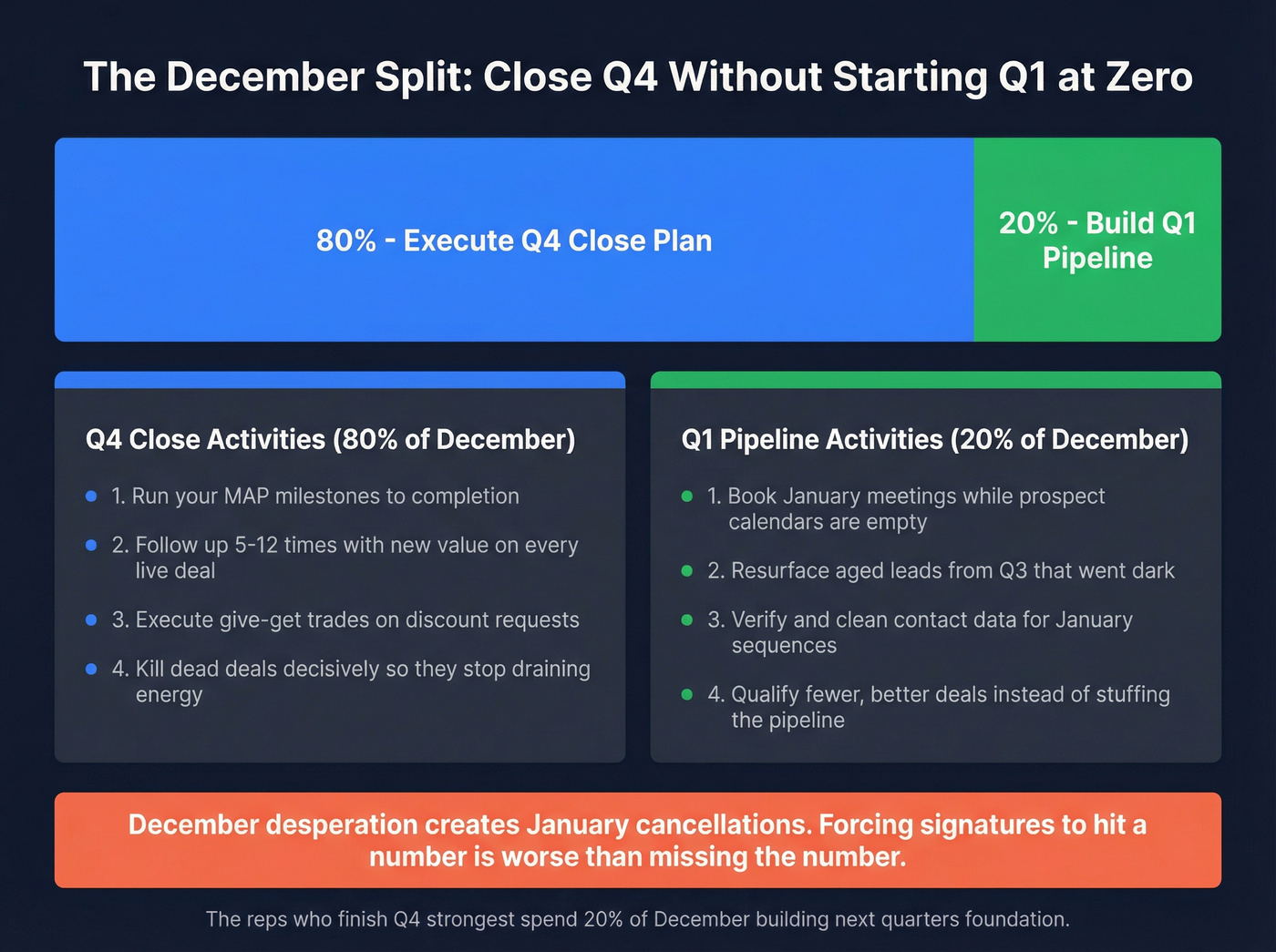
While you're executing your Q4 close plan, book January meetings in December. Prospects who aren't ready to sign this year are often happy to lock in a January slot while their calendar is empty. The same "do less, do it better" principle applies: fewer, better-qualified January meetings beat a bloated pipeline of maybes. The Assess-Plan-Execute cadence only works if December execution includes pipeline generation for Q1. Don't start the year at zero. In our experience, the reps who finish Q4 strongest are the ones who spent 20% of their December time building next quarter's foundation instead of chasing deals that were already dead (use pipeline health metrics to keep yourself honest).
FAQ
When is it too late to close a deal before year-end?
If a deal hasn't shown meaningful activity by mid-November - no stakeholder meetings, no procurement movement - move it to Q1. Enterprise procurement and legal teams often freeze in the last two weeks of December. Protect your time for deals that can actually close.
How many follow-ups does a year-end deal need?
Most deals require 5-12 touchpoints, but the majority of reps stop at two or three. Each follow-up should bring a fresh insight or resource - not just "checking in." Persistence with new value is what separates top performers from the 84% who miss quota.
How do I make sure year-end outreach actually reaches prospects?
Verify contact data before the blitz. Stale emails and dead phone numbers silently destroy Q4 velocity. Bulk verification catches bounces, catch-all domains, and spam traps - and the free tiers on most verification tools handle enough contacts to clean your highest-priority pipeline before December sequences launch.