

Enterprise Account Management: The Operating Manual Nobody Gave You
You just got promoted into enterprise account management. Four accounts, each worth $2M+ in annual revenue. Your predecessor left a half-finished spreadsheet, three months of unanswered Slack threads, and zero documentation. Your VP says "don't let anything churn." Helpful.
This is the operating manual that should've come with the title - frameworks, KPIs, templates, and benchmarks for running enterprise accounts as a system, not a series of fire drills.
What You Need (Quick Version)
Managing large accounts is a systems problem, not a relationship problem. Relationships matter, but they don't scale and they don't survive personnel changes. Here's what you actually need:
- An account plan. According to Momentum ITSMA, fewer than 20% of companies have fully embedded account planning into operations. The ones that do attribute up to 77% of revenue growth to account-based strategies.
- A tiering model that tells you where to spend your hours.
- A whitespace grid that maps expansion opportunities by business unit and product.
- A KPI dashboard that gives your CFO and your CS team different views of the same truth.
What follows gives you each of those, with templates and benchmarks - the operational artifacts you can implement this week, not next quarter.
What Is Enterprise Account Management?
Managing four enterprise accounts is a fundamentally different job than managing fifteen mid-market ones. This discipline centers on growing and retaining your largest, most complex customer relationships. An enterprise AM typically owns 2-3 accounts, sometimes up to 5. Each one is a business unto itself.
The threshold varies by company, but high-value agreements exceeding $250,000 typically require at least six months of strategic planning and execution. The average B2B sales cycle now runs 6.5 months, up from 4.9 months in 2019. Enterprise deals push well past that.
The biggest structural difference from mid-market AM? Multi-threading. A mid-market account has one champion and one economic buyer. An enterprise account has procurement, legal, IT, multiple business unit leads, and an executive sponsor that can change as the org evolves. You're managing a network, not a contact.
In practice, enterprise AM roles are usually built around a small set of named accounts, with quota tied to renewals plus incremental growth - and a lot more internal selling than external. The discipline overlaps heavily with strategic account management, which applies many of the same frameworks to a company's highest-value relationships regardless of deal size.
Role, Skills, and Compensation
The core responsibilities cluster into four buckets: expansion revenue (upsell and cross-sell), renewal management, forecasting accuracy, and internal advocacy. That last one is underrated - half the job is convincing your own company to prioritize your account's needs.
The skills that matter most aren't the ones on job descriptions. Yes, you need executive communication and strategic thinking. But the enterprise AMs who consistently hit plan build internal coalitions as effectively as external ones. They know how to get their solutions engineer prioritized, how to escalate without burning bridges, and how to translate customer pain into language that moves product roadmaps.
Career progression typically runs from mid-market AM to enterprise AM to strategic/named accounts to VP of Customer Success or CRO. Some move laterally into enterprise sales. The comp reflects the stakes:
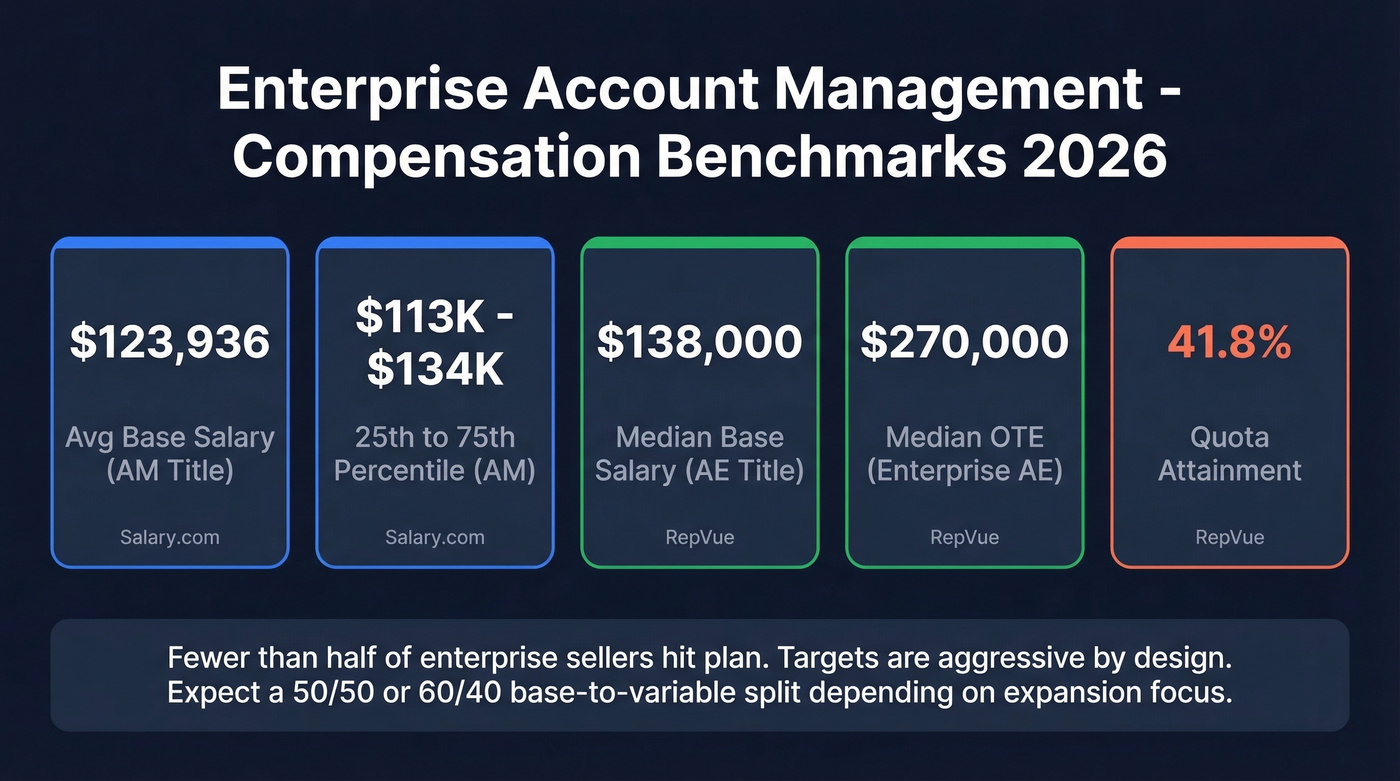
| Metric | Figure | Source |
|---|---|---|
| Avg base salary (AM title) | $123,936 | Salary.com (Mar 2026) |
| 25th-75th percentile (AM) | $113,791-$133,844 | Salary.com (Mar 2026) |
| Median base salary (AE title) | $138,000 | RepVue (Mar 2026) |
| Median OTE (Enterprise AE) | $270,000 | RepVue (Mar 2026) |
| Quota attainment | 41.8% | RepVue (Mar 2026) |
The Salary.com figure captures the "Enterprise Account Manager" title specifically. The RepVue data covers Enterprise Account Executives - an adjacent role, but the closest comp benchmark with reliable self-reported data. The $138K median base for AEs versus $124K for AMs reflects the heavier variable component in AE comp. For quota-carrying enterprise AM roles, expect a 50/50 or 60/40 base-to-variable split depending on how expansion-focused the role is.
That 41.8% quota attainment number isn't a typo. Fewer than half of enterprise sellers hit plan. The targets are aggressive by design.
The Account Planning Framework
Why Most Companies Get This Wrong
Here's the thing: everyone agrees account planning matters. Almost nobody does it well. Momentum ITSMA found that fewer than 20% of companies have fully embedded account planning into their operations, yet those that do attribute up to 77% of revenue growth to account-based strategies. The rest treat planning as an annual exercise - a slide deck built for QBR season and forgotten by February.
The companies that get it right see dramatically different results. Mature account-based programs report 72% higher ROI than any other marketing investment. A study of 1,034 account managers across 62 countries found that disciplined account planning improves win rates by 75% and customer understanding by 72%.
The gap between "we do account planning" and "account planning is embedded in how we operate" is enormous. Let's close it.
ICP Scorecard and Account Tiering
Before you can plan an account, you need to know which accounts deserve a plan. Not every enterprise logo warrants the same investment. A weighted ICP scorecard forces objectivity into what's usually a gut-feel exercise.
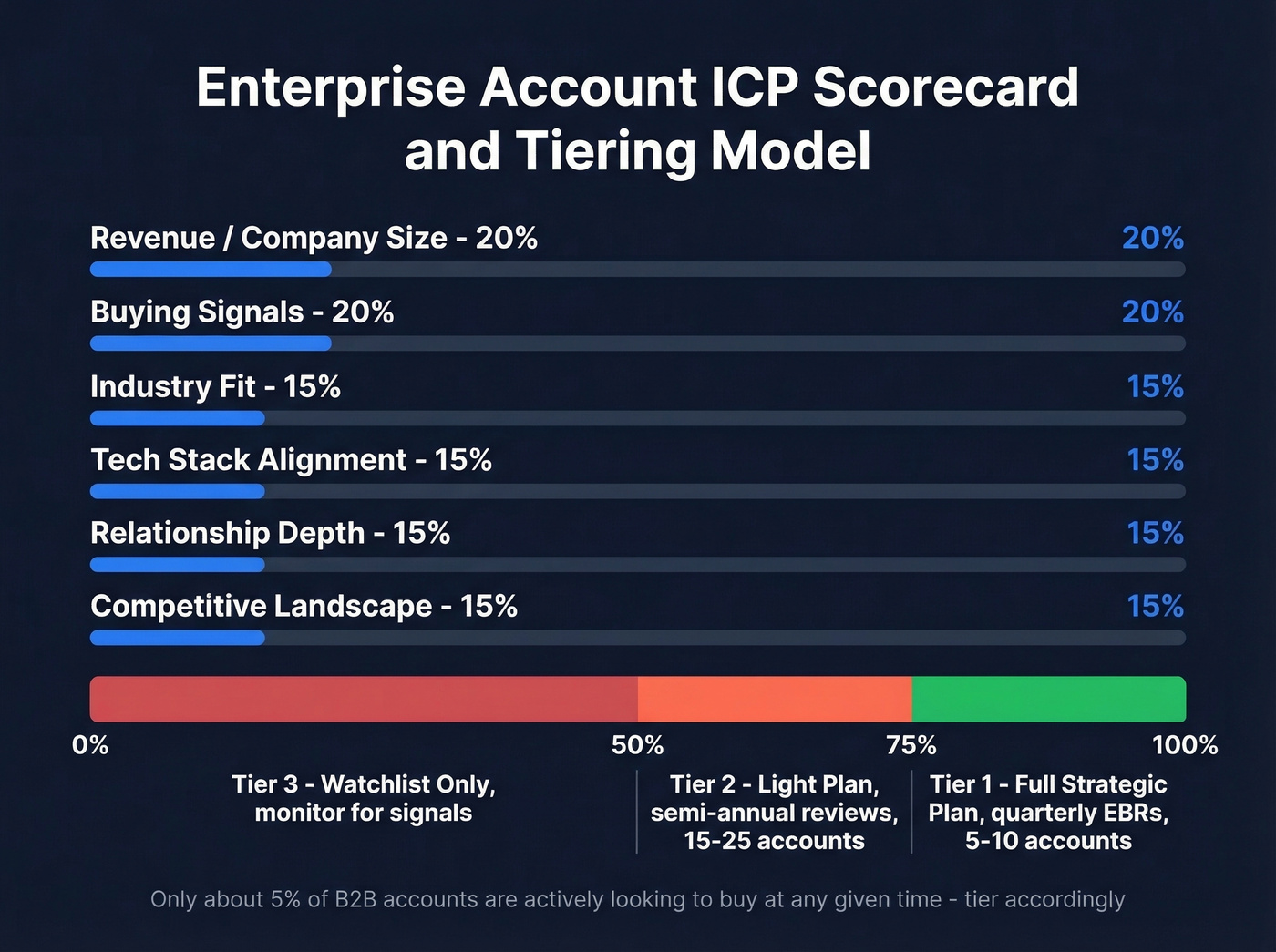
Six dimensions determine each account's score:
- Revenue/company size (20% weight) - Can this account support a meaningful contract?
- Industry fit (15%) - Does your product solve a core problem in their vertical?
- Tech stack alignment (15%) - Are they running infrastructure that makes integration easy?
- Buying signals (20%) - Job postings, tech evaluations, leadership changes?
- Relationship depth (15%) - Do you have multi-threaded access, or are you single-threaded into one champion?
- Competitive landscape (15%) - Are you the incumbent, or displacing someone entrenched?
Accounts scoring above 75% get a full strategic plan with quarterly reviews. The 50-75% range gets a lighter-touch plan with semi-annual check-ins. Below 50%, monitor for signals but don't invest planning cycles.
This maps to a three-tier model. Tier 1 is your top 5-10 accounts - the ones that justify quarterly executive business reviews and dedicated cross-functional resources. Tier 2 covers 15-25 accounts with semi-annual reviews. Tier 3 is your watchlist. Only ~5% of B2B accounts are actively looking to buy at any given time. Your tiering model should reflect that reality.
Building a Strategic Account Plan
A good account plan has eight sections. Not five, not twelve. Eight covers the ground without becoming a document nobody reads.
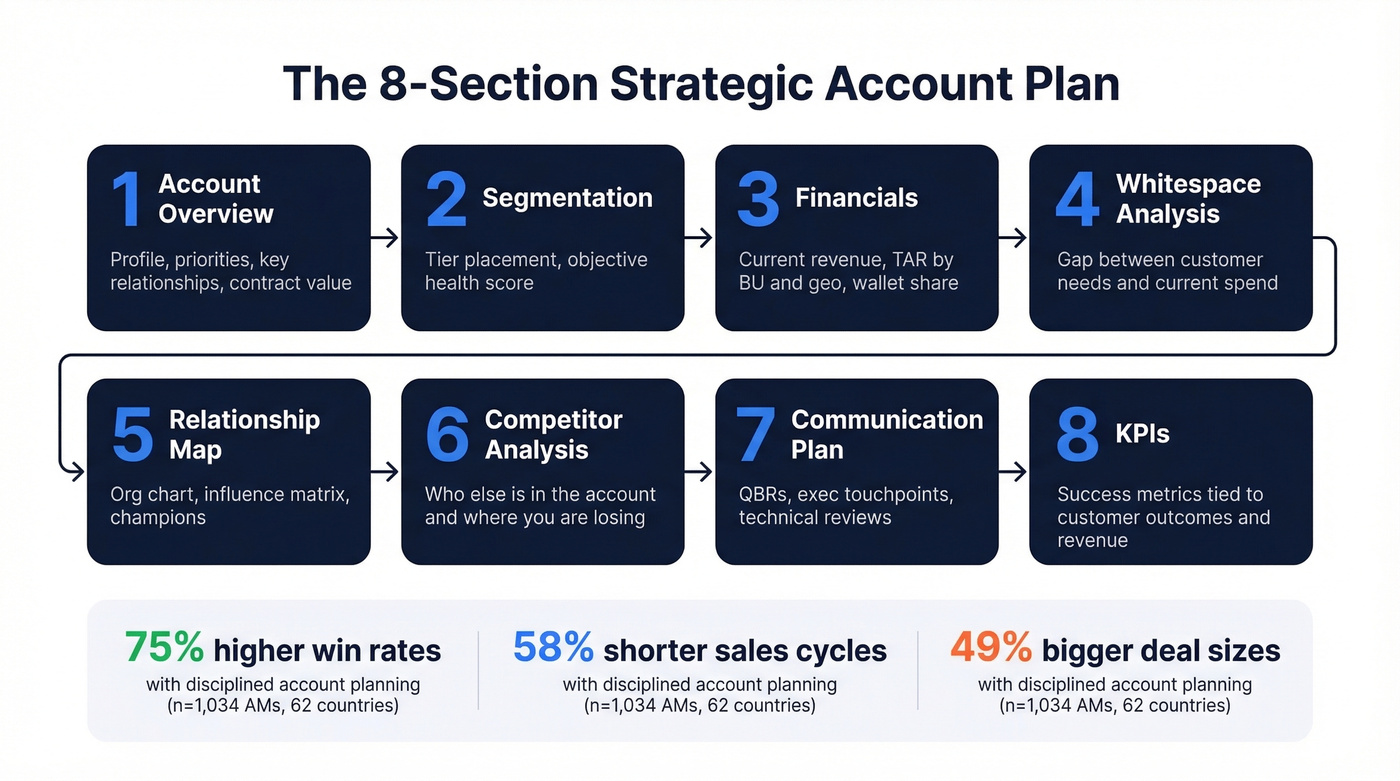
- Account overview - Company profile, strategic priorities, key relationships, current contract value.
- Account segmentation - Tier placement and rationale, using an objective health score.
- Account financials - Current revenue, total addressable revenue by business unit and geography, wallet share vs. competitors.
- Whitespace analysis - The gap between what the customer needs and what you're selling them.
- Relationship mapping - Org chart, influence matrix, budget authority, champion identification.
- Competitor analysis - Who else is in the account, what they're selling, where you're winning or losing.
- Communication plan - Year-long interaction cadence: QBRs, executive touchpoints, technical reviews.
- KPIs - Success metrics for this specific account, tied to customer outcomes and your revenue targets.
The same cross-country study found that organizations doing this well also see shorter sales cycles (58% reported improvement), stronger customer loyalty (55%), and bigger deal sizes (49%). The plan isn't paperwork - it's the mechanism that makes all of those outcomes possible.
The Planning Process: Snapshot, SWOT, Co-Edit
The best account planning process we've seen follows three steps, adapted from SalesHood's framework.
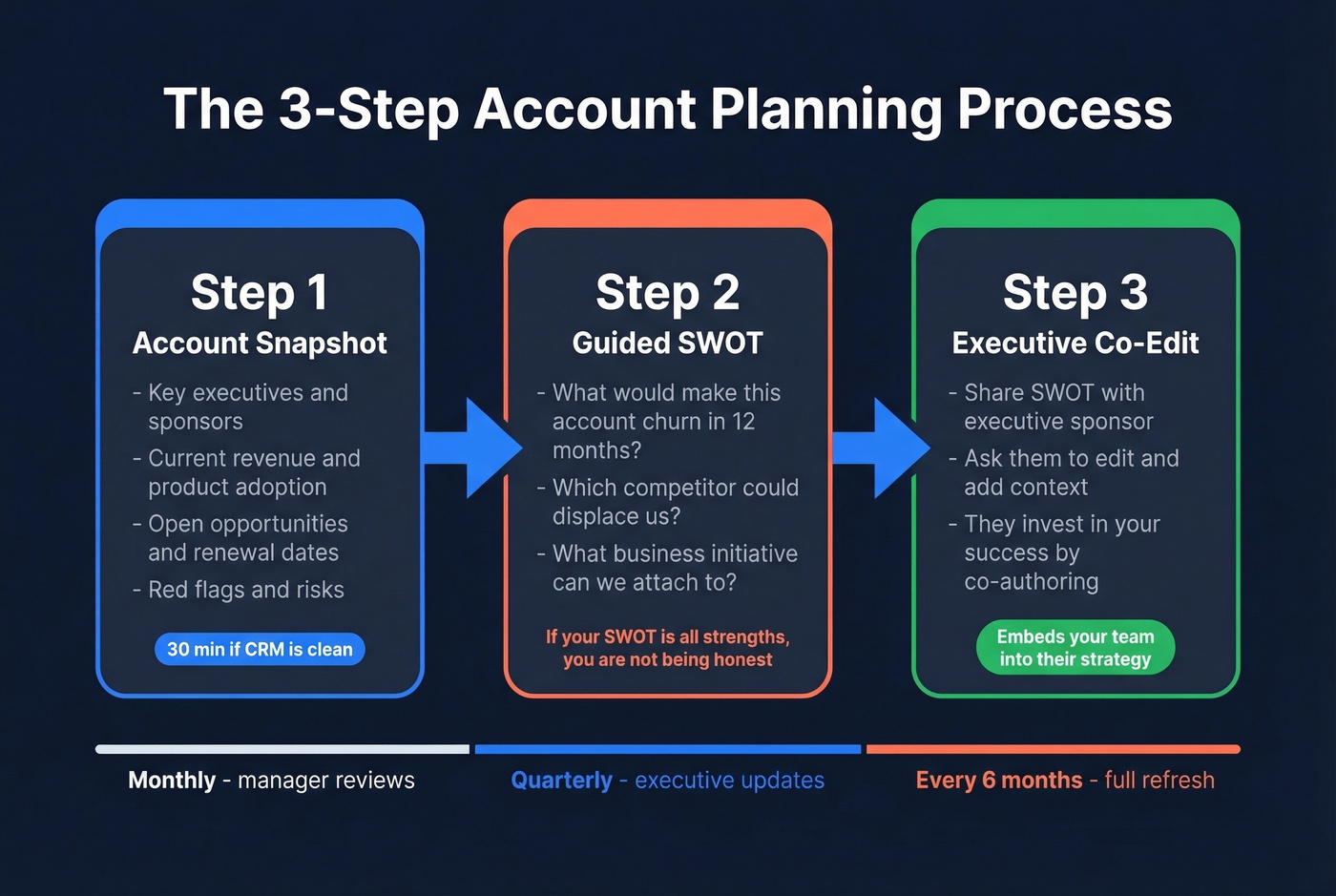
Step 1: Account snapshot. Capture what you know today - key executives, current revenue, product adoption, open opportunities, renewal dates, red flags. This takes 30 minutes if your CRM is clean, two hours if it isn't.
Step 2: SWOT analysis with guided prompts. Don't brainstorm in a vacuum. Use specific prompts: "What would make this account churn in 12 months?" "Which competitor is best positioned to displace us?" "What business initiative could we attach to?" If your SWOT is all strengths and opportunities, you're not being honest.
Step 3: Executive co-editing. Share the SWOT with your executive sponsor and ask them to edit it. This isn't just about getting better information - though you will. It's about embedding your team into the account's strategic thinking. When an executive co-authors your plan, they've invested in your success.
Frame this as part of the rhythm of the business, not an annual obligation. Monthly manager reviews, quarterly executive updates, and a full refresh every six months.
Whitespace Analysis - The Expansion Playbook
In our experience, the whitespace grid is the single highest-ROI artifact an enterprise AM can build. The concept is simple: list the customer's business units down the left side and your products across the top. Mark each cell as Saturated (fully penetrated), Underway (active opportunity), Not a Fit (genuinely irrelevant), or Whitespace (opportunity not yet pursued).
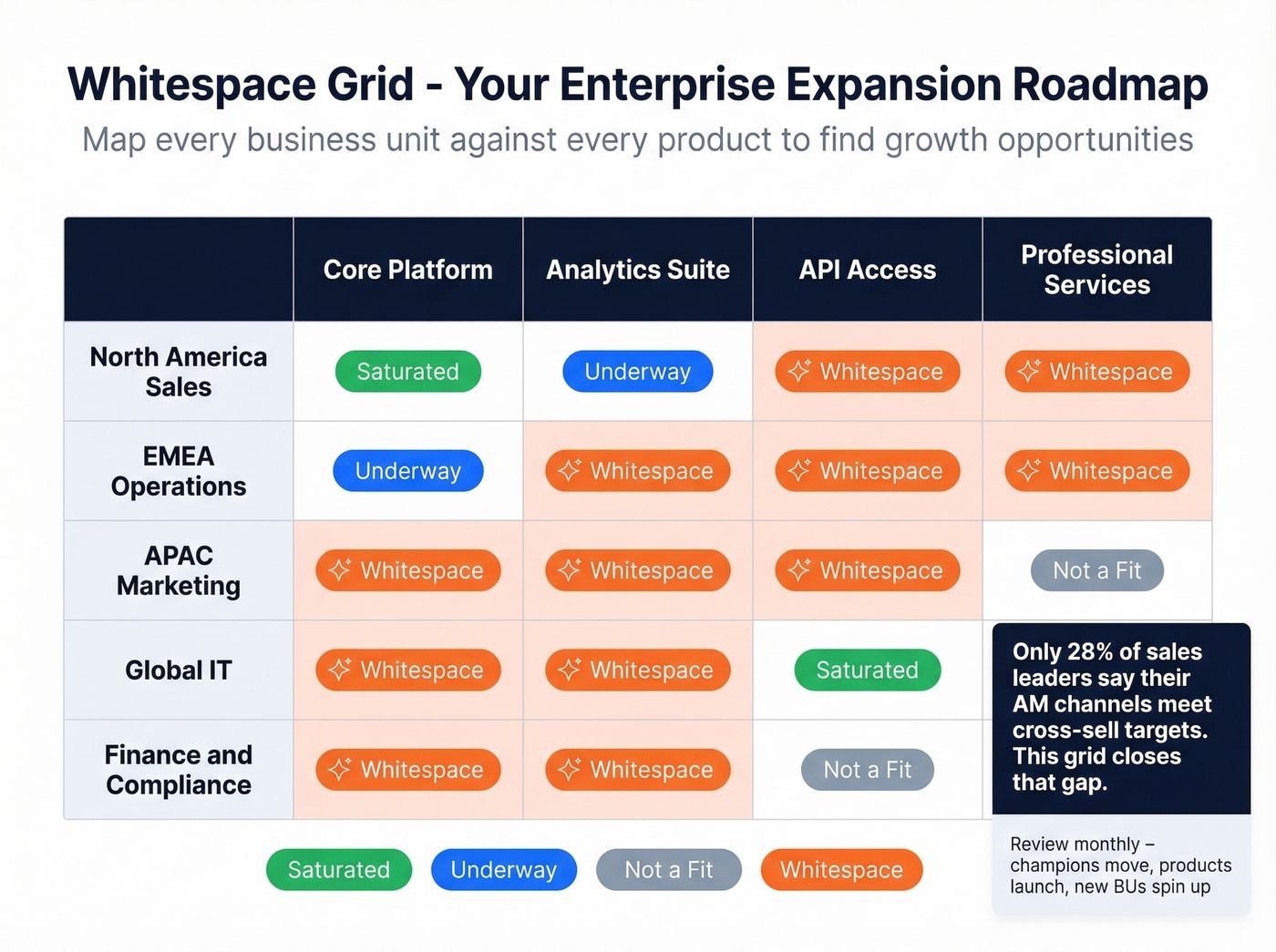
The whitespace cells are your expansion roadmap. CEB/Gartner research found that only 28% of sales leaders believe their account management channels meet cross-sell and account growth targets. That gap exists because most teams don't systematically map where the opportunities are - account planning for sales reps often stops at the current opportunity, while the whitespace grid forces you to think about the entire account.
Review the grid monthly with your account team. New business units spin up. Products launch. Champions move to different divisions. A whitespace cell that was "Not a Fit" six months ago might be wide open today.

Your whitespace grid is only as good as your contact data. Prospeo gives you 98% accurate emails and 125M+ verified mobile numbers across every business unit, so you can multi-thread enterprise accounts without bouncing into oblivion.
Stop single-threading into one champion. Map every stakeholder now.
Multi-Threading Enterprise Stakeholders
Buying committees have ballooned. Salesforce research puts the average at 11 stakeholders; studies tracking enterprise-specific deals put it at 25, up from 16 in 2017. If you're single-threaded into one champion, you're one reorg away from losing the account.
Start with relationship mapping. For each stakeholder, document their influence level (decision-maker, influencer, blocker, end user), budget authority, attitude toward your solution (champion, neutral, detractor), and the last meaningful interaction your team had with them. An influence matrix buried in a slide deck is worthless - put it in your CRM where it triggers reminders.
The hardest part of multi-threading isn't the framework. It's reaching people. Enterprise orgs shuffle leadership constantly, and a new VP joining your account means the person controlling your renewal budget is someone you've never met.

This is where verified contact data becomes critical. Prospeo lets you filter by company, title, department, and seniority to find exactly who you need, with 98% email accuracy and contacts refreshed on a 7-day cycle. You can push verified contacts straight into your CRM - the difference between proactive multi-threading and reactive scrambling.
The rule of thumb: for every Tier 1 account, maintain active relationships with at least 5-7 stakeholders across different functions and seniority levels. If you can't name them right now, that's your first action item.
KPIs That Actually Matter
The Five Metric Groups
Every enterprise AM dashboard should track five categories. Not all are "your" metrics - some belong to CS, some to finance - but you need visibility into all of them.
| Metric | Formula | Example |
|---|---|---|
| Customer Lifetime Value | Avg purchase value x frequency x lifespan | $24K/yr x 4 yrs = $96K |
| Net Promoter Score | % Promoters - % Detractors | 70% - 10% = NPS 60 |
| Customer Churn Rate | (Customers lost / Customers at start) x 100 | 25 / 500 = 5% |
Upsell and cross-sell revenue is your whitespace grid in dollar terms. Track total expansion revenue against the grid to see which cells are converting. Example: $20K upsell + $15K cross-sell = $35K expansion for the quarter. (If you need a clean definition and examples, see upsell and cross-sell.)
Engagement metrics - meeting frequency, executive touchpoints, product adoption, support ticket trends - are your leading indicators. By the time churn shows up in the lagging metrics, you've already lost.
NRR - The Gold Standard
Net Revenue Retention is the single metric that tells you whether your account base is growing or shrinking. NRR above 100% means expansion revenue exceeds churn and contraction. Below 100% is a red flag - you're losing ground even if you're adding new logos.
Gross Revenue Retention strips out expansion and shows pure retention. If your GRR is low, you have a churn problem that upselling can't paper over. Both numbers belong on your executive dashboard. (If you want the retention math, start with renewal rate.)
Dashboard Archetypes
You need two dashboards, not one.
The CFO one-pager shows MRR bridge (starting MRR + expansion - churn - contraction = ending MRR), forecast vs. budget variance, and renewal pipeline by quarter. Keep it to one page. CFOs don't scroll. If your forecast is consistently off, use a dedicated sales forecasting view.
The CS war-room dashboard shows health score distribution across your book, the renewal calendar for the next 90 days, a red accounts list with owner and action plan, and NPS trend over time. This is the operational view that drives your weekly account team meetings.
Enterprise Sales Cycle Benchmarks
Enterprise deals take longer than anyone budgets for. Here's what the data shows:
| Deal Size (ACV) | Avg Cycle Length |
|---|---|
| $50K-$100K | 120 days |
| $100K-$250K | 170 days |
| $250K-$500K | 220 days |
| $500K+ | 270 days |
Company size matters too. Selling into organizations with 10,001+ employees averages 185 days regardless of deal size. The bureaucracy alone adds weeks.
Real talk: win rates sit at ~20-21%. Four out of five enterprise deals end in a loss or no-decision. That's not a failure of your team - it's the structural reality of complex B2B sales. Plan your pipeline coverage accordingly. (For broader context, see enterprise B2B sales.)
And here's the productivity problem that makes everything harder: reps spend only 28-30% of their time actually selling. About 18% goes to CRM and admin work. The average rep uses ~10 tools to close deals, and 66% report feeling swamped by the fragmentation. If you're an enterprise AM juggling account plans, stakeholder maps, QBR prep, and internal advocacy, that 28% number probably feels generous.
Mistakes That Kill Enterprise Accounts
Staying tactical when you should be strategic. The most common failure mode is becoming an order-taker. The customer asks for a feature, you escalate it. They report a bug, you chase engineering. You're fulfilling requests without ever uncovering the business outcomes behind them. Strategic AMs connect customer requests to those outcomes and use the connections to drive expansion conversations.
Being reactive instead of proactive. If you're learning about leadership changes, competitive threats, or budget shifts from your champion instead of before your champion, you're behind. We've seen accounts churn not because the product failed, but because the AM didn't see the reorg coming and lost all their relationships in a single quarter. Set up alerts for executive moves, earnings calls, and industry shifts. Stay ahead. (A practical way to operationalize this is tracking sales triggers.)
Assuming internal alignment exists. Your solutions engineer, your CSM, your executive sponsor, and your product team all think they understand the account. They don't - not unless there's a structured account plan that everyone references. Without one, you get misaligned resources, conflicting messages to the customer, and the slow erosion of trust that precedes churn.
The "set and forget" plan. Look, if your last account plan update was six months ago, you don't have an account plan - you have a historical artifact. Plans need monthly reviews with your manager and quarterly refreshes with the broader account team. A plan that doesn't evolve with the account is worse than no plan at all, because it creates false confidence.
Skip the enterprise playbook if your deals are small. If your deal sizes sit below $100K, you probably don't need a dedicated enterprise AM function at all. You need a strong mid-market team with good playbooks. Enterprise account management only justifies its cost when the accounts are large enough and complex enough that losing one changes your quarter. Running this playbook on mid-market accounts just creates expensive overhead.
Tools for Enterprise Account Managers
The enterprise AM tech stack breaks into five categories. You don't need ten tools - you need the right one in each category.
| Category | Tool | Starting Price |
|---|---|---|
| CRM | Salesforce | $25/user/mo (enterprise tiers run $150-300+/user/mo) |
| CRM | HubSpot | Free; paid plans from ~$90/user/mo |
| CRM | Pipedrive | $14/user/mo |
| Account Planning | DemandFarm | Custom pricing (~$500-2,000+/mo) |
| Contact Data | Prospeo | Free tier available (75 emails + 100 Chrome extension credits/mo) |
| Conversation Intel | Gong | ~$100+/user/mo |
| Dashboard | Looker Studio | Free |
| Dashboard | Power BI | $10/user/mo |
| Dashboard | Tableau | $75/user/mo |
CRM: Salesforce is the default for enterprise orgs, though enterprise licensing is a different animal than the $25 starter plan. HubSpot or Pipedrive handle account management workflows at a fraction of the cost for smaller teams. (If you're comparing options, start with examples of a CRM.)
Account planning: DemandFarm is purpose-built for key account planning with org charts, whitespace mapping, and relationship scoring. It replaces the PowerPoint-and-prayer approach most teams default to.
Conversation intelligence: Gong captures and analyzes customer calls. For enterprise AMs running QBRs and executive meetings, the ability to review what was actually said - versus what you remember - is invaluable.
Dashboards: Looker Studio is free and handles most reporting needs. Power BI at $10/user/mo is the enterprise standard for Microsoft shops. Tableau at $75/user/mo is powerful but overkill for most AM dashboards.
Enterprise account plans fall apart when contacts change roles and data goes stale. Prospeo refreshes every record on a 7-day cycle - not the 6-week industry average - so your org charts and stakeholder maps stay current through every reorg.
Your predecessor's spreadsheet is already outdated. Your data shouldn't be.
FAQ
What's the difference between enterprise and strategic account management?
The terms are largely interchangeable. "Strategic" emphasizes planning methodology and long-term growth, while "enterprise" emphasizes account size and organizational complexity. Both involve fewer accounts, deeper multi-threaded relationships, and KPIs focused on expansion and retention rather than new logo acquisition. Don't get hung up on the label - the discipline is the same.
How many accounts should an enterprise AM manage?
Two to five Tier 1 accounts is the standard. Some organizations layer in 10-15 Tier 2 accounts with a lighter-touch cadence, but more than five true enterprise accounts dilutes strategic depth. If your leadership is assigning eight-plus accounts per AM, they're under-resourcing the function.
What tools do enterprise account managers need?
The core stack is a CRM for pipeline and relationship tracking, an account planning framework, verified contact data for multi-threading, and a dashboard for KPI visibility. Conversation intelligence like Gong is a strong add if budget allows. Beyond that, resist the urge - the average rep already uses ~10 tools, and 66% feel swamped by the fragmentation.
How does account planning differ for sales reps vs. AMs?
Sales reps build account plans focused on closing a single opportunity - mapping the buying committee, identifying the champion, building a business case for one deal. Enterprise AM planning is broader and ongoing: it covers the full relationship lifecycle, tracks whitespace across every business unit, and plans expansion over multiple quarters. The AM's plan is a living document, not a one-time artifact tied to a single deal cycle.