

8 Enterprise Sales Best Practices That Actually Move Deals in 2026
Only 43.5% of sales reps hit quota last year. Win rates are down 18% compared to 2022, and cycles keep stretching. Meanwhile, 61% of B2B buyers now prefer a rep-free experience, and 92% start with at least one vendor already in mind.
The enterprise sales best practices that worked three years ago are leaving money on the table - or worse, losing deals to committees that can't reach consensus. These eight practices separate top-quartile closers from everyone else.
Quick Version
Three highest-leverage changes for enterprise reps right now:
- Qualify every deal with MEDDPICC - teams that fully adopt it report 18% higher win rates.
- Co-create a Mutual Action Plan for every deal over $50K - 26% higher win rate.
- Fix your contact data. You can't multi-thread a 12-person buying committee when half your emails bounce and two stakeholders left the company last quarter.
Enterprise Sales Cycle Benchmarks
Cycle length varies wildly by deal size. Knowing where your deals should land helps you spot stalls before they kill momentum.
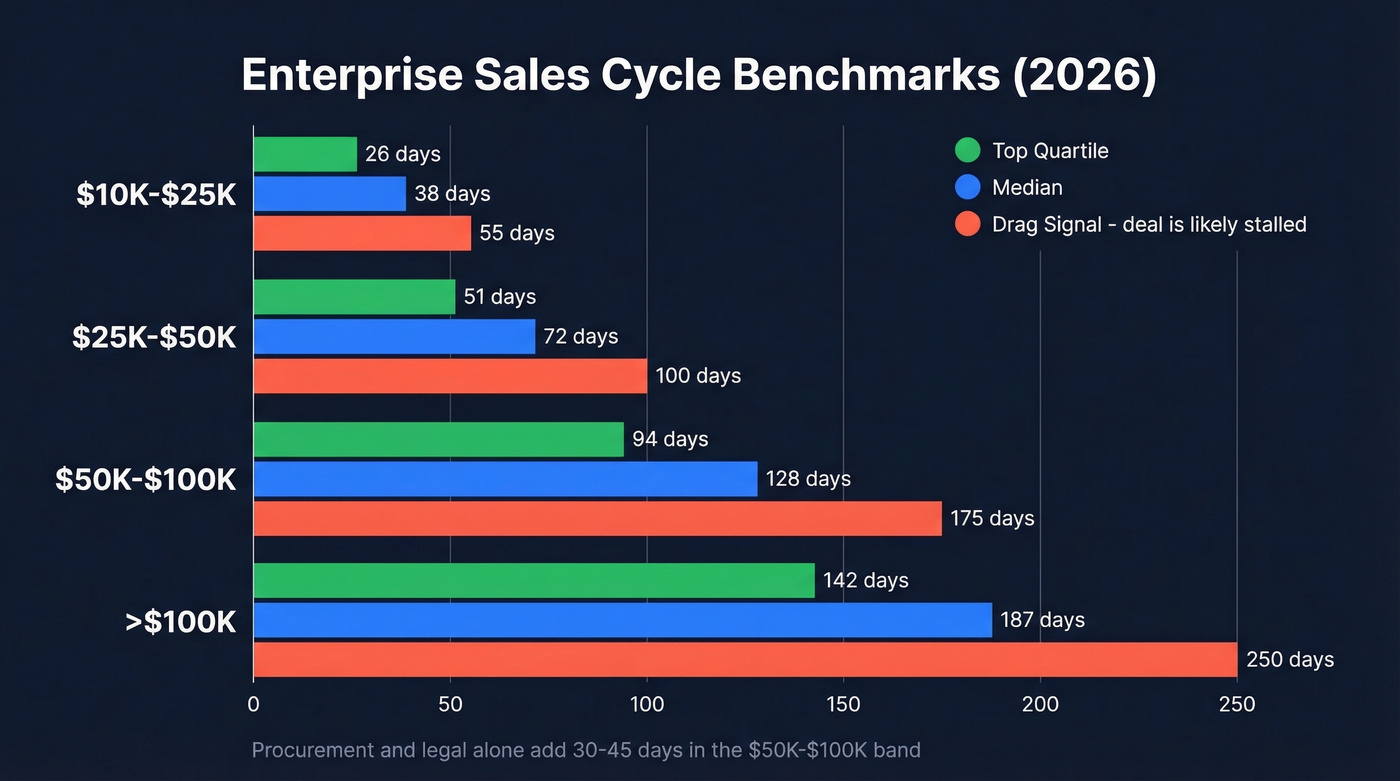
| ACV Band | Median Days | Top Quartile | Drag Signal |
|---|---|---|---|
| $10K-$25K | 38 | 26 | >55 |
| $25K-$50K | 72 | 51 | >100 |
| $50K-$100K | 128 | 94 | >175 |
| >$100K | 187 | 142 | >250 |
Source: TechGrowthInsights 2026 benchmarks
Procurement and legal alone add 30-45 days in the $50K-$100K band. If your deal is past the drag signal threshold and you haven't engaged procurement yet, that's not a pipeline deal. It's a wish.

Enterprise deals stall when you can't reach the full buying committee. Prospeo gives you 98% accurate emails and 125M+ verified mobile numbers - refreshed every 7 days, not every 6 weeks. Map every stakeholder from the economic buyer to procurement, and actually connect.
Stop losing deals because your champion's contact list is outdated.
The 8 Practices That Close Complex Deals
1. Qualify with MEDDPICC
73% of SaaS companies selling above $100K ARR use some version of MEDDPICC. Teams that fully adopt it report 18% higher win rates and 24% larger deal sizes. The framework forces you to validate eight elements before a deal earns real pipeline status: Metrics, Economic Buyer, Decision Criteria, Decision Process, Paper Process, Identify the Pain, Champion, Competition.
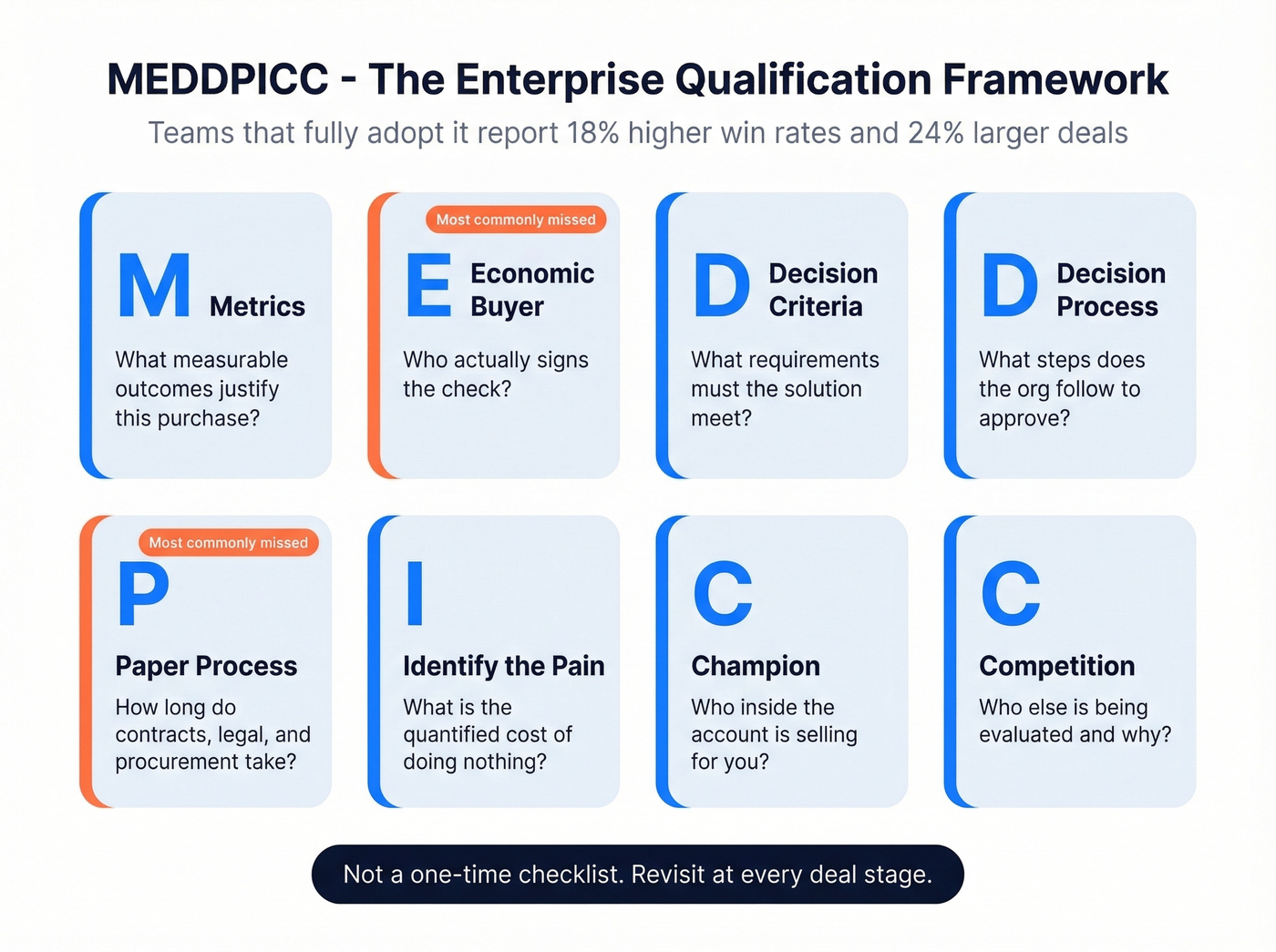
The two elements that trip up most reps are Economic Buyer and Paper Process. If nobody on your side can name the person who signs the check - not the person who wants the product, the person who funds it - the deal is fragile. Three discovery questions that cut through:
- "Walk me through how your last purchase of this size got approved. Who signed off?"
- "What metrics would your CFO need to see to greenlight this in the current budget cycle?"
- "If we agreed on terms tomorrow, what's the procurement timeline look like?"
MEDDPICC isn't a checklist you fill out once. It's a living qualification lens you apply at every stage. We've watched teams fill in every field during Stage 1 discovery and never update it again - that's how most implementations quietly fail. Among all enterprise deal strategies, rigorous qualification has the most direct impact on forecast accuracy.
2. Multi-Thread the Buying Committee
Gartner surveyed 632 B2B buyers and found that 74% of buying teams demonstrate unhealthy conflict during the decision process. Buying groups range from 5 to 16 people across as many as four functions. Selling to one champion and hoping they carry the deal internally is a losing strategy.
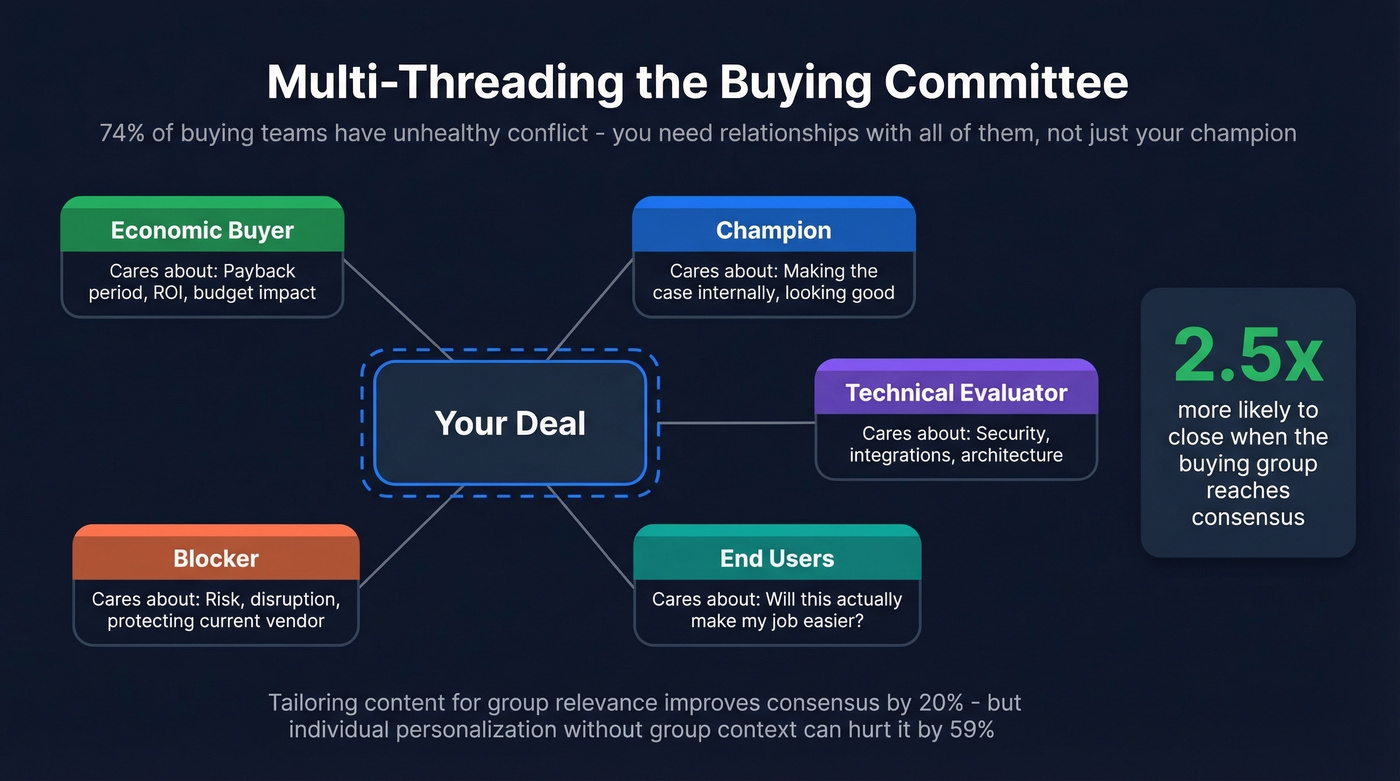
Here's the stat that should change how you think about this: buying groups that reach consensus are 2.5x more likely to report the deal was "high-quality." Consensus isn't just nice - it's the mechanism that gets deals funded and renewed.
Map every stakeholder by role: economic buyer, champion, technical evaluator, end users, and - critically - the blocker. The CFO cares about payback period. The IT lead cares about security posture. The end user cares about whether this thing actually makes their job easier. Tailoring content for buying-group relevance improves consensus by 20%, while individual-level personalization that ignores group dynamics can actually hurt consensus by up to 59%.
You can't multi-thread if half your emails bounce. Prospeo gives you verified emails at 98% accuracy and 125M+ verified mobile numbers for every stakeholder on the map, refreshed every 7 days - so you're reaching the VP of Procurement, not their predecessor who left two quarters ago.
3. Build a Mutual Action Plan
Deals with Mutual Action Plans have a 26% higher win rate. Yet only 45% of sellers use them consistently, and 12% never use them at all. That's free win-rate lift sitting on the table.
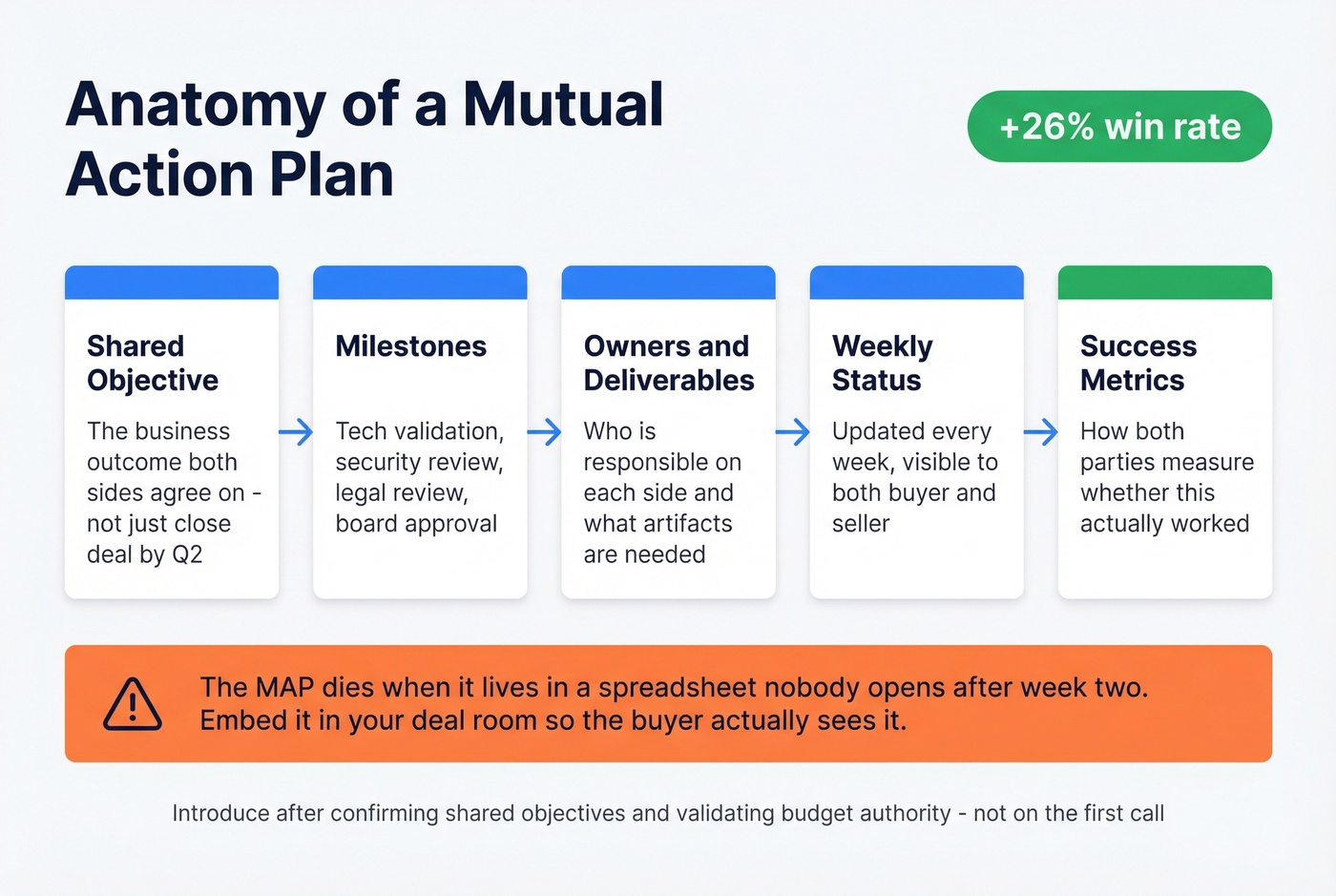
A MAP is a co-created roadmap - not a one-sided project plan you email over. Introduce it after confirming shared objectives and validating budget authority. The core structure:
- Objective - the shared business outcome, not "close deal by Q2"
- Milestones - technical validation, security review, legal, board approval
- Owner + Deliverables - who's responsible on each side, and what artifacts each step requires
- Status - updated weekly, visible to both sides
- Success metrics - how both parties measure whether this worked
In our experience, the MAP dies when it lives in a spreadsheet nobody opens after week two. Embed it in your deal room or digital sales room or engagement platform so the buyer actually sees it. A shared, visible plan keeps both sides accountable and compresses cycle time - one of the most underused tactics in complex deal management.
4. Arm Your Champion with a Business Case
Your champion will eventually walk into a room without you and pitch this deal to people who've never seen a demo. They need ammunition.
A business case isn't a feature deck - it's a stakeholder-facing document focused entirely on ROI. Keep the executive summary under 150 words. Structure it around four sections:
- Challenges - the quantified cost of the status quo
- Recommendation - your solution, framed as their decision
- Business impact - ROI, payback period, risk reduction
- Investment - total cost, payment terms, implementation timeline
The CFO doesn't care what your product does. They care what it returns. Payback norms for SaaS investments run 6-12 months; enterprise platforms can stretch to 12-24 months if the NPV justifies it. "Reduces onboarding from 30 days to 15" beats "AI-powered onboarding acceleration" every single time.
5. Parallelize Procurement and Legal
Week 14 of a $150K deal. Legal has had the MSA for three weeks. Your champion is apologizing. The quarter is slipping.
This scenario is entirely preventable. Start security questionnaires the moment technical validation begins, not after. Ask your champion in the first month how long procurement typically takes. Engage their procurement team before the deal is "ready" - because by the time it's ready, you've already lost a month. Parallel paths beat sequential ones every time.
6. Use AI to Reclaim Selling Time
Reps spend roughly 30% of their time actually selling. Gartner's data shows reps who partner effectively with AI are 3.7x more likely to meet quota.
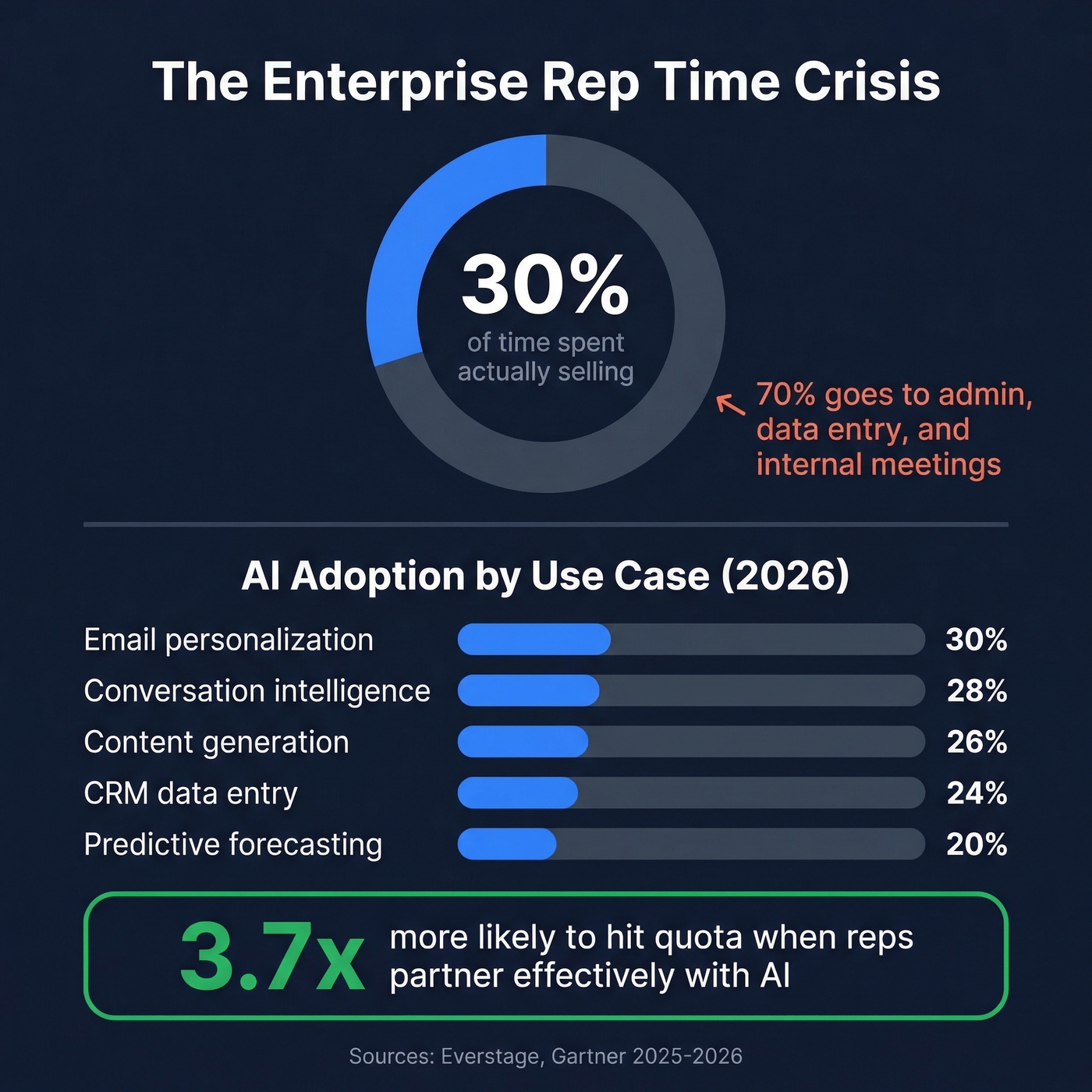
| AI Use Case | Adoption |
|---|---|
| Email personalization | 30% |
| Conversation intelligence | 28% |
| Content generation | 26% |
| CRM data entry | 24% |
| Predictive forecasting | 20% |
If your team hasn't adopted conversation intelligence yet, that's the highest-ROI starting point. Recorded calls with AI-generated summaries eliminate the "what did they actually say about budget?" problem entirely. The biggest unlock isn't any single use case - it's automating the 70% admin burden so reps can spend more time on discovery, multi-threading, and deal strategy.
7. Fix Your Data Before You Prospect
You pulled 12 stakeholders from your CRM. Four bounced, two left the company, one's an intern. Now your carefully planned multi-threading strategy is a three-contact email blast.
Let's be honest: every practice in this article - MEDDPICC, MAPs, multi-threading - depends on reaching the right people with accurate information. Self-sourced pipeline gets a lot harder when SDR coverage is thin, and that problem compounds fast when your data is stale. We've seen teams triple their multi-threading coverage just by switching to a verified data source with a weekly refresh cycle instead of the 6-week industry average.
If you're cleaning lists and trying to stop bounces before they hit your domain, start with email bounce rate benchmarks and a real email deliverability guide.

8. Why High-Touch Selling Still Wins
This one sounds simple. It is.
Demandbase's former SVP of sales used a post-it note system: every active deal gets a checkmark when you've touched it that day. No checkmark by 4 PM? Pick up the phone. The principle extends beyond individual reps - run war rooms weekly to pressure-test your top deals. Is the champion still engaged? Has the economic buyer gone quiet? Is the business case back-of-the-napkin simple, or did it turn into a 40-slide deck nobody reads?
Here's the thing: enterprise deals die from neglect more often than from competition. I've watched more seven-figure opportunities evaporate because a rep went quiet for two weeks than because a competitor had a better product. Consistent, daily momentum is the antidote.
Not every deal deserves the same effort, though. Tier your accounts: full team selling for top-tier, targeted outreach for mid-tier, automated sequences for the rest. For your largest accounts, think beyond the initial close - ELA and subsidiary expansion plays can double deal value without doubling the sales cycle.
Three Things to Implement This Week
These enterprise sales best practices only work if you act on them. Start with MEDDPICC - even a lightweight version forces better qualification conversations immediately. Next, build a MAP template and use it on your next deal above $50K. Finally, audit your contact data. Skip this step if you're confident every stakeholder in your top 10 deals has a verified email and direct dial. If you're not confident, that's your answer.
If you need a faster way to operationalize this across outbound, revisit your sales prospecting techniques and tighten your sales activities so the right accounts get the right touches.
MEDDPICC falls apart when you can't identify or reach the economic buyer. Prospeo's 300M+ profiles with 30+ filters - including job changes, department headcount, and funding signals - let you validate every stakeholder before the deal earns pipeline status. At $0.01 per email, bad data is no longer an excuse for a missed quarter.
Qualify faster when every contact in your MEDDPICC grid is verified.
FAQ
How long is a typical enterprise sales cycle?
Median enterprise sales cycles run 72-187 days depending on deal size. Deals over $100K ACV average 187 days; top-quartile teams compress that to 142 days. Procurement and legal review alone can add 30-45 days on top of the core selling process.
What's the difference between MEDDIC and MEDDPICC?
MEDDPICC adds Paper Process, Implicate the Pain, and Competition to the original MEDDIC framework from PTC (1996). Both qualify deals by validating metrics, economic buyers, decision criteria, and champions. MEDDPICC better handles procurement complexity and competitive positioning - it's the dominant version for $100K+ deals.
How many stakeholders are in enterprise deals?
Gartner data shows enterprise buying groups range from 5 to 16 people across up to four functions. 74% of these groups experience unhealthy conflict during the decision process, which is why multi-threading and consensus-building matter more than winning over a single champion.
What tools do enterprise sales teams need?
The core stack includes a CRM (Salesforce, HubSpot), a sales engagement platform (Outreach, Salesloft), and conversation intelligence (Gong). For contact data, tools like Prospeo cover 300M+ profiles at 98% email accuracy with a 7-day refresh cycle - starting at roughly $0.01 per email with a free tier. Budget $40-80K/year for a mid-market stack; enterprise deployments run higher.