

Enterprise Sales Enablement: What It Costs, Who Owns It, and Why Most Programs Fail
The enterprise sales enablement market hit $5.23B in 2024 and is on track for $12.78B by 2030. Money's pouring in. Yet 58% of pipelines stall because reps don't add value, and roughly 65% of marketing content never gets used by sales. Results aren't keeping pace with spending, and the problem isn't effort - it's architecture.
This is a revenue function, not a training function. The market has consolidated into two mega-platforms. Budget $42K-$180K+/year for platforms like Showpad, Seismic, and Highspot. Measure win rate and pipeline velocity, not completion rates. And before any of it works, your reps need verified contact data for every stakeholder in the buying committee - because the best battlecard in the world is worthless if it bounces off a dead email address.
What Enterprise Enablement Actually Means
Standard enablement helps reps sell better. Enterprise-grade enablement orchestrates a commercial engine across complex deals with 11+ stakeholders, sales cycles that stretch past a year, and multiple buying committees. Today, 76% of organizations have dedicated enablement - up from 32% five years ago. It's table stakes.
The function rests on three pillars: content (right asset, right moment, right persona), coaching (methodology reinforcement and deal-level guidance), and technology (the platform layer tying it together). But enablement isn't just downstream from GTM strategy - it feeds back into it. Your enablement team should identify messaging gaps, test what resonates, and optimize the insights loop between sales, marketing, and product.
The best programs in 2026 personalize at the rep level. If enablement only receives strategy and never shapes it, you've built a content library, not a commercial engine.
Why Most Enablement Programs Fail
Three patterns explain the gap between spending and results - though honestly, we've seen all of them show up simultaneously in the same org.
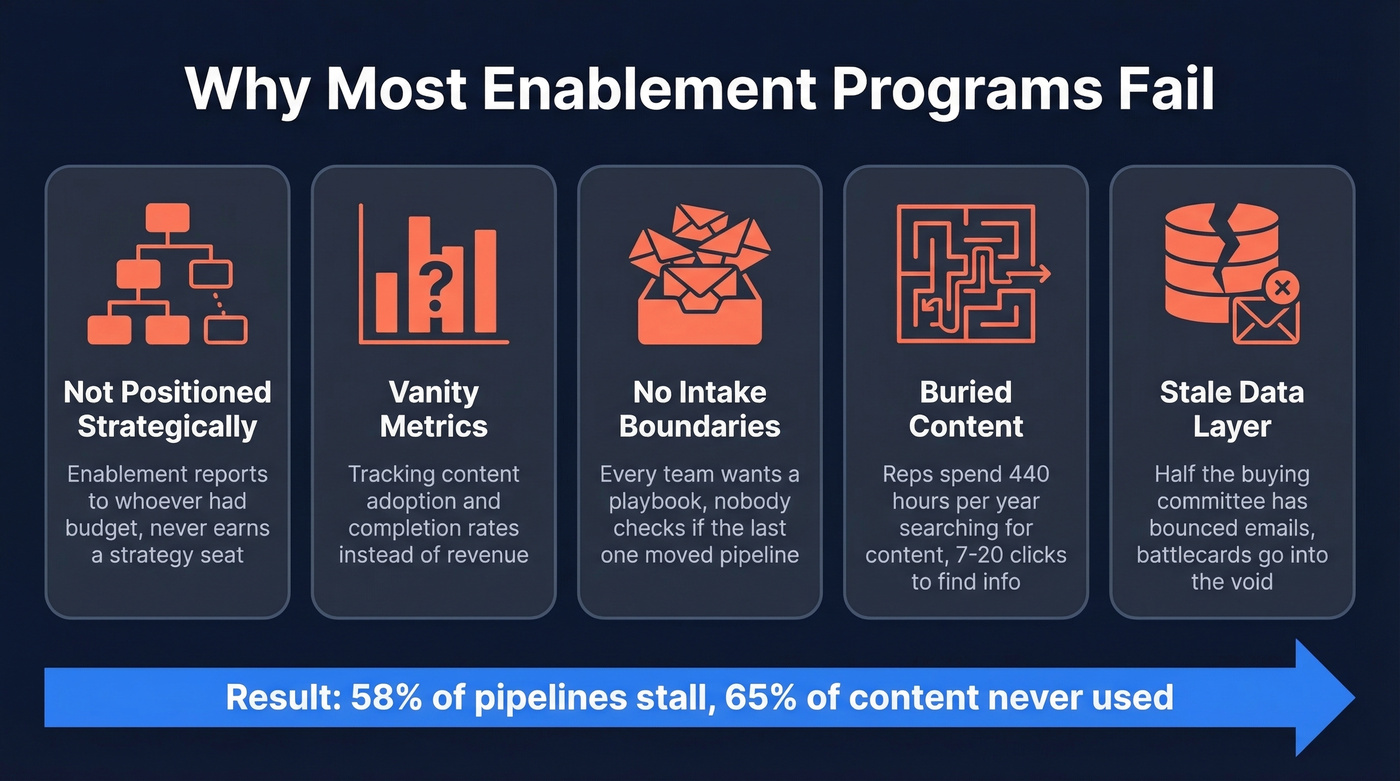
Not positioned strategically. Enablement reports to whoever had budget, gets treated as a service desk, and never earns a seat at the strategy table. If your enablement lead isn't in the deal review, you've already lost.
Measuring vanity metrics. Half of enablement teams track content adoption. It's one of the most-tracked and least useful metrics in the stack. Completion rates and attendance tell you nothing about revenue.
No intake boundaries. Without a prioritization framework, enablement becomes a request queue. Every team wants a new playbook. Nobody asks whether the last one moved pipeline.
Burying content in clunky systems. Revenue teams spend 440 hours per year searching for or creating content. One enablement buyer reported needing 7-20 clicks to find information in their LMS - and called engagement "abysmal." Reps already spend only 30% of their time selling. A high-friction content system makes that number worse.
Ignoring the data layer. Your platform delivers content beautifully. But if the CRM has stale contacts for half the buying committee, reps are sending battlecards into the void. This one gets overlooked constantly, and it's the silent killer of enablement ROI.
Who Owns Enablement
The reporting line matters more than most leaders admit.
| Reports To | % of Orgs |
|---|---|
| RevOps | 39.4% |
| Sales | 25.4% |
| C-Suite | 16.6% |
| Marketing | 5.2% |
| Product Marketing | 3.5% |
| HR | 2.6% |
| Other | 7.3% |
Three org models dominate. Centralized teams work best for a single sales motion with consistent methodology. Hub-and-spoke - a center of excellence with embedded specialists - suits multi-product or multi-geo orgs. Fully decentralized enablement works at scale but risks inconsistency.
A common planning ratio: 1 enablement FTE per 20-40 sellers. We've seen teams try to stretch one enablement manager across 80+ reps. It doesn't work. You end up with a content librarian, not a strategic function. (If you're benchmarking roles and scope, see enablement manager responsibilities.)
How to Measure Enablement ROI
| Metric | % Tracking |
|---|---|
| Content adoption | 50.0% |
| Quota attainment | 43.1% |
| Win rate | 42.2% |
| Revenue generated | 37.9% |
| Sales cycle length | 33.6% |
| Sales velocity | 27.5% |
| Pipeline growth | 23.2% |
| Deal size | 14.6% |
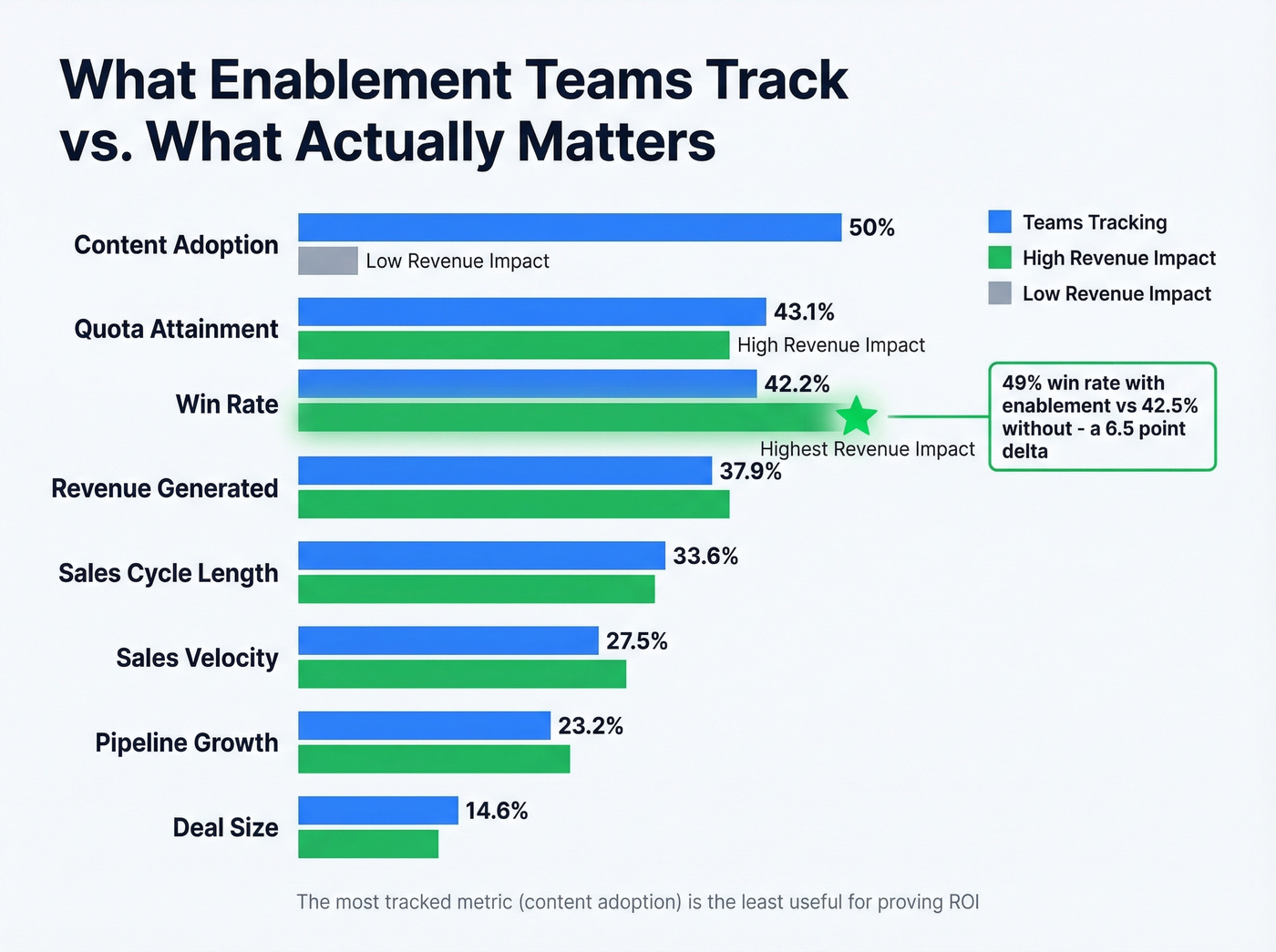
Content adoption tops the list, but it's a process metric, not an outcome metric. The number that matters is win rate. Organizations with formal enablement programs see a 49% win rate on forecasted deals vs. 42.5% without. That 6.5-point delta is the business case.
Forrester data shows delivering the right content at the right time generates 50% more sales-ready leads at 33% of the cost - which is the ROI story your CFO actually needs to hear.
Here's the thing: the CFO conversation goes better when you bring your own baseline data - your current win rate, your current ramp time, your current content utilization - not a vendor's ROI calculator. Measure the delta after 90 days. That's what gets budget renewed. (To pressure-test pipeline impact, use a simple pipeline health scorecard.)

You just read that 58% of pipelines stall because reps don't add value. But stalls also happen when reps can't reach the buying committee at all. Prospeo gives your team 98% verified emails and 125M+ direct dials across 300M+ profiles - refreshed every 7 days, not every 6 weeks. At $0.01/email, fixing the data layer costs less than one month of your enablement platform.
Stop sending battlecards to bounced addresses.
The Platform Landscape in 2026
Two mergers reshaped the market. Seismic and Highspot announced their merger in February 2026. Showpad completed its acquisition of Bigtincan in October 2025. The inaugural 2025 Gartner Magic Quadrant for Revenue Enablement Platforms named both Highspot and Showpad as Leaders.
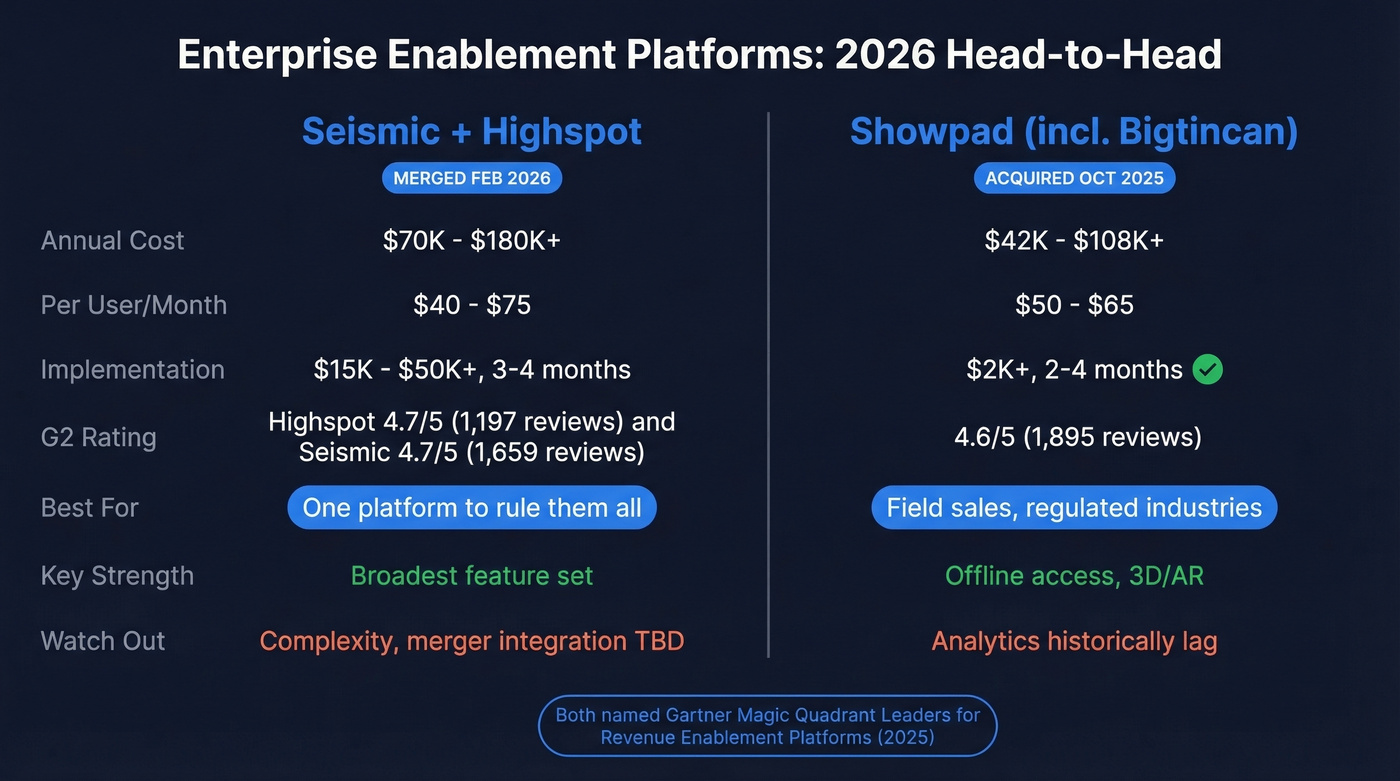
Every major enablement platform hides pricing behind "request a demo." Ironic, given that enablement is supposed to eliminate exactly this kind of friction.
| Seismic + Highspot | Showpad (incl. Bigtincan) | |
|---|---|---|
| Annual cost | $70K-$180K+ | $42K-$108K+ |
| Per user/month | $40-$75 | $50-$65 |
| Implementation | $15K-$50K+ / 3-4 mo | $2K+ / 2-4 mo |
| G2 rating | Highspot 4.7/5 (~1,197); Seismic 4.7/5 (~1,659) | 4.6/5 (~1,895) |
| Strength | Broadest feature set | Field sales, offline, 3D/AR |
| Best for | Orgs wanting one platform to rule them all | Field sales / regulated industries |
| Watch out | Complexity; merger integration TBD | Analytics historically lag |
When evaluating, prioritize ease of access - can reps find content in under 3 clicks? - integrations with your existing stack like Salesforce, Outlook, and Teams, analytics tied to revenue outcomes, and AI capabilities for content personalization. The tool sprawl problem is real: 91% of sales orgs use 3+ enablement tools, and 43% of those tools are underutilized. Consolidation isn't just a vendor trend; it's a survival strategy.
Let's be honest: if your average deal size is under $25K and involves fewer than five stakeholders, you probably don't need a $100K+ enablement platform. A well-organized Google Drive, a solid CRM, and disciplined content tagging will get you 80% of the way there. Save the platform budget for when deal complexity actually demands it.
The Upstream Data Problem Nobody Talks About
Enterprise deals involve 11+ stakeholders. Your enablement platform delivers the right content to the right rep at the right moment. But it assumes the CRM has verified contacts for every member of the buying committee.
That assumption is wrong more often than anyone admits.
If reps email bounced addresses or call disconnected numbers, the $100K+ platform investment is wasted. Bounce rate on outbound sequences is an underrated enablement metric - if you're above 5%, you don't have a content problem, you have a data problem. Bad contact data is pure drag on everything downstream. (If you want benchmarks and fixes, start with email bounce rate and the broader email deliverability stack.)
Prospeo maintains 300M+ professional profiles with 98% email accuracy and 125M+ verified mobile numbers, all on a 7-day refresh cycle. At roughly $0.01 per email, it's the foundational data layer that makes enablement content actually reach the buying committee. Teams like Snyk saw bounce rates drop from 35-40% to under 5% and AE-sourced pipeline jump 180% after fixing their data foundation. (For vendor comparisons, see data enrichment services.)

Enterprise deals have 11+ stakeholders. Your enablement stack delivers content beautifully - but CRM enrichment is the silent killer of ROI. Prospeo's enrichment API returns 50+ data points per contact at a 92% match rate, plugging directly into Salesforce and HubSpot. Teams using Prospeo book 26% more meetings than ZoomInfo users and 35% more than Apollo.
Enrich every stakeholder in the deal before your next QBR.
What's Changing in 2026
The category isn't "sales enablement" anymore - Gartner named it Revenue Enablement Platforms for a reason. The shift extends enablement beyond sales to CS, marketing, and partner teams. (If you're building the marketing side of the house, map it to marketing enablement.)
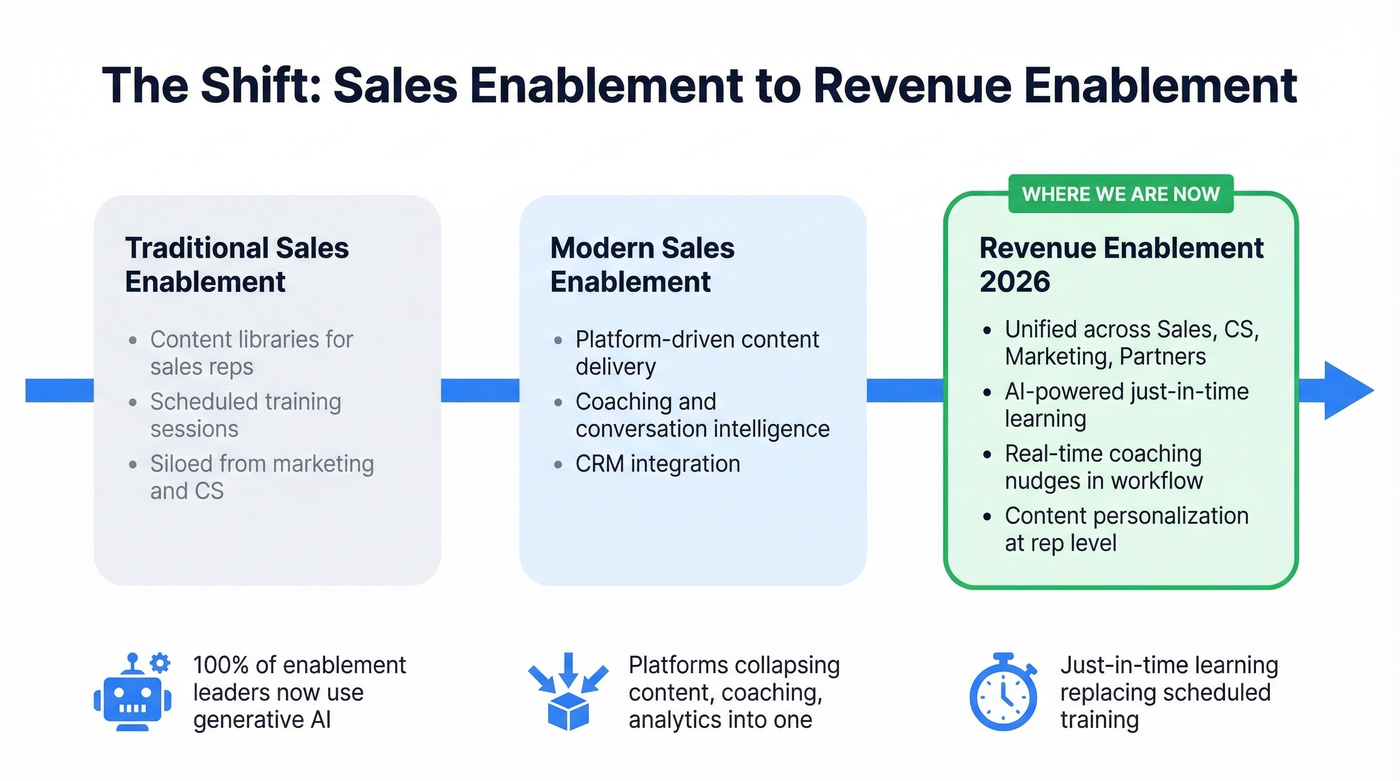
100% of enablement leaders now use generative AI to drive performance. The trend isn't adoption; it's convergence. Platforms are collapsing content management, coaching, conversation intelligence, and analytics into unified stacks. Just-in-time learning - one-click playbooks, real-time coaching nudges, auto-generated next steps surfaced contextually in the flow of work - is replacing scheduled training sessions. (For the tooling layer, see generative AI sales tools.)
The best enterprise sales enablement programs in 2026 don't pull reps out of their workflow. They meet reps inside it.
Enterprise Sales Enablement FAQ
What's the difference between sales enablement and revenue enablement?
Revenue enablement extends beyond the sales team to include customer success, marketing, and partner teams under a unified strategy. Gartner renamed its analyst category "Revenue Enablement Platforms" in 2025, signaling the shift is already mainstream.
How long does implementation take?
Expect 3-4 months for mid-market deployments and 6+ months for global enterprise rollouts. Showpad implementations can start faster from $2K+, while Seismic/Highspot typically runs $15K-$50K+ in implementation fees alone.
What's the first metric an enablement team should track?
Win rate on forecasted deals. Organizations with formal enablement programs see a 49% win rate vs. 42.5% without - a 6.5-point delta that justifies the investment. Content adoption is the most commonly tracked metric, but it doesn't prove revenue impact.
How do you staff an enablement team?
Plan for 1 enablement FTE per 20-40 sellers, depending on scope and deal complexity. Most enablement teams report into RevOps (39.4%) or Sales (25.4%), with C-suite ownership at 16.6%.
How do you ensure reps have accurate buying committee data?
Enablement platforms manage content and coaching but don't solve contact data quality. Pair them with a data layer like Prospeo that verifies emails and mobile numbers across 300M+ profiles on a 7-day refresh cycle, ensuring reps aren't sending battlecards to bounced addresses.