

Enterprise Sales for Startups: What Actually Changes and How to Win
Enterprise deals can become 60% of your revenue at much higher margins - but the shift from SMB can break every process you've built. One founder on r/Entrepreneurs put it bluntly: "Nothing transferred." He'd been closing $99/month SMB deals in days. His first enterprise deal took a year. Enterprise sales for startups means rebuilding your sales process, legal templates, security posture, and support model from scratch.
That's the trade. Budget a year of infrastructure building before real revenue flows.
What You Need (Quick Version)
- Expect 4-6 month sales cycles minimum. Your first deal will take longer.
- 4-8+ stakeholders will touch every deal - legal, security, finance, ops, the champion, and their boss.
- Legal and security readiness isn't optional. SOC 2, MSAs, DPAs - ready before your first conversation.
- Sell it yourself first. Founders convert 2-3x better than early sales hires. Close at least 5 enterprise deals before delegating.
- Use verified prospect data to reach decision-makers without burning your domain on bounced emails.
What Changes Going Upmarket
The shift from SMB to enterprise isn't incremental. It's structural. Many founders underestimate just how different selling to enterprise customers really is from the self-serve motion they've perfected, and the gap shows up in every part of the business - not just sales calls.
| SMB | Enterprise | |
|---|---|---|
| Cycle length | Days to weeks | 4-6 months |
| Stakeholders | 1-2 | 4-8+ core (committees can reach ~25) |
| Buying process | Self-serve / card | Procurement + legal |
| Requirements | Product works | SOC 2, MSA, security review |
| ACV range | $1K-$10K | $25K-$100K+ |
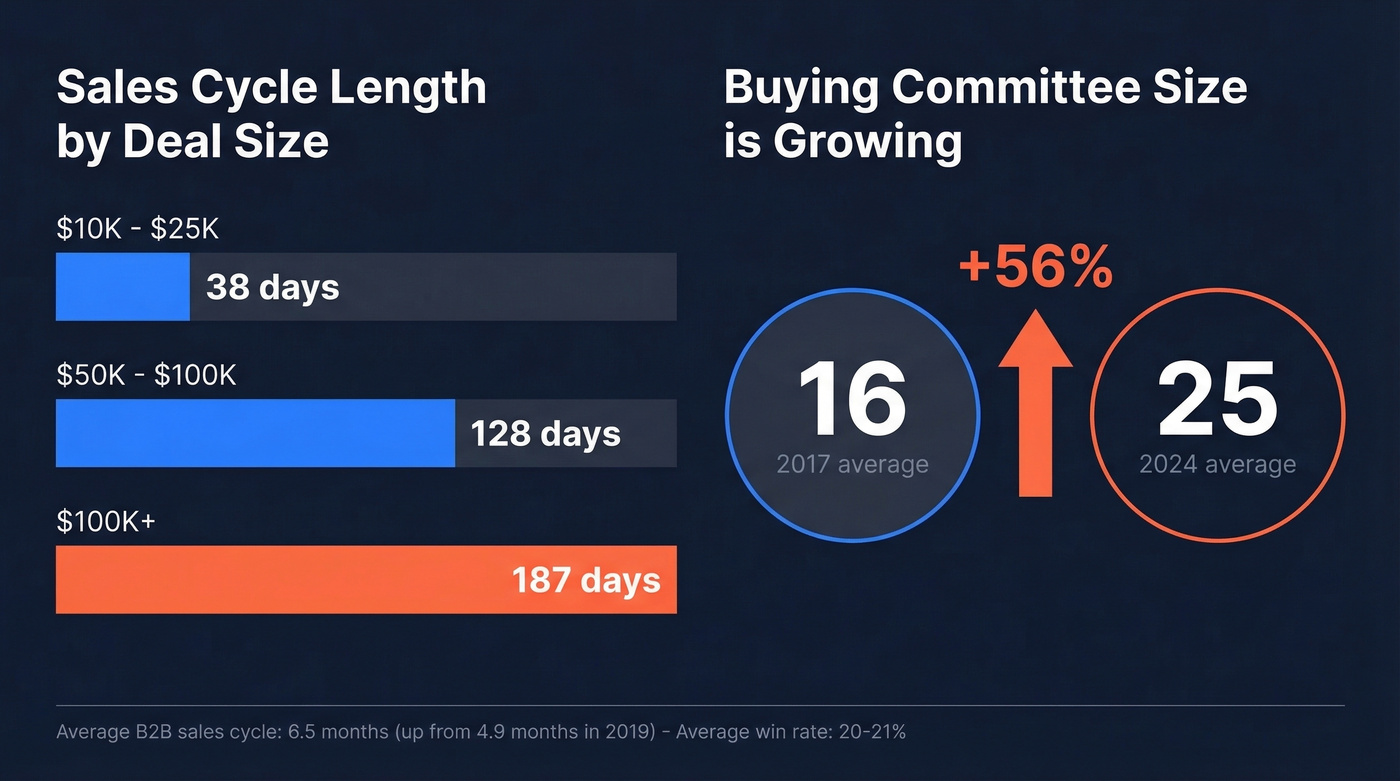
The granularity matters when you segment by deal size. Median cycle lengths show $10-25K deals closing in about 38 days, $50-100K deals taking 128 days, and anything above $100K running 187 days. Buying committees now average 25 stakeholders - up 56% from 16 in 2017. That growth explains why cycles feel like they're getting longer: they are, with average B2B sales cycles sitting around 6.5 months, up from 4.9 months in 2019. Average win rates hover around 20-21%, which means four out of five deals you invest months into won't close. Set expectations accordingly.
The procurement and legal layers alone add 30-45 days to cycles above $50K. If you're coming from a self-serve motion where customers swipe a card, this will feel like your pipeline has stopped moving entirely.
The Founder-Led Sales Playbook
Here's the thing: founders are better at closing large deals than early hires. Founders convert 2-3x better because enterprise buyers trust authority, depth, and the ability to make commitments on the spot. A sales rep can't say "we'll build that feature next quarter." You can. This isn't theoretical - lemlist bootstrapped to $26M ARR and beehiiv hit $20M+ ARR in under four years, both driven by founder-led selling.
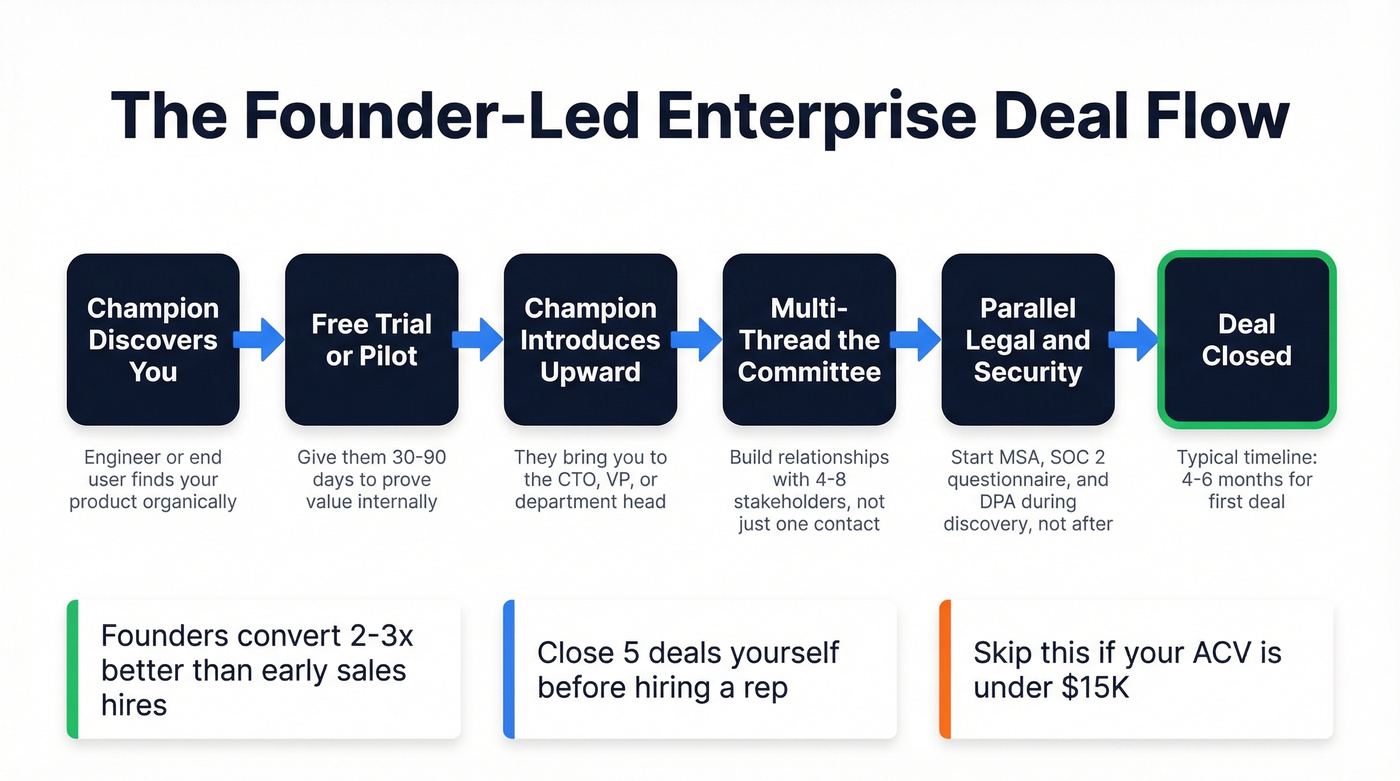
One Reddit founder's first enterprise deal started with an engineer who discovered the product organically. He gave that engineer a free trial for a few months. That engineer became the internal advocate who introduced the product to the CTO and eventually shepherded it through procurement. Six months, start to finish. The infrastructure you build on deal one compounds on every deal after.
Once your champion gets you in the door, you're presenting to their boss, their boss's peers, and eventually procurement. Multi-threading - building relationships with multiple stakeholders - becomes necessary above ~$30K ACV. Don't rely on a single contact. Then comes the phase that kills deals: the CTO says yes, but legal wants an MSA, security sends a 200-question questionnaire, and finance needs invoicing compliance. Top performers front-load this work. Start security questionnaires during discovery, not after the verbal yes, and run approvals in parallel.
The critical mistake is hiring a sales rep before you understand this process yourself. We've watched founders delegate after one or two deals and wonder why their new hire can't close. You need to know what "done" looks like before you can train someone else to get there. Five closed deals is the minimum.
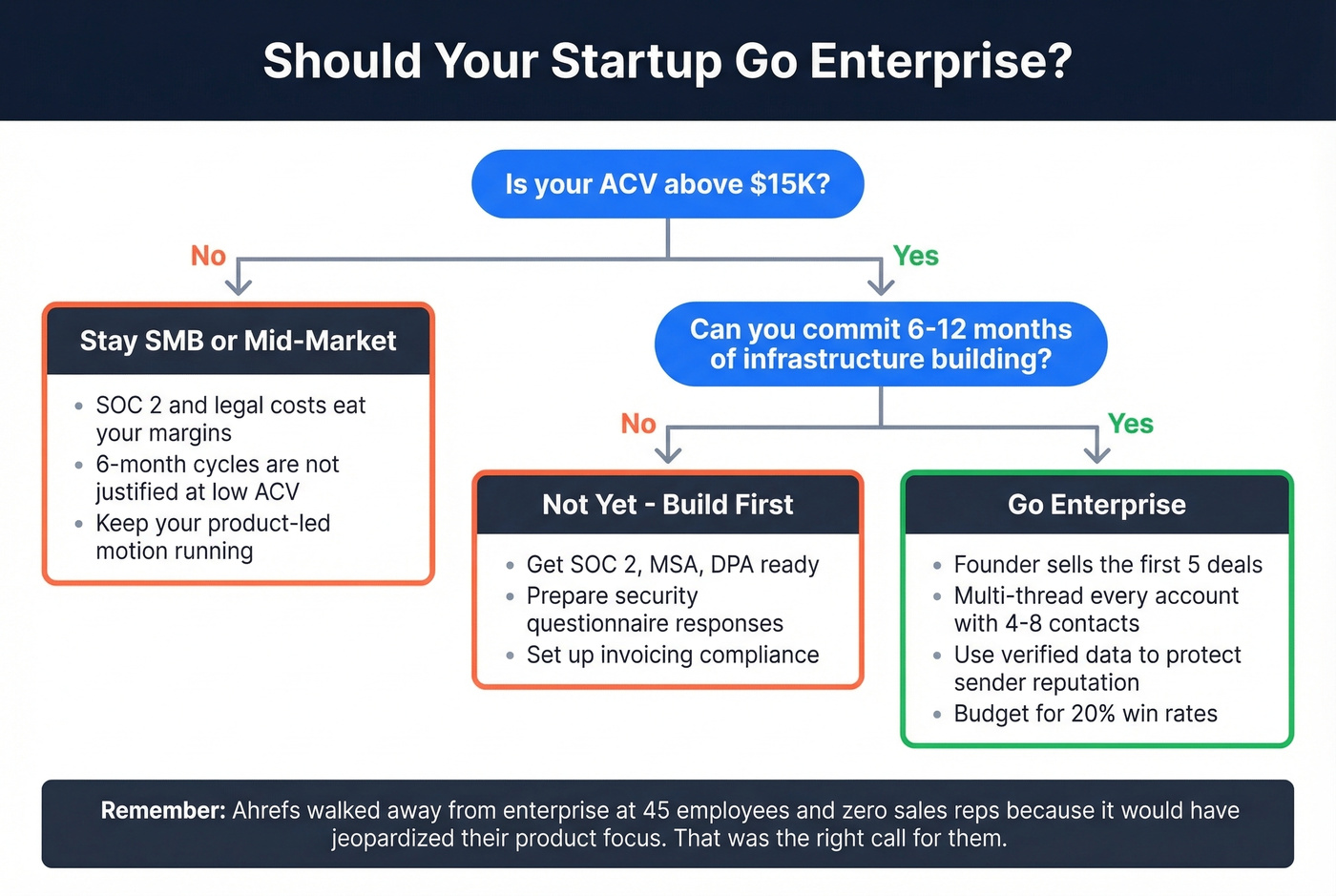
Skip the upmarket push entirely if your ACV is under $15K. The overhead of SOC 2, legal reviews, and six-month cycles will eat your margins alive. Selling to large organizations only makes sense when the deal size justifies the infrastructure.
Building Your Enterprise Prospect List
Enterprise outreach is unforgiving. You get one shot at credibility with a VP or CTO. When you're multi-threading into accounts with 4-8 stakeholders, bad contact data compounds fast - a bounced email doesn't just waste a touch, it signals you're not a serious vendor.
The workflow that works: start by identifying accounts showing buying signals like funding rounds, headcount growth, or tech stack changes, then map the full buying committee before reaching out. We've found that layering intent data with firmographic filters - company size, department headcount, recent funding - cuts research time dramatically while keeping outreach relevant. From there, you need verified contact data for every stakeholder on the committee. Snyk's 50 AEs dropped their bounce rate from 35-40% to under 5% and generated 200+ new opportunities per month after switching to verified data. That kind of accuracy gap is the difference between looking like a credible vendor and landing in spam.

Let's be honest - most startups burn their first few months of enterprise outreach on bad data. Prospeo's 30+ search filters and 98% email accuracy help you map full buying committees without torching your sender reputation, and the free tier gives you 75 emails a month to test the workflow before committing.

Enterprise deals have 4-8+ stakeholders. One bounced email to a CTO or VP signals you're not a serious vendor. Prospeo's 30+ filters - including intent data, funding, and headcount growth - let you map the full buying committee, then deliver 98% accurate emails for every contact.
Build your enterprise target list in minutes, not months.
Snyk's 50 AEs cut bounce rates from 35% to under 5% and generated 200+ opportunities per month with verified data. When your first enterprise deal takes 6 months to close, you can't afford to waste cycles on bad contacts. Prospeo gives you verified emails at ~$0.01 each with a free tier to test before you commit.
Your enterprise pipeline is too expensive to build on unverified data.
Enterprise Readiness Checklist
28% of deals fail when buyers can't secure internal approval. Don't let paperwork kill a six-month deal.
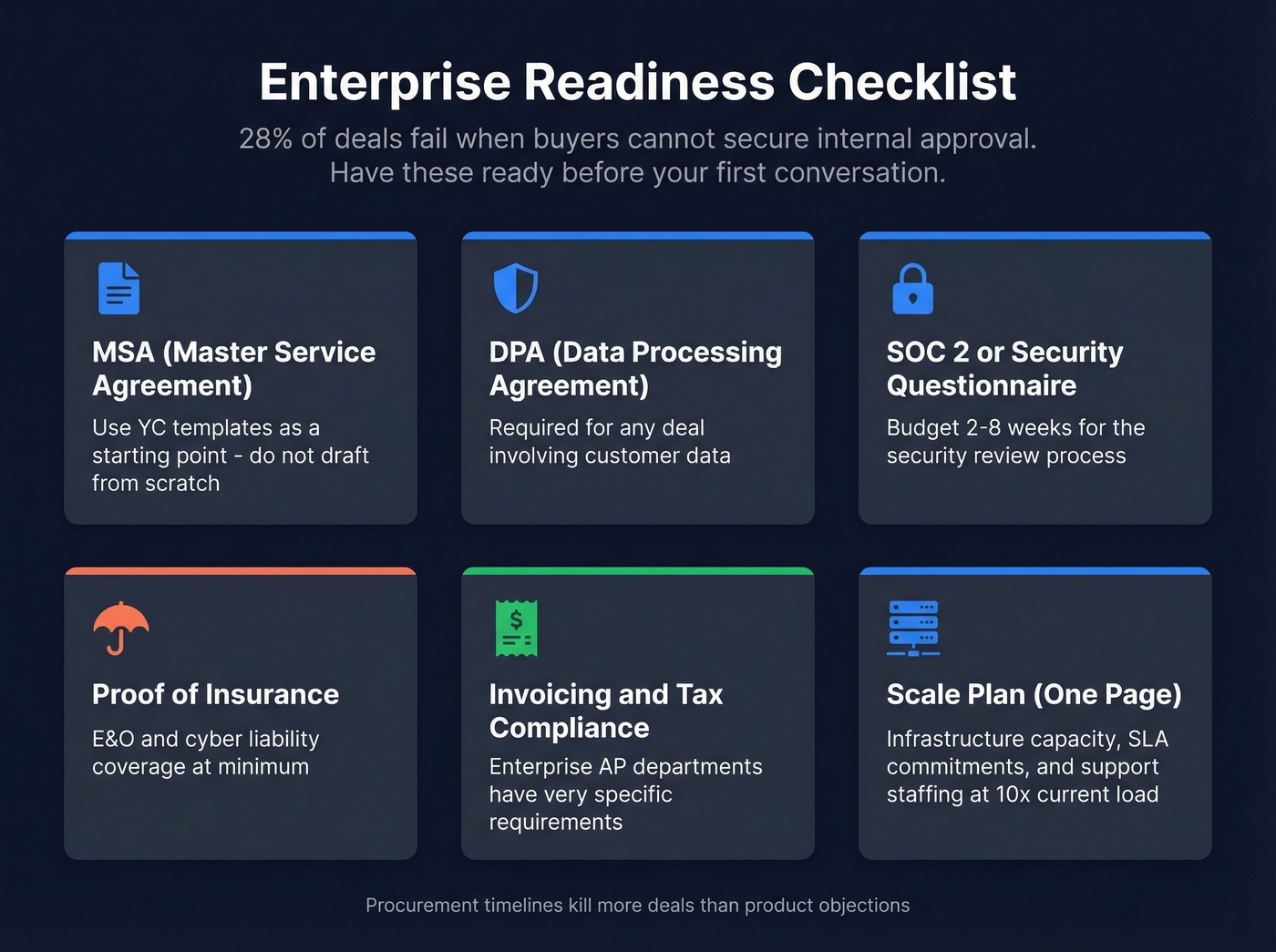
Have these ready before your first enterprise conversation:
- MSA - YC publishes solid templates. Don't draft from scratch.
- DPA - required for any deal involving customer data.
- SOC 2 or security questionnaire responses - if you don't have SOC 2 yet, prepare thorough questionnaire answers. Budget 2-8 weeks for the security review process.
- Proof of insurance - E&O and cyber liability at minimum.
- Invoicing and tax compliance - enterprise AP departments have specific requirements. Tools like Paddle handle this.
- Scale plan - a one-page document covering infrastructure capacity, SLA commitments, and support staffing at 10x your current user base. Enterprises don't just want a demo; they want to know you won't buckle under load.
Pricing Your Enterprise Tier
Most founders underprice their enterprise tier. In our experience, the Anchor Test is the best gut check: name a price high enough that you wince slightly. If the buyer doesn't flinch, you're still too low.
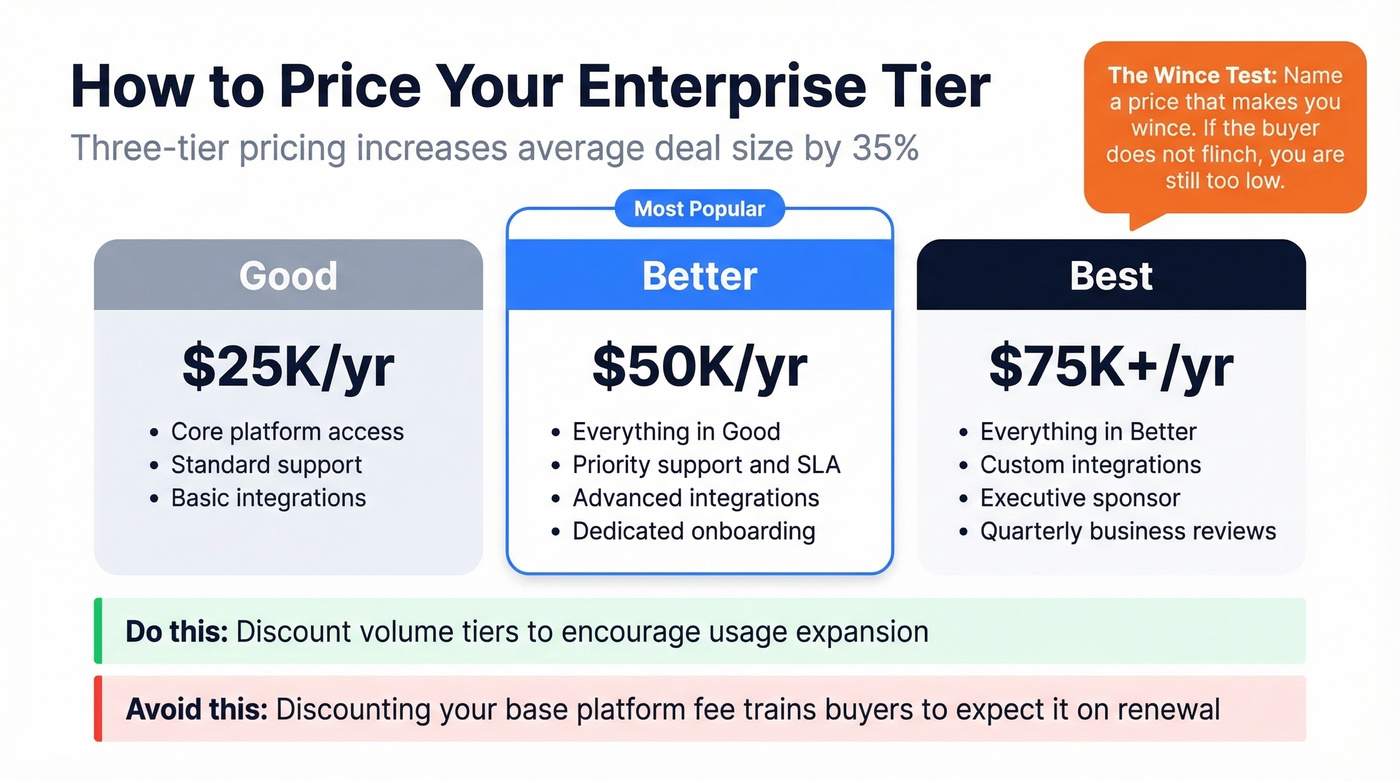
Most startups price their first enterprise tier between $25K-$75K annually. If you're coming from a $99/month SMB product, that jump feels enormous - but enterprise buyers expect it. Present three tiers: good, better, best. This approach increases average deal size by 35%. Annual prepay discounts typically run 15-20%.
When you negotiate, discount volume tiers rather than your base platform fee. Discounting the base trains buyers to expect it on renewal. Discounting volume gives them a reason to expand usage - which is what you actually want.
When NOT to Go Enterprise
Enterprise isn't right for every startup. Back in 2019, Ahrefs - then a team of 45 with zero sales reps - famously walked away from enterprise courtship because the customization demands, legal complexity, and high-touch support would've jeopardized their product focus. That was the right call for them.
Watch for the "pipeline that never closes" pattern. You add a "Contact Us" enterprise tier, log some pipeline, and then champions leave, reorgs kill momentum, and security reviews stall indefinitely. A $150,000 conference booth that generates zero closed revenue is a real thing that happens. One r/startups commenter described the first enterprise close as "worth the pain" - but only because the deal actually closed. If your product-led motion is working and your ACV sits comfortably in the $5-10K range, think hard before diverting resources into a six-month cycle that may never convert.
Enterprise Sales FAQ
How long does an enterprise sales cycle take?
Median is 128 days for $50-100K deals and 187 days for deals above $100K. Budget 4-6 months minimum, and expect your first deal to take longer as you build legal and security infrastructure from scratch.
When should a startup hire its first sales rep?
Close at least 5 enterprise deals yourself first. Founders convert 2-3x better because they carry executive authority and product depth. Reps spend only 28-30% of their time actually selling - the rest is admin and internal navigation. You need to understand the full cycle before you can set a new hire up to succeed.
What documents do startups need for enterprise procurement?
At minimum: an MSA, DPA, SOC 2 report or completed security questionnaire, proof of insurance, and invoicing compliance documentation. Prepare these before your first conversation - procurement timelines kill more deals than product objections.
How do you find enterprise decision-makers without burning your domain?
Use a B2B data platform with intent signals and verified contacts. Map the full buying committee before reaching out, verify every address to protect sender reputation, and keep bounce rates under 5%. That's the threshold where deliverability stays healthy across most ESPs.