

Enterprise Sales Management: A Playbook for Complex Deals
Enterprise sales management breaks when teams run it with SMB playbooks. Only 16% of reps hit quota, buying committees have ballooned to 25 stakeholders, cycles stretch 6-18+ months, and reps burn 70% of their time on non-selling tasks. The gap between top-performing enterprise teams and everyone else isn't talent. It's operating rigor.
Enterprise vs. SMB Sales
The differences are structural, not just scale.
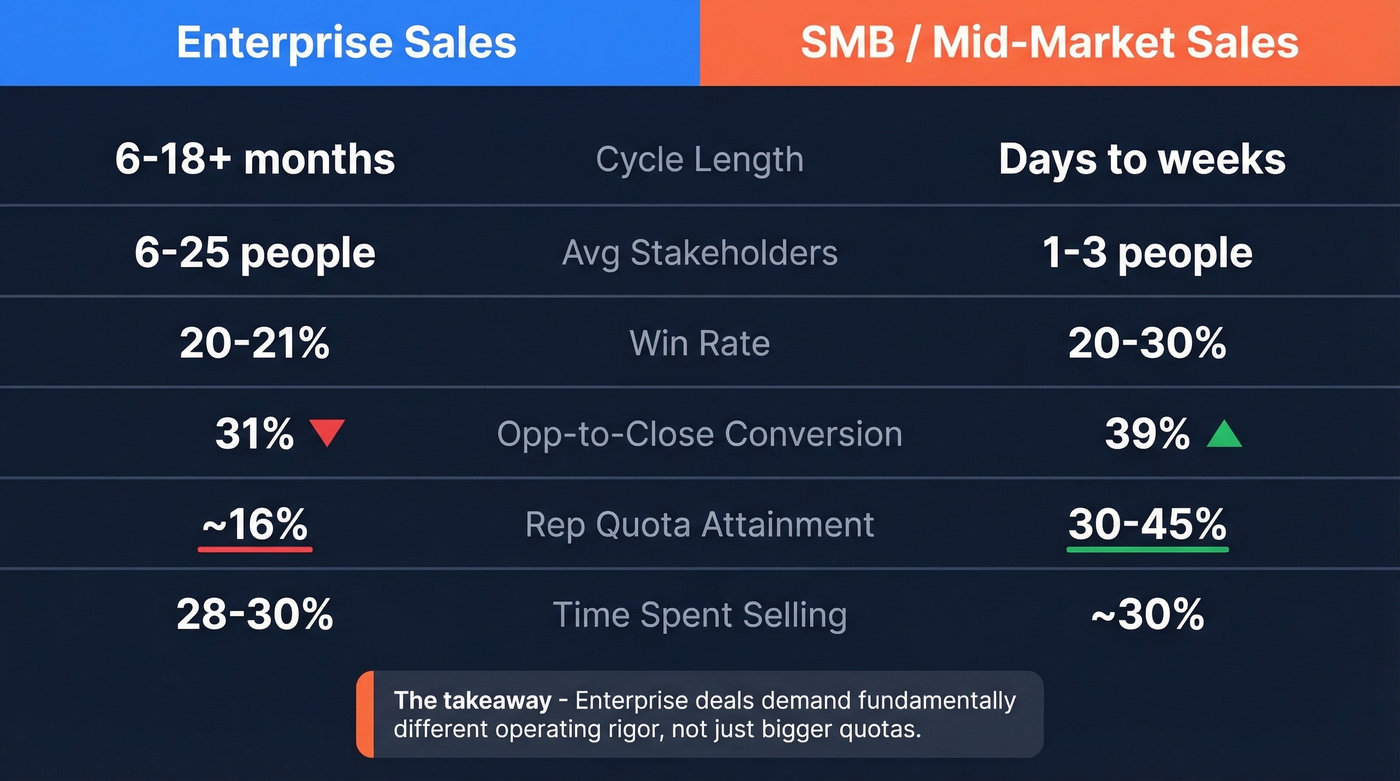
| Dimension | Enterprise | SMB/Mid-Market |
|---|---|---|
| Cycle length | 6-18+ months | Days to weeks |
| Avg stakeholders | 6-25 | 1-3 |
| Win rate | 20-21% | 20-30% |
| Opp-to-close conversion | 31% | 39% |
| Rep quota attainment | ~16% | 30-45% |
| Selling time % | 28-30% | ~30% |
That 31% vs. 39% conversion gap doesn't sound dramatic until you multiply it across a $2M quota. Enterprise managers need to squeeze yield from every stage of a longer, more complex funnel - and the math gets unforgiving fast when a single slipped deal can blow a quarter.
The Enterprise Sales Manager Role
Don't confuse this with an enterprise AE who got promoted. The manager's job is coaching, not closing - pipeline governance, deal strategy, forecasting accuracy, rep development, and alignment across marketing, CS, product, and legal.
The best managers operate as consultative advisors to their own reps, not deal-desk administrators. They teach reps to sell outcomes, not features, and they spend most of their time in deal strategy conversations rather than reviewing dashboards. Compensation reflects the complexity: expect $140K-$250K OTE depending on company size and region.
Org Design for Enterprise Teams
Frank Cespedes' HBS framework offers four alignment models:
- Geography - when local relationships and time zones drive deals
- Product line - when technical depth matters more than account breadth
- Customer size - matching selling motion to deal complexity
- Industry vertical - healthcare, financial services, and government teams almost always land here
Three operational models dominate in practice. The assembly line (SDR to AE to CS/AM) scales cleanly but creates handoff friction that kills momentum on 12-month deals. The island model gives AEs full ownership but limits specialization. Then there's the pod model - multi-team units covering named accounts - which is where most enterprise orgs are heading, pairing AEs with SEs at a common 1:1 to 2:1 ratio. Named-account loads typically run 5-20 per AE depending on ACV and whitespace.
Fair warning: only 11% of sales orgs can drive commercial success while executing a structural transformation. Plan the transition in phases.
Why MEDDPICC Is Non-Negotiable
MEDDPICC was born at PTC in 1996, where it helped the company grow from $300M to $1B in four years. 73% of SaaS companies selling above $100K ARR use some version of it. Full adoption correlates with 18% higher win rates and 24% larger deal sizes. Teams using formal qualification report 28% higher win rates than unstructured teams.
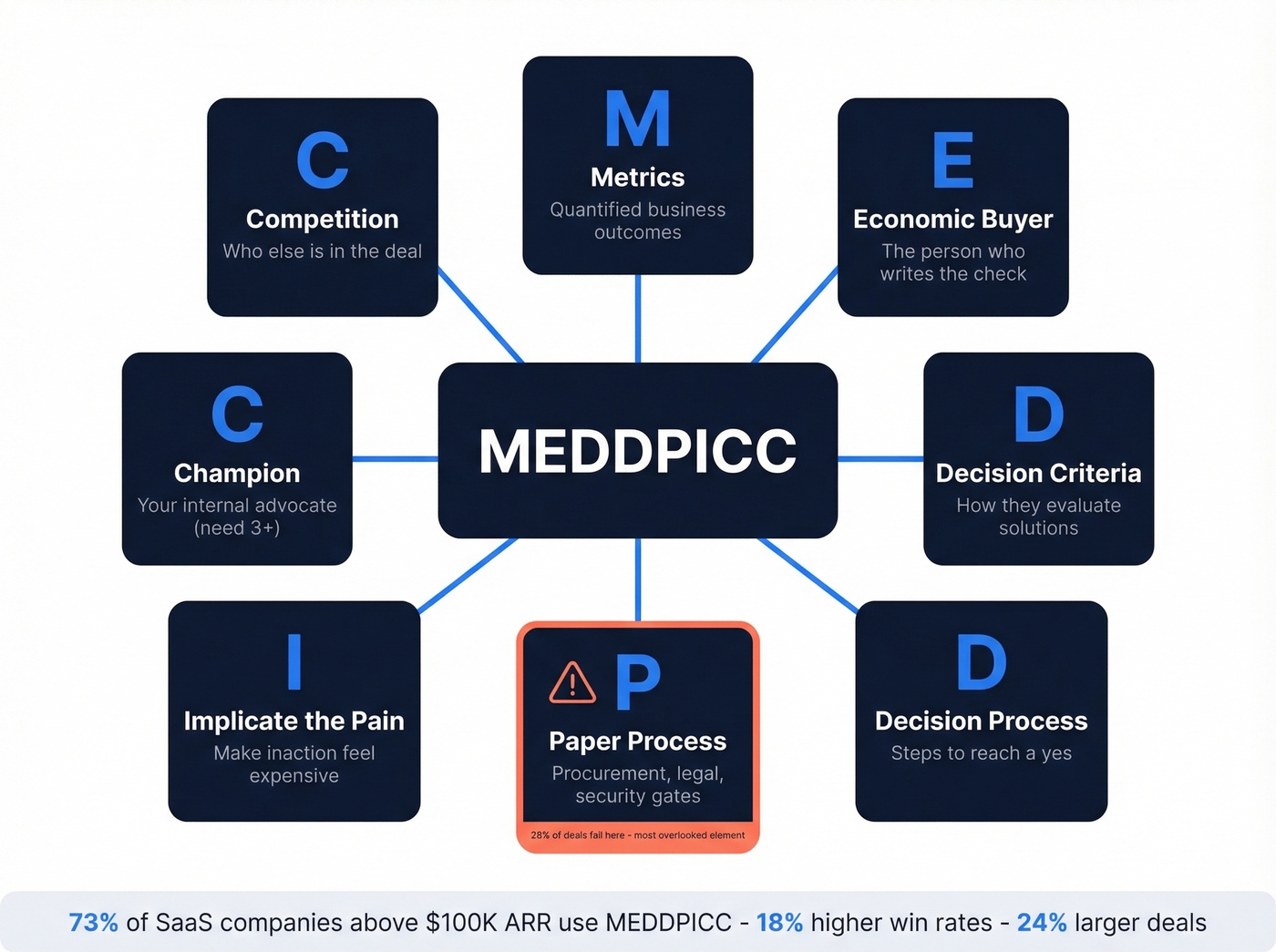
The eight elements: Metrics (quantified business outcomes), Economic Buyer (the person who writes the check), Decision Criteria, Decision Process, Paper Process (procurement, legal, security gates), Implicate the Pain, Champion (your internal advocate - enterprise deals typically need at least three), and Competition.
The most overlooked element? Paper Process. 28% of deals fail when buyers can't navigate internal approval. We've seen reps celebrate a verbal "yes" from the VP of Engineering only to watch the deal die in legal review six weeks later. Map procurement, legal, and security requirements early in the cycle - not the last week before close.

MEDDPICC falls apart without accurate contact data for every stakeholder. When buying committees hit 25 people, you need verified emails and direct dials for champions, economic buyers, and blockers alike. Prospeo delivers 98% email accuracy and 125M+ verified mobiles - refreshed every 7 days, not every 6 weeks.
Map the full buying committee with data you can actually trust.
Pipeline Governance and Forecasting
Here's the thing: it's Q3 pipeline review, your top AE has been working a $400K deal for 8 months, and you ask who the economic buyer is. Silence. That's a forecasting problem disguised as a deal problem - and 86% of B2B purchases stall at some point for exactly these reasons.
79% of sales orgs miss forecast by more than 10%. World-class teams hit 80-95% accuracy; average B2B orgs sit at 50-70%. In our experience, the teams that hit 80%+ all share one thing: weekly MEDDPICC-scored deal reviews where managers actually challenge assumptions instead of rubber-stamping rep optimism.
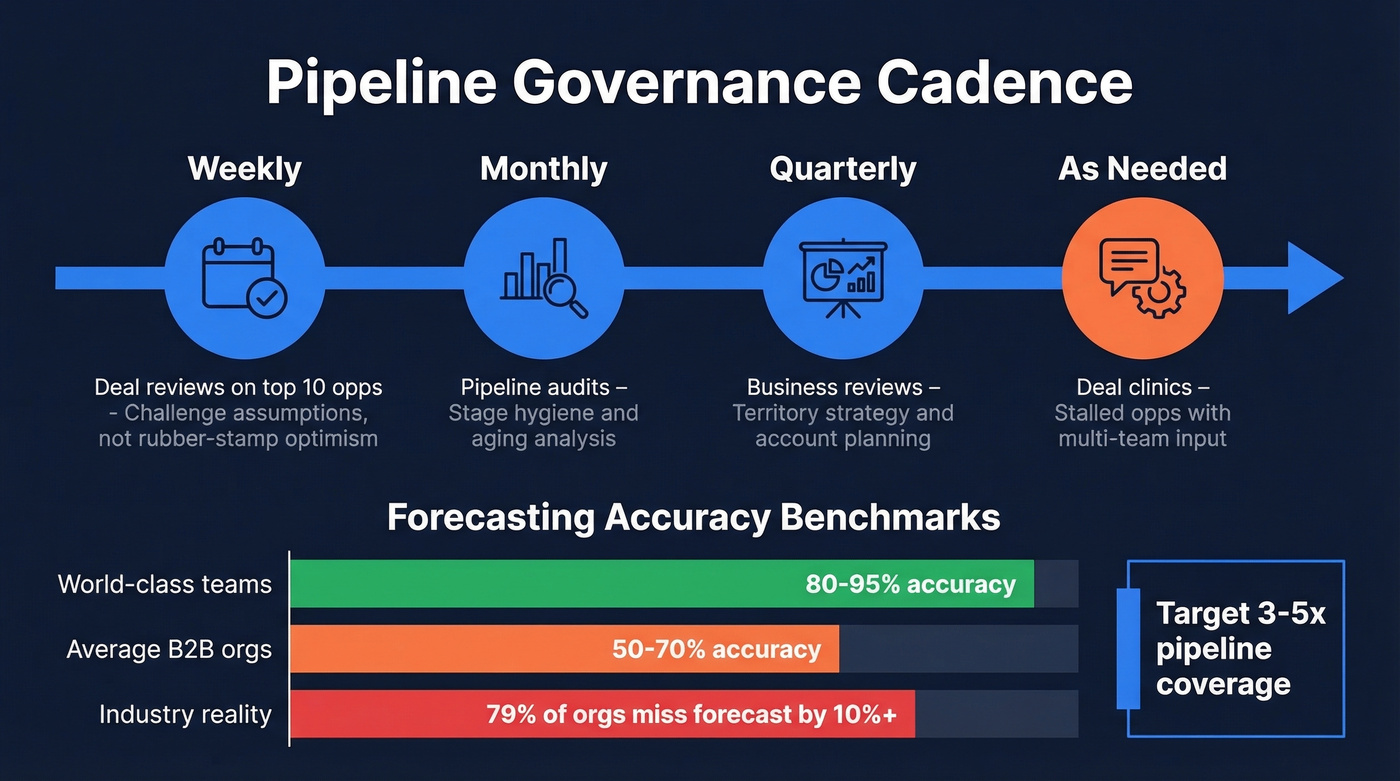
Target 3-5x pipeline coverage and build a cadence that catches problems early:
- Weekly - deal reviews on top 10 opportunities
- Monthly - pipeline audits for stage hygiene and aging
- Quarterly - business reviews for territory strategy
- As needed - deal clinics for stalled opportunities with multi-team input
Account Planning That Gets Used
Fewer than 20% of companies have fully embedded account planning into operations, and only 5% of B2B accounts are actively buying at any given time. You can't plan deeply for every account. Don't try.
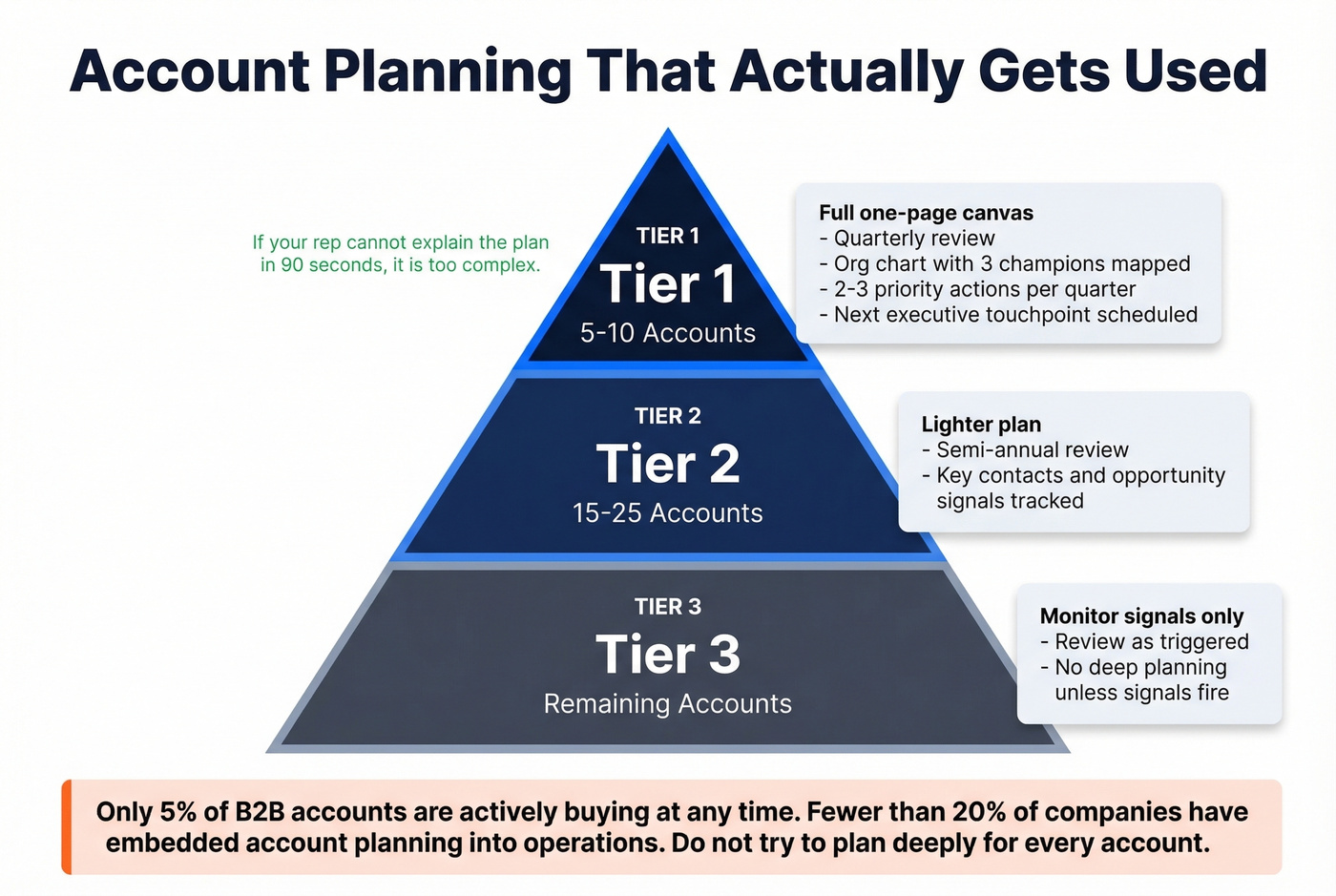
| Tier | Accounts | Plan Depth | Review Cadence |
|---|---|---|---|
| Tier 1 | 5-10 | Full one-page canvas | Quarterly |
| Tier 2 | 15-25 | Lighter plan | Semi-annual |
| Tier 3 | Remaining | Monitor signals | As triggered |
Skip the 30-page plans nobody updates. A Tier 1 review should fit on one page: the org chart with your three champions mapped, 2-3 priority actions for the quarter, and the next executive touchpoint scheduled. If your reps can't explain the plan in 90 seconds, it's too complex.
The Enterprise Sales Tech Stack
Enterprise teams run on layers. Here's what each category costs in 2026:
- CRM: Salesforce (~$25-$300/user/mo depending on edition), HubSpot ($20-$150/seat/mo)
- Sales engagement: Outreach or Salesloft (~$100-$150/user/mo)
- Conversation intelligence: Gong (annual contracts, often ~$100-$150/user/mo)
- Revenue intelligence: Clari (~$30K-$100K+/yr)
- Intent/ABM: 6sense (~$123K/yr), Demandbase (~$50K-$150K/yr for enterprise contracts)
- Data enrichment: Prospeo (~$0.01/email, free tier available)
AI is reshaping this stack fast - 81% of sales teams are now investing in AI tools, and AI-adopting teams report 83% revenue growth versus 66% for those without. The winners aren't adding more tools. Reps already juggle around 10. They're consolidating around fewer, better-integrated layers.

Your tech stack doesn't matter if your data is rotten. You can have the best CRM, the best engagement platform, and the best conversation intelligence - none of it helps if your reps are emailing dead addresses. Enterprise reps prospect into named accounts with 6-25 stakeholders per deal, and stale data refreshed every 4-6 weeks means bounced emails at exactly the wrong moment.
This is where data freshness becomes a real competitive edge. Prospeo runs a 7-day refresh cycle across 300M+ professional profiles with 98% email accuracy and 125M+ verified mobile numbers. When you're multi-threading into a 15-person buying committee, every valid contact matters. Snyk's 50 AEs cut bounce rates from 35-40% to under 5% after switching to a provider with a weekly refresh cycle, growing AE-sourced pipeline 180% and generating 200+ new opportunities per month.
If you're evaluating vendors, start with data enrichment and how it plugs into your CRM.
Your enterprise tech stack is only as good as the data feeding it. Rotten contact data means reps waste their already limited 30% selling time chasing bounces instead of closing six-figure deals. Prospeo enriches your CRM with 50+ data points per contact at 92% match rates - for roughly $0.01 per email.
Stop letting bad data blow your pipeline coverage targets.
Mistakes That Kill Enterprise Pipeline
Let's be honest - we've watched teams make every one of these, sometimes all at once.
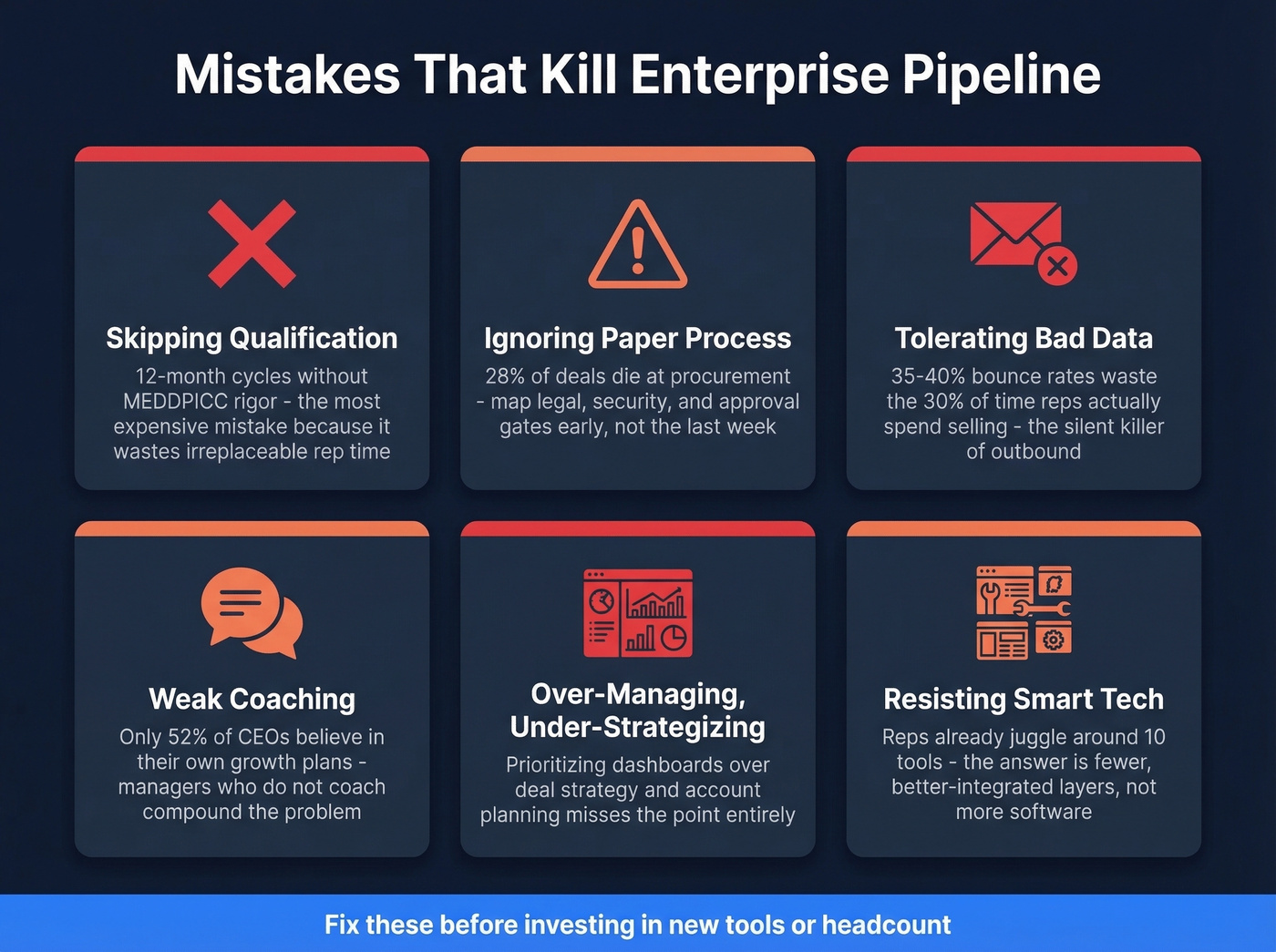
Skipping qualification. Running 12-month cycles without MEDDPICC rigor, then wondering why deals slip every quarter. This is the most expensive mistake on the list because it wastes the scarcest resource: time your reps can't get back.
Ignoring the Paper Process. 28% of deals die at procurement. Map it early or lose late.
Tolerating bad contact data. Bounce rates of 35-40% happen more often than anyone admits, and they waste the roughly 30% of time reps actually spend selling. The consensus on r/sales is that bad data is the silent killer of outbound - and they're right. (If you want the benchmarks and fixes, start with bounce rates and email deliverability.)
Weak coaching. Only 52% of CEOs believe in their own growth plans. Managers who don't coach compound the problem - especially without a clear sales leadership system.
Over-managing, under-strategizing. Prioritizing dashboards over deal strategy and account planning. Skip this trap if you want your team to actually close.
Resisting smart tech adoption. Reps already use around 10 tools. The answer isn't more software; it's fewer, better-integrated layers that actually talk to each other.
FAQ
How long do enterprise sales cycles take?
Enterprise cycles typically run 6-18+ months depending on deal complexity and procurement requirements. The average B2B cycle is now 6.5 months - up from 4.9 months in 2019. Deals above $500K ACV skew toward the longer end, especially in regulated industries with multi-layer security reviews.
What's a good enterprise win rate?
Enterprise win rates average 20-21% across the industry. Teams with formal qualification frameworks like MEDDPICC report 18% higher win rates. If you're consistently below 15%, fix qualification rigor before investing in coaching or new tools.
What tools do enterprise sales teams need?
At minimum: CRM (Salesforce or HubSpot), sales engagement (Outreach or Salesloft), conversation intelligence (Gong), and a verified data provider with a weekly refresh cycle. Add revenue intelligence and intent data as budget allows. For the data layer, tools like Prospeo cover verified emails at ~$0.01/lead - far cheaper than legacy providers charging $1+ per record.
How do you structure an enterprise sales org?
Most high-performing teams use a pod model - pairing AEs with SEs at a 1:1 or 2:1 ratio, organized by industry vertical. Named-account loads run 5-20 per AE depending on deal size. Only 11% of orgs successfully restructure without disrupting revenue, so plan transitions in phases rather than doing a full reorg overnight.