

Event Lead Generation: The 2026 Playbook for Turning Events Into Pipeline
It's Monday morning. You're back at your desk with 150 badge scans, a stack of business cards, and a vague memory of a promising conversation with someone from a fintech company - but you can't remember which one. By Wednesday, the momentum's gone. By Friday, those leads are cold.
This is the central failure of event lead generation - not the events themselves, but the broken system between capture and conversion.
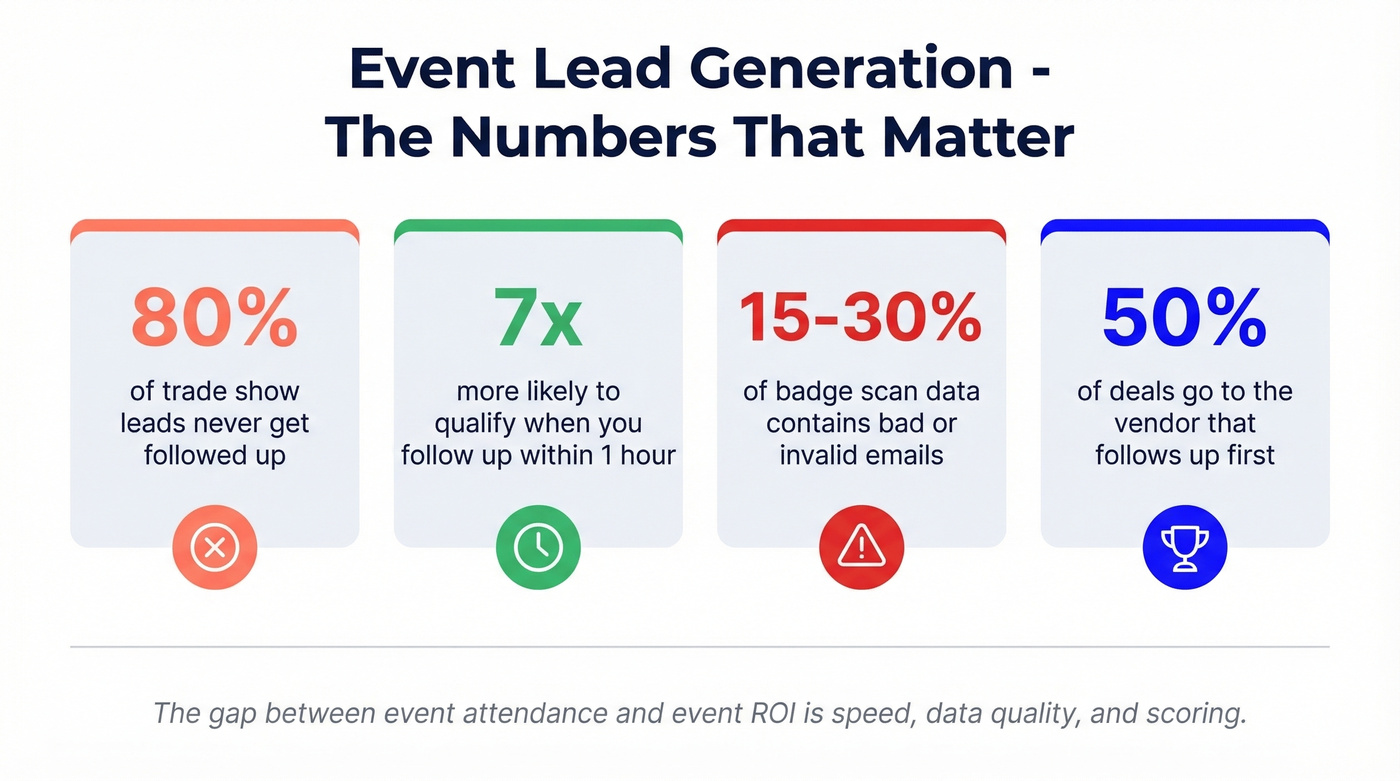
Nearly 80% of trade show leads never get a follow-up. Not because teams don't care, but because the data's messy, the scoring's nonexistent, and by the time marketing cleans the list, the buying window has closed.
The Short Version
If you take nothing else from this playbook, build these four habits into every event:
- Score leads at the booth before you leave the venue. A simple hot/warm/cold tag based on four criteria (framework below) saves your team days of post-event triage.
- Verify your captured data before any sequence fires. Badge scans and handwritten emails produce 15-30% bad data. Run your list through a verification tool before hitting send - dirty data kills follow-up before it starts.
- Send your first follow-up within one hour, not one week. Harvard Business Review data shows contacting within an hour makes you 7x more likely to qualify a lead than waiting longer. Wait 24+ hours and you're 60x less likely.
- Measure pipeline influenced, not badge scans collected. 500 scans that produce zero meetings is a vanity metric. Track cost per opportunity and lead-to-meeting rate instead.
What Is Event-Based Lead Generation?
Event-based lead generation is the process of capturing, qualifying, and converting potential buyer contacts through in-person or virtual events - trade shows, conferences, webinars, hosted dinners, roundtables, and everything in between.
In a world of inbox fatigue and ad blindness, events remain one of the most effective trust-building channels in B2B. 85% of B2B marketers rely on lead generation to bring in new business, and events tend to outperform most digital channels on conversion quality. On ROI: B2B marketing averages 5:1, trade shows deliver about 4:1, and webinars average 213% - while even PPC, the default digital channel, sits around 36%.
Events compress the trust-building cycle. A 10-minute booth conversation replaces weeks of nurture emails. The challenge isn't whether events work. It's whether your team captures and acts on the leads fast enough to convert that trust into pipeline.
Which Events Generate the Best B2B Leads?
Not all events are created equal. Your CPL, lead quality, and conversion rates shift dramatically based on format.
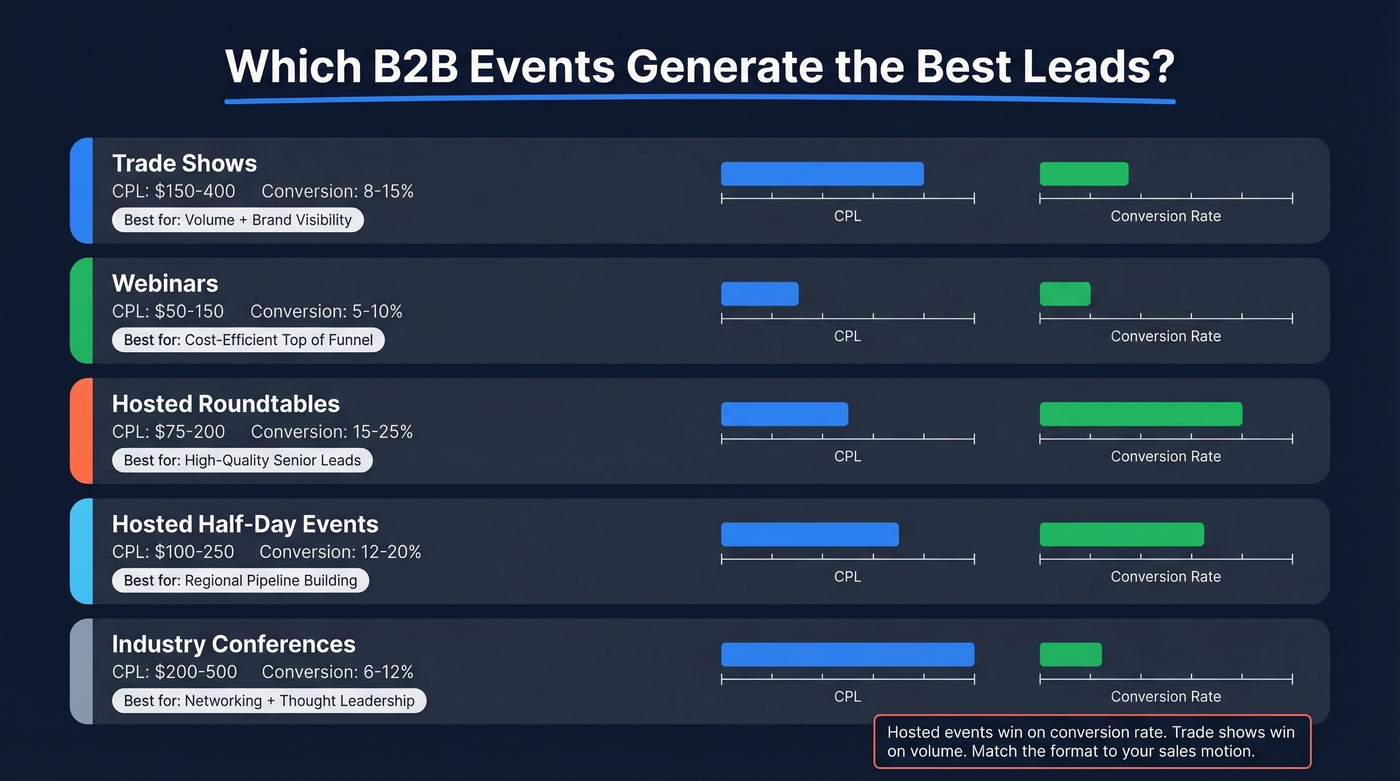
| Event Type | Common CPL Range | Lead-to-Opportunity Range | Best For |
|---|---|---|---|
| Trade shows | $150-400 | 8-15% | Volume + brand visibility |
| Webinars | $50-150 | 5-10% | Cost-efficient top-of-funnel |
| Hosted roundtables | $75-200 | 15-25% | High-quality, senior leads |
| Hosted half-day events | $100-250 | 12-20% | Regional pipeline building |
| Industry conferences | $200-500 | 6-12% | Networking + thought leadership |
The strategic question isn't just "which event?" - it's "attend or host?" One agency founder on Reddit put it bluntly: buying tickets to big conferences feels like throwing money at badge scans when hosting your own events gives you control over who shows up. The logic checks out. When you host, you control the invite list, the format, and the follow-up. When you attend, you're competing with every other exhibitor for the same crowd.
Here's the thing: if your average contract value is under $25K, you probably don't need a $50K trade show booth. A series of hosted roundtables at $5-10K each in 2-3 metro areas where your ICP concentrates will almost certainly outperform on pipeline generated. Trade shows win on volume. Hosted events win on conversion rate. Match the format to your sales motion.
The Pre-Event Playbook
Most event ROI is won or lost before anyone sets foot on the show floor.
Identify 20-30 target accounts attending. Start with the event's attendee list, your CRM, and your ABM target account list. Cross-reference against your ICP and existing pipeline. Don't go in blind.
Pre-schedule meetings. Reach out 2-3 weeks before the event. "We'll be at booth 412 - can we grab 15 minutes on Day 1?" converts better than hoping for walk-ups.
Monitor the event hashtag. Social listening in the week before reveals who's excited, who's speaking, and who's complaining about problems you solve.
Set specific goals. "Generate leads" isn't a goal. "Book 12 qualified meetings and capture 80 scored contacts" is. Tie your event investment to a pipeline number.
Train your booth staff and test your tech. The #1 data quality killer is untrained reps who scan a badge and move on without adding context. Run through your lead generation workflow before the event - what fields to fill, what questions to ask, how to tag leads. A Gather Capture analysis highlights inadequate staff training and lack of CRM integration as two of the most common failure modes. Cloud-based capture tools with offline capability prevent the nightmare scenario of losing data when conference Wi-Fi inevitably fails.
On-Site Lead Capture
Capture Context, Not Just Contact Info
Badge scans give you a name and an email. They don't tell you why someone stopped at your booth, what problem they're trying to solve, or whether they're evaluating vendors this quarter.
That context is the difference between a generic follow-up email and one that books a meeting.
The best booth teams add notes, voice memos, and tags to every interaction. One workflow shared on r/b2bmarketing: snap a photo of the business card, let a capture tool extract the details into your CRM, and send a personalized intro while you're still at the event. The outreach feels less reactive and more like a continuation of the conversation you just had. If your reps are scanning badges without asking a single qualifying question, you're collecting contacts, not leads.
Score Leads Before You Leave
Don't wait until you're back in the office to figure out who's hot. Score every lead on four dimensions before you leave the venue:
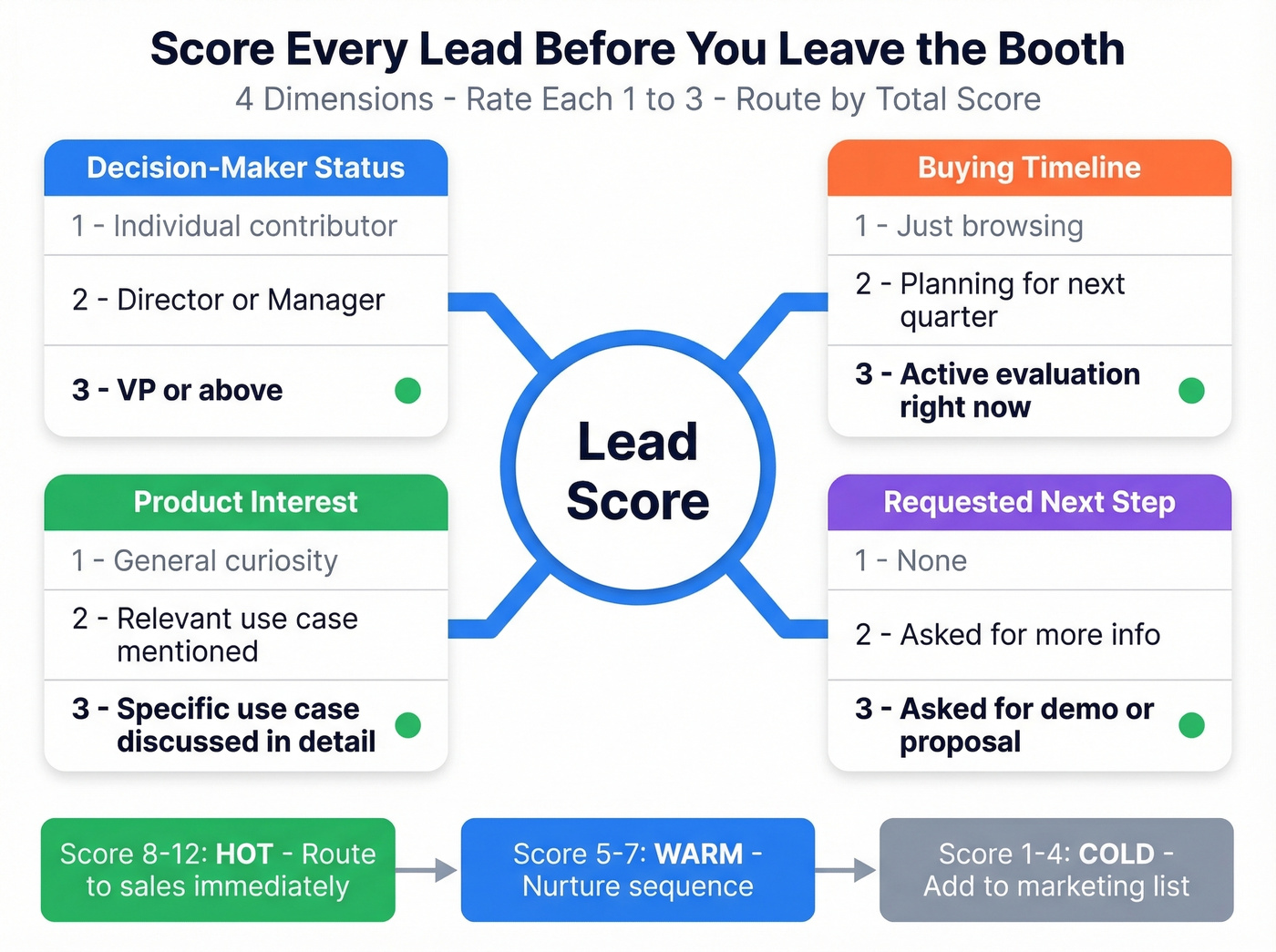
| Dimension | Score 1-3 |
|---|---|
| Decision-maker status | 1 = individual contributor, 3 = VP+ |
| Buying timeline | 1 = "just browsing," 3 = active evaluation |
| Product interest | 1 = general curiosity, 3 = specific use case discussed |
| Requested next step | 1 = none, 3 = asked for demo/proposal |
Leads scoring 8+ are hot - route them to sales immediately. Scores of 5-7 go into a nurture sequence. Below 5, add them to your marketing list and move on.
This matters because 50% of deals go to the first company to follow up. If you're spending two days post-event sorting through an unsorted spreadsheet, your competitor who scored at the booth is already booking demos.

Badge scans produce 15-30% bad data. Prospeo's 5-step verification catches invalid emails, spam traps, and catch-all domains before your post-event sequence fires - at 98% accuracy and $0.01 per email.
Clean your event list in minutes, not days. Start free.
Verify Before You Outreach
Here's where most event playbooks fall apart. You've captured 200 contacts, scored them, and built your follow-up sequences. Then you hit send - and 25% bounce.
Badge scans pull from registration data that's often months old. Manual entry introduces typos. People hand you personal emails instead of work addresses. We've seen lists from large trade shows come back with 35%+ invalid addresses, and the commonly cited 15-30% bad data figure is conservative. Every bounced email chips away at your sender reputation, and after two events with dirty lists, your domain deliverability is damaged for months.
Upload your event CSV to Prospeo before your first sequence fires. 98% email accuracy, results in minutes, roughly $0.01 per verified address. Cleaning a 200-contact list costs about $2 and takes five minutes. Compare that to a 25% bounce rate tanking your sender reputation.
If you're trying to diagnose why your sequences suddenly stop landing, start with email bounce rate benchmarks and fixes, then work backward into list hygiene and verification.
Post-Event Follow-Up
Timing Rules
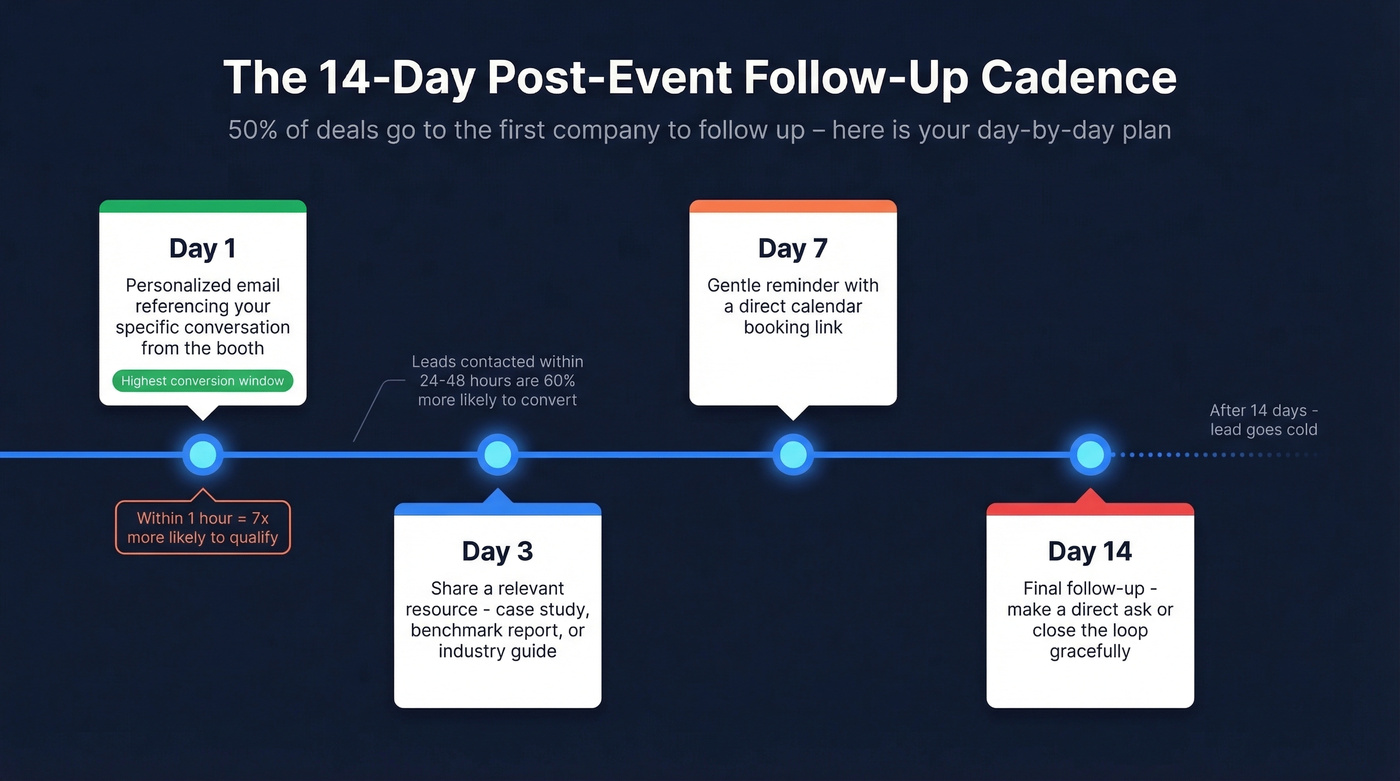
Speed kills - in a good way. Leads contacted within 24-48 hours are 60% more likely to convert than those reached after a week. When trade show leads get proper follow-up within 7-10 days, 20-30% convert into sales opportunities.
Day-by-Day Cadence
- Day 1: Personalized email referencing your specific conversation
- Day 3: Share a relevant resource - case study, benchmark, or guide
- Day 7: Gentle reminder with a meeting link
- Day 14: Final follow-up - direct ask or graceful close
Templates That Book Meetings
Hot lead - same day (score 8+):
Subject: Quick follow-up from [Event Name] - [specific topic discussed]
Hey [First Name],
Great talking at [Event] about [specific pain point they mentioned]. You mentioned you're evaluating [solution category] this quarter - I put together [specific resource] that addresses exactly what we discussed.
Worth a 20-minute call this week? [Calendar link]
Warm lead - next day (score 5-7):
Subject: From [Event Name] - thought this would help
Hi [First Name],
We met briefly at [Event] - you were interested in [general topic area]. I wanted to share [resource] that covers [relevant angle].
If it's useful, happy to walk through how teams like [similar company] are approaching this. Open to a quick call next week?
Tie every template back to the context you captured on-site. "Great meeting you" is forgettable. "You mentioned your team's struggling with bounce rates on outbound" is specific enough to earn a reply.
If you want more variations you can swap in by lead temperature, use these sales follow-up templates as a starting point.
You identified 30 target accounts at the event but only captured emails for half. Prospeo's 300M+ profile database fills the gaps - find verified emails and direct dials for every decision-maker you spoke with, refreshed every 7 days.
Turn badge scans into complete, verified contact records before the leads go cold.
Virtual Events: Scoring Invisible Leads
Virtual events flip the lead scoring model. You can't read body language, but you get something better: behavioral data. Platforms like SpotMe track granular engagement signals that in-person events can't match - watch time, rewatches of product demo sections, poll and Q&A participation, and mid-session content downloads. Each of these is a buying signal that badge scans never capture.
The critical distinction is between registered-but-absent attendees and deeply engaged participants. The first group belongs on a marketing list. The second group is pipeline material. Treating every registrant equally wastes sales time.
One format we've seen work well for mid-funnel leads is the "deminar" - a product demo disguised as an educational webinar. You're teaching something useful while showing the product in context, and the behavioral scoring data tells you exactly who leaned in versus who tabbed away after five minutes.
If you want a more formal model for weighting those engagement signals, adapt a standard lead scoring rubric to your virtual platform events.
Essential Tools for Event Lead Capture
You don't need a $50K platform to run effective lead gen from events. Match the tool to your event volume and motion.
| Category | Examples | Typical Pricing | Best For |
|---|---|---|---|
| Full-lifecycle | Cvent, Bizzabo, Splash | $10K-50K+/yr | 5+ events/year |
| Lead retrieval | iCapture, Captello, Boomset | iCapture from ~$8K/yr; rentals $300-500/person/event | Trade show exhibitors |
| Virtual platforms | SpotMe, Hubilo, Swapcard | $5K-25K+/yr | Webinar-heavy teams |
| Field capture | Leadbeam | ~$200-500/mo | Reps without a booth |
| Data verification | Prospeo | Free tier available; ~$0.01/email paid | Post-capture verification |
The buy-vs-rent math for lead retrieval is worth running. iCapture costs $8,000/year for unlimited use. Conference-provided rental scanners run $300-500 per person per event. If you're exhibiting at more than two shows a year, owning breaks even fast.
Skip the full-lifecycle platforms if you're running fewer than five events a year - the setup cost and learning curve aren't worth it for occasional use. For teams doing one or two trade shows plus a handful of webinars, a lead retrieval tool paired with a verification step covers you.
If you're evaluating vendors for the verification/enrichment layer, compare options in our roundup of data enrichment services.
Five KPIs That Prove Event ROI
- Qualified leads captured - scored contacts, not raw badge scans. If you can't tell hot from cold, you didn't qualify.
- Lead-to-meeting rate - what percentage of captured leads convert to a booked call within 14 days? Benchmark: 15-25% for well-run events.
- Pipeline influenced - total dollar value of opportunities where an event touchpoint appeared in the journey. This is the number your CFO cares about.
- Cost per opportunity - total event spend divided by opportunities created. Trade shows should target $500-1,500 per opportunity to justify the investment.
- Follow-up speed - median hours from capture to first touch. If this number is above 24, nothing else on this list matters.
Let's be honest: teams that track badge scan volume as their primary event metric are measuring activity, not outcomes. Anchor your reporting to pipeline influenced and cost per opportunity, and you'll have a much easier time justifying next quarter's event budget.
To make those numbers easier to defend internally, align your reporting with a broader set of lead generation metrics and funnel benchmarks.
FAQ
What is event lead generation?
Event lead generation is the process of collecting, qualifying, and converting potential buyer contacts through in-person or virtual events - trade shows, conferences, webinars, and hosted roundtables. It spans the full lifecycle from pre-event targeting through post-event follow-up and pipeline creation.
Which event type generates the most B2B leads?
Trade shows generate the highest volume, but hosted roundtables produce the highest quality - expect 15-25% lead-to-opportunity rates versus 8-15% for trade shows. Webinars win on cost efficiency at $50-150 CPL. Match the format to your average deal size and sales cycle length.
How fast should you follow up after an event?
Within one hour if possible - HBR data shows 7x higher qualification rates versus waiting longer. At minimum, your hottest leads should hear from you within 24 hours. After 48 hours, conversion rates drop by 60%.
How do you capture leads without a booth?
Pre-schedule meetings with target accounts attending the event, then connect with speakers and engaged audience members after sessions. Use a mobile capture app to log every conversation with context - name, company, pain point discussed, and agreed next step. You need a plan, not a booth.
How do you clean event lead data before outreach?
Upload your captured list to a verification tool before launching any sequence. Badge scans and manual entry produce 15-30% bad data. Verification costs roughly $0.01 per contact and protects your sender reputation from bounce damage.