

Examples of B2B Marketing That Actually Show the Numbers
Only 12% of B2B marketers rate themselves as "highly effective" - out of a survey of over 1,000 practitioners. That stat explains a lot. Most articles listing examples of B2B marketing name brands, describe campaigns in vague terms, and never show a single metric. We got tired of reading those, so we built this differently. Every example below has a number attached, a budget tier, and a reason it worked.
Quick version: If you've got budget, ABM produces the highest documented ROI - Snowflake generated $50M in pipeline from 200 accounts. If you're scrappy, founder-led content paired with verified outbound data is the fastest path to pipeline.
What Is B2B Marketing?
B2B marketing is how one business convinces another business to buy its product or service. The mechanics are wildly different from selling to consumers. Buyers are nearly 70% through their purchasing process before they ever talk to a salesperson, and 67% of customers now prefer self-service over speaking with a rep at all. Your demand generation and inbound marketing have to do the heavy lifting long before a rep gets involved.
| Dimension | B2B | B2C |
|---|---|---|
| Audience | Committees of 3-10 | Individual consumers |
| Sales cycle | Weeks to months | Minutes to days |
| Decision drivers | ROI, efficiency, risk | Emotion, price, convenience |
| Content tone | Educational, data-driven | Entertaining, aspirational |
B2B marketing isn't about awareness for its own sake. It's about building enough trust and evidence that a committee of skeptical professionals says yes.
B2B Marketing Campaigns by Type
Content Marketing
GfK/NIQ "Human vs AI" - GfK built a debate-style content hub pitting human insight against AI, distributed through YouTube, search, and social. The results: 6.87 million impressions against a 5 million target, with 90% of those impressions coming from Google Search and social ads using only 34% of the media budget. They didn't outspend the competition - they out-distributed them. Budget: Mid-Market ($5K-$50K)

DocuSign Industry Content Hubs - DocuSign created vertical-specific hubs tailored to industries like healthcare and financial services, and the payoff was enormous: +60% higher engagement, +300% page views, and a 22% pipeline uplift. The lesson isn't "make content hubs." It's that generic content underperforms industry-specific content by a massive margin every single time. Budget: Enterprise ($100K+)
Account-Based Marketing (ABM)
ABM is the highest-ROI B2B marketing strategy when you've got defined target accounts and the patience to execute. It's not a renamed email blast - it's coordinated outreach across multiple channels, tailored to specific accounts.
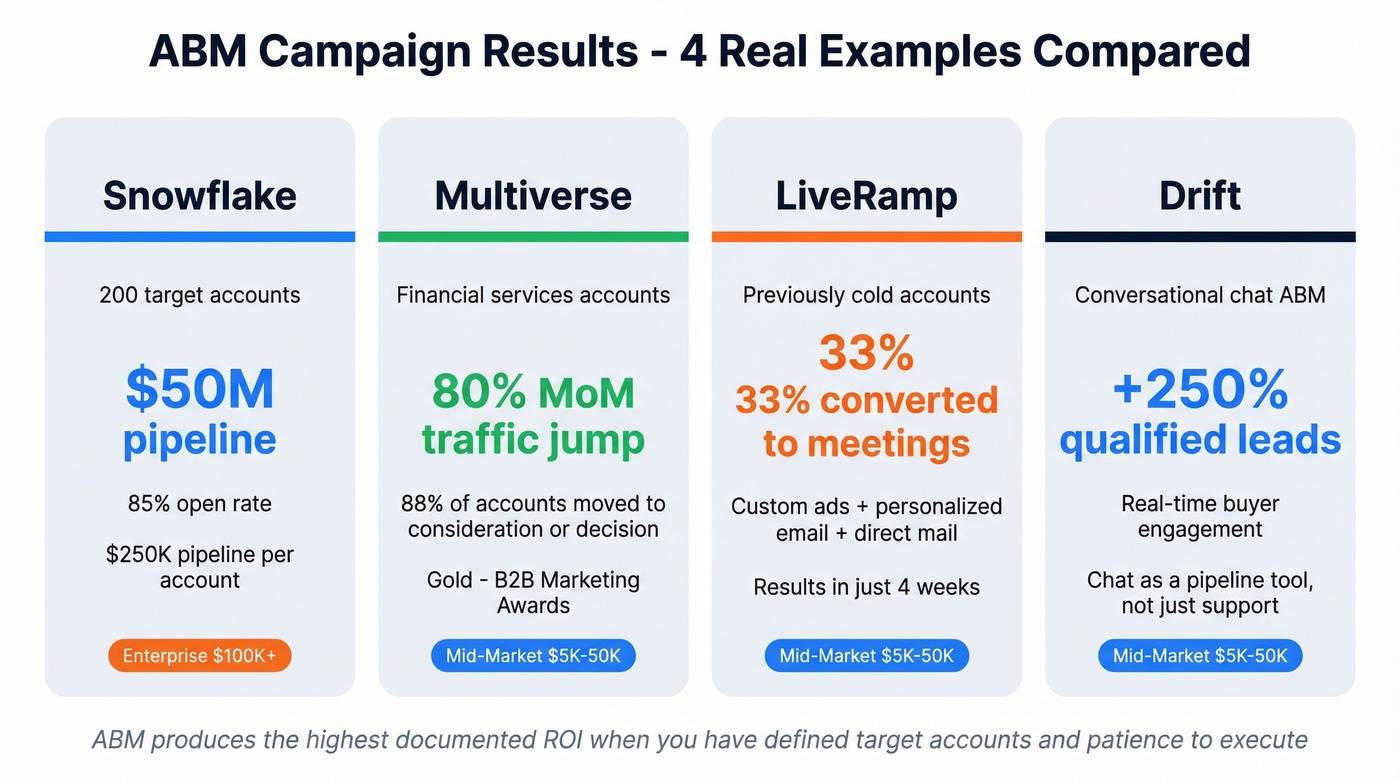
$50M in pipeline from 200 accounts. That's the number that makes Snowflake's ABM program the most-cited B2B advertising example of the decade. They researched 200 large enterprise accounts, hit them with premium direct mail and tailored digital experiences, and saw 85% open rates. That works out to $250K in pipeline per account. Budget: Enterprise ($100K+)
Multiverse vs. LiveRamp - two paths to ABM success. Multiverse's "Turning FS Giants Into AI Trailblazers" campaign targeted financial services accounts across multiple channels, driving an 80% month-over-month jump in direct site traffic and moving 88% of targeted accounts into consideration or decision stages. It won Gold at the B2B Marketing Awards for Best ABM Campaign. LiveRamp took a higher-touch approach with custom ads, personalized email, and direct mail, converting 33% of previously cold accounts to meetings within four weeks. Both mid-market budgets, completely different execution styles, both effective. Budget: Mid-Market ($5K-$50K)
Drift embedded conversational chat into its ABM strategy, using real-time buyer engagement to qualify and route accounts. The result: +250% qualified leads. This is the B2B digital marketing example that proved chat isn't just a support tool. Budget: Mid-Market ($5K-$50K)
Creative B2B Marketing on Social Media
McAfee "Keep It Real" leaned into intentionally surreal, AI-generated creative to highlight scam risks - a clever meta-play that used the thing people fear (AI fakery) to sell the solution. Social engagement ran 50% above benchmark, and CTR hit 55% above benchmark. B2B social doesn't have to be boring. Surreal, slightly weird creative outperforms polished corporate content more often than marketers admit.
Canva has used social-first content to teach users how to solve real problems with design. The pattern is simple: B2B social works best when it teaches something useful instead of broadcasting corporate messaging. Budget: Scrappy ($0-$5K)
Email Marketing
Email remains the highest-ROI channel in B2B - returning $36-$40 for every $1 spent. Average open rates sit at 21-22%, with click rates between 2.6% and 3.2%. Those numbers sound modest until you compare them to paid channels where you're paying per impression.
The campaigns that outperform these benchmarks share one trait: segmentation. We've seen teams double their click rates simply by splitting their list into three segments based on engagement recency and buying stage. The math isn't complicated - relevance drives response. Budget: Scrappy ($0-$5K)
Paid Media & PPC
Pinterest "P is for Performance" repositioned the platform as a lower-funnel performance channel using action-movie-style creative. Advertisers using Pinterest's performance tools saw up to 28% more conversions and 96% more traffic, and the share of ad revenue from advertisers using at least three performance tools jumped from 2% to 23% within a year. Budget: Enterprise ($100K+)
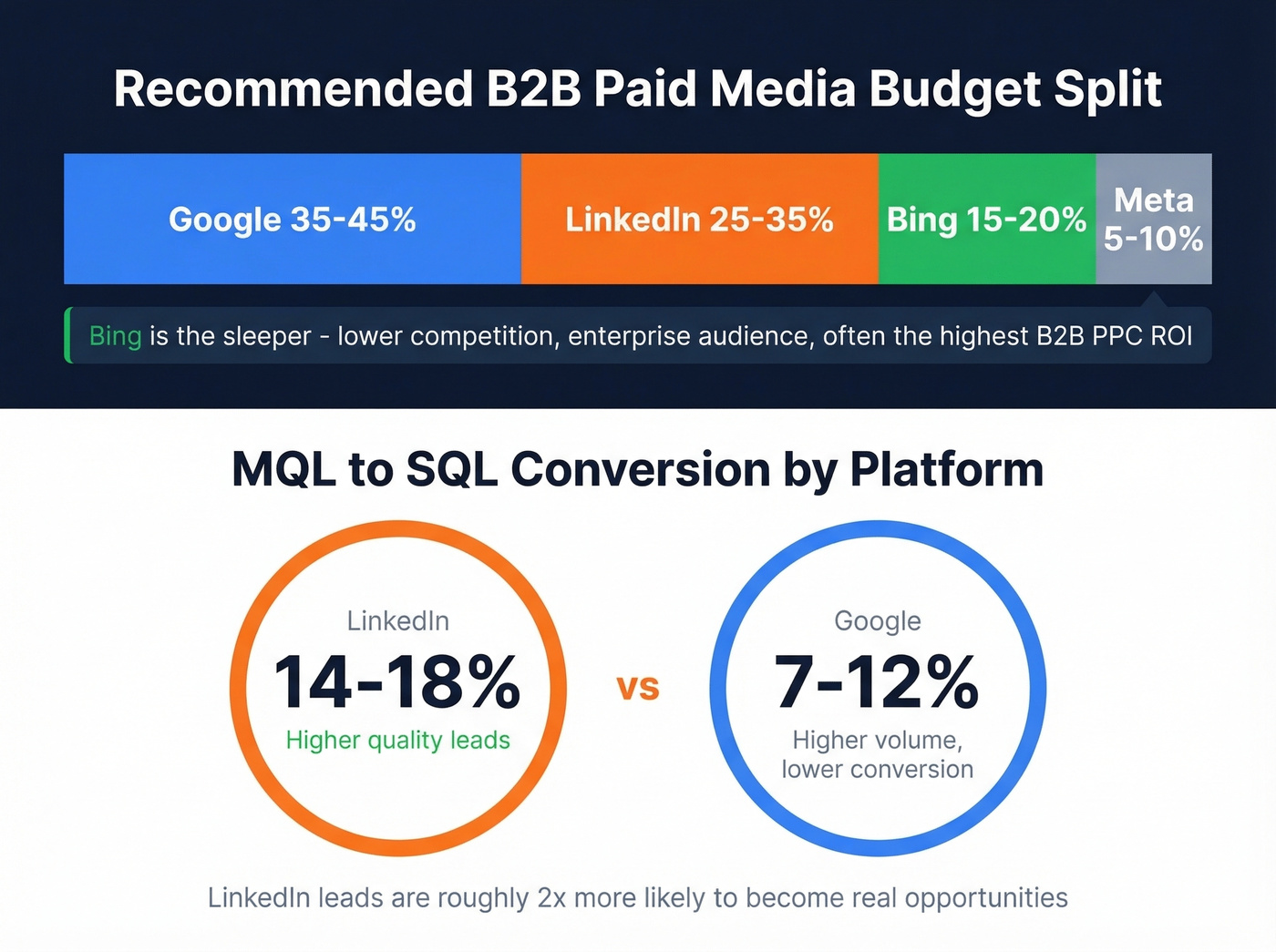
Platform selection matters more than creative optimization for B2B paid media. LinkedIn's MQL-to-SQL conversion runs 14-18% versus Google's 7-12%, meaning LinkedIn leads are roughly twice as likely to become real opportunities.
Here's the budget split that works for most B2B teams: Google 35-45%, LinkedIn 25-35%, Bing 15-20%, Meta 5-10%. Bing is the sleeper - it often delivers the highest ROI in B2B PPC because competition is lower and the audience skews enterprise.
Storytelling & Innovative Campaigns
BLP "The Heist: Cautionary Tales" created an Ocean's 11-inspired YouTube series about regulatory consequences. Not exactly the topic you'd expect to generate leads. But it produced 515% more leads than the campaign target and earned international press coverage. Consequences framing - showing what happens when you don't act - outperforms benefits framing in regulated industries. Budget: Mid-Market ($5K-$50K)
Adobe Fortune 500 ABM used AI/predictive targeting and account-level personalization and reported +60% average deal size and +40% retention among targeted accounts. The pattern: B2B storytelling and personalization work when they make a complex product immediately clear and reduce perceived risk. Budget: Enterprise ($100K+)
Data-Driven Outbound
Here's the B2B marketing example nobody puts on listicles because it's not cinematic - but it's how most high-growth companies actually fill pipeline.
Meritt tripled their pipeline from $100K to $300K per week after switching to verified contact data. Their bounce rate dropped from 35% to under 4%, and connect rates tripled to 20-25%. That's not a marginal improvement - it's a completely different business. Budget: Scrappy ($0-$5K)
Snyk had 50 AEs each prospecting 4-6 hours per week. After implementing verified data, bounce rates dropped from 35-40% to under 5%, AE-sourced pipeline jumped 180%, and they generated 200+ new opportunities per month. Budget: Mid-Market ($5K-$50K)

Both teams used Prospeo's 300M+ profile database with 98% email accuracy and a 7-day data refresh cycle. That weekly refresh is what separates "outbound works" from "outbound is dead" - most data providers refresh every 4-6 weeks, which means a huge chunk of your list is already stale by the time you hit send.
If you're building this motion, start with a repeatable B2B cold email sequence and lock down email deliverability before you scale volume.

Snowflake's ABM generated $50M from 200 accounts. LiveRamp converted 33% of cold accounts to meetings. Every winning B2B campaign starts with reaching the right people. Prospeo gives you 300M+ profiles with 30+ filters - buyer intent, technographics, job changes, funding - so your campaigns hit decision-makers, not dead ends.
Build your next campaign on 98% accurate data for $0.01 per email.
Email returns $36-$40 per dollar spent - but only when your list is clean. Teams using unverified data see 35%+ bounce rates that torch domain reputation and kill deliverability. Prospeo's 5-step verification and 7-day data refresh keep bounce rates under 4%, so every campaign you launch actually lands.
Stop burning budget on bounced emails. Get verified contacts in seconds.
Benchmarks - What Good Looks Like
Before you benchmark your campaigns against Snowflake's $50M pipeline, calibrate expectations with industry averages.
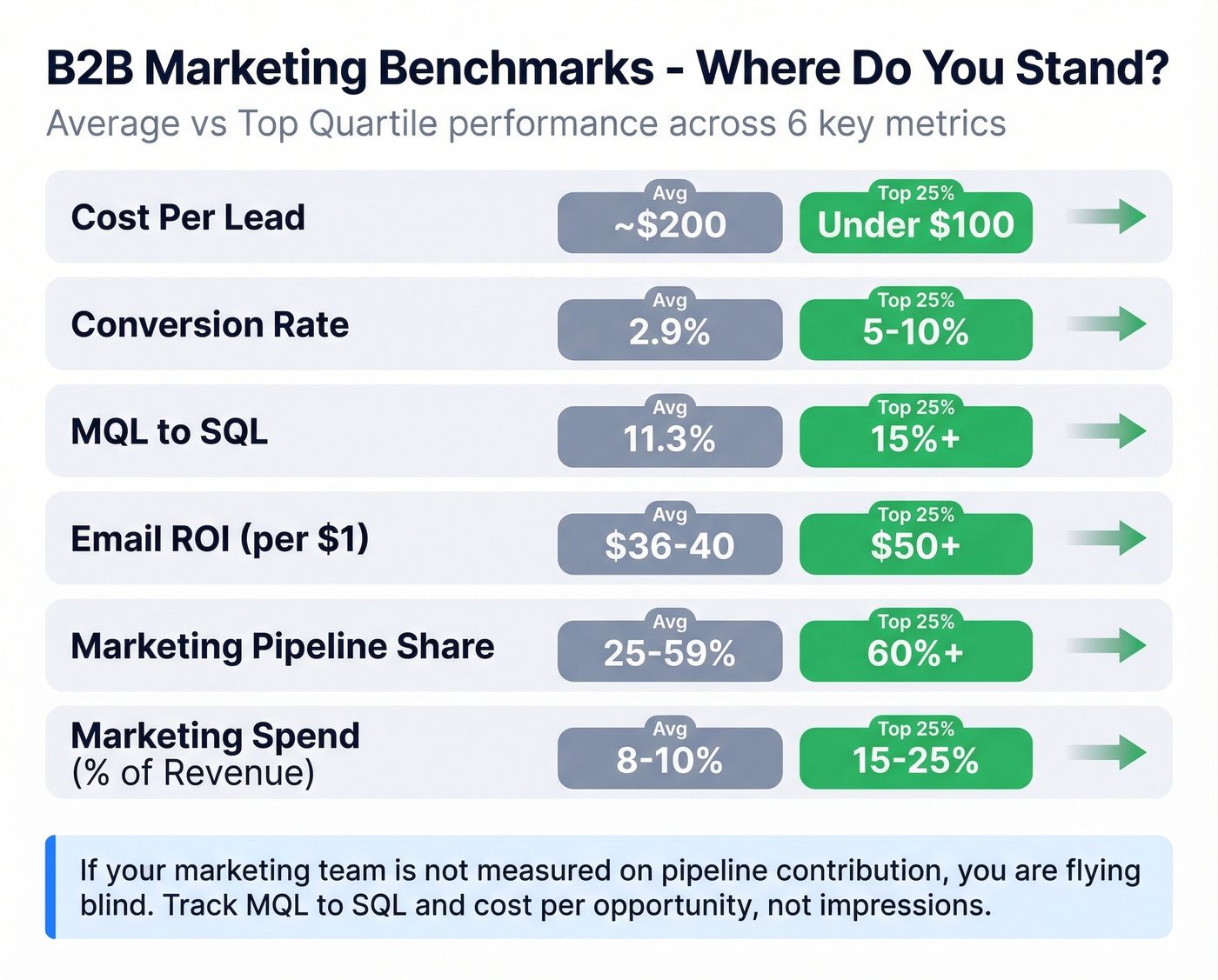
| Metric | Average | Top Quartile | Your Target |
|---|---|---|---|
| B2B cost per lead | ~$200 | Under $100 | ______ |
| Conversion rate | 2.9% | 5-10% | ______ |
| MQL to SQL | 11.3% | 15%+ | ______ |
| Email ROI | $36-40 per $1 | $50+ per $1 | ______ |
| Marketing pipeline share | 25-59% | 60%+ | ______ |
| Marketing spend (% of revenue) | 8-10% | 15-25% (high-growth) | ______ |
The conversion rate benchmark comes from an analysis of 100M+ data points across 14 industries. The 2.9% average includes both form fills (1.7%) and phone calls (1.2%). If your campaigns hit 5%+ consistently, you're outperforming most of the market.
Let's be honest: marketing contributes 25-59% of pipeline in established companies. If your marketing team isn't measured on pipeline contribution, you're flying blind.
Mistakes That Kill B2B Campaigns
Five mistakes we see repeatedly, each with the fix:
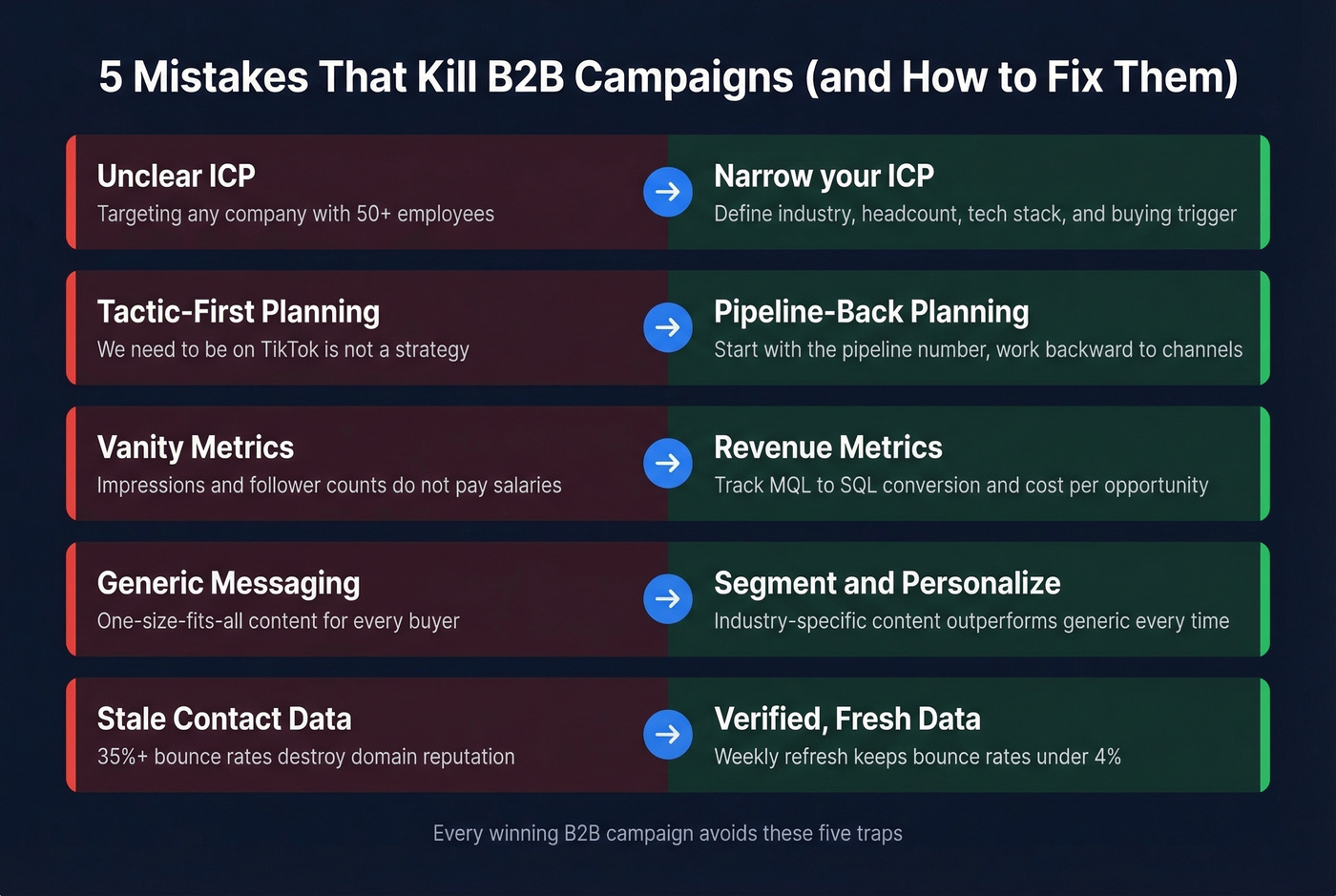
- Unclear ICP. If your ideal customer profile fits "any company with 50+ employees," it's not an ICP. Narrow to industry, headcount range, tech stack, and buying trigger.
- Tactic-first planning. "We need to be on TikTok" isn't a strategy. Start with the pipeline number you need to hit, then work backward to channels.
- Vanity metrics. Impressions and follower counts don't pay salaries. Track MQL-to-SQL conversion and cost per opportunity.
- Generic messaging. Buyers are 70% through their journey before talking to sales. If your content reads like every competitor's, you've already lost.
- Siloed teams. Marketing generates leads that sales ignores. Sales blames marketing for lead quality. The fix is shared pipeline metrics and weekly alignment.
Skip the most creative campaign in the world if your contact data is garbage. Bad data doesn't just waste budget - it destroys domain reputation. Before you launch any email campaign, verify your list first.
B2B Marketing Trends for 2026
51% of companies are increasing experiential marketing spend through 2026, signaling a swing back toward in-person and hybrid events after years of digital-first fatigue. Meanwhile, 70% of marketers say their employers provide zero generative AI training - even though more than half say AI is already important to their role. That gap is going to create winners and losers fast.
Here's my hot take: the teams obsessing over the latest marketing automation tool while ignoring content quality and sales alignment are optimizing the wrong variable. The CMI data backs this up - the top effectiveness drivers are content relevance and quality (65%), team skills (53%), sales alignment (45%), and technology (43%). Technology ranks dead last. If your average deal size is modest, you probably don't need a six-figure martech stack. You need three people who write well and talk to sales every week. Fundamentals beat tool-chasing every single year.
For teams looking for B2B campaign ideas they can actually execute, the examples above are organized by budget tier for exactly that reason - pick the tier that matches your resources and replicate the playbook.
FAQ
What are the main types of B2B marketing?
Content marketing, ABM, email, paid media, social, events, and data-driven outbound. Most effective B2B strategies combine three to four of these channels with measurement tied directly to pipeline, not vanity metrics like impressions or follower counts.
What's the most effective B2B marketing strategy?
ABM produces the highest documented ROI - Snowflake generated $50M in pipeline from 200 accounts. For SMBs, founder-led content paired with verified outbound data is the fastest path to pipeline. Choose strategies that match your budget and sales cycle rather than copying enterprise playbooks wholesale.
How much should a B2B company spend on marketing?
The benchmark is 8-10% of revenue for established companies. High-growth companies invest 15-25%. Average B2B cost per lead runs about $200, though this varies widely by channel - email and outbound with verified data typically deliver the lowest CPL.
How do you measure B2B marketing success?
Track pipeline contribution first - marketing should drive 25-59% of total pipeline. Then measure MQL-to-SQL conversion (11.3% average, 15%+ top quartile) and cost per opportunity. If you're only reporting on leads, you're measuring the wrong thing.
What's the cheapest way to start B2B outbound?
Verified email outbound is the lowest-cost starting point. Prospeo's free tier includes 75 email credits per month - enough to test messaging on a targeted list. Pair that with a free sending tool like Instantly's trial, and you can run a real campaign for under $100/month.