Fathom vs Gong (2026): Which Sales AI Tool Should You Choose?
You just got the renewal quote. It's not subtle. And two "important" calls last week never recorded because nobody admitted the bot (or the host got stuck in a waiting room).
That's the real Fathom vs Gong choice: a lightweight notetaker your reps will actually use vs a revenue platform you'll run like a system of record.
Make the call on four lenses: first-year TCO, recording coverage, output format (CRM-ready vs narrative), and governance/admin lift. Get those right and the "AI quality" argument mostly takes care of itself.
30-second verdict
Pick Fathom if...
- You want the best value for structured, CRM-ready notes and fast adoption.
- Your biggest pain is "reps aren't logging anything," and you need clean summaries, action items, and follow-ups with minimal setup.
- You're SMB or lean mid-market without a dedicated conversation intelligence admin.

Pick Gong if...
- You're ready to operationalize coaching + deal analytics + governance at scale. Gong pays off when managers run weekly workflows: scorecards, libraries, deal reviews, and risk signals.
- You need enterprise-grade controls (EU/US data residency options, BYOK, auditability) and deeper RevOps integration patterns.
- You're willing to pay for a platform purchase plus implementation, not just "a recorder."
Skip both if your bottleneck is pipeline, not conversations.
Look, buying better call summaries won't fix an empty calendar.
Decision tree (use this, don't overthink it):
- Need EU data residency, BYOK, and audit-grade governance -> Gong
- Need CRM-ready notes fast with near-zero admin -> Fathom
- No RevOps/enablement bench to run a program -> Fathom
- Managers doing weekly deal reviews + coaching scorecards -> Gong
Three quick scenarios
- 5-20 reps, no RevOps bench: Fathom.
- 50+ reps, managers doing weekly deal reviews: Gong.
Fathom vs Gong at a glance (feature + fit matrix)
| Category | Fathom | Gong | Winner (plain-English) |
|---|---|---|---|
| Best for | Fast adoption + structured notes | Coaching + deal governance | Fathom for notes; Gong for governance |
| G2 segment skew | SMB 78.4% | Mid-market 69.3% | Fathom for SMB; Gong for mid-market+ |
| Reviews (G2) | 5.0 (6,502) | 4.7 (6,468) | Fathom |
| Reviews (Capterra) | 5.0 (806) | 4.8 (558) | Fathom |
| Capterra sentiment | 805 positive / 0 neutral / 1 negative | 549 / 6 / 3 | Fathom |
| Recording approach | Bot-free capture on supported setups (e.g., Google Meet via extension + desktop app) | Bot join across supported integrations; native Zoom option | Gong for coverage; Fathom for simplicity |
| Summary output | Structured sections by default | Rich, often longer-form | Fathom |
| Coaching workflows | Light | Deep (scorecards, libraries, manager workflows) | Gong |
| Deal/pipeline analytics | Lighter deal view | Deal analytics + risk signals | Gong |
| Salesforce writeback depth | Notes-focused | Deeper objects + governance patterns | Gong |
| SSO/SAML | Available on higher tiers | Enterprise-grade SSO/SAML | Gong |
| Audit logs / API | Basic logs | Audit-grade options (incl. Audit API) | Gong |
| EU data residency | US-only (no EU data center option) | Yes (EU/US choice) | Gong |
| Admin lift | Low | Medium-high | Fathom |
| Pricing model | Public, self-serve | Quote-based bundles | Fathom |

G2 sub-ratings explain adoption speed. On G2's comparison, Fathom leads on the day-2 ops stuff that decides whether a rollout sticks:
| G2 sub-score | Fathom | Gong | Winner |
|---|---|---|---|
| Ease of setup | 9.6 | 9.1 | Fathom |
| Ease of admin | 9.6 | 9.1 | Fathom |
| Quality of support | 9.7 | 9.2 | Fathom |
Here's the thing: if your average deal size is in the low five figures and you don't run formal deal reviews every week, Gong's often overkill. You'll pay platform money to solve a notes problem, and Fathom solves the notes problem cleanly.
We've seen this play out in real rollouts: a team buys Gong, nobody owns the weekly coaching cadence, and three months later it's basically an expensive call archive that a couple managers use and everyone else ignores.
You can sanity-check the "easy + clean output" vs "enterprise + depth" split on G2's comparison page and Capterra's head-to-head listing.

You're comparing Fathom and Gong to capture more from conversations. But the real revenue bottleneck isn't note-taking - it's reaching decision-makers in the first place. Prospeo gives you 300M+ profiles with 98% verified emails and 125M+ direct dials, refreshed every 7 days.
Fix the pipeline problem no call recorder can solve.
Fathom vs Gong pricing & first-year TCO (what you'll actually pay)
Fathom's priced like a SaaS product. Gong's priced like a platform purchase. Budget them differently.
Fathom pricing (published)
- Free: $0
- Premium (individual): $20/mo or $16/mo billed annually
- Team: $19/user/mo or $15/user/mo billed annually (2-user minimum)
- Business: $29/user/mo or $20/user/mo billed annually (2-user minimum)
For sales orgs, Team and Business are the real contenders.
Gong pricing (budget ranges that match the market)
Gong sells quote-based bundles. Model it like this:
- Per-user license: $1,000-$3,000 per user/year (most teams land around $1,600)
- Platform fee (annual): $5,000-$50,000+
- Implementation/onboarding (one-time): $7,500-$65,000
Gong cost jumps when you add modules (Foundation plus add-ons like Engage, Forecast, Data Cloud). That's not "one more feature." It's a different purchase.
Gong also offers free Collaborator seats (limited access), which helps when stakeholders only need occasional viewing. Useful, but it doesn't erase platform fees.
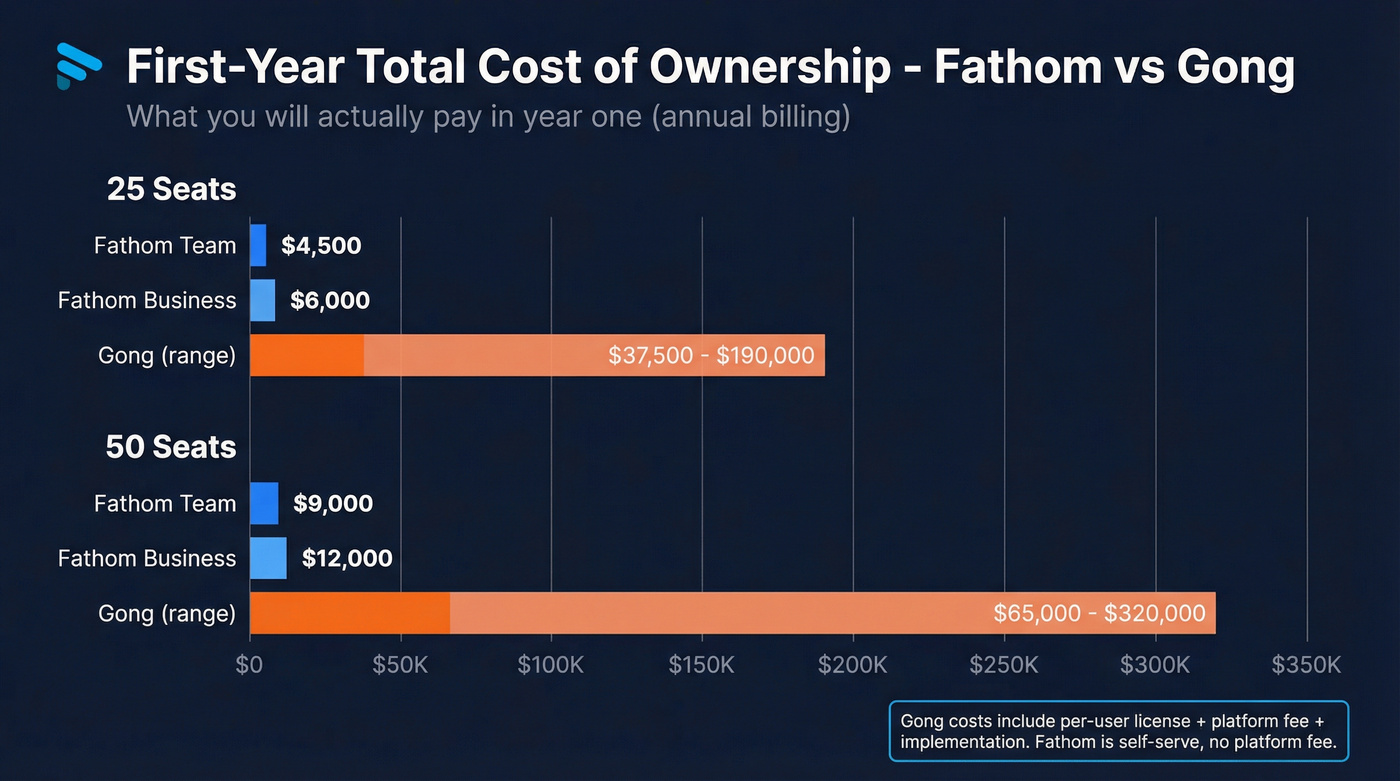
First-year TCO examples (25 seats, 50 seats)
| Seats | Tool | First-year cost |
|---|---|---|
| 25 | Fathom Team (annual) | $4,500 |
| 25 | Fathom Business (annual) | $6,000 |
| 25 | Gong (year 1) | $37,500-$190,000 |
| 50 | Fathom Team (annual) | $9,000 |
| 50 | Fathom Business (annual) | $12,000 |
| 50 | Gong (year 1) | $65,000-$320,000 |
Math notes (so Finance doesn't side-eye you):
- Fathom Team annual: $15/user/mo -> $180/user/year
- Fathom Business annual: $20/user/mo -> $240/user/year
- Gong ranges combine per-user + platform + implementation
Procurement callouts that change the deal
Contract reality:
- Gong runs annual contracts; multi-year's common.
- Renewal uplifts often land 5-15%.
- Early termination penalties often run 50-100% of remaining fees.
One lever procurement teams miss: Fathom runs a switch program for teams moving off Gong, including migration support and an offer that can offset remaining term (for example, free Business for the remainder of your contract). If you're mid-contract, check that before you assume you're "stuck."
Recording coverage: bot vs native, consent, waiting rooms
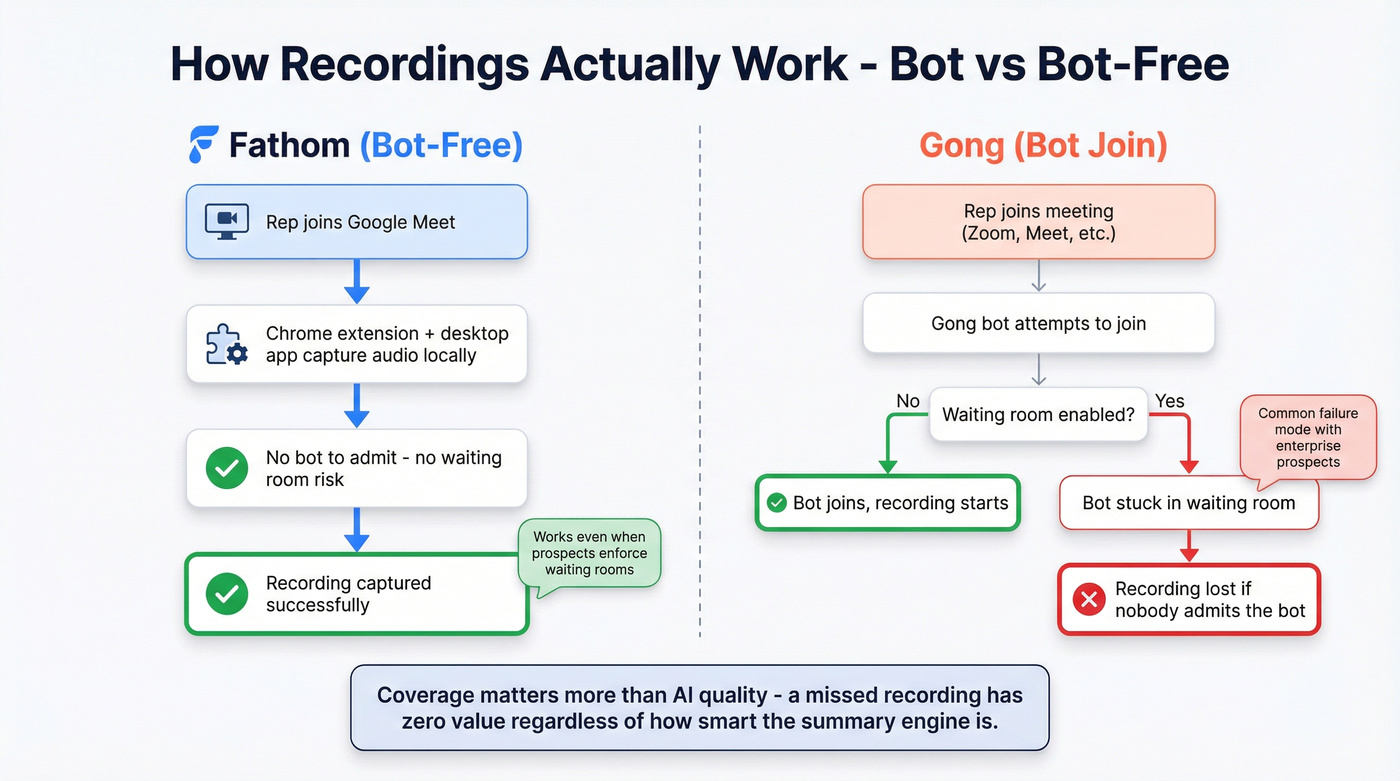
Recording coverage is where tools earn trust. Miss a call and reps stop believing the system.
Recording coverage matrix
| Topic | Fathom | Gong |
|---|---|---|
| Bot required? | No (on supported setups like Google Meet via extension + desktop app) | Yes (bot join) |
| Native recording | No | Yes (Zoom) |
| Waiting room dependency | Not applicable when there's no bot to admit | Bot must be admitted |
| Consent page flow | Not core | Supported across key integrations |
| Google Meet capture | Chrome extension + desktop app | Bot join |
| OS support | macOS/Windows | Web-based + integrations |
Gong's model: the bot joins meetings across supported conferencing integrations, which drives strong coverage until a waiting room blocks it. Gong's web conferencing docs also cover consent-page flows for Zoom, Google Meet, Webex, and GoToMeeting, and Zoom's native recording option can improve audio quality and speaker identification.
Fathom's model: on Google Meet, Fathom uses a Chrome extension + desktop app workflow. It's straightforward once set, and it avoids the "admit the bot" failure mode entirely.
One scenario we keep seeing: a rep books a first call with a picky enterprise prospect, the prospect's IT forces a waiting room, and the rep's too nervous to ask "can you admit our recording bot?" That call's gone. Forever.
Concrete setup gotchas (fixable, but real):
- For Meet-based capture, the Google Meet link must be in the Google Calendar LOCATION field and scheduled on your Primary Calendar.
- Waiting rooms need a policy: either admit the bot every time or disable waiting rooms for external calls.
- Consent language needs a single owner (legal + RevOps), not "whoever notices."
Checklist for a clean pilot:
- Run a 20-call pilot across messy meeting types (external prospects, internal deal reviews, partner calls).
- Test waiting rooms, dial-ins, and multi-speaker interruptions.
- Confirm recordings land where reps live (Slack + CRM), not just in a library.
Summary quality & CRM-ready notes (output format beats "smartness")
Summary quality isn't about clever prose. It's about whether the output matches your workflow.
Fathom wins when you want summaries broken into sections like pain, requirements, objections, timeline, next steps, and Q&A. Gong summaries shine when you use them inside Gong's coaching and deal workflows, but they often read longer and less paste-ready for CRM.
What "good" looks like (use this to judge both tools)
Ask four questions:
- Can I scan it in 15 seconds?
- Can I paste it into Salesforce without rewriting?
- Does it separate facts from next steps?
- Does it capture objections and decision process cleanly?
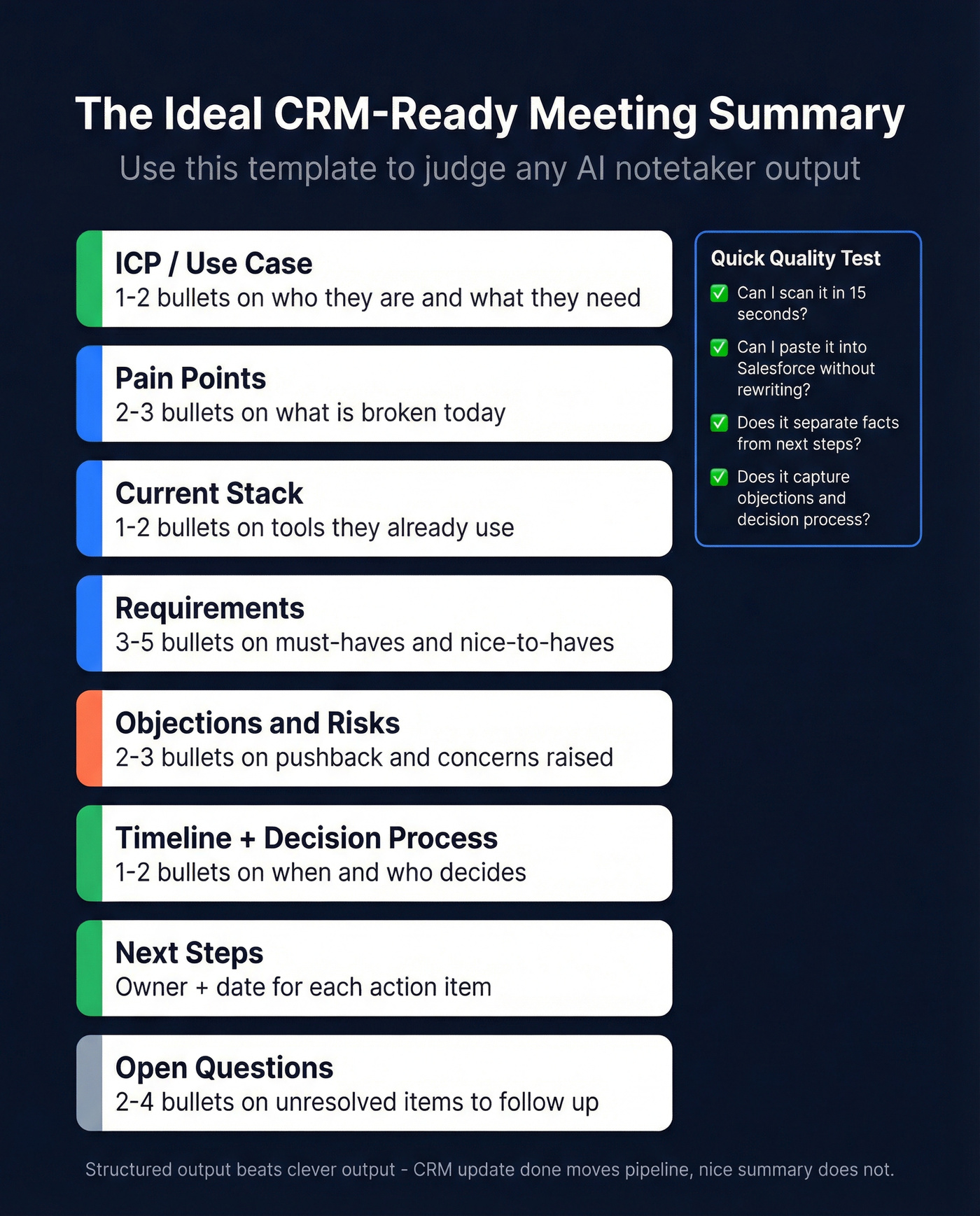
Mini template: ideal demo summary (CRM-ready)
- ICP / use case: 1-2 bullets
- Pain: 2-3 bullets
- Current stack: 1-2 bullets
- Requirements: 3-5 bullets
- Objections / risks: 2-3 bullets
- Timeline + decision process: 1-2 bullets
- Next steps: owner + date
- Open questions: 2-4 bullets
Output-focused pros/cons
Fathom strengths
- Structured sections make notes operational immediately.
- Reps adopt it fast because the value shows up the same day.
Gong strengths
- Best-in-class when you connect calls to coaching scorecards, libraries, and deal inspection.
- Strong for manager-led orgs that run weekly call reviews.
How to trial accuracy without getting lost: use a standardized 15-minute script with 3-4 speakers, test a quiet room and a noisy environment, then compare speaker labeling, action items, and critical facts (numbers, dates, next steps) while tracking WER, diarization quality, action-item precision/recall, and latency.
Bottom line: structured output beats clever output in sales workflows, because "nice summary" doesn't move pipeline but "CRM update done" absolutely does.

Security, compliance & data governance (procurement-grade)
If security's a real buying criterion, Gong and Fathom play different games. Gong's built for enterprise procurement. Fathom clears the bar for most SMB/mid-market teams without turning your CI tool into a governance project.
To keep this grounded, anchor your review in the vendors' own documentation: Gong's Trust Center and security feature summaries, and Fathom's security FAQ.
What security teams ask in practice (not the marketing checklist)
Security reviews rarely fail on "do you encrypt data?" They fail on operational controls:
- Can we choose where data lives (EU vs US)?
- Can we control keys (BYOK) or at least validate KMS usage?
- Can we prove who accessed what (audit logs/API into SIEM)?
- Can we prevent exfiltration (download/export restrictions by role)?
- Can we redact sensitive data (digits/PII) at scale?
- What's the retention and deletion story, including backups?
Side-by-side: Gong vs Fathom security posture
| Area | Gong | Fathom |
|---|---|---|
| SOC 2 | Type II | Type II |
| ISO | ISO 27001:2022 (plus related standards) | No ISO 27001 listed |
| AI management | ISO 42001:2023 | Not listed |
| Data residency | EU or US choice | US-only storage (per Fathom security FAQ) |
| Encryption | TLS in transit; AES-256 at rest | TLS in transit; encryption at rest |
| Key management | BYOK available; KMS-backed | Standard KMS-backed model (no BYOK) |
| Auditability | Audit-grade options incl. Audit API | Basic logs |
| Retention | Configurable retention policies | Custom data retention policies on Business |
| Redaction | Digit-sequence redaction (English calls only) | Limited redaction controls |
| GenAI training policy | Customer data not used to train generative models | De-identified improvement with opt-out; AI sub-processors can't train on user data |
| Deletion & backups | Deletion process defined; backups handled per policy | After account deletion, removed from backups after 7 days |
Concrete control details that matter (and why)
Encryption & key management Gong documents TLS 1.2+ in transit and AES-256 at rest, with cloud key management (AWS KMS) and BYOK options for orgs that require customer-managed keys, while Fathom documents encryption in transit and at rest and keeps the model simple, which speeds approval but won't satisfy teams that require customer-managed keys.
Access control & exfiltration prevention Gong's permission profiles let admins restrict who can download, export, share externally, or access specific libraries, which is the difference between "we're SOC 2" and "we can actually stop data walking out the door." Fathom's controls are lighter-weight and line up with teams that mainly need secure storage and reasonable workspace controls.
Auditability Gong's Audit API exists for a reason: security teams want machine-readable audit events pushed into SIEM tools for monitoring and incident response. If your org has a real security operations function, this isn't a nice-to-have.
Data residency Need EU data residency? Gong's the clean answer. If US-only storage is acceptable, Fathom's posture is plenty for most teams and usually faster to approve.
If you sell into regulated industries or your security team reads docs line-by-line, Gong reduces friction. If you're a normal B2B team that needs strong baseline controls without a long governance project, Fathom's the smoother path.
Implementation & admin lift (and the minimum Gong operating model)
This is where the decision becomes a resourcing decision.
Fathom setup is end-user onboarding plus a few workspace settings. Gong setup is an integration project, especially if Salesforce is your system of record and you care about governance.
Gong implementation: what actually gets configured
A practical setup checklist:
- Enable Salesforce API access (this blocks teams more than they'd expect)
- Create an integration user with correct permissions
- Configure connected apps (Gong integration app + SSO app if needed)
- Confirm read/write scope across objects (commonly Lead, Contact, Account, Opportunity, activity objects, and history tracking)
- Decide what writes back to CRM (activities, key points, custom objects)
- Configure Slack integration (admin required in both tools)
- Establish permission profiles, retention, and sharing/export controls
That's not bloat. That's governance. Gong becomes part of how you run deals.
Minimum operating model for Gong (what you must staff)
If you want Gong to pay off, run this cadence:
- RevOps owner (weekly): integrations, CRM writeback, permissions, data hygiene, dashboards
- Enablement/Managers (weekly): scorecards, call reviews, library curation, onboarding
- Security/IT (monthly/quarterly): SSO, retention, audit review, vendor risk posture
If nobody owns this, Gong turns into an expensive call archive.
Multi-team purchase scenario (Sales + Research/CS)
When Sales wants coaching but another team (Research, CS, Product marketing) wants tagging, alerts, and searchable libraries, Gong fits better because it's built for cross-team governance. The catch's the same: you need an owner and a weekly operating rhythm, or the multi-team value never shows up.
What to pair with either (so you get more calls worth recording)
Fathom and Gong optimize what happens after a meeting exists. If you need more qualified meetings, add a data layer first.
Prospeo is the B2B data platform built for accuracy: 300M+ professional profiles, 143M+ verified emails, 125M+ verified mobile numbers, 98% verified email accuracy, and a 7-day refresh. It's self-serve, GDPR compliant, and built for teams that are tired of burning domains on bad data.
And yes, I'm opinionated here: if your bounce rate's ugly or reps keep saying "these lists are trash," fix that before you spend six figures on conversation intelligence.
If you want a simple way to pressure-test your list quality, run it through an email verifier first and track bounces by segment.
Gong costs $37K–$190K in year one for 25 seats. Fathom's cheaper but still records calls you already booked. For $0.01 per verified email, Prospeo fills the calendar so your AI notetaker actually has something to record.
Book 26% more meetings before you optimize how you record them.
FAQ
Is Gong worth it for teams under 25 reps?
Yes, if managers run weekly coaching and deal reviews and RevOps owns governance. If you mainly want call notes and summaries, Gong's the expensive route. Under 25 reps, Fathom's usually the cleaner buy for adoption and cost.
Does Fathom work without a meeting bot (and what are the setup limits)?
Yes. On Google Meet, Fathom records via a Chrome extension plus a desktop app, so there's no bot to admit. The practical limits: it's macOS/Windows only, and Meet links need to be scheduled correctly (LOCATION field) on your Primary Calendar.
What's the real first-year cost of Gong vs Fathom for 25-50 seats?
For 25-50 seats, Fathom's straightforward: about $4.5k-$12k/year on Team or Business annual plans. Gong's a platform purchase: roughly $37.5k-$320k in year one, depending on per-seat pricing, platform fees, implementation, and modules.
Which is better for compliance and data residency: Gong or Fathom?
Gong. It supports EU/US data residency choices, BYOK, and audit-grade controls that enterprise security teams ask for. Fathom covers SOC 2 Type II and solid baseline security, but it stores data in the US only (per its security FAQ) and offers lighter governance controls.
If we choose Fathom or Gong, what should we use to generate more qualified meetings?
Use Prospeo when pipeline creation's the bottleneck. It delivers 98% verified email accuracy, verified mobiles, enrichment, and a 7-day refresh with self-serve pricing and no contracts. Build cleaner lists, book more meetings, then let your call tool handle coaching and conversation insights.
Summary: choosing between Fathom and Gong
If you're making the Fathom vs Gong call this week, don't buy on vibes. Buy on operating model.
- Choose Fathom if you want fast adoption and CRM-ready notes with minimal admin.
- Choose Gong if you're committing to a managed program: coaching workflows, deal governance, and enterprise controls.
- If meeting volume's the real problem, fix the top of funnel first with Prospeo, then worry about which tool summarizes the calls.