

How to Find Company Details for Any Company, Anywhere
You need to find company details fast, and all you have is a name. No revenue figures, no headcount, no idea who the decision-maker is. You start searching and immediately hit a wall of outdated directories, paywalled databases, and state portals that look like they were built in 2003. Experian research found that 85% of businesses say poor-quality customer data hurts their operational efficiency - moments like this are exactly why.
The information exists. It's just scattered across dozens of sources, each with different coverage, freshness, and access models. Let's fix that.
What You Need (Quick Version)
Verifying a company exists? Start with OpenCorporates, which is free and covers 100+ registries worldwide, or your state's Secretary of State portal for US entities.
Researching a public company's financials? Go straight to SEC EDGAR. Full filings, free, no account required - it doubles as a free company revenue lookup for any publicly traded US firm.
What Counts as "Company Details"?
The phrase means different things depending on whether you're a sales rep, an investor, or a compliance officer. Here's the full breakdown:
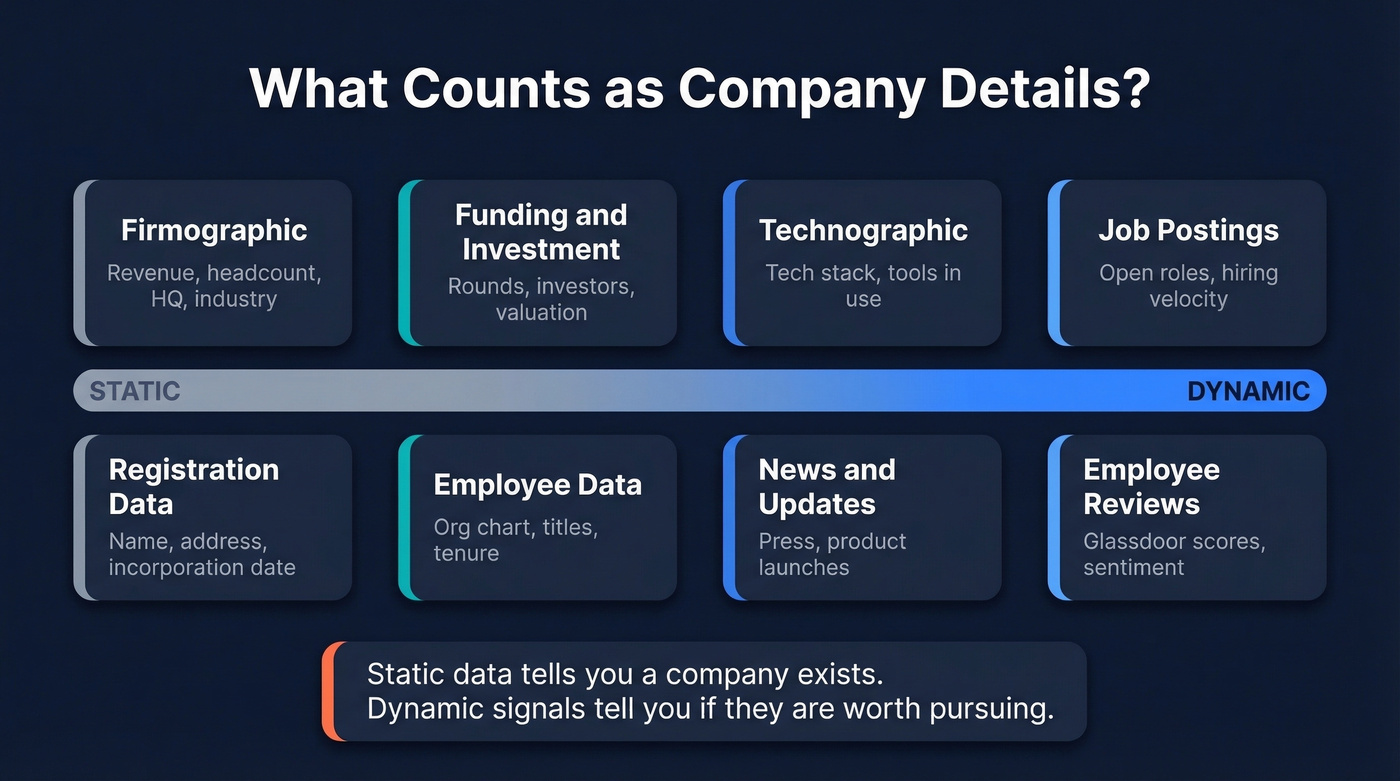
| Category | What It Includes | Static or Dynamic? |
|---|---|---|
| Firmographic | Revenue, headcount, HQ, industry | Mostly static |
| Technographic | Tech stack, tools in use | Dynamic |
| Employee data | Org chart, titles, tenure | Dynamic |
| Job postings | Open roles, hiring velocity | Dynamic |
| News & updates | Press, product launches | Dynamic |
| Funding & investment | Rounds, investors, valuation | Event-driven |
| Employee reviews | Glassdoor scores, sentiment | Dynamic |
| Competitive positioning | Market share, alternatives | Dynamic |
The critical distinction: static registration data like company name, address, and incorporation date tells you a company exists. Dynamic signals - who they're hiring, what tech they use, whether they just raised a round - tell you whether they're worth pursuing. Company employee data falls squarely in the dynamic camp and requires regular refreshes to stay useful.
If you're building lists for outbound, this is also where data enrichment becomes the difference between "nice-to-have" and "usable."
Free Sources for Company Lookups
You don't need to pay for basic company verification. Here are the free sources worth knowing.
SEC EDGAR (Public Companies)
If the company is publicly traded in the US, EDGAR is the definitive source. 10-K annual reports, 10-Q quarterly filings, proxy statements, insider transactions - all fully searchable and completely free. For financial deep-dives on public companies, nothing else comes close.
Annual reports also disclose total headcount, so if you're wondering how to find out how many employees a company has, the 10-K is the most authoritative starting point for public firms.
OpenCorporates (Global Registry Search)
OpenCorporates aggregates data from 100+ company registries worldwide into a single search interface. It won't give you financials or contacts, but it's a fast way to confirm a company's legal name, jurisdiction, registration status, and available filings.
State Secretary of State Portals (US Registration)
Every US state maintains its own business entity database, and the experience varies wildly. Some states let you search by officer name and pull UCC filings. Others barely support a name search, and a few charge small fees per lookup or document. The Coordinated Legal directory compiles links to every state's portal - bookmark it.
Companies House (UK)
For UK-registered businesses, Companies House is free, fast, and surprisingly detailed. Filing history, director names, registered address, and accounts where available. It's the gold standard for what a government registry should look like.
Company Websites & News
Don't overlook the obvious. A company's own website is often the richest single source for private firms - About pages, leadership teams, press releases, and investor pages. Pair that with Google News for coverage of smaller companies that national outlets won't touch. Local newspapers and trade publications cover companies that Bloomberg never will.
How to Research Private Companies
Private companies are where things get harder. They aren't required to file with the SEC, so the depth of information you'd find for a public company simply doesn't exist.
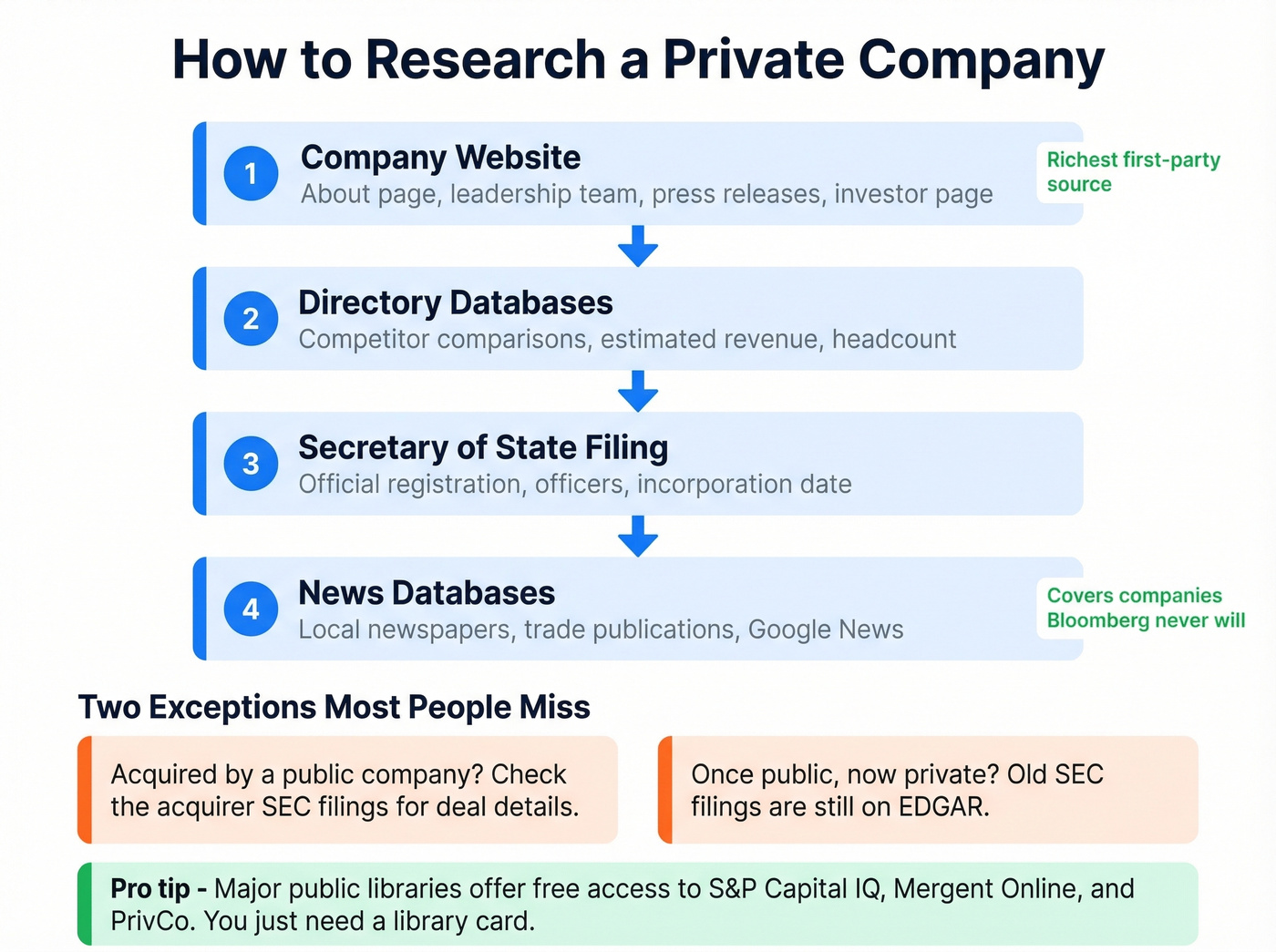
Here's the workflow that actually works:
- Start with the company website - usually the richest first-party source.
- Move to directory databases for competitor comparisons and estimated revenue.
- Check the state Secretary of State filing for official registration details.
- Search full-text news databases, focusing on local and trade publications.
Two exceptions worth knowing. If a private company was acquired by a public company, the acquirer's SEC filings will disclose deal details. And if a company was once public before going private, older SEC filings remain accessible on EDGAR.
Here's a tip most people miss: major public libraries offer free access to expensive research tools. The New York Public Library provides access to S&P Capital IQ, Mergent Online, and PrivCo, which covers financials for private companies with $10M+ revenue. You'll need a library card and sometimes on-site access, but it's genuinely free access to tools that cost thousands per year.
If you're doing this for prospecting, pair the workflow with a clear ideal customer profile so you don't over-research bad-fit accounts.

You just read about piecing together company details from SEC filings, state portals, and library databases. Prospeo returns 50+ data points per company - revenue, headcount, tech stack, funding, and verified decision-maker contacts - in a single lookup. 300M+ profiles, refreshed every 7 days, starting at $0.01 per email.
Skip the scavenger hunt. Get complete company details in one search.
International Company Lookups
International company lookups feel harder because they are harder. Europe alone has 27 separate national legal systems, each with its own company register, disclosure rules, language, and access model. There's no single EU-wide company register that gives you deep financial or ownership data.
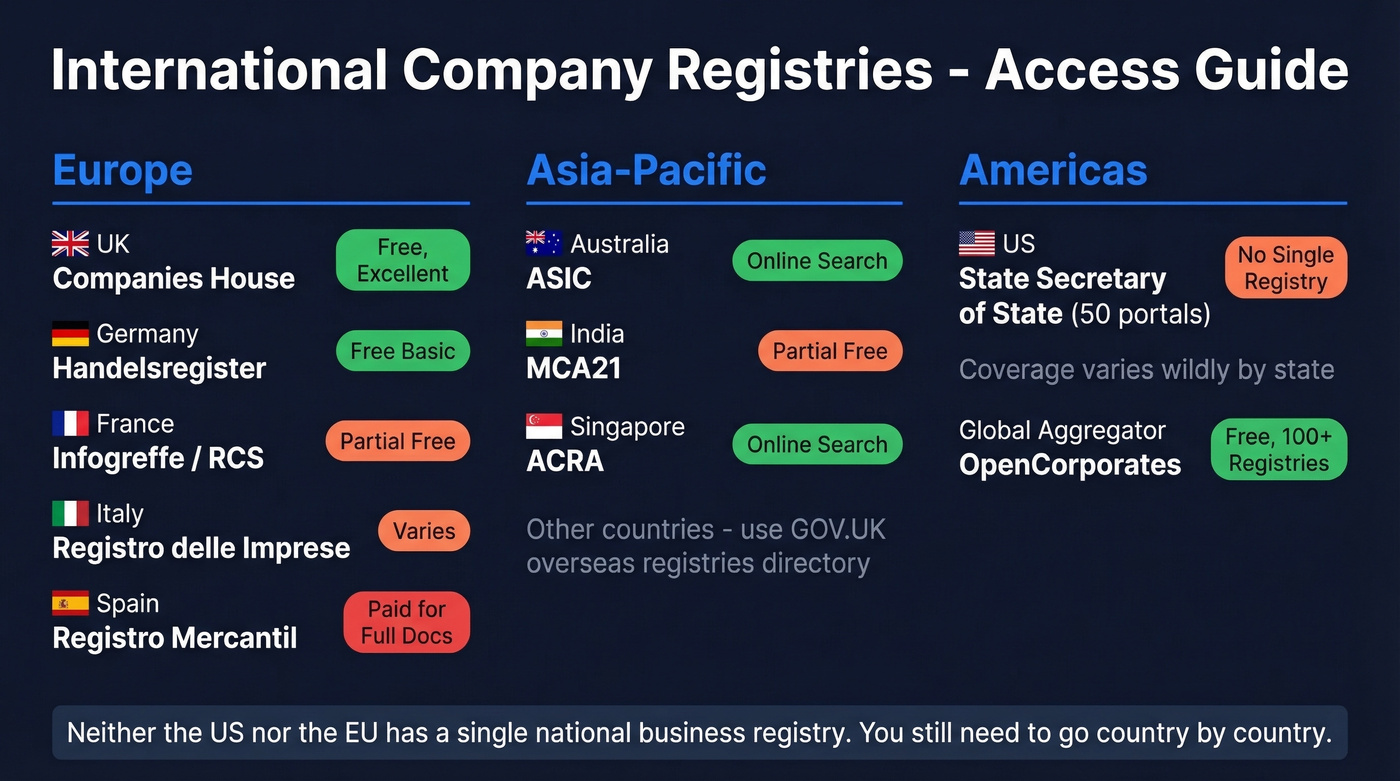
The EU's Business Registers Interconnection System (BRIS) improves cross-border connectivity, but it doesn't replace national registers for anything beyond basic lookups. You'll still need to go country by country.
Key European Registers
| Country | Register | Notes |
|---|---|---|
| UK | Companies House | Free, excellent depth |
| Germany | Handelsregister | Free basic search |
| France | Infogreffe / RCS | Partial free access |
| Italy | Registro delle Imprese | Varies by chamber |
| Spain | Registro Mercantil | Paid for full docs |
Asia-Pacific Registers
APAC coverage is thinner but improving. Australia's ASIC, India's MCA21, and Singapore's ACRA all offer online company searches with varying levels of free access. For other countries, the GOV.UK overseas registries directory links to registries across Africa, the Americas, Asia, the Caribbean, Europe, the Middle East, and Oceania. It's the most organized starting point available.
The fact that neither the US nor the EU has a single national business registry is genuinely frustrating. You'd think this would be a solved problem by now.
Tools to Research Companies at Scale
Free registries work for one-off lookups. But when you're researching 50 accounts for an outbound campaign or enriching a CRM with thousands of records, you need a database - especially when you need employee counts and contact info across multiple companies simultaneously.
If you're comparing vendors, start with a ranked list of the best B2B databases and then narrow by your region and use case.
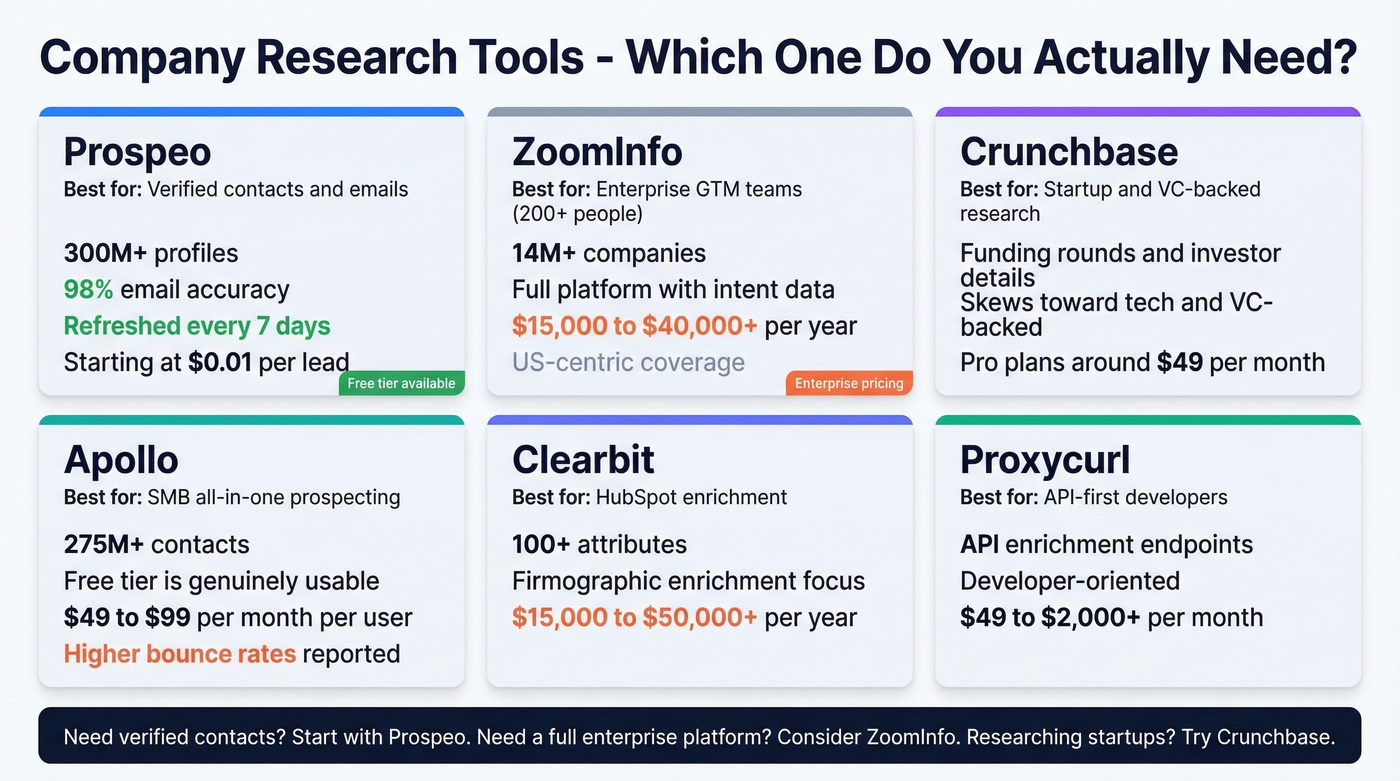
Two models dominate the market: aggregators that pull from multiple data sources and proprietary database providers that maintain their own datasets. Aggregators tend to have broader but shallower coverage. Proprietary databases go deeper on their core markets but have blind spots elsewhere. Understanding which model a tool uses explains why coverage and accuracy vary so much between platforms.
| Tool | Best For | Coverage | Pricing | Scope |
|---|---|---|---|---|
| Prospeo | Verified contacts | 300M+ profiles | Free tier; ~$0.01/lead | Contact data, not financials |
| ZoomInfo | Enterprise GTM | 14M+ companies | ~$15,000+/yr | Full platform, US-centric |
| Crunchbase | Startup/funding data | Millions of companies | Free + Pro ~$49/mo | VC-backed companies |
| Apollo | SMB all-in-one | 275M+ contacts | Free; ~$49-99/mo | Broad but variable accuracy |
| Clearbit | HubSpot enrichment | 100+ attributes | ~$15,000-50,000/yr | Firmographic enrichment |
| Proxycurl | API-first enrichment | API enrichment endpoints | $49-2,000+/mo | Developer-oriented |
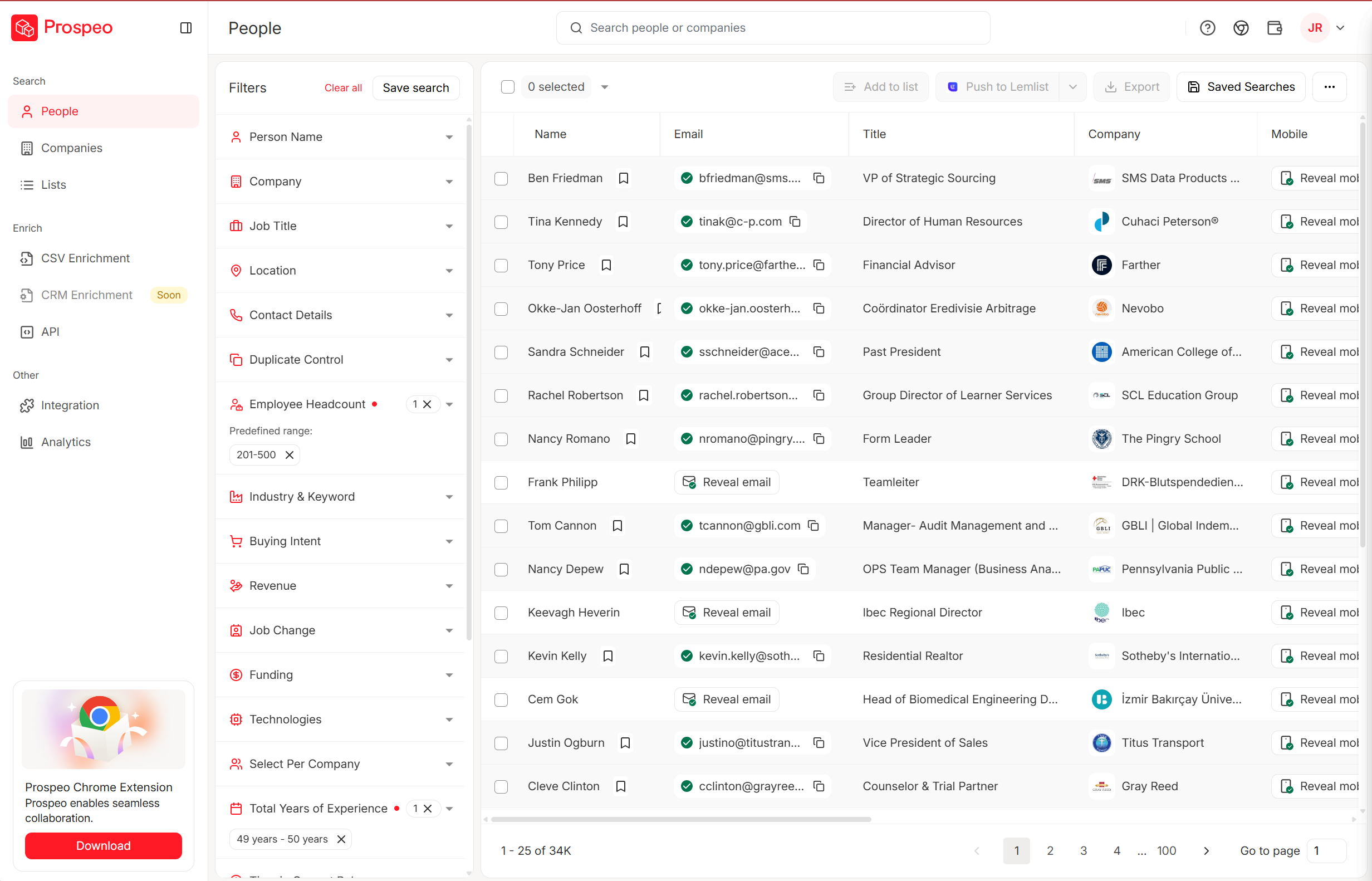
Prospeo
Every free registry tells you a company exists. None of them tell you who to contact. Prospeo bridges that gap with 300M+ professional profiles, 143M+ verified emails, and 125M+ verified mobile numbers. The 98% email accuracy comes from a proprietary 5-step verification process with catch-all handling, spam-trap removal, and honeypot filtering - and data refreshes every 7 days versus the 6-week industry average.
The workflow is straightforward: use 30+ search filters to build a targeted list, then export or enrich with verified contact data attached. The enrichment match rate runs 83%. Snyk's sales team dropped their bounce rate from 35-40% to under 5% after switching - and their AE-sourced pipeline jumped 180%. Pricing starts free with 75 emails per month, and paid plans run roughly $0.01 per lead with no annual contracts.
If deliverability is a priority, it’s worth understanding email list verification and how it impacts bounce rates.
ZoomInfo
Use this if you're a 200+ person sales org that needs a single platform for everything from prospecting to intent to conversation intelligence. Skip this if you're a team of 5-20 that just needs accurate contact data.
ZoomInfo is the enterprise default - 14M+ companies, deep US coverage, and a full GTM platform. The problem is price: a mid-market contract typically runs $15,000-40,000+ per year before add-on modules. Users consistently flag regional coverage gaps in APAC and EMEA. Look, if your average deal size doesn't justify a five-figure data spend, you're probably overpaying. Most teams don't need all-in-one - they need accurate data and a way to act on it.
Crunchbase
Best for startup and venture-backed company research - funding rounds, investor details, leadership changes, acquisition history. Skip it if you need coverage of bootstrapped businesses or traditional industries, because Crunchbase skews heavily toward VC-backed tech. Pro plans run ~$49/month and unlock advanced search and export. The free tier is a solid starting point for quick lookups.
Apollo
Apollo is the obvious starting point for SMB teams that want prospecting, sequencing, and a contact database in one platform. The free tier is genuinely usable, and paid plans start around $49-99/month per user. The database covers 275M+ contacts. We've seen higher bounce rates from Apollo lists compared to platforms with proprietary verification infrastructure, though - something to watch if deliverability matters to your workflow.
If you're building outbound sequences, use a dedicated outbound email automation tool so your data and sending stay cleanly separated.
Clearbit
Clearbit enriches records with 100+ firmographic and technographic attributes. If you're already on HubSpot, it plugs directly in. The catch: pricing isn't transparent anymore. Expect enterprise-tier pricing in the $15,000-50,000/year range depending on volume. Reviewers have flagged the credit system as unintuitive after recent UX changes.
Proxycurl
An API-first enrichment tool built for developers. Pricing runs $49/month basic, scaling to $2,000+/month for high volume. If you don't have a developer on staff, look elsewhere.
From Company Details to Contacts
You don't need 15 tools. You need three: a free registry for verification, a data platform for contacts, and your own judgment about which accounts are worth pursuing.
In our experience, the real bottleneck in company research isn't finding that a company exists - it's going from "I know the company" to "I have the right person's verified email." Manual research yields 20-30 contacts per day. A quality database delivers 400-600 targeted contacts in 15 minutes. That's not a marginal improvement. It's a different workflow entirely.
To keep that workflow consistent, document your B2B prospecting strategies and standardize what “good data” means for your team.
Researching companies one by one across 27 European registers and dozens of APAC portals doesn't scale. Prospeo's database covers global companies with 30+ filters - buyer intent, technographics, headcount growth, funding - so you can find and enrich company details in bulk with an 83% match rate.
Turn hours of manual company research into a 30-second enrichment workflow.
Due Diligence and Compliance
Not all company research is about sales. If you're evaluating an acquisition target, vetting a vendor, or running KYB checks, the stakes are higher and the checklist is longer.
Businesses lost over $4.7 trillion globally to financial crime in 2025, according to Nasdaq's Global Financial Crime Report. Proper due diligence isn't optional. 85% of M&A deals see purchase price reductions during the diligence process, and 50% of tech deals collapse entirely based on what's uncovered.
A thorough due diligence process covers 12 categories: financial, legal/corporate, contracts, IP, employment, tax, environmental, regulatory, insurance, real property, technology, and commercial. For a basic verification checklist, cross-reference at minimum: state registry filing for active status, SEC filings if applicable, BBB profile, and court records for pending litigation. Each source catches things the others miss.
If you're operating in regulated markets, align your process with B2B compliance requirements before you scale data collection.
Making Employee Data Work
B2B contact data decays 25-30% per year. People change jobs, companies get acquired, email domains migrate. A list that was 95% accurate in January can be 70% accurate by December. Keeping org charts current, tracking title changes, and identifying new decision-makers - that's what separates teams that hit quota from teams that burn through stale lists.
The downstream impact is measurable. Bad data produces 15-30% email bounce rates. Verified data brings that down to 2-5%. High bounce rates don't just waste sends - they damage your sender reputation, which tanks deliverability for every future campaign. The gap between weekly and six-week data refresh cycles compounds fast when you're running outbound at scale.
If you're troubleshooting deliverability, start with check bounce and then audit your sending setup.
FAQ
What's the best free tool to look up company details?
OpenCorporates for global searches - it aggregates 100+ company registries into one interface. For US public companies, SEC EDGAR gives you full financial filings for free. Neither requires an account, and both cover the basics most people need for initial company verification.
How do I find details on a private company?
Start with the company website, then check directory databases and state Secretary of State filings for official registration data. Major public libraries like the NYPL offer free access to tools like S&P Capital IQ and PrivCo for financials. Private company financials are often self-reported estimates, so cross-reference where possible.
Can I find company details for international businesses?
Yes. The GOV.UK overseas registries directory links to company registries by region worldwide. For EU companies, check national registers directly - Germany's Handelsregister, France's Infogreffe, Italy's Registro delle Imprese. For APAC, try Australia's ASIC, India's MCA21, or Singapore's ACRA. There's no single global register, so expect country-by-country lookups.
How do I go from a company name to a verified email?
Use a B2B data platform that maps company records to individual contacts. Prospeo lets you upload a list of target companies and returns verified emails and direct dials in minutes - 83% enrichment match rate at roughly $0.01 per lead. The key differentiator between platforms is verification infrastructure; look for tools with proprietary email verification rather than third-party providers.
How often does company data go stale?
B2B contact data decays 25-30% per year due to job changes, company closures, and email migrations. A list that's accurate today will have significant gaps within 6-9 months. Tools with weekly data refresh cycles keep bounce rates under 5% versus the 15-30% common with infrequently updated databases.