


Floworks AI Pros and Cons (2026): What Every Buyer Should Know
Most "Floworks AI reviews" are thinly disguised sales pitches from competing vendors. We wanted to write something more useful: an actual breakdown of what works, what doesn't, and whether this tool deserves your budget in a market where only 2% of AI SDR implementations stick.
The AI SDR category is projected to grow from $4.27B to $18.19B by 2032, per Fortune Business Insights. That kind of money attracts a lot of vaporware. Floworks isn't vaporware - but it still has gaps worth understanding before you hand it your domain reputation.
Quick Verdict
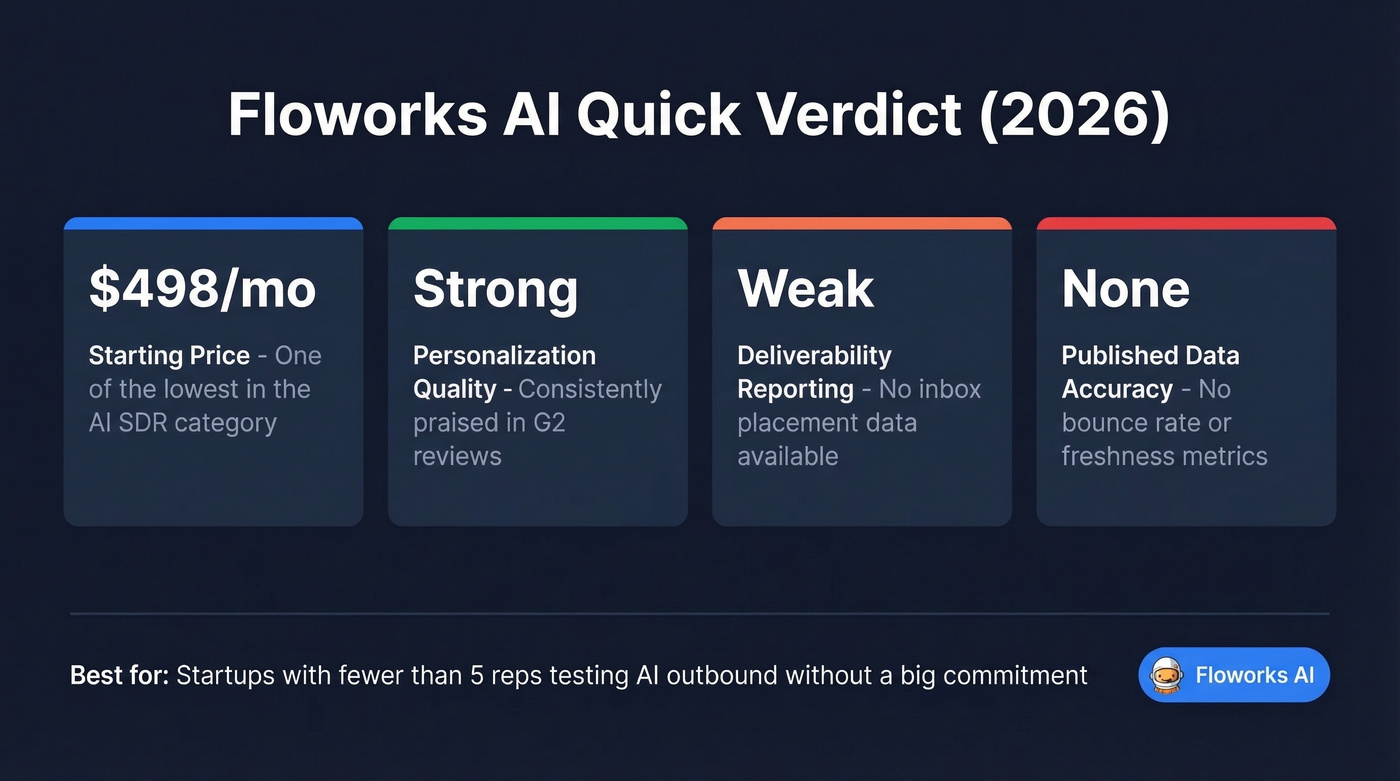
Floworks is one of the lowest-priced autonomous AI SDRs available at $498/mo. It's built for startups with fewer than five reps who want to test AI outbound without a $30K annual commitment. Strong personalization, real proprietary tech. Skip it if you need deliverability reporting, proven ROI data, or published data accuracy metrics.
What Floworks AI Actually Does
Floworks' flagship product is Alisha, an AI SDR agent that handles the full outbound cycle: lead research, personalized email writing, multi-channel sequencing across email and LinkedIn, automated follow-ups, objection handling, and autonomous meeting scheduling via calendar integration.
According to its YC Launches listing, Alisha pulls from 10+ sales databases and monitors intent signals across 20+ sources. The system runs on Floworks' proprietary ThorV2 model - not a generic LLM API call. Two-way CRM sync keeps your pipeline updated, and the platform can trigger new campaigns based on deal progression.
Pricing Breakdown
| Plan | Price | Contacts/mo | Reachouts/mo | Key Inclusions |
|---|---|---|---|---|
| Pro (Agencies) | Pay per meeting | Managed | Managed | Managed lead gen, premium support, unlimited warmup, unlimited email + LinkedIn accounts |
| Ultra (Startups) | $498/mo | 1,000 | 7,500 | Unlimited warmup, unlimited email + LinkedIn accounts |
| Advanced (Enterprise) | Custom (~$2,000+/mo est.) | 5,000+ | 40,000+ | Dedicated AM, private deliverability network, unlimited warmup |
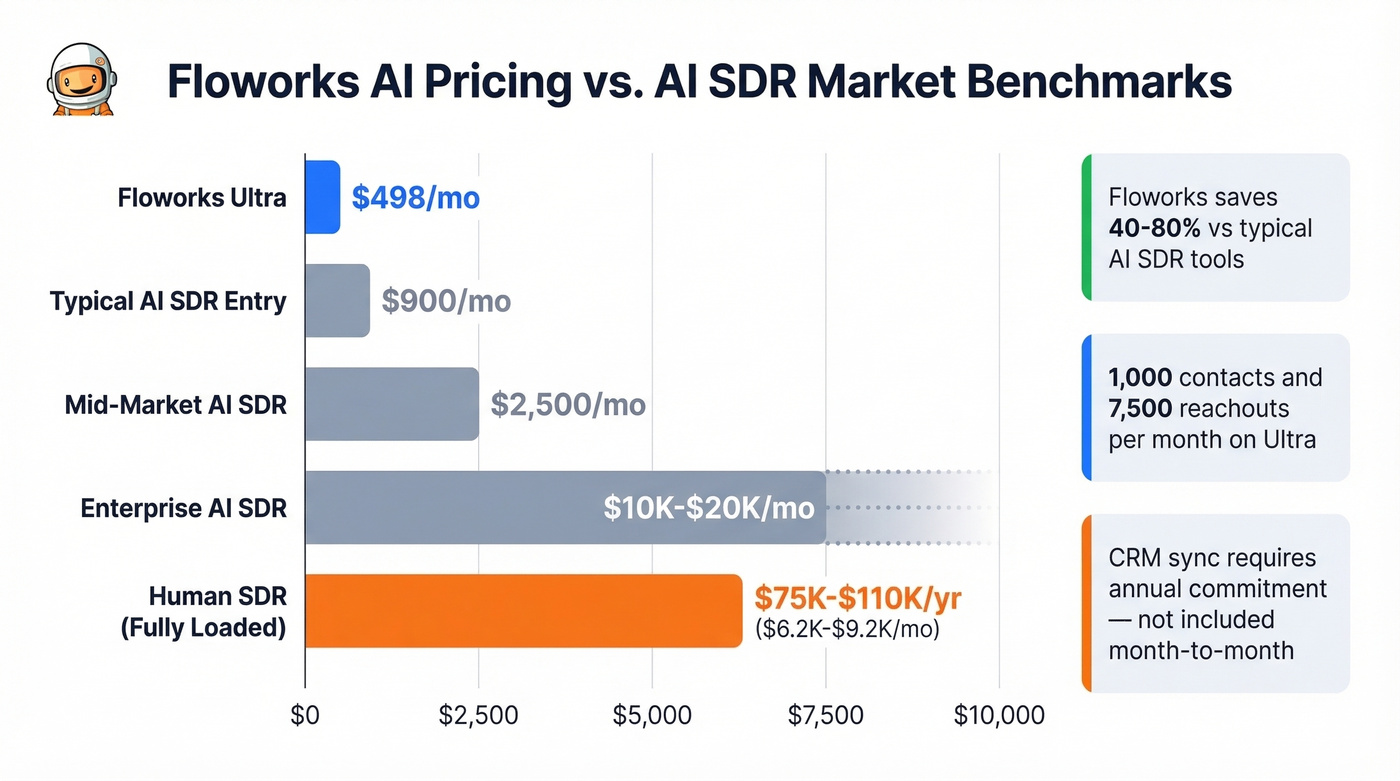
The Ultra plan is the one most buyers will evaluate. Autonomous AI SDR tools typically start around $900/month, with $2,500/month as a common mid-market anchor and enterprise plans reaching $10K-$20K/month. Floworks' own pricing page uses $2,500/mo as the "typical" anchor. At $498/mo, Ultra undercuts much of the category. For context, a fully loaded human SDR costs $75K-$110K/year.
One flag worth noting: CRM sync requires an annual commitment on both Pro and Ultra. You can run Ultra month-to-month, but without CRM integration, pipeline visibility takes a real hit.
The Pros
Personalization that actually works
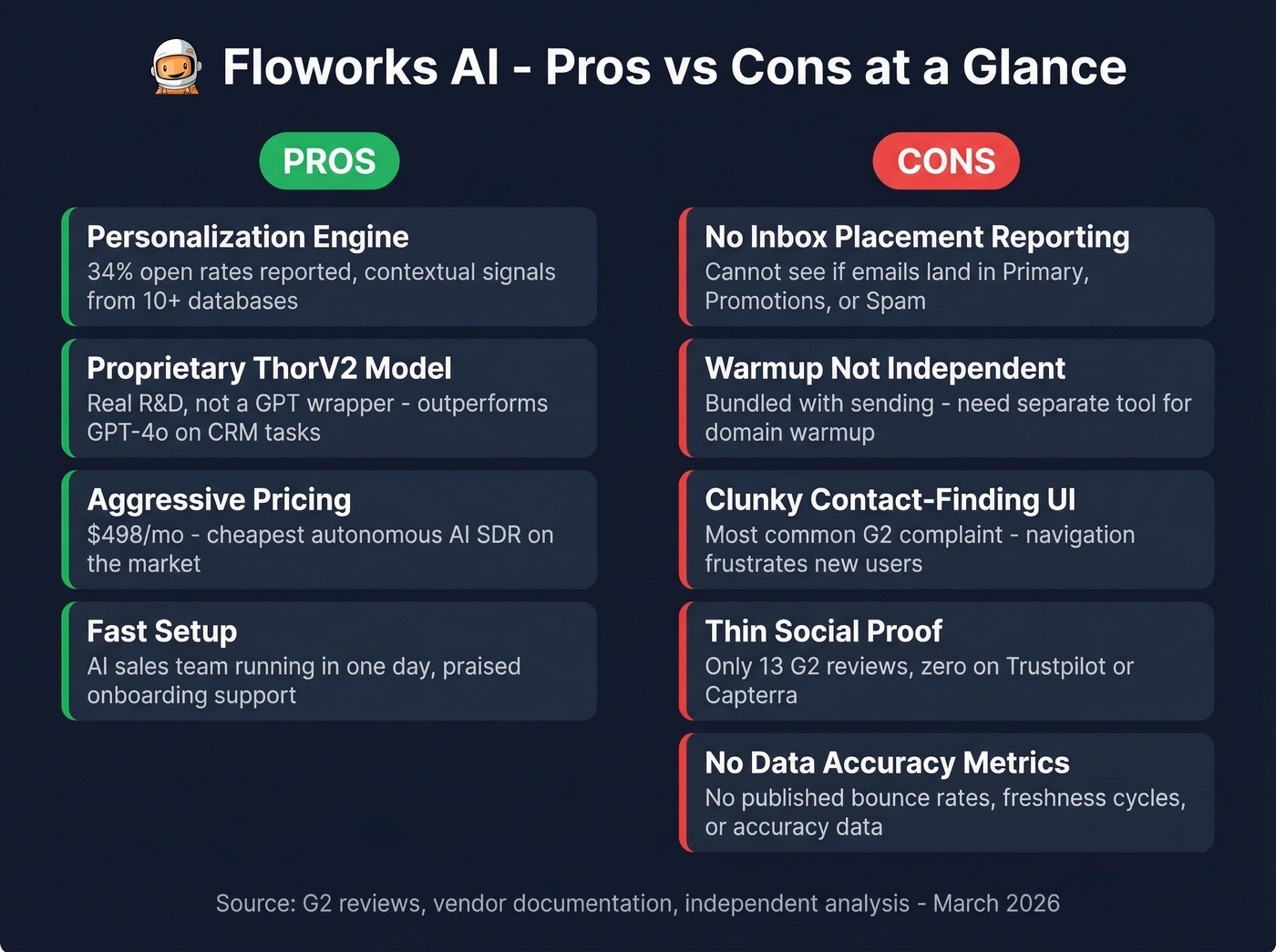
When we audited the G2 review sample, hyper-personalization was the most consistently praised feature. Alisha pulls contextual signals - recent activity, company news, role context - and the output reads noticeably better than most AI-generated cold emails. One user reported 34% open rates in a September 2024 G2 review, which is strong for cold outbound. If you're a founder-led team that needs quality copy fast without hiring a copywriter, this is the feature that'll sell you.
Real R&D, not a GPT wrapper
Floworks published a paper on ThorV2, their proprietary function-calling architecture. In their own benchmarks, ThorV2 outperformed GPT-4o and Claude-3 Opus on accuracy, reliability, and latency for HubSpot CRM function calling. That's a genuine technical differentiator - though it's still a vendor-authored benchmark, so take the specific numbers with appropriate skepticism.
Aggressive pricing
$498/mo is a low-end price point for autonomous agents. Period. For a startup with 2-3 reps, that's a testable bet, not a budget crisis.
Fast setup
Floworks claims you can have an AI sales team running in one day. G2 reviews praise ease of use and responsive support, which usually translates to faster onboarding than the 2-week pilot cycles some enterprise tools demand.

Floworks sends thousands of emails on your behalf but publishes zero data accuracy metrics. That's a gamble with your domain reputation. Prospeo gives you 143M+ verified emails at 98% accuracy on a 7-day refresh cycle - with 5-step verification including catch-all handling and spam-trap removal.
Don't let an AI SDR burn your domain with unverified data.
The Cons
No inbox placement reporting
You can't see whether your emails land in Primary, Promotions, or Spam. For a platform sending thousands of emails on your behalf, this is a serious blind spot. High bounce rates hurt domain reputation and lead to throttling and worse placement across your entire domain - not just the campaigns you're running through Floworks. In our experience, inbox placement reporting is the first thing teams regret not having once they scale past a few thousand sends per month.
Warmup isn't independent
Email warmup is bundled with outbound sending. You can't manage warmup separately, so if you need to warm a new domain before launching campaigns, you'll need a separate tool anyway. That's an extra cost and workflow that the pricing doesn't account for. (If you're comparing options, see unlimited warmup tools.)
Contact-finding UI needs work
The most consistent G2 complaint is the interface for finding and researching contacts. Navigation is clunky, and the AI-prompt-based lead research has a learning curve that frustrates new users. This isn't a dealbreaker, but it slows down the "running in one day" promise.
Thin, geographically skewed social proof
Floworks has 13 G2 reviews total: 10 from mid-market companies, 3 from small businesses, with reviews concentrated in Asia and skewing toward IT & services. Zero presence on Trustpilot or Capterra. We didn't find Floworks-specific threads on Reddit either, largely due to name collisions with "Flo" returning unrelated results. Broader AI SDR subreddit sentiment is skeptical - users consistently flag generic copy, deliverability anxiety, and hallucinated personalization as category-wide problems. For a tool managing your outbound reputation, that's a narrow validation base.
No published data accuracy metrics
Floworks doesn't publish database accuracy rates, freshness cycles, or bounce rate benchmarks. You're trusting a black box with your sender reputation. (If you need a baseline, start with data enrichment services and verification.)
CRM integration gated behind annual plans
Month-to-month evaluators won't get CRM sync. That limits the tool's value for any serious pipeline workflow and makes the "low-risk test" framing a bit misleading if you need full functionality to evaluate properly.
The Data Quality Problem
Here's the thing: in a category where only 2% of AI SDR implementations stick, and bad data is a primary driver of churn, running unverified contacts through an autonomous email engine is a recipe for domain damage. Floworks publishes no database accuracy metrics, no bounce rate data, no freshness cycle. That silence should make you nervous.

Independent verification is non-negotiable. Prospeo covers 143M+ verified emails at 98% accuracy on a 7-day refresh cycle, with 5-step verification that includes catch-all handling, spam-trap removal, and honeypot filtering. The workflow is simple: export your Floworks contacts as a CSV, run them through verification, strip the invalid addresses, and feed clean data back in. At roughly $0.01 per email, it's cheap insurance against torching your domain. (More on benchmarks and fixes in our email bounce rate guide.)
Most Teams Don't Need an Autonomous AI SDR Yet
Let's be honest - if you can't measure deliverability, you can't scale volume safely. And Floworks doesn't let you measure deliverability. The AI SDR category is exciting, but the infrastructure underneath most of these tools isn't mature enough for teams sending at real volume.
If your average deal size is modest and you're running a small team, you'll probably get more ROI from a solid sequencing tool like Smartlead or Instantly paired with verified data than from an autonomous agent you can't fully monitor. We've seen teams triple their pipeline just by fixing their data quality - no AI agent required. (If you're building a stack, compare outbound lead generation tools and SDR tools.)
90-Day Evaluation Framework
Don't sign up without defining these metrics upfront.
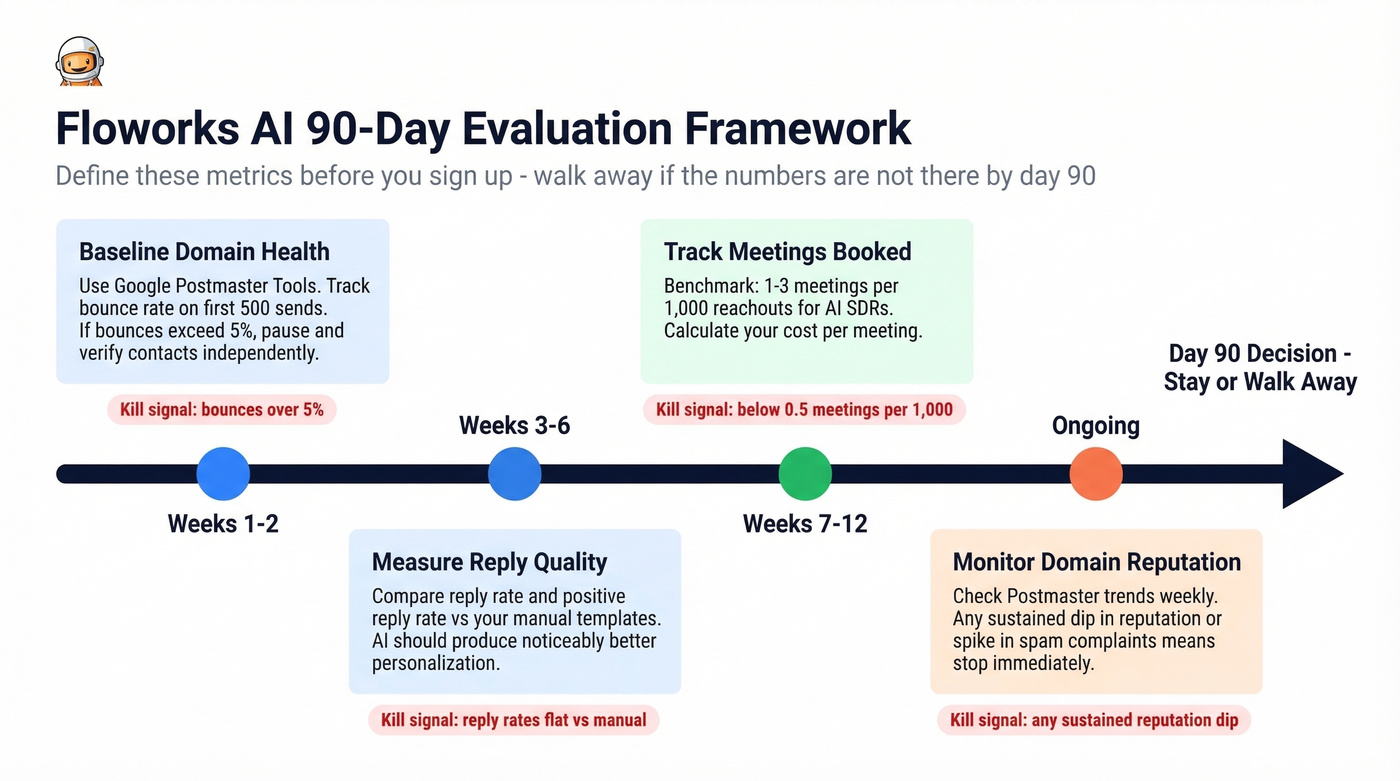
Weeks 1-2: Baseline your domain reputation using Google Postmaster Tools. Track bounce rate on the first 500 sends. If bounces exceed 5%, pause and verify your contact list independently before sending another email.
Weeks 3-6: Measure reply rate and positive reply rate. Floworks should produce noticeably better personalization than your manual templates. If reply rates are flat, the AI isn't adding value - it's just adding cost. (If you need copy help, start with sales follow-up templates.)
Weeks 7-12: Track meetings booked per 1,000 reachouts. Industry benchmarks for AI SDRs hover around 1-3 meetings per 1,000 reachouts. If you're below 0.5, kill it.
Ongoing: Monitor domain reputation signals weekly. Any sustained dip in Postmaster trends or spike in spam complaints means the tool is doing more harm than good, regardless of how many emails it's sending. (For a deeper checklist, see our email deliverability guide.)
Set a hard 90-day deadline. If the numbers aren't there, walk away. The $498/mo price makes this a low-risk experiment - but only if you actually measure.
The Bottom Line
Floworks is a legitimate option for startups testing AI outbound. The personalization engine is strong, ThorV2 is real technology, and $498/mo is genuinely cheap for an autonomous agent. But weighing the Floworks AI pros and cons honestly, the tool has real gaps in deliverability reporting, data transparency, and social proof that you can't ignore.
Regardless of which AI SDR you choose, pair it with dedicated data verification. Bad emails will tank your sequences faster than any AI can write them.
The article's biggest red flag: no inbox placement reporting and no published bounce rate data. Teams using Prospeo to verify contacts before sending see bounce rates drop below 4%. At roughly $0.01 per email, verification costs less than a single wasted send on a bad address.
Clean your contact list before your AI SDR touches it.
FAQ
Is Floworks AI worth $498/month?
For startups testing AI outbound, it's one of the cheapest autonomous AI SDRs available and the personalization engine genuinely outperforms most competitors. But pair it with verified contact data - Floworks publishes no database accuracy metrics, and unverified emails will burn your domain faster than you'd expect.
How does Floworks compare to other AI SDR tools?
Floworks undercuts most autonomous AI SDR tools on price by 40-80%. It's weaker on deliverability reporting than dedicated outbound platforms like Smartlead or Instantly, and strongest on email personalization and setup speed. The G2 review base is thin at 13 reviews concentrated in Asia, so independent validation is limited compared to more established tools.
What are the biggest drawbacks for startups?
No inbox placement reporting, no published data accuracy metrics, and CRM sync locked behind annual plans. The $498/mo price makes it a low-risk test, but set a 90-day evaluation window with clear metrics before committing further. Verify all contact data independently before feeding it into any autonomous sending tool.