

How to Write a Follow-Up Email After an Inquiry (With Templates)
You sent the quote three days ago. Silence. Now you're staring at a blank compose window, fingers hovering over the keyboard, about to type the five words that kill more deals than bad pricing: "Just following up on this."
In this r/sales thread, that exact vibe is what the OP is trying to avoid - because it reads as needy. Every follow-up email after inquiry needs to earn the reply. Not beg for one.
The Short Version
- Respond to the initial inquiry within 5 minutes. 78% of buyers go with the first company that responds. Speed beats polish.
- Send a maximum of 3 follow-ups - at 2-3 days, 5-7 days, and 10-14 days. Your first follow-up alone boosts reply rates by 49%.
- Every follow-up must add new information. "Just checking in" isn't a strategy. It's a confession that you've got nothing else to say.
Your Follow-Up Problem Is Actually a Speed Problem
Most people obsess over the perfect template when the real issue is response time. Responding to an inquiry within 5 minutes makes that lead 21x more likely to qualify compared to waiting 30 minutes. After an hour, qualification rates drop below 0.5%.
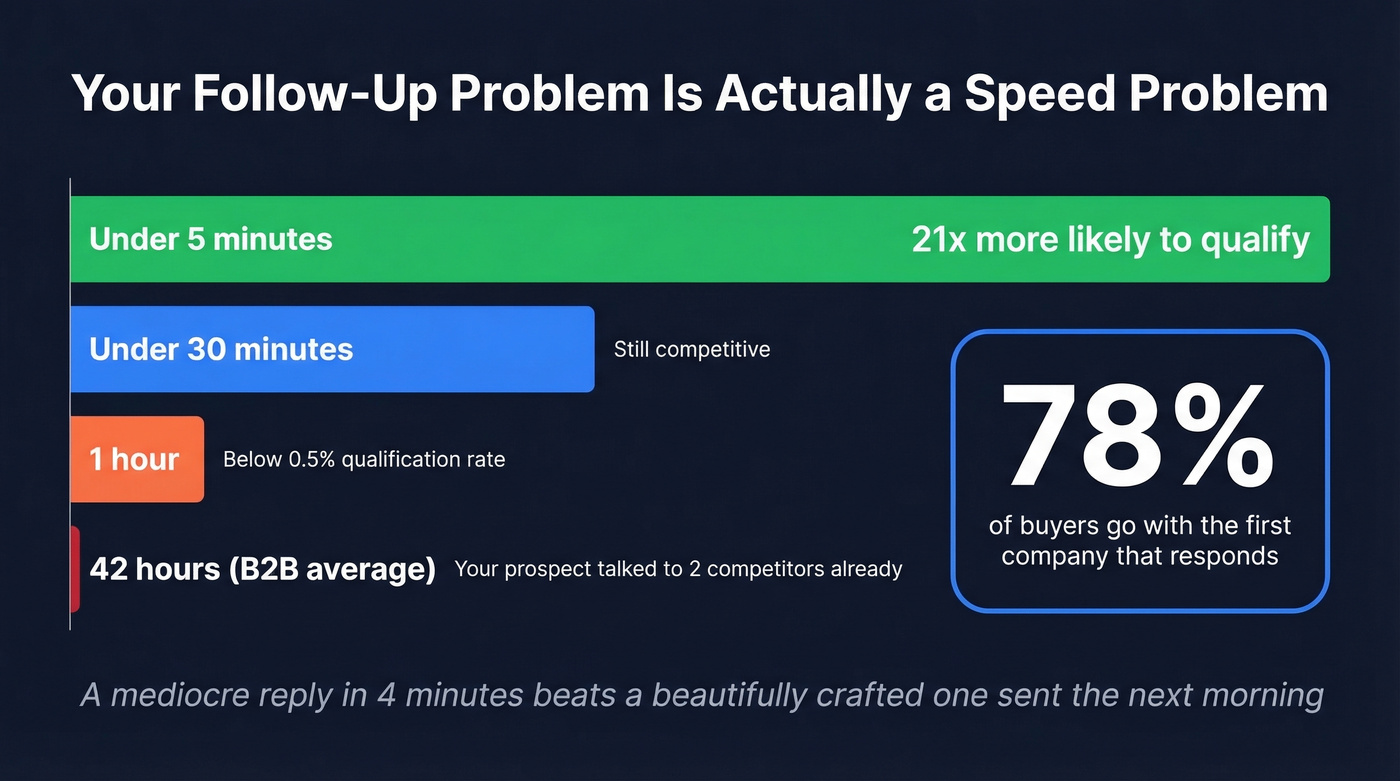
The average B2B company takes 42 hours to respond. By then, your prospect has talked to two competitors and forgotten your name.
Stop perfecting your follow-up copy and start cutting your initial response time. A mediocre reply in 4 minutes beats a beautifully crafted one sent the next morning.
When to Send Each Follow-Up
An analysis of 16.5 million emails found that a single email peaks at an 8.4% reply rate. Each additional follow-up shows diminishing returns, and sending 4+ emails more than triples unsubscribes and spam complaints. Three follow-ups is the hard cap.
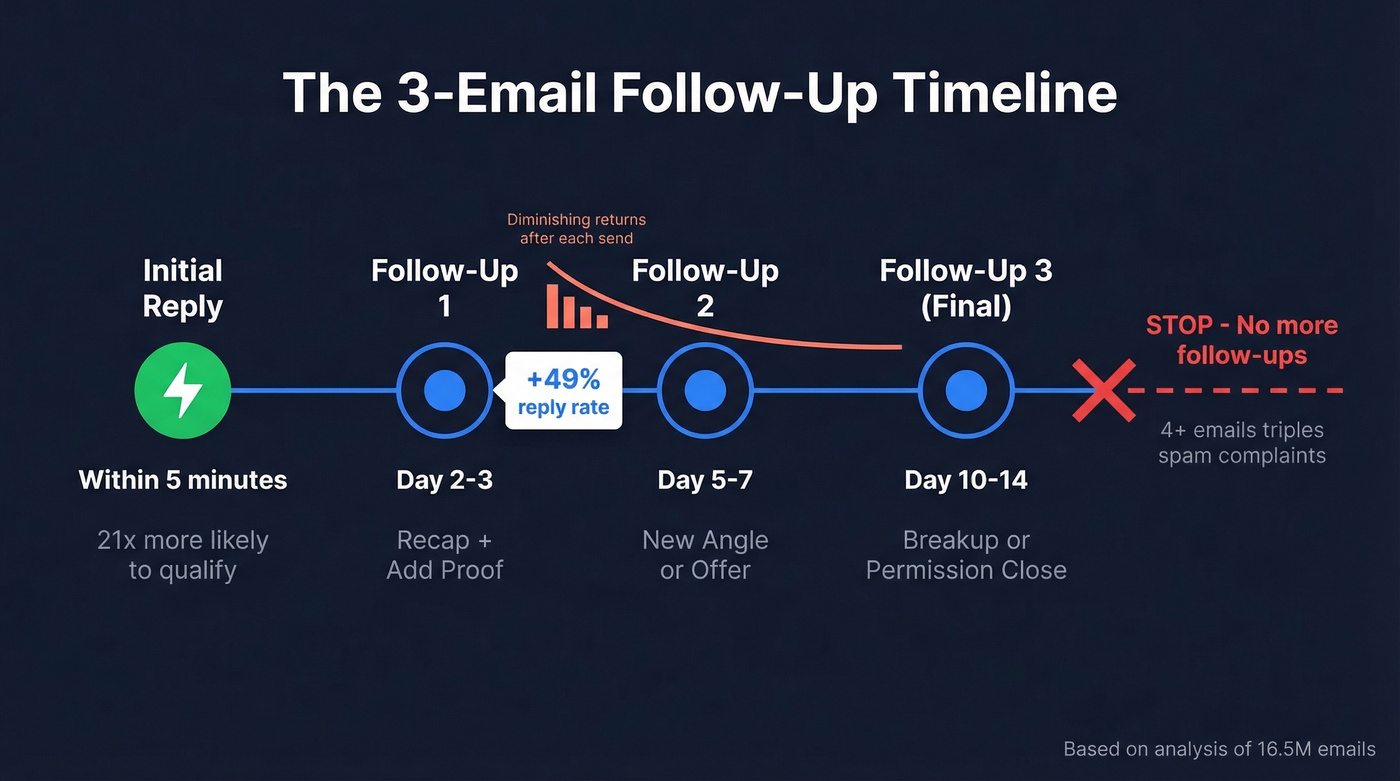
| Follow-Up | Timing | Purpose |
|---|---|---|
| #1 | 2-3 days | Recap + add proof |
| #2 | 5-7 days | New angle or offer |
| #3 | 10-14 days | Breakup / permission close |

Speed kills deals - but so does bouncing. If 35% of your follow-up emails never land, your timing doesn't matter. Prospeo's 98% email accuracy means your inquiry follow-ups actually reach the inbox, not a dead address.
Stop following up with email addresses that don't exist.
How to Structure a Follow-Up That Gets Replies
We've tested this across dozens of campaigns, and the framework that consistently works is dead simple: open with intent or a recap of their inquiry, add a value layer (case study, metric, pricing clarity), close with a single clear CTA, and write the subject line last. Structuring your follow-up email after inquiry around intent, value, and action is what separates replies from silence.
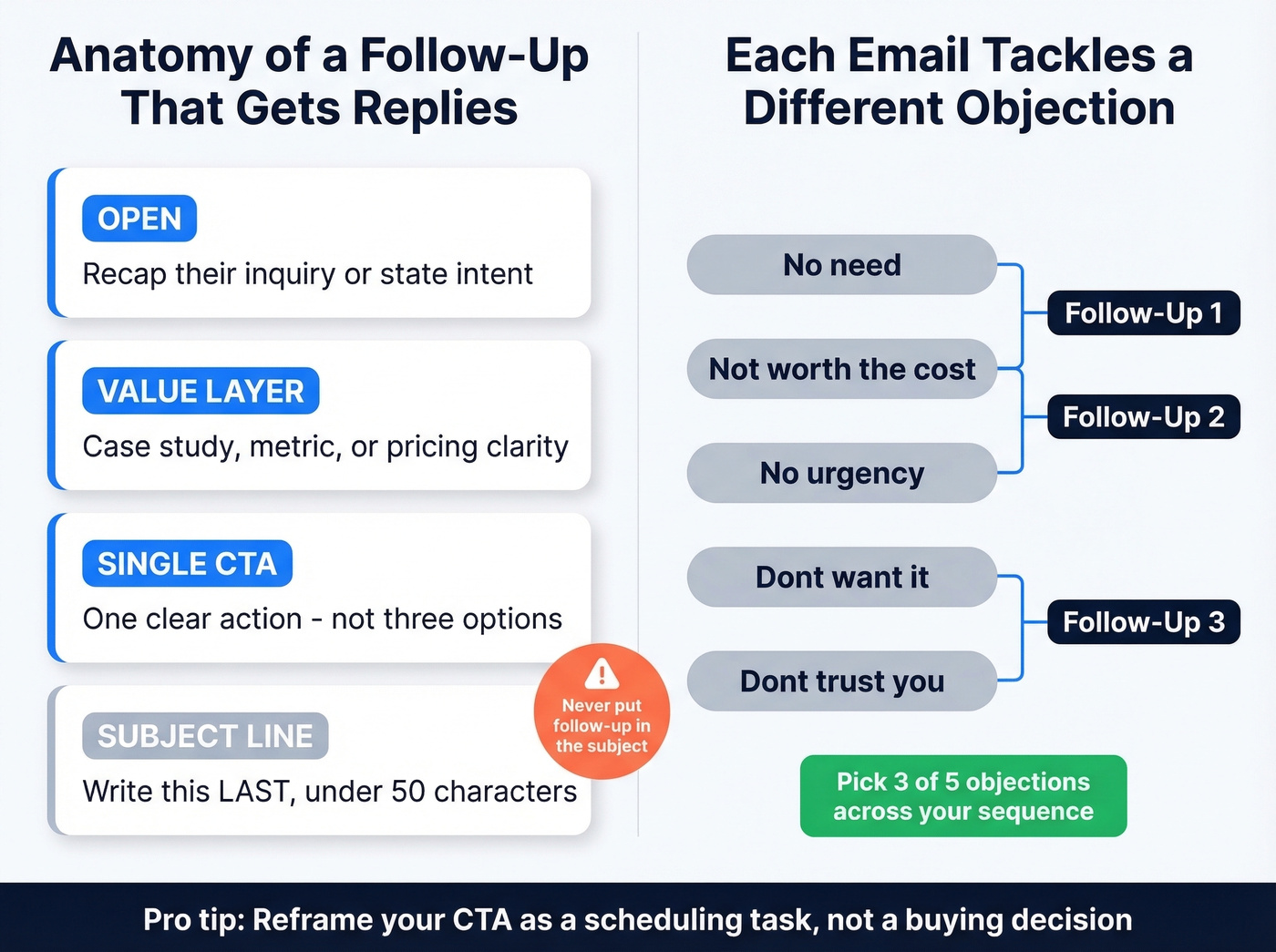
The real insight comes from GMass's analysis of follow-up mistakes: each follow-up should address a different objection. Their framework identifies five core objections - no need, not worth the cost, no urgency, don't want it, don't trust you. Your three follow-ups should tackle three of those.
If you want more options beyond these three touches, pull ideas from our follow-up templates and adapt them to the inquiry context.
For your CTA, steal the logistics angle from this r/sales thread: "I'm finalizing my schedule for next week - does Thursday or Friday work?" It reframes the reply as a scheduling task, not a buying decision.
If you're trying to avoid sounding like you're "just checking in," this guide on how to say just checking in professionally gives better phrasing patterns.
Subject Line Rules
Keep subject lines under 50 characters. Mobile clients truncate aggressively, and personalized subject lines boost opens by 26%+.
Never put "follow-up" in the subject line. It signals low-value content and increases ignore rates. Reply in the same email thread when possible - a "Re: ..." subject line gets opened because it looks like an ongoing conversation, not a cold touch.
Write the subject line last, after you've drafted the body. Clarity improves when you already know the message. Better alternatives: "I forgot to mention..." / "Quick question about [their company]" / "[Their company] <> [Your company]."
For more swipeable options, use these email subject line examples and keep the same "value-first" logic.
3 Inquiry Follow-Up Email Templates
Personalized follow-ups hit roughly 18% response rates versus 9% for generic templates. Every template below adds new value - never just "bumps" the thread.
Template 1 - First Follow-Up (2-3 Days)
Use when: Prospect opened your first email or clicked a link but didn't reply.
Subject: Quick thought on [their specific question]
Hi [Name],
Thanks for reaching out about [specific thing they asked]. I pulled together a quick example - [Company X] had a similar situation and saw [specific metric/result] within [timeframe].
Would it help to walk through how that'd apply to [their company]? I've got time Thursday or Friday afternoon.
[Your name]
Template 2 - Second Follow-Up (5-7 Days)
Use when: No engagement signals at all - they haven't opened or replied to anything.
Subject: One thing I should've mentioned
Hi [Name],
Wanted to share something I missed in our initial exchange - [new data point: pricing breakdown, ROI stat, or case study].
If budget timing is a factor, we also offer [flexible option]. Happy to send over the details.
[Your name]
Template 3 - Final Follow-Up (10-14 Days)
Use when: You've sent two follow-ups with no response and need to close the loop.
Subject: Should I close this out?
Hi [Name],
I don't want to crowd your inbox. If the timing isn't right, totally understand - just let me know and I'll follow up in [Q next quarter / 3 months].
If you're still interested, I can have a proposal ready by [date].
[Your name]
In our experience, this breakup email often gets the fastest replies of the three because it forces a simple yes/no decision. The 16.5M-email dataset backs stopping here - going beyond three follow-ups doesn't improve reply rates and actively damages your sender reputation.
If you're running this as part of a broader B2B cold email sequence, keep the same "new info per touch" rule so you don't train prospects to ignore you.
5 Mistakes That Kill Your Follow-Ups
1. "Just bumping this" with zero new information. If your first email didn't compel a reply, sending the same message again won't change the outcome. Instead: "Since we last spoke, I ran the numbers on [specific thing] - thought you'd want to see this."
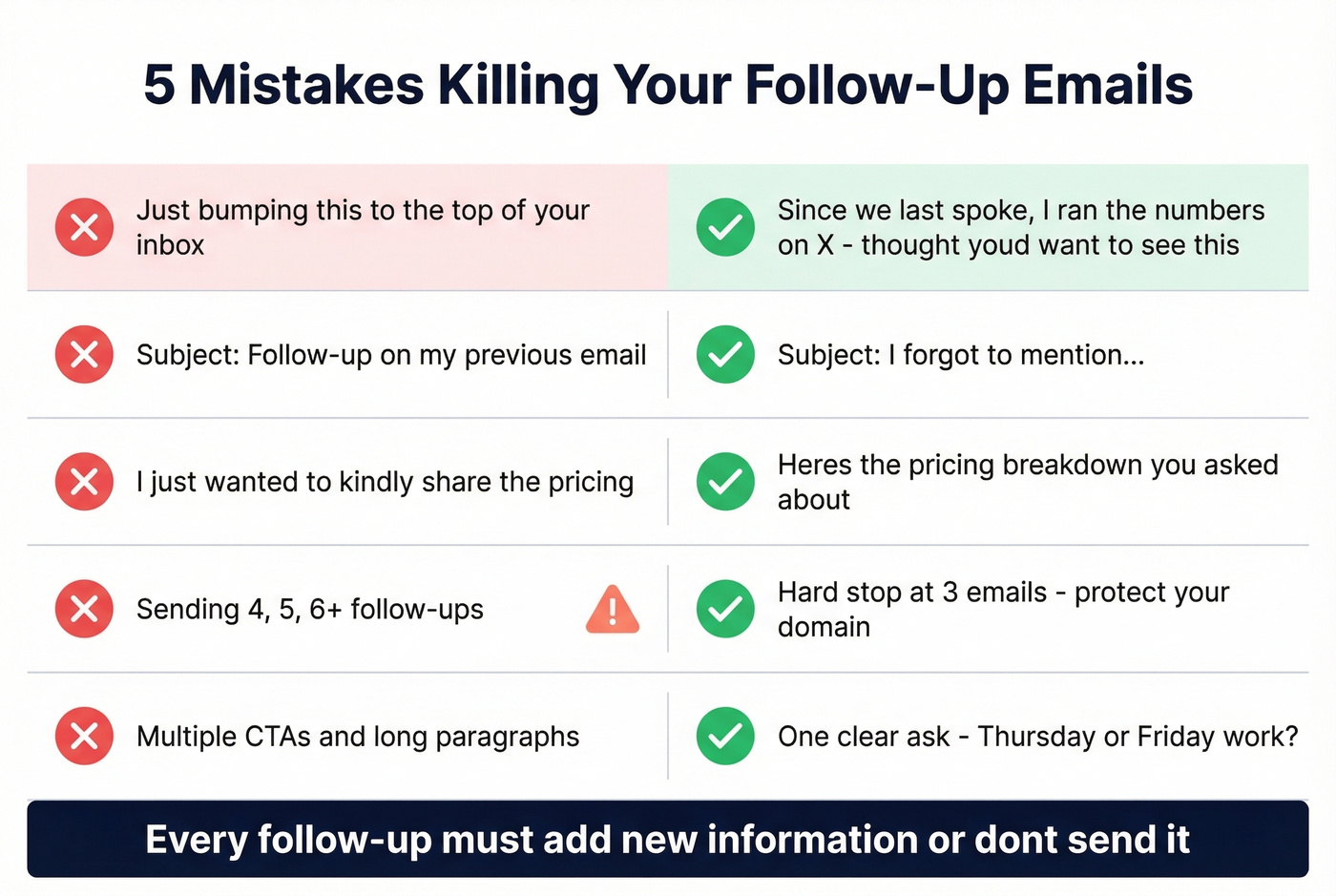
2. Using "follow-up" in the subject line. It screams "I have nothing new to say." Rewrite it: "I forgot to mention..." or "Thought of something for [company]."
3. Writing "kindly" or "just wanted to." "Kindly" lands as condescending in professional contexts, and "just wanted to" weakens your message by burying the point. Drop the softener entirely and lead with the substance. "Here's the pricing breakdown you asked about" beats "I just wanted to kindly share the pricing."
4. Sending 4+ follow-ups. That same 16.5M-email dataset is clear: four or more emails more than triples unsubscribes and spam complaint rates. Three is the ceiling. After that, you're hurting your domain reputation for a marginal chance at a reply that probably wasn't coming anyway. If you're seeing deliverability issues, start with the fundamentals in our email deliverability guide and then tighten your sending limits.
Let's be honest about one more thing: if your average deal is under $7k, you probably don't need more than two follow-ups. The third email's marginal return isn't worth the sender reputation risk at that price point. Save the persistence for enterprise deals where the payoff justifies it.
If you're tracking performance, benchmark against typical follow-up email reply rate ranges so you know whether it's messaging or list quality.
Three follow-ups is the hard cap - so every send has to count. Prospeo gives you 143M+ verified emails refreshed every 7 days, so you're never wasting a follow-up on stale data that bounces and tanks your domain reputation.
Protect your sender reputation with data that's never more than a week old.
FAQ
How many follow-ups should I send after an inquiry?
Three maximum. An analysis of 16.5 million emails shows that four or more follow-ups more than triples unsubscribes and spam complaint rates without improving reply rates. Space them at 2-3 days, 5-7 days, and 10-14 days.
How long should I wait before sending a follow-up email after inquiry?
Two to three days for the first, five to seven for the second, ten to fourteen for the final. Respond to the initial inquiry itself within five minutes - leads contacted that fast are 21x more likely to qualify.
What if my follow-up emails keep bouncing?
The address is probably invalid or outdated. Run contacts through a verification tool before sending - bad data kills sequences before they start. Prospeo's catch-all domain handling and 98% accuracy rate catch addresses that other tools miss.
What should I write instead of "just following up"?
Lead with new value: a relevant case study, a pricing detail you missed, or a specific data point about their business. "Since we last spoke, I ran the numbers on [X]" outperforms "just checking in" because it gives the prospect a reason to reply.