

How to Write a Follow Up Email After Meeting with a Potential Client
The meeting went perfectly. They nodded at the right moments, asked smart questions, said "this looks promising" - and then vanished for four days. You're refreshing your inbox like it owes you money.
Only 2% of deals close after a first meeting, so the follow up email after meeting with a potential client isn't optional. It's where the deal actually starts.
Here's the quick version: send within 24 hours, keep it 50-125 words, recap one specific thing from the meeting, include a concrete next step, and never write "just checking in." If they don't reply, follow the 3-7-7 cadence (Day 0, Day 3, Day 10, Day 17). And verify the email address before you hit send - a bounced follow-up after a great meeting is worse than silence.
What the Data Says
Belkins analyzed 16.5 million cold emails across 93 business domains and found a single email pulls an 8.4% reply rate. That's actually the high point - sending 4+ emails in a sequence triples unsubscribe rates and more than triples spam complaint risk. Zendesk puts the broader sales outreach response rate at 8.5%.
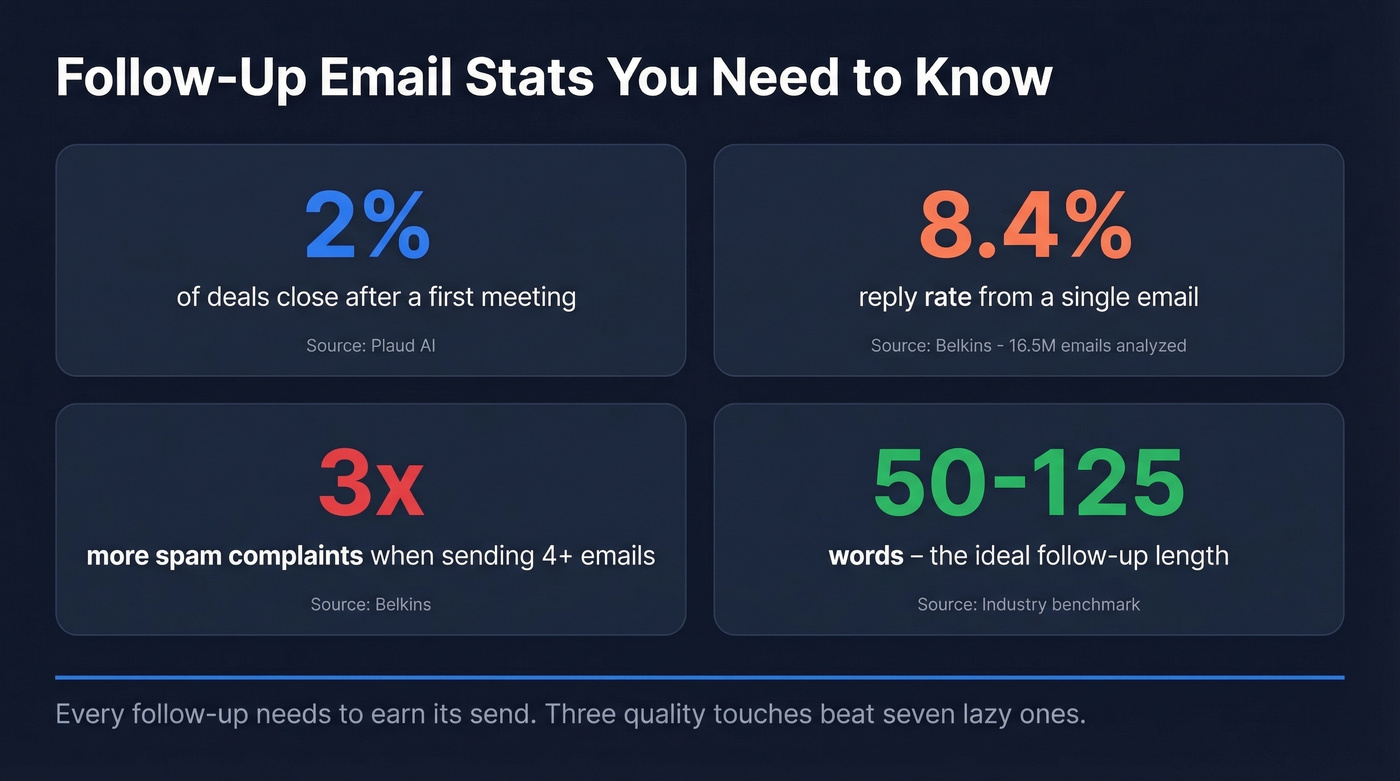
The takeaway isn't "don't follow up." It's that every follow-up needs to earn its send. Three quality touches beat seven lazy ones every time.
Anatomy of a Post-Meeting Follow-Up That Gets Replies
The structure that works mirrors what Dropbox recommends for any post-meeting email: Thank -> Value Recap -> Specific Next Step. No preamble, no filler.
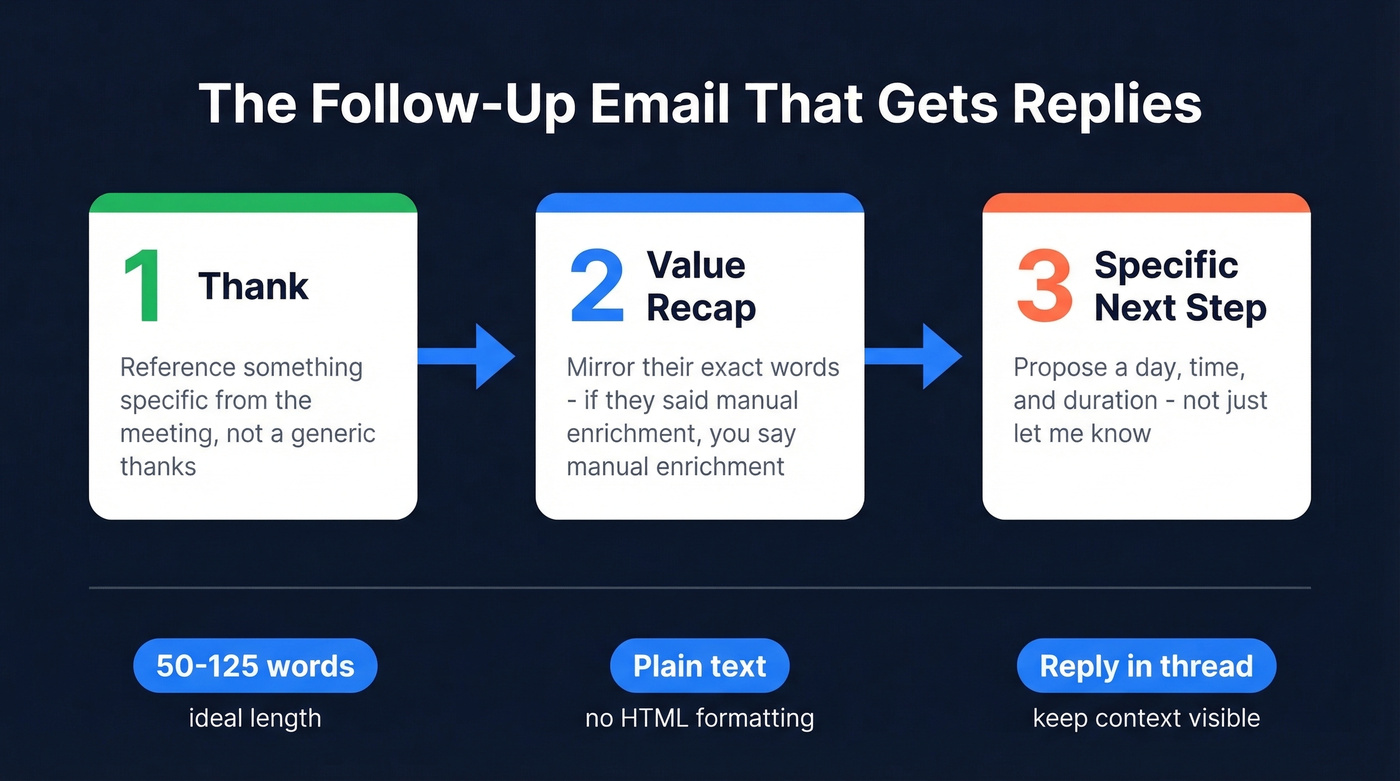
Keep it between 50 and 125 words. Anything longer and you're writing for yourself, not the prospect. The single best personalization move? Mirror the prospect's exact language from the meeting. If they said "we're drowning in manual enrichment," your follow-up should say "manual enrichment" - not "data hygiene challenges."
Always send as a reply in the same thread. It keeps context visible and avoids the "new email from a stranger" problem. Plain text, no HTML formatting - your follow-up should look like a real email, not a marketing blast.
5 Templates for Every Post-Meeting Scenario
Stop obsessing over the perfect template. The reason your follow-ups don't work isn't the wording - it's that you're emailing the wrong person, at the wrong address, with nothing new to say. Templates get you started. Cadence and verification are what close deals.
If you want more options beyond these, start with our sales follow-up templates and adapt them to the meeting context.
Each follow-up should address a different reason the prospect hasn't responded. GMass identifies five objection buckets: no need, value unclear, no urgency, don't want it, or don't trust you. The templates below map to the most common scenarios and the objection behind each.
After a Discovery Call
Objection addressed: Value unclear - they're not sure you understand their problem.
Subject: Next steps on [their specific pain point]
Hi [Name],
Thanks for the conversation today. The challenge you described around [specific pain point in their words] is exactly what we've helped [similar company type] solve.
I'd love to walk you through how that would work for your team. Does [specific day] at [time] work for a 30-minute demo?
Best, [You]
After a Demo or Presentation
Objection addressed: No urgency - they liked what they saw but aren't feeling the push.
Here's the before/after on this one. Most reps send a generic "thanks for your time" recap. The version that works anchors on the moment they leaned in.
| ❌ Generic version | ✅ Anchored version |
|---|---|
| "Thanks for the demo today. Let me know if you have questions." | "Great demo today. I noticed you had the strongest reaction when we showed [specific feature]. I've attached a case study that goes deeper on that exact workflow." |
Subject: The [feature they reacted to] piece - quick resource
Hi [Name],
Great demo today. I noticed you had the strongest reaction when we showed [specific feature]. I've attached a [case study / one-pager] that goes deeper on that exact workflow.
Worth a 15-minute call Thursday to map this to your setup?
[You]
After Sending a Proposal
Objection addressed: Value not worth cost - they're weighing the numbers.
Don't write "did you get my proposal?" Give them something new instead.
Subject: Quick thought on [their specific challenge]
Hi [Name],
While putting together your proposal, I ran across a case study from [similar company] that's eerily close to your situation - they cut [metric] by [number]. Attached.
Happy to walk through how those numbers would translate for [their company]. Free Wednesday afternoon?
[You]
Why this works: You're not asking if they read the proposal. You're giving them a reason to believe the numbers in it.
The No-Response Value-Add
This is where most reps default to "just bumping this to the top of your inbox." Don't. The "finalize my schedule" framing below comes straight from a r/sales thread - it works because it gives the prospect a reason to respond that isn't about you.
Subject: Trying to finalize my calendar for next week
Hi [Name],
I'm locking in my schedule for next week and wanted to see if [day] works for you. In the meantime, here's a [testimonial / article / ROI calculator] that's relevant to what we discussed.
If timing's off, just let me know - happy to revisit in [timeframe].
[You]
The Breakup Email
The most underused tool in sales. Permission-to-close framing triggers loss aversion, and in our experience, breakup emails generate more replies than the two emails before them combined.
Subject: Should I close this out?
Hi [Name],
I haven't heard back, so I'm guessing the timing isn't right. Totally fine - I'll close out my notes on this for now.
If things change, I'm a reply away.
[You]

Your follow-up templates are useless if they bounce. Prospeo verifies emails with 98% accuracy through a 5-step verification process - catch-all handling, spam-trap removal, and honeypot filtering included. One bounced follow-up after a promising meeting costs you more than any tool ever will.
Verify your prospect's email before you send that follow-up.
Subject Lines That Work
Never put the word "follow-up" in your subject line. NetHunt calls this out specifically - it signals "I have nothing new to say." Keep subject lines to 6-10 words, since 60%+ of emails open on mobile and anything longer gets truncated.
If you need more ideas, pull from these email subject line examples and tailor them to the meeting.
| Do This | Not This |
|---|---|
| Reference the meeting topic | "Following up" |
| Add new value | "Just checking in" |
| Create curiosity | "Circling back" |
| Keep under 10 words | Write a full sentence |
Subject lines worth stealing:
- Meeting recap: [Topic] - [Date]
- I forgot to mention...
- Quick thought on [their specific challenge]
- The [feature] piece we discussed
- Should I close this out?
- [Mutual connection] suggested I send this
- Trying to finalize my calendar
- One thing I missed on [topic]
The 3-7-7 Follow-Up Cadence
Here's the framework we've seen work best for post-meeting follow-ups: the 3-7-7 cadence. Send your first follow-up on Day 0 - within 24 hours of the meeting. Follow up again on Day 3. Then Day 10. Then Day 17, which is your breakup email.
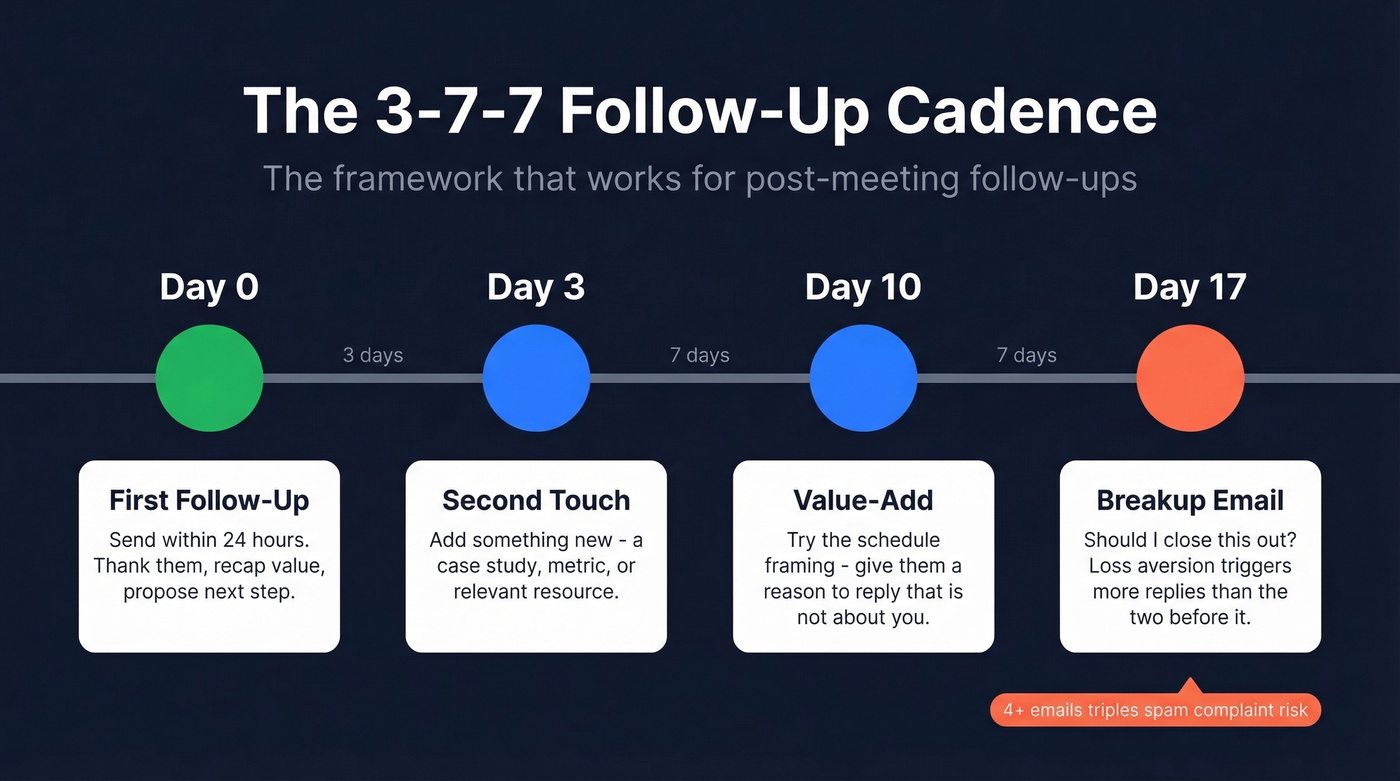
This aligns with Outreach's benchmark of 8-12 touchpoints over 17-21 days. But for post-meeting sequences specifically, three quality follow-ups is the sweet spot. Pushing past four emails triples unsubscribe rates and more than triples spam complaint risk - and a spam complaint from a prospect you already met is a relationship killer.
Let's be honest about the AI meeting tools pushing transcript-based follow-up drafts right now. They're fine for a first draft. They still fail if the email bounces. The cadence matters less than whether your message actually arrives.
If you're building sequences at scale, a dedicated follow up email software tool can help you stay consistent without spamming.
3 Mistakes That Kill Your Reply Rate
Look, most follow-ups don't fail because of bad writing. They fail because of bad infrastructure. We've watched teams agonize over word choice while sending to dead email addresses.
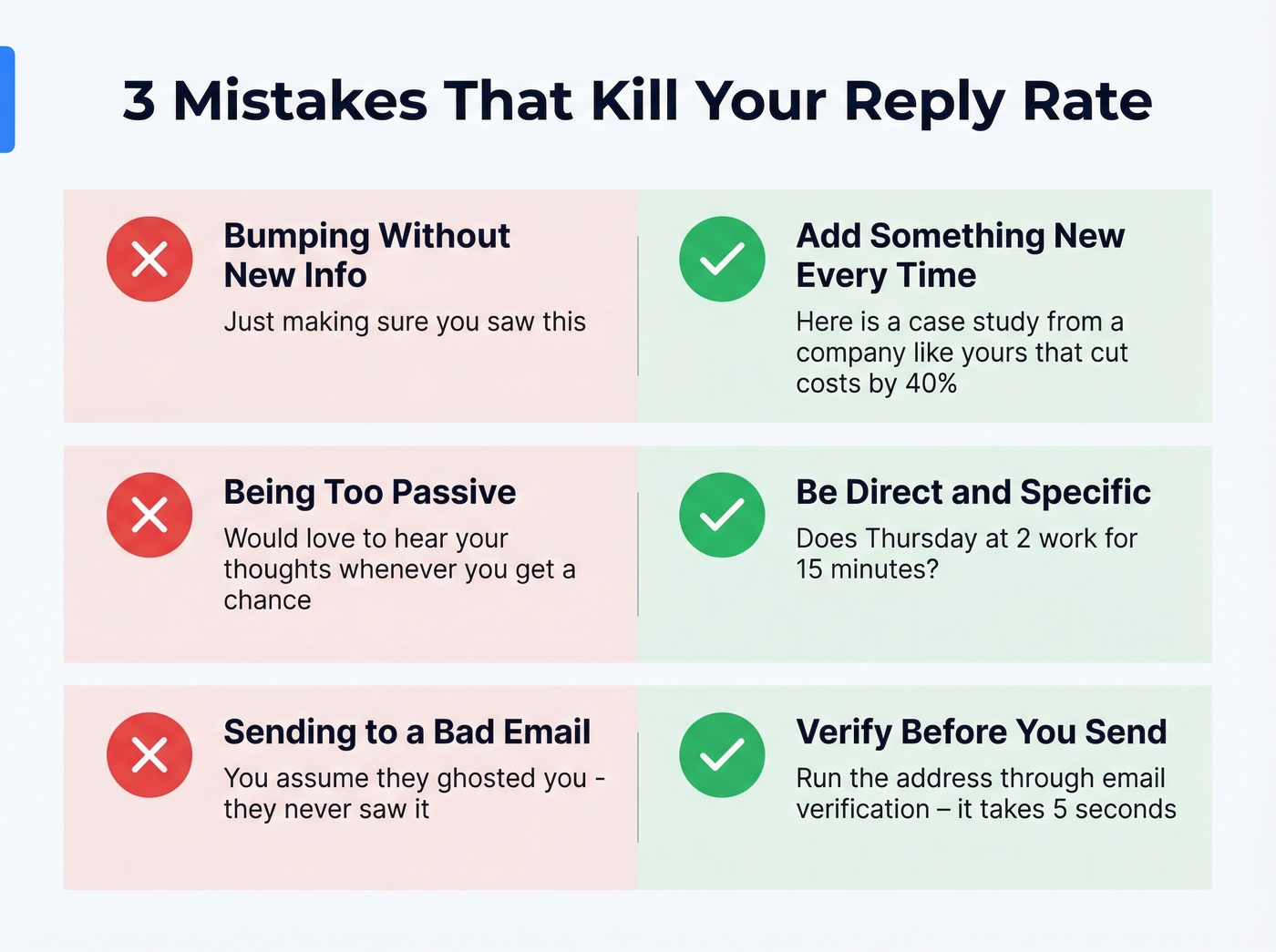
1. Bumping without new information. "Just making sure you saw this" tells the prospect you have nothing new to offer. Every follow-up should contain something they didn't have before - a case study, a relevant metric, a new angle on their problem.
If you catch yourself writing "just checking in," use these alternatives from how to say just checking in professionally.
2. Calibrating tone wrong. There's a thread on r/Accounting where the poster admits their follow-ups are "too polite (doormat-ish)" and clients take months to respond. Being professional doesn't mean being passive. "Would love to hear your thoughts whenever you get a chance" is weaker than "Does Thursday at 2 work?"
3. Sending to a bad email address. This is the invisible deal-killer nobody talks about. Your follow-up bounces, you assume the prospect ghosted you, and momentum dies. They didn't ghost you - they never saw it. Run the address through Prospeo's email verification before you send. It takes seconds, catches spam traps and honeypots with 98% accuracy, and the free tier covers 75 verifications per month - more than enough for every prospect you meet with.
If you're troubleshooting deliverability, start with email bounce rate benchmarks and fixes, then work through a full email deliverability guide.
The best follow-up cadence fails when you're emailing the wrong person. Prospeo gives you verified emails and direct dials for 300M+ professionals - refreshed every 7 days, not 6 weeks. Find the decision-maker's real contact info at $0.01 per email, no contracts.
Stop refreshing your inbox - start reaching the right one.
FAQ
How long should I wait to send a follow up email after meeting with a potential client?
Send your first follow-up within 24 hours of the meeting - same business day if possible. After that, follow the 3-7-7 cadence: wait 3 days for the second touch, then space follow-ups 7 days apart. Your breakup email lands around Day 17.
How many follow-up emails is too many?
Three quality follow-ups is the sweet spot for post-meeting sequences. The 16.5M-email dataset from Belkins shows that 4+ emails triples unsubscribe rates and more than triples spam complaint risk. End your sequence with a breakup email - "Should I close this out?" - which often generates more replies than the emails before it.
What should I do if my follow-up email bounces?
A bounced follow-up kills deal momentum and hurts your sender reputation. Verify the address before sending - your CRM data may be stale, or the prospect gave you a secondary address. Skip this step if you're 100% certain the address is current (you just received an email from it, for example), but for anything older than a few weeks, verification is worth the five seconds it takes.