

How to Follow Up After Sending a Quote (Without Sounding Desperate)
You sent the quote. You refreshed your inbox six times before lunch. Nothing. By day three, you're drafting a "just checking in" email you already know won't work.
48% of reps never send a second message, yet follow-ups generate 42% of all campaign replies. The reps who write a strong follow up email after quote delivery win deals. The ones who follow up well win more.
Here's the deal: your first touch should land on day 2-3, with a second at day 5-7, and a final attempt at day 10-14. Every message must add new information - a case study, a reframed objection, a deadline. Never "just checking in." If you're getting ghosted consistently, the problem might be your quote, your contact data, or the wrong recipient - not your persistence. Templates and the full cadence are below.
Why Prospects Go Silent After a Quote
Silence after a quote feels personal. It isn't. The prospect didn't ghost you because they hate you - they ghosted because one of these things is happening:
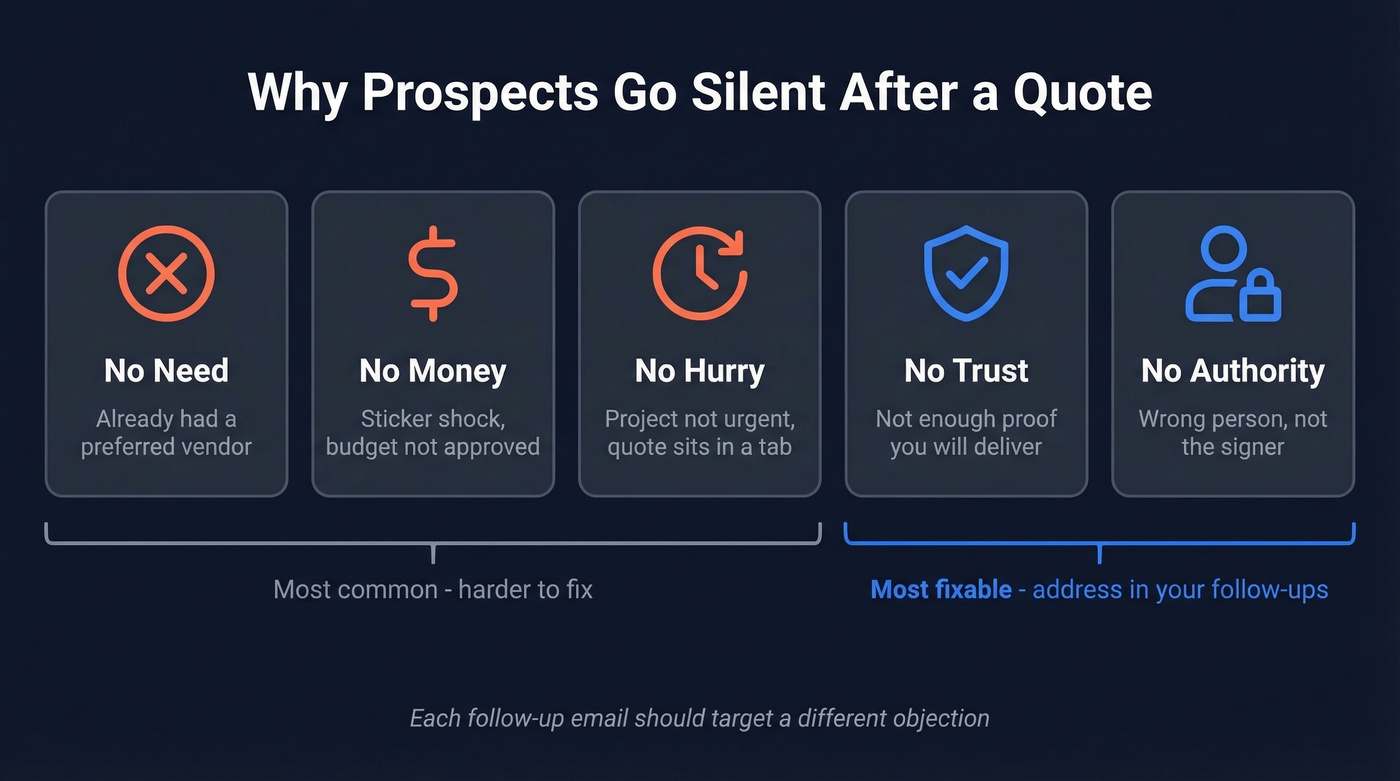
- No need - they were comparison shopping and already had a preferred vendor.
- No money - the number was higher than expected and they don't know how to say that.
- No hurry - the project isn't urgent, so your quote sits in a tab they'll "get to later."
- No trust - they don't have enough proof you'll deliver.
- No authority - the person you quoted isn't the person who signs.
The first three are the most common. The last two are the most fixable. Each message in your sequence should address a different one of these objections - not just repeat "hey, any update?"
Here's the contrarian take most follow-up guides skip: the follow-up isn't the problem. The quote is. If you're consistently ghosted, look at the quote itself. Is the pricing clear? Is there a next step? Is there any urgency? Did it even go to the right person? I've watched teams obsess over follow-up copy while sending quotes with no clear call to action, no expiration date, and no ROI framing. That's not a follow-up problem - it's a quote problem. Fix the quote and you'll need fewer follow-ups.
The Follow-Up Cadence
Three follow-ups is the sweet spot. After that, you're not persistent - you're annoying.
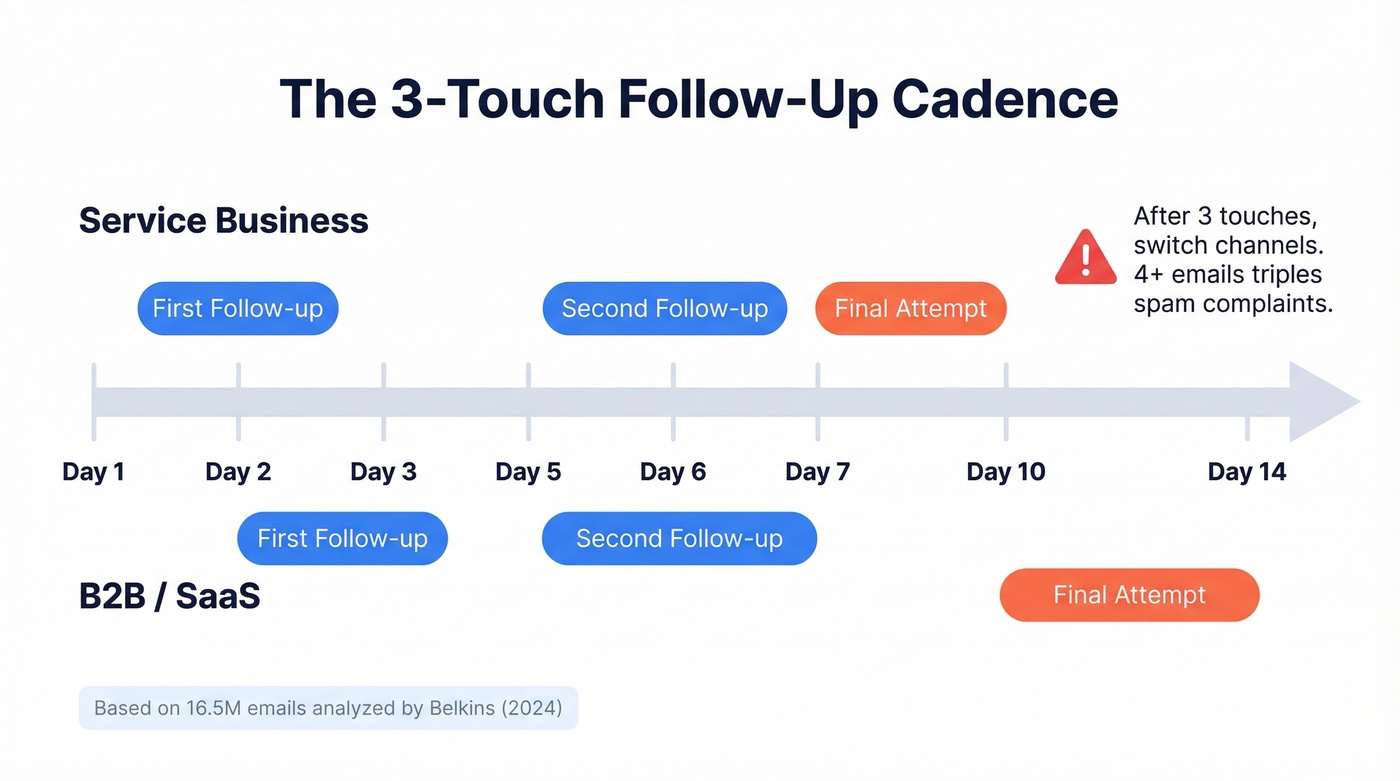
Belkins analyzed 16.5M cold emails (Jan-Dec 2024) and found the highest reply rate (8.4%) comes from the first email alone. Performance steadily declines with each additional touch, and sending 4+ emails in a sequence more than triples unsubscribe and spam complaint rates.
The right cadence depends on what you're selling:
| Touch | Service Business | B2B / SaaS |
|---|---|---|
| First follow-up | Day 2 | Day 2-3 |
| Second follow-up | Day 6 | Day 5-7 |
| Final attempt | Day 7-10 | Day 10-14 |
Company size matters too. Small businesses with 2-50 employees tolerate more touches - reply rates hold at 9.2% to 8% to 8.4% across the first three emails. Enterprise buyers tolerate fewer, so make every message count.
We've seen teams run five or six follow-ups on enterprise deals and wonder why their domain reputation tanks. Three emails, then switch channels. That's the rule.
7 Templates That Actually Get Replies
Each template maps to a specific scenario. Copy, customize, send.
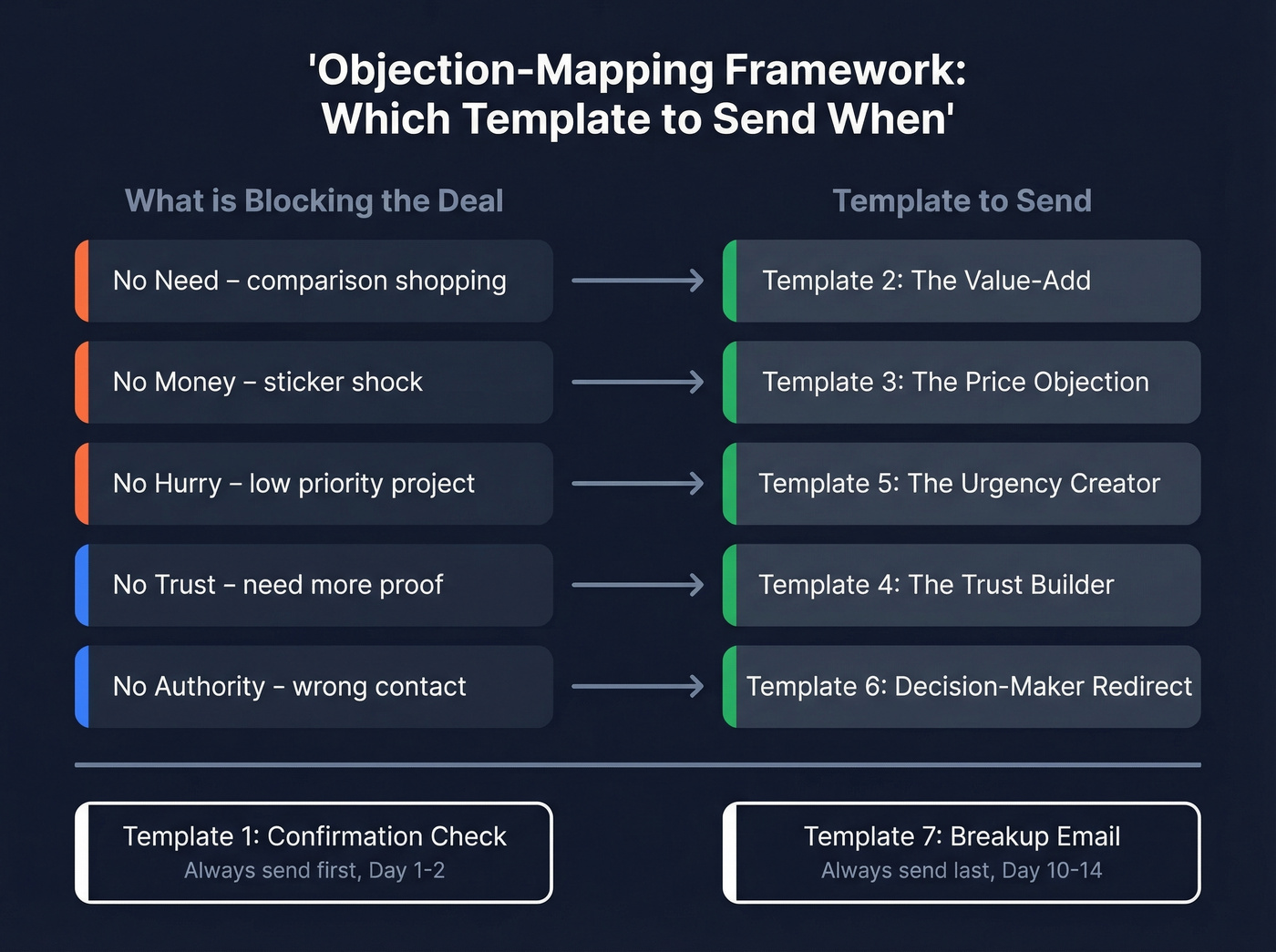
Template 1: The Confirmation Check (Day 1-2)
Scenario: You just sent the quote and want to confirm receipt.
Subject: Quick question on the proposal
Hi [Name],
Wanted to make sure the quote I sent [day] came through - I know attachments can be finicky. If you have any questions about the scope or pricing, happy to jump on a quick call.
[Your name]
Low-pressure, gives them an easy reason to reply ("yes, got it"). Don't overthink this one.
Template 2: The Value-Add (Day 2-3)
Scenario: No response yet. Time to add something they didn't have before.
Subject: [Company name] + [relevant result]
Hi [Name],
Since I sent the quote, I pulled a quick case study from a similar [industry/company size] client - they saw [specific result, e.g., "a 34% reduction in onboarding time"] within the first 90 days.
Thought it might help as you're evaluating. Happy to walk through the numbers if useful.
[Your name]
New information resets the conversation. You're not "checking in" - you're giving them something. This is the single most important template in the sequence. If you only send one follow-up after delivering a proposal, make it this one.
Template 3: The Price Objection (Day 3-5)
Scenario: You suspect sticker shock is the holdup.
Subject: Making the numbers work
Hi [Name],
I know pricing is always part of the conversation. One thing worth flagging: [specific ROI framing, e.g., "teams using our platform typically recover the annual cost within 2-3 months through reduced churn"].
If budget is a concern, I have a couple of options that might fit better. Worth a 10-minute call?
[Your name]
When to skip this: If your quote was already the lowest bid, price isn't the issue. Jump to Template 4 instead. But if you quoted above market - or if you didn't include any ROI framing in the original quote - this is your chance to reframe price as investment. Don't discount. Reframe.
Template 4: The Trust Builder (Day 5-7)
Scenario: They need social proof before committing.
Subject: What [similar company] said after 6 months
Hi [Name],
Totally understand if you're still weighing options. [Client name] was in a similar spot - they went live in [timeframe] and hit [specific metric]. I can connect you with their team if that'd help.
Either way, the quote is valid through [date].
[Your name]
Third-party validation is more persuasive than anything you can say about yourself. The offer to connect them directly with a reference customer is the power move here - most reps never make it.
Template 5: The Urgency Creator (Day 7-10)
Scenario: You have a legitimate deadline, capacity limit, or seasonal factor.
Subject: Heads up on timing
Hi [Name],
Quick flag - [specific urgency: "our implementation team is booking into Q3" / "pricing holds through the 15th" / "we're capping new onboards this month at 5"]. Didn't want you to miss the window if this is still on your radar.
[Your name]
Urgency-based follow-ups consistently outperform generic check-ins, but only when the deadline is real. Manufactured scarcity - "this offer expires Friday!" when it doesn't - destroys trust faster than silence. If you don't have a genuine deadline, skip this template entirely.
Template 6: The Decision-Maker Redirect (Day 7-10)
Scenario: You suspect you're emailing the wrong person.
Subject: Should I loop in anyone else?
Hi [Name],
I know these decisions sometimes involve other stakeholders. If it'd be helpful, I'm happy to send a summary to your CFO or procurement lead so they have the context they need.
Just let me know who else should be in the loop.
[Your name]
CC'ing the actual buyer is one of the highest-leverage moves in a stalled deal. This email gives the prospect permission to bring in the decision-maker without feeling bypassed. Let's be honest - half the time the person who requested the quote doesn't have signing authority, and everyone involved knows it but nobody says it out loud.
Template 7: The Breakup Email (Day 10-14)
Scenario: Final attempt. Give them an easy out.
Subject: Should I close this out?
Hi [Name],
I haven't heard back, so I'm guessing the timing isn't right. Totally fine - I'll close out my follow-up on this.
If anything changes, the quote is here whenever you're ready. No hard feelings either way.
[Your name]
The breakup email is one of the highest-converting messages in the entire sequence. Removing pressure paradoxically brings people back. Give someone an exit and they'll often walk through the door instead.

Half the time your quote is sitting in the inbox of someone who can't sign it. Prospeo's 300M+ profile database with 30+ filters - including job title, seniority, and department - lets you find the actual decision-maker before you send the quote, not after three follow-ups go unanswered.
Stop following up with the wrong person. Start with the right one.
Subject Lines That Drive Opens
We analyzed the full 5.5M-email dataset in our subject line guide - here are the highlights for post-quote scenarios.
Personalized subject lines hit a 46% open rate and 7% reply rate, compared to 3% reply for generic ones. The sweet spot is 2-4 words. Open rates drop after 7. Front-load your key message into the first 33 characters - that's all most mobile clients display.
Never put "follow-up" in your subject line. It screams "I'm nagging you." We've tested dozens of formats, and the ones that work read like a colleague wrote them, not a marketer.
Five subject lines that work for post-quote scenarios:
- Quick question on the proposal
- [Company name] + [specific result]
- Making the numbers work
- Heads up on timing
- Should I close this out?
One caveat on open rates: Apple Mail Privacy Protection inflates opens by roughly 18 points, and Apple Mail accounts for about 46% of email clients. Track reply rates instead - that's the metric that actually correlates with revenue.
Mistakes That Kill Your Follow-Up
"Just checking in." If your message says this, you've already lost. It adds zero value and signals you have nothing new to offer. Same goes for "touching base," "circling back," and "bumping this to the top of your inbox." The consensus on r/sales is that these phrases are the fastest way to get archived.
Sending the same email twice. Each touch must add new information - a case study, a reframed objection, a deadline. If you can't think of something new to say, you're not ready to send. (If you need more angles, borrow from these sales follow-up templates.)
Over-emailing. The 16.5M-email dataset is clear: 4+ emails in a sequence more than triples spam complaints. Three touches, then switch channels or send the breakup.
Writing novels. Your follow-up should be readable in under 30 seconds. Cut "I hope you are doing well" and every other filler sentence. Get to the point.
Ignoring bad contact data. Look - one underrated reason for silence is that the email never arrived. 17% of cold emails never reach the inbox, which means your carefully crafted message might be going to a dead address. Prospeo refreshes contact records every 7 days - compared to the 6-week industry average - so the email you pull today is still valid tomorrow. (If deliverability is a recurring issue, start with an email deliverability guide.)
Verify Before You Follow Up
Before you send another word, run through this checklist.
Use tracking signals. If you're using a proposal tool like PandaDoc, check whether the quote was actually opened. No opens after 48 hours? The email might not have landed. (If you're relying on opens, understand how an email tracking pixel works.)
Confirm the decision-maker. Are you emailing the person who signs, or the person who requested the quote? These are often different people. If you're not sure, Template 6 solves this. (This is also where MEDDPICC economic buyer thinking helps.)
Verify the email address. Use a verification tool to confirm the address is valid before you waste another message on a dead inbox. Prospeo checks emails in real time with 98% accuracy and flags catch-all domains, so you're not sending into a void. (If you want a deeper workflow, see how to check if an email exists.)
Most follow-up guides assume the email was delivered. That's a dangerous assumption when nearly one in five cold emails never hits the inbox.
When to Switch Channels
After two email follow-ups with no response, stop emailing. Pick up the phone, send a video message, or go multi-channel.
A LinkedIn message paired with a profile visit hits an 11.87% reply rate - higher than any follow up email after quote in the sequence. And omnichannel outreach boosts results by 287% compared to email alone.
If someone's ignoring three emails, a fourth won't break through. A phone call might. A personalized video definitely stands out. Three emails, then pick up the phone - that's the move. (If you want a system for this, build a cold calling system alongside your email cadence.)
Template 6 only works if you can actually find the CFO or procurement lead's verified email. Prospeo delivers 98% email accuracy with a 7-day refresh cycle, so when you redirect to the real buyer, your message lands - not bounces. At $0.01 per email, one closed deal pays for a lifetime of lookups.
Get verified emails for every stakeholder in the deal - for a penny each.
FAQ
How long should I wait before following up on a quote?
Wait 2-3 business days. 90% of buyers who respond do so within two days of their last interaction. If you haven't heard back by day three, send your first message with new information - a case study, ROI data, or a relevant reference - not a "checking in" note.
How many follow-up emails is too many?
Three is the sweet spot for most deals. The 16.5M-email analysis found that 4+ emails in a sequence more than triples unsubscribe and spam complaint rates. After three touches, switch to phone, video, or send the breakup email.
What if the prospect asked for the quote but never responds?
Don't assume disinterest - verify delivery first. 17% of cold emails never reach the inbox. Confirm you're emailing the decision-maker and try a different channel. If the address itself is stale, tools like Prospeo can validate it in real time before you invest more effort.
What's the best subject line for a quote follow-up?
Keep it 2-4 words and avoid the word "follow-up." Top performers include "Quick question on the proposal" and "Should I close this out?" Personalized subject lines generate a 46% open rate versus 28% for generic ones - front-load the key detail into the first 33 characters for mobile visibility.