

How to Follow Up After a Rejection Email (With Templates That Work)
A candidate on r/jobhunting replied to a rejection with a three-sentence note - gratitude, continued interest, keep me in mind. Two weeks later, the recruiter emailed back because a spot opened unexpectedly. In another thread, someone's friend crushed a superday, got rejected citing "fierce competition," and then received an offer three weeks later when the hiring plan changed.
These aren't fairy tales. They're uncommon, but they happen - and they only happen to people who send a follow up email after rejection.
Should You Even Reply?
Let's be honest: replying to a rejection is almost never going to reverse the decision. Ask a Manager puts it bluntly - hiring managers are "very unlikely to change their mind" based on a gracious reply. But you can plant seeds for the next opening.
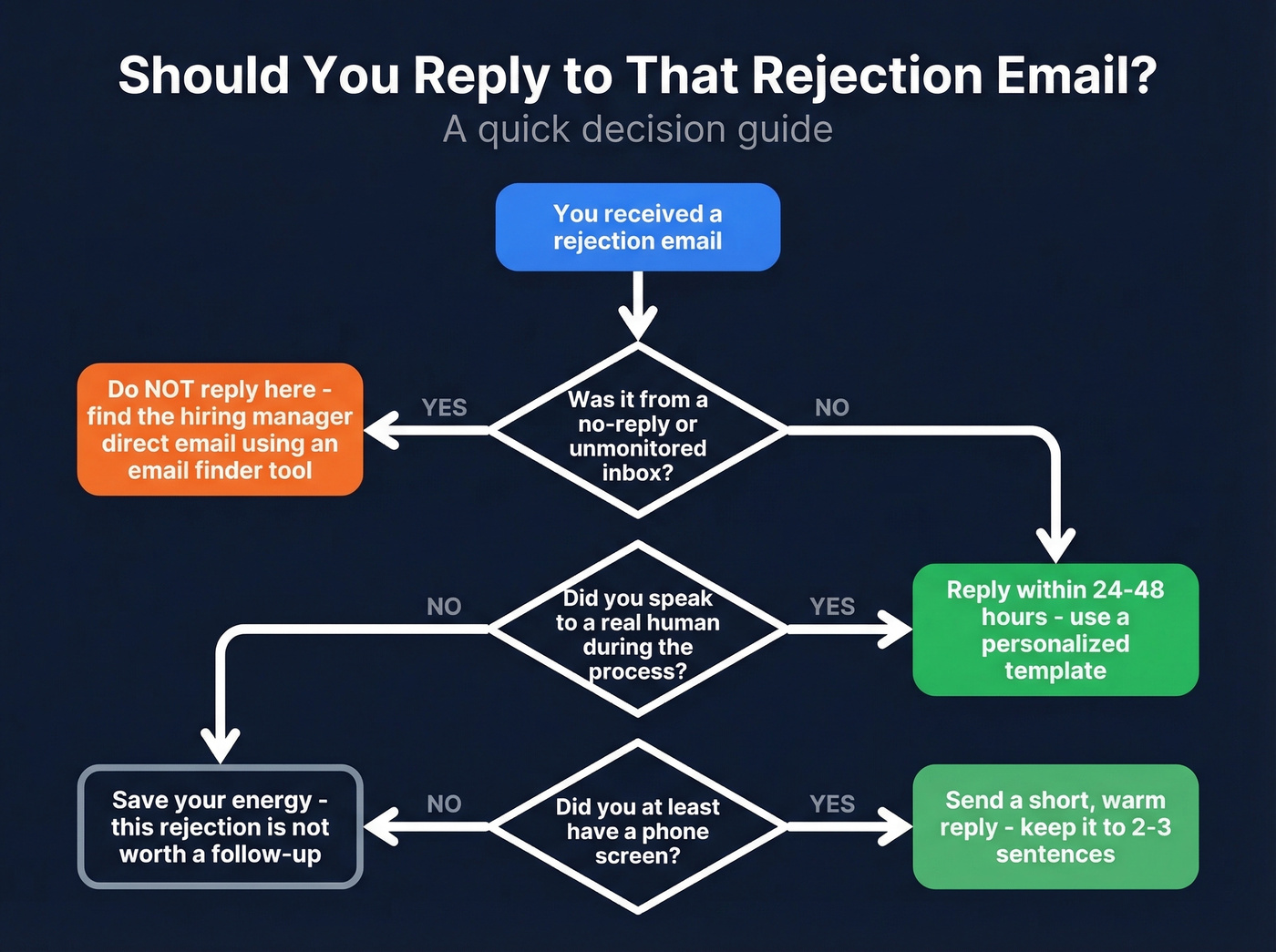
Before you draft anything, run through this quick check:
- Was the rejection from a no-reply or unmonitored inbox? Don't reply. It goes nowhere.
- Did it come from a real recruiter or hiring manager? Reply.
- Did you actually speak to a human during the process? Always reply after you've interviewed - phone screen, panel, final round.
If the rejection came from a no-reply inbox, you need the hiring manager's direct address. Prospeo's email finder verifies professional emails in real time with 98% accuracy, and the free tier includes 75 credits per month - more than enough for a job search. If you’re trying to track down a decision-maker, this is the same idea as finding a direct email address.
What Hiring Managers Actually Think
Most candidates don't reply. Typically under 20% bother, especially after early-stage rejections. The ones who do stand out - not because the email is magical, but because it's rare. We've watched hiring managers go back to runner-ups months after a rejection simply because that person stayed top of mind.
A Founding Talent Lead quoted by Fyxer said it plainly: "Sometimes we actually feel like giving no feedback is safer for us as a company." Legal risk, bandwidth, and the difficulty of documenting "culture fit" all conspire against detailed feedback. Don't take silence personally.
What matters is the runner-up effect. Headcount changes, first-choice candidates take other offers, budgets shift. When that happens, the candidate who sent a thoughtful reply is the one they remember.
Subject Lines That Work
Don't overthink this. Three options:
- Reply in-thread - simplest and most natural
- "Response to [Position] opportunity" - clear and professional
- "Keeping in touch for future openings at [Company]" - signals long-term interest without pressure
If you want more options, borrow from these email subject lines and keep them simple.

Got rejected from a no-reply inbox? Your follow-up deserves to reach an actual human. Prospeo's email finder verifies hiring managers' direct emails in real time - 98% accuracy, 75 free credits/month.
Stop replying to inboxes nobody checks. Find the real address.
5 Templates You Can Copy
Every template below follows the same skeleton: gratitude, brief disappointment, continued interest, and - where appropriate - a feedback request. Don't send them verbatim. Recruiters read a lot of these, so swap in real details from your conversations. If you need more examples for outreach, these sales follow-up templates are also useful for structure and tone.
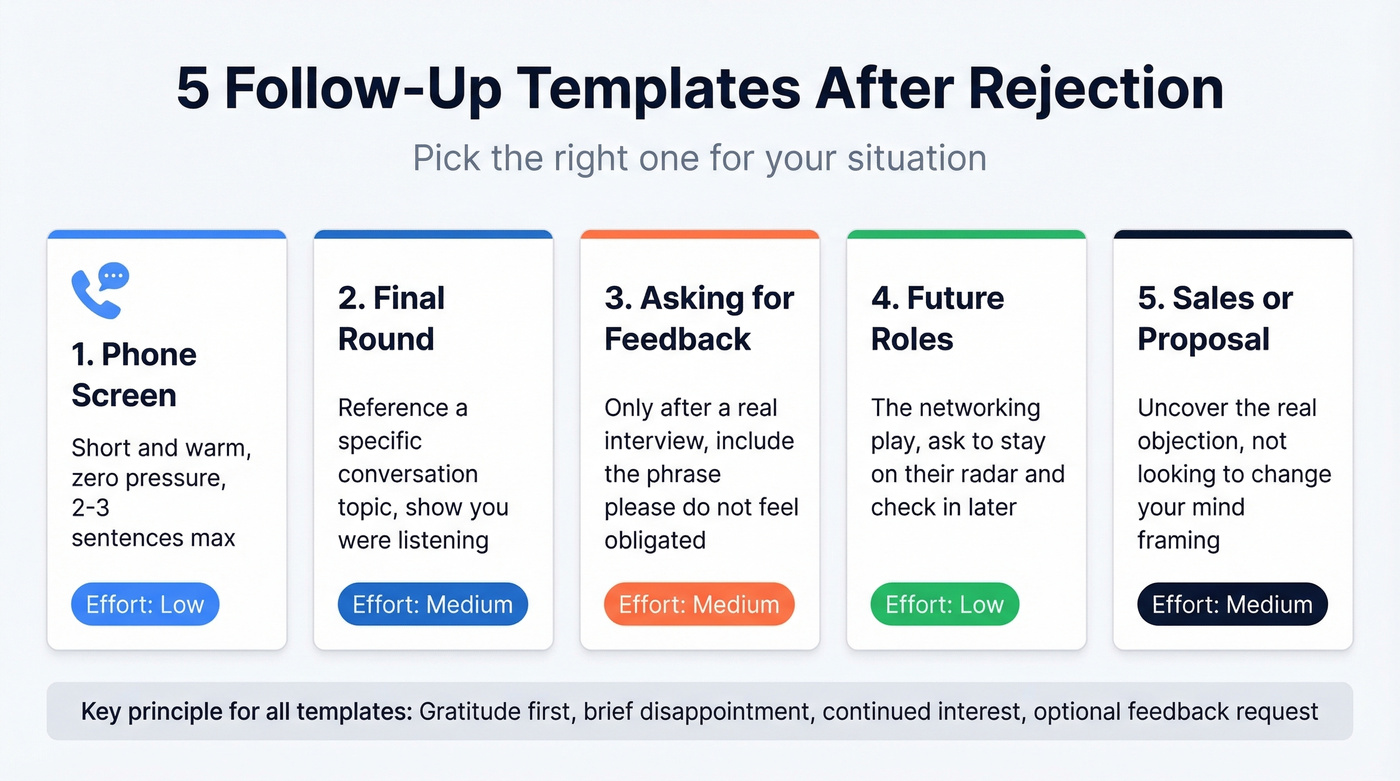
1. After a Phone Screen
Hi [Name],
Thank you for letting me know. I enjoyed learning about the [role] and the direction [Company] is heading. If anything changes or a similar position opens up, I'd love to be considered. Wishing you and the team all the best.
Short, warm, zero pressure. For phone screens, this is all you need.
2. After a Final-Round Rejection
This one matters most. You invested hours, maybe days. The hiring manager knows it.
Hi [Name],
I appreciate you taking the time to share this. While I'm disappointed, I genuinely enjoyed our conversation about [specific topic from interview - a project, a challenge, a strategy]. It reinforced my interest in [Company], and I'd welcome the chance to connect if a future role aligns. Thank you again for the experience.
Referencing something specific from the conversation is what separates this from a form reply. In our experience, the candidates who get callbacks aren't the ones with perfect emails - they're the ones who prove they were actually listening during the interview.
3. Asking for Feedback
When to use this: Only after you've had a real interview, not a resume-screen rejection. Send within 24-48 hours - long enough to process the sting, soon enough that the hiring manager still remembers you.
What NOT to do: Don't ask "What did I do wrong?" or list reasons you think you deserved the role. Both put the recruiter on the defensive.
Hi [Name],
Thank you for the update. I really valued the opportunity to interview. If you have a moment, I'd appreciate any feedback on my candidacy - please don't feel obligated to answer, but anything you can share would help me improve. Either way, I'm grateful for the experience.
The "please don't feel obligated" phrasing reduces pressure and actually makes feedback more likely.
4. Expressing Interest in Future Roles
Hi [Name],
Thanks for letting me know. I remain very interested in [Company] and would love to stay on your radar for future openings in [department/function]. Would it be alright if I checked in occasionally? I'd also be happy to connect on professional networks to keep in touch.
This is the networking play. You're not asking them to reconsider - you're building a relationship that pays off when the next req opens. If you’re unsure how to phrase a light touchpoint, use these patterns for a connection email.
5. After a Sales or Business Proposal Rejection
Hi [Name],
Appreciate you getting back to me. I understand the timing isn't right. Would you be open to sharing what drove the decision? I'm not looking to change your mind - just want to make sure I'm addressing the right priorities if we revisit this down the road.
In sales, many "rejections" aren't final. This template opens the door to the real objection without being pushy.
How to Ask for Feedback Without Being Annoying
94% of talent professionals say providing interview feedback improves candidate experience. Yet most candidates never ask, and most recruiters never volunteer it.
Here's the thing: feedback often doesn't come because legal teams worry about liability, early-stage rejections happen before meaningful notes exist, and "culture fit" is nearly impossible to articulate without sounding vague. A non-response isn't a slight - it's self-preservation.
One story worth highlighting: a candidate who got rejected followed up with a 15-minute Loom video walking through ideas for the team. The recruiter reconsidered, the candidate advanced, and they got the offer. That's extreme - most people shouldn't do this. But it illustrates the principle: showing genuine investment can shift perceptions. (If you’re curious about the tactic, see this Loom video cold email breakdown.)
Stop treating every rejection as a networking opportunity. If you didn't make it past the resume screen, save your energy. The rejections worth responding to are the ones where you actually spoke to a human, had a real conversation, and built even a sliver of rapport. Those are the relationships that compound over time.
The Sales Version
The dynamics differ in B2B sales, but the principle is identical: persistence pays. 80% of sales require five or more follow-up touches, only 2% of sales happen on first contact, yet 44% of reps give up after the first follow-up. Only 8.5% of outreach emails get responses.
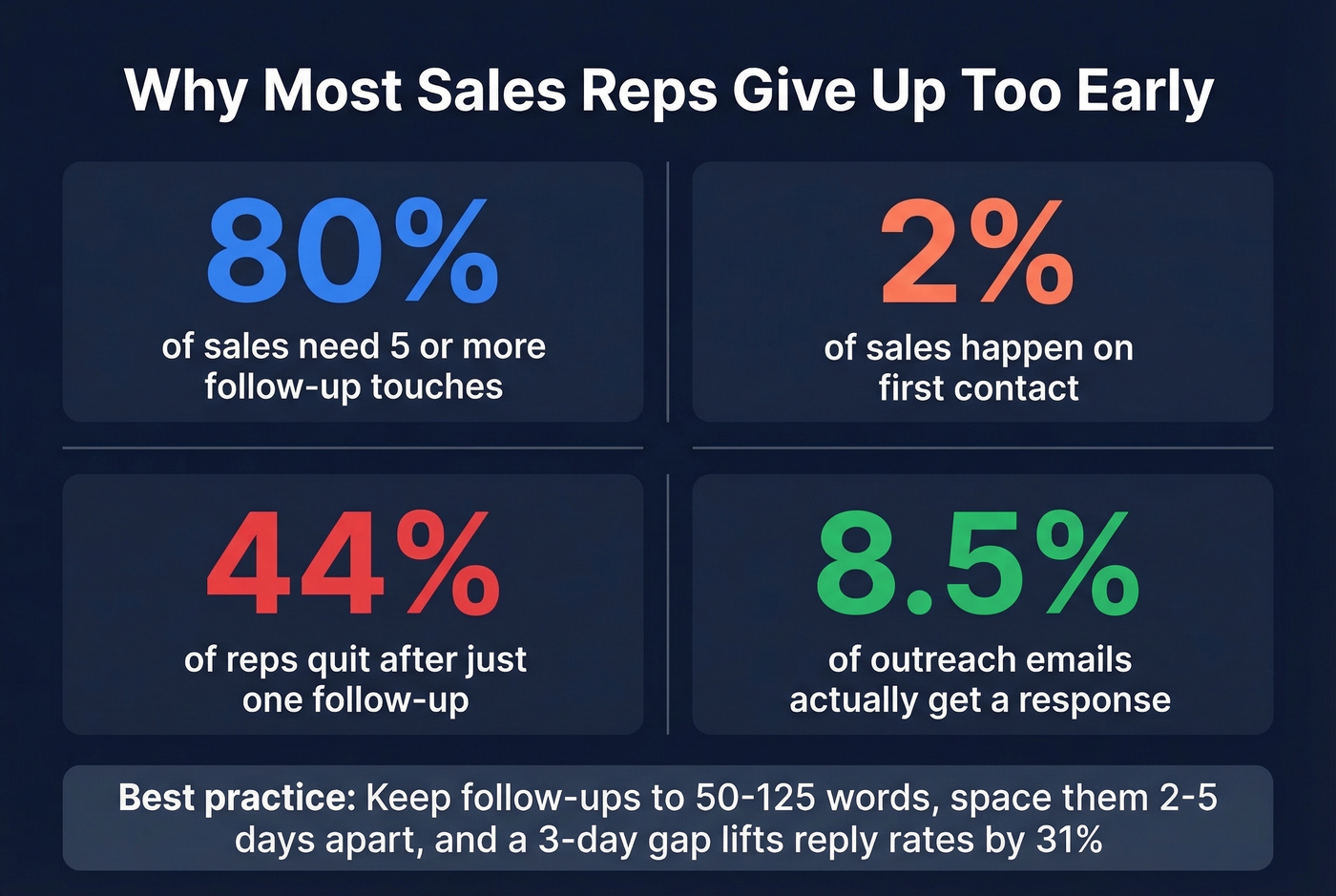
Many "no's" are really "not now." Keep follow-ups to 50-125 words and space your touches 2-5 days apart - a three-day gap between emails lifts reply rates by 31% compared to daily sends. For teams running outbound at scale, the bottleneck isn't writing the follow-up; it's knowing who to send it to. That's where verified contact data makes the difference between follow-ups that land and follow-ups that bounce. If you’re building a repeatable system, a lightweight follow up email software tool can help.
Whether you're following up after a rejection or pivoting to a sales role where 'no' is just the start - having verified contact data changes the game. Prospeo gives you 300M+ professional profiles at $0.01/email.
Turn every rejection into a future opportunity with the right contact data.
FAQ
How long should I wait before replying to a rejection email?
24-48 hours is the sweet spot. That window gives you time to process the disappointment and draft something thoughtful, while the hiring manager still remembers your conversation. Wait a full week and you risk fading from memory entirely.
Should I reply to an automated rejection from an ATS?
No. Those messages typically come from unmonitored inboxes, so your reply won't reach a human. Instead, find the hiring manager's direct email through the company website or a verified contact tool, then send your note there.
Does responding to a rejection ever lead to an offer?
Rarely as a direct reversal, but runner-up candidates who stay in touch get called back when headcount changes or first-choice hires fall through. The success stories on Reddit are real - just uncommon. Your reply is a long-term play, not a Hail Mary.